Showing posts with label Eileen Atkins. Show all posts

Tuesday, January 14, 2025

Last Chance Harvey

Most of this was written at the time of the film's release. I saw this in a theater because the cast was so good, how could I not?

 
Last Chance Harvey (Joel Hopkins, 2008) Consigned to forgotten corners of the internet amid the dark alleys of the streaming services, this amiable and genial little semi-romantic semi-comedy boasts a fine casting of plucky players trying to make more of it than it is. Maybe it's only on the lists of those completists who want to see every single movie that Dustin Hoffman or Emma Thompson starred in (and certainly those are good goals), but I would be surprised if anybody had ever heard of this movie, which seems a shame. You read the reviews and practically everyone says is that Hoffman and Thompson are magical together, and if it was just them...the movie would be amazing.

The titular Harvey Shine (Dustin Hoffman) is a musician working for ad agencies writing commercial jingles, but he's always wanted to be a jazz pianist. He's been hired to write yet another innocuous ear-worm, but he's on his way to London for his estranged daughter's wedding (he at least feels the absolute need to be there). He's told, rather cruelly by his boss (Richard Schiff) to take his time, enjoy himself...because he won't have a job when he gets back.

Hey...Mazel tov!
Add to that, his estrangement from his family (his ex-wife, played by
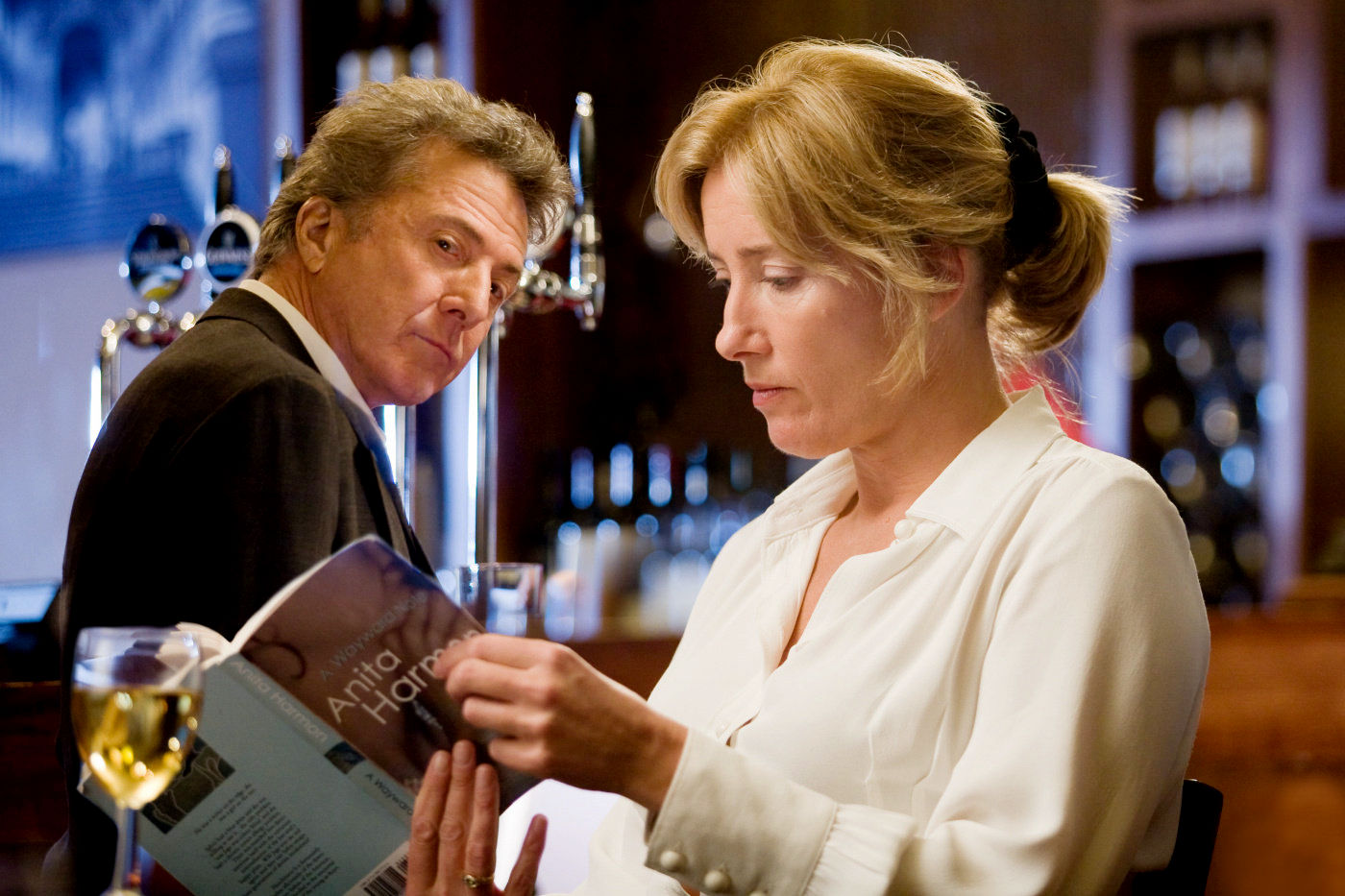
Kathy Baker, is now married to James Brolin's character) his awkwardness with social situations in general, and that dear daughter wants her step-dad to give her away, Shine is having a very bad time of it. He spends the wedding at the back of the church (at least he's there), but he's determined to skip the reception and just slink home, until he finds his flight delayed with a long layover. Only thing to do is hit the bar, and once there, he has a strained conversation with Kate Walker (Emma Thompson, always exactly right), an airline worker he previously had blown off while she was just doing her job.
She wouldn't be there if a connection didn't happen
...not merely back to the U.S., but between the two characters...and as I said it's amiable and genial and you probably already know where it is heading. Hoffman is such an adept spur-of-the-moment actor and Thompson is such a quick wit and sharp writer that it's like seeing your two best friends spark off each other and say what you will about the rest of it, but that is a joy.
There is a complication or two of the An Affair to Remember variety—don't worry, no one gets hit by a bus—and we get to witness what may be
the longest wedding reception in history. The slight story-line is fleshed out with Kate's eccentric mother (the wonderful Eileen Atkins) who thinks that there's a Rear Window-style murderer living next door. Hilarity ensues.


Still, you could do worse than this one to kill a little time, especially with such a good cast.

Tuesday, May 21, 2024

Wicked Little Letters

Post Pardon Depression
or
A Comedy of Ill-Manners
 
I think I've mentioned before that you can't watch a British mystery series without one episode involving the investigation of a rash of poison-pen letters (that may or may not be true) that disrupt a community. There was one major movie, Henri-Georges Clouzot's The Raven, that we mentioned previously. 
 
The origin of this particular trope came from the scandal of the "Littlehampton Letters", a Sussex incident that caused quite the scandal between 1920 and 1923. The general story is that Edith Swan, a spinsterish woman who lived with her upright Christian parents, began to receive letters of an unseemly manner and of such vulgarity that she made complaints to the police. Suspicions immediately turned to Edith's neighbor on Western Street, Rose Gooding, as Rose seemed a person of questionable character, known for causing rows and for her obscenity-laced language. It didn't help that the letters appeared to be signed by Rose. That first letter started: "You bloody old cow, mind your own business and there would be no rows. – R." That Rose had a child and was living with a man didn't help things. Nor did that the letters appeared after Rose was reported to Child Protective Services by someone in the neighborhood.
Rose was arrested and charged with criminal libel, and as she could not afford bail, she was in prison for three months. During Rose's incarceration, the letters naturally ceased. When she was released, the letters began again, expanding in scope, and Rose was again arrested, convicted and sentenced to 12 months in prison.
All neat and tidy, said the law. But the story didn't end there, through the efforts of a dogged police-womanSussex's first
Woman Police Constable Gladys Moss, who began to suspect that things weren't as neat and tidy as her male counterparts believed it to be. With the help of Scotland Yard, she was able to trace who the letters were coming from—the courts wouldn't allow writing analysis in the trials—and catch the actual culprit in the act.
Wicked Little Letters tells the story of the case, and, truly, it lives up to it's opening title: "This is more true than you'd think." Oh, there are little changes here and there, mostly for the sake of diversity in casting, and to ram home the point that those times were more prejudicious than our own (although it's ironic that they try to make the point of how good we've got it by casting non-white players to signal to us that these people are dealing with oppression and prejudice*). Actually, our times are just as bad, only less by a matter of degrees.
Edith Swan is played by 
Olivia Colman, her parents by Timothy Spall and Gemma JonesJessie Buckley is Rose Gooding and her live-in man is Malachi KirbyAnjana Vasan plays Woman Police Constable Moss, and Rose's neighborhood allies include Eileen AtkinsLolly Adefope, and Joanna Scanlan. However much kerfluffle may have been going on in Western Street in the 1920's, it couldn't have been as entertainingly chaotic as this cast makes the circumstances involved. Colman, particularly, is a study in contrasts. Initially making friends with Buckley's Rose, Colman's Edith couldn't be more thrilled—a little shocked at her raw forthrightness—as Rose is as free-spirited as Edith is repressed, belittled, and subjugated in her father's household. When the whole letter-thing is delivered at her doorstep, she becomes alternately victimized, outraged, and (once the papers get ahold of it) prideful of her role as upright citizen standing up for the decency of civilization. Her performance is a master-class of expressiveness whatever the role Edith takes on.
And Buckley holds her own with the more ostentatious part as Rose, unapologetically coarse even as she's being accused of coarseness, while fully realizing that she is just a gavel's slam away from losing her family as a consequence. But, her Rose is a scrapper, not willing to go down without a fight, even as it appears as her whole world is falling apart. And Vajan, after years of bit parts and one-line roles, pops right out of the screen as a determined copper not content to merely know her place, her eyes almost comically revealing the frustration and battling fierceness required to see justice done. 
Wicked Little Lies careens between comic (it's rated "R" for hysterically "pervasive language"), dire, and subversive—when dealing with authority figures (predominantly male)—and made with the intent of taking the mickey out of the status quo. There is just the hint of hysteria in the parties involved rebelling against their circumstances, even if the actions don't quite push through the complacency. One wants to call it a comedy of manners, if it wasn't so enthusiastically ill-mannered.
It's also rather deliciously quaint, as one can only imagine the reaction any of these characters would have if they were exposed to social media.
 
Crikey!
 
* I don't want to harp on this too much, because I'll sound like some backwards stick-in-the-mud—you cast people because they're good, not because they're a "type"—but it occurs in the same way with the writers portraying Rose Gooding as an Irish immigrant, to reinforce that she was an outsider of "low" character. Gooding was born in Lewes in Sussex, and merely moved into the neighborhood, rather than coming from Ireland. Sometimes I think these things are betraying prejudices in the act of pointing them out. Anyway, the real people were all lily-white, and the actors portraying them are damned good.

Thursday, June 16, 2022

Tea with the Dames

Tea with the Dames (UK Title: Nothing Like a Dame)
(Roger Michell, 2018) Sometimes it's nice to look behind the curtain. To look past the artifice and see the real, and meet the illusionists who create the illusions. What they think and feel informs the art and can sometimes one can glimpse the individual choices made to produce it, what the priorities are in making it, and it can even change how one subsequently views the art.
 
And, let's face it, it's fun to get "the dish," the gossip, the dirt, which is fun and facetious and is the spoonful of spice that makes the "educational purposes" go down a little easier.
 
The late director Roger Michell had the idea to film a little ritual he'd heard about. Of how four ladies of the theater: Joan Plowright, Eileen Atkins, Maggie Smith and Judi Dench would regularly get together at the West Sussex home of Plowright and her husband Laurence Olivier, when he needed a place close to where he was directing theater. The four saw the place as a bit of an idyll to unwind, talk shop, and as a means to get away with their families. Michell wanted to film the actresses, all named Dame Commander of the Order of the British Empire, talking in a shared space of community.
But, it could hardly be called intimate. Proving that the mere act of observing changes the outcome, the actresses are beset by make-up artists, proper lighting, weather, staging—"have you ever sat like this in your life?"—and a flurry of crew—at one point, Maggie Smith chides a set photographer for taking too many pictures in her field of view and at another, they express shock that it's the first day of one of the crew-members. One is sure that one is watching real conversations—prompted, of course—and the actresses are very forthright, but one gets the sense that they're being honest, they're holding things in reserve for good behavior.
Plowright, nearly completely blind, is imperious, but chummy, Smith is hilariously tart, Dench completely honest, and swearing like a sailor, while Atkins is unafraid to be vulnerable.
—At one point, Plowright mentions that "none of us was ever in the front ranks of great beauties" Atkins recounts hearing an overheard conversation between producer-director in an early stage role: "She's not very pretty, is she?" "No, but she's sexy." "That saved me," she confesses.
—All of them recount stage jitters, with Atkins saying that "On the way to the theater I always think, would you like to be run over now? Or in a massive car accident? And I only just come out on the side of no."
—Michell asks what it was like to work with their husbands and Smith immediately replies "Which one?"
—commenting on their physical frailties, Maggie Smith asks Plowright if she wants to borrow one of her hearing aids (as Plowright's batteries have worn out) and Dench cackles "...and we have three working eyes between us!"
—During her stage run in "Othello" with Olivier, Smith recounts how a slap delivered by him connected and she wryly comments "It was the only time I saw real stars at the National Theater" and how Olivier was always criticizing how she said her vowels, and upon walking in on Olivier applying his Moor make-up "schmudge" said "How now, brown cow?" and noting her vowels, he said "Much better!"
—Dench is forced to recall her questioning director Peter Hall to play Cleopatra: "Are you sure you want a menopausal dwarf to play this?"
Interspersed with the interviews is much archival footage and photographs in their roles throughout their careers, both on stage and in film, as well as the ceremonies where they received their respective British honors, and it's a trip to see them through various stages of their lives doing comedy, drama, even Dench's turn as Sally Bowles in the 1969 staging of "Cabaret." There's some tart chiding of Dench's seeming to now get every part in Hollywood films. The conversation is lively, but, as the documentary nears its end, one can see energies starting to flag, and silences punctuating the conversation. It's a reminder of fragility even for the grandest of dames, even at the highest of teas.
"That's RUDE!" says Dench, outraged.
They're Americans." says Plowright. "That's how they talk!"

Tuesday, September 22, 2020

Evening (2007)

Written at the time of the film's release...

Evening (Lajos Koltai, 2007) Okay, before we say anything about this movie, look at the cast--that'd be the reason people would be drawn to this movie: Vanessa Redgrave, Meryl Streep, Glenn Close, Eileen Atkins, Claire Danes, Natasha Richardson, Toni Collete. That is some heavy-duty fire-power and far eclipses the male contingent of Patrick Wilson, Hugh Dancy and Barry Bostwick.

Add in the stunt-casting: Natasha Richardson plays the daughter of Vanessa Redgrave's character, which should be easy to do as she's Vanessa Redgrave's daughter. Then there's Mamie Gummer, whose character's wedding is the centerpiece of the flash-backs for this film, and who is played in the present-day by Gummer's real-life mother, Meryl Streep.* All nice for a little conversation-starter at the coffee-klatsch.
But the reason to see this film is late in the proceedings: it's a scene between the two old friends played by Streep and Redgrave, both very old, and the latter, dying. And it's amazing. Redgrave is always good--surprising in how she can breathe life into any kind of scene. To see Streep and her play off of each other, is one of those rare moments of seeing two great actors at the top of their game combining their talents, even if the movie is no great shakes.** Upon finding out who her visitor is, Redgrave's arms fly out, reaching for her, a girlish gasp in delight escaping from this bed-ridden woman of no strength, but for that moment, she's young again, in memory and reality. And the two become gossipy friends again, though Streep's character is held in check somewhat by reality, and Redgrave's has no time for holding back. Great actresses. Great scene.
But the rest of the film is lacking. Whenever the film is off of Redgrave (her nurse is played by Eileen Atkins, who is Streep's counterpart in England), the film lags. Claire Danes plays the younger version in the flashbacks for the better part of the film, and though Danes can make her character dither at the drop of an impulse, that part feels soapy and over-written, and not as felt. And the present-day conflicts of the Redgrave character's children seem far less interesting than the flights of fancy of their dying mother, who flickers in and out of fantasy and reality. In the end, her obsessions are passed off as not amounting to much, though they're important to her, and the lesson of the film--there are no mistakes--comes off as hopelessly banal as saying "It is what it is."
Still, it's an impressive cast, but it's a mired chick-flick, that tested the patience of some chicks I know.

*"Nepotism," I hear you cry. And it is. Funny thing is, Gummer was cast first, and then and only then was Streep, who'd been in screenplay-writer Cunningham's The Hours, approached to play the older part. On the DVD, Gummer cracks: "Nice to be able to find my Mom a job!"

**I'm thinking here of DeNiro and Brando in The Score, or Brando and George C. Scott in The Formula, or Hepburn and Wayne in Rooster Cogburn or Hepburn and Fonda in On Golden Pond. These are events couched in humble films of limited means, and it's just fun to watch legends work together, even if you have to suffer through the rest of the movie to do it.

Friday, June 1, 2018

The Avengers (1998)

The Avengers (Jeremiah Chechik, 1998) "Mrs. Peel, we're needed..." and in a much better movie.

I know, not what you expected (this isn't Marvel's The Avengers (created for the comics in 1963, but the British TV series created in 1961), but, then, neither was this movie to me. "The Avengers" were a proven property, a memory (fond) of my youth, especially when it was on American television, during the height of the "Bond craze" of the 1960's. It started out in its early "video" days as a fairly straight-ahead detective procedural with Patrick Macnee as John Steed, who worked with Dr. David Keel (Ian Hendry), then Venus Smith (Julie Stevens), then Cathy Gale (Honor Blackman). The shows became increasingly bolder, cheekier and more in the spy realm, reaching its zenith during the "Emma Peel" years, when Diana Rigg played Steed's partner. By that time, the show was practically a comedy, with odd off-kilter conspiracies, sci-fi and fantasy elements. Most folks tuned in for the repartee, as the plots became fairly disposable; Steed and Emma became the focus of the show, he of the fusty suits and bowler hat, she of the catsuits and judo fights. It was fun, disposable, and a joy to watch.
The movie version gets only one out of the three. After years in development hell with a script by Batman scribe Sam Hamm with Mel Gibson as the proposed lead, the original ideas were scrapped and a new revised attempt was made. The blunders begin by miscasting Ralph Fiennes as Steed and Uma Thurman as Peel. Fiennes fares slightly better, but he plays Steed as withdrawn and a bit docile, whereas the Steed of the series was a proud peacock of an extrovert. Ms. Thurman's Mrs. Peel is everything the series' Rigg wasn't—pale, inexpressive and...American. As if to overcompensate for the lack of joie de vivre in the leads, the movie goes overboard with elements of goofiness in a plot about robotic clones, Teddy bear conspiracists, mechanical bees, and a plot to—dare I say it?—rule the world...by controlling...the weather?
Sean Connery had been saying for years that he'd wanted to play a Bond villain, but knew those producers would never go for it—or pay the salary he wanted. This is the movie where he gets to, and his August DeWynter, is played hammily and with much brio. He gets the best lines and looks like he's having fun(certainly more than the audience). Fiennes looks miserable most of the time, and Thurman is mostly unreadable. There's also an interesting supporting cast, largely wasted, featuring Jim Broadbent, Fiona Shaw, John Wood, Eddie Izzard, Eileen Atkins, and a cameo by MacNee...who plays a character who's invisible. He's the lucky one in the cast.
The script—by Don McPherson—is a mess, and Jeremiah Chechik (who made National Lampoon's Christmas Vacation and Benny & Joon) tries to bring some style to it at the sacrifice of pace and, after the film was slashed from two hours to 90 minutes following a disastrous preview, a certain level of coherence.  It's one of the few movies where I walked out with a feeling of contempt for the whole rotten show.
"No, really, have you read this script?"
MacNee and Rigg as "The Avengers"

Friday, September 5, 2014

Magic in the Moonlight

That Voodoo That Doesn't Work So Well
or
A Pratfall of Faith

Chief Dan George's Old Lodge Skins character in Little Big Man probably said it best; after a botched ascending of his spirit that results in a rain-storm that he decides to escape (only physically) he rasps "Sometimes the magic works. Sometimes it doesn't."

It's that way with movie-making, too. Even a director who makes a classic film, can make a total disaster (even if an interesting one) the next time out. There's no easy formula for making great films; if there were, then Robert McKee would have more credits in his IMDB listing than the TV-Abraham and some "Barbie" direct-to-video releases. No, even the best and most consistent of directors—say, Ernst Lubitsch—couldn't make a masterpiece every single time. Given what it takes to make movies—the coordination, the expense, the collaboration, the casting (and the cast's individual moods on any given day of shooting), the weather, even the catering can affect a movie—it is something of a miracle that the things manage to come together...at all. And the great ones...well, the great ones have an undefinable quality, a God Particle, that make them rise above the journeyman exercise and become indelible and special. What that quality is, no one could tell you while making the movie—it's just that something...*clicks*...sometimes by design, sometimes by the happy accident in the editing room, or on the stage, that unanticipated sparkle of stardust that makes a classic.


Woody Allen's had a good run lately with his international films—the British films with Scarlett Johanssen, the Spanish Vicky Christina Barcelona, the sweetly ethereal Midnight in Paris, and the slightly spastic To Rome with Love. His last film, Blue Jasmine, garnered almost universal acclaim. It was about time for him to stumble, ala Stardust Memories, Deconstructing Harry, Sweet and Lowdown, or The Curse of the Jade Scorpion. Those are the ones I'm not crazy about, but, like the Coen Brothers, Allen can be polarizing, it's actually more rare for him to make a movie that everybody agrees on, than to make a genuine stinker.


But Magic in the Moonlight is one of those. A great cast (Colin Firth, Emma Stone, Eileen Atkins, Marcia Gay Harden, and Jacki Weaver) is wasted in an exercise of warmed-over material (which Allen can be really good at saving—one can see echoes of all manner of things in Allen's movies once he lost his TV-movie amateurishness with Annie Hall, but his spin is always a little deeper and gives a fresh perspective, if only, like Blue Jasmine, to take a classic like A Streetcar Named Desire and put it into a contemporary sensibility).   
Stanley Crawford (Firth) is a professional magician and magical skeptic. As the magician Wei Ling Soo, Stanley stages big, broad set-pieces—making an elephant disappear on-stage, sawing a woman in half, transporting himself across stage—but for him, it's all mechanics, no mystery. Off-stage, the magic stops. The make-up comes off and Stanley reveals himself as a surly diva, contemptuous of his audiences of rubes, because his "day-job" is as a de-bunker. He makes magic for a living, but doesn't believe in it, demystifying and debunking it, in his life.

A friend tells him about a mystic, Sophie Baker (Stone), who has the well-to-do family Catledge in thrall. The Catledge scion (Hamish Linklater) is in love with her; his mother (Weaver) uses her to contact her recently-deceased husband. The friend, also a skeptic, hasn't been able to see what Sophie is doing to pull off the charade and is beginning to think she might be a genuine clairvoyant and asks Stanley to observe and see if he can find out how she does the voodoo that she does seemingly so well.*
Sophie impresses Stanley (she seems to know a lot about him although they've never met) and a seance that produces some knocking "Yes/No" answers and a floating candle he can't explain makes him think that maybe she might be truly clairvoyant. Not only that, he begins to have feelings for her, and his cynical facade begins to crumble as something approaching belief and faith creeps into his own psyche. Sophie's unexplainable powers is a catalyst for the worldly (and world-weary) man for whom there is no magic left in the world...except (let's spell it out) the Possibility of Love. It's Metaphor 101, and where Allen (in his "earlier, funnier" and certainly more romantic days) might have made something out of this...even a joke...here it is quite charmless and devoid of any magic...not even the glimmer of fantasia that informed earlier films.  
Part of the lack of charm may be the chemistry that doesn't exist between Firth and Stone. Stone has that problem that a lot of actresses have with "Woodian" dialogue—they don't sound like they'd speak it, let alone think it.
** There's something just a little mannered in the delivery (even Diane Keaton occasionally had this problem when being too direct). You can believe it when it's someone naturally airy as in Blue Jasmine, but here Stone's psychic appears to be all show.

But the real problem is Firth and his character. Despite his reputation as a fan-favorite, Firth has always been something of a cold fish and excelled at playing them—in fact, that's part of why he's so popular as his Mr. Darcy from the "Pride and Prejudice" mini-series starts out as a lip-curling judge and warms up under the tutelage of Jane Austen's Elizabeth Bennet. Here, there isn't much of that redemption on display. Even smitten, his skeptical magician is snide and charmless, and we've spent so much time with him when he's downright nasty, that the character never really recovers any sympathy. I spent an awful lot of time in this film squirming in my seat uncomfortably over his baldly insulting dialogue and the way no one ever calls him out on it. He's Henry Higgins without the ability to cajole and prompt, a total "Prig-malion," in fact. Yes, he may be capable of falling in love, but it would difficult to imagine anyone loving him back. It's partly the fault of Allen's script and partly Firth's handling of it, but this year's Allen film has none of the magic promised in the title.


* Cole Porter's "You Do Something to Me" is the Main Title theme and runs throughout the film.

** It's part of the reason why Allen stammers so much when he acts—he's feeling his way along the thought process to come to the thought—it's a tried and true method that has worked wonders for such prevaricaters and obfuscaters as Jimmy Stewart and Hugh Grant.  When Kenneth Branagh had to play the "Woody Allen" stand-in in Celebrity, he stammered.