Showing posts with label Claire Danes. Show all posts

Tuesday, September 22, 2020

Evening (2007)

Written at the time of the film's release...

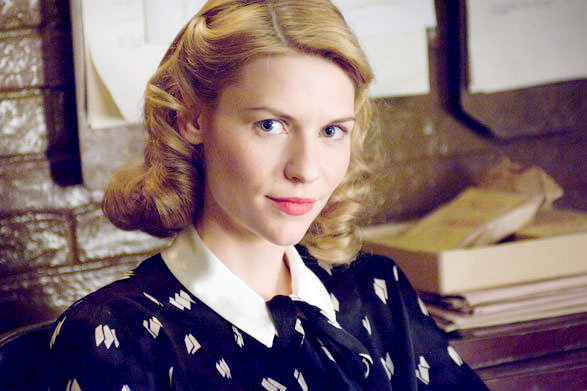
Evening (Lajos Koltai, 2007) Okay, before we say anything about this movie, look at the cast--that'd be the reason people would be drawn to this movie: Vanessa Redgrave, Meryl Streep, Glenn Close, Eileen Atkins, Claire Danes, Natasha Richardson, Toni Collete. That is some heavy-duty fire-power and far eclipses the male contingent of Patrick Wilson, Hugh Dancy and Barry Bostwick.

Add in the stunt-casting: Natasha Richardson plays the daughter of Vanessa Redgrave's character, which should be easy to do as she's Vanessa Redgrave's daughter. Then there's Mamie Gummer, whose character's wedding is the centerpiece of the flash-backs for this film, and who is played in the present-day by Gummer's real-life mother, Meryl Streep.* All nice for a little conversation-starter at the coffee-klatsch.
But the reason to see this film is late in the proceedings: it's a scene between the two old friends played by Streep and Redgrave, both very old, and the latter, dying. And it's amazing. Redgrave is always good--surprising in how she can breathe life into any kind of scene. To see Streep and her play off of each other, is one of those rare moments of seeing two great actors at the top of their game combining their talents, even if the movie is no great shakes.** Upon finding out who her visitor is, Redgrave's arms fly out, reaching for her, a girlish gasp in delight escaping from this bed-ridden woman of no strength, but for that moment, she's young again, in memory and reality. And the two become gossipy friends again, though Streep's character is held in check somewhat by reality, and Redgrave's has no time for holding back. Great actresses. Great scene.
But the rest of the film is lacking. Whenever the film is off of Redgrave (her nurse is played by Eileen Atkins, who is Streep's counterpart in England), the film lags. Claire Danes plays the younger version in the flashbacks for the better part of the film, and though Danes can make her character dither at the drop of an impulse, that part feels soapy and over-written, and not as felt. And the present-day conflicts of the Redgrave character's children seem far less interesting than the flights of fancy of their dying mother, who flickers in and out of fantasy and reality. In the end, her obsessions are passed off as not amounting to much, though they're important to her, and the lesson of the film--there are no mistakes--comes off as hopelessly banal as saying "It is what it is."
Still, it's an impressive cast, but it's a mired chick-flick, that tested the patience of some chicks I know.

*"Nepotism," I hear you cry. And it is. Funny thing is, Gummer was cast first, and then and only then was Streep, who'd been in screenplay-writer Cunningham's The Hours, approached to play the older part. On the DVD, Gummer cracks: "Nice to be able to find my Mom a job!"

**I'm thinking here of DeNiro and Brando in The Score, or Brando and George C. Scott in The Formula, or Hepburn and Wayne in Rooster Cogburn or Hepburn and Fonda in On Golden Pond. These are events couched in humble films of limited means, and it's just fun to watch legends work together, even if you have to suffer through the rest of the movie to do it.

Thursday, July 2, 2020

Stardust (2007)

Written at the time of the film's release...

"Getting killed by pirates...heart eaten by a witch...meet Victoria--I can't seem to decide which is worse!"

Matthew Vaughn's film of Stardust is so far removed from his last film, Layer Cake, that it would take a Babylon Candle to bridge the two (Don't know what a "Babylon Candle" is? Then you'll have to see the film. You should anyway). 

Layer Cake (an updated aside—it's the film where, suddenly, Daniel Craig, managed to emerge from behind the furniture into a eye-catching starring performance) was a whooping, swooping kitchen-sink-and-Porsche's story of drug-dealing in contemporary London. And while some of the stylistic touches are the same for Stardust, the story couldn't be more different. For instead of modern-day Britain, he is spinning his camera through Neil Gaiman's Faerie-Land.
Gaiman's reach is all things mythical, from the twee to the atrocious--across the stars, underground, beyond the pale and underneath your fingernails. He borrows from all sources, and puts them through his own personal salad-shooter and spits them out with his own dressing. In his work you'll find echoes of Shakespeare, Marlowe and Milton, G.K. Chesterton and Jorge Luis Borges and the Brothers Grimm, Greek mythology and Roman gods, History and Urban Legend, The Arabian Nights and the Book of the Dead, The Bible and the DC/Marvel Multiverses. 
I've been reading Gaiman with delight (no pun intended) for years, starting with his "Sandman" saga, which dragged on for maybe a dozen more issues than necessary because he had so many stories he wanted to get to, but I also love his "Violent Cases," and much of his book-work. It is with some trepidation that one watches his forays into film--Jon Peters owns the film-rights to "Sandman," for instance, and Gaiman wrote the English translation for Princess Mononoke, and worked on "Mirrormask," and there's talk of filming "Good Omens," the book he co-wrote with Terry Pratchett.* That's scary talk. For what it's done to the works of Alan Moore, Hollywood looks like a gold-plated abortion clinic, and one wonders if they could do any justice to Gaiman's work. Even to attempt to film his "Signal to Noise" would be to destroy it.
Stardust makes the transition fairly well, though it eliminates the faeries and sprites that populate Gaiman's world like smoke, dust and flotsam do in Ridley Scott's (they also serve as little "Rosencrantzes" and "Guildensterns"). They throw in a sock-o finale, and the film has none of the delicacy of Charles Vess' illustrations from the graphic novel that Gaiman expanded to book-length. In fact, it has the sensibility several refinements up from Monty Python-design. But it does retain Gaiman's special form of "myth-busting," the wink-and-a-nod to the "real" world that suffused The Princess Bride, but without the Borcht Belt cinched around its waist.
What's interesting is how Paramount is selling it...or not selling it, as the case may be. Looking at the poster, you'd think it was one of the endless string of pre-teen or teen fantasy novels adaptations that are filling the Previews, or as reverent as Chronicles of Narnia, when nothing could be further from the truth, (but there are enough spinning helicopter shots of big landscapes to reassure the Suits that it has a "Lord of the Rings" quality). It's frequently hilarious in surprising and snarky ways, especially in the casting. 
Michelle Pfeiffer may not be the best at holding an accent, but her comic timing, and willingness to play against her looks is delightful. Robert DeNiro makes an entrance and you worry that he's been put in the wrong movie, but then he comes through with flying colors. Peter O'Toole does wonders with his limited screen-time as the Lion-King of a family of blue-bloods, and Rupert Everett shows up long enough to tweak his image hilariously. It's a fun, fine, un-gooey fairy tale that charms and delights. It's not doing well at the theaters, so do yourself a favor and go. Don't wait for Paramount to get their act together to convince you.


* "Good Omens" was made into a TV Mini-series in 2019 on Amazon Prime.

Saturday, November 24, 2018

Me and Orson Welles

Written at the time of the film's release.

"Waiting for Orson"

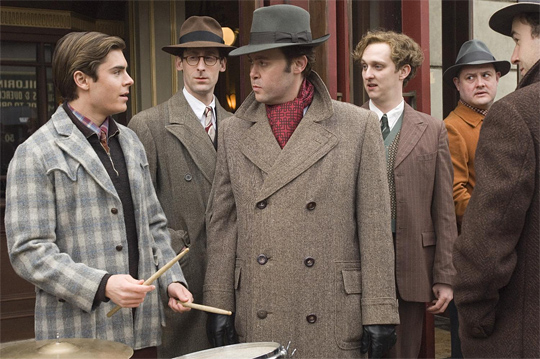
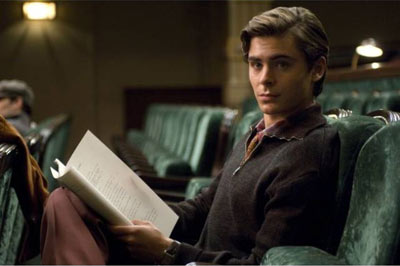
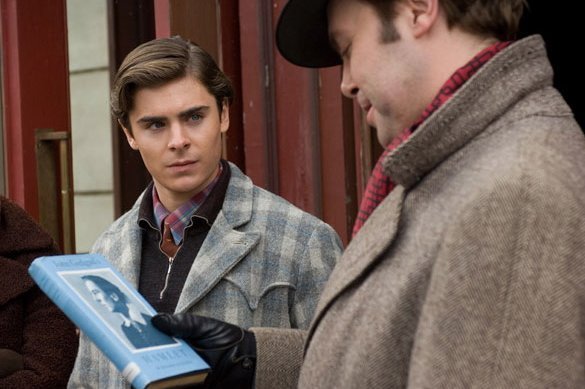
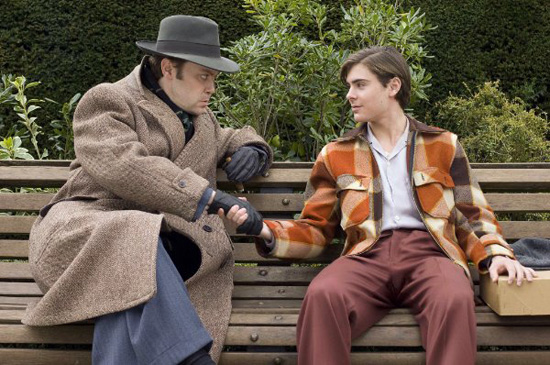
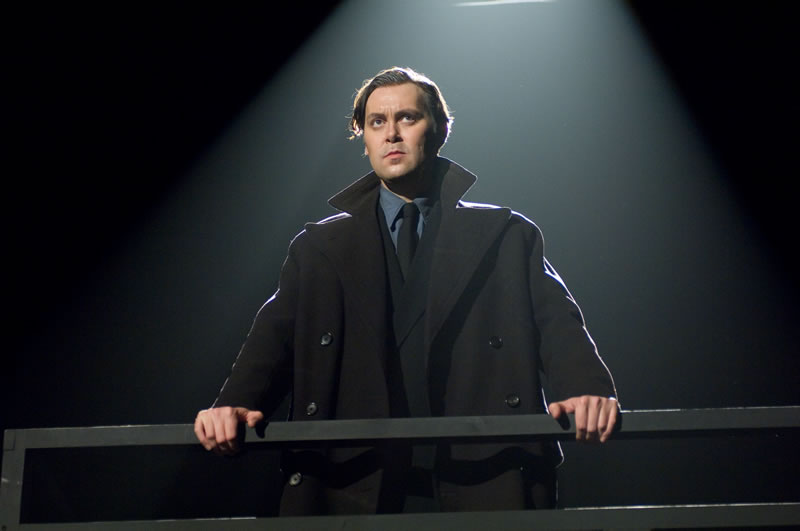
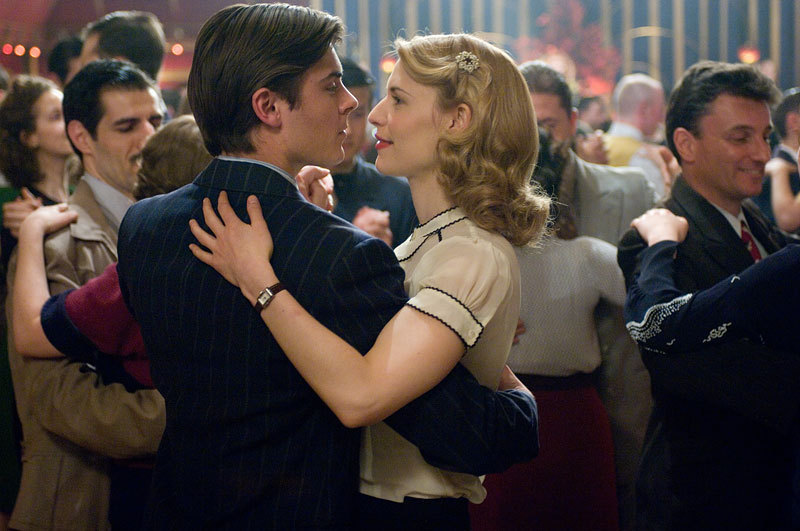
Young Richard Samuels (Zac Efron) is 17, "almost an actor," which puts him just a few hefty years (and worlds) behind the 22 year old Orson Welles (Christian McKay), who has established (by a shoestring) his Mercury Theater in New York, where he is in rehearsals for his modern-dress version of "Julius Caesar"—that is when he is not being whisked from studio to studio by ambulance to perform in various network radio shows, carrying on affairs with ballet dancers, associates, and "just met" women behind the aching back of his pregnant wife.*

Young Samuels manages to vocally pad his resume a bit and kibitzes with some of the players, just enough that
when Welles himself shows up to see the lighting of the big neon sign outside of "his" theater, he sees another bright, shiny object, and as he's about to fire a troublesome actor and "junior" can play the ukulele, Welles hires him on the spot...so he can fire the other kid. "He had a personality problem with Orson," says the Mercury's girl Friday Sonja Jones (Claire Danes). "Meaning he had a personality."

And that just wouldn't do. It's all about Orson, even when it isn'tThere's not that much difference between on-stage and off-stage because the star of it all is Orson Welles, manufacturing drama where there is none, generating excitement even needlessly, and making sure that the limelight is on him. He is the hero of it all and the villain with the best lines. He desires to be, as Alice Roosevelt said of her president-father, "the bride at every wedding and the corpse at every funeral." Life isn't enough, and art has to be stretched to accommodate him.
So do budgets. This fascist recreation of "Julius Caesar" is "modern dress" because there is no money for costumes, but nobody has to know that, it looks like a comment is being made and art is reflecting life au courant. Just like doing a "Voodoo" Macbeth means his all African-American cast is that much cheaper. It looks like a statement, but its merely the ones with a bottom line.
But it's a fine recreation, and if you're not interested in the details, it still makes a compelling story of getting what you need, whether you want it or not. For those who do know the history, it's particularly fun to see
Big Names tossed off: there's Joe (James Tupper), and Lloyd (Leo Bill) and Coulouris (Ben Chaplin) and Jack (Eddie Marsan).** McKay only slightly resembles Welles, and his voice is a timbre higher, but his phrasing, his articulation are spot-on....if the mannerisms seem to be those of the Welles that is familiar on-screenAnd if Zac Efron isn't entirely up to the task of playing his part, that's okay. His role is "Candide," trying to run with thoroughbreds, while he's still admiring the track, crushed with more experienced hoof-tracks. And Efron has just enough skill to do nothing when playing a kid who "doesn't know what he doesn't know." It's a boy's version of The Devil Wears Prada, but it's also The Stunt Man, where illusion is all and practiced and can dazzle the rubes. "J.H. (John Houseman) says everything about theater is bull-shit." says Sonja (which she explains is spelled with a "j" but pronounced with a "y"). But the trick is getting the bull-shit to flow in one direction and that's towards the audience, so they can't see the gears in the background, and the compromises, and the cat-fights and ego-clashes and the spit flying in the klieg-lights. It's new and they've never seen it before, and like the magician he was, Welles was good at deflection while making you never want to blink.

And director Linklater (Dazed and ConfusedA Scanner Darkly) suddenly seems to understand that. Where before he was content to trace his way through movies, now he's using it as a weapon to win over the audience rather than merely please himself. The big joke at the beginning of the film is a seemingly endless number of production companies that "present" Me and Orson Welles. Hell, the Isle of Man Film Commission is a producer and so is the special effects company that maintains the period illusions (they had me at the "Re-Elect Laguardia" bumper-sticker on the phone-booth), for like Welles, Linklater is trying to make his movie any way he can, and in one telling shot in the latter part of the movie, he shows how deep he knows his themes. He starts with a close-up of an orchestra singer, and she's nothing to look at. But as the camera moves back, back, back in the hall, soon all you hear is her voice and the spangling of her dress and at some point, it doesn't matter where—she's the most beautiful girl in the world and she can make you fall in love. It's a simple camera move, just a way-stop to what is important in the scene, but it speaks volumes about illusion and The Moment.

It's this trickery and the fascination with the curtain that distinguishes this little recreation of Welles' prestidigitation from Tim Robbins' hyper-serious (and more than a little dull) Cradle Will Rock. At times, it seems like Robbins was making a judgmental spoof rather than telling the story, which in its own way reveled in the incalculable effect of stirring theater.
And Linklater has a keen grasp of what makes Welles tick (not in his words, because "the official" Welles confounds biographers by telling different stories of his past), but by his actions. Welles had a fascination with the ephemeral, of the moment that could disappear in a flash and make you wonder if it was ever really there to begin with. Not wanting to be tied down, or set things in stone, he was finally confounded—not in the confused sense, but the frustrated sense—with film and its opening dates and burned-in images and permanent records. Change it, compress it, speed it up, keep everybody on their toes—they might see something up there—that was the Welles credo. Keep it fresh, or, at least play it fresh. Everything is fleeting, nothing is permanent, so you better move fast and enjoy it, or move past and forget it. "Ripeness is all." In that way, Me and Orson Welles is in the same radar zone with Up in the Air.
At a time when James Cameron is recycling his old stuff as futuristic, and trumpeting it as revolutionary at the top of his ego, the most amazing thing in this movie season is how two boy-filmmakers, Guy Ritchie and Richard Linklater, grew up to make stellar, fun and deep entertainments out of the past. Like Quentin Tarantino, these film-makers always gave off an air of being too hip for the screening room, but like Tarantino's Inglorious Basterds, Sherlock Holmes and Me and Orson Welles are smart, tough entertainments that may only appeal to the loges, but the fact that, given the materials, these directors can rise so magnificently to the occasion is the most eye-opening of movie-going experiences.
For awhile now, I've been peppered with little alerts about this movie on Welles-groups on the Internet and taking them with a grain of salt. There've been other movies about those wild early years, even a couple of TV-movies about "The Night That Panicked America," and "RKO 281" (about the making of Citizen Kane) and they've been tepid exercises that oftentimes embellished the facts. But, I think Welles would have enjoyed this one, and even roared with laughter a couple of times. But he would have had one problem with it.

That billing
.


72 Years difference: the NYT Hirschfeld cartoon for "Julius Caesar"

The 2009 cartoon of "Me and Orson Welles" in The New Yorker.


* The story is fiction based on fact: Author Robert Kaplow saw a photograph of the "Julius Caesar" production of Welles with a young man playing a lute, and decided to write a story about that young man. Except for the fact that his story is fictional, the rest if fairly accurate. Odd. Usually goes the other way.

** That would be Joseph Cotton, Norman Lloyd (who, like Cotton, worked with Hitchcock-becoming Hitchcock's Supervising Producer on "Alfred Hitchcock Presents" and starring as Dr. Auschlander on "St. Elsewhere," George Coulouris (who had a long, storied career on stage and in Hollywood), and John Houseman, who produced theater and films for many years and then, late in life, became a character actor, first in Seven Days in May, then became ubiquitous, first winning a Best Supporting Actor Award for his Professor Kingsfield in The Paper ChaseHe EARNED it).