Showing posts with label Fantasy. Show all posts

Thursday, April 24, 2025

Millions

Written, initially, when it was released on video. And recently expanded because it's so darned good and everybody needs a good movie every once in awhile...

Millions (Danny Boyle, 2004) "The French have said au revoir to the franc, the Germans have said auf wiedersehen to the mark, and the Portuguese have said...whatever to their thing."
 
"Now, it's our turn to say good-bye to sterling. This Christmas, we are going to get the euro. Good-bye, old pounds. Everyone says we're going to miss you."
 
It's 2002, and with the establishment of the European Union, the country-specific currency in the days of conflicting exchange rates was being replaced by the euro in 12 of the member states (although it's now in 20 of the 27 EU countries) as of the first of that year, all in the name of solidarity and globalization. Such a radical shift is the sort of thing to make great stories of, and this little parable (of a sorts) is a remarkable example of making a great story out of cultural change (and not just the monetary kind).
Director Danny Boyle begins Millions with a sun-dappled intro to a child's world, and a visit to the site of a new housing development, where our hero Damian (
Alex Etel) and his brother Anthony (Lewis McGibbon) imagine the building of their soon-to-be new home in fantastical stop-motion animation set to John Murphy's cooing Elfmanesque score.* One is instantly charmed, not only by the fairy-tale way in which the story is introduced, but also by the promise of what is to come. Anything is possible.
But, the sequence is interspersed with shots of impossibly propulsive trains, indicating—along with the house-building sequence that, in this child's world, things can move pretty fast.
Once, they've moved into their new home named appropriately "Serendipity" ("Surprisingly spacious with attractive views!" enthuses Anthony), it's off to school with them, where Anthony is better able to adapt than Damian who when he's asked if he has any heroes rattles off the names of saints (with whom he's obsessed) enthusiastically detailing their grisly fates to the horror of his fellow students (whose heroes are footballers).
But, their lives change when Damian imagines an audience with Clare of Assisi (1194 to 1253 and the patron saint of television...no, really) in his hermitage made of moving boxes taped together to form an ornate structure and its interrupted by the construction being crushed by a flying Nike bag filled with pound notes—£229,520 to be precise—which Damian assumes (naturally) that it came from God. His brother, Anthony, is far less deistic and thinks—maybe—it came from a passing train, but doesn't question it enough to see the opportunities implied. The kids stash the loot, vow to not tell their Dad, and Anthony begins to use it to gain friends at their new school to form a "posse."
But, Damian has other ideas (of course). Since the funds came from God, he starts to distribute it the way his idols, the saints, would. His first act is to buy a bunch of pigeons and release them, as per St. Francis (who dutifully shows up to give his approval and suggest that Damian use the money to help the poor). With aid from St. Nicholas, he leaves stuffs a lot of pound notes into the mail-slot of some neighboring Mormon missionaries (they needed a dish-washer and a microwave), the Ugandan Martyrs persuade Damian to give to a Christian charity that will provide wells to African villages (that one is so obvious and un-anonymous it gets him in trouble with his whole family and exposes the fact that he has the loot), then St. Peter comes by for a visit and tells him maybe he should slow down a little as miracles aren't always what they seem.
Damian with St. Francis (note the halo)
 
Meanwhile, there's all this money with a certifiable expiration date and two boys have to figure out how to use it while it's still valuable. Anthony starts to tour real estate "for investment opportunity." Damian comes to realize that even though giving to the poor is a really good idea "it's really hard" to do. Plus things get...complicated once Da knows there's all this money and then, there's the business of some guy nosing around the neighborhood looking like he's lost something really valuable. And Doyle maintains his penchant for keeping things visually fascinating and telling a story in unconventional ways, but still conveying what he absolutely means.
Millions is one of those ones I missed in the theater, and one I deeply regret for having missed it. It's a little gem of a movie Boyle made between his zombie-film 28 Days Later (which will be getting a sequel this year) and his sci-fi film Sunshine but sweeter than his usual fare, although—Doyle being Doyle—it does flirt with some dark material involving child jeopardy, but it ultimately has its sacred heart in the right place.
At one point St. Peter tells Damian: "Something that looks like a miracle turns out to be dead simple." Millions isn't dead simple, but it is something of a miracle.
 
It's a highly charming movie, while avoiding the usual cute kid cliches, and maintaining a quite sophisticated tone of drama and off-the-wall comedy. That was a trick even Disney found hard to pull off.** It gets a very high recommendation from me. 

* I was delighted to see that the score was performed by the Seattle Symphony Orchestra and The Northwest Boychoir and recorded at Studio X of my old stomping ground Bad Animals and recorded by old comrade Reed Ruddy. Nifty!
 
** This being what they are, and the film being originally produced by Fox Searchlight, it is now the property of The House of Mouse. 
Everybody watches "Who Wants to be a Millionaire" which is some sort of career-foreshadowing.

Wednesday, May 29, 2024

IF (2024)

A Big IF'n Steal
or
"What Kind of a Kid Comes Up with an Invisible IF???"

Everybody loves bed-time stories. That ritual of childhood that settles one down from the turbulent activities of childhood and lulls the mind and the nerve-endings to slowly limbo under the bar of sleepiness and gather the necessary 40 winks of REM sleep needed to recharge the batteries and the burgeoning brain-cells of the aware recently-minted child. It can also work for the preoccupied and agitated adult who is lucky to eke out 30 winks without resorting to warm milk and a couple of pills. Bed-time stories are nice and cozy and curatives for the sleep-reluctant child and the sleep-resistant adult and that's a good thing.
 
IF (standing for "Imaginary Friend" and not to be confused with the 1968 Lindsey Anderson movie starring Malcolm McDowell) is not unlike a good bed-time story. But more on that later.
 
IF tells the story of little Bea (Cailey Fleming), who would bristle at that "little" adjective. As she's likely to tell anyone stoically "I'm not a kid anymore." No. She's 12. And as much as her grandmother (Fiona Shaw) wants to treat her like the kid she was, she is highly resistant. There's bad reason for that. She's visiting grandma's in New York, because her Dad (director John Krasinski) is in the hospital there for an upcoming operation—we're not given a lot of specifics but one guesses that it's heart surgery, and Bea is determined to tough it out, be grown-up about it, and not to be a child.
She's had experience at that, as we're shown in the opening credits sequence filled with home movies, she had a rather bucolic childhood full of laughs and the love of her parents. So bucolic that only rarely do you see Mom wearing a warm hat (which will fly by any child watching this movie, but adults will see it and think "cancer"). Bea, you see, lost her Mom at any early age, and now Dad's in the same hospital and she's going to be serious about it, act like an adult, and won't let him or his mother try to cheer her up.
That will be somebody else's job, as she stumbles into the orbit of various "Imaginary Friends" who are at loose ends because their own "Real" friends have grown up and forgotten them. They're employing a placement service run by Calvin (Ryan Reynolds) who is trying to find them new humans, and Bea eventually decides to help out. Cal takes her to the Memory Lane Retirement Home, located in Coney Island, and, with a slightly frayed older teddy bear IF named Lewis (Louis Gossett Jr., in his final role) to start the process of finding new kids for the old IF's.
It does not go well, and Lewis suggests a change of tack—rather than finding replacement people for the IF's, they should try to re-unite them with their old Unimaginary Friends. At this point, you begin to realize that the rules governing IF's is rather arbitrary, and it only gets more arbitrary as the movie goes along. The plot if as untethered as the orphan IF's and lacks any real depth, which puts it at odds with the inspiration that Krasinski was going for when he imagined this movie.
IF references two staples of the Imaginary Friend trope, the movie Harvey (of course) and Bill Watterson's "Calvin and Hobbes" cartoon strip. But, the true inspiration is the output of Pixar Studios. Krasinski has gone on-record to say that his intention was to make a "live action Pixar movie." One can certainly see it when one considers the steals from Up, Monsters, Inc., touches of Inside Out, some character designs that certainly are inspired by Pixar creations. And, admittedly, it is a high bar to set oneself as Pixar has consistently been at the top of the form as far as story-telling, film-making ingenuity, and artistic craftsmanship.
But, there's something that Pixar consistently accomplishes that Krasinski utterly fails at: emotional depth. Yes, it's fun to make a movie about toys, about monsters hiding in the closet, about any high-concept merchandisable gimmick that looks fun. But, Toy Story is just play-things without the concept of abandonment (that's checked off rather clean-fingered in IF), the motivations behind monsters and their creators) in Monsters, Inc., the yearning for something better despite prejudice in Ratatouille, the overcoming of grief in Up (big IF'n steal there!), or the deep-dive into the psychological stew of Inside Out. Krasinski begs, borrows and steals parts from Pixar, but he can't make them work together for a satisfying, mind-blowing epiphany the way that the Pixelators can.*
And, gosh, everybody tries so hard to make it work it was causing me to grind me teeth down to the root. Krasinski—the actor—is constantly working the comedy card, quite winningly, Reynolds, as if sensing he should play against type, dials down the clownishness he excels at, and Cailey Fleming comes off the best, gamely tossing any "cute-kid" shenanigans to survive this zombie of a movie. 
But, one of the big selling points of the movie is the list of star-voices for the Imaginary Friends. It's quite impressive looking at the list: besides Gossett, there's Steve Carell and Phoebe Waller-Bridge with the more prominent roles, plus Awkwafina, Emily Blunt, George Clooney, Bradley Cooper, Matt Damon, Bill Hader, Richard Jenkins, Keegan-Michael Key, Blake Lively, Sebastian Maniscalco, Christopher Meloni,** Matthew Rhys, Sam Rockwell, Maya Rudolph, Amy SchumerAllyson Seeger and Jon Stewart. That would all be great...if anybody really registered as distinctive personalities. As it is, everybody comes and goes so fast that there really isn't any time to register who they are and how those voices related to the characters they play. They don't. For all the personality they bring to the roles they could have just had Frank Welker do all of them—and given Welker's versatility it would probably be an improvement.
Reynolds, Fleming and Gossett's Lewis interview Wall•e...er, uh, Jon Stewarts's Robot
(not that you could tell)

It's a bit like the trick John Huston played with his mystery film of The List of Adrian Messenger, where big A-lister guest stars were scattered in disguise around the movie to see if audiences could guess if they could see them. A nice gimmick, that. But, the real reason to do it was to draw audiences to a movie that only boasted George C. Scott as its lead actor. Here, they're just padding the resumé.

And it results in one of those little things that's emblematic of IF's problems. There is a running gag (more of a stumbling gag...) where Reynolds' Cal keeps tripping over an invisible IF named "Keith." He trips. Yells "KEITH!" After he does it the first time, Cal muses "What kind of a kid comes up with an invisible IF???" And they do the joke again...and again...and again. If you miss the first one, you don't get the rest of them.
 
To top that off, when they're running the credits (which I noticed people stayed through to figure out who's voice was what) at the end of the IF voices, Brad Pitt is listed as the voice of "Keith." Even though...he never says anything throughout the entire movie.*** It would be tempting to say that, like Keith, IF has no "there" there, but some things do work, just not enough to make a movie that's more than only "surface" deep, merely gets by, and certainly doesn't have the resonance of its Pixar betters.
 
Jon Krasinski has done some good work in the past. But, here he bunts and expects it to be a home run. Now, that's imaginary.  
 
Oh, and how is IF like a good bed-time story? Because I was fighting sleep the entire movie.

* Oh, there's an epiphany, but if you don't see it coming a mile away, then you should have your movie-watching credentials revoked (or your movie-chain club card). Oh, and it's a steal from M. Night Shymalan.

Surprise Ending once, Shame on You. Surprise Ending Repeated, Shame on Me.

 
**  ♪Chung-Chung
 
*** The same joke was played when Brad Pitt played an invisible character in Deadpool 2

Friday, May 17, 2024

Star Wars, Episode 1: The Phantom Menace in 3-D

Episode I: The Phantom Menace is back in theaters for a 25th Anniversary (Really? That long ago?) and it's doing really well at the box-office, beating out NEW movies. And I've been hearing "buzz"...like an NPR report on "All Things Considered Weekend" that damned with faint praise (hardly the "reconsideration it promised).

But, it did raise some issues, that led to some actual...thoughts. So, I'm re-running my review of The Phantom Menace when I viewed it in its 3-D version.


Star Wars, Episode 1: The Phantom Menace (in 3-D) (George Lucas, 1999/2012/in perpetuity) "Star Wars" is the one series I was curious to see in 3-D—the clean, simple lines of force (pardon the pun) from the first immersion into those films (a long, long time ago in 1976) was along a line that extended from behind our heads to points close to the center of the screen: the opening titles that flashed, then crept into a distant infinity; hyperspace travel that zipped into that same bulls-eye quadrant; the cavernous, warehouse spaces of the Empirical HQ's; the approaching death-spirals of various death-stars; slaloms through asteroids and skimming over ice-fields. The movies already seemed yearning to stretch 2-D images into three-dimensional spaces, and although Lucas' spacial sense and action lines became increasingly complicated, and precise cutting more extreme, he always kept that sense of background/foreground busyness that leant itself to three-dimensions without (literally) rubbing our noses in it...or poking our eyes with it.
Naturally, they'd start with Episode 1 this time. After all of Lucas' tinkering over the years, 3-D seems like a natural place to go, especially for the reasons already listed, and there's been enough time out of theaters to make projected images seem unique (plus, there's a ready-made audience already grown up on all six films, who may actually prefer the prequels to their predecessors...despite the sneering of their fathers--"Shut UP, Dad!").

But, whatever the design sense going into the films, they were still SHOT flat.  Yes, there's a lot of post-production digital imagery that can be manipulated, but the actors—the live ones, anyway—are still forever tied to the backgrounds on location, and any cutting/pasting/shifting is going to make those portions look as fake as those late-model View-master pix that weren't taken with stereo-cameras on location, and looked instead like cardboard standees in front of a shifted background.

Not sure how they did it—I suspect it's the adding of shaped shadows to facial features and bodies—but, the 3-D effects are convincing and seamless, and although the picture loses some luster due to the lower light-levels (and those damn glasses), they're the same minor annoyances one finds in any 3-D presentation-it goes with the depth-of-territory.  And, as most of the SW films, pains had already been made to make things multi-planed enough to justify the conversion. Some of the speedier foreground elements tend to go rather unmenacingly phantom-like, but those are on rare occasions. 


Some random thoughts:
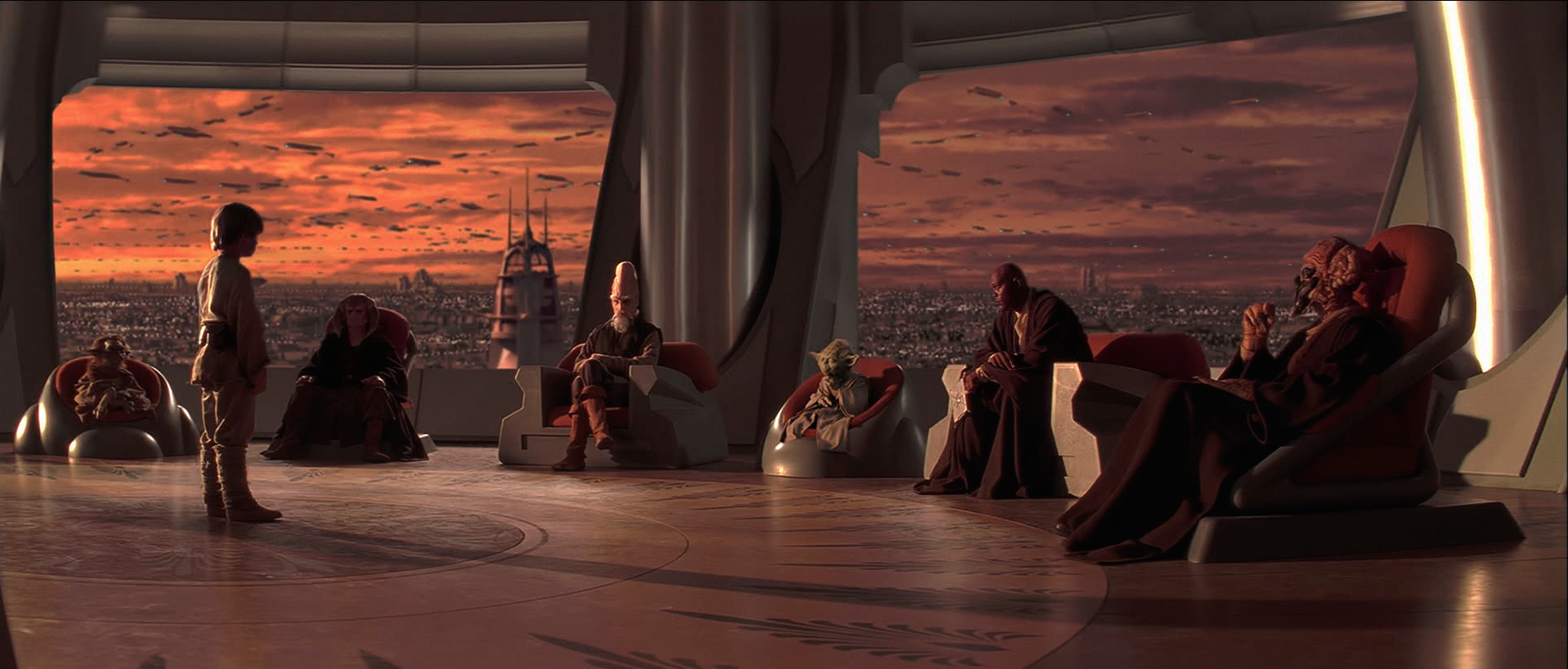
—The big vista shots, especially with the Naboo city-scapes, tend to look a bit more miniaturish in 3-D—although the sky-scraping Coruscant scenes play very well.
—I also got the impression that some shots which resisted conversion were just replaced with closer shots—the main ones being
Qui-Gon Jinn (Liam Neeson, who seems to have made the best choice in underplaying his radical Jedi ideologue, although it tends to undermine the character's importance) clucking a Tatooine beast-of-burden into motion, which I was under the impression was done in a fuller shot than the close-up this has, and Obi-Wan Kenobi (Ewan McGregor, who had the best acting arc of all the actors in the prequels) doing a spinning lightsaber move seems to have been moved a bit closer than the original.
—I don't remember The Phantom Menace moving as fast as this viewing seemed to. It's still pretty amazing to see how precise the editing is, and yet manage to get all the visual information necessary to follow what's going on, something not helped by the sound mix, which tends to prefer effects impression over clarity.

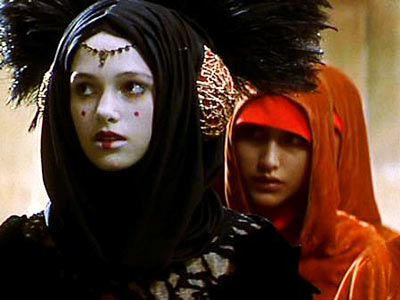
—Interesting how
Keira Knightley blends in the role of Queen Amidala's decoy/hand-maiden with Portman's more formal Queen acting (although, considering Knightley is probably a full foot taller than the miniaturish Portman, shouldn't the instinctual Jedi have noticed the subterfuge a little earlier?).

—The last 20 minutes work like gang-busters with the cross-cutting Battle for Naboo on four fronts—
the Gungan invasion by battle-droids, the Padme-led attack on the palace, the attack on the droid-command ship, and the three-sided lightsaber duel, and it's helped immeasurably by John Williams' "Duel of the Fates," which after consisting of a subdued omnipresent sonic wallpaper for most of the film, kicks things into high-gear. 

—Haters are still going to hate it—and, indeed, the fan-boy line has been staunchly adhered to in 3-D reviews—but, the Trade Federation plot resonates a bit more after the NAFTA kerfluffle and the bank meltdowns, and I still like the midi-chlorian idea making Anakin a "virgin birth"—leading me to the thought at the time "what if Jesus Christ turned out to be an asshole?"—even if it was all revealed to be a bio-engineering project by Palpatine in Revenge of the Sith.

No, it ain't perfect—it's a little stiff, with shots of smiles for smiles' sake, and the dialogue clunks along, even if some vital bits of information are slipped in under the radar, along the way. But, as one friend remarked after seeing a student-remixed version of Episode IV, "God, I forgot it was such a cheese-fest." It is. The thing is based on old "
Flash Gordon" serials and embraces the sensibilities of that style of ham-fisted major-key film-making. It's a fantasy film, not a Guide For Living, and subtlety was never in the blue-print. It is a small, quaint little conceit-film-series made Epic by the adoration of its fans. 
Yet, for some reason, George Lucas is to blame for the pushing of "product" (I haven't read any of the 3-D reviews, but the word "greed" keeps popping up in them), when it's the marketplace that drives these things. If people stopped buying this stuff, he wouldn't keep tossing it out there, revamping, tinkering, and attempting to make the films transition across the decades and technologies. We have met the Sith, and they are Us. And, boy, are we dumb!

2024 "Reconsideration"

As Roger Ebert said in his review of The Phantom Menace, "If it were the first 'Star Wars' movie, 'The Phantom Menace' would be hailed as a visionary breakthrough. But this is the fourth movie of the famous series, and we think we know the territory."

Just so. 
But, there were a couple things that Lucas hadn't really addressed in his Universe filled with exotic creatures and wondrous sights.
One of them was fashion, not only in apparel, but also in architecture. The previous films the former was dominated by uniforms and casual wear, and for the latter—other than the cloud-city of Bespin and the militaristic gloss of the Death Stars—everything else was supposed to suggest an improvised environment cobbled together with wire and spit.
Now, there had to be vast functioning cities of well-engineered design with an established history. And the clothes, for the higher end of dignitaries and royalty, had to have an air of regality and authority, where no one was allowed to dress like a scruffy nerf-herder. Nobody really complained about that.
The other was ethnicity. In a bio-diverse Uni-sphere, it was a little improbable that everybody would sound either American of British (the only exception being Millennium Falcon co-pilot Nien Nunb, who spoke in Kenyan). And so, for the sake of diversity, understand, accents were provided for the Gungans, the Trade Federation, and for Watto, the junk dealer on Tatooine. Character accents (that is, the way they speak)—eschewing the very recognizable French, German, and Italian kind—were treated as if they were racial slurs (they are considered offensive, still, in that NPR "reconsideration" above). But, the binary Yank/Brit accents are a bit limiting for such a Universe, don't you think? Shouldn't it be a bit more diverse? To American audiences, apparently not. It's not in our comfort zone. As I said at the end of the piece above, boy, are we dumb.
But, hey, it's just a movie. It's not like anybody treats it like a religion or anything.
Right?

That's right. "We think we know the territory."
 
What we don't know is how damn sensitive we are.

Wednesday, January 17, 2024

Mirror, Mirror

Don't Trust Anyone Over Four Feet
or
"No, Snow!  Don't Mess with Traditional Story-Telling!  It's Been Focus-Grouped, and It Works!!"

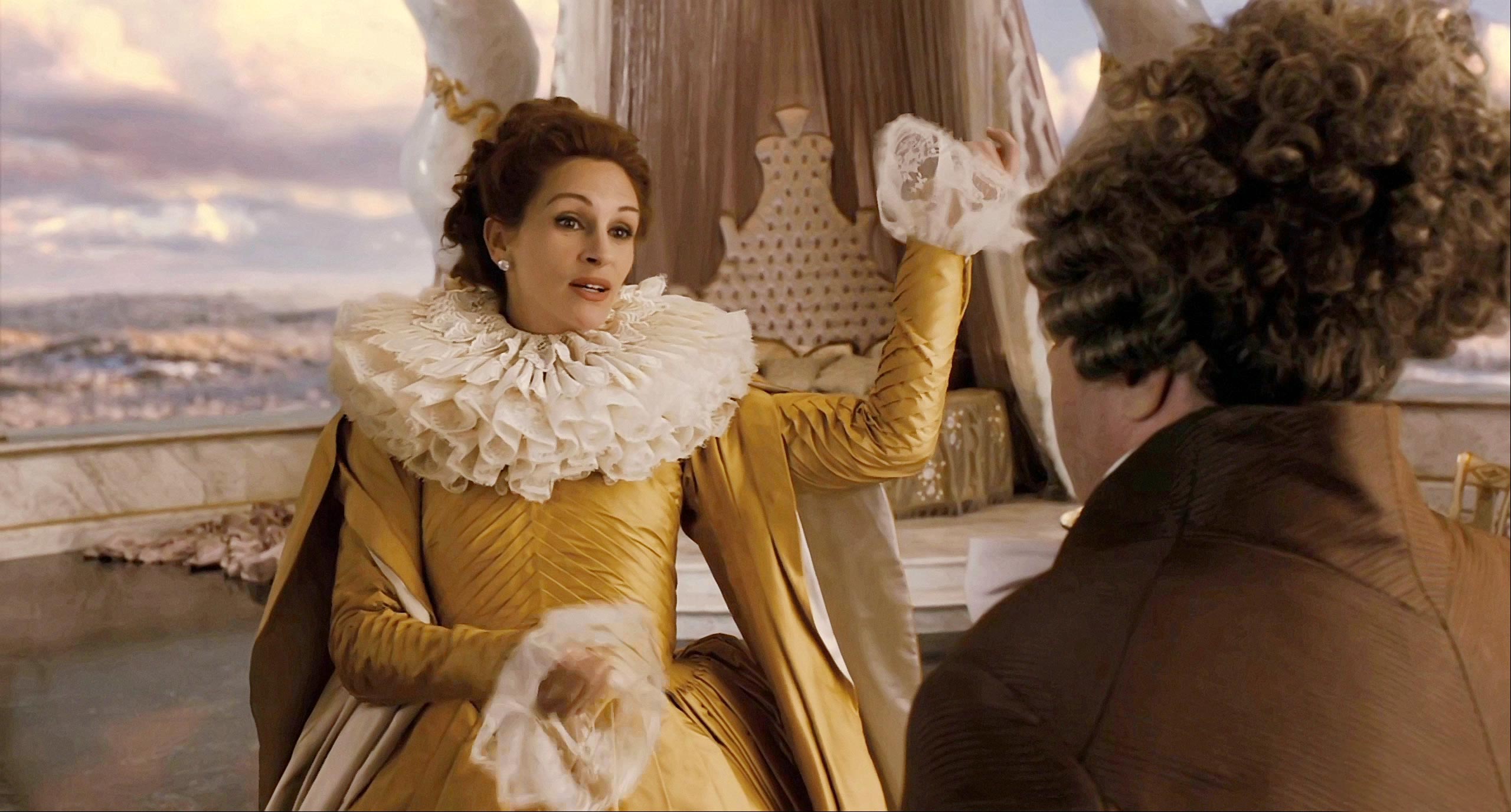
I approached Mirror Mirror with some trepidation. It's the sort of movie that curdles my gray matter—taking a traditional fairy-tale and updating it for modern audiences, with anachronisms, modern slang and catch-phrases, a fractured fairy-tale denying its origins and playing "hip." Also, it's a Julia Roberts vehicle and I don't "buy" Roberts in anything but comedic roles (which this one is).

But the other choice was to see Wrath of the Titans, for which I had no desire (Really? They're trying to make a franchise out of that one?) and so it was the "Snow White" knock-off, even though the prospect seemed rather Grimm.
It did have one thing going for it, however. Even though produced by Brett Ratner, it was being directed by an inspired choice—Tarsem, who vaulted from R.E.M. music videos to
The Cell
,* then rebounded with a fine film no one bothered to see, The Fall. I'd passed on his Immortals last year (though I plan to watch it on video sometime soon, now that it's out), but, as Tarsem can do some visionary work, he just might be able to pull it off.
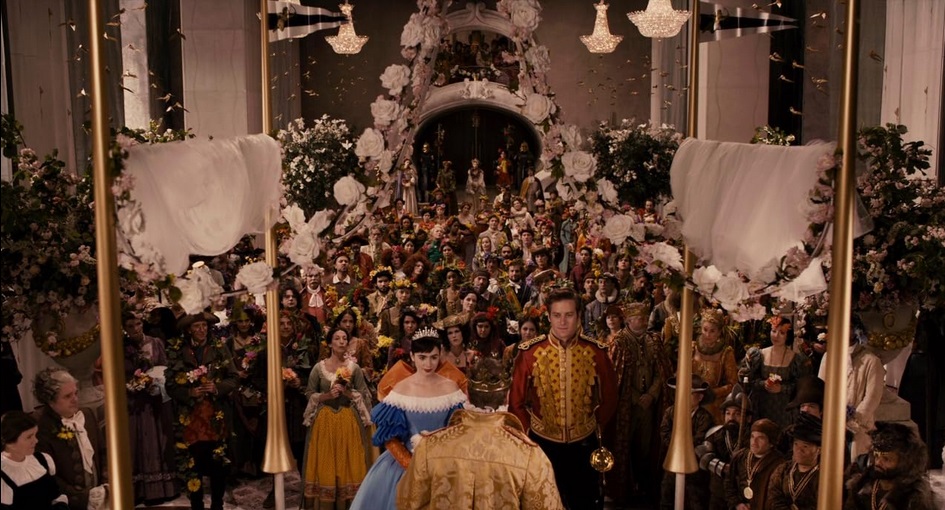
It might well have been lame in any other hands, but the director's spectacular design sense, not only for sets and costumes, but also how to frame them for maximum effect is combined with a breezy comedy style that is never idle, and never hangs for a laugh, so that not only is the frame full, but the soundtrack as well, with one overhanging punch-line that crowds through before each cut.

And yes, it's anachronistic, with such a polyglot of styles that it goes beyond, say, Terry Gilliam-madness into a Moulin Rouge!-ish goofy slap-dashery in which nothing is sacred except the movie's own internal rules of play, stopping just short of the Python-line of anarchy.  There is no single accent in place to latch onto geographically, except for some Anglo-Saxonisms—indeed, Arnie Hammer's Prince Alcott of Valencia, is pure American, but does it with such Ivy-League bravado that you accept he's a prince.

And this variation of the story has just enough "Hamlet" mixed in—Ms. White (an Audrey Hepburn-esque 
Lily CollinsPhil's kid) is the daughter of The King (Sean Bean
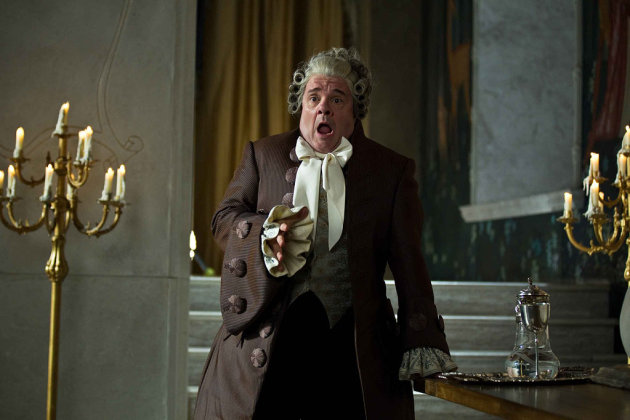
**), who is murdered (unbeknownst to all) by his new step-wife The Queen (Roberts), who then rules the Kingdom into the ground, while White awaits taking the throne on her 18th birthday (that is, if the Queen ever permits it). Instead, she spends it going out to see what's become of her Father's legacy and is distressed to learn there's no singing and dancing in the streets (as she remembers) but begging and poverty instead. This causes a political debate in the family, leading to Snow being banished by The Queen to be dispatched by her lackey Brighton (played with Costello-ish consternation by Nathan Lane).
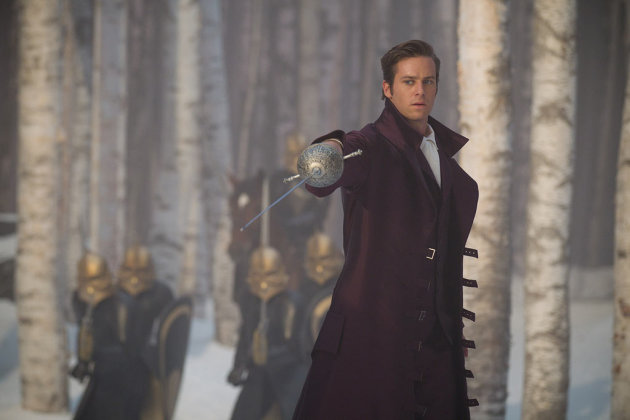
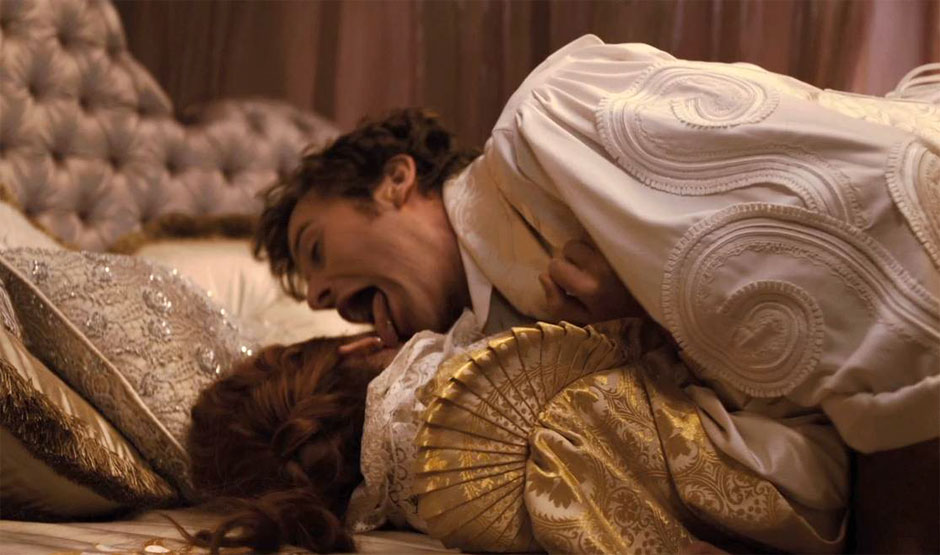
Along the way, we meet the handsome Prince (Hammer, who is aggressively great here, better than his Winklevoss twins in 
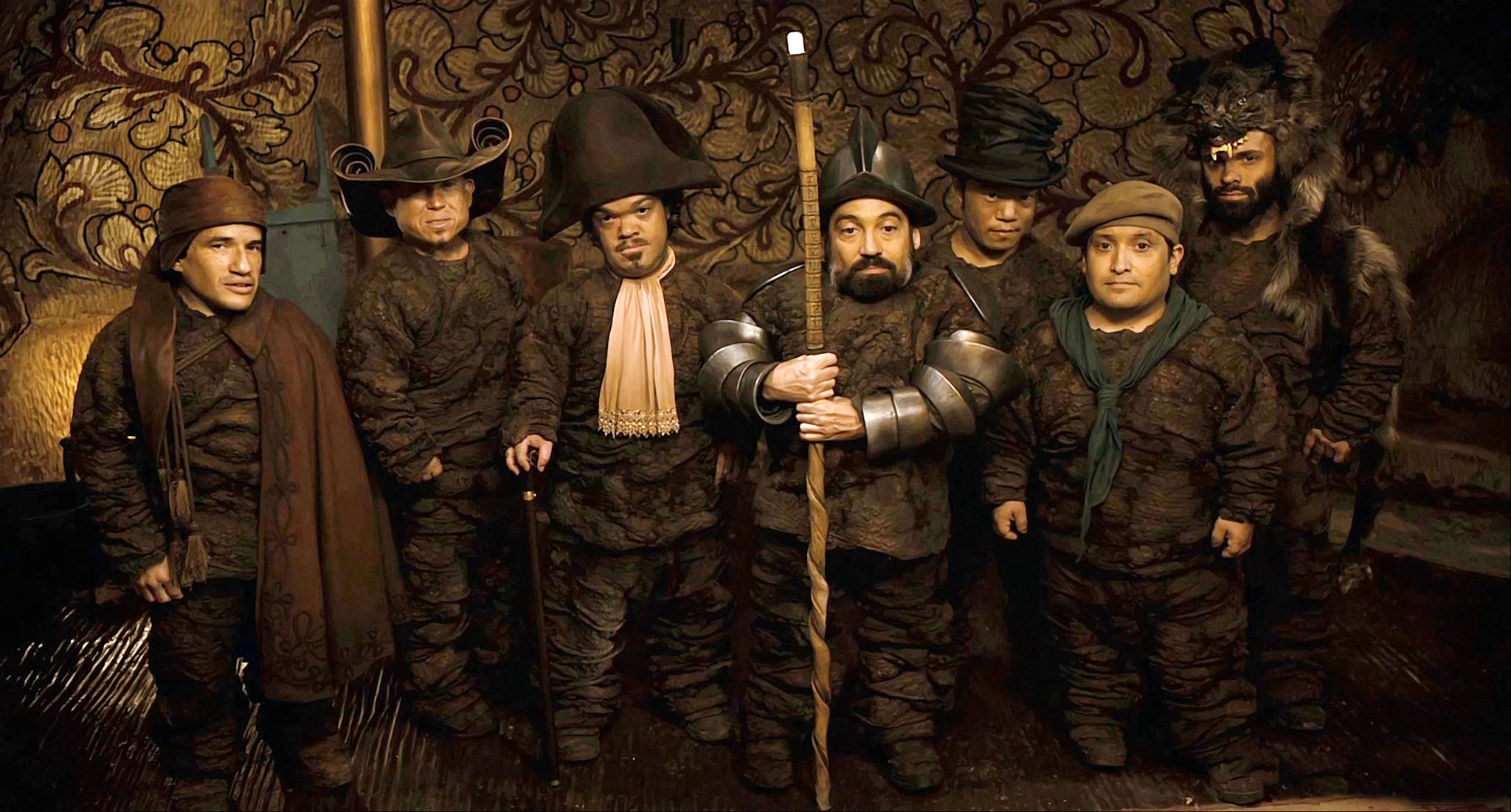
The Social Network, and decidedly better than being cocooned in make-up for J. Edgar, one thinks though that he is doomed to play scions), who is accosted by highwaymen...who just happen to be The Seven politically incorrect Dwarves (Napoleon, Half-pint, Grub, Grimm, Wolf, Butcher, and...Chuck, played with gruff zeal distinctively, by Jordan Prentice,Mark Povinelli, Joe Gnoffo, Danny Woodburn, Sebastian Saraceno, Martin Klebba,and...Ronald Lee Clark, all threatening to steal the show, as well—"beats workin' in a mine," as one of them says).  Before long, everybody's path is crossed once or twice, along with swords and stars in lovers' eyes.

Thing is, in its cartoonish way, it works in live-action, as well as when Disney goes sassy these days with classic tales, and, given the edge by Tarsem's crack sense of timing and way of knowing no bounds in design and camera moves (and Alan Menken's Mickey-Mousing
*** score doesn't hurt in that regard, either) the effect is somewhat the same.

Walked in loathing the idea and walked out kinda lovin' it. Pretty happy about that, given the Grimm prospects. Seems fair, if not the fairest of them all.
The music video in the End Credits, which shows how Tarsem throws things 
in from left field, as in this "Bollywood" style sequence.

*
Another example of Tarsem's work—a cheeky gladiator themed Pepsi commercial, 
featuring Enrique Eglesias, Beyonce, Britney Spears and Pink, with the music of Queen.

** Is there something in Sean Bean's contracts that stipulates that any character he plays not make it to the last reel? The last movie I saw where one of his characters survived was The Martian.

*** © Disney Corporation. I use this in the musical definition of the term (not in its "common, inferior" usage) where the music follows the action on-screen precisely, as in notes that follow foot-steps, say. And now this joke is a bit ironic as, this year, Mr. Mouse is in the public domain. So, now, I can make that animated cartoon of "Maus" starring Mickey.