Showing posts with label Samuel L. Jackson. Show all posts

Friday, May 17, 2024

Star Wars, Episode 1: The Phantom Menace in 3-D

Episode I: The Phantom Menace is back in theaters for a 25th Anniversary (Really? That long ago?) and it's doing really well at the box-office, beating out NEW movies. And I've been hearing "buzz"...like an NPR report on "All Things Considered Weekend" that damned with faint praise (hardly the "reconsideration it promised).

But, it did raise some issues, that led to some actual...thoughts. So, I'm re-running my review of The Phantom Menace when I viewed it in its 3-D version.


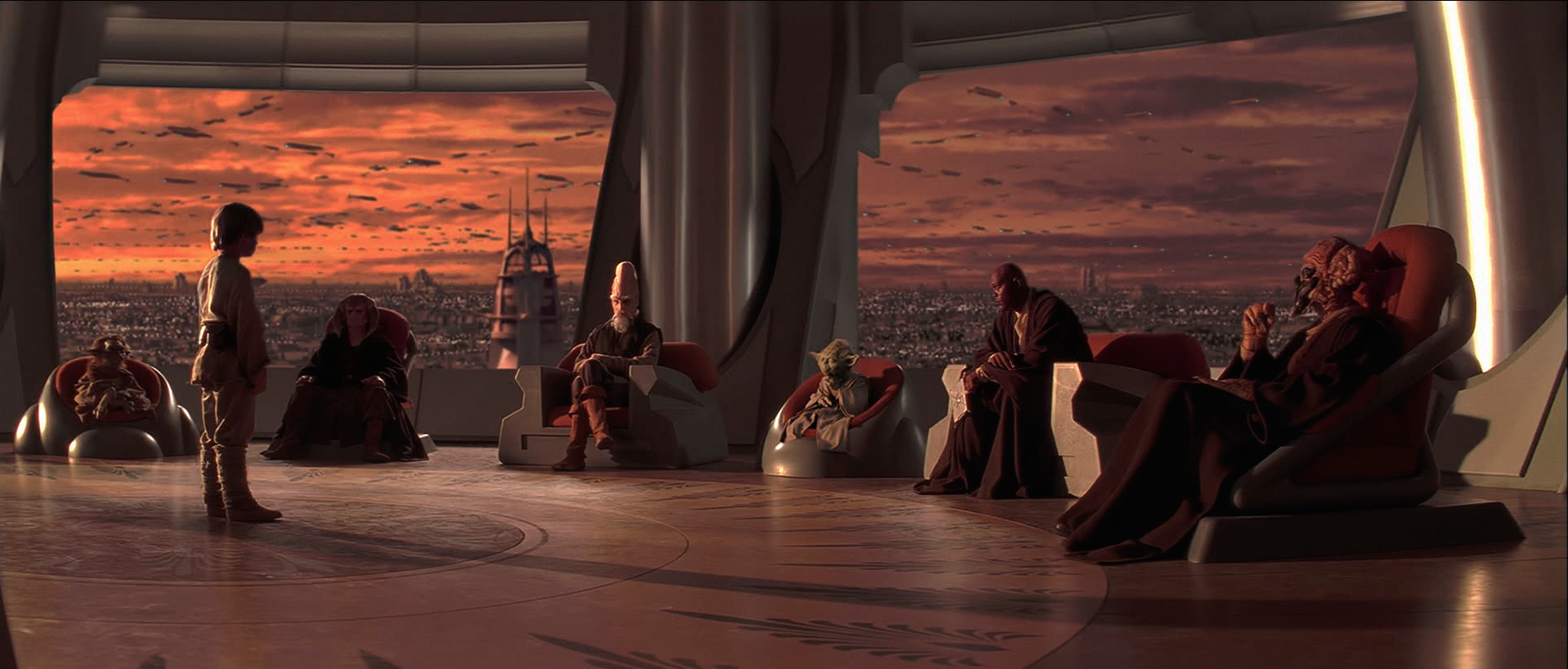
Star Wars, Episode 1: The Phantom Menace (in 3-D) (George Lucas, 1999/2012/in perpetuity) "Star Wars" is the one series I was curious to see in 3-D—the clean, simple lines of force (pardon the pun) from the first immersion into those films (a long, long time ago in 1976) was along a line that extended from behind our heads to points close to the center of the screen: the opening titles that flashed, then crept into a distant infinity; hyperspace travel that zipped into that same bulls-eye quadrant; the cavernous, warehouse spaces of the Empirical HQ's; the approaching death-spirals of various death-stars; slaloms through asteroids and skimming over ice-fields. The movies already seemed yearning to stretch 2-D images into three-dimensional spaces, and although Lucas' spacial sense and action lines became increasingly complicated, and precise cutting more extreme, he always kept that sense of background/foreground busyness that leant itself to three-dimensions without (literally) rubbing our noses in it...or poking our eyes with it.
Naturally, they'd start with Episode 1 this time. After all of Lucas' tinkering over the years, 3-D seems like a natural place to go, especially for the reasons already listed, and there's been enough time out of theaters to make projected images seem unique (plus, there's a ready-made audience already grown up on all six films, who may actually prefer the prequels to their predecessors...despite the sneering of their fathers--"Shut UP, Dad!").

But, whatever the design sense going into the films, they were still SHOT flat.  Yes, there's a lot of post-production digital imagery that can be manipulated, but the actors—the live ones, anyway—are still forever tied to the backgrounds on location, and any cutting/pasting/shifting is going to make those portions look as fake as those late-model View-master pix that weren't taken with stereo-cameras on location, and looked instead like cardboard standees in front of a shifted background.

Not sure how they did it—I suspect it's the adding of shaped shadows to facial features and bodies—but, the 3-D effects are convincing and seamless, and although the picture loses some luster due to the lower light-levels (and those damn glasses), they're the same minor annoyances one finds in any 3-D presentation-it goes with the depth-of-territory.  And, as most of the SW films, pains had already been made to make things multi-planed enough to justify the conversion. Some of the speedier foreground elements tend to go rather unmenacingly phantom-like, but those are on rare occasions. 


Some random thoughts:
—The big vista shots, especially with the Naboo city-scapes, tend to look a bit more miniaturish in 3-D—although the sky-scraping Coruscant scenes play very well.
—I also got the impression that some shots which resisted conversion were just replaced with closer shots—the main ones being
Qui-Gon Jinn (Liam Neeson, who seems to have made the best choice in underplaying his radical Jedi ideologue, although it tends to undermine the character's importance) clucking a Tatooine beast-of-burden into motion, which I was under the impression was done in a fuller shot than the close-up this has, and Obi-Wan Kenobi (Ewan McGregor, who had the best acting arc of all the actors in the prequels) doing a spinning lightsaber move seems to have been moved a bit closer than the original.
—I don't remember The Phantom Menace moving as fast as this viewing seemed to. It's still pretty amazing to see how precise the editing is, and yet manage to get all the visual information necessary to follow what's going on, something not helped by the sound mix, which tends to prefer effects impression over clarity.

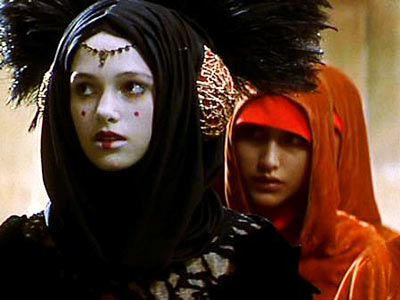
—Interesting how
Keira Knightley blends in the role of Queen Amidala's decoy/hand-maiden with Portman's more formal Queen acting (although, considering Knightley is probably a full foot taller than the miniaturish Portman, shouldn't the instinctual Jedi have noticed the subterfuge a little earlier?).
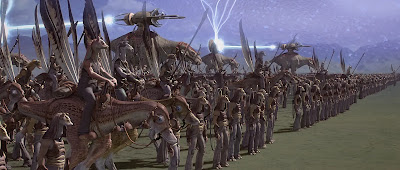
—The last 20 minutes work like gang-busters with the cross-cutting Battle for Naboo on four fronts—
the Gungan invasion by battle-droids, the Padme-led attack on the palace, the attack on the droid-command ship, and the three-sided lightsaber duel, and it's helped immeasurably by John Williams' "Duel of the Fates," which after consisting of a subdued omnipresent sonic wallpaper for most of the film, kicks things into high-gear. 

—Haters are still going to hate it—and, indeed, the fan-boy line has been staunchly adhered to in 3-D reviews—but, the Trade Federation plot resonates a bit more after the NAFTA kerfluffle and the bank meltdowns, and I still like the midi-chlorian idea making Anakin a "virgin birth"—leading me to the thought at the time "what if Jesus Christ turned out to be an asshole?"—even if it was all revealed to be a bio-engineering project by Palpatine in Revenge of the Sith.

No, it ain't perfect—it's a little stiff, with shots of smiles for smiles' sake, and the dialogue clunks along, even if some vital bits of information are slipped in under the radar, along the way. But, as one friend remarked after seeing a student-remixed version of Episode IV, "God, I forgot it was such a cheese-fest." It is. The thing is based on old "
Flash Gordon" serials and embraces the sensibilities of that style of ham-fisted major-key film-making. It's a fantasy film, not a Guide For Living, and subtlety was never in the blue-print. It is a small, quaint little conceit-film-series made Epic by the adoration of its fans. 
Yet, for some reason, George Lucas is to blame for the pushing of "product" (I haven't read any of the 3-D reviews, but the word "greed" keeps popping up in them), when it's the marketplace that drives these things. If people stopped buying this stuff, he wouldn't keep tossing it out there, revamping, tinkering, and attempting to make the films transition across the decades and technologies. We have met the Sith, and they are Us. And, boy, are we dumb!

2024 "Reconsideration"

As Roger Ebert said in his review of The Phantom Menace, "If it were the first 'Star Wars' movie, 'The Phantom Menace' would be hailed as a visionary breakthrough. But this is the fourth movie of the famous series, and we think we know the territory."

Just so. 
But, there were a couple things that Lucas hadn't really addressed in his Universe filled with exotic creatures and wondrous sights.
One of them was fashion, not only in apparel, but also in architecture. The previous films the former was dominated by uniforms and casual wear, and for the latter—other than the cloud-city of Bespin and the militaristic gloss of the Death Stars—everything else was supposed to suggest an improvised environment cobbled together with wire and spit.
Now, there had to be vast functioning cities of well-engineered design with an established history. And the clothes, for the higher end of dignitaries and royalty, had to have an air of regality and authority, where no one was allowed to dress like a scruffy nerf-herder. Nobody really complained about that.
The other was ethnicity. In a bio-diverse Uni-sphere, it was a little improbable that everybody would sound either American of British (the only exception being Millennium Falcon co-pilot Nien Nunb, who spoke in Kenyan). And so, for the sake of diversity, understand, accents were provided for the Gungans, the Trade Federation, and for Watto, the junk dealer on Tatooine. Character accents (that is, the way they speak)—eschewing the very recognizable French, German, and Italian kind—were treated as if they were racial slurs (they are considered offensive, still, in that NPR "reconsideration" above). But, the binary Yank/Brit accents are a bit limiting for such a Universe, don't you think? Shouldn't it be a bit more diverse? To American audiences, apparently not. It's not in our comfort zone. As I said at the end of the piece above, boy, are we dumb.
But, hey, it's just a movie. It's not like anybody treats it like a religion or anything.
Right?

That's right. "We think we know the territory."
 
What we don't know is how damn sensitive we are.

Wednesday, February 7, 2024

Argylle

Accent on the "Arrrgh"
or
Henry Cavill's Failed James Bond Audition (Part 3)

Aubrey Argyle (Henry Cavill), an agent for an intelligence division (headed by Richard E. Grant) is on a mission in Greece to find a source of information (doesn't matter what it is...it never matters). In contact with his associates, Wyatt (John Cena) and Keira (Ariana DeBose), he infiltrates a dance club where he asks the seductress LaGrange (Dua Lipa) to dance the "whirleybird," a dance where he basically wears his partner as a muffler. She reveals that the whole set-up is a trap to kill him. She exits, while everyone in the club pulls out an automatic weapon. With such a circular firing squad, Argylle escapes, but is fired upon by a waiting LaGrange. Keira pulls up in a range rover to pursue her, but is shot through the heart. He alerts Wyatt that LaGrange is making her escape, and makes the choice to leave the wounded Keira and hijacks a vehicle to pursue LaGrange himself. As she speeds off down a winding, switch-backing road, Argylle takes the shortest route, over the roof-tops of local buildings, crashing down stair-cases, causing all sorts of damage to the scenery, architecture, and his own vehicle, that, if there was any sort of local press, would create so much havoc that the term "secret mission" would no longer apply. And, it's all for not, as Agent Wyatt, reaches out to the passing LaGrange and merely plucks her off her speeding motorcycle. Okay. So, (one may ask) why the carnage? These guys are talking to each other...why didn't someone just say..."You're strong. Grab her by the designer-label and yank her off her bike?"
Cut to: a book lecture. Author Ellie Conway (
Bryce Dallas Howard) is finishing reading what we'd just seen to her rapt audience. They all applaud her awaiting her to sign her latest book, the fourth in her "Argyle" series about a fictional secret agent with a Dexter Poindexter hair-cut, who's big, strong, impossibly handsome and somehow does undercover work that nobody notices. Nobody brings up that point during her Q-and-A (maybe because screenwriter Jason Fuchs is moderating the talk).
But, after her talk she goes home to her cat, Alfie (director Matthew Vaughn's nepo-kitty, Chip), and her Argylle action figures and tries to write another chapter of her forthcoming book. But, she's stuck, so stuck that even the fantasy-Argylle in her imagination starts to get a little irritated with her. Phone-call to mother (Catherine O'Hara), who advises her that the manuscript to her latest book feels incomplete and she shouldn't end it with a cliff-hanger—why doesn't she come by for a visit and they can resolve it (Sure, that's what I always do when I'm stuck in writerly quick-sand!), and she takes a train—she hates to fly—to go visit.
She and the cat intend to spend an isolated train-trip while she researches, but the train compartment's a bit crowded—anyone wanting to take the seat across from her is rebuffed with a "someone's already sitting there." Except for this one guy (Sam Rockwell), who rather blithely sits across from her, irritates her cat (and her) and wants to make small talk. Elly nose-dives into her book and doesn't engage—he recognizes her and is a big fan of her work (swell!). But around the time she asks him what it is that he does for work—"Espionage" is his answer—she's approached by an autograph-seeker, whose pen sprouts a hypodermic needle and the guy, Aiden Wilde, takes the guy out with a few swift moves.
Aiden is not what he seems (nothing is, as we're to find out). Suddenly, everybody in the train compartment starts to attack Aiden trying to get to Elly. While she sits there, horrified—and imagining that it's her agent Argylle doing the fighting—he flails, kicks, somersaults, and uses everybody's weapons against them. This is some well-organized kidnapping that's been planned out—all those assassins with all those tickets—then, you'd think that they'd all rush at once instead of waiting until their turn at bat. And in the next car, is a bunch of guys with automatic weapons. Big automatic unconcealable weapons. Is Amtrak that lax? And is there no such thing as innocent by-standers in this movie?
Apparently not. Argylle
is one of those spy-fantasy flicks along the lines of Flint, Matt Helm, Austin Powers and Vaughn's own "Kingsman" series, that make the Bond series look like "kitchen-sink" dramas. Things happen very fast so you don't have time to consider the lack of story-logic, gravity, mass, physics and the day-to-day realities of life and the Universe that would stop this movie cold if anybody in the audience raised their hand and said "Excuse me...that makes no sense." In Matthew Vaughn's universe, that audience member would instantly be executed (with colorful smoke!) by every other audience member.
It's eye-candy, not brain-candy. It's a comedy, not an adventure, or a thriller, or a mystery, or an espionage film, or a drama...or much of anything, really. One is never engaged in any means to an end because  It's designed that you sit back, relax, eat your pop-corn, and silence your brain along with your cell-phone (as a matter of fact, it's one of those movies that you could text, make a phone-call, play a game, and not miss a detail—nothing matters and anything might be contradicted fifteen minutes later). The Elly-fantasy sequences are just as realistic as the Elly-"reality" sequences, and if you have a memory retention of more than thirty seconds, you're going to get irritated. Enjoy the popcorn; it's much more substantial.
Great cast, though. John Cena knows how to play comedy merely by timing and not by expression, Bryce Dallas Howard's quite good for what she's been given to work with. Bryan Cranston knows what the material's worth and just chews, chews, chews, and Catherine O'Hara's a bit wasted. Henry Cavill...well...the man's a poser and one wonders how many of these things he's going to do before the internet just throws up their hands and says "James Bond? Anybody but him." The film is also a bit of a bait-and-switch as Cavill and Cena's screen-time amount to about twenty minutes of screen-time. "Such small portions." The film has something to disappoint everybody.
The one thing I clung to throughout the entire movie was Sam Rockwell. From the moment he shows up to the final frame, he's invested in his character and makes it work. Where many in the cast are posturing and playing over-the-top, Rockwell's off-the-cuff insouciance and embracing of the weird feels natural and oddly charismatic. It may be too much to say that Rockwell believes the performance and sells it his manic energy, but he provides a genuineness in something that feels so faked. The one thing you come away sure of after the movie is how damned talented Rockwell is. He's a treasure, worth far more than any plot McGuffin is worth.
Thinking about the movie too much depresses me, but if you want further thoughts—and a lively panel discussion—Argylle is the subject of Episode 721 of the Lambcast (I'm the one grumbling throughout).
 
The best part of the movie (aside from Sam Rockwell) is the trailer.  Here it is. Save yourself the trouble. 

Yeeeeaah...it isn't...and it won't.
"The Bigger the Lie," indeed.

Saturday, January 1, 2022

The Other Guys

Written at the time of the film's release...

Saturday is traditionally "Take Out the Trash" Day. (Remember when Adam McKay made comedies?)

"Did That Go the Way You Thought It Was Gonna Go?""Nope."
or 
"Anything You Say Can and Will Be Used...(what's the rest?)" "As a Flotation Device..."

More comedy, and this one's even very funny for its first half, but then, once one scene goes sideways and doesn't work, the whole thing falls apart like a hostage situation gone wrong.  And the audience is the hostage, waiting for it to kick back in...but it never does.

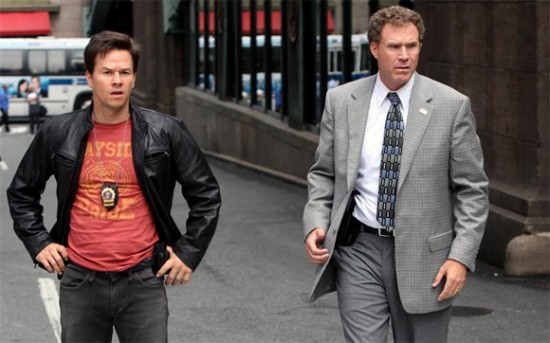
Allen Gamble (Will Ferrell) and Terry Hoitz (Mark Wahlberg) are two New York City detectives working in the considerable shadow of detectives Danson and Highsmith (Dwayne Johnson and Samuel L. Jackson in nice parodies of their "serious" screen-work), a team of glory-hounds for whom property damage is all in a day's conflagration, but who refuse to do the paperwork.  Gamble is self-described as "an accountant for law-and-order," and Hoitz is riding a desk-job after a shooting that goes wrong.* Gamble loves the mundane filing, but his partner Hoitz, itches to be "in the field." "I'm a peacock!" he is fond of remonstrating. "You've got to let me fly!" At which point, he is reminded that peacocks do not fly.** 
Unperturbed, and when advancement in the ranks becomes possible, the two glom onto a white-collar crime that Gamble has discovered that has connections to a series of high-profile robberies. 
The mis-matched pair
(Hoitz is volatile, Gamble is eerily up-beat) are completely street-dumb and their investigation is constantly being dis-railed (sometimes literally) by distractions and their lack of ability to resist the charms of their high-rolling suspect's lifestyle. Their increasing frustration with the case and each other (as well as Hoitz's relationship problems, in contrast with the milquetoast Gamble's inexplicable attractiveness to women) is fertile ground for situations that explode in conflict.
It works and works gang-busters for the first hour. The combination of loose script and improvisation is beefed up by all the actors (especially Ferrell and
Michael Keaton
, who does quick-silver wonders with the cliche "harried Captain" role), especially when the story is building and we're getting to know the characters. The "left-field" surprises come fast and loose, and the timing by the actors (and the editing) is crack. One senses trouble early on when Anne Heche (uncredited, by the way) is given a thankless role in which she's really not allowed to do anything funny...or much of anything. But Ferrell, for the most part, is at the top of his game playing the contrary stiff in a room full of crazies, and Wahlberg who, depending on the material, can be brilliant, plays pathetic frustration hilariously.  Even Eva Mendes acquits herself well in the mix, milking laughs out of the role of Gamble's absurdly perfect wife—Gamble's sexual magnetism makes for a great series of running gags throughout the movie.
But, right at the point where Bob, the union rep, gets dissed and leaves the room, the entire movie goes flat.*** Maybe the improv was getting too expensive and they decided to "coast." Maybe the assurance of an "action-filled" finale made them scrimp on the script.  Maybe the irrelevant story-line getting in the way changed the tone. Maybe everyone got tired. But, for whatever reason, The Other Guys is two movies..."Good Cop" comedy and "Bad Cop" comedy.
Interestingly, the most useful part of the movie is the end credits where the increasing disparity between the incomes of the top 1% earners and the rest of us is presented in chilling graphic detail.
"Wilhelm" Alert @ 1:30
 
* Hint:  He's called "The Yankee Clipper" around the squad-room.

** What can I say?  It's New York, and the Bronx Zoo is the closest they come to a peacock.  Peacocks do indeed fly, but it's a brief, clumsy, scary thing to watch—which I think was the point of bringing it up in the movie.

*** It's funny I can pinpoint it, because that's where the movie became NOT funny, and I thought to myself..."Well, THAT didn't work..." and watched to my amazement as very little worked after.

Thursday, August 26, 2021

The Protégé (2021)

Da Nang, Girl!
or
"You Only Get Lucky Once"
 
Martin Campbell can be a hell of a competent director. He's introduced a couple of James Bond's (Pierce Brosnan in Goldeneye and Daniel Craig in Casino Royale) and directed the best of their movies. He did both "Zorro" films with Antonio Banderas and directed one of my "Anytime Movies", the mini-series "Edge of Darkness." But, the film version of Edge wasn't all that good. And he directed the mish-mash that was Green Lantern. When the material is sharp and focused, and when he has the right actors lined up, Campbell is top-notch (here's hoping the Broccoli kids hire him to premiere the next Bond—if the script is good). He's a fine director of action scenes and he also knows how to keep the movies zipping along at a brisk pace. He can also take complicated material and scrape it down to the bare essentials so it doesn't matter, and even add a stylistic flourish or two that gives it a certain style that can surprise the most jaded of movie-watchers, rising above the tendency of producers to jam through the latest craze of movie cliche's and hammer down the brass-tacks of what makes a good entertainment.
 
His latest film, The Protégé, has just opened, and it's nice to see that he can still, at the tender age of 77, show the young directing bucks how to stage an action scene, of which there are plenty.
It's a rainy night in Da Nang, Vietnam, and an operative named Moody (Samuel L. Jackson) is looking for bad guys. When he stealths through what appears to be a stronghold, he finds somebody beat him to the draw—all the well-armed baddies are bleeding out on the floor. A brief scan of bullet-holes leads him to open a cabinet to find a small girl pointing a gun at his head. She pulls the trigger on an empty chamber. He takes the gun from her, commenting that her choice of weapon was usually reliable, reloads the chamber, and hands it back to her saying "Now you're good to go." She does not kill him. They leave together.
It's 30 years later in Bucharest, Romania, and the son of a Romanian don is kidnapped. The ransom is €30,000 and when the drop is made, the woman picking it up (Maggie Q) finds herself looking down the barrels of several automatics. She is taken to the Don's palatial moÅŸie, where he talks big, shows her the money, and slaps her around. She cooly states "I didn't come for the money...I came for you" and opens a hidden stilleto in the phone (there's an app for that?) and punctures his jugular, blood spraying everwhere, and kicking him into his indoor pool, then dispatches his guards. She ignores the money, and walks outside where guards come running up to shoot her *viiip* one's down *viip**viip* the rest fall.
Okay, this may sound spoilerific—it's only for this particular sequence—but it's indicative of the action strategy—the fight's are bloody, spurty, and require some gore make-up, and sometimes things happen that aren't explained until later. It requires some patience along with the visceral jolts. Just go with it.
But, the gist is that Moody and Anna—that's the Maggie Q character, but we don't learn their names until deep into the movie, and it feels like the makers don't care—are a hitman team ("We find people that can't be found") working globally and based in London, where Ana runs a rare book store, one is not sure why, but it's nice to have a day-gig. One day, Michael Rembrandt (Michael Keaton) ambles into the shop looking for a specific book for a birthday present. He and Anna trade cute reparteé, but ultimately it's no sale and he leaves. But, it's a visit by Michael Keaton, so it must be significant, and the ramifications of the visit, which is in reality a sort of recce, will drive the plot of the rest of the movie, and set Anna on a vengeance quest, one that will take her back to Da Nang "and a rendezvous with her past."
Not the sort of summary that would make an executive spill his Stoly and say "I've GOT to make that picture!" But, there are joys. Some of the dialogue is snappy and everybody drawls it out in a world-weary, dryly wisenheimer kind of way. There's a dinner scene between Q and Keaton where they taunt and banter while holding automatics under the table at each other that's a nice little essay on advancing the story-line, but also keeping repartee entertaining, like Nick and Nora busting wise over cocktails. Keaton can be off and on, depending on the material, but when he's on, he's an eye-magnet, and here, he's so simultaneously sharp and relaxed that you watch his every move. There's a shot where he bounces back into the scene to deliver some random comment that feels ad-libbed, like he caught the camera running and said "This'll be fun" and everybody just kept it. And Q is sleek and confident, even when she's jumping off a balcony. There is a list of absurdities in the film a mile long, but the director keeps it fast and punching, so the movie never stalls out. Not for a moment. Every movie drags in places. The Protégé is always light on its feet and pushes the momentum, if not exactly pushing expectations.


Thursday, July 11, 2019

Spider-Man: Far From Home

Spider-Man's European Vacation
or
Spider-Man, Spider-Man
Visiting Europe (Not Amsterdam)
London, Prague and "The Boot"
Too Much Gadgetry in His Suit
Mon Dieu!
Qu'Est-ce Que C'est, Spider-Homme.
(Wherever There's a Baguette/
Aunt May's Too Young to Nag Yet)
Stay Sticky, Spider-Maaaaaaan!)*

Upfront: I liked Spider-Man: Far From Home more than I liked Spider-Man: Homecoming, but I'm not sure that will be the way of the mob. The central premise is "people will believe anything" and it spends more time than a White House spokesman proving that very point. I think folks will believe that less than the ability to wipe out half a Universe with a snap of your fingers. ("Yeah, man, but...ya know..."Stones.")

Spider-Man: Far From Home acknowledges the events of The Avengers movies (Infinity War and Endgame) right off the bat—even before the Marvel Studios Logo—everyone is calling it "The Blip" and it has caused all sorts of embarrassing havoc in the world. For example, Peter Parker's Aunt May (Marisa Tomei) re-appeared in her apartment after it rented out to someone else—embarrassing—the courts, insurance companies, and homeowners associations must be swamped. Reappearing students at Peter's high school have found that five years have elapsed (but not their three-picture deals) and a lot of their friends have graduated and moved on—and the absent students had to take their mid-terms again (I'm surprised the admins remembered, but at least the kids who returned didn't need a note to explain their absenteeism).
Anyway, they acknowledge it (but avoid the complexities), as well as the deaths of The Vision, Black Widow, Captain America (heh) and, of course, Iron Man Tony Stark. Especially Tony Stark. And Peter Parker (Tom Holland), only recently pulled back together, is feeling that death, and it's tearing him apart. It was Stark who recruited him for the Avengers, it was Stark who built his suits, and it is Stark that the public wants Spider-Man to live up to—they're looking for another Iron Man and they assume it will be Spider-Man.** But, as Peter tells Stark majordomo "Happy" Hogan (Jon Favreau, in between Disney jungle movies) he doesn't think he can live up to the Legacy. "Nobody expects you to live up to Tony Stark," Hogan counsels. "Even he couldn't live up to it." As a parting gift, Happy bequeaths some last Stark tech—a pair of glasses with interactive gizmo's, access to all sorts of Stark Industries technology, and its AI interface, EDITH. "Tony loved acronyms," says Hogan. "It stands for "Even Dead, I'm The Hero." 

Best line of the movie.
Samuel L. Jackson's reprise of "Bitch, please....." from Kong: Skull Island is the second.
So, while Peter feels the great power/great responsibility weight of the Legacy, his class is preparing for a science field-trip in Europe. Why Europe? Because 77% of Americans believe in angels, that's why. For Peter, this is of high importance, not so much for the science stuff, but for...yaknow...personal stuff. No longer enamored of Liz Toomes (Laura Harrier from Homecoming and, one should mention, BlackKklansman), he's more interested in Michelle "M.J." Jones (Zendaya), pretty, blunt ("You look pretty." "And therefore, I have value?"), and oddly dark—he wants to let her know that he likes her and he plans to make La Grande Gesture by telling her on top of the Eiffel Tower. But, he has a rival for MJ's affections in Brad (Remi Hii) who, after the blip, has aged five years and turned into something of a hunk. So, Spidey's attentions are focused on that.
Un-focusing are the constant calls from Nick Fury (Samuel L. Jackson) of S.H.I.E.L.D., who, with Agent Hill (Cobie Smulders) is trying to web-sling Peter into helping out with what seem to be a global crisis of elemental monsters—earth, air, water, and fire—which are popping up all over the world causing considerable damage. But, where these things are coming from, and why, are a mystery. But, they have a good idea. And it comes from an unlikely source—a previous victim, whose own Earth has been destroyed by the elementals.
His name is Quentin Beck (Jake Gyllenhaal, more on him later) who has traveled to this Earth (616, in case you want to update your Facebook profile) from his own (Earth-833)—if it existed. His Earth was destroyed by the Fire elemental that was allowed to get out of control and consume his world. How, Beck, whom Parker dubs "Mysterio," got here, no one knows—presumably the same way the "things" got here, by subtracting 217, turn right at Mars. Fury wants Spider-Man to team up with Mysterio, who seems to have a knack with his magical Dr. Strange-ish powers, to try to stop the threat, but Parker is reluctant—he's not Iron Man and not sure he could do anything to stop something so huge. But, Fury is insistent, and he has a contingency plan.
He uses the considerable resources of S.H.I.E.L.D to re-route the school science trip to wherever they think the elementals will appear, which although it may be a bit abrupt to the group, but it comes with upgrades, so nobody's complaining. Well, except for Parker who bleats to best-friend Ned, "Nick Fury has hijacked our summer vacation!!" Yes, he has. But, he hasn't done it alone.
That's the plot and the main gist of the important elements (no pun intended). The film-makers flesh it out with the side-characters, and a hint of intrigue that doesn't feel too threatening in its implications. It's wise that they come down to Earth after the cosmic implications of The Avengers movies—although they flirt with the Marvel version of the Multi-verse, only to let it go...leave that to Into the Spider-verse. Also, the threat, though having elements of the supernatural, boils down to that most Earth-bound of villains, the Disgruntled Employee. But, the threat part is mere window-dressing. It's a bit dull—what we've come to expect.
The best part of Spider-Man: Far From Home is not the super-heroics (aside from a very creative "dream" sequence); it's the kids. The messy, fussy, hormonal, and slightly desperate mood-yanks of teen-ager-dom are neatly, comically, played out, especially of kids in unfamiliar surroundings and disorienting circumstances. The throwing of semi-confident kids into non-comfort zones and their ability to cope—or not—is well thought out and played. And the tentative, nervous romantic pairing of Zendaya and Holland makes for the most enjoyable Spider-couple in any of the versions of Spider-Man brought to the screen.
There are elements that bothered me—the CGI of the Mysterio fights with the Elementals are some of the dodgier special effects I've seen in the Marvel movies...and the characterization of Nick Fury seemed...off to me. Now, maybe I'm being too much of a Marvel-zombie saying this, but...could this have been done deliberately? It's not a good strategy because I found it a bit disorienting, but given the way the film plays out, one could make the case that they was intentional. Still, it makes my Spider-sense tingle.
And Jake Gyllenhaal? I've seen Gyllenhaal do great things, even in "iffy" movies. But, here, he's terrible and it might be the biggest character mis-fire since Ben Kingsley's The Mandarin in Iron Man Three (or Paul Giamatti's Rhino in The Amazing Spider-Man 2). One could imagine someone doing some great things with the role, but Gyllenhaal's portrayal has no depth, and little consistency from scene to scene. It might have been the script, but I suspect the actor was thinking how he'd ever live down the costume, rather than looking at the character with a solid through-line.
Anyway, good times most of the time. Definitely stay for the End-Credits scenes, one of which brings back a beloved Spider-Man character, and the other which made me even more suspicious those things that bothered me were deliberate.
Made me go "Hmmmm."
"Stay sticky...except with Aunt May"

* Alternate Lyrics:
Takes His Class on a Trip/
Awfully Vague about "The Blip"/
Oh, Snap! There Went the Spider-Man
** Uh, why? It's not like Hawkeye can become Thor, or The Hulk become Black Widow...I mean, these heroes do what they can based on their skill-sets, people. 
a) I still find it funny that so much emphasis is put on Iron Man—he was a Tier 2 super-hero at Marvel, the movie series wasn't great, but it's only Robert Downey Jr.'s portrayal that kick-started the Marvel Studios success story. Downey was the corner-stone and BVP utility actor for the studio, which is why he's being lionized.
b) Why Spider-Man? Does everybody know the link between the two heroes? The public didn't know. We know, because we've seen the movies...Oh, it's okay, Marvel. Keep collecting your zillions.