Showing posts with label Bryan Cranston. Show all posts

Wednesday, February 7, 2024

Argylle

Accent on the "Arrrgh"
or
Henry Cavill's Failed James Bond Audition (Part 3)

Aubrey Argyle (Henry Cavill), an agent for an intelligence division (headed by Richard E. Grant) is on a mission in Greece to find a source of information (doesn't matter what it is...it never matters). In contact with his associates, Wyatt (John Cena) and Keira (Ariana DeBose), he infiltrates a dance club where he asks the seductress LaGrange (Dua Lipa) to dance the "whirleybird," a dance where he basically wears his partner as a muffler. She reveals that the whole set-up is a trap to kill him. She exits, while everyone in the club pulls out an automatic weapon. With such a circular firing squad, Argylle escapes, but is fired upon by a waiting LaGrange. Keira pulls up in a range rover to pursue her, but is shot through the heart. He alerts Wyatt that LaGrange is making her escape, and makes the choice to leave the wounded Keira and hijacks a vehicle to pursue LaGrange himself. As she speeds off down a winding, switch-backing road, Argylle takes the shortest route, over the roof-tops of local buildings, crashing down stair-cases, causing all sorts of damage to the scenery, architecture, and his own vehicle, that, if there was any sort of local press, would create so much havoc that the term "secret mission" would no longer apply. And, it's all for not, as Agent Wyatt, reaches out to the passing LaGrange and merely plucks her off her speeding motorcycle. Okay. So, (one may ask) why the carnage? These guys are talking to each other...why didn't someone just say..."You're strong. Grab her by the designer-label and yank her off her bike?"
Cut to: a book lecture. Author Ellie Conway (
Bryce Dallas Howard) is finishing reading what we'd just seen to her rapt audience. They all applaud her awaiting her to sign her latest book, the fourth in her "Argyle" series about a fictional secret agent with a Dexter Poindexter hair-cut, who's big, strong, impossibly handsome and somehow does undercover work that nobody notices. Nobody brings up that point during her Q-and-A (maybe because screenwriter Jason Fuchs is moderating the talk).
But, after her talk she goes home to her cat, Alfie (director Matthew Vaughn's nepo-kitty, Chip), and her Argylle action figures and tries to write another chapter of her forthcoming book. But, she's stuck, so stuck that even the fantasy-Argylle in her imagination starts to get a little irritated with her. Phone-call to mother (Catherine O'Hara), who advises her that the manuscript to her latest book feels incomplete and she shouldn't end it with a cliff-hanger—why doesn't she come by for a visit and they can resolve it (Sure, that's what I always do when I'm stuck in writerly quick-sand!), and she takes a train—she hates to fly—to go visit.
She and the cat intend to spend an isolated train-trip while she researches, but the train compartment's a bit crowded—anyone wanting to take the seat across from her is rebuffed with a "someone's already sitting there." Except for this one guy (Sam Rockwell), who rather blithely sits across from her, irritates her cat (and her) and wants to make small talk. Elly nose-dives into her book and doesn't engage—he recognizes her and is a big fan of her work (swell!). But around the time she asks him what it is that he does for work—"Espionage" is his answer—she's approached by an autograph-seeker, whose pen sprouts a hypodermic needle and the guy, Aiden Wilde, takes the guy out with a few swift moves.
Aiden is not what he seems (nothing is, as we're to find out). Suddenly, everybody in the train compartment starts to attack Aiden trying to get to Elly. While she sits there, horrified—and imagining that it's her agent Argylle doing the fighting—he flails, kicks, somersaults, and uses everybody's weapons against them. This is some well-organized kidnapping that's been planned out—all those assassins with all those tickets—then, you'd think that they'd all rush at once instead of waiting until their turn at bat. And in the next car, is a bunch of guys with automatic weapons. Big automatic unconcealable weapons. Is Amtrak that lax? And is there no such thing as innocent by-standers in this movie?
Apparently not. Argylle
is one of those spy-fantasy flicks along the lines of Flint, Matt Helm, Austin Powers and Vaughn's own "Kingsman" series, that make the Bond series look like "kitchen-sink" dramas. Things happen very fast so you don't have time to consider the lack of story-logic, gravity, mass, physics and the day-to-day realities of life and the Universe that would stop this movie cold if anybody in the audience raised their hand and said "Excuse me...that makes no sense." In Matthew Vaughn's universe, that audience member would instantly be executed (with colorful smoke!) by every other audience member.
It's eye-candy, not brain-candy. It's a comedy, not an adventure, or a thriller, or a mystery, or an espionage film, or a drama...or much of anything, really. One is never engaged in any means to an end because  It's designed that you sit back, relax, eat your pop-corn, and silence your brain along with your cell-phone (as a matter of fact, it's one of those movies that you could text, make a phone-call, play a game, and not miss a detail—nothing matters and anything might be contradicted fifteen minutes later). The Elly-fantasy sequences are just as realistic as the Elly-"reality" sequences, and if you have a memory retention of more than thirty seconds, you're going to get irritated. Enjoy the popcorn; it's much more substantial.
Great cast, though. John Cena knows how to play comedy merely by timing and not by expression, Bryce Dallas Howard's quite good for what she's been given to work with. Bryan Cranston knows what the material's worth and just chews, chews, chews, and Catherine O'Hara's a bit wasted. Henry Cavill...well...the man's a poser and one wonders how many of these things he's going to do before the internet just throws up their hands and says "James Bond? Anybody but him." The film is also a bit of a bait-and-switch as Cavill and Cena's screen-time amount to about twenty minutes of screen-time. "Such small portions." The film has something to disappoint everybody.
The one thing I clung to throughout the entire movie was Sam Rockwell. From the moment he shows up to the final frame, he's invested in his character and makes it work. Where many in the cast are posturing and playing over-the-top, Rockwell's off-the-cuff insouciance and embracing of the weird feels natural and oddly charismatic. It may be too much to say that Rockwell believes the performance and sells it his manic energy, but he provides a genuineness in something that feels so faked. The one thing you come away sure of after the movie is how damned talented Rockwell is. He's a treasure, worth far more than any plot McGuffin is worth.
Thinking about the movie too much depresses me, but if you want further thoughts—and a lively panel discussion—Argylle is the subject of Episode 721 of the Lambcast (I'm the one grumbling throughout).
 
The best part of the movie (aside from Sam Rockwell) is the trailer.  Here it is. Save yourself the trouble. 

Yeeeeaah...it isn't...and it won't.
"The Bigger the Lie," indeed.

Tuesday, June 27, 2023

Asteroid City

Meep! Meep!
or
Margot Robbie's in the Tupperware
 
“Asteroid City does not exist. It is an imaginary drama created expressly for the purposes of this broadcast. The characters are fictional, the text hypothetical, the events an apocryphal fabrication."

Well, of course they are! It's a Wes Anderson movie!
 
Early on, with Anderson's movies—back before they got really stylistic with consistent lateral camera moves and a severe one-point perspective, and looked like they could have happened in the "real world"—there was a depth to the subject matter that was undeniable. That has remained to this day, even while the visual look of the films have become more juvenile and seem to be contained in toy-like play-sets that defy good construction practices or even three-dimensionality. Characters became types moving around in play-houses that seem to be defiantly artificial...like shooting in a western town that were deliberately shown to be propped up stage settings and mere facades. Most directors try to expand their horizons along with their budgets and to take pains to make things more realistic and less like pre-planned photographed dramatizations. Not Wes Anderson.
Hitchcock said of Spielberg that he was "the first one of us who doesn't see the proscenium arch" noting that Spielberg grew up with film, rather than the stage. But, Anderson is going a different direction. He WANTS you to see the proscenium arch, and will go out of his way...with a child-like glee...to make sure it's noticed and appreciated to be artificial. His new film, Asteroid City is one more step in that direction as it's story looks like it takes place in one of Maurice Noble's desert landscapes in the Road-runner cartoons.*
But, that's one aspect of Anderson's film (he usually has at least two he's presenting in his movies). Usually, he's as stringent in his story through-line as he is with a tracking shot (his The French Dispatch, with its a handful of stories, being an exception). This one, he's made a layered story, through several simulated media—television, stage, and film—each one has its place in the film and each one is subject to being violated, one by the other.
Now, Asteroid City tells the story of what happens when a bunch of "super-genius" kids arrive with their families at the titular city—famed for its vicinity to  the "Arid Springs Meteorite" impact crater—for the "Junior Stargazer/Space Cadet" convention put on by "The Larkings Foundation" and the U.S. Military under its United States Military-Science Research and Experimentation Division. They're to be given awards for their inventions—it should be noted that those inventions (jet-packs, destructo-rays, projecting on the Moon) were not viable in the setting of 1955, but would be just the sorts of things kids would want to invent. Each family have their issues and quirks, and they become unwitting witnesses to a major event in the history of mankind.
So, that's the plot. But, it's not the whole movie. We begin—in black-and-white and a square Academy ratio—with a television program (of the arts-programming "Omnibus" variety) where the host (
Bryan Cranston) intones that they are presenting a special production of a play by famed playwright Conrad Earp (Edward Norton) called "Asteroid City" and after a brief episode where Earp meets actor Jones Hall (Jason Schwartzman), we begin with a wide-screen version of the play in the colors of a faded post-card you'd find in a rack at a tourist trap.
Augie Steenbeck (played by Jones Hall played by Jason Schwartzman)—photographer—arrives (barely) at 'Roid City with his three daughters Andromeda, Pandora, and Casseiopeia as well as his son Woodrow (Jake Ryan), who is participating in the awards contest. Augie was a war photographer, still has shrapnel in his head, and takes his station wagon in to be serviced (by mechanic Matt Dillon)—it having given up the ghost miles down the road. It's decided that they will stay in town for the convention, rather than stay with Augie's father-in-law, Stanley Zak (Tom Hanks).
Stanley is concerned about this, but he's more distressed that Augie hasn't told the kids that Augie's wife/his daughter died two weeks ago, and don't you think it's about time to do that? So Augie stoically tells the kids—"Are we orphans now?" "No, I'm still alive."—which affects them all deeply, despite Woodrow being steeped in all things science and the three daughters, embracing mysticism seeing themselves as witches (well, two witches and one vampire). To allow the kids to grieve, Augie lets the kids bury their mother's ashes (contained in a Tupperware container) temporarily in the car-park until their grandfather can arrive to take them to his home for a more proper burial.
Also there for the awards ceremony is actress Midge Campbell (played by Mercedes Ford, played by
Scarlett Johansson), who is studying her lines for a new play and develops a curious relationship with Augie—seeing as their neighbors and all. Like the majority of the actor/characters, they are demonstratively undemonstrative, and—if I may use the word again—"stoic." These are, after all, adults in the 1950's, having lived through a ghastly world war, only to see it emerge with advances in technology and weaponry that dwarf, and could ultimately consume them. The many small inconveniences of living in a desert tourist trap not to far away from a nuclear test-site, leave them unfazed.
It is only when a cosmic event happens that is ultimately beyond their understanding that things change. Asteroid City, due to that happenstance is shut down and quarantined, leaving the temporary residents stranded. But, true to their nature—or perhaps the nature that Conrad Earp has given them—they react more to the minor annoyances that the quarantine imposes, rather than the perspective shock that its cause should have created.
Seems a bit like real life, doesn't it?
Anderson and consigliere Roman Coppola were writing this in 2020, so the COVID quarantine may not have been the genesis for the project, but filming during COVID restrictions certainly did, necessitating the recasting of Bill Murray when he came down with the plague. Still, when the outrage in real life is over the inconvenience of wearing masks rather than the loss of more than a million souls (you can't make this stuff up!), one can infer that it was on the creative minds.
Six feet apart?
But, there is one attitude shift present from the happenstance; Anderson abandons his persistent horizon-bisecting in the frame for something else—overhead shots looking down on the players. Oh, everything still has that one-point perspective, but from above with no horizon in sight, putting (in camera-terms) the people on screen at a disadvantage, making them smaller, vulnerable, putting them in their place—at least from the perspective of an observing extra-terrestrial. It's a bit jarring, but completely apt. It's the only evidence of a new perspective in the movie.
So, I found it fascinating, but then, I always look forward to Anderson's films. They may not come to an all-encompassing conclusion, but instead take on the mantle of a childish inquiry without answers. They make me feel a little younger, where playfulness was everyday, and not in those moments in between crises. They embrace innocence, but leave plenty of room for cynicism and mild bemusement, rather than a-musement. And the cultural touchstones he invokes are pretty sophisticated, even if he's not being sophisticated about them. I'm all in for that.
 
I hope he never grows up and loses it.
And Asteroid City is the perfect come-back for all those scary A-I generated parodies of "visionary director" Wes Anderson that are flooding YouTube now ad nauseum. Whatever the "brave new world" of AI generates, Anderson will always top it. I find that reassuring.

 * Anderson even throws in an occasional stop-motion road-runner just so we get the point.
"Wow"
 
Some more shots from Asteroid City, just because they amuse me... 

Wednesday, May 17, 2023

Larry Crowne

Written at the time of the film's release...although...I still remember parts of it that delighted me, despite my half-hearted review at the time.

T. Hanks for the Mediocrity
or
My Big Fat Career Mistake

I'm sure the intentions were better (aren't they always?), possibly saying something about the displacement of late baby-boomers in the job market, and how "it's never too late to learn" belying the "old dogs/new tricks" canard. Maybe co-writer/director/acting lead Tom Hanks just wanted to make something hopeful and sunny in bad economic times...a flare in the night-sky...the proverbial single candle rather than curse the darkness.

Well, it's more like a candle in the wind, and this blows. Formulaic, with an implied "wah-wah" comedy goose at the end of every scene, Larry Crowne has a "made-for-TV" movie feel that gets under your skin like intravenous sand-paper.  Larry (Hanks) is in his early fifties, divorced, a twenty-year Navy vet working at a box-store, where he's received "Employee of the Month" fetes nine times.  He's one of those guys who owns everything he does, taking a certain pride in all aspects of his job, even picking up and disposing the stray trash he finds in the parking lot. The implication is already there: while the rest of the world goes on its self-absorbed way, Larry "cares." And that can't come to any good.
Called in for what he thinks is his tenth EOTM award,
he is fired instead; corporate has crunched the numbers and sees him, as never having gone to college, as not being "advancement" material—he's already been passed over for promotions by duller, but degreed, employees. Adrift, Larry finds no work, and so goes to community college in his '50's, with similar outcasts (though dissimilar aspects) most younger, but without the team-player skills that Larry has acquired.

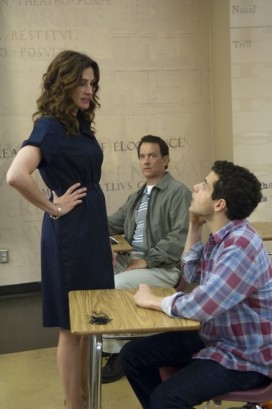
Teaching one of those classes—Speech 217—is Mercedes Tainot (
Julia Roberts), bored, tired, unmotivated, with a dead-beat author-husband (the wonderful Bryan Cranston), who, like Larry at the beginning of the film, doesn't know she's in the process of transitioning, so cynical is her world-view. Her students are an odd collection of rabbits, that she's just trying to keep awake and inspire the one thing she can't seem to muster up—giving a rip. And Crowne is the oddest rabbit in the bunch. She glowers, as she sees him slowly change under the influence of younger students—particularly women, and particularly one student who has it in mind to completely "make-over" Larry to his puzzlement and the vexation of her boyfriend.
This area of the movie has more than its share of "wah-wah" moments
, and as much fun as Roberts' slow-burn is (and she's great at it), they have the feel of sit-com situations that might be fun for the matinee crowd. It's there that the writing hand of Nia Vardalos, she of My Big Fat Greek Wedding, is the most evident. Hanks and his wife, Rita Wilson (who is also in this with a small, rather frightening part) were the ones who took Vardalos' one-woman show and shepherded the development of it into a Big Fat Success. The demographic for Larry Crowne skews a little bit to the same age, with the same toothless observational satire that never offends, even when it tries to be a little "naughty."  It's all for naught.


And yet. And yet...
Hanks and one of his co-studen...
WAIT A MINUTE! That's Rami Malik!
I had the opportunity once to tell a clerk who thought she was "too forward" approaching me in a store aisle: "Take it from an 'old guy:' never regret being delightful." That lesson applies here. Twenty-four hours after "grumping" my way through Larry Crowne, the saccharine had dissolved in my mind and the "good stuff" remained...Larry's unexpected, all-inclusive, concise and perfect final project in class that nicely ties a bow around the movie, a cast of great people getting to be charming (Cedric the Entertainer, Taraji P. Henson—she's a favorite of mine—Wilmer Valderrama—!!, George Takei—!!!, a little spitfire named Gugu Mbatha-Raw—late of "Dr. Who," MI-5, and "Undercovers"—that you just want to hug, and...almost too good to be true...the always-welcome, never-failing Pam Grier). The thing is...for as saccharine as the movie feels going down, it leaves a pretty good after-taste. One forgets just how much one might have suffered through it, and how unsufferable it can be, and is left remembering the good parts. Meaning that Larry Crowne is a similar experience to childbirth.
Not a ringing endorsement...but it could be worse.
But, 12 years later, I still remember how good that final class project was. One may gripe. One may be cynical. But, delightful lasts.

Thursday, April 26, 2018

Isle of Dogs (2018)

No Future on Trash Island
or
"Sheesh, Igor, I Think He Chewed Your Ear Off"

The Japanese city of Megasaki is in crisis. It is determined that the city is suffering from the effects of "canine saturation" and a resulting public health crisis from a dog-flu epidemic called "Snout Fever." To ward off the risk, Megasaki's mayor, Kobayashi (voiced by Konichi Nomura—it's animated, they're all "voiced")—hiding the centuries-long grudge his family has held against dogs—institutes a plan to banish all bowsers from the city to a small archipelago called "Trash Island." To show the populace his own good will and that he, himself, will suffer from the decision, the first dog to be sent into exile is "Spots" (Liev Schreiber—yes, the dogs talk, in English), the service animal of Kobayashi's orphaned nephew Atari (Koyu Rankin, who speaks in Japanese). "Spots" is left alone and abandoned on Trash Island, but he will not be alone for long.
Soon, every dog from Megasaki is on Trash Island and it's a dog-eat-dog existence. Well, actually, no...dogs haven't resorted to cannibalism, but there is a rumor that one group did...well, let's not get into this. 99% of the population does not resort to cannibalism, as Megasaki provides a steady steam of trash for the various packs to fight over. It is not a good life on Trash Island, but at least it is somewhat sustainable.
"Is this worth fighting over?" "Yes, it is"
Isle of Dogs concentrates on one particular loose-knit pack: King (voiced by Bob Balaban); Duke (voiced by Jeff Goldblum); Boss (voiced by Bill Murray), and Rex (voiced by Edward Norton); into their midst comes an outlier named Chief (voiced by Bryan Cranston), who is far more independent than the others, probably because of their backgrounds and history, and despite his more decisive demeanor, there is a certain reluctance to take his advice on anything...despite the other four's inability to plot a course of action.  Even in a dog-pack, there can be inherent prejudice.
King, Duke, Boss, and Rex....and...Chief.
Their differences can best be explained in these lines of dialogue making the demarcation known.

Rex: I used to sleep on a lamb's wool beanbag next to an electric space heater. That's my territory, I'm an "indoor" dog.
King: I starred in twenty-two consecutive Doggy Chow commercials. Look at me now, I couldn't land an audition.
Boss: I was the lead mascot for an undefeated high school baseball team. I lost all my spirit, I'm depressing.
Duke: I only ask for what I've always had, a balanced diet, regular grooming, and a general physical once a year.
Chief: You're talking like a bunch of housebroken... pets.
Rex: You don't understand. Uh, how could you, I mean you're a...
Chief: Go ahead say it. I'm a stray, yeah.
Yeah. He's a stray. Go ahead. Make something of it.
Things change for the pack with the arrival of a mini-airplane  that has a slight accident and crashes onto a Trash Island beach. The pilot is none other than Kobayashi's nephew, Atari, who has come in search of his lost dog, Spots. The pack (who do not speak Japanese—they speak English standing in for canine) bands together to find Atari's lost guard=dog and begin an odyssey of sorts on Trash Island to find the boy's ditched dog. The trek allows Atari to bond with Chief—they are, after all, both unattached strays—a relationship that benefits both parties.  
Isle of Dogs is the product of director-co-writer Wes Anderson, who basically did a full story-board breakdown for stop-motion animators to emulate—as he did in Fantastic Mr. Fox—has stated that the film is influenced by the films of Kurosawa and the Rankin/Bass television specials of the 1960's. Sure, it's very possible. But, an awful lot of Anderson's work can be seen to be based on the stop-motion animation work he saw as a kid. But, it's also unmistakably Anderson's style, with images that have a strict one-point perspective, a rather strict symmetry and camera movements leaning on the lateral (with the occasional direct zoom that makes sure not to move the center-point). Watching one of Anderson's stop-motion movies is like watching Stanley Kubrick make a "Lego" movie.
In between Fox and this film, Anderson made the live action The Grand Budapest Hotel, which pushed the 'feel' of the live-action film into a more animated sensibility, even employing a similar stop-motion sequence to illustrate the Hotel's vertiginous tram. He continues the strict one-point perspective that he has been increasingly been using throughout his career. You can also see a major up-tick in the design of the film, far above that displayed in Fox, creating vast spaces that extend to the horizon. You also see him employing a mixed-media approach, combining the live-action with animation (particularly in television transmissions that are featured).

It's a great leap in form for Anderson, who creates a fun little adventure story with an increased sophistication that's quite fun to see.

The "Fearful Symmetry" of Wes Anderson's Isle of Dogs