Showing posts with label Actor-Directed. Show all posts

Tuesday, August 1, 2023

The Greatest Game Ever Played

Written at the time of the film's release...

The Greatest Game Ever Played (Bill Paxton, 2005)
Mark Twain said it best, "Golf is a good walk spoiled."

Director Bill Paxton compounds the error.

Despite the inherent drama of Mark Frost's* account of the David versus Goliath 1913 U.S. Open, Paxton takes the advice to "keep-your-eye-on-the-ball" a bit too literally in order to punch up the movie's visual fireworks. Though Frost has fashioned a good story of contrasts, pitting a renowned British pro--the greatest golfer of his day--against an unseasoned American amateur, Paxton keeps threatening to derail it with fancy camera moves and divot-POV's. It becomes a bit of a crutch; rather than solving the perpetual "make it interesting" challenge of filming golf, the director fashions every power-stroke with a new "fly-away" special effects shot. Once or twice, sure, it is fun. And it's all well and good to try and enliven the proceedings of one of the slowest-moving sports, but the swooshing, spinning flight paths he employs on so many shots become wearying and take away from the human drama, which is where the strength of the story lays.
Fortunately, Paxton's cast couldn't be finer. Shia LaBoeuf's Francis Ouimet is a constant revelation of emotions--he has one of those faces that the camera loves; every thought in his head etches something across his chinless features. By contrast, Stephen Dillane's Harry Vardon is all-laser-beam-intensity, betraying nothing but an iron will. One of Paxton's best moves is a shot of Vardon in the gallery, watching Ouimet play.The faces in the crowd turn their heads following the result of a powerful wood shot, except for the British golfer fixated on the kid's moves. Dillane has been doing more and more impressive work lately...in The Hours, and as Thomas Jefferson in HBO's "John Adams." If Thames wants to stop playing revolving doors with their Sherlock Holmes series on shorts (Richard Roxburgh, Rupert Everett) they could do worse than trying out Dillane as The Great Detective.
Yeah, yeah "He looks so young." 
It's a great story--a heart-warming story, made more so by the fact that it's true.** There was no need to go as overboard as Paxton does. One of the first things you learn in golf is that you do better if you don't try so hard. 
 
Grace wins over power.

* Frost more famously co-created "Twin Peaks" with David Lynch, and also co-wrote the screenplay for "The Fantastic Four" proving that no matter how well you've played before you can still occasionally be below par.

*** It's true a lot--but not completely. AND HERE, THERE BE SPOILERS. Highlight no further.


--the final score was actually Ouimet - 72, Vardon-77, and Troy-78. It didn't come down to the wire as depicted in the film.

Friday, May 19, 2023

Short Cut To Hell

Short Cut To Hell
(James Cagney, 1957) No, I didn't make a mistake. This film was directed by James Cagney—the only one where he took on those duties—he'd previously only acted and produced—and only as a favor (along with some curiosity whether he could do it) to his producer-friend A.C. Lyles. It sources from the novel "A Gun for Sale" written by Graham Greene (and made into the Veronica Lake-Robert Preston film, This Gun for Hire, which had made a star out of Alan Ladd). At this point in his career, the only aspirations Cagney had were probably retirement to his farm, although he would not do so until 1962, following the completion of One, Two, Three for Billy Wilder.
 
Still, it's Cagney, with his rich history of acting in the Warner Brothers hey-day and for such directors as Hawks, Walsh, Wellman, and Ford. He had seen what worked in movies and what didn't, and he was pretty good at getting the most out of a script, and bending it if he had to. What tricks of the trade could that most adept and able of actors bring to the director's chair?
"Learn your lines ... plant your feet ... look the other actor in the eye ... say the words ... mean them."
Yvette Vickers planting her feet.
The first five minutes has no dialogue except for one line—"Let me GO, you skinny little runt!"—as the curious daughter (Yvette Vickers) of a land-lord conspires to enter the room of a mystery-man (Robert Ivers) with an idea to seduce, or, if it goes wrong, make trouble. But, when she harasses the guy's cat, he man-handles her out of the room, soothes the kitty, then gets ready for work. Hat, coat, gat, and take a towel. Then go out and gun down a functionary at the Oakland City Engineering Department—and just to be thorough his secretary—in cold blood. Seems the newly stiff is—or was—an inspector wanting to prosecute Imperial Contractors (known as "The Organization" in the parlance of the shady) for its faulty building practices which have lead to the collapse of a downtown building. The killer pockets his gun, lifts the appropriate files and leaves. It's the job, and he's good at it. What's the towel for? It makes a good make-shift silencer.
But, any job involves paper-work; he has to be paid...in cash. He meets the florid Imperial middle man, Bahrwell (
Jacques Aubuchon)—his substantial middle owing to his love for peppermint patties and the obsequiousness he displays may be due to a cushy life. At the meeting, the hired gun, Kyle Niles, accepts the money—conveniently in new 20's and 50's—and makes it clear to his verbose fellow-diner that if there are any issues, or any double-cross, he will handle the revenge work himself, gratis, starting with him.
But, what the hired gun doesn't know is the money didn't come from the bank as Bahrwell had claimed, but came from the Imperial payroll in a sham robbery already reported to the police. Once the serial numbers of the bills start showing up, they'll be able to trace it back to the City Hall Murderer, and it's not too soon before the police start nosing around his apartment. Knowing the cops will be staked out at the airport, he decides to take a train out of town to L.A.
Except for one complication—the cops are there, too. Not on a stake-out, but more informally, as the guy in charge of looking for Niles—Sgt. Stan Lowery (William Bishop) is seeing his steady girl, singer Glory Hamilton (Georgann Johnson) off to L.A. for her new gig at an only somewhat reputable club. After all, Bahrwell goes there as a regular. And it's only because of the lousy scheduling of the Oakland-L.A. line (perhaps) that Glory, Bahrwell, and a town-skipping Niles happen to be on the same train...in conveniently adjoining coaches, all the better for Bahrwell to see them and assume that the gun-man and Glory are in some sort of cahoots.
So, innocent Glory gets intertwined in the death-struggle between Bahrwell, Bahrwell's boss at Imperial (the untraceably named "AT"—played by
Richard Hale, who was Boo Radley's father in To Kill a Mockingbird: "the meanest man to ever take a breath of life"), and the bullet-headed assassin they hired together. It doesn't get pretty, with the film's screenwriter's and Cagney just suggesting the crueler aspects of all three men.
So...how is it? Anybody who knows me knows that I think the sun rises and sets on Cagney—that he was, if not the best, one of the best TWO screen actors to be captured on film. And I'd been wanting to see this a long time. And, so I can safely tell you...it's pretty lousy, almost amateurish. Blame it on the budget, sure. But, one has to be honest and say that Cagney is no auteur taking care of details. At one point, Bahrwell is reading a newspaper about the City Engineering killings in big bold headlines, but when he folds the paper, you can't help but notice that the rest of the paper is blank. That's the sort of detail you notice, even in the scruffy non-Vistavision-for-black-and-white-TV version that I saw. One suspects Cagney of toughening things up a bit, taking things right to the edge, but he never crosses the line to true sordidness.
And Cagney knew what to do with scripts, so how does he allow such thudding dialogue like "Not with your boy-friend chasing me; you're my insurance—my life insurance!" Or this exchange: "You're gentle." "Yeah, c'mon, let's go." And there's an admirable directness that just unfortunately crosses into camp when Kyle confronts the villainous AT: "I don't take orders, young man! I GIVE 'em!" BANG! Not even a sneering "My order is you fall down and die!"
And (okay) the greatest actor of the screen can't seem to inspire good performances out of his cast: Aubuchon is so obsequious he could be a cartoon, Bishop was meant to be the fourth lead in a serial, and Robert Ivers is such a mis-fire as Kyle that you wonder what inspired his casting—looking for an unknown who could be the next Alan Ladd by way of James Dean and Richard Widmark? Oh, he's good at the sarcasm, and he's a good mover/runner, if of the "flopping around" variety. But, the menace is all rather "weaselly" and of the "see? I'm tough" school, rather than "I'm so tough I don't have to play it" variety. You don't worry that he'll get shot; you worry he's going to catch a cold.
The only good performance is from Johnson, a utility player of just about every television show ever made and a main-stay of the soap "Somerset" (and others of their ilk—geez, she even played a Starfleet Admiral!). She sells her lines and her emotions with a committed earnestness that can best be described as "110%"—even if nobody else is giving her anything to work with—a slightly less-restrained version of Doris Day, with a touch less theatricality. She's plucky, even managing to make you believe this character would have the moxie she displays in the most unbelievable of circumstances. Cagney probably liked her a lot.
But, he didn't like the experience. Shortcut to Hell is the only movie Cagney ever directed, and his assessment of it was typically frank and has the ring of truth and honesty to them that he brought to his roles: "We shot it in twenty days, and that was long enough for me. I find directing a bore, I have no desire to tell other people their business."
 
I was enough for him to be good at his own job.

Wednesday, May 17, 2023

Larry Crowne

Written at the time of the film's release...although...I still remember parts of it that delighted me, despite my half-hearted review at the time.

T. Hanks for the Mediocrity
or
My Big Fat Career Mistake

I'm sure the intentions were better (aren't they always?), possibly saying something about the displacement of late baby-boomers in the job market, and how "it's never too late to learn" belying the "old dogs/new tricks" canard. Maybe co-writer/director/acting lead Tom Hanks just wanted to make something hopeful and sunny in bad economic times...a flare in the night-sky...the proverbial single candle rather than curse the darkness.

Well, it's more like a candle in the wind, and this blows. Formulaic, with an implied "wah-wah" comedy goose at the end of every scene, Larry Crowne has a "made-for-TV" movie feel that gets under your skin like intravenous sand-paper.  Larry (Hanks) is in his early fifties, divorced, a twenty-year Navy vet working at a box-store, where he's received "Employee of the Month" fetes nine times.  He's one of those guys who owns everything he does, taking a certain pride in all aspects of his job, even picking up and disposing the stray trash he finds in the parking lot. The implication is already there: while the rest of the world goes on its self-absorbed way, Larry "cares." And that can't come to any good.
Called in for what he thinks is his tenth EOTM award,
he is fired instead; corporate has crunched the numbers and sees him, as never having gone to college, as not being "advancement" material—he's already been passed over for promotions by duller, but degreed, employees. Adrift, Larry finds no work, and so goes to community college in his '50's, with similar outcasts (though dissimilar aspects) most younger, but without the team-player skills that Larry has acquired.

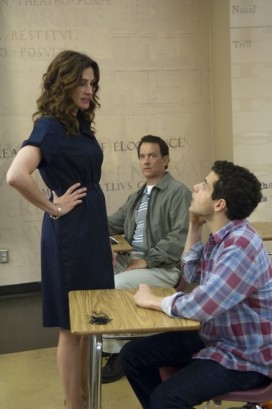
Teaching one of those classes—Speech 217—is Mercedes Tainot (
Julia Roberts), bored, tired, unmotivated, with a dead-beat author-husband (the wonderful Bryan Cranston), who, like Larry at the beginning of the film, doesn't know she's in the process of transitioning, so cynical is her world-view. Her students are an odd collection of rabbits, that she's just trying to keep awake and inspire the one thing she can't seem to muster up—giving a rip. And Crowne is the oddest rabbit in the bunch. She glowers, as she sees him slowly change under the influence of younger students—particularly women, and particularly one student who has it in mind to completely "make-over" Larry to his puzzlement and the vexation of her boyfriend.
This area of the movie has more than its share of "wah-wah" moments
, and as much fun as Roberts' slow-burn is (and she's great at it), they have the feel of sit-com situations that might be fun for the matinee crowd. It's there that the writing hand of Nia Vardalos, she of My Big Fat Greek Wedding, is the most evident. Hanks and his wife, Rita Wilson (who is also in this with a small, rather frightening part) were the ones who took Vardalos' one-woman show and shepherded the development of it into a Big Fat Success. The demographic for Larry Crowne skews a little bit to the same age, with the same toothless observational satire that never offends, even when it tries to be a little "naughty."  It's all for naught.


And yet. And yet...
Hanks and one of his co-studen...
WAIT A MINUTE! That's Rami Malik!
I had the opportunity once to tell a clerk who thought she was "too forward" approaching me in a store aisle: "Take it from an 'old guy:' never regret being delightful." That lesson applies here. Twenty-four hours after "grumping" my way through Larry Crowne, the saccharine had dissolved in my mind and the "good stuff" remained...Larry's unexpected, all-inclusive, concise and perfect final project in class that nicely ties a bow around the movie, a cast of great people getting to be charming (Cedric the Entertainer, Taraji P. Henson—she's a favorite of mine—Wilmer Valderrama—!!, George Takei!!!, a little spitfire named Gugu Mbatha-Raw—late of "Dr. Who," MI-5, and "Undercovers"—that you just want to hug, and...almost too good to be true...the always-welcome, never-failing Pam Grier). The thing is...for as saccharine as the movie feels going down, it leaves a pretty good after-taste. One forgets just how much one might have suffered through it, and how unsufferable it can be, and is left remembering the good parts. Meaning that Larry Crowne is a similar experience to childbirth.
Not a ringing endorsement...but it could be worse.
But, 12 years later, I still remember how good that final class project was. One may gripe. One may be cynical. But, delightful lasts.

Saturday, July 3, 2021

Dick Tracy (1990)

Saturday is traditionally "Take Out the Trash" Day...

Dick Tracy (Warren Beatty, 1990) Chester Gould's gangster comic strip, "Dick Tracy," started October 4, 1931 and, because it was so popular, it migrated to radio, movie serials, and even a short-lived television series. Gould's style was flamboyant, violent—bullets passed through bad-guy's bodies—and more than a little serio-comic (the villains had names that matched their physiques, so "Flat-Top" actually had a flat-head, and such). Gould made no mistake whose side Tracy was on, as his jaw was so square, you could slice sandwich meat on it, and sometimes ventured into the techno-exotic with Tracy's "two-way wrist radio" beating the I-watch by some 50 years. About the time I started reading it, Tracy and family was traveling to the moon on a magnetic Space Coupe and Tracy's son fell in love with the daughter of the Moon's Supreme Leader!

So much for the grit of a crime strip.
Tracy was popular, and after the successes of recycled comics on movies and Broadway, movie people started to buy up marketable properties. "Dick Tracy" was picked up in the 1980's for the inevitable film adaptation, and went through "development hell" through the hands of many creatives and studios, starting with United Artists, then a co-production between Universal and Paramount, and stars like Clint Eastwood, Harrison Ford, Mel Gibson, Richard Gere and Tom Selleck (the usual suspects in the 80's) were sought out to star as Tracy. And Warren Beatty.
Beatty'd wanted to make a Tracy movie since 1975, when the rights weren't available, and watched from the wings as the film went through script development, director changes, and studio involvement, then purchased the rights in 1985, taking the film to Disney, and directing the film himself when the studio's Jeffrey Katzenberg couldn't interest any other director to take the reins. Beatty had already left the project once when director Walter Hill wanted to make the film more realistic and violent. Beatty had another idea, making a stylized homage to the old-style strip with a limited (just seven, with no gradients), but eye-popping color pallet, supervised by production designer Richard Sylbert.
With Beatty onboard, casting came easily...almost too easily. Glenne Headly played girlfriend Tess Trueheart, Charlie Corsmo played an orphan whom Tracy will eventually adapt, Seymour Cassel as co-hort Sam Catchem, James Keane as Pat Patton, and Charles Durning as Chief Brandon. But, as he did with Reds, Beatty started to hire pals to fill up the film and take on smaller characters, particularly the villains, who—unlike the leads—would be encased in prosthetic make-up (designed by John Caglione and Doug Drexler) to resemble Gould's group of bad-guy uglies.
Entombed in polyurethane are Al Pacino (as main villain "Big Boy" Caprice), James Caan (as a "Godfather"-type), Dustin Hoffman, Paul Sorvino, R.G. Armstrong, Henry Silva, William Forsythe, Ed O'Ross and other character actors who get the make-up, while Kathy Bates, Dick Van Dyke, Alan Garfield, John Schuck, Hamilton Camp, Catherine O'Hara, Estelle Parsons, and Henry Jones get minute screen-time, just enough for recognition.
And then, there's Madonna. The pop-star's role as a "bad-girl" femme fatale was, no doubt, beefed up when "The Material Girl" was cast, and of all the cast-members she seems to get the most screen-time besides Beatty, effectively crowding out the "Tess Trueheart" storyline for vamping in the tried and true Mae West manner. To be sure, she gives the movie a lot of cross-promotional material, releasing an album in support, and doing her best with the Stephen Sondheim songs Beatty acquired for the film. But, the role is slight in importance and its prominence merely there to put posteriors in theater-seats. So, she was indulged.
Which seems to be the over-arching—emphasis on the "arch"—theme of the film. Studio-bound and slightly inert, that limited pallet (which only distracts rather than serves a purpose) makes the enterprise look cheaper than it should, and, overall, Beatty's Tracy is an over-indulgent mess, flabby with excess, and uneven in pace, when the model of the thing should have been the tight, break-away austerity of film-noir. The thing went so far over-budget and the results still look dodgy and stagey. In fact, the film reminds of something that achieved the same results with greater success but hemmed in with a bargain basement budget in the 1960's.
And that was the "Batman" TV-show. It, too, had stars as villains, with a lot of make-up and a lot of scenery-chewing, the comic aspect of the characters were played up, the fights were unbelievably choreographed and tongues were placed firmly in cheeks. However, the "Batman" TV series had a "camp" sensibility, deliberately over-staging the drama and acting styles to achieve comic effect. It knew it was over-the-top and aimed high to achieve it. It knew it was deliberately jumping the shark (before "jumping the shark" was a "thing") Dick Tracy has very little of that intentionally self-deprecating humor, and plods along like it knows it's funny...even when it isn't. And although Adam West's deliberately haughty Batman persona wouldn't play for Tracy, give West his due in finding a way to effectively tight-rope the material; Beatty plays the character fairly straight...which is a bit dull. Pacino knows that he's going for comedy, but he doesn't have the timing or comic discipline to make it work. Sure, he gives it the energy (he always does), but that doesn't make it funny.

My memory of Dick Tracy was that it was elephantine in the way the film version of Annie was, but with none of the charm, or the ability to project something genuine without hedging its bets, lest it be thought unhip. Everything is encased in artifice, even in its rooting for "the good guys" with their sense of right and wrong. If they can't even do that with a straight face, then they just don't know Dick

Saturday, June 12, 2021

Gangster Story

Saturday is traditionally "Take Out the Trash" Day....

Gangster Story (Walter Matthau, 1959) An odd one, this.  And not a very good one, but still an oddity. A capital "B" B-movie, directed by Walter Matthau, and the only movie he ever directed (someday I want to see the one Cagney directed, too), done very early in his career. At the time, Matthau was a stage actor, but since 1950 he'd been doing small parts in TV series, and didn't make his first film until 1955's The Kentuckian (starring Burt Lancaster and, as we're on a theme here, directed by him, as well) and would start becoming a fixture in films with Elia Kazan's A Face in the Crowd.   

It's not known whether it was done on a dare, or out of desperation. The script wasn't much, but Matthau took the job, starring in and directing, because he had gambling debts. His co-star was his wife, Carol Grace, and instead of New York, it was filmed in sunny Los Angeles, mostly during the day, unusual for a supposed film-noir, and where the most shadows are seen in, of all places, a library.

Matthau is fine, his performance, at least, is professional, but loose and schlumpy, and plays well, even in scenes that are patently absurd...like the one where his con character Jack Martin stages a bank-vault robbery by posing as a movie director rehearsing a scene—distracting the guards to "stay in character" and convincing the bank president to open the vault. (Really? It's that easy? Everyone is that dumb and star-struck, not even asking for a filming permit and with no cameras, no crew, nothing?), while most of the other performers range from merely amateurish to a painfully charitable "at least they remembered their lines." 
Wouldn't have mattered if they didn't. The entire movie is post-dubbed, the dialogue replaced in the studio after the fact—whether because they had no sound recordist during filming (it was a five-man crew...and edited by future porn director Radley Metzger) or background sounds are so pervasive. It does create a rather unnerving sequence, late in the movie (when nobody was paying attention?) where dialogue is punctuated a few times by the sound of the timing "beep" that alerts the actor when to talk—no one bothered to take them out...it wasn't in the critical first or last reels, and maybe it was just overlooked. 
Professionalism aside, what this movie most resembles is the 1973 film Matthau made with director Don Siegel, Charley Varrick, about "the last of the independents" (criminal division). Both Martin and Varrick are bank-robbers, who get caught up in a situation they're not accustomed to: not only avoiding the police, but also the organized crime lord attached to the last institution Matthau's perp robbed. Both involve a good amount of time on the lam and hiding out, although Martin capitulates and, to settle differences, joins the organized bad guys to save his neck. The quirky, nastily-funny Siegel film is full of invention and colorful characters; everything about Gangster Story is pure black-and-white, and is really worth watching only for the curiosity factor. Matthau moved on, and when this vampire of a movie rose from the dead in conversation he'd crack wise in interviews saying the film "premiered at Loew's in Newark and never crossed the Hudson." He never was tempted to direct again.