Showing posts with label Al Pacino. Show all posts

Saturday, July 13, 2024

Righteous Kill

Saturday is traditionally "Take Out the Trash" Day...

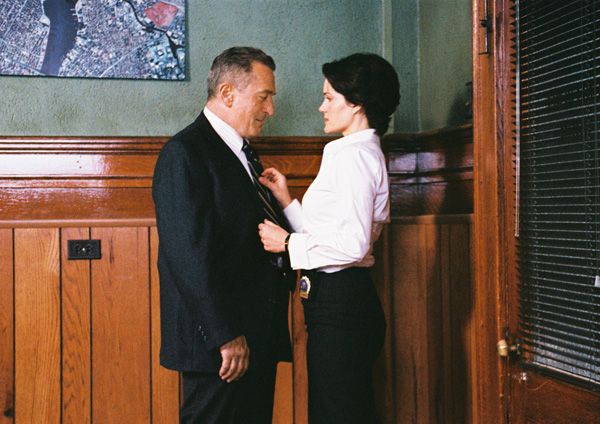
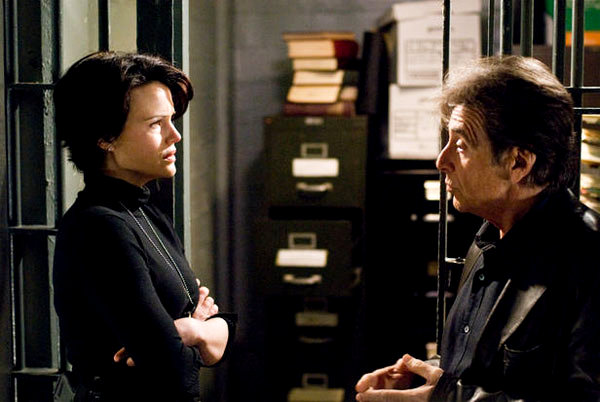
Righteous Kill (Jon Avnet, 2008) Someone is killing "Scott Free's"—those scum-bags that you just know are guilty but have some smooth-talking fancy-pants lawyer or some milque-toast judge who lets 'em walk, sneering, to prey on Society again...until they show up with a bullet-hole in the middle of their forehead. Two buddy cops, Turk (Robert De Niro) and Rooster (Al Pacino) start to add things up when one of the perps they arrested shows up deader than a Keanu Reeves performance. Looks like it's murder "and somebody's responsible." A vigilante? Certainly. But, if its revenge they're after, why are so many of these guys showing up dead? It's then that they think that the killer may be a cop.

But who?

Complicating matters is that most of the cops, including De Niro, Pacino, plus Carla Gugino, John Leguizamo, plus Donnie Wahlberg-o are creeps, so it could be any of 'em, except for the Captain of the squad (Brian Dennehy) but only because you couldn't believe Dennehy could sneak up on anybody but a bed-ridden quadriplegic.

So the question is: which of the crazy actors is playing the crazy character killing all these people?
The answer:
who cares? With a movie this terrible, and victims painted so sneeringly evil they're cartoons it's hard to work up much sympathy or even interest in finding their killer.
That's the problem of the writer. But director Avnet is so ham-fisted, he can't seem to hold a shot or light a set without sabotaging the drama of a scene. He's so busy "nuancing" things that you have trouble following the plot. He's not even talented enough to get out of the way of De Niro and Pacino (or, God forbid, rein them in) to make a scene play.
And, let's face it, having
those two legends on the screen should be a treat: they didn't work together in The Godfather: Part II (obviously), but their scenes in Michael Mann's Heat were tantalizingly short. Here, they're in almost every scene together (although Avnet can't seem to find the wherewithal to keep them in the same shot), and you realize they're like oil and water, or Mumbles and Loudmouth—they're two actors who've known each other for years, but their characters don't seem to. Or else the movie would be over in five minutes. But no, the suspicions and subsequent doubts must be fully explored, the red herrings must stink up the joint, and the script-writer must throw in a couple of feints that make no sense once the movie is over—they're there just to con the audience.*
What a waste. The big mystery is given this script, how could it attract two of the most iconic, respected and (when paired) legendary actors? Sounds like the biggest con was going on behind the scenes. Righteous Kill is the last thing you would expect a film starring De Niro and Pacino would be—a very pedestrian run-of-the-mill movie.

2024 Update: The story goes that at the premiere of this film, De Niro approached Pacino and said that they should never do another movie like this again, that they should find properties they could be proud of appearing in together.
 
As a result, the two actors didn't appear in another film until Martin Scorsese's The Irishman (I Hear You Paint Houses).

* Now, movies are by nature, the manipulation of reality—and the audience—to tell a story.  But, there's doing it well, and there's doing it the Righteous Kill way. 

Wednesday, April 24, 2024

Stand-Up Guys

There are so many movies with actors "of a certain age" being disrespectful that it's almost its own sub-genre.  Here's one from 2013, and this was written at the time of the film's release...

"We're Still Here!"
or 
"...End of Story" 

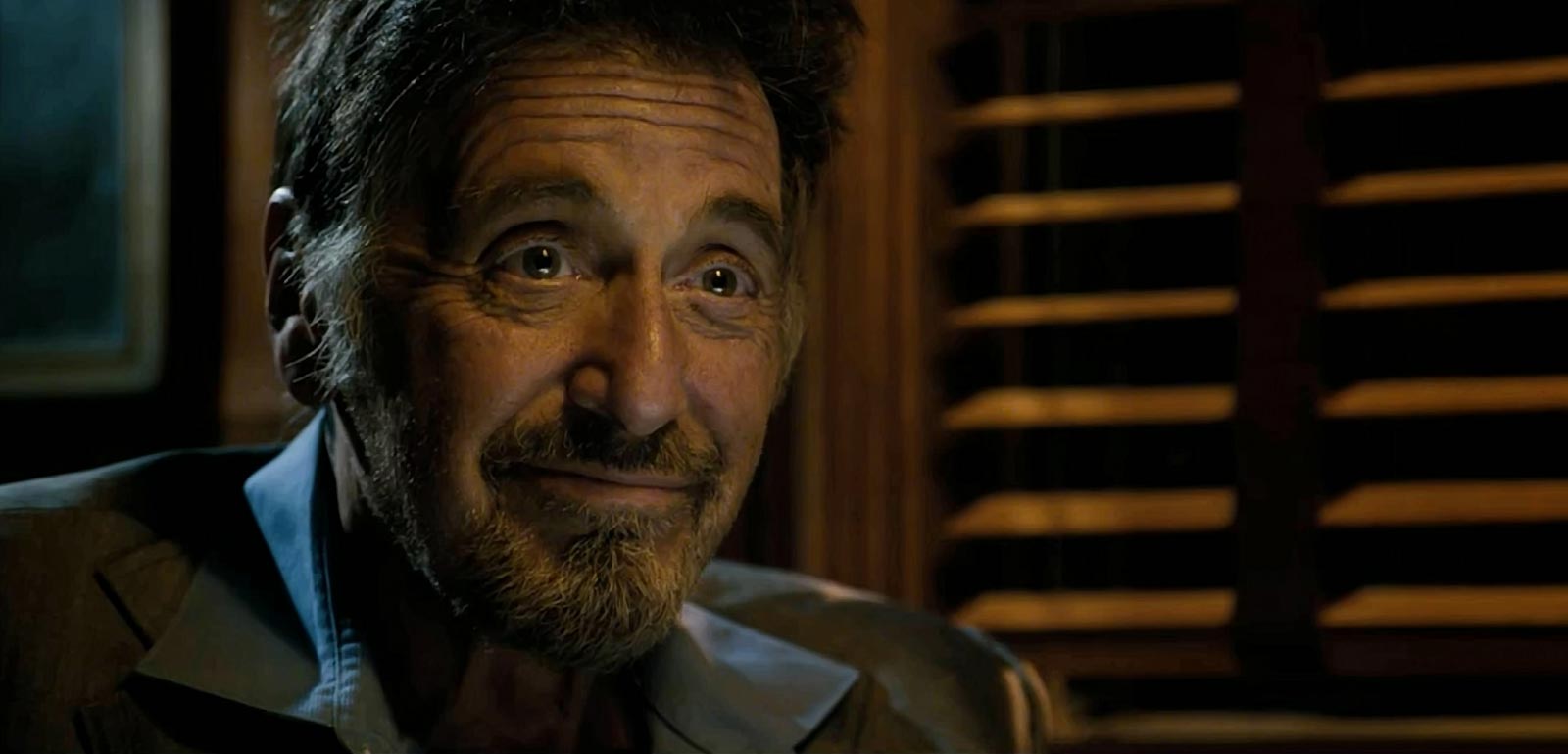
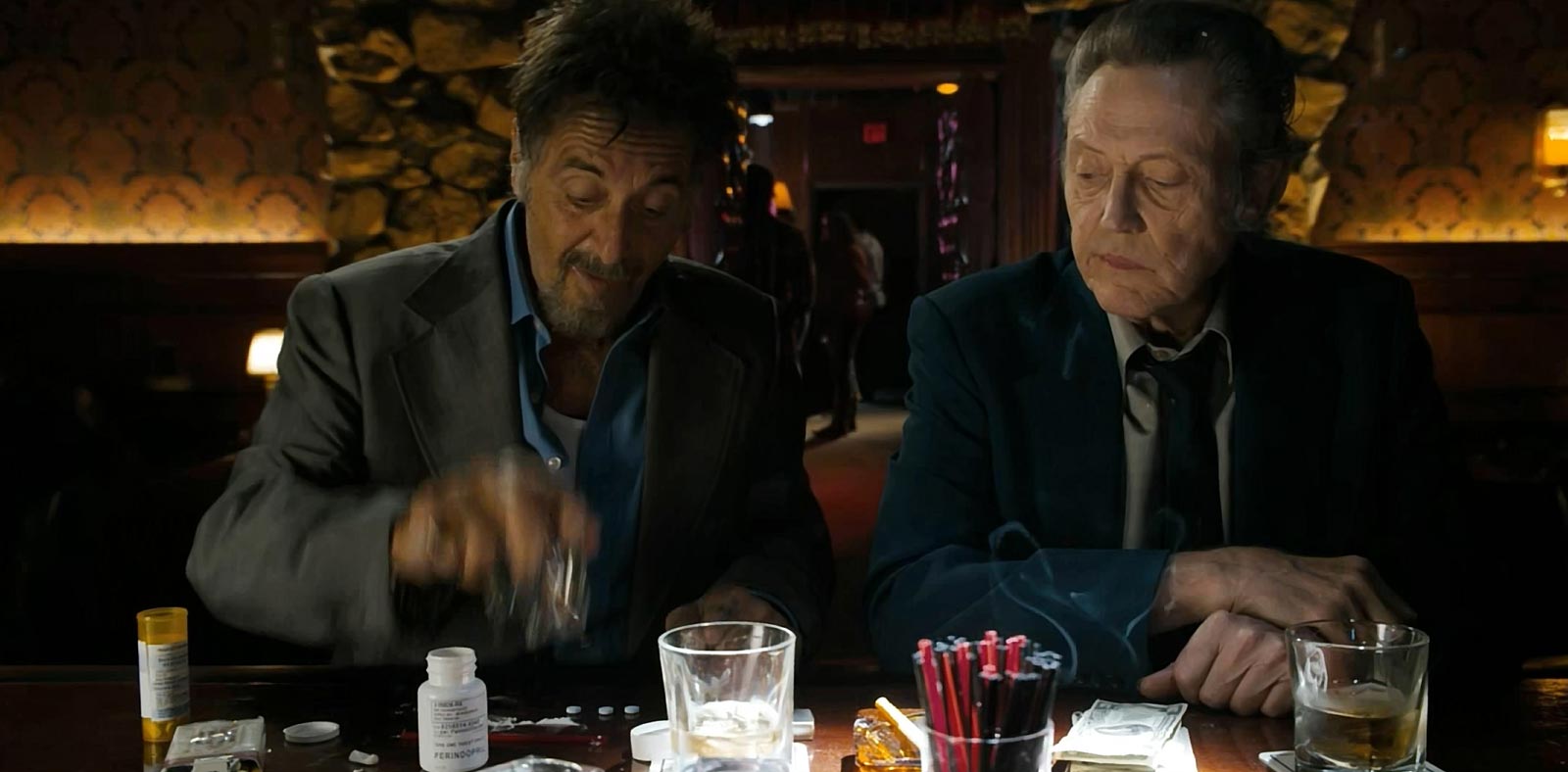
Oh, man, it's painful, the first few minutes of Stand Up Guys, the new gangster-with-gags film directed by Fisher Stevens. Valentine (Al Pacino) is being released from prison after 28 years, for his part in a robbery that turned deadly. On the outside, waiting for him, is Doc (Christopher Walken), who was also part of that robbery but managed to stay out of the gray-bar hotel for reasons unknown and is now "retired," spending his free time being a diner habitué and painting landscapes.

Doc takes Val home to his apartment, which the ex-con compares unfavorably to the accouterments he has recently vacated. At this point in the movie, Val announces that he wants "to party," at which point I resisted an urge to get up and get popcorn. It wasn't going to be pretty, whichever way it was played, comedy, bathos, or weirdness. The obligatory visit to a whorehouse is somewhat lightened by Lucy Punch (a Brit actress playing a longish Island accent) as the daughter of the madam these guys used to know in their and her prime.
Things don't go well (nyuk, nyuk) so Doc and Val rob a drug store (very easily)—Val gets little blue pills and proceeds to take too many of them, and Doc has some expensive prescriptions he needs to supplement—complications arise, so to speak, which requires a trip to the hospital, where Julianna Margulies provides an "E.R." flashback and informs the two about her father, their former getaway driver, who's stuck in a nursing home.
Alan Arkin
plays that character, and it's at that point that the movie picks up with a couple quick chase sequences and a needed pivot point for the Pacino-Walken dynamic. The movie gets better with Arkin's presence, even though one can't say it improves. But Arkin's added energy manages to lift the movie over the speed-bumps that the script-cliché's drop in the path. Where Pacino is manic and Walken is passive, Arkin manages to bridge the gap (and their vocal pauses) with a complacent nervousness that bounces off both actors entertainingly.

It's unfortunate watching, really. To see these gold-standard actors (all Academy Award winners, not that that really matters) reduced to mining what they can out of a vein of tin is disheartening, no matter what smiles they can produce out of it. Something could have been done, recent examples of the story-form being
In Bruges and Going in Style.
* But just the casting of these young-now-aging turks can't make this one any more than it is, a faded half-hearted comedy about aging gangsters that might have been enough to re-team Jack Lemmon and Walter Matthau back in the day.
This is a minor, minor, minor film with major talent in it that eventually makes the most of the material, but can't elevate it into something worthwhile or even makes a statement.
And, frankly, I'm getting too old for movies like this.

* Martin Brest's 1979 comedy-drama about over-the-hill retired thieves trying to supplement their meager Social Security—Pacino surely knew about it, as it starred his mentor, Lee Strasberg.

Thursday, March 21, 2024

Knox Goes Away

Schrödinger's Murderer
or
"Did You Bury This Guy?" "No. Why?" "'Cause If You Had, I'd've Dug Him Up and Killed Him Again."

Knox Goes Away is a lot better than people say it is.

Michael Keaton's second directed film—his first was the little seen The Merry Gentleman—is another pulpy film noir about a hit-man. The first (which Keaton basically took over when the original director was incapacitated) was more of a character study, contrasting its hired killer becoming something of a guardian angel to a woman in need of protection. But, as opposed to the first, this time director Keaton's fully committed and this one is more of a puzzle film, with Keaton's contract killer, John Knox, having to solve two problems simultaneously, both as them as personal as could be. 

It's not territory Knox is familiar with, as he's as cold as they come, not even wanting to know about the individuals he's hired to kill. He doesn't need a reason, as much as his partner Tom Muncie (Ray McKinnon), tries to justify the murders they've been hired to commit ("because in ten minutes, Tommy, he's not gonna be anybody"). He just does the job, cleans up the scene to avoid suspicion, then goes away. He's a bit of a ghost. The record has him ex-Army ("Deep Reconnaissance Officer") and he did a stretch for tax evasion (of all things) but, given his trade, it could have been a lot worse.
But, Knox is smart. He's extremely well-read—someone says he has 10,000 books in his house—majored in English Lit and History and he has the nickname of "Aristotle" that he got in the Army for always having a book in his hand. And he survives by his wits. His assets are all neatly tucked away, and he has few strings attached—he had a wife and kid, but they've been out of the picture since prison—except for co-workers, like Muncie, and "acquaintances" in the business. There's a hooker (
Joanna Kulig), who shows up like clockwork every week (Knox lends her books).
He survives by his wits. But, his first problem is they're starting to fail him. A visit to a neurologist and an E-ticket through an MRI gives him good news and bad news—he doesn't have Alzheimer's (as he feared), he has CJD—Creutzfeldt-Jakob Disease—which is worse. Statistically, 70% of people die within a year of diagnosis, but Knox has weeks, not months. The forgetfulness will increase, there'll be hallucinations, coordination issues, vision problems...then dementia, palsy, coma, then his brain will just stop making him breathe...The Big Erasure. "I'm sorry," the neurologist says lamely. "S'okay, Doc" says Knox. "Even if I hated you for telling me, I'd forget soon enough."
Knox keeps it quiet. He tells Muncie their upcoming job will be his last one—that he's "going away" (truer words...)— and then he'll start "putting his affairs in order" as the doctor recommended. But, that last job of his goes bad, he screws it up when he has "an episode", proving that he's not too good at this "death" business when it happens to take the lead. He makes due with the clean-up, for all the good it'll do, but it's botched and there's nothing he can do about it. The cops are gonna see through the inconsistencies and start looking around. He's losing it and he knows it. Now, he has to work fast.
Then, the other problem happens and it's one he can't ignore, as taxing as it is on his dwindling resources. In a way, it's a similar but more complicated scenario than the issues he had to just make-do with on the botch-job. But he has to get this one right. He cannot fail at this because it'll screw up everything else that he's planned in "putting his affairs in order." But, his disease will make the likelihood of screwing up that much more likely...and he has to be precise. He has to get it right.
So, he goes to an old contact in "the business," Xavier Crane (
Al Pacino, doing some of the most subtle work he's done in ages). Crane is retired (although he keeps reminding Knox "you know I'm a thief"), but Knox asks him a big solid: look at his plans, check them, make sure they're right...and, if they are, check in with Knox...daily...to make sure things are going on schedule and monitor Knox's condition. Crane becomes caretaker to Knox and his plan...and it's one the old pro doesn't take lightly.
I'm not saying anything about what Knox has to deal with—for one thing, it's really spoilery, and for another, it's a bit problematic—it's a little too convenient that it happens just at that time (one keeps expecting a twist that says the whole thing's a set-up but it doesn't), but one could, if being generous, explain it away using the "life's what happens when you're busy making other plans" trope. But, everything is so inextricably linked that it's actually far more resonant than if all Knox had to do was liquefy his assets and make sure that everything is "clean."
What Knox does in the ensuing couple of weeks will only reinforce one's confusion about his condition—what is he doing? Why is he doing that? Is he losing it? Truth be told, he is, but he's working on a scheme he came up with years ago...with an awful lot of last-minute improvisation. But, he's gotta do it without screwing up.
Meanwhile, on a parallel track, the cops—in the form of Detective Emily Ikari (Suzy Nakamura, who's so good) and her partner, Rale (John Hoogenakker)—are looking at how Knox "cleaned up" that last hit and it just isn't adding up as what Knox wanted it to look like. And they're starting to circle around Knox as the forensics start to come in, confirming their theories. It's just a matter of time, something Knox doesn't have.
Like I said, this one is better than people say it is. I don't know what the issue is—maybe it's too complicated for today's entertainment "journalists" or maybe a lot of the stuff just goes over people's heads, but it's a lovely exercise in how one deals with a "post-'Dateline'" world of micro-forensics, DNA research, cell-phones, and a security camera on every street corner. It's intricate without broad strokes and there are a lot of sly subtleties in the script, direction and acting.
Keaton's great in this, certainly as an actor, but—as he showed in setting up shots on The Merry Gentleman—he has a good eye for story-telling camera placements of a certain moody edge...without the burden of the "attention-getting" tricks that early directors fall prey to. I did have some issues with how he portrayed Knox's condition—it didn't seem like Alzheimer's to me—but then reading up on CJD with its dementia AND hallucinations, I could see what Keaton was going for. Marcia Gay Harden's in this and she's terrific as Knox's ex, James Marsden might be a tad too mercurial in his part (but he's supposed to be a hot-head) and Pacino plays his wizened mentor role with the former quiet intensity of his past. It's good to have that back.
I like it for its intricacies, its resonances, and the fatalism that should run through any good film-noir. And it is a film-noir, despite the sunshine and the surprising humor that runs through it (Nakamura's delivery, for example, is as dry as a bone). I'm thinking of one particular shot of Detective Ikari near the end that in contrast to the rest of the story shows what an uncaring Universe we inhabit, no matter our intentions and competence. That shot didn't need to be there, but Keaton kept it in, and it's heart-breaking given the rest of the film. That's noir, and this little film, slipping under the radar, manages to revive the form, staying true to its inherent world of cynicism, but seeming so triumphant.

Thursday, December 9, 2021

House of Gucci

The Handbag Company That Didn't Know a Thing About Baggage
or
"Father, Son, and House of Gucci" (The Sign of the Double-Cross)
 
The family Gucci are not happy with Ridley Scott's House of Gucci, and for once I have something in common with them. Scott's second film released this year is the lesser of the two—the other being The Last Duel—but both films deal with people obsessed with legacy and imagine themselves more important than they are and taking things to such an extreme that one can see the results and consider that hubris could be considered a cause of death.

"Inspired by a true story" (which means that there are more factual liberties taken than one "based on a true story" in some sort of cinematic legalese), it tells of Patrizia Reggiani (played bodaciously by Lady Gaga, who should, at least, get some sort of award for most extreme hip-swing), who rose from being a book-keeper at her step-father's trucking business to the wife of Maurizio Gucci (played—rather tentatively—by Adam Driver), prodding him from being a law student with no desire to be part of the family business to becoming the majority stock-holder of the company.
Maurizio ended up running Gucci, despite his initial reticence, and then began living the "Gucci lifestyle" of spending money recklessly and running the business into the ground, as well as having affairs that would occupy his time and his budget. Finally, he asked Patrizia for a divorce, and she hired, through a psychic advisor of hers, to have Maurizio murdered in front of the Gucci building. She, the psychic and the hit-men were all convicted and sent to prison. End of story.
So, it must be embarrassing for the family that House of Gucci is less about them than it is about Patrizia, less about the glorious history of Gucci selling high-priced shoes and accessories to a easily-impressed world, than it is about a non-Gucci and the way that she so easily manipulated and up-ended the House of Gucci-branded cards. Well, live by public gullibility, die by public gullibility—the attention is directed from over-priced flotsam to scandal and once things like murder and tax evasion are put in court documents it becomes part of the public record and not so easily manipulated in-house. No wonder they're pissed.
Not that Scott and his writers have done such a miraculous work of art. Scott keeps things moving along with much less fluff in the air this time (perhaps indicating that this whole world is a bit unnatural?) and the luxurious furnishings and art knock-offs adorning the spaces are in fine crystal-clear display. It is cast with a buzz-inducing corral of actors in the secondary roles that created so much anticipation for this one that it couldn't possibly live up to expectations (live by the press release, die by the press release) and it simply does not.
They have their moments—Jeremy Irons as Maurizio's estranged father Rodolfo (living in his film-career past), Al Pacino as Uncle Aldo (in a sort of nightmare-version of what Godfather III could have been like) and Jared Leto as cousin Paolo (portrayed as something of a dim-wit, but in that weird Leto-land situated somewhere between comedy and tragedy). Irons, at least, plays things fairly straight, giving Rodolfo a diseased dignity even in his knowledge that his best days are past while he ruefully wallows in them—the best scene of the film is his "meeting" with Leto's Aldo trying to gain acceptance for his fashion sense where he charitably considers all his ideas and politely savages them. But, Pacino's avuncular Aldo has the same DNA as Eli Wallach's Don Altobello in GIII—smiling, but with a knife up his sleeve, a slow trickster, not altogether good at what he does. He has two explosive moments—both in involving Leto—but for the most part the three big supporting actors are in another movie where they're starring.
But, it's La Gaga's movie. Pratizia Reggiani is the only character in the piece who is seriously ambitious (without being deluded), while everyone else is either lethargically complacent or spineless. Like Gaga herself, the part calls for someone with ambitious goals and a ruthless way of achieving them and she tears into the role with a fierceness that is almost animalistic.
It would be ironic if Scott found his project becoming known as being "that Lady Gaga movie" and having it wrested from his hands in the same way the Gucci's saw their work being taken from them. "Inspired by a True Story," indeed.

Saturday, July 3, 2021

Dick Tracy (1990)

Saturday is traditionally "Take Out the Trash" Day...

Dick Tracy (Warren Beatty, 1990) Chester Gould's gangster comic strip, "Dick Tracy," started October 4, 1931 and, because it was so popular, it migrated to radio, movie serials, and even a short-lived television series. Gould's style was flamboyant, violent—bullets passed through bad-guy's bodies—and more than a little serio-comic (the villains had names that matched their physiques, so "Flat-Top" actually had a flat-head, and such). Gould made no mistake whose side Tracy was on, as his jaw was so square, you could slice sandwich meat on it, and sometimes ventured into the techno-exotic with Tracy's "two-way wrist radio" beating the I-watch by some 50 years. About the time I started reading it, Tracy and family was traveling to the moon on a magnetic Space Coupe and Tracy's son fell in love with the daughter of the Moon's Supreme Leader!

So much for the grit of a crime strip.
Tracy was popular, and after the successes of recycled comics on movies and Broadway, movie people started to buy up marketable properties. "Dick Tracy" was picked up in the 1980's for the inevitable film adaptation, and went through "development hell" through the hands of many creatives and studios, starting with United Artists, then a co-production between Universal and Paramount, and stars like Clint Eastwood, Harrison Ford, Mel Gibson, Richard Gere and Tom Selleck (the usual suspects in the 80's) were sought out to star as Tracy. And Warren Beatty.
Beatty'd wanted to make a Tracy movie since 1975, when the rights weren't available, and watched from the wings as the film went through script development, director changes, and studio involvement, then purchased the rights in 1985, taking the film to Disney, and directing the film himself when the studio's Jeffrey Katzenberg couldn't interest any other director to take the reins. Beatty had already left the project once when director Walter Hill wanted to make the film more realistic and violent. Beatty had another idea, making a stylized homage to the old-style strip with a limited (just seven, with no gradients), but eye-popping color pallet, supervised by production designer Richard Sylbert.
With Beatty onboard, casting came easily...almost too easily. Glenne Headly played girlfriend Tess Trueheart, Charlie Corsmo played an orphan whom Tracy will eventually adapt, Seymour Cassel as co-hort Sam Catchem, James Keane as Pat Patton, and Charles Durning as Chief Brandon. But, as he did with Reds, Beatty started to hire pals to fill up the film and take on smaller characters, particularly the villains, who—unlike the leads—would be encased in prosthetic make-up (designed by John Caglione and Doug Drexler) to resemble Gould's group of bad-guy uglies.
Entombed in polyurethane are Al Pacino (as main villain "Big Boy" Caprice), James Caan (as a "Godfather"-type), Dustin Hoffman, Paul Sorvino, R.G. Armstrong, Henry Silva, William Forsythe, Ed O'Ross and other character actors who get the make-up, while Kathy Bates, Dick Van Dyke, Alan Garfield, John Schuck, Hamilton Camp, Catherine O'Hara, Estelle Parsons, and Henry Jones get minute screen-time, just enough for recognition.
And then, there's Madonna. The pop-star's role as a "bad-girl" femme fatale was, no doubt, beefed up when "The Material Girl" was cast, and of all the cast-members she seems to get the most screen-time besides Beatty, effectively crowding out the "Tess Trueheart" storyline for vamping in the tried and true Mae West manner. To be sure, she gives the movie a lot of cross-promotional material, releasing an album in support, and doing her best with the Stephen Sondheim songs Beatty acquired for the film. But, the role is slight in importance and its prominence merely there to put posteriors in theater-seats. So, she was indulged.
Which seems to be the over-arching—emphasis on the "arch"—theme of the film. Studio-bound and slightly inert, that limited pallet (which only distracts rather than serves a purpose) makes the enterprise look cheaper than it should, and, overall, Beatty's Tracy is an over-indulgent mess, flabby with excess, and uneven in pace, when the model of the thing should have been the tight, break-away austerity of film-noir. The thing went so far over-budget and the results still look dodgy and stagey. In fact, the film reminds of something that achieved the same results with greater success but hemmed in with a bargain basement budget in the 1960's.
And that was the "Batman" TV-show. It, too, had stars as villains, with a lot of make-up and a lot of scenery-chewing, the comic aspect of the characters were played up, the fights were unbelievably choreographed and tongues were placed firmly in cheeks. However, the "Batman" TV series had a "camp" sensibility, deliberately over-staging the drama and acting styles to achieve comic effect. It knew it was over-the-top and aimed high to achieve it. It knew it was deliberately jumping the shark (before "jumping the shark" was a "thing") Dick Tracy has very little of that intentionally self-deprecating humor, and plods along like it knows it's funny...even when it isn't. And although Adam West's deliberately haughty Batman persona wouldn't play for Tracy, give West his due in finding a way to effectively tight-rope the material; Beatty plays the character fairly straight...which is a bit dull. Pacino knows that he's going for comedy, but he doesn't have the timing or comic discipline to make it work. Sure, he gives it the energy (he always does), but that doesn't make it funny.

My memory of Dick Tracy was that it was elephantine in the way the film version of Annie was, but with none of the charm, or the ability to project something genuine without hedging its bets, lest it be thought unhip. Everything is encased in artifice, even in its rooting for "the good guys" with their sense of right and wrong. If they can't even do that with a straight face, then they just don't know Dick. 

Tuesday, May 11, 2021

Ocean's Thirteen

The Plot Thickens.... 

Oceans Eleven was an enjoyable, breezy updating of a not-very-good "Rat Pack" movie with a nicely eclectic cast from many walks of the entertainment industry. It was a lark, with no real sense of any danger or risk. It just seemed like director Steve Soderbergh and star George Clooney (partners in the production company, Section 8)were getting free rein of Vegas and dragging along a bunch of pals along with them.
Oceans Twelve, however, showed signs of fatigue. Instead of Vegas, it was filmed in Europe. The large majority of the cast was arranged to "rot in jail" for most of its running time, while Matt Damon and Julia Roberts carried the weight of the plot, storyline and ad-libbed dialogue to sometimes excruciating effect (Okay, so Roberts played Tess Ocean, the wife of George Clooney's character, and when he gets way-laid, she flies to Europe where she's recruited to pass herself off as...Julia Roberts, and hilarity ensues when *gasp* Bruce Willis "cameos in" to complicate matters!!) Not much worthwhile there, but Clooney got to write off his Lake Como estate, so I guess that's something.
So, now it's the third go-'round, the unlucky Thirteen and to "play it safe" and "cover all bets," the crew goes back to Vegas to avenge another hoodwinking of deep-pockets gang member Reuben (Elliott Gould) by another puffed-ego Vegas properties owner, one Willie Bank, played by Al Pacino on cruise control. Once again, it's a con of "Mission: Impossible" proportions involving false identities and accoutrements, loaded dice, coins and roulette balls and the use of not one, but two large tunnellers (that were used to dig the Chunnel we're told) to carry out the various schemes. While it's true you have to spend money to make money this movie takes it to new extremes. 
Along the way there are pleasant cameos by
Julian Sands and Eddie Izzard (Roberts and Catherine Zeta-Jones' absences are explained away quickly--"it's not their fight"), Vincent Cassel (from 12) and even Exec. Producer Jerry Weintraub. Everything's in place--everybody's a wise-acre, Clooney makers a tuxedo look like casual wear, Pitt's wardrobe is still horrendous, and they even manage to work in Andy Garcia's rival casino owner in on the plot--though fortunately, they don't turn him into a suddenly reformed "good guy." 
Ellen Barkin and Matt Damon
(with the nose he wasn't allowed to wear in The Brothers Grimm)

Because Pacino's on board, there's a couple sneaky Godfather references in the dialog--one to Pacino's face, but like most of the in-jokes (right down to the last lines) they're so "inside" that they'll probably go over a large portion of heads. But despite these minute differences, it's the first movie all over again--like Return of the Jedi, the third in the "Star Wars" series and Last Crusade, in the "Indiana Jones" cycle--but as with those films, the ingredients making up Ocean's Thirteen have been left out to curdle a bit. It's fun and all, with a couple of laugh-out-loud moments involving Oprah Winfrey, and Soderbergh directed, shot and edited the thing himself, but is it too much to ask for something a bit more original? One gets the impression that if not for the perks to cast and crew, they would have done well to have left the table and cashed out a little earlier.

Saturday, June 27, 2020

Serpico

Serpico (Sidney Lumet, 1973) 

"A policeman's first obligation is to be responsible to the needs of the community he serves ... The problem is that the atmosphere does not yet exist in which an honest police officer can act without fear of ridicule or reprisal from fellow officers. We create an atmosphere in which the honest officer fears the dishonest officer, and not the other way around."
Frank Serpico

Based on Peter Maas' best-seller ("Serpico: The Cop Who Defied The System" published 1973) about the Knapp Commission (1970-1972) and its star-witness, Frank Serpico, whose whistle-blowing on wide-spread systemic (there's that word) corruption in the New York City Police Department (and his subsequent suffering of acts of reprisal within his department), led to the formation of the commission by the city government. Serpico testified to the common practice of bribes given to officers and shake-downs for protection which were so pervasive and so accepted that any one—like Serpico—who did not take money were considered untrustworthy among the rank and file, a culture that was so topsy-turvy as to be Orwellian.

But, Serpico lived it on a day-to-day basis, and despite threats and intimidation, lived to tell the tale.

Events happened so fast that a film utilizing Maas' material was turned around very quickly for a December, 1973 release only a year after the commission had wrapped up its duties and made its recommendations. Director Sidney Lumet (a quick replacement for John G. Avildsen, who was originally attached) made short work making the film—4 1/2 months for shooting and post-production—utilizing locations in all five burroughs of New York City. It also had the benefit of new star Al Pacino, fresh off his role as Michael Corleone in The Godfather, providing a two film range where he could play both the extremes of both heroes and villains.
The film starts towards the end of events in 1971, with a thrumming drumbeat of windshield wipers as Detective Frank Serpico (Pacino) is being driven by car to the hospital after being shot in the face on a drug-bust.  Police guards are stationed at his hospital room and he's visited by Chief Sidney Green (John Randolph)—who has been working with Serpico on internal investigations and who suspects he's been shot by one of his partners in the narcotics division.
It's 1960 and Frank Serpico, the son of Italian immigrants, has made them proud graduating from the police academy, fulfilling a life-long dream of being one of the guys in blue who "know what's going on." But, he starts to become dissatisfied with how his fellow officers do their jobs and before long, he gets a plain clothes job with the Bureau of Criminal Investigation. But, working the street in suits and ties seems a bit stupid to him, so he begins to grow his hair out, and dress in more funky clothes. The other cops think he's crazy...or gay...but he gets results, even though one of his fellow officers might take a shot at him for not recognizing he's a cop.
He draws the attention of Bob Blair (Tony Roberts), a detective with the Mayor's Office of Investigations and the two make an unlikely friendship: Serpico knows the streets and Blair knows the politics and when the detective is given his share of split bribe money, he turns it back to his sergeant and informs Blair, who wants to do an official look into it, but Serpico won't testify lest he become a target for fellow officers, so the two quietly drop it, but Serpico begins recording his phone calls and gets transferred to another division, one described as "clean as a hound's tooth".
It's the first of many transfers, each more frustrating than the next because they all are taking bribes, pay-offs or letting well-connected criminals skate as long as they get their take. He's told with some intimidation by his colleagues, that you can't trust a cop who doesn't take bribes, so he confides in the well-meaning Captain Inspector McClain (Biff McGuire), who tells him he'll take his complaints to the commissioner if he'll just be patient and continue gathering evidence on the inside. But, after a year and a half of "gathering evidence" nothing is done, while Serpico becomes increasingly afraid for his life. Blair is stymied by politics when he tries to take it to the office of the Mayor.

The two become convinced that the only way to solve the problem is to take what they know out of the PD, especially when they learn that, despite assurances, the matter has been deliberately buried in the department and never gone any higher. Even when the matter is taken up, finally, by a grand jury and Serpico exposes himself to danger and retribution by testifying, that the matter is limited to street cops and not the higher authorities who are tolerating it. Finally, with the the assistance of Chief Green and Blair, a reluctant Serpico takes his story to the New York Times, and he is re-assigned to a dangerous Brooklyn narcotics division. It is at that time that he is shot and hospitalized.
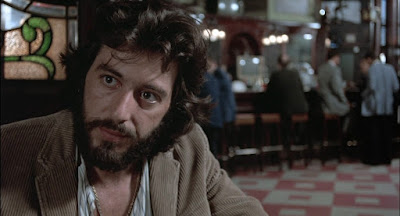
These days...these times...with extra attention on the way policing is done post-911 and their militarization in anticipating terrorist attacks in the worst case and calls for defunding the police and diverting funds to social services, the plight of Serpico paints a nightmare scenario. Today's talk of the "one bad apple" coloring the whole of a police barrel is turned on its stem in his story where he is "the one good apple" under constant pressure to be rotten and "doing the right thing" is the exception rather than the systemic norm. One wants to think the best, but the reality is often a different story.
A lot of it has to do with culture. Most work environments I've seen and worked in lately seem to be more adversarial than service, although it is never talked about openly "on the floor." Co-workers will gripe and kvetch about customers and their idiosyncracies (if not downright cravenness) in an environment where the myth of best practices is that the customer is always right. Peer pressure and tribe mentality exacerbates the tendency to create an "us against them" environment. In a job where one is armed and in "warrior-mode" that pressure might be one's last line of defense in a dangerous situation and risking it by "rocking the boat" might not be in one's best interest. One wonders if George Floyd would be alive if the three rookie cops who observed his arrest had spoken up, even if it was questioning the methods of a more veteran officer. Conscience may make cowards of us all, but it certainly doesn't make us conscientious. Not when we're constantly watching our backs.
Despite its production rush, Serpico is one of those paranoid thrillers that's only enhanced by the nervous energy Lumet throws at it, and its a tour de force for Pacino, who appears in nearly every scene and shows how he can carry an entire film on his back with an on-point performance that veers from soulful to manic and is often a pain in the ass without losing an audience's attention or patience. 

"In these challenging times," it is a film that resonates even more than the time it was made.

Lumet would make an unofficial "police corruption trilogy" with this film, 1981's Prince of the City and 1990's Q & A.

Through my appearance here today ... I hope that police officers in the future will not experience ... the same frustration and anxiety that I was subjected to ... for the past five years at the hands of my superiors ... because of my attempt to report corruption. I was made to feel that I had burdened them with an unwanted task. The problem is that the atmosphere does not yet exist, in which an honest police officer can act ... without fear of ridicule or reprisal from fellow officers. Police corruption cannot exist unless it is at least tolerated ... at higher levels in the department. Therefore, the most important result that can come from these hearings ... is a conviction by police officers that the department will change. In order to ensure this ... an independent, permanent investigative body ... dealing with police corruption, like this commission, is essential.