Showing posts with label Jeremy Irons. Show all posts

Friday, August 2, 2024

Swann in Love

Swann in Love
(Volker Schlöndorff, 1984) Some things are just miracles of happenstance.
 
Director Volker Schlöndorff (The Lost Honor of Katarina Blum, The Tin Drum) was having dinner with his regular screenwriter Jean-Claude Carrière and writer-director Peter Brook when Brook casually mentioned that he'd done an adaptation of a section of Marcel Proust's "In Search of Lost Time" (or as it was published in English "A Remembrance of Things Past") and had sufficiently "cracked it" to make a screenplay in the spirit of the novel, but, owing to a busy schedule, couldn't find the time to direct it (as was his intention) and that the producers were looking for a replacement. 
 
"A terrific excitement gripped me..." the director recalled. "'I am available,' I said half-jokingly without thinking it over." Schlöndorff had read the Proust novel when he was seventeen at his boarding school. "Proust revealed three worlds to me: the French language, the corresponding society and the unknown regions of love and jealousy." And the memory of the book was so vivid, he did not go back and re-read it, merely using Brook's script as a template, to recreate the world of La Belle Époque, with a lushness and luxuriousness that recalled the work of Luchino Visconti (who'd tried to make a version of it in 1969) ably helped by the cinematography of Ingmar Bergman's cinematographer Sven Nykvist.
Jeremy Irons plays Charles Swann, a well-to-do bon vivant in Paris, accepted in most social circles despite being Jewish. He is a habitue of the most fashionable salons of Paris and, if looked on with suspicion by most of the husbands, is positively cooed over by their wives, particularly the Duchesse de Guermantes (Fanny Ardant) and Madame Verdurin (Marie-Christine Barrault), the latter of whom has suggested that Swann might have an interest in a courtesan, Odette de Cracy (Ornella Muti), to whom he is introduced by his friend, the Baron de Charlus (Alain Delon, in a role that he plays floridly and rather heroically—he's the most fun I've ever seen him).
Their meeting does not initially go well, but over the course of lunch Swann becomes smitten and then obsessed with Odette, his thoughts becoming consumed by her. Especially when she doesn't make herself available to him. His days are spent trying to find out details about her—who her male companions might have been, if she's ever slept with women—personal details the knowledge of which might put him off, but having no desire to not possess her completely. This might cost him—prestige, respect, Odette would never be accepted in the society he enjoys—but, although warned, he loses control of his perceived dignity for this one woman.
"Why do I subject myself to such humiliation?" he muses at one point. "I used to think Odette was ugly! I had to fall in love with her because she reminded me of a Botticelli. Now I've decided to fall out of love with her and I can't. I can't. I can't. I can't! Tonight - tonight, I finally understand that her love for me - which I rejected at first - that the feelings she had for me will never be revived. But without her I will cease to exist. It's an illness that could prove fatal. And yet I'm afraid of being cured." And, later, "My love for Odette goes beyond physical desire. It is so caught up in my actions, my thoughts, my sleep, my life, that without it I'd cease to exist...My love is an illness that has reached the stage where it cannot be removed without destroying me. As surgeons say, it's inoperable."
Wow. Tough words. A brutal self-assessment. And Swann will risk everything—his friends, his status, his dignity—for her. Even when Madame Verdurin attempts to insert a rival between him and Odette, Swann will not be deterred, going so far as to spend the night in Paris trying to find her, trying to find out out anything about the time away from him—actions that even Swann's lowly carriage driver thinks are beneath him—until he can win her over, something that she already desires.
"You fear affection? How odd." she says to him at one point. "That's all I look for. I'd give my soul to find it."
And, in a way, she does. There is compromise for comfort, and Swann certainly provides affection, obsessively so, but she loses her own autonomy in that particular bargain (hardly something that is out of the ordinary in any society, much less 19th Century France). Swann, who spends way too much time in his own head, is left, toward the end of his life, to contemplate the mystery of what has become of him, with his usual brutality: "To think that I wasted years of my life - that I wanted to die - that the love of my life - was a woman I didn't like - who wasn't my type."
Well, it's not a mystery to me, as I've nattered on about my thoughts on that subject. But, Proust...and Brook and 
Schlöndorff, in their time...rather bravely dissect the details and peculiarities and humiliations and self-flagellations that an obsessive love can wreak on a rational mind. It's a lovely film with a particularly wicked sensibility towards a too-common subject. We've had scads of rom-comedies. But, seemingly too few...rom-tragedies?...that still have, outside of the mind, anyway, a conventionally happy ending.


Thursday, December 9, 2021

House of Gucci

The Handbag Company That Didn't Know a Thing About Baggage
or
"Father, Son, and House of Gucci" (The Sign of the Double-Cross)
 
The family Gucci are not happy with Ridley Scott's House of Gucci, and for once I have something in common with them. Scott's second film released this year is the lesser of the two—the other being The Last Duel—but both films deal with people obsessed with legacy and imagine themselves more important than they are and taking things to such an extreme that one can see the results and consider that hubris could be considered a cause of death.

"Inspired by a true story" (which means that there are more factual liberties taken than one "based on a true story" in some sort of cinematic legalese), it tells of Patrizia Reggiani (played bodaciously by Lady Gaga, who should, at least, get some sort of award for most extreme hip-swing), who rose from being a book-keeper at her step-father's trucking business to the wife of Maurizio Gucci (played—rather tentatively—by Adam Driver), prodding him from being a law student with no desire to be part of the family business to becoming the majority stock-holder of the company.
Maurizio ended up running Gucci, despite his initial reticence, and then began living the "Gucci lifestyle" of spending money recklessly and running the business into the ground, as well as having affairs that would occupy his time and his budget. Finally, he asked Patrizia for a divorce, and she hired, through a psychic advisor of hers, to have Maurizio murdered in front of the Gucci building. She, the psychic and the hit-men were all convicted and sent to prison. End of story.
So, it must be embarrassing for the family that House of Gucci is less about them than it is about Patrizia, less about the glorious history of Gucci selling high-priced shoes and accessories to a easily-impressed world, than it is about a non-Gucci and the way that she so easily manipulated and up-ended the House of Gucci-branded cards. Well, live by public gullibility, die by public gullibility—the attention is directed from over-priced flotsam to scandal and once things like murder and tax evasion are put in court documents it becomes part of the public record and not so easily manipulated in-house. No wonder they're pissed.
Not that Scott and his writers have done such a miraculous work of art. Scott keeps things moving along with much less fluff in the air this time (perhaps indicating that this whole world is a bit unnatural?) and the luxurious furnishings and art knock-offs adorning the spaces are in fine crystal-clear display. It is cast with a buzz-inducing corral of actors in the secondary roles that created so much anticipation for this one that it couldn't possibly live up to expectations (live by the press release, die by the press release) and it simply does not.
They have their moments—Jeremy Irons as Maurizio's estranged father Rodolfo (living in his film-career past), Al Pacino as Uncle Aldo (in a sort of nightmare-version of what Godfather III could have been like) and Jared Leto as cousin Paolo (portrayed as something of a dim-wit, but in that weird Leto-land situated somewhere between comedy and tragedy). Irons, at least, plays things fairly straight, giving Rodolfo a diseased dignity even in his knowledge that his best days are past while he ruefully wallows in them—the best scene of the film is his "meeting" with Leto's Aldo trying to gain acceptance for his fashion sense where he charitably considers all his ideas and politely savages them. But, Pacino's avuncular Aldo has the same DNA as Eli Wallach's Don Altobello in GIII—smiling, but with a knife up his sleeve, a slow trickster, not altogether good at what he does. He has two explosive moments—both in involving Leto—but for the most part the three big supporting actors are in another movie where they're starring.
But, it's La Gaga's movie. Pratizia Reggiani is the only character in the piece who is seriously ambitious (without being deluded), while everyone else is either lethargically complacent or spineless. Like Gaga herself, the part calls for someone with ambitious goals and a ruthless way of achieving them and she tears into the role with a fierceness that is almost animalistic.
It would be ironic if Scott found his project becoming known as being "that Lady Gaga movie" and having it wrested from his hands in the same way the Gucci's saw their work being taken from them. "Inspired by a True Story," indeed.

Wednesday, September 15, 2021

Zack Snyder's Justice League

Zack Snyder's Justice League
(Zack Snyder, 2021) Buying the DVD of Zack Snyder's Justice League—his sanctioned "taking-back" of the Warner Brothers "studio-notes" theater version—cost as much as two months of HBOMax, and I must say, in comparison, it was a bargain. I have been reluctant to be swayed into buying into streaming services, maintaining that theaters will come back, and there are very few enticements for having them take money out of my accounts month after month, when the economic model necessitates other means of seeing them.
 
So...(I hear you ask) "is it better?" Yup. And by a wide margin. My initial review of the theatrical version of Justice League was somewhat laudatory—more concerned with knee-jerk backlash towards it—but, in seeing it again a couple times one could see the pacing issues, grating inconsistencies of tone, a certain desperation in the product to compress the content gracelessly and be winsomely attractive. "The Snyder Cut" takes more chances and takes a lot more time doing it. The Warner mandate to cut Snyder's intended two-part 4 1/2 hour opus into a single 2 hour film must have seemed an impossible feat to accomplish (and one must give kudo's to Joss Whedon for even attempting it and managing to meet their specs despite the ham-fisted result), especially when the evidence shows just how much of Snyder's film wasn't in the theatrical version (which we'll simply call "Josstice League"). The story is basically the same, but, good Lord, there are whole completely different versions of scenes throughout the thing, with nary a line repeated. There are bits and pieces in the story-line—the first Earth-war with Apokolips, the Gordon scenes, the confrontation at the "Superman memorial"—but for the most part the shot choices and dialogue are unique to this version. There are far fewer "oh, yeah..." moments than "that's new" moments. And, for me, there weren't any "I miss that" moments...at all.
The length is daunting, which is why I think it was never, ever intended to be one film (that and Snyder has a tendency to make super-hero films that are already prepping for sequels). Still, the overall experience of watching it feels much more organic than the cropped mess of the "Josstice League." Segments progress naturally—they "feel" right. And more importantly, the big action set-pieces—like the fight under the Gotham harbor—finally "work" in how they're shot and edited in sequence—they have geography and you see how things are playing out among all parties and how the stakes rise and fall as they intensify.
What's more, the film hinges on the characters given short-shrift in "Josstice League"—those being Jason Momoa's Aquaman, Ezra Miller's Flash, and especially Ray Fisher's Cyborg. Sure, there's plenty of scenes with Gal Gadot's Wonder Woman and a lot more with the Amazon's, a couple of tid-bits with Ben Affleck's Batman (with even more taken out), less haggling among the heroes, more of Alfred (Jeremy Irons), more of Joe Morton's Silas Stone and his co-hort at StarLabs, Ryan Choi (Ryan Zheng)—these are all improvements utilizing good actors—and you get representations from Jack Kirby's gallery of "Fourth World" villains (most prominently, Kirby's "Big Bad Guy" Darkseid), and a considerable "Steppenwolf" upgrade.
It's the three heroes-in-hiding from Batman v. Superman: Dawn of Justice, that get a lot more coverage and a bit more respect. Momoa's Aquaman has a lot more scenes with Mera (Amber Heard) and now, also Vulko (Willem Dafoe) and there's a bit of a continuity gaff in that here, nobody can talk underwater as in the Aquaman stand-alone film (they have to make air-bubbles to communicate). The Flash is given more background including a rescue of young Iris West (Kiersey Clemons) and the character's annoying geeking is toned down substantially and slightly matured. But, it's the story of Victor Stone/Cyborg that is the most expanded and the most from which the film benefits. Fisher is given much more chance to shine as he goes from bitter accident victim to reluctant super-paraplegic to confident team member.

But, it's not all roses. This version is rated "R" for a reason. There are a couple of prominent "f"-bombs* that may be earned but won't impress the parents of young superhero fans. And the level of carnage is greater with prominent blood spatters (that would have been digitally removed for theaters) and the final disposition of Steppenwolf by Wonder Woman (she is an sword-wielding Amazon, after all) that is far more MPAA-adverse than just letting the bad guy be dispatched by his own minions off-screen. Edgier, but not the way parents, censors (or even the Comics Code Authority) would like. One is always aware that in the movie-world, the film creators are always less concerned with body-counts than the comics-heroes (as dictated in the comics by parental watch-groups) would be.
This prompts the question for whom film-makers are making movies, even though, in this special case, Snyder has had the supported mandate to please himself. With the content far more unconstrained than the behavior displayed in the four-color versions, are they making it for themselves, for the fans, or for the studio? One would say the first, less the second, with the third being the cranky arbitrator between the two. Snyder makes them for himself—what he'd like to see—and for that imagined film audience that wants more realistic, mature versions of childhood heroes (ala the Christopher Nolan model—Nolan is still the exec. producer of this one)** It's interesting to think about, given the many hands involved.
So, I was pleased with what I saw, tarnished slightly by the fact that I'd seen a bastardized version before.*** But, what a difference it does make to have a singular vision, whatever issues one might have with it, rather than an elephant made by committee. In a subtle way the film makes that point, and one hopes that Warner learns it, and that Marvel takes the lesson as a cautionary tale.

 
* One was deliberately added by Snyder in his "new footage" shot for the Snyder version. If he doesn't have to fight over it with the studio, I suppose he said "why the fuck not?" So, Batman says it. And Cyborg says the other one at the height of his bitterness.
** Nolan has been working exclusively with Warner for almost two decades, but the recent rifts over the super-hero movies he and his wife have shepherded there (and the studio's insistence on simultaneous streaming) have had a consequence—Nolan's next film (involving J. Robert Oppenheimer) is being made with Universal. Warner wasn't even being negotiated with.
*** One curiosity I had was the way the theatrical version photographed Gadot's Wonder Woman—it's more sexualized, seeming to concentrate on her posterior than apparent when Snyder and director Patty Jenkins called the shots. And, yes, Snyder had no such prurience in his cut.

Batman gets Frank Miller's goofy Bat-tank.

Saturday, August 22, 2020

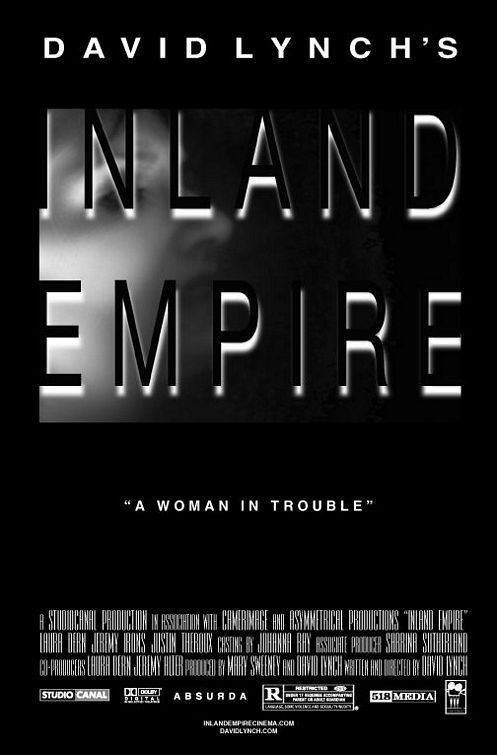
Inland Empire

Written (or composed) at the time of the film's release. It was an experiment to reflect the film's style. 

It failed...just like the film did.


Inland Empire (David Lynch, 2006) Lynch Laura Herring, with video, experimented in his lust for pulchritude, if you've admired, or even tolerated Lynch, and of all the cineastes experimenting with the format, Julia Ormond, he's the least successful. 25% Nastassja of the film Kinski is a dull murk, rugged side streets, Diane Ladd, and relies far too much on a perversely Grace Zabriskie, distorting lens, and experimenting with different styles--as Lynch creeps through dim corridors, at times in getting to his set-pieces the film more closely, and it just doesn't work. "You're getting to be a rabbit with me" Lot of big names: William H. Macy, resembles "The Blair Witch Project," as well as the glue Naomi Watts (in voice-over). Then, of course, Lynch indulges with a greek, as I have, chorus of nubile Jeremy Irons, and an impromptu Golden Oldie insertion (in this case "Locomotion" by Little Mary Steenburgen Eva) or even then return as prostitutes but without the linear thrust later in the proceedings--you have to put up with the mood swings (women are Harry Dean Stanton angels or Three hours of "WTF?" whores, in his movies) 
Oh yeah, did I mention that Saturday is "Take Out the Trash" Day?
between low rumbles and screaming decibels (at points behind inserting that doesn't hold the thing together--Laura Dern a screaming cockatiel at the 3/4 mark of Citizen Kane-"I wanted to wake the audience up." At times, yields potential starlets abundant dividends. Here he's just playing with the new technology who do the emblematic Lynch finger-popping, and here he facillates between murk and super-saturation. Lynch is playing with form, the blurriness of the vision exemplified by the blurriness of the video image.


Hey, Dave! Next time, write it when you're awake, buddy! Looking forward to the next one.

Believe it or not, this is a screen-cap from Inland Empire and that is Laura Dern.
Kinda...

Wednesday, April 15, 2020

Appaloosa

"The Unforeseeable"

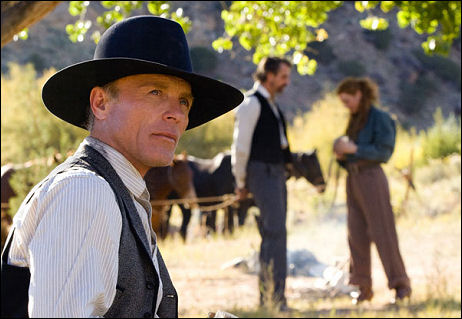
Virgil Cole and Everett Hicks (Ed Harris, Viggo Mortensen) law enforcers for hire, have been "pards'" for a long time now. They're two peas in a pod, and when they ride into the town of Appaloosa (in the New Mexico Territory, circa 1882) they already know what they're gonna say to the town-fathers about their marshaling problem. They've done it before; the two form a unit in everything: conversationally, they finish each other's sentences, and where Cole is a pistol man with a fast draw, Hicks has an 8-gauge shotgun that can distribute a wide enough pattern to make a mob think twice....before it cuts them in two. Cole's contract with the town is simple: if he's going to enforce the law, he has to make the laws. As Hicks explains, "Whatever Mr. Cole states, it's law."

Ed Harris' sophomore directorial effort (after the particularly well-done bio-pic Pollack) is a minor western, limited in population and scope. Based on Robert B. Parker's* novel of the same name, it still manages to do what it does very well, and provides a collection of very good actors (including Harris, Mortenson, Renée Zellweger, Jeremy Irons, Timothy Spall and Lance Henriksen) with complex roles that they clearly enjoy taking on. These people are infused with quirk, and character drives the story-line. Where Harris is brittle and short with words, Mortenson is laconic and lanky. Zellweger's Allie French happily screws up her face in a pinched manner that I haven't seen before--either mighty pleased with herself, or trying to keep the prairie dust off her face, I'm not sure which. Irons carries on the long tradition of English gentlemen-actors lovingly chewing western scenery.
After making a none-too-subtle point about a town that wants security giving away its freedoms, the film settles into the...what's that word?...resolution of the conflict between Irons' predatory land-baron, Bragg, and the homespun issues that occur with the arrival of Zellwegger's Allie French. Will a triangle develop? Who gets the girl? What happens to men of principle when the compromise of love enters the picture? A held prisoner in the jail reminds one of the Alamo consequences of Rio Bravo, but it's not dwelled upon for very long, and the story keeps advancing, despite the well-traveled terrain into unknown territory.
And I've always had a fondness for Western colloquialisms that arise from each new author tackling Westerns, and Parker and Harris and co-scenarist Robert Knott do not disappoint.
Little details stand out: Harris makes a point of showing the high forehead tan-line that's a permanent part of every hat-wearing citizen of Appaloosa (of course, that would be true, but it's too rarely seen in "perfect make-up" movie Westerns), and his gun-fights are brief, brutal affairs that are over in a flash of wills and smoke. "That happened quick!" muses Hicks after a long-odds gun battle is finished. "Everybody could shoot!" is Cole's tight-jawed reply.
And situations are repeatedly presented showing how much will is required "out there." Hesitancy could mean death. And the rules of the jungle claim jurisdiction even in a desert covered in clap-board. It's refreshing to see a Western that doesn't cloak itself as an epic. The aims of Appaloosa are small, but ring true.

* After John D. MacDonald, Parker is a favorite author when one is looking for pleasingly composed, enjoyably readable genre story-telling. His "Spenser" novels are his C'sTF, but his westerns, and his post-Chandler Phillip Marlowe stories are great fun to relax with.

Friday, August 10, 2018

Margin Call

The Economy and how it grinds up people has been on my mind of late. Here are some movies I've written about in that subject matter. 

Written at the time of the film's release.

"When The Music's Over (...And the Band Plays On)"
or
"Momma, There's Wolves in the House"

Margin Call begins like The Company Men and Up in the Air—in the midst of a corporate slaughter—people being fired from jobs they've held a long time. Cut-backs. "Generous" severance. Thanks for your service.  Security will escort you out.

Eric Dale (Stanley Tucci) listens to it all, a little stunned, but tentative. "Uh, listen," he says in the middle of the administering of Last Rights, "I was working on something and I'm not finished yet." Doesn't matter. Go to your office. Empty your desk. Proprietary information. Your losing your phone, e-mail, etc."No, really..." he says.
Doesn't matter. He's out. On the way to the elevator, he runs into two of his turks, Peter Sullivan (Zachary Quinto) and Seth Bregman (Penn Badgley). "Am I safe?" asks Seth (as Seth is wont to do). But Peter walks him to the elevator to tell him how much his mentorship meant to him. Dale cuts him off. "I know. I was working on something. They won't let me finish it," says Dale as he hands him a USB drive. And as the elevator doors shut, he has just enough time to say "Be careful."

Fwump. 

It's the "be careful" that gets everybody's attention. "He said that?"
Sullivan begs off the traditional drinks for the battle survivors and takes a look at Dale's figures. Then he sees something. Digs, does some calculations and then stares at his projections screen. Over the next twelve hours, the world will go to Hell and he's the only one who sees the gate.
Margin Call is a boardroom thriller about our recent financial crisis, but its played like a mystery story. Everybody speaks in code. The night is dark and no one is betraying secrets. No one knows what's around the corner and everybody's looking behind them for the knife. Written and directed by J.C. Chandor (Who? This is his first film and it is an impressive debut*), it plays out like a conspiracy—it is—and if so much of it didn't anticipate the dawn, one would be tempted to call it a film noir; there is a palpable air of organized evil, built of greed and self-interest, that hangs over the film, for what is being planned is the crime of the century.
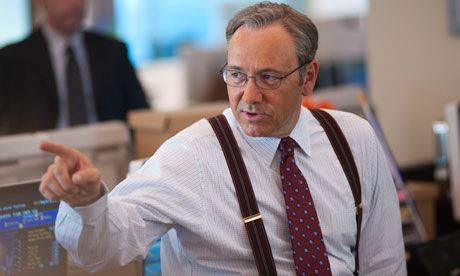
The cast is uniformly superb—how could it not be with the likes of Kevin Spacey, Jeremy Irons, Simon Baker, Paul Bettany, Demi Moore, and Tucci?—but those performances depend on the great dialog generated by Chandor and the way he presents what should be dry material as drama and intrigue.  These are gangsters in Gucci, cold-blooded, playing the long odds and the fast kill, but instead of "going to the mattresses" they are isolated in fancy cars and well-appointed high-rise board-rooms, their views of the world their actions are affecting armored by safety glass. There isn't much soul-searching (they're business-people, so why look in a dry hole?) about what devastation their actions will bring, except for the immediate future and what it will do "for business."  Even then, loyalty to the corporate mantra of "be first, be smarter or cheat" trumps conscience. That would make a hell of a slogan wouldn't it?
If one could gripe (and there is little to gripe about), one could argue that, if anything, this reverse "Godfather"—where business-people are gangsters, rather than gangsters as business-people—is heavily romanticized. There are no "Masters of the Universe" statements coming from these mortgage titans (as one heard from Wall Street bar-recordings on "This American Life," where these mavens crowed about deserving bonuses from bail-outs because "they're smarter than everybody else"), but, rather, short-term hedges about "dog-eat-dog" survival. No cynical betting against failure schemes, but merely making the best out of a bad situation before everyone else does.  
As bad as Margin Call makes its protagonists, the truth is even worse—there were folks betting on things coming crashing down and profiting from it. It doesn't take a rocket scientist to see that a fix was in and that analysts saw it coming, not, suddenly, seeing it and going "Garsh, this looks bad." And the worst thing that's happened to these people is a little traffic congestion on Wall Street.

That is, if they're working at all.


* Hey, there. James from 2018 here.  Chandor was no fluke nor a flash in the pan. He followed up Margin Call with the Robert Redford masterclass All is Lost in 2013 and the woefully unappreciated A Most Violent Year in 2014.

Thursday, March 15, 2018

Red Sparrow

From Russia, With (JLaw)ve
or
Welcome to the Trump Nightmare

If prostitution is the world's oldest profession, "honey-trap" is probably the second. That conceit of deceit is such a useful tool of spy-craft (and entertainment about it) that one doesn't need look over the "spy" or "thriller" genre even shallowly before running into it (the first review of this month featured Dr. Mabuse, the Gambler from 1922 which had it, and in Hitchcock films, there's Notorious and North by Northwest, it's in the second of the James Bond films and the first of the novels and on and on and on). In films, the concept has always been played for romance, cheap thrills, and instilling some sense of sex and intrigue and the potential of betrayal into the thriller mix. It's a trope of the movies and thrillers, for god's sakes.

That's why it's so damn amusing to see all the "Aunt Flo's" on the internet having their hissy-fits and purple hemorrhages over Red Sparrow, the new spy thriller (based on a book—the first of ANOTHER trilogy—written by former CIA op Jason Matthews), re-teaming director Francis Lawrence (he did the Will Smith I am Legend and Water for Elephants) with his "Hunger Games" star Jennifer (no relation) Lawrence. The difference is Matthews wasn't working to amuse, but to paint a darker, colder, and more realistic "take" on the sordid business of finding an opponent's weak-spot and exploiting it, a strategy that employs all sexes and permutations. The "honey-trap" business was the first to embrace the LGBTQ community without any discrimination, whatsoever (as opposed to our military who preferred homophobia to national security after the 9-11 attacks by dismissing much-needed Farsi translators if they were gay). This is a point that Red Sparrow brings up, but does not exploit. If they had, I think there would have been less squawking about Jennifer Lawrence and the bloody violence and the sexual manipulation. Maybe. Maybe, it's because people don't like their romantic tropes and fairy-tales punctured.
Dominika Egorova (Lawrence, Jennifer Lawrence) is living the good life in Moscow. She is the prima ballerina at the Bolshoi Ballet, toasted by everyone, and feted by party officials. The position provides a good apartment downtown and medical care for her Mother, Nina (Joely Richardson), who is suffering from...we're never sure what. During her performance at the opening gala, her dancing partner, Konstantin (Sergei Polunin) lands on her leg, snapping it, effectively ending her career...and with that, will go the apartment and her Mother's care.
Dominika is approached by her Uncle Vanya (heh...oh, he's played by Matthias Schoenaerts) who is high up in Soviet Intelligence. He is (of course) sympathetic to Dominika's plight, but gives her a chance that she might be able to take care of her Mother. He has a little assignment: He wants her to seduce a Party official and replace his phone with one provided by the SRV, so they can plunder his information, but also track him and...maybe find out his voting patterns. It's sure not anything to do with Russian orphans. Just saying. He also tells her that her rival at the Bolshoi is now the prima performer, and has long been rumored to be involved with the dancer who broke Dominika's leg. It is Vanya's opinion that Dominika was "I, Tonya'd"
Dominika sneaks into the Bolshoi one night, not completely healed from her leg injury, walking on crutches. When Konstantin and her rival, Anya, are finished with their practice, she waits, and finds them in the sauna snogging. Using her cane, she attacks Anya, breaking her jaw, and beats Konstantin, effectively crippling him. Vonya notes the coincidence of the attacks, but says nothing. Dominika has a job to do.
Once she is back on her feet, a dress is provided, a room booked at a swanky hotel, and a time when the official, Ustinov, will be there. She is given the phone, but has no idea what the device will do. Her main concern is attracting the attention of Ustinov. She needn't have worried...Ustinov has left his party and is buying her a drink within two minutes of her sitting at the bar.
It is simplest of matters to convince Ustinov that she will do what he wants if he can provide medical assistance for her Mother...but she doesn't anticipate how aggressive a predator Ustinov is. Before she can even think about replacing the phones, Ustinov is attacking her. But, he is interrupted by a masked figure wrapping a wire around his throat and strangling him, his blood falling on Dominika who can only look on with horror. The masked man, an assassin named Simyonov (Sergej Onopko) tosses her some clothes, a motorcycle helmet, and an escape route past Ustinov's guards, and brought to a secure location where she is told by Vanya that the rendezvous was always going to be a "hit," that she wasn't informed to get her cooperation and, now that she's the only witness to the murder, her life will be in constant danger from intelligence officers...unless she becomes one of them. Dominika has no choice but to be sent to "Sparrow School."
Dominika has another term for it: "whore school," but for her safety and her Mother's, she goes to the remote location, where she is greeted by "Matron" (Charlotte Rampling) and she is told that her "body belongs to the state," and she and her fellow-recruits, male and female, will be taught espionage skills and the fine art of manipulating human beings to their purposes. But, first, they have to be broken down, their past lives forgotten, their attitudes erased, their inhibitions discarded—they belong to Mother Russia now, which (as Matron explains) must take the place as the supreme power of the world, given the breakdown of the West.
It's at this point, that it all clicked into place for me; Red Sparrow is merely Ian Fleming's From Russia With Love from the "honey-pot" point of view. The scenes with "Matron" have an eerie, creepy similarity and Rampling's play-book for her performance in her role is very similar to Lotte Lenya's (she played the Russian Colonel Klebb, who recruits the girl—also a former ballet dancer—to the task of seducing a spy from the other side). And, damn, if that isn't the exact-same assignment Dominika is given; a CIA agent, Nate Nash (don't laugh...he's played by Joel Edgerten) has been making regular contact with a Soviet spy named Marble (??) but after a suspicious meeting in Gorky Park that had all the appearances of some form of trap, Nash managed to escape getting caught and has fled the country. His contact has made it plain that he will only deal with Nash, who is now stationed in Budapest, and it is up to Dominika to find the agent and find out who "Marble" is, so that he can be eliminated. Just like From Russia With Love. But, without the gadgets. Or the quips. Or the train-fight. Not even an exploding helicopter.
One of the handful of times Lawrence smiles in the film.
Or the fun, for that matter. You can count on one bloody hand-print how many times Lawrence smiles in this film—her face is usually a determined inscrutability, a mask that hides what she's thinking or where her loyalties lie, which is important to the drama, and her words? She says what will gain her the most advantage, saying what everyone wants her to say.  But, it is a tough film and Dominika is ruthless, but not in an action-cartoon sort of way (like Salt or Atomic Blonde or even as "the Black Widow" is presented in the Marvel films. The fights are not balletic, the violence is...messy and bloody. There is one particularly grueling fight that seems to take as its inspiration the killing of Gromek in Hitchcock's Torn Curtain—not as stylized, though—that has its central thesis just how hard it actually is to kill someone.  
In fact, the film is brutal in ways that will make you wince...a lot. Matthews wanted to portray a more realistic spy-world where water-boarding is just a prelude for nastier ways to extract information and it is anything but glamorous. In fact, be prepared to be repulsed. There are no "nerve agents" in Red Sparrow, but the deep-rooted Soviet animus inherent in such attacks—as recent as last week's in Salisbury are very much evident. The graphic garrotings and flayings employed by the Simyonov character are merciless, and, in fact, the whole movie's tone is that way, even that of the movie's protagonist.
But it feels more "right" (or should we say "appropriate") for the movie to take this tact when morality is the farthest thing from any objective being portrayed. It's a world of blackmail and cold manipulation, and even if it does have a "kicker" that might be satisfying to an audience, one can take no pleasure in it...or the movie.
Director Lawrence makes the thing look great and he has a good cast—I haven't even mentioned that Jeremy Irons and Ciaràn Hinds are in it as high Russian functionaries—Edgerton is a bit bland, but then, he's supposed to be, and Lawrence manages to make her sparrow vulnerable when she needs to be (in the first part of the film) and deliberately opaque during the rest of the film's course, while, for the most part, keeping her Russian dialect—as tough to sell (think of Cate Blanchett in Indiana Jones and the Kingdom of the Crystal Skull) as any accent there is. She's always interesting to watch, always making tough choices, and capable of even making her state-run little monster relatable.