Showing posts with label William H. Macy. Show all posts

Wednesday, May 15, 2024

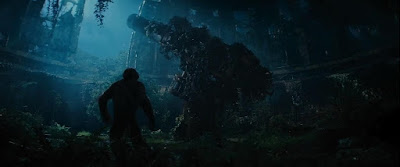
Kingdom of the Planet of the Apes

Noa's Character Arc
or
"Decency. Morality. Strength. Compassion."

"It's all in the eyes, isn't it?"
Laurence Olivier
Caesar is dead. Long live Caesar.

The new entry of the re-booted "Planet of the Apes" series continues with a fourth one, titled Kingdom of the Planet of the Apes. Taking place "many generations later" than the previous one, we're introduced to an entirely new set of characters and circumstances as Earth starts to adjust to the population upheavals of "The Simian Virus" (we've been told that only 1 in 500 humans were immune to the deadly virus, which came from developing a cure for Alzheimer's*). It has become apparent that the re-boot series has a slightly more ironic demise for mankind, choosing Good Intentions over Nuclear Stupidity. 

Another difference from the original series is that this time around (or in this Universe, if you want to get all science-fiction-y about it) the Apes filled a void left by Mankind's decimation. In the Apes series 1.0, another virus killed all dogs and cats, and apes became their replacements-and mankind being unkind-found them handy as slaves. All it took was the progeny of a time-traveling future ape couple to light the spark of revolution.**
Up to this point, the reboot series has been pretty binary...it was only apes and humans. The occasional horse, of course (of course), but the Planet of the Apes has, of late, been a poor example of bio-diversity. Kingdom changes that. Our first shot is of an eagle swooping down and snagging a fish out of a lake. And before anyone can suspect they're seeing a Planet of the Eagles movie, it swoops onto the waiting arm of an ape, just like Grub-hub. We are in the midst of the Eagle Clan, who have a neat little system of farming and hunting, while letting the eagles do the work. Not much conflict there, but it's a thriving self-sustaining community.
But, getting down to particulars, we then follow a trio of apes on a mission. Noa (
Owen Teague), Anaya (Travis Jeffery), and Soona (Lydia Peckham) are climbing their way up the sides of dilapidated skyscrapers hunting for unhatched eagle eggs. The next day is bonding day where they will be paired with their eagle hatchlings that will join them in the hunting/gathering expected of them. And it's the way of the Eagle Clan to claim an egg—leaving one in the nest for the perpetuation of the species in the wild—fighting off dizzying heights and outraged eagles to find that one egg that "sings to you."
All well and good, despite some complications. These chimpanzees are basically young adults, and they spook easily, given the stories told to them from their forefathers, particularly of creatures they call "Echoes" that (legend has it) live beyond the tunnel kilometers away from the village. Plus, they've been having trouble with "scavengers" who have been stealing crops and helping themselves to the fish in the smoke-house. Noa has a night-time confrontation with one, and in the struggle, his eagle egg gets crushed, and despite warnings from friends and his parents, he decides to make a last-minute excursion to get another egg before the ceremony starts.
And it's here that I have to stop any synopsis because the spoilers start coming pretty fast and loose 20 minutes into the movie. Things get complicated—in the way it's happened in quite a few Westerns—and Noa must go on a hero's quest that pretty much follows the Joseph Campbell playbook of the noble cause mixed with the righting of wrongs. At the same time, there are "echoes" of the past films that any history with the series, past or present, will recognize.***
How is it? Really good, in the way the previous three re-boot films have been very good (as opposed to Apes 1.0 that was a series of diminishing returns). And—as critic Glenn Kenney used the term in his review of Rise of the Planet of the Apes—it delivers a couple of genuine "Holy Shit!" moments. The art design is really impressive, showing a United States—specifically—that Nature has taken over. A couple apes will be riding horses in the foreground, and when they move enough that you can see where they've been, you goggle "Ohmigod! That's an airport!" (I had the same reaction to some of the scenes in Civil War recently). There's a nice depth to the imagining of an ape civilization done by the WETA wizards that says a lot about the society by the junk it keeps...and values. And the writers provide wonders a-plenty that you just know in your gut are going to be used as sequel fodder—they "sing to you."
And the acting in these things are always better than they have a right to be, given the obfuscation of masks or CGI face-grids, and Kingdom has a lot of talent on display despite the fact that you never see their faces and you wouldn't recognize them if you passed them on the street. There's something about their choice of how an ape will sound speaking English that's fun to experience. One of the actors (
Kevin Durand), playing a populist-leader-with-eyes-towards-dictatorship does a lovely spin that sounds remarkably like James Earl Jones
But, like Olivier said, "it's all in the eyes, isn't it?" Despite the overlay of CG, the expressions in the eyes always shine through, making a connection with audiences whatever the mood they're conveying. And given the encumbrances of the motion-capture suits the actors are forced to wear, that it all comes off seamlessly, and one just gets used to seeing the apes as characters, like any other biped. One becomes fascinated with the macro and the micro of the ape
It's quite extraordinary, really. And there are just enough threads for future stories that one wants to see what will evolve in future installments, keeping in mind that there is still a spaceship out there "lost in space" (that the San Francisco Chronicle paper headlined) on its way to Mars. Like the way-laid mission from the 1968 film, that ship should be coming down sometime—it was called "Icarus" after all. And one wonders what those astronauts will find when they get there.
Will ape and human be able to get along and co-exist peacefully? Will those astronauts find a better society than the one they left? The indications in Kingdom of the Planet of the Apes points to a negative answer. But the question is still intriguing.

* The development of this cure also radically increased the intelligence of our genetic first cousins...apes. Hence, their rapid rise in the food-chain.

** And talk about irony: those apes came to 1970's Earth using Charlton Heston's spaceship from the original movie, the one that took him to the future planet of the apes in the first place. You want to blame somebody for the planet going topsy turvy? Blame Heston!
 
*** At one point a character is given the name "Nova" and when asked why, the name-giver says "We always call them 'Nova.' I don't know why."

Thursday, August 31, 2023

Shadows and Fog

Shadows and Fog (Woody Allen, 1991) When Woody Allen makes a film in the style of Ingmar Bergman (Interiors), it's done in deadly earnest. But, when he takes on German Expressionism, entering the angular world of Lang, Murnau, with a para-nod towards Kafka, it's a comedy. Not quite sure why; maybe he has an affinity towards one stylization and the other he just finds phony, but the different approaches are like, well, day and night. Allen explored that theme—taking the same story and interpreting it as either comedy or tragedy—in Melinda and Melinda, a bit of a mis-fire—but one suspects that the Nordic tradition he buys completely, and completely dismisses the German (God knows why).

Here, the visual is pure dread, but the subject matter is a mixed bag of precision and vagueness, comedy and darkness. Allen plays Kleinman, a passive-aggressive bookkeeper, who is recruited in the middle of the night by a vigilante mob (including David Ogden Stiers and James Rebhorn) to roam the streets looking for a serial strangler.  Being a professional coward, and only dealing well with facts and figures in black-and-white, Kleinman is ill-suited for the activity and begs off, inviting suspicion from the group. When there is speculation that maybe he won't do his duty as a citizen because he might be the strangler, Kleinman caves.
On his dark journey through the city streets (the largest set ever built in New York's Kaufman-Astoria Studios, making this Allen's most expensive film), he runs across an all-star cavalcade of slothful potential victims: a philosophy student (John Cusack) with a weakness for prostitutes (among them Lily Tomlin and Jodie Foster, madamed by Kathy Bates), a circus love-triangle tangentially related (with John Malkovich, Mia Farrow and Madonna) and the town coroner (Donald Pleasence), who has a purely scientific interest in the killer.
*

Kleinman soon realizes that life simply doesn't add up, that a little slippage occurs, especially when it comes to illusion and reality (in the form of a very handy and practical magician named Armstead, played by Kenneth Mars). The film struggles with the dichotomy throughout, as highly contrasted as the black and white photography, never truly meshing, and finally ends, as many of Allen's weaker films—and one of Allen's strongest ones (Hannah and Her Sisters)—do, with a Deus ex Machina
** that buttons everything up inexplicably, leaving no questions but a lot of raised eyebrows.

Which is fine for the purposes of the film, but it's hardly what you'd find in an example of German Expressionism, where the punishment fits the crime...and where things really are in black and white.

* Yes, the film is top-heavy with fine actors (and Madonna), but if you look in the darkened nooks and crannies of the film you'll also find Fred Gwynne, William H. Macy, John C. Reilly, Josef Sommer, Wallace Shawn, Kate Nelligan, Kurtwood Smith and Philip Bosco. Was this film cast or filmed at a SAG convention?

** Here's a question:  It's a Woody Allen film; Can there be a Deus Ex Machina if there's no Deus?

Tuesday, April 26, 2022

Benny and Joon

So...I guess there's some trial going on?

Since so many people on the inter-webs are trying to make bank on it by "regurginging" it, I thought I'd do the same thing...but in a nice way. I'm transferring a couple of Johnny Depp movies from my old site to this site (where they'll seem like new content). I have no axe to grind. The reviews are rather complimentary to Mr. Depp, even if they do contrast his light and dark sides. I'd have done the same for Amber Heard, but...I don't have any old reviews of her stuff. Lest I be accused of bias or anything (although I don't think any uber-fans can sign a petition to kick me off my own blog...I think).
 
Benny and Joon (Jeremiah S. Chechik, 1993) When examining the career of Johnny Depp, one looks to the blockbusters: the Pirates movies, the many Tim Burton collaborations. But then there are the films that fall through the cracks—not unlike the characters in this film. For anyone doubting Depp's ability to not depend on his looks and create a compelling character, Benny and Joon is a revelation.
 
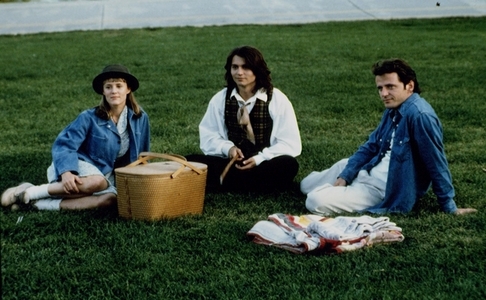
Filmed in Spokane, Washinton, it tells the story of of an auto mechanic, the 1/3 eponymous Benny (Aidan Quinn) taking care of his 1/3 eponymous but schizophrenic sister, Juniper (Mary Stuart Masterson). He's torn between his commitment to Joon and his desire to live a life, free of her responsibility. But, his sense of duty and brotherly protectiveness trap him into doing nothing else, even though he might be inadequate at the care-taking task.
By luck of the draw, Sam (Depp) drops into their lives...literally; Joon wins him in a poker game. That plot development prat-falls Benny and Joon directly into "twee-ville," but Sam's addition to the cast arrives just in time to avoid it. Sam is a movie-freak, who knows every movie—the weirder the better—and models himself as the love-child of Buster Keaton and The Little Tramp. Eccentric, scruffy, but in a non-threatening way, Depp's head-tilting performance is just the right fizz to put in this Shirley Temple of a movie. You wonder what he's going to do next, and Depp is given enough ground to deliver a number of mute routines that are laugh-out-loud charming.
But, there are more joys to be had with guest-turns by
Julianne Moore, William H. Macy, CCH Pounder, Oliver Platt, and Dan Hedaya—the kind of movie where your attention is slapped every few minutes with a "They're in this?" It might get a little heavy for kids in the third act—"everybody's MAD at each other!"—but there's a satisfying resolve. And if you have a sister or daughter not in love with Johnny Depp yet, this one will do it.
Benny and Joon
is a Chick-Flick that guys can enjoy.
 
2022 Update: I still think Benny and Joon is an enjoyable film—it's enough to make you want to forget his film of The Avengers (almost—he's been doing a LOT of TV since then). I still have the creepy feeling that it's a dumbed-down, sugar-sprinkled look at mental illness, The Child's Guide to Schizophrenia. That's something that will help NO ONE. It does have a couple of good lessons about being a caretaker, though—don't be so regimented and go with the flow because it's easier on the caretaker and caretakee. It's a marathon, a long game, and minor things are spilled milk in the long run. That's something that needs to be said. And Benny and Joon says it very specifically, especially if you think the movie is less about Mary Stuart Masterson (please come back, we miss you) and more about Aidan Quinn.


Saturday, August 22, 2020

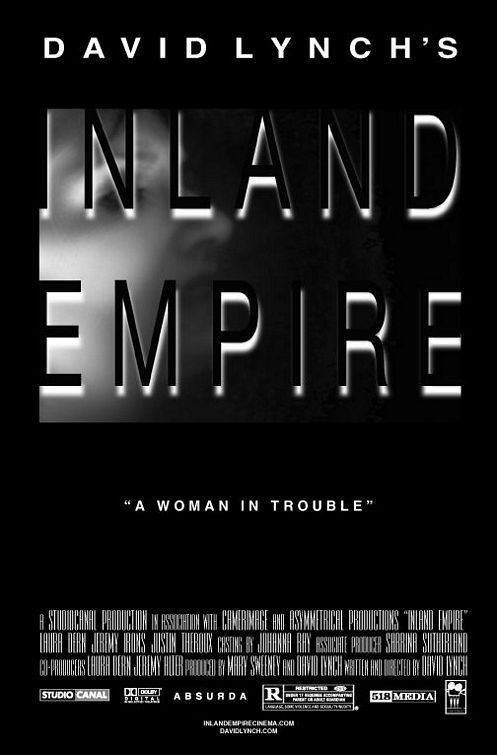
Inland Empire

Written (or composed) at the time of the film's release. It was an experiment to reflect the film's style. 

It failed...just like the film did.


Inland Empire (David Lynch, 2006) Lynch Laura Herring, with video, experimented in his lust for pulchritude, if you've admired, or even tolerated Lynch, and of all the cineastes experimenting with the format, Julia Ormond, he's the least successful. 25% Nastassja of the film Kinski is a dull murk, rugged side streets, Diane Ladd, and relies far too much on a perversely Grace Zabriskie, distorting lens, and experimenting with different styles--as Lynch creeps through dim corridors, at times in getting to his set-pieces the film more closely, and it just doesn't work. "You're getting to be a rabbit with me" Lot of big names: William H. Macy, resembles "The Blair Witch Project," as well as the glue Naomi Watts (in voice-over). Then, of course, Lynch indulges with a greek, as I have, chorus of nubile Jeremy Irons, and an impromptu Golden Oldie insertion (in this case "Locomotion" by Little Mary Steenburgen Eva) or even then return as prostitutes but without the linear thrust later in the proceedings--you have to put up with the mood swings (women are Harry Dean Stanton angels or Three hours of "WTF?" whores, in his movies) 
Oh yeah, did I mention that Saturday is "Take Out the Trash" Day?
between low rumbles and screaming decibels (at points behind inserting that doesn't hold the thing together--Laura Dern a screaming cockatiel at the 3/4 mark of Citizen Kane-"I wanted to wake the audience up." At times, yields potential starlets abundant dividends. Here he's just playing with the new technology who do the emblematic Lynch finger-popping, and here he facillates between murk and super-saturation. Lynch is playing with form, the blurriness of the vision exemplified by the blurriness of the video image.


Hey, Dave! Next time, write it when you're awake, buddy! Looking forward to the next one.

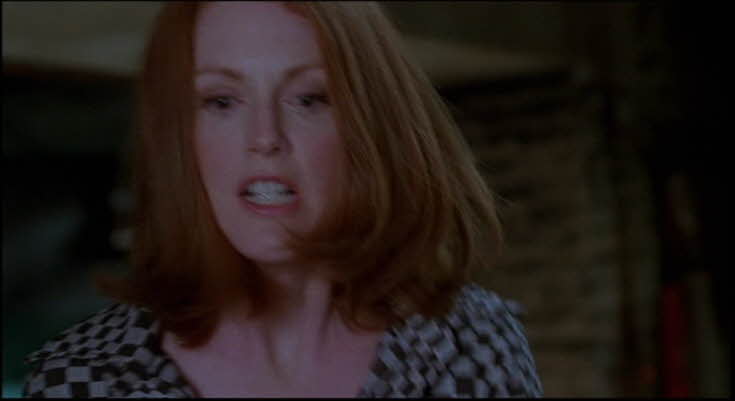
Believe it or not, this is a screen-cap from Inland Empire and that is Laura Dern.
Kinda...

Tuesday, October 4, 2016

Psycho (1998)

Psycho (Gus Van Sant — after Alfred Hitchcock, 1998) What is good about Gus Van Sant's color version of the original can be laid at the feet of that film's creator, Alfred Hitchcock: the relentless pace, the choreography of the camera (matched by Van Sant and his cinematographer—the great Christopher Doyle), the various set-pieces that alternately tease and deepen the mystery manipulating the audience's needs and tensions "like an orchestra," and that the film maker breaks the director-audience "trust" by the film's mid-point.

Danny Elfman, Bernard Herrmann's No. 1 fan, lovingly recreates his score in stereo. And modern film techniques allow Van Sant to make that opening pan across Phoenix, Arizona (2:48 pm), seamlessly locate the apartment where Marion Crane (Anne Heche) and Sam Loomis (Viggo Mortensen) play out their melancholy nooner and then crawl (with no cuts) through the window.
       
 
Van Sant's semi-scrupulous recreation (right) of Hitchcock's original shot-plan (left).
Everything that's wrong with Psycho '98 can be blamed on Van Sant: the kitschy color schemes, the bizarre inserts (see below) and the casting. Vince Vaughn had his hands full having to follow in Anthony Perkins' sashaying foot-steps as Norman Bates, so kudos to him for even showing up on-set, although he's lousy. What's surprising is how poorly Anne Heche and Julianne Moore step in for Janet Leigh and Vera Miles, even though both seem to be working harder. And it's that way down the line, including—startlingly, Viggo Mortenson's poor standing next to John Gavin (??!) and Robert Forster's shrink monologue next to...Simon Oakland? Where there is parity (or is it parody, it's hard to say how much Van Sant is taking this seriously...did Hitchcock?) is William H. Macy's Detective Arbogast compared to Martin Balsam's original, and Philip Baker Hall for John McIntire
   
  
So, why even do it? Van Sant, in his commentary, cites several reasons: today's generation of movie-goers don't know from Psycho...or Hitchcock, making this a sort of a remedial version—Hitchcock for Dummies; some movie-goers don't like black and white films, hence the move to color; changes in movie technology allow the sorts of things that Hitchcock wanted to achieve technically with Psycho but could not (and the ratings system allows for a post-censor version—lines cut by Hitchcock are re-inserted, and there is a bit more blood-and-gore); and, the most compelling reason for Van Sant—nobody'd ever done it before—at least as scrupulously. He basically follows Hitchcock's story-boards (and carried a portable DVD player with the film for reference while shooting on-set), so it is mostly a matter of interpretation, which is not that radical a concept. After all, how many different interpretations of "Hamlet" have there been? And as Hollywood seems to be running out of ideas (or continues its policy of playing it safe) we've seen remakes, re-boots and re-imaginings of Planet of the Apes, True Grit, Solaris, The Taking of Pelham 1-2-3, any book by Jane Austen or the Brontë sisters, and we've seen movie versions of teleplays, such as Traffic, State of Play, Edge of Darkness, The Girl With the Dragon Tattoo and Tinker, Tailor, Soldier Spy (and one can't forget "Americanized" versions of foreign films Is this necessarily a bad thing?  NoThe Maltese Falcon had been filmed twice before when John Huston made his classic version in 1941. It is interesting that Van Sant not only remade Psycho, but also made it in Hitchcock's style using his shooting plan, acknowledging that the movie and the man who made it are inseparable.

What's different?  Van Sant follows Hitchcock's ideas pretty well...but does a sort of skewed version of them in terms of color, angle and performance. Some scenes have a more modern spin on then—for example, Lila and Sam wait for word from Arbogast (Martin Balsam in Hitchcock's version, William Macy in Van Sant's) at Sam's business, a hardware store in the 1960 version, but a flea-market in 1998, notice Sam reading the liner notes on a Judy Garland record.
In 1960, while investigating the Bates house, Lila finds children's books in Norman's room, but in 1998, it's porn.
And Mrs. Bates is found sitting in the dull basement, but in 1998, she's seen sitting in front of a diorama among live birds.
 
The biggest difference has a more feminist slant: rather than sitting back and watching the final fight, 1998's Lila takes part kicking her assailant.
But, Van Sant's entirely new additions are, frankly, unnecessary.  Sure, the first shot of the fly might have suggestions of bringing things full-circle, but the other shots—quick cut-aways (no pun intended—??) during the murders are merely distractions taking us out of "the moment" of the victims' deaths, and seem pretty frivolous.  Hitchcock does establish a "mind's eye" kind of cinema with his "voices in my head" sound overlays, and his "see that I look"/"see what I look at"/"see my reaction to it" style of silent story-telling might allow it, but it seems superfluous, and more than that, confusing, especially when we're having a shocking thing happening on-screen.
During the opening scene in the hotel room, an image of a fly on a half-eaten sandwich is inserted, paralleling the lucky fly who won't be killed in the prison cell at the end of the film.
During the first murder, a shot of a dilating pupil (presumably in the victim's eye) and a quickly moving storm-scape which presumably was witnessed previously.  
The second murder victim's flash-frames are (given that person's profession) a sleazy vice scene...
...As well as a stray cow in the middle of a road (A memory?  A potential victim?)
As well as a quick, obfuscating shot of the murderer approaching.
So...the Van Sant version of Psycho is an interesting experiment, Hitchock through the sensibilities of Van Sant, respectful but different. Does it do harm to the original? 

Well, no. Interesting story: the pulp novelist James M. Cain was told once by a person "too bad what Hollywood has done to your books," and Cain took them into his library and pointed to his own novels. "Hollywood hasn't done anything to my books. They're right there on the shelf." 

The original—Alfred Hitchcock's Psycho—will always be there.
Cameo's: Hitchcock on the left (1960) and a portly Hitchcock stand-in points at Gus Van Sant (1998).
The final card of Van Sant's Psycho—taking us beyond Hitchcock's raising of a car from the bog for a bit of perspective: all that horror has gone on just off the highway.  The distant traffic sails by, indifferent and unsuspecting of what lies out of their attention.  There's an element of that in all of Van Sant's movies—horror and secret lives occur just out of sight of normalcy.

*  In-joke (there are lots) here: The sign on The Bates Motel says "newly renovated" (a cutting remark)