Showing posts with label Laura Dern. Show all posts

Saturday, December 10, 2022

The Founder

The Founder
(
John Lee Hancock, 2005) "Build a better mouse-trap and people will beat a path to your door." That's how the old saw goes to inspire a capitalist economy. But, old saws can become rusty with the new tools of business acquisition, mergers, takeovers (hostile and non) and buy-outs. They're enough to take those better mousetraps and have their builders snapped by their own inventions.
 
Take McDonald's. The world-wide phenomenon had humble beginnings...but few locations. At the beginning, it was successful—the efficiency and fine-tuning that went into it producing Mcburgers on an industrial scale like Henry Ford's assembly lines almost insured it. But efforts to expand it fell by the way-side like so many paper wrappers due to consistency issues, as in quality control or an arbitrary change of menu on the part of the manager. The originators—Richard and Maurice McDonald—could manage their one San Bernardino location. But, out of sight/out of managerial control was the order of the day. Without the McDonald boys riding herd, the others were the Wild, Wildly Unprofitable West.
Which is when Ray Kroc (Michael Keaton) wanders into town. John Lee Hancock's peripatetic little film tells the story of how Kroc made a multi-national corporation out of a hamburger stand and created an empire that straddles the oceans with golden arches. Kroc starts the film out as a salesman for "5-spindle" milkshake mixers for the company Price Castle. We watch as he goes down the road, lugging his mixer sample going from drive-in to drive-in, delivering his message of positivity and opportunity: "You increase the supply, and the demand will follow... Increase supply, demand follows. Chicken, egg. Do you follow my logic? I know you do because you're a bright, forward thinking guy who knows a good idea when he hears one."
But, even Ray is starting to sour on it, as he goes from crappy drive-in to crappy drive-in where the service is shoddy, the wait is frustrating, and the scenery is a bunch of JD's hanging out with nothing better to do. He props up his no-sales attitude with "Power of Positive Thinking" motivational records until he follows up an order for eight of his multi-spindle milkshake mixers at a location in San Bernardino, California. What he sees is different. People are lining up to get food. He goes up to a window, orders a burger, fries and a shake, all for 35¢...and it's given to him right there right then. "What's this?" "It's your food." Knife, fork? Nope. Just eat it. Where? "Anywhere you want."
Ray is dazzled, not only by the efficiency, but also the line of people who get served pretty darn quick. He goes to meet the managers Dick (Nick Offerman) and Mac (John Carroll Lynch), who are only too proud to show him their set-up (and grateful for the mixer order being delivered), but also are dying to tell him their story of failure after failure...movie theaters, other restaurants...until they came up with the formula, their "Speedee Service System" a designed, engineered, even choreographed assembly line that guarantees a steady supply of product with no customer-waiting and an iron-grip on quality control that ensures cleanliness of the facility and consistency of product.
Kroc is besotted with the earning possibilities of the restaurant and spends his return trip thinking up angles. The McDonald's formula is basically set-and-forget and is a money-maker and he wants in. But, these guys, the McDonalds, have shown him everything, every secret that they have, and detailed plans for a prototype restaurant design (with attention-getting "golden arches") that is small, efficient and easily copied. He doesn't steal all of this information. Instead he suggests franchising the thing with the McDonalds in a partnership—they already tell him that franchising doesn't work, that there are other "McDonalds" restaurants, but with varying menus and a lackadaisical approach to efficiency and quality control. Kroc convinces them, after info-gathering visits to those owners, that their success CAN be repeated...if only their plans are followed to the letter. To the very proud and meticulous thinker Dick, this is music to his ears, and they go into business with their apparently like-minded partner. 
Kroc mortgages his house (without telling his wife, played by
Laura Dern) and starts to make plans to open those "golden arches" restaurants in the mid-West to much fanfare, with his face as the main booster for the new locations—with Dick and Mac already busy with their original place in San Bernardino. He follows their plans, their hiring practices, their choreography, everything, but insinuates himself with the powers-that-be that okay the locations and see him as each community's "rain-maker," a role that the salesman in Kroc likes. He wants to expand further, faster, but the profit margin of each restaurant is too low to build at the pace he wants, so he proposes changes. He gets firm "no's" to the changes by Dick, but Ray goes ahead with the changes at every location...except the brothers' San Bernardino location. 
Already the partnership is starting to fracture. But, it was doomed to fail from the beginning, even as it began to explode. Dick and Mac are inventors; Ray is a salesman. Dick and Mac take pride in their work and are content to maintain the status quo; Ray never had to do the work they did, but appreciates the brilliance of the ideas, recognizes it's a winner and wants to be the man behind the dream. Dick and Mac are thinking about McDonald's; Ray is thinking about himself. A quote in a book I just read* says "Ideas are the trash of the business. Execution is everything." And Ray knows how to execute...in all senses of the term.
Ray will eventually and literally "drink their milkshake" (in the psuedo-profunditry of the line from There Will Be Blood) through a series of agreements and one out-of-the-box thought given to him by an accountant (
B.J. Novak)("You're not in the hamburger business...you're in the real estate business") that would never have occurred to the original McDonalds, so concentrated are they on maintaining their original business that they can't see the future for the present. It's the difference between givers and takers and evolution is a bitch. And learning new lessons can be hard.
It's a wonderful film about the American Dream and the Individual's Nightmare, and how a good idea can be stolen right out from under you. Hancock's direction is straightforward and fast-moving, enhanced by a wickedly fast-paced editing style. And acting honors go to Offerman, but especially Keaton, who easily transitions from huckster to shuckster to diabolical kingpin without seeming to show the difference between them. Keaton is always fun to watch, even when his characters turn your smile into a toothsome rictus, and the film is an amazing thing to watch.

Just don't be surprised that your next meal at MickeyD's might have a bitter taste you didn't notice before.
 
* The Big Bang Theory: The Definitive, Inside Story of the Epic Hit Series" by Jessica Radloff 

Tuesday, August 9, 2022

The Master

Written at the time of the film's release. As a bit of context, the incident in the first paragraph referred to the 2012 attack on American facilities in Benghazi, Libya, which was initially blamed on Islamists fired up by a video trailer for a film called Innocence of Muslims, The attack was lately determined to be pre-meditated.

The Master: Scientologist-Baiter
or
"Tom and I Are Still Friends"


One wonders why, if a (laughable) movie trailer was so important to cause bloodshed in the Middle East, The Master isn't causing a ruckus in Los Angeles, the home of Scientology. Perhaps Scientologists have thicker skins (and more tolerance) than radical Islamists, who seem to find any excuse to cause harm at the drop of a Koran, or perhaps it would cause a worrisome spike in the members' auditing, or because—really—it has less to do with Scientology than other issues...like what would draw someone to a situation like Scientology—or any belief system—in the first place.

Paul Thomas Anderson's latest film has a similar theme to his previous films—the combustibility of individuals in a collective, and takes a similar tack—get the best individuals in their fields, wind them up and let them go, producing an oblique open-ended vessel into which audiences can pour their interpretations. It's not that Anderson doesn't have anything to say, so much as he'll be damned if he comes right out and says it, and sets up situations that suggest relevancy, waiting for the happy accident that will inform the whole. It's not that there isn't a directorial hand here—there's a reason there are so many close-up's—it's that there's isn't a sure directorial stance.
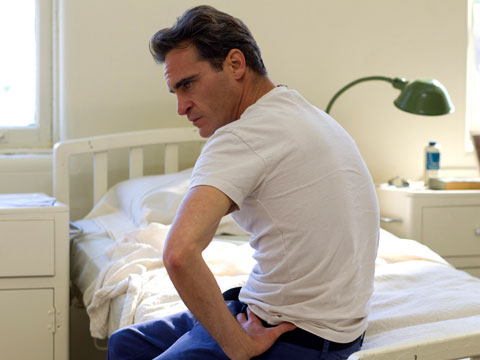
After useless psychoanalysis, Freddie turns the examination on others. 

So, you have a lot of surface, the brilliant spot-on "feel" of the production design by Jack Fisk and David Frank, the crisp cinematography of Mihai Malairemare Jr. , the individual performances of Philip Seymour Hoffman, Amy Adams, and (especially) Joaquin Phoenix on display, to an amorphous end that challenges, and often begs for, interpretation. Fortunately, the material is strong enough, and Anderson's contextual thesis is rich enough that one can throw all manner of thoughts into the stew, and make one's own meal out of it. 
We first encounter Freddie Quell (Phoenix) in the Navy during the battles in the South Pacific during World War II.
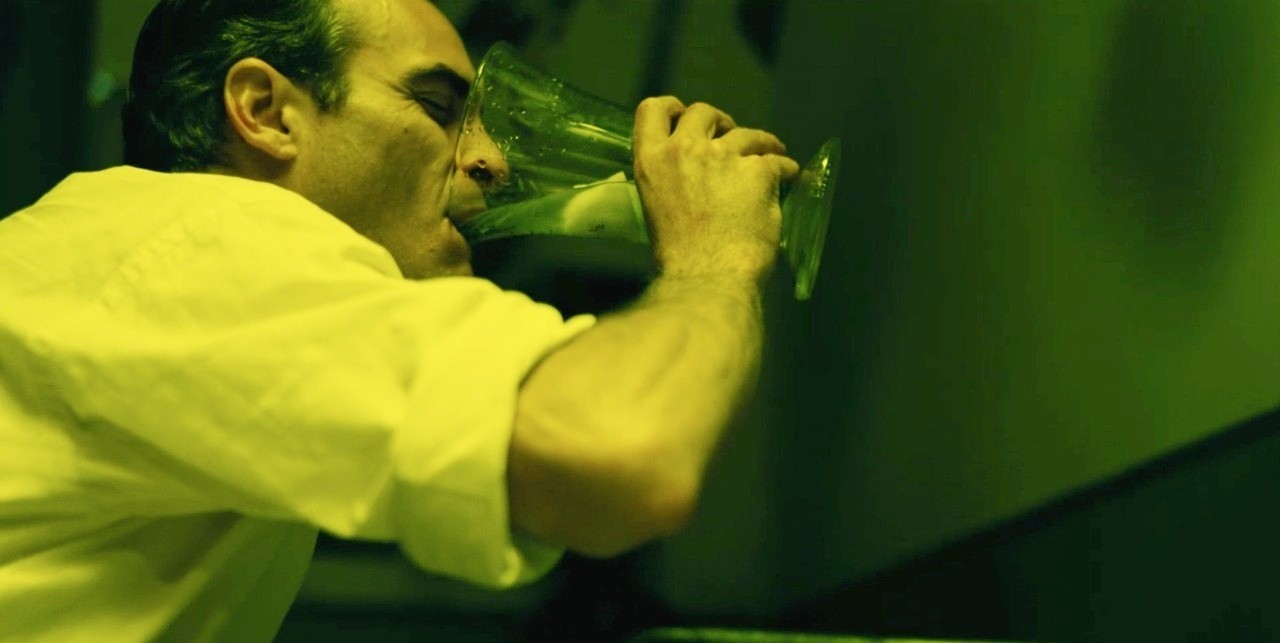
* Even there, in the midst of hundreds of young men in close quarters, he's an outsider, a loner connecting with no one except for his one discernible skill-mixing noxious brain-cell killing concoctions out of anything handy. He spends his time isolated, in some form of inebriation, the limits of behavior and humor blurred to indiscernibility, and when he's out of the service, he's immediately transferred to a psych division, where he is examined endlessly to no avail—the doctors are spending all their time trying to find the answer to what's wrong. 
It's all too obvious what's wrong—he's a barely functioning alcoholic obsessed with sex—but there's no cure for a complete lack of self-awareness or perspective, and Quell is released to the world, unchanged and unremorseful, just another problem that can't fixed and so is dispatched out of anyone's responsibility, to let Nature or Darwinism deal with him. He's a perpetual outcast on the edge of functionality, unstable and instinctually acting out. A job as a department store photographer ends up as an ironic choice—he spends his days looking in, trying to document normalcy, while on breaks, he uses his darkroom chemicals to create some bizarre cocktail to fry his brain and ease his isolation, while trying to make time with a store model. 
Phoenix is brilliant in this
, a raw nerve and not just mercurial, but mercurial at a high boil. The photography job ends with a violent incident of his own making, and he winds up as a migrant worker where, again, he moonlights with moonshine, and has to go on the lam where he stows away on a boat that has been commandeered for a wedding party.
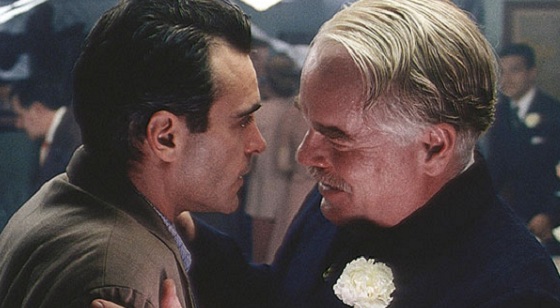
It's here that he meets Lancaster Dodd (Hoffman in a varied, extravagant performance that feels a bit like Orson Welles in Citizen Kane) self-described as "a writer, a doctor, a nuclear physicist and a theoretical philosopher. But above all, I am a man, a hopelessly inquisitive man, just like you."

 
"Just like you."
Yes and no. Dodd is the gypsy-evangelist of something called "The Cause," a nebulous philosophy for which he is the architect and messiah. The rules of The Cause change a bit according to need and the whims of Dodd (who erupts in petulant anger when challenged on it, by believers and non- alike) even though the origins of it supposedly date back "trillions of years" (later, his son will tell Quell "he's just making all this up as he goes along").
He's drawn to Quell for his potent concoctions, for his raw contrariness, which Dodd finds a challenge to his self-improvement methods (called "processing"), and because Quell's feral anti-social fury is a reflection of Dodd's free-thinking, but with the irresponsibility that he doesn't have the freedom to practice. Both men are self-medicating outliers, unable or unwilling to fit in—square pegs in the rounded holes of society.

For Quell, Dodd's processing is a tonic, though not as bracing as what he can make himself, a form of questioning self-examination that, instead of making one feel bad about oneself, makes one feel good. And for Quell, seeming to belong for the first time in his life, The Cause feels like home and family.

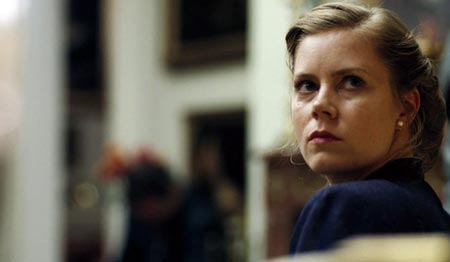
What color are her eyes?  You decide.

Not all the family is happy, though. Dodd's followers, including his Lady McBeth of a wife (Adams), fear Quell's aggressiveness and unpredictability, she especially questions whether Quell will ever improve and worries about the effect he will have on her husband and their cottage industry. Quell may be the best patient for the very therapy that they espouse, but the danger lies in how much damage he will prove to their house of cards in the process. It's a battle of co-dependents for The Cause, while the two men find the limits to their visions of paradise. There's a lot of room for mis-interpretation here, most especially in Dodd and Quell's scene in which the older man seeks to calm the emotions of both of them by singing, as if it was a lullaby, "(I'd Like to Get You on a) Slow Boat to China" which ends with the phrases "All to myself/Alone," emphasizing the isolation of both the Messiah and the acolyte, as they set themselves adrift.
So, in the end, once the credits have rolled up, what does it all mean? What's the point?** I'm honest enough with myself to say I don't have a flippin' clue, except what I've laid out here as themes and observations, but will admit that it is all up there on the screen, ready to be interpreted in as individual a manner as any audience member can provide, which is what makes Anderson (along with Terrence Malick, who is a bit more focused) one of our most enigmatic of filmmakers. Whether that makes him a visionary or a charlatan—like the filmmakers, captains of industry, and religious leaders he portrays, making it up as he goes along—depends on our interpretation, as well. And it is enough for me that he continues on the path he takes—not going for the easy superhero flick, or facile rom-com—without compromising anything...not even his intentions. It makes him brave, admirable...and always watchable. Challenging to be sure, but I like a challenge.
No, really. We're all together in this.

* One of the running motifs of the film is the time spent on ships of some sort, adrift.

** It's been amusing to read film critics struggling with this one, some finally merely knocking over their king to just call it a "character study."  It's a tough one, alright.  But, it is trying to say something about the human condition, even if only to say it has no easy answers, either, not even for those who espouse and specialize in easy answers.  I like that, but one wishes there was more provided by the film-maker, rather than just providing a rorschach test for us to throw our interpretations onto.

Thursday, June 16, 2022

Jurassic World: Dominion

It Comes Down to Animating Old Fossils
or
"It's Always Darkest Just Before Eternal Nothingness..."
 
Oh, they have been hyping Jurassic World: Dominion to the point where one doesn't have to see the movie to feel harassed by dinosaurs. There's a glut of advertising tie-ins, a "look-back" television special (which I admit I watched), and I'm sure there's a breakfast cereal ready to hit shelves ("T-Chex!").
 
If there is, I'm sure it will be rather stale.
 
This is the sixth "Jurassic Park" film in the franchise, the third in the "Jurassic World" sub-set, which, when written and published by Michael Crichton, seemed like the flimsiest of his high concept novels. The whole thing started as a 1983 screenplay about a lone geneticist creating a dinosaur with disastrous Frankensteinian results. But, Crichton couldn't crack the reason "why" a geneticist would do such a thing. He decided that the only reason to do it would be for entertainment purposes, so he spliced Americans' fascination with theme parks* with kids' fascination with dinosaurs, and (of course!) the thing was a massive best-seller. 
 
And a hit movie; Universal Pictures only agreed to Steven Spielberg's passion project Schindler's List (which they "knew" would not make money) if he first agreed to make Jurassic Park (which they knew would), and both films garnered the studio tons of money and awards. Spielberg even waived his own rule to not make sequels when he directed The Lost World years later. He is an Executive Producer on all the films.
But, that's all pre-history. What's this one about? Well, it's all about ecological catastrophe. The filmmakers have brought back the character of Lewis Dodgson (now played by
Campbell Scott), head of the rival genetics company BioSyn who has hired geneticist Dr. Wu (BD Wong again), who has engineered a super locust that decimate crops that are not grown with BioSyn seeds, thus cornering the market on food production and threatening a world shortage unless his products are not used. The Jurassic Park island of Isla Nublar was destroyed due to volcanic eruptions, but Lost World's Isla Sorna (or "Site B"), where the engineering work was done is still a preserve for some of the creatures. Dinosaurs are now migrating throughout the Earth, which would seem like a big deal. Raptor whisperer Owen Grady (Chris Pratt) and Claire Dearing (Bryce Dallas Howard) live in the Sierra Nevada Mountains, carrying for Maisie Lockwood (Isabella Sermon), the cloned daughter of an InGen executive. The surviving member of three trained raptors, Blue, is also living in the Sierra Nevadas.
 
Got all that?
BioSyn has been very busy, not just planning a world food crisis, but also trying to track Maisie and Blue's child Beta (wait, I didn't say that Blue reproduced?) to bring back to their Alpian HQ for study. Meanwhile, there seems to be a black market for capturing the animals—something that Dearing is involved in trying to stop. That's when Ellie Sattler (Laura Dern) starts to become interested in those locusts and their ties with BioSyn. She recruits Alan Grant (Sam Neill), who is always glad to see her, for a little tour of the BioSyn plant to see what's going on. And guess who's working for BioSyn now: chaos theorist Ian Malcolm (Jeff Goldblum)!
Meanwhile, back at the ranch, Grady and Dearing discover that Maisie and Beta have been clone-napped by BioSyn and they set off to get them back, using contacts from the CIA. They track them to Malta—where there is evidently a big black-market—and meet up with a pilot Kayla Watts (
DeWanda Wise), who had seen Maisie being transferred to a flight to Italy. So...everybody's going to the same place!
So...everybody's going to the same place and there will be dinosaurs there. You can guess the rest of the movie. Dinosaurs and humans do not mix unless it's in a dinosaurs stomach, so there's going to be a lot of threatened mastication going on. And a lot of running and hiding, and even more distracting dinosaurs with flares. In fact, there are so many of those, they could have just done it in one instance with a single J.J. Abrams movie
But, except for running around and hiding from dinosaurs, that's the rest of movie. The entire set-up has been explained and there's really nothing left to do. The trouble is the movie is set up like a bad Bond movie with a minimum of plot that merely threads action sequences. And, unfortunately, the stunt coordinator and second unit director is Dan Bradley (he's not listed in the movie on IMDB but his name is in the credits), who scurries through action sequences with quick shots that they barely register.
How's the cast? Well, Dern, Howard, and Goldblum do the best work—they also have the best lines—and Wise does some nicely laconic work as an Indiana Jones type. But, Pratt seems slightly disengaged as if he was thinking about the next project he's doing. And Neill is always a welcome presence, but his character has relatively little to do, so he goes in for that Harrison Ford-style mugging that was done in Return of the Jedi, just so he's got something to do.
But, the main attraction for the movie is usually the dinosaurs—and with the characters going by the numbers in this one, they have to be—and even there, this movie isn't all that impressive. Oh, the CGI wizardry has advanced so far from its origins in the original that you can practically see a brontosaurus' uvula for all the detail they put into it now. But, the CGI versions have less credibility than the puppets and animatronics—although a couple of triceratops babies look a little dodgy, too. There is no sense of wonder anymore, or sense of awe, especially as the 'saurs are moving so fast that they have less sense of mass...or threat.
As a result,
Michael Giacchino's score has very few places for John Williams' celebratory, awe-filled theme for Jurassic Park—just a couple of snippets here and there—and that tells you all you need to know about the movie: fast and transitory, not pausing enough to take anything in, or dwell on it. The ideas have all been mined, so it just jumps from danger sequence to danger sequence.
Perhaps it's time to take a break, not make any of these for awhile, and, in the meantime, take some of Michael Crichton's DNA and recreate him, just so we can get some new ideas. 


A sequence that was supposed to open Jurassic Park: Dominion but was cut for time.
Do you think anybody would be interested in a Director's Cut?
 
* Crichton had used the same theme of parks in his directorial debut, Westworld

Saturday, August 22, 2020

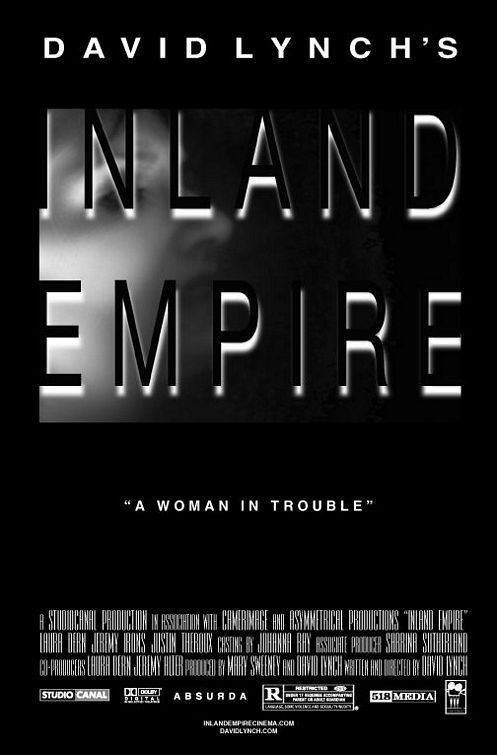
Inland Empire

Written (or composed) at the time of the film's release. It was an experiment to reflect the film's style. 

It failed...just like the film did.


Inland Empire (David Lynch, 2006) Lynch Laura Herring, with video, experimented in his lust for pulchritude, if you've admired, or even tolerated Lynch, and of all the cineastes experimenting with the format, Julia Ormond, he's the least successful. 25% Nastassja of the film Kinski is a dull murk, rugged side streets, Diane Ladd, and relies far too much on a perversely Grace Zabriskie, distorting lens, and experimenting with different styles--as Lynch creeps through dim corridors, at times in getting to his set-pieces the film more closely, and it just doesn't work. "You're getting to be a rabbit with me" Lot of big names: William H. Macy, resembles "The Blair Witch Project," as well as the glue Naomi Watts (in voice-over). Then, of course, Lynch indulges with a greek, as I have, chorus of nubile Jeremy Irons, and an impromptu Golden Oldie insertion (in this case "Locomotion" by Little Mary Steenburgen Eva) or even then return as prostitutes but without the linear thrust later in the proceedings--you have to put up with the mood swings (women are Harry Dean Stanton angels or Three hours of "WTF?" whores, in his movies) 
Oh yeah, did I mention that Saturday is "Take Out the Trash" Day?
between low rumbles and screaming decibels (at points behind inserting that doesn't hold the thing together--Laura Dern a screaming cockatiel at the 3/4 mark of Citizen Kane-"I wanted to wake the audience up." At times, yields potential starlets abundant dividends. Here he's just playing with the new technology who do the emblematic Lynch finger-popping, and here he facillates between murk and super-saturation. Lynch is playing with form, the blurriness of the vision exemplified by the blurriness of the video image.


Hey, Dave! Next time, write it when you're awake, buddy! Looking forward to the next one.

Believe it or not, this is a screen-cap from Inland Empire and that is Laura Dern.
Kinda...

Saturday, February 1, 2020

Marriage Story


"It's All About You" (But, It Can't Be About Everybody Simultaneously)
or
"You don't want to be married...not really." "But, I didn't want this."

Noah Baumbach's new film Marriage Story begins with opening arguments, like a trial, but with all the best intentions. Nicole Barber (Scarlett Johansson) in voice-over talks about the things she admires about her husband Charlie (Adam Driver). Never mind what the details are, they're spelled out on camera as she goes over them. Then, it's Charlie's turn. And as with hers, it's a glowing review of what impresses and endears Nicole to him. It may not BE them in reality, but it's what the other observes, retains, and endears that person to them.
In which case, it's just as much about the writer as it is the subject.

What those opening minutes is about is not opening arguments, it's therapy. Charlie and Nicole are in couples' therapy, trying to fix their marriage...or "re-adjust" it might be the better term. And when things have become strained—strained enough to go to couples' therapy—it's always a good exercise to do that "What I like about you" essay in order to try and re-ignite the relationship pilot-light that's been doused by coaxing the parties to recall why they got together in the first place. It's a history exercise while ignoring the history that has occurred since. Anyway, it's a good exercise for a counselor to try, especially if the pair are easily susceptible to reconciliation by just remembering what they've forgotten.
It doesn't work so well for Nicole and Charlie—they don't even read their essays. And Nicole is in such a state of agitated self-doubt, she doesn't think that what she's written is good enough. That's what she says, anyway. Maybe she thinks it's pointless to read it. Charlie, on the other hand, would be more than happy to read his—if Nicole will read hers. Maybe we should mention that Nicole is an actress and Charlie is a director. Both live in New York now and have for some time. Charlie moved there to pursue his theater ambitions. Nicole had made a splash in a teen movie and had moved to New York to pursue acting challenges and it's there where the two met, formed a theater company, and married and had one child, a boy, Henry (Azhy Robertson).
Charlie just won a MacArthur grant and Nicole has a chance for a role on a sci-fi series that shooting on the West Coast. Charlie's supportive (and all), but he won't be going with her because the little play she was starring in and Charlie directed is on a track to go to Broadway (BROAD-WAY!) and he kinda doesn't understand why she would leave the cast and go do that sci-fi thing. But, who knows if the pilot will get picked up so, sure, he's "okay" with it. "Go do your little space-pilot."
"What's this?" "You have been served."
But, what to do with Henry? Nicole's family is back there, so that's a slam-dunk. But, Charlie's doing all this prep for Broadway and trying to keep the company together, and it's a little inconvenient to go schlepping across the country to see his own kid.
So, are you starting to see where this is heading? Are you starting to realize why they were in couple's therapy at the beginning of the movie, even BEFORE we knew there were these issues? 
It becomes apparent that, when the pair aren't together, that Charlie is a bit clueless about what's going on and how deeply felt Nicole's alienation is, so when he goes out to Los Angeles and everybody from Nicole's family is all-smiles and glad to see him, he is caught flat-footed when he's served with divorce papers instead of a family meal. Then, the fine details begin to appear. The divorce is being done in L.A.—it was filed there, Nicole is residing there and that's where her attorney is—so Charlie, working in New York, has to travel to Los Angeles for it. It also means that if he wants custody—or even visitation rights—of his child, he must establish a residence in Los Angeles. As someone points out, if the kid's best interest is in mind, why is all the money for the kid's education being wasted for appearances sake?
The first lawyer Charlie consults (Ray Liotta) has a good reputation of being a bad-ass attorney and, resultingly, a high retainer and their first interaction does not go well—the attorney is already in attack mode and Charlie hasn't quite gotten there yet as it's all pretty new to him. It also seems that the way Charlie has lived his life has been completely counter to how the law system will favorable grant him a consideration of custody. 
He switches tactics then, going with a more folksy lawyer (Alan Alda), who is more human but less effectual, has the warm-fuzzies and keeps it on a more human level and (frankly) is a last resort to meet a filing deadline, which could have lost him custody—or any visitation time, even if he'd been Mother Theresa.
Nicole, on the other side of the judicial scales, has hired Nora Fanshaw (Laura Dern) who has a warm, sympathetic side and a competitive side, wanting the best outcome for her clients, but one also gets the impression it's all about her. Let's be fair; all the lawyers have that and how they play up the customer service aspect is based on their personalities. Like psychiatrists, one has to find the right fit, and that may take many tries. But one thing is consistent: the laws are made to benefit lawyers, not real human beings. They do their dance, wear their outfits, and rely on the least common denominator, or the people who throw up their hands in frustration at the slightest complication for the system to deal with its clutter. The legal system is a jungle and its survival of the fittest, or the most stubborn, or the ones with the most money.
The devil is in the details and Baumbach's meticulous piling-on of the roadblocks and legal hoops makes the compelling case that the charitably nimble are the one best able to adapt of the species. He's aided and abetted by extraordinary performances throughout, but chief among them being his leads, Scarlett Johansson and Adam Driver. Talk about nimble: Driver has always been good—he's a subtle chameleon—but Johansson is so good that she is frequently taken for granted (Hmmm...). Both actors give a master-class in making the mundane interesting and Baumbach's unforgiving camera would pick up any false note that might flicker across a face. There's no danger of that with this cast, with Liotta being the most theatrical, Dern being the most calculating and Johansson and Driver being the most fiercely submerged in their parts.
Any movie is reflected and consumed by what the viewer brings to it, whatever life experience and prejudices they kaleidoscope it through. During the watching of it, I kept wondering if Baumbach's sympathies were with Charlie than Nicole (he's not—Charlie's the most screwed up of the couple and has the most territory to change in the plot) and whether some reviewer is going to dismiss it as an irrelevancy and another film about the troubles of the White-Privileged. Sorry, but the cast of Parasite could play this movie, and it would be just as pointed with David Oyelowo and Taraji P. Henson top-lining it. I'd love to see that movie. But, this is superb just as it is.
My favorite shot of the film—it's a last-minute visual pun, but also
shows that Driver's Charlie has turned a corner.
I've never flat-out loved a film of Baumbach's before, although I know lots of people who've regarded well The Squid and the Whale (which I'll have to revisit—I'll become a big fan of Jeff Daniels in the last year)or Margot at the Wedding or Greenberg (which I'll re-post reviews of next week)—after seeing those three, I'd passed on Baumbach's work ever since (with the exception of his documentary about Brian DePalma because...well...DePalma), but I'm attempting to get through The Meyerowitz Stories (it's tough) and I suppose Frances Ha is a "must." But, frankly, Marriage Story is such a revelation and engaged me far more than any of his films have.  
In fact, it is hard for me to decide which is the best film of the year—this one or Greta Gerwig's Little Women. But, given that the two are a couple, and the film's couldn't be more different from each other, I'll pass on deciding which one is the better. I'd hate to come between the alliance of two such extraordinary film makers.

Even if their next work is a collaboration, Barbie, about (yes) a Barbie doll that wants to escape her Malibu Dreamhouse existence for life in the real world.