Showing posts with label J. Show all posts

Saturday, November 23, 2024

JFK

JFK
(
Oliver Stone, 1991) 
 
"To sin by silence when we should protest makes cowards of men."
 
At the time of this film's release, Stone's movie-collage of Kennedy assassination conspiracy theories was more than controversial, it was inflammatory. Experts in "the field" criticized it for playing fast and loose with facts and some went so far as to call it dangerous in its implications. There was so much flummery going on, some of which contradicted other speculations of the film, that it was considered a new form of propaganda, where new possibilities popped up before previous assertions were followed up on, that one was simply overwhelmed with the slew of speculations so that, finally, nothing was ever concluded. There were no answers, merely a mountain of questions, all of them vague and unsubstantiated. Stone was merely throwing stuff up at the screen and seeing if anything stuck.
Stone answered these charges by saying that he was making a new kind of film, and that he was trying to build a new narrative for the Kennedy assassination, not provide a definitive answer, but to ask questions, merely. The evidence of film bears it out—at least at first glance—as it's so filled with theories and goes down so many rabbit-holes, unchecked and unverified (Stone has stated he was using the films Rashomon and Z as his models). But, one only has to see how Stone starts the movie to know where he thinks the center of the conspiracy lies. After that quote by author and spiritualist Ella Wheeler Wilcox, he introduces Kennedy's predecessor, Dwight Eisenhower's final address as President, in which he warns of "the military-industrial complex". Like so many openings of so many movies, it is the director's thesis statement, providing that one bit of detail before launching into a history of Kennedy's recent history (narrated by Martin Sheen, who has played both John and Robert Kennedy in the past).
"I'm ashamed to be an American today."
The film proper begins the day of Kennedy's assassination as New Orleans District Attorney Jim Garrison (Kevin Costner, who had, in 1998's Bull Durham, delivered a speech in which his character states "I believe that Lee Harvey Oswald acted alone.") sees the assassination coverage on television initially in his office, then watches mournfully from a nearby bar where the local booze-hounds are free to weep in their beers or grunt their approval of the President's death. At the same point he cuts away to an argument between two men in the bar, New Orleans private detective Guy Bannister (Edward Asner) and an operative Jack Wheeler (Jack Lemmon),* which leads to a fight in Bannister's office when Martin brings up past suspicious activity. Meanwhile, Garrison starts looking into local links to the assassination and brings in pilot David Ferrie (Joe Pesci), who might have had links with Oswald. And despite Ferrie being sketchy and giving conflicting stories, they let him go.
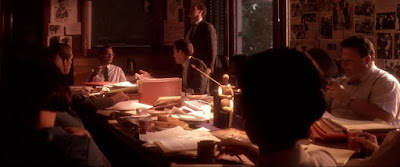
"It's all broken down, spread around, you read it and the point gets lost."

It is only after the Warren Commission Report on the assassination is released that Garrison picks up the threads of the case again. A chance airplane encounter with a Senator (Walter Matthau), whose skepticism —"That dog don't hunt!"—about the report sparks Garrison to again call in Ferrie, but also Martin, who had seen Lee Harvey Oswald in Bannister's office and follow up leads not explored after the initial inquiry was dropped. One name keeps popping up—"Clay Bertrand" but nobody knows who that is. Turns out that "Bertrand" is an alias of Clay Shaw (Tommy Lee Jones), well known in New Orleans business circles as a wealthy benefactor and who had connections with Ferrie and thus Oswald. Garrison and his team have Shaw picked up for arrest despite their inquiries producing only denials.
 
"Oh, you are so naive"
 
One aspect of the film that is both a high achievement and problematic is the way that it mixes archive footage with deftly re-created new footage in such a way that it is nearly impossible to determine one from the other. Stone and his cinematographer, the wizardly Robert Richardson, mix and match formats, color and black-and-white, 35mm and 16mm, and all sorts of film stocks to create and re-create source footage and the results are nearly indistinguishable, especially the way they are cross-cut between each other. It lends the air of verisimilitude—and certainly adds a dynamic tension between the transitions—but one is never sure if one should believe what one is seeing. Is that press footage from the day of the shooting or is Stone just fabricating something he wants you to see?
It's troubling. There's a fine line between making it look right and obfuscation and given that film, by its very nature, is manipulative—even with documentaries—the level of distrust this attention to detail evokes is extremely high. What are we to believe? The answer is whatever the director wants you to believe. And given Richardson's deserving Oscar-winning work on this film to match the look, the grain and the confusion of archive footage, some of which might even be familiar, distinguishing the true from forgery is almost impossible. And audiences become susceptible.
One should always be aware that it's a fictional film of real-life events. And rather than speaking truth, it can only come up with conjecture.

 
"And the truth is on your side, bubba."
 
Stone makes his own case on what happened in a middle sequence where Garrison goes to Washington D.C. to meet an informant, a former military official who only identifies himself as "X" (Donald Sutherland, who's brilliant in a role of pure exposition). That Garrison would fly to D.C. to meet an anonymous source strains credulity (he surely must know his name before agreeing to meet, but then, the reality is Garrison never met this character, communicating with him in un-cinematic exchanges of letters).
It is 'X''s contention that Kennedy was making feasibility studies for withdrawing troops from Vietnam—"X" was doing the inquiries—and that this rattled the cages of the Pentagon and the CIA. "X" is unexpectedly assigned to...Antarctica...and only learns of the assassination the next day when he reads a New Zealand newspaper that has a full run-down on Oswald as the assassin when he hadn't even been charged yet. To "X" this smacks of "black ops" work (which he also used to do). Oh, and did I mention that "X" was also part of Kennedy's security detail? "X" seems to have got around.
Anyway, by the end of his exposition, "X" has a conspiracy that could involve the Pentagon, "the military-industrial complex", FBI, CIA, Cuban exiles, the Mafia, the Secret Service and Lyndon B. Johnson—he was in the fired-upon motorcade, after all—and all of them had grudges against Kennedy, but mostly, they didn't want to cease operations in Vietnam which was making a lot of people a lot of money. This is the same Vietnam War that Oliver Stone fought in from 1967 to 1968 with the 25th Infantry, which was a traumatic experience for him, and that he has made the subject of three of his films.
"X" refuses to come forward with this information and flat-out refuses to be a witness for Garrison's prosecution, but "X" tells him that his best chance is that he's the only guy conducting a trial involving the Kennedy assassination. "
Your only chance," he says "is to come up with a case. Something. Anything. Make arrests. Stir the shit-storm. Hope to start a chain reaction of people coming forward. Then the government will crack." And, with those words of encouragement, he walks away, leaving Garrison hanging. Stone cuts to the Eternal Flame at Kennedy's grave. When Stone gets in trouble, he goes for sentimentality.
The film's last hour is that most deadly of momentum killers, a trial, with Exhibit A being a long speech by one character...in this case Garrison.* That speech wouldn't stand in a court of law and it isn't made clear if it's a closing argument (that barely mentions the defendant Clay Shaw) or a part of Garrison's evidentiary overview (it starts with objections from the defense and then they are never heard from again), but Stone is dramatically stretching truth...and credulity...to make his point. And it goes on forever, like the stultifying final speech in court in Ayn Rand's The Fountainhead. It's only Stone's direction, Richardson's chameleon cinematography and Joe Hutshing and Pietro Scalia's quick-silver editing that keeps it interesting as film. And almost impossible to make counter-arguments against the assertions, they come so fast and furiously.
Stone's film ends with "what's past is prologue." Okay, so let's look at the past. All previous American political assassinations, successful or otherwise, before and after Kennedy's own, have been due to "lone gun-men" (or women). The most suspicious shooting is that of Martin Luther King, Jr.  And most damning of all, recent events have seen Presidents and Vice-Presidents questioning or ignoring, even humiliating their own intelligence or military agencies...but manage to remain very much alive. Kennedy was less of a threat...he merely wanted to wind down a war...as has been done recently...and Stone would have you think he was killed for it.
Yet, History doesn't bear that out. In fact, though they may rebel (or at least write a book), they don't assassinate. "That dog don't hunt."

Remember, "what's past is prologue."
But, the film did have an impact. 99% of the documents that were sealed after the assassination have been brought to light, particularly to the issues raised in the movie (The President John F. Kennedy Assassination Records Collection Act of 1992 was passed in 1992, the year after the movie's release). Although the stated goal of the act was to release all documents by October 2017, some still have not been released. Trump went back on a promise to release them pushing it back to when he was out of office, then Biden delayed them (COVID...for some reason) then released some in 2022 and 2023.** We're at 99% except for those that would cause "identifiable harm... to the military, defense, intelligence operations, law enforcement, or conduct of foreign relations... of such gravity that it outweighs the public interest in disclosure."
Same old excuse. "It'll keep us from doing our jobs" they say, even if those jobs have dramatically changed in 60 years. But, if JFK is worth anything, it is for its shaming of our government agencies' lack of transparency to commit them to act in that 1992 law. Six decades is two generations of secrets. Too many people and too many prominent people have expressed their doubts to not have as many answers as possible to wash away as many questions as possible.
Not that that will make a difference. We've reached the Age of Un-reason where nobody believes their own eyes anymore. If everything was released, unredacted and transparent, it is doubtful that the truth would be accepted...especially by those who make their livings as professional doubters and skeptics.

The true conspiracy has always been theirs. As in the mantra of All the President's Men, one merely has to "follow the money."
"It's up to you."
 
* The film is awash with cameo's and "guest-stars" in what Stone intended to be like the roster of The Longest Day, but it feels more like the many odd cameos in The Greatest Story Ever Told, that seem ill-though-out and are actually distracting and pull you right out of the movie. John Candy? 

** This is just part of Garrison's summation from the film:
The Warren Commission thought they had an open-and-shut case. Three bullets, one assassin. But two unpredictable things happened that day that made it virtually impossible. One, the eight-millimeter home movie taken by Abraham Zapruder while standing by the grassy knoll. Two, the third wounded man, James Tague, who was knicked by a fragment, standing near the triple underpass. The time frame, five point six seconds, determined by the Zapruder film, left no possibility of a fourth shot. So the shot or fragment that left a superficial wound on Tague's cheek had to come from the three shots fired from the sixth floor depository. That leaves just two bullets. And we know one of them was the fatal head shot that killed Kennedy. So now a single bullet remains. A single bullet now has to account for the remaining seven wounds in Kennedy and Connelly. But rather than admit to a conspiracy or investigate further, the Warren Commission chose to endorse the theory put forth by an ambitious junior counselor, Arlen Spector, one of the grossest lies ever forced on the American people. We've come to know it as the "Magic Bullet Theory." This single-bullet explanation is the foundation of the Warren Commission's claim of a lone assassin. Once you conclude the magic bullet could not create all seven of those wounds, you'd have to conclude that there was a fourth shot and a second rifle. And if there was a second rifleman, then by definition, there had to be a conspiracy.

*** Whether Trump will release any more documents in his next term one can only speculate. I don't believe a word the man says so even if he says he will, I'd be looking at updates on the website: https://www.archives.gov/research/jfk

Thursday, November 7, 2024

Juror #2

A Rainy Night in Georgia
or
Juris-Imprudence (So, Help Us, God)
 
If I recall (having seen every episode) Clint Eastwood never appeared on the old "Perry Mason" TV show—one of the few elder statesmen-actors still working not to do so (and he was working for that show's network at the time). He seems to be making up for that with Juror #2, a courtroom drama with enough twists and turns to make Perry trip while hulking out of his chair at the defense table (come to think of it they rarely had juries on the "Mason" show—budget, you know).
 
James Michael Sythe (Gabriel Basso) is being tried for the brutal murder of his girlfriend, Kendall (Francesca Eastwood). They'd been seen fighting at a local watering-hole on a dark-and-stormy night and the politically-inclined District Attorney (Toni Collette) makes the case that Sythe was seen following after the victim as she was walking home in the torrential down-pour. Her body was found the next morning in a culvert under a bridge dead from blunt-force trauma. His attorney (Chris Messina) argues nobody saw the murder (even if a lot of people saw the fight at the bar). No murder weapon was found and Sythe maintains his innocence. One of the jurors, a retired copy (J.K. Simmons), says "He shoulda took the plea deal." 
But, one guy on the jury, Justin Kemp (
Nicholas Hoult), expectant father and reluctant jurist, isn't so sure. Once on the jury and hearing the details of the case, he starts having flash-backs of a night a year ago, when he was at the same bar the night that argument happened, but his wife had just lost twins, and he was thinking of having a drink, despite being in AA for four years sober. He remembers driving down the same road where the girl was killed and, distracted by his phone, took his eyes off the road and he hit something. Hit something hard. But, getting out of his car and looking around, he saw nothing, and, supposing he'd hit a deer and it ran off, he got back in his car and drove home.
Now, sitting in court, hearing the particulars, he's not so sure. Maybe it was this girl, Kendall, that he hit with his car. Day after day he sits in the courtroom hearing testimony from investigators and expert witnesses all leading to the suspicion that it was Sythe who did it deliberately. The trouble is: nobody saw him do it. It's all circumstantial and speculation. And the more Kemp hears, the more he thinks he might be the guilty party and the guy he's going to sit in judgment of is innocent.
What would you do, dear reader? I'd like to think that you'd do the right thing and turn yourself in and let an innocent man go free. But, my reading of "the times" (and the lack of civics classes in public education) tells me that nobody admits to doing anything wrong if nobody knows about it. Let sleeping dogs lie. Nobody's getting hurt. It wasn't my fault. I needed the money. I had a rotten childhood. In today's environment, George Washington would have hid the axe. Honesty's for suckers and losers. Kemp's excuse is he has a family with a baby due any minute, he can't do that to them.
But, what about Kendall? Her aggrieved family? What about the schlub who's being railroaded by the cops and the judicial system and may go to prison for life for something he didn't do? Is that justice? Kemp goes to his AA sponsor—a lawyer (Kiefer Sutherland)—who tells him vehicular man-slaugher will get him 30 years to life if he admits what he did, but maybe, just maybe, the jury will find the guy innocent and the problem will just...go away. And when closing arguments are over and the case goes to the jury, it is near-unanimous that Sythe should go to prison—except for one juror, Kemp. And he begins a methodical, near desperate process to convince the fellow jurists that Sythe is not guilty...within a reasonable doubt. And he's the perfect man for the job...as he may be the guilty party.
It sounds like an upside-down version of 12 Angry Men—the television-play and movie where one jury-member tries to convince his determined fellow jurists that the person they're supposed to judge is not guilty (and for a while it goes down that path)—but, there are complications and points of jurisprudence that threaten to up-end the entire trial. But, what none of the members of the court see is that they've got the wrong guy (sure, they've got the most likely guy), but what they don't see is the responsible party is right under their noses, and he is completely irresponsible to do what is expected of him—to do the right thing. Justice really is blind here, as Eastwood keeps visually reinforcing again and again and again.
It's a different movie, one that Eastwood's fans might not cotton to as it features nobody to root for, and the protagonist is dishonest, vulnerable, self-interested and...the worst sin of all, has self-doubts. Usually in Eastwood's film of choice, they're stalwart in the face of implacable enemies and chart a straight course towards what is a resolution or usually revenge. Sure, there have been vulnerable Eastwood protagonists, flawed Eastwood protagonists, even Clint veered off the straight and narrow in things like Bronco Billy and Tightrope. But, to have self-doubt come into play, I think you'd have to go all the way back to...Breezy. And not only self-doubt. In another age, at another time, one could see Kemp as a villain, a slightly sociopathic one with a narcissistic tunnel-vision that prevents him from seeing anything beyond his own situation. He's at least a coward, and a selfish one at that. Let another man rot in jail for something he did? What a lying skank.
But, that, the movie is saying is the point. At one point, the judge in the case tells the jurors "this process, as flawed as it is, is still the best way of finding justice." But, is it? In a world of people of good faith and strength of character, it very well may be. But, it is dependent on honesty and the penalty of the law. If everybody is lying on the stand, without the fear of perjuring themselves, the system ("flawed as it is") is worthless. Anybody not doing their job rightly, be they police, lawyers, judges, or witnesses threatens to derail any pretense of achieving "justice." And in a worthless system, where justice may actually be derailed, everybody is at risk. You only have to look at the work of the Innocence Project to see the results of a process that doesn't care about truth or innocence but only in the "feeling" that it's good enough or to make things seem done (hence the dependency on plea-deals). People fall through the cracks in such a system and then become lost in it. And some die in it. You can't seek to rid Society of corruption with a means that, in itself, is corrupt.
 
Eastwood hasn't done anything like this before—although Mystic River comes close—basing his movie around "the bad guy" (if we want to be simplistic about it), however self-serving the character's rationalizations for doing so. And he's aided immeasurable by the one thing Eastwood has always excelled at: casting. Everybody in this is playing top of their game, but none so much as the seemingly ubiquitous Nicholas Hoult. Hoult has an open face like a young Tom Cruise (back when he could play vulnerable) but the eyes are haunted and tentative like they're already seeing what's about to happen...and dreading it. And there's just enough doughy softness to him that you might end up caring about what happens to the guy, even though the moral quagmire the movie negotiates makes you want to see him get his "just desserts."
 
I was going to end this review with a rant about the Warner Brothers studio only releasing this one to 50 theaters (the reason being that Eastwood's last feature Cry Macho under-performed at the box office which rankled the WB CEO and made him wished he'd never financed it, despite Eastwood earning Warner a couple billion dollars easily from his output). Eastwood made this movie at the age of 93 (which is astonishing) and there is "talk" about his retiring—I doubt he will—so it seemed a churlish way to put one of your big earners out to pasture. But, evidently, the film is making enough money in the U.S. (and Eastwood's films always do well in Europe) that the studio is increasing the number of venues and extending its limited run in existing theaters by a week.
 
So, no rant. Merely a grumbling acknowledgment through my teeth that the theater situation is "not as bad as it could've been." And a grim smile while saying you should try to find a theater nearby that's showing it and see for yourself. This is a good one. And it might be the last chance you get.
"Courtesy Warner Brothers" Yeah, I suppose...

Wednesday, October 16, 2024

Joker: Folie à Deux

Doubling Down on a Pair of Jokers
or
The Roar of the Greasepaint (The Smell of the Crowd)
 
Folie à deux (French for 'madness of two'), also called shared psychosis or shared delusional disorder (SDD), is a psychiatric syndrome in which symptoms of a delusional belief are "transmitted" from one individual to another.
 
Re-reading my review of Joker—a film which earned a billion dollars in revenues and secured Joaquin Phoenix a Best Actor Oscar—I soft-pedaled my major reservation to the film, which was "if you're going to make a movie about a comics fan-favorite with a proven track record, maybe you should stick a little closer to the source?" The Joker, of course, was a villain—some would say THE villain of The Batman series—but the Joker without Batman is a bad guy with no opposition, a villain without redemption, and the stomping grounds of Gotham City merely a 'burg without hope...not someplace you want to go to have a good time. Director Todd Phillips went a different route through town, basing his version of "Joker" on two Martin Scorsese movies (Taxi Driver and The King of Comedy), but without that director's Catholic horror at the consequences of dwelling incessantly in an isolated mind with delusions of grandeur. Centering your film around such a character was always going to be morally questionable and never on the side of the angels.
The movie, however, was a hit. And in the movie business, when you have a hit, you make a sequel, because, in Hollywood, lightning always strikes twice in the same place, despite overwhelming evidence of diminishing returns, both artistically and financially.
 
So, here, we have that sequel, Joker: Folie à Deux, which was trumpeted as a continuation of Phillips' Joker story, but adding another character from the Batman series (initially "The Animated Series" actually), the Joker's hench-woman and moll, Harley Quinn—probably the most toxic relationship in any comics setting, even more than the brick-throwing antics in Krazy Kat. But, Phillips puts the same anti-clockwise spin on the story, leaving behind the comics and the arcana. And starting fresh with old jokes.
The new film starts with a cartoon made by the animation team directed by Sylvain Chomet who made The Triplettes of Belleville as well as the unrealized Jacques Tati project, The Illusionist
. It's a deflection—a lot of the movie is (as was the last one)—for when the blood-red curtains ending the cartoon open, we cut to the reality: Arthur Fleck (Phoenix) incarcerated in a wing of Gotham City's Arkham Asylum (done in full Titticut Follies grimness). Every morning, the wards are opened up by the guards (including Brendan Gleeson's Jackie Sullivan) so that the inmates can empty their bed-pans and get their requisitioned meds. Sullivan always begins the day by asking Fleck "Got a joke for me, Arthur?" but lately the erstwhile "Joker" has been silent.
You see, he's awaiting trial for the murder of talk-show host Murray Franklin, as well as three toughs who assaulted him on a subway, and for an unnamed orderly at Arkham (all presented in the first film). His attorney (Catherine Keener) has been diligently working on his case trying to keep Arthur appearing normal so she can plead insanity at his upcoming trial to keep him from being executed. But, Arthur's reputation precedes him like a shadow—he did, after all execute Franklin on live-television. And, there are those "Joker" fans in Gotham, fanning his flames—there was even a made-for-TV movie about him that gets mentioned a lot. Things are not looking good for Arthur.
That is until his relatively good, albeit drugged, behavior allows him to participate in a music-therapy program in another wing, where he meets Lee Quinzel (Lady Gaga), and their mutual attraction begins to perk him up. Just like in the cartoon at the beginning, Arthur starts to break into song—but just in his imagination—old standards like "If They Could See Me Now," "For Once in My Life," "They Long to Be (Close to You)," "To Love Somebody,""Bewitched," "That's Entertainment!" and even "The Joker" from the Newley-Bricusse musical "The Roar of the Greasepaint! The Smell of the Crowd!" (which is a little too on-the-painted-nose) others start popping up whether it's just Arthur standing in front of a TV, or director Phillips goes off on some extravaganza set-piece (he's already made a shot call-back to The Umbrellas of Cherbourg, so it isn't unsuspected.
The trouble, though, is pacing. Just as Joker would stop-cold whenever Phoenix had a chance to improvise for the camera, Folie a Deux stutters to a stop—or at least a slow crawl—whenever the music starts. The songs aren't delivered as bouncy show-stoppers, but slow internal monologues with hesitant half-hearted voices (even the Gaga), so there's a slight cringe factor whenever someone starts to break into song, off-set somewhat by the anticipation of what musical style Phillips will borrow (will it be La La Land? M-G-M? The Sonny and Cher Show?), and long after the joke wears a little thin, it will still be crooning along until somebody snaps out of the reverie. It tries the patience.
It will try the patience of comic book fans, as well. Just as Arthur is not "The Joker" of the comics (no, really), Lee is not Harley Quinn in any sort of incarnation, animated, live action, or four-color. The original Harley was a psychologist at Arkham Asylum, who fell under the Joker's spell during evaluations of him at the facility, and then things get a little muddled as she acquired above-human abilities and an acrobat's agility. For the longest time, she was attached to Joker's hip as a moll, henchwoman, girlfriend, soul-mate, but, eventually, that relationship became so damned toxic—they're both crazy, after all, and homicidal—that to keep Harley Quinn a viable character, keeping them apart seemed the only answer with DC Comics acting as the aggrieved parents pushing the couple apart. But, Lee in  Folie 
à Deux is somebody else. She's initially a fellow inmate, a firebug committed by her parents who happens to meet Arthur by accident and the sparks (heh) fly. But, even that's not right. In this, Lee is a hanger-on, like those souls who marry incarcerated prisoners for whatever reason—"in love with being in love" (but without conjugal obligation) reflected glory, "I can save them" fantasies, or just plain "bad wiring"—and she had herself committed with the intention of sharing his glory.
But, when Arthur is on trial, eventually serving as his own defense attorney (with Harvey Dent—played by Harry Lawtey serving as prosecutor), he's confronted by the reality of what he's done, and seems less the mythic failure of chaos and societal retribution, but, a flawed, screwed-up schlub, Lee dumps him, taking away the last shred of fantasy he has—even his fan-base becomes threatening to him, leaving him a good deal less better off than he was before.
Fantasy versus reality comes to a hard truth: that maybe the love of his life isn't what he thought it was (but, then, they did this in the first movie) and that the thronging crowds supporting him are merely a slathering mob there for their own self-aggrandizement (I've seen that one, too; I watch politics). Fleck has to confront the horrors of both of those realities and when they hit, there's no song or fantasy sequence to play him out.
Now, this all plays right into my film-philosophical wheel-house where love is a form of insanity and musicals are a false form that breaks the agreed-upon screen/reality wall to have characters break into unchallenged song to express internal emotions they're incapable of with mere dialog. What Phillips has done seems perfectly natural to me in the crazy-illusion film-world, especially when combined with lunatic characters like Joker and Lee. Sure, the film has flaws—I've brought up the pacing issue—but all the actors are great in it, including Phoenix and Gaga, and the concept is just enough "out-there" to maintain the themes of the first film and build on them.
And what is the theme? I'd contend that it's a cock-eyed continuation of a couple expressed in
Christopher Nolan's Batman series—"You either die a hero or you live long enough to see yourself become the villain" (even if you actually start out as a villain but are a hero in your own mind) and where the symbol is the powerful thing, not the man inhabiting it. In the movie, Arthur Fleck isn't competent to carry on the mantle of "Joker" and he gets rejected.
Remember what I said about basing a movie on a villain unopposed, without redemption? There's no future in it. But "The Joker" is a popular character, some poor souls might say he's more popular than "The Batman" himself. So, you make a movie about him. But, "The Joker" that everybody (meaning the fan-base) likes is the agent of chaos, the contrarian, the one who's in control of things and leads the heroes on a merry—if deadly—chase. The Joker That brings in the box-office bucks is the one ahead of the game. That's the Joker that people respond to. That's The Joker that has fans.
This "movie-Joker" is not him; he's never in control. And I think that was always Phillips' intention with Arthur Fleck. A guy who fell between the cracks and by acting out inspired mob-hysteria among the anti-social. Joker: Folie 
à Deux—the name means so much more when you consider all this—is the the natural continuation of this premise and the logical conclusion. The movie does exactly what it wanted to do, bless its twisted little heart.
The result, of course, is the last riotous laugh: the movie is being rejected by its fan-base. Not because it's musical, but because this Joker is a loser. In many fan-circles, you can do bad things—horrible things—but, you can't be "a loser". That does nothing for fans wanting to identify with an agent of chaos, or see The Joker as the guy in charge manipulating the "order" of things. So, the sheep are rioting...or doing what sheep do when they protest, they find another patch of grass to gnaw away on and ignore what's not working for them anymore. As in the Who song "Let's forget you/better still" and find some other power symbol for their needful mimicking narcissism.
 
And that's the truth of it. Power fantasies are merely that. Fantasies. And when the fantasy fades away, well, as Arthur says "You get what you f-ing deserve."
 
"You can say that again, pal!"

Wednesday, August 14, 2024

Jim Henson: Idea Man

I'm Your Puppet
or
Having a Hand in Everything
 
When I was growing up, I fixated on several things to the point of obsession. One was the comic-strip Peanuts. One was America's Space Program. Howdy Doody. Looney Tunes cartoons. J.P. Patches (if you know, you know).
 
Puppets. I think I watched everything that Paul Winchell did. Kukla, Fran and Ollie, Shari Lewis.
 
And Jim Henson. This was before he became the creator of "The Muppets," and was an up-and-coming skit contributor—he'd appear on "The Ed Sullivan Show" and other variety venues, and he had a regular "gig" on "The Jimmy Dean Show" with Rowlf the Dog.
 
But, Henson did things differently. His "bits" would be his bizarre looking puppets (including one which would become well-known as "Kermit the Frog") lip-syncing to some popular record and the bit would usually end with some 90° turn, sometimes violently. They were hilarious and seemed to erupt from some fertile ground of imagination that none of the other entertainers on "The Tube" seemed to have access
.
Henson hadn't intended to become a pioneering puppeteer. He just wanted to get into television, a medium that fascinated him. Although he'd been introduced to puppetry watching the tube, he wasn't personally involved with the art until his last year at Northwestern High School in Hyattsville, Maryland, continuing to study it at The University of Maryland, College Park, where he met his "Muppets" partner and future wife, Jane Nebel.
With wife Jane, Henson devised the skits and bits that the Muppets performed on local and national television shows, as well as doing commercials. On weekends, he began experimenting with film projects, exploring stop-motion animation, rhythmic editing, and juxtaposed cross-cutting. His first, Time Piece, was Oscar-nominated for "Best Live Action Short" in 1965 (it's presented in its entirety below).
Kermit's origins began from the discarded green coat of Henson's mother.
The rest you no doubt know, from Henson's work on Sesame Street—also directing many short avant-garde films for various "numbers" segments—with its vast array of puppets and full-size figures to walk on-set, "The Muppets Show" and movies, "Fraggle Rock," a brief recurring stint on the first season of "Saturday Night"—the percursor title for "SNL," the films The Dark Crystal and Labyrinth. Hundreds of hours of content for movies and television. Plus innovations in puppet-performing, animatronics, special effects, and film-making...not to mention overseeing the construction and manufacturing of building imaginative creatures.
Painted halved ping-pong balls for eyes...
Now, Ron Howard just made a documentary about Henson—Jim Henson: Idea Man—and has been the case for Howard's product lately, it didn't get a theatrical release, but went straight to Disney+ for streaming (except for an appearance at the Cannes Film Festival) on May 31, 2024. So, what was it doing as an ABC special this past Sunday? Disney+, being notoriously stingy with their streaming product, put it on broadcast television within 3 months of its premiere...that's a bit unprecedented. But, follow the logic: Henson's Muppet properties (except those wholly owned by Henson) are owned by Disney. Disney also owns the ABC network, and the night it premiered NBC was airing the closing ceremonies of a much-storied Olympic Games. ABC needed to put something special up rather than roll over and die in the ratings. It's as simple as ABC. Or ABC/Disney.
The fledgling Muppet crew
Howard, who has had an illustrious career as a director—aside from his acting career—has turned in another "safe" documentary. Chapter headings, talking heads (good ones!), a smorgasbord of clips that would even please The Swedish Chef, and a design sense based on things Henson himself had innovated. It's by-the-numbers, like a Ken Burns documentary without that director's eye towards the breath-taking shot, the spurious but telling anecdote and the impeccable eye towards getting the most out of a photograph. Howard colors inside the lines.
Howard is no innovator. His films have no mystery, they never haunt, and they never linger in the mind with deeper implications. He tells the story, simply, effectively, and gets out leaving no after-image. Where a recent documentary on Fred Rogers by a great documentarian like Morgan Neville will leave you in contemplation, Howard makes you feel like you've heard the story enough to feel satisfied. It's like a bed-time story told by a competent nanny. Henson would have never done an auto-biographical film, but he would have made it a thrill-ride with thrills, near-spills and a bit of danger to it.
Those elements are best inhabited by the words of Henson's co-workers, kids, ships that passed, and stars that shined for him. Like Frank Oz, who joined Henson as a high-schooler and under his tutelage became a brilliant puppeteer, actor, personality and director and in his interview seems to share a weight of gratitude. Rita Moreno talks about guesting on "The Muppet Show" and blowing take after take because she couldn't stop laughing until the last take where she barely holds it together...and they used it! "The nostril-flares tell you I'm about to lose it." Jennifer Connelly talks about being a 14 year old on a Henson set...co-starring with David Bowie and feeling like the place was a playground.
 
And in a way, it was, one that we all had access to and could play in. We couldn't see the dollars spent, the hours of prep, the uncomfortable positions (try holding your arm up for 10 minutes!), nor could we see the actual performers, merely their avatars, hidden behind desks, tables, props, out of sight and, rather miraculously, out of mind—even to the people they were performing with. We saw the tip of the ice-berg of creativity, that by the time it appeared on-screen had been honed to a science, made easy to laugh at, without having to consider the men (and women) behind the curtain. 
 
Like Oz.

Henson never played it safe. Maybe, someday, there will be a documentary that will take his same radical tack at looking at this man perpetually behind the curtain while simultaneously so on-stage and call the man what he was: a magical genius.