Showing posts with label Gary Oldman. Show all posts

Saturday, November 23, 2024

JFK

JFK
(
Oliver Stone, 1991) 
 
"To sin by silence when we should protest makes cowards of men."
 
At the time of this film's release, Stone's movie-collage of Kennedy assassination conspiracy theories was more than controversial, it was inflammatory. Experts in "the field" criticized it for playing fast and loose with facts and some went so far as to call it dangerous in its implications. There was so much flummery going on, some of which contradicted other speculations of the film, that it was considered a new form of propaganda, where new possibilities popped up before previous assertions were followed up on, that one was simply overwhelmed with the slew of speculations so that, finally, nothing was ever concluded. There were no answers, merely a mountain of questions, all of them vague and unsubstantiated. Stone was merely throwing stuff up at the screen and seeing if anything stuck.
Stone answered these charges by saying that he was making a new kind of film, and that he was trying to build a new narrative for the Kennedy assassination, not provide a definitive answer, but to ask questions, merely. The evidence of film bears it out—at least at first glance—as it's so filled with theories and goes down so many rabbit-holes, unchecked and unverified (Stone has stated he was using the films Rashomon and Z as his models). But, one only has to see how Stone starts the movie to know where he thinks the center of the conspiracy lies. After that quote by author and spiritualist Ella Wheeler Wilcox, he introduces Kennedy's predecessor, Dwight Eisenhower's final address as President, in which he warns of "the military-industrial complex". Like so many openings of so many movies, it is the director's thesis statement, providing that one bit of detail before launching into a history of Kennedy's recent history (narrated by Martin Sheen, who has played both John and Robert Kennedy in the past).
"I'm ashamed to be an American today."
The film proper begins the day of Kennedy's assassination as New Orleans District Attorney Jim Garrison (Kevin Costner, who had, in 1998's Bull Durham, delivered a speech in which his character states "I believe that Lee Harvey Oswald acted alone.") sees the assassination coverage on television initially in his office, then watches mournfully from a nearby bar where the local booze-hounds are free to weep in their beers or grunt their approval of the President's death. At the same point he cuts away to an argument between two men in the bar, New Orleans private detective Guy Bannister (Edward Asner) and an operative Jack Wheeler (Jack Lemmon),* which leads to a fight in Bannister's office when Martin brings up past suspicious activity. Meanwhile, Garrison starts looking into local links to the assassination and brings in pilot David Ferrie (Joe Pesci), who might have had links with Oswald. And despite Ferrie being sketchy and giving conflicting stories, they let him go.
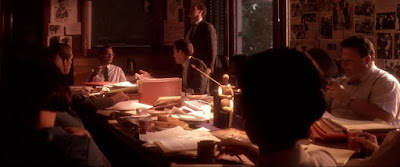
"It's all broken down, spread around, you read it and the point gets lost."

It is only after the Warren Commission Report on the assassination is released that Garrison picks up the threads of the case again. A chance airplane encounter with a Senator (Walter Matthau), whose skepticism —"That dog don't hunt!"—about the report sparks Garrison to again call in Ferrie, but also Martin, who had seen Lee Harvey Oswald in Bannister's office and follow up leads not explored after the initial inquiry was dropped. One name keeps popping up—"Clay Bertrand" but nobody knows who that is. Turns out that "Bertrand" is an alias of Clay Shaw (Tommy Lee Jones), well known in New Orleans business circles as a wealthy benefactor and who had connections with Ferrie and thus Oswald. Garrison and his team have Shaw picked up for arrest despite their inquiries producing only denials.
 
"Oh, you are so naive"
 
One aspect of the film that is both a high achievement and problematic is the way that it mixes archive footage with deftly re-created new footage in such a way that it is nearly impossible to determine one from the other. Stone and his cinematographer, the wizardly Robert Richardson, mix and match formats, color and black-and-white, 35mm and 16mm, and all sorts of film stocks to create and re-create source footage and the results are nearly indistinguishable, especially the way they are cross-cut between each other. It lends the air of verisimilitude—and certainly adds a dynamic tension between the transitions—but one is never sure if one should believe what one is seeing. Is that press footage from the day of the shooting or is Stone just fabricating something he wants you to see?
It's troubling. There's a fine line between making it look right and obfuscation and given that film, by its very nature, is manipulative—even with documentaries—the level of distrust this attention to detail evokes is extremely high. What are we to believe? The answer is whatever the director wants you to believe. And given Richardson's deserving Oscar-winning work on this film to match the look, the grain and the confusion of archive footage, some of which might even be familiar, distinguishing the true from forgery is almost impossible. And audiences become susceptible.
One should always be aware that it's a fictional film of real-life events. And rather than speaking truth, it can only come up with conjecture.

 
"And the truth is on your side, bubba."
 
Stone makes his own case on what happened in a middle sequence where Garrison goes to Washington D.C. to meet an informant, a former military official who only identifies himself as "X" (Donald Sutherland, who's brilliant in a role of pure exposition). That Garrison would fly to D.C. to meet an anonymous source strains credulity (he surely must know his name before agreeing to meet, but then, the reality is Garrison never met this character, communicating with him in un-cinematic exchanges of letters).
It is 'X''s contention that Kennedy was making feasibility studies for withdrawing troops from Vietnam—"X" was doing the inquiries—and that this rattled the cages of the Pentagon and the CIA. "X" is unexpectedly assigned to...Antarctica...and only learns of the assassination the next day when he reads a New Zealand newspaper that has a full run-down on Oswald as the assassin when he hadn't even been charged yet. To "X" this smacks of "black ops" work (which he also used to do). Oh, and did I mention that "X" was also part of Kennedy's security detail? "X" seems to have got around.
Anyway, by the end of his exposition, "X" has a conspiracy that could involve the Pentagon, "the military-industrial complex", FBI, CIA, Cuban exiles, the Mafia, the Secret Service and Lyndon B. Johnson—he was in the fired-upon motorcade, after all—and all of them had grudges against Kennedy, but mostly, they didn't want to cease operations in Vietnam which was making a lot of people a lot of money. This is the same Vietnam War that Oliver Stone fought in from 1967 to 1968 with the 25th Infantry, which was a traumatic experience for him, and that he has made the subject of three of his films.
"X" refuses to come forward with this information and flat-out refuses to be a witness for Garrison's prosecution, but "X" tells him that his best chance is that he's the only guy conducting a trial involving the Kennedy assassination. "
Your only chance," he says "is to come up with a case. Something. Anything. Make arrests. Stir the shit-storm. Hope to start a chain reaction of people coming forward. Then the government will crack." And, with those words of encouragement, he walks away, leaving Garrison hanging. Stone cuts to the Eternal Flame at Kennedy's grave. When Stone gets in trouble, he goes for sentimentality.
The film's last hour is that most deadly of momentum killers, a trial, with Exhibit A being a long speech by one character...in this case Garrison.* That speech wouldn't stand in a court of law and it isn't made clear if it's a closing argument (that barely mentions the defendant Clay Shaw) or a part of Garrison's evidentiary overview (it starts with objections from the defense and then they are never heard from again), but Stone is dramatically stretching truth...and credulity...to make his point. And it goes on forever, like the stultifying final speech in court in Ayn Rand's The Fountainhead. It's only Stone's direction, Richardson's chameleon cinematography and Joe Hutshing and Pietro Scalia's quick-silver editing that keeps it interesting as film. And almost impossible to make counter-arguments against the assertions, they come so fast and furiously.
Stone's film ends with "what's past is prologue." Okay, so let's look at the past. All previous American political assassinations, successful or otherwise, before and after Kennedy's own, have been due to "lone gun-men" (or women). The most suspicious shooting is that of Martin Luther King, Jr.  And most damning of all, recent events have seen Presidents and Vice-Presidents questioning or ignoring, even humiliating their own intelligence or military agencies...but manage to remain very much alive. Kennedy was less of a threat...he merely wanted to wind down a war...as has been done recently...and Stone would have you think he was killed for it.
Yet, History doesn't bear that out. In fact, though they may rebel (or at least write a book), they don't assassinate. "That dog don't hunt."

Remember, "what's past is prologue."
But, the film did have an impact. 99% of the documents that were sealed after the assassination have been brought to light, particularly to the issues raised in the movie (The President John F. Kennedy Assassination Records Collection Act of 1992 was passed in 1992, the year after the movie's release). Although the stated goal of the act was to release all documents by October 2017, some still have not been released. Trump went back on a promise to release them pushing it back to when he was out of office, then Biden delayed them (COVID...for some reason) then released some in 2022 and 2023.** We're at 99% except for those that would cause "identifiable harm... to the military, defense, intelligence operations, law enforcement, or conduct of foreign relations... of such gravity that it outweighs the public interest in disclosure."
Same old excuse. "It'll keep us from doing our jobs" they say, even if those jobs have dramatically changed in 60 years. But, if JFK is worth anything, it is for its shaming of our government agencies' lack of transparency to commit them to act in that 1992 law. Six decades is two generations of secrets. Too many people and too many prominent people have expressed their doubts to not have as many answers as possible to wash away as many questions as possible.
Not that that will make a difference. We've reached the Age of Un-reason where nobody believes their own eyes anymore. If everything was released, unredacted and transparent, it is doubtful that the truth would be accepted...especially by those who make their livings as professional doubters and skeptics.

The true conspiracy has always been theirs. As in the mantra of All the President's Men, one merely has to "follow the money."
"It's up to you."
 
* The film is awash with cameo's and "guest-stars" in what Stone intended to be like the roster of The Longest Day, but it feels more like the many odd cameos in The Greatest Story Ever Told, that seem ill-though-out and are actually distracting and pull you right out of the movie. John Candy? 

** This is just part of Garrison's summation from the film:
The Warren Commission thought they had an open-and-shut case. Three bullets, one assassin. But two unpredictable things happened that day that made it virtually impossible. One, the eight-millimeter home movie taken by Abraham Zapruder while standing by the grassy knoll. Two, the third wounded man, James Tague, who was knicked by a fragment, standing near the triple underpass. The time frame, five point six seconds, determined by the Zapruder film, left no possibility of a fourth shot. So the shot or fragment that left a superficial wound on Tague's cheek had to come from the three shots fired from the sixth floor depository. That leaves just two bullets. And we know one of them was the fatal head shot that killed Kennedy. So now a single bullet remains. A single bullet now has to account for the remaining seven wounds in Kennedy and Connelly. But rather than admit to a conspiracy or investigate further, the Warren Commission chose to endorse the theory put forth by an ambitious junior counselor, Arlen Spector, one of the grossest lies ever forced on the American people. We've come to know it as the "Magic Bullet Theory." This single-bullet explanation is the foundation of the Warren Commission's claim of a lone assassin. Once you conclude the magic bullet could not create all seven of those wounds, you'd have to conclude that there was a fourth shot and a second rifle. And if there was a second rifleman, then by definition, there had to be a conspiracy.

*** Whether Trump will release any more documents in his next term one can only speculate. I don't believe a word the man says so even if he says he will, I'd be looking at updates on the website: https://www.archives.gov/research/jfk

Saturday, December 23, 2023

A Christmas Carol (2009)

Christmas is Monday. B/CL is closed on Mondays...like theaters and like museums...so I won't be posting then. Besides, it's Christmas, Scrooge!  So, here's what I would've posted on Monday were I posting.

Written at the time of this version's release (Oh, don't worry! I'm sure another version is coming out shortly).


"God Bless Us, Every Mega-Pixel"
 
  
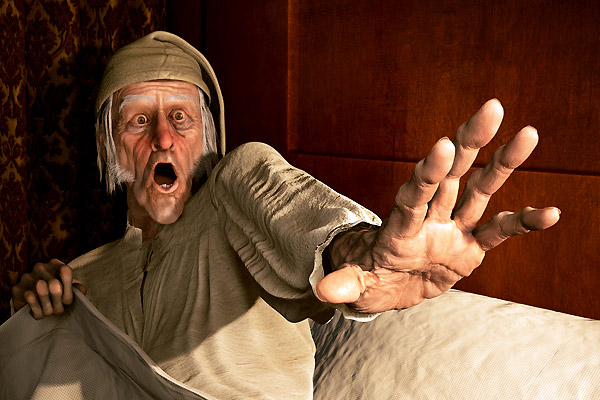
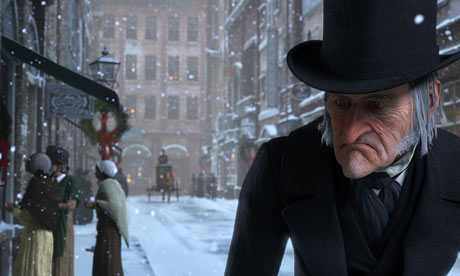
Everyone has a favorite "Christmas Carol" (or I should say, "version" of "A Christmas Carol").* A novella, it is the perfect length for adaptation to movie (with some padding) or television special (with some commercials). And being as it's in the Public Domain, anybody can adapt it without paying any money to Mr. Dickens (who probably haunts the producers, every one!). Hence the title: Disney's 'A Christmas Carol.'tm **
 
Disney may own it, but it's Robert Zemeckis and Jim Carrey's "A Christmas Carol," and it stands up against even beloved ghosts of "Christmas Carols" past. Face it. There are so many, that presentation becomes the main criterion to base a judgement, like "Hamlet." And format has a lot to do with what drives Zemeckis' version. Skip the 3-D aspect for a moment. This motion capture-CG "take" does some very interesting things with the story (adapted within a farthing of Dickens' original by Zemeckis himself) that are only possible with animation—the ghosts being integral to the story.
"A Christmas Carol" is a ghost story. The ghosts and their tours of Scrooge's life past, present and future must be enough to slap Scrooge giddy, make him "scared straight," turn his perspective from "profit" to "a common good." 
In other words, it must turn him from a "cool, conservative man" to a "bleeding heart liberal."*** You have to have really scary ghosts to do that. Really scary ghosts. Any half-steps and Scrooge would be a "champagne liberal," and what good are they?
In this version,
Carrey not only plays "Scrooge" (through Zemeckis' ever-improving "motion-capture" technique) but also the three Ghosts: a cooing Irish flame for the past, a roaring Scottish present, and a funereally silent Future. Each has their own presentation of their visions, Past whisking Scrooge to his old haunts, Present turning Scrooge's sitting room into a camera obscura to spy the current Christmas, flinging Scrooge to a stage street to present Want and Ignorance, two feral spirits—the one growing up violent behind prison bars, the other morphing into a hooker and into a straight-jacketed mad-woman. And Future, in a neat touch, forms itself from Scrooge's own shadow. 
There emerges during the sequence a chase as Scrooge is pursued by his own nightmarish funeral cortege pulled by two red-eyed horses, a bit that old Walt would have been proud of. It soon deteriorates into a demonstration of 3-D (which Zemeckis and Pixar are already masters of—the previews of
James Cameron's Avatar shows a few problems) as bedlam as a mouse-sized Scrooge must scramble through the sewers to escape a terrible fate. One could live without it, as well as the "snuffing" episode of Christmas Past were the sequence not a vivid demonstration of just how well Zemeckis uses the technology to bring a life-like edge to the movie. And that's where this "Christmas Carol" truly makes its mark. 
Where this version of "A Christmas Carol" is unique is that this marks the occasion when "motion capture" CG "got the faces right." Zemeckis' previous experiment in this realm,
Beowulf, had an odd, plasticene feel to it, mouths didn't crinkle correctly in speech, faces wobbled in perspective. Not here. Carrey is a broad actor, to be sure. But he's also an actor of simultaneous quicksilver subtleties, and this film captures it all. It's one thing to flit the camera perspective through snow-storms and sail through the chains of a scale, falling chestnuts, and the "eye" of a wreath (all done in the film's credits), but it's quite another artistic thing to capture the look of pleased instant love
on young Ebeneezer's face when he first meets his beloved Belle (Robin Wright Penn), or to show the pleading terror and remorse when a ghostly Scrooge comes "face-to-face" with a mourning Bob Cratchit (a perfect Gary Oldman). Keep your dizzying flights of fancy 3-D. It's in those moments of intricate expression when "Disney's 'A Christmas Carol'" truly soars.

* Well, since you asked, I have my own favorites—usually the ones that are a bit scarier in their psychic psychological warfare on Scrooge. I like the "Alastair Sim" version often sighted as a favorite, and love the "George C. Scott" version for television from 1984 (he's scarier at the end than at the beginning!), but my favorite—and this is probably a case of "Mom's Apple Pie Syndrome"—is "Mr. Magoo's Christmas Carol," which, even though it is a musical, even though it is a cartoon and even though Scrooge is Jim Backus, still manages to pack an emotional wallop, more than any "live" version I've seen, including this version.  

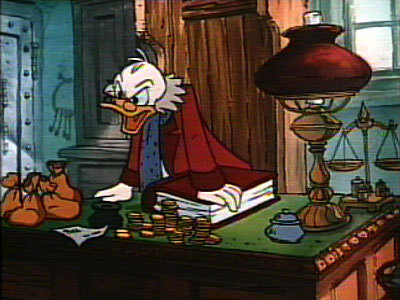
** They've already done a version with Mickey Mouse: "Mickey's Christmas Carol" (1983). Scrooge McDuck played Scrooge. Natch.  

*** I have to bring this up: a couple years ago one of the Zucker bros. directed a conservative version of "A Christmas Carol," but it took the Christmas out of it—I guess it's "An X-mas Carol," then,...talk about your "Wars on the Holidays"(sic)—called "An American Carol" in which a Michael Moore type (played by Chris Farley's brother—more popularly known as "Chris Farley's brother") is shown the Ghosts of America Past, Present, and Future in order to "scare" him into being more conservative—frankly the Bush II Administration had the opposite effect on me. Not to paint with too large a brush, but conservative political humor tends to be so ham-fisted and structurally unsound that it can't even see its own hypocritical ironies.

Saturday, July 29, 2023

Oppenheimer

Ch-Cha-Chain (Reactions) of Fools
or
Fallout: If the Radioactive Doesn't Get Ya, The Political Will 
 
I took a course in college called "The History of the Atomic Bomb," so I already knew about J. Robert Oppenheimer and the Manhattan Project, and Lester Groves, and Edward Teller, and Enrico Fermi, and Niels Bohr, and Richard Feynman. Our best and brightest...as well as Germany's best and brightest, having escaped the Nazis.

I've listened to the plays, seen previous adaptations, know the story backwards and forwards. I got a C+ on my final paper around the subject of "Should we have dropped the bomb on Japan?" (I don't remember which side I took, but I believe it was favoring the Demonstration scenario).
 
But, I've been interested in seeing Oppenheimer, because I wanted to see what director Christopher Nolan would do with it. J. Robert Oppenheimer led a life that could have filled a few movies, but Nolan has compressed it into one three hour film, with the highs and the lows, and of the parallel tracks and rippling occurrences that underscored and undercut his career, and made the man who oversaw the construction of an atomic bomb from theory to reality become a pariah to the very country he handed it to on a desperately sizzling platter.
And Nolan in the past has been a wizard of sorts playing with the possibilities of story-telling and film-making, and juggling and parsing scenarios so as to create  adrenaline-generating third acts that brings everything together for a thematic jolt. One could say he creates these puzzles in the editing room, if the conceits of the films weren't so inextricably linked to the construction.
But, here, Nolan keeps it rather simple: two stories running parallel to each other, both involving hearings on their subject matters. They're sub-titled 1: "Fission" (in which atoms are split): in color, involving an older Oppenheimer in 1954 being grilled by a back-room secreted committee over whether he would retain his top security clearance; 2: "Fusion" (in which atoms are combined): in black and white, involving the very public hearing of Lewis Strauss to become Secretary of Commerce in Eisenhower's cabinet in 1959.
Two seemingly unrelated stories, but tied together so deeply that to split the two would be like splitting atoms, as they both deal with brilliance, arrogance, ego, and their limitations. There couldn't be one story without the other. And just as you can't have a nuclear explosion without fallout, both men—Oppenheimer and Strauss—would learn of consequences, that will haunt them to the end of their days.
Nolan starts the movie with a peaceful image—rain falling in water—but, as serene as it is, it's the natural image to describe the film. Just as rain falling will ripple out in concentric circles, actions will have reactions and those will spread without much control, a chain reaction that will only dissipate until it runs out of energy. And Oppenheimer is a film interrupted with small moments—a spark, a ripple, the sound of stamping feet, a line of poetry—that will echo throughout the film as mysterious fragments until we see them in context and realize their importance to the whole, like little figments of conscience that haunt until they are reasoned into clarity.
We see the the path of Oppenheimer (brilliantly played by
Cillian Murphy) to Los Alamos—a terrain he loves ("If I could combine physics with New Mexico, my life will be perfect"), through European studies—he gives lectures in Dutch—meeting the great minds of physics—Heisenberg, Bohr—then re-enters the U.S. to teach at Berkeley, hoping to initiate a field of study in quantum physics, which starts with one student, then many. Concerned with unionizing the colleges for faculty and techs, he flirts with the Communist Party, but, does more with one of their members, Jean Tatlock (Florence Pugh), who will challenge him, mystify him, and ultimately be used against him.
He marries Kitty Puening (
Emily Blunt), has a child, and although he's playing with things nuclear, he can't seem to manage a nuclear family. He's approached by General Leslie Groves (Matt Damon) to lead the Manhattan Project to develop a nuclear bomb before the Nazis, and although Groves knows Oppenheimer's leftist leanings, he still wants "Oppie" to lead the project—"I wonder if you could tell me how the Army would treat a humble physicist" "I would if I ever met one"—and as part of the project, Oppenheimer figures out the best rail-access for delivering fissionable material from three corners of the country and winds up with New Mexico, isolated, empty of population and surveillance, to build something that is only a theory...before the Nazi's do. "We have one advantage," Oppenheimer tells Groves. "Antisemitism." Germany has driven out its top nuclear physicists.
Well, you know the story. We've all lived in a world with constant nuclear brinksmanship, and the few souls who remember a time before "The Bomb" are dying off. We're used to it now (which seems inconceivable to me) and we're at a time of such complacency that you still hear mentions on the news of "nuclear options" and "tactical nukes." But, Oppenheimer takes us back to a time when the Atom Bomb was not only apocalyptic, but also inconceivable. At the time of its creation, there were a lot of "unknowables" about the Bomb. All they knew was that it would be big and cause a lot of destruction in a wide area—a city destroyer. But, at the time of the Trinity test, nobody knew if the chain reaction in the air would stop or if it would keep feeding on itself, incinerating the area, and possibly more. And, they didn't know anything about fallout.
The fallout—of all kinds—is the new thing here. With the responsibility of building a weapon with so much destructive power—with the complete agency of the government to do it—comes with it the emergence of those who see that power and covet it. And this is where the Strauss story comes in. Played quite amazingly by 
Robert Downey Jr., Lewis Strauss is a political operative and functionary, whose ego cannot merely appreciate the accomplishments of Oppenheimer and his team, so he must control it, harness it, and by doing so, subvert it to his own ends. As Oppenheimer did to nuclear fission, Strauss does to Oppenheimer and does so with a cold-blooded zeal. And given Oppenheimer's past propensity to fill any intellectual void with affairs and radical politics, Strauss is given the very weapons needed to undermine any attempts to prevent the scientist's efforts to keep the destructive genie contained, slowing nuclear proliferation and ever-increasing mega-tonnage. "Amateurs chase the sun and get burned," Strauss says at one point "Power stays in the shadows."
Oppenheimer is a solid three hours long, packed pillar to post with detail and small roles by very good actors—Nolan newbies like
Rami MalekCasey AffleckAlden Ehrenreich, Josh HartnettJames RemarJason Clarke, and vets of past films like Kenneth Branagh, David Dastmalchian, Matthew Modine, Tom Conti, Gary Oldman—and one may begin to think that the Strauss story gets a bit superfluous and should even be cut, but it is essential to the story and theme of how one man can make a difference, for good, evil or both. And of how power corrupts—even the pursuit of power corrupts—and though one may blaze with brilliance like a nuclear flash, it is not self-perpetuating...and fades...even if it consumed by itself.
Yeah, I took a course in college. But, you learn something new every day...if you're doing it right.
 
Nolan wrote the screenplay, based on the 2005 biography "American Prometheus: The Triumph and Tragedy of J. Robert Oppenheimer" and starts with these apt words: "Prometheus stole fire from the gods and gave it to man. For this he was chained to a rock and tortured for eternity."
The haunted gaze of the elder Oppenheimer
—a look both accusing and guilty

Thursday, August 11, 2022

The Dark Knight Rises

Written at the time of the film's release.

The Bane of Our Existence

or
"Okay, What Joker Put Yeast in My Dark Knight?"


"All stories end in death, and he is no true story teller who would keep that from you"--Hemingway

"If you want a happy ending, that depends, of course, on where you stop your story"--Welles

So, Christopher Nolan's "Batman" trilogy ends in a nearly 3 hour film that neatly wraps up the story. How does it end? That would be telling. The comics went through a phase where Bruce Wayne ruminated that he was working towards a world where he wasn't needed. That's a nice little "buttoning up" of the "Dark Knight" story, but it's not complete. What of Bruce Wayne? Nolan has the opportunity in his version to really end it—he doesn't have to sell comic books next month—so, he can take it anywhere he wants to go. And one realizes (if one really wanted to end the story) that the only real happy ending that could be achieved is if Bruce Wayne became the one thing he never knew as a child—a caring, present father. Anything else makes the story a tragedy, and Bruce Wayne the last victim of the gunman's bullets that killed his parents. Given this series' downbeat tone (that of the sacrificial martyr) and of the available previews for The Dark Knight Rises, such a scenario does not seem likely. Given that, Nolan can take the tragedy of his hero in any number of directions.
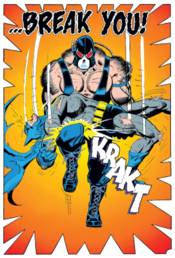
Bane (Tom Hardy here) is the perfect villain to bring into the mix. A hopped-up minor character, he is best known as the lead antagonist for the "Knightfall" storyline (that seemed to last a couple years). In "Knightfall," the drug-pumped super-villain released every criminal in Gotham's prison system for The Bat to deal with, while he hung back, biding his time. Then, when the Batman, weakened and exhausted, finally confronted him, Bane broke his back, leaving Wayne paralyzed and unable to fight on. It fell to the rest of "The Batman Family" (including the once-and-future "Robin's") to take on the mantle and continue the fight.

Nolan's canvas is a bit broader, taking into consideration the events of the two previous films to create something a bit more apocalyptic, a rumination on the fractious quality of good vs. evil and the slippery slope to Hell that ideology and good intentions can be tilted towards. Nobody's pure in this one, there's no whack-job with delusions of grandeur behind the assault on Gotham City, with avarice their sole motive. Everybody, wearing white or black, thinks they're doing the right thing. And everybody's wrong.

It's eight years since the events of The Dark Knight that resulted in the deaths of D.A. Harvey Dent, Rachel Dawes, and the subsequent disappearance of the man suspected in the killings, the Bat-man (Christian Bale). Now, Bruce Wayne is an exile in his newly-rebuilt Wayne Manor, walking stiffly with a cane due to some unknown injury (part of me wants to think it was due to him being stabbed by one of The Penguin's umbrellas). He sees no one, is a recluse, and there are rumors he's turned into a Howard Hughes-style eccentric, apparently due to a massive investment in a clean energy prototype that failed and cost Wayne Enterprises a fortune...or at least half of it.
The chief backer for the project, Miranda Tate (Marion Cotillard) tries to get past the constant guards of faithful butler Alfred (Michael Caine, putting in the most emotional performance he's done in years) and Wayne exec Lucius Fox (Morgan Freeman), who fill the functions of acting as Wayne's heart and brains (and conscience), if not as surrogate Mother and Father. A rival exec, Daggett, is trying to take over W.E., by any means necessary, in this case, employing a terrorist named Bane, who has his own bones to pick (and break) with Gotham's golden boy. At the beginning of the film, Gotham in morosely complacent (and obviously filled with exposition), having cleaned up crime by the draconian Dent Anti-Crime Act, which has incarcerated over a thousand criminals in Gotham's Blackgate Prison.

But things are percolating underground, disrupting Gotham's infrastructure.  Bane has an army of misfits and big plans that have outgrown the desires of his patron, and there's a lithe cat burglar named Selina Kyle (Anne Hathaway), who is caught with her hands in the Wayne Manor safe by the man himself ("Oops," she says, not very convincingly). Yes, she's pilfered Martha Wayne's pearl necklace, but more importantly, Bruce Wayne's fingerprints. What does she want with those?

It's only one piece in an intricate puzzle of escalating consequences that Batman must unravel if he is, once again, to save Gotham City, and he must confront his past and overcome great injury, physical and emotional, if he is to prevent a catastrophe...
one of his own devising.

That's the gist of it, but it is convoluted by elaborate set-pieces that are, frankly, jaw-dropping, and ends up with Gotham isolated from the rest of the nation, in the hands of criminals with big ideologies and little concern for how roughly they're applied. The police are paralyzed—most of them trapped in the deep infrastructure of the city (a little too conveniently) while Bane initiates a countdown to total destruction.

A countdown of five months.

To quote The Riddler:"????" Five months? How suspenseful is that? And you'd think that somebody, somewhere, would be able to unravel the plot or situation in such a time-frame. But, it's basically a set-up for what Nolan depends on to generate suspense throughout the movie—the last minute "save," that is usually explosive and comes from nowhere, because the writer-director has made motivations ambiguous enough as to be unreadable.* Everyone has got a secret that will be revealed at the most opportune moment of drama. If the mystery was revealed in a drawing room, it would feel like cheating, and the revelations almost psychic.
Speaking of unreadable, Tom Hardy's Bane is hampered by a mask of a morphine dispenser (to keep him from feeling pain), as opposed to the enhancement-juice-pumping-apparatus from the comics (This leads one to ask: if the guy can be stopped by breaking the mask, why does Our Hero employ so many body-blows?  Face-shots, man!!). He is perpetually muffled by this thing, which Hardy compensates for with an almost jolly Father Christmas speaking style, making a clever, unnerving ying-yang effect for the character. Ultimately, though, he's something of a vapor-tiger, like Darth Vader, the big bloated bloviator who's merely a "blind," a distraction for the real danger.


But...five months??**
Another thing: Nolan has come out publicly saying that he wants to make a Bond movie (and the snowbound facility infiltration in Inception is a bowler-tip to them). I would submit that he already has, this film being it. So much of it is borrowed from Bond that all one needs is a casino scene to make it complete (a costume party has to suffice
***). The opening sequence, the-villain-that-feels-no-pain, the duplicitous females, obligatory "Q" scene, the tick-tock final set-piece and other aspects can be attributable to Bond films of the past. At least someone is borrowing from the Bond series this time, instead of the other way around.
But, his world of comic-book fantasy is far more gritty and down-to-Earth than any other, and that's what makes "The Dark Knight Trilogy" good; it's relatable, it feels like it could happen, if someone had the will, the wherewithal and the wallet to do it. It also feels of our time. There's been a lot of gas about the politics in this film—uninformed, desperate gas—but the whole uprising scenario, the subjugation of the privileged with no benefit to the less fortunate, the breaking down of society and the cleaving of its people is the stuff of water-cooler vitriol and feels like the temper of the times. The Tea Party AND the Occupy Wall Streeters can both find things to point at and go:"See?"
I'm not going to speculate which side is right, and Nolan is obtuse (and politically slippery) enough to play it right down the yellow stripe of the road. But, this British director is saying something about the State of the Union with a full child-warbled rendition of The Star Spangled Banner (before a particularly horrific football game) and a shot of American flags in tatters on a city street, deep in the movie. They're there for a reason, but not for anything specific enough other than "we're a fragile alliance and we're in trouble."
And that we need heroes—selfless ones, for whom profit is not a motive—and that, "anyone can be Batman."****

* Case in point:  there's a scene where Catwoman uses a Wayne-supplied bat-bike to blow a hole in a tunnel to make an evacuation tunnel for the sealed-off city, a task initiated by the Caped Crusader.  Following it, Nolan sits on a pull-in shot of Hathaway with an enigmatic smile on her face that communicates...nothing. Except an odd complacency. It will only be resolved...if there's anything TO be resolved, later in the film. 

** There are neat touches, and a refresher of both The Dark Knight AND Batman Begins will help. One nice thing—Nolan recalls a scene from BB when a young Bruce Wayne falls down a tunnel and is subsequently rescued by his father, by having a similar scenario played out here, with the Obi-Wan presence of a dark father figure from his past. Nice touch.

*** A masked ball at which, like in Batman Returns, Bruce Wayne doesn't wear a mask.  Heh.

**** Just not Nicolas Cage, please...
What do they say at Marvel? "What a poser..."