Showing posts with label Christian Bale. Show all posts

Wednesday, June 26, 2024

The Fighter (2010)

Written at the time of the film's release...

"Put Back What You Use"
or
"I-Yi-Yi-Yi-Yi'm Not Your Stepping-Stone"

The family that preys together, stays together.  For the extended family of boxer Micky Ward (Mark Wahlberg), the preying is mostly internal although they have the illusion that they're getting the best of everybody else.

Micky is the younger brother (step-brother, actually) of Dickie Eklund (Christian Bale), former up-and-coming boxer, who had one glory moment: knocking down Sugar Ray Leonard in a match some years before. Now, he's a part-time trainer for his half-brother and a full-time crack addict. HBO is making a documentary about Dickie, who, despite his years and habits, still thinks he's on the comeback trail. But the pipe keeps him missing training sessions with Micky, leaving the heavy lifting to his trainer (Mickey O'Keefe playing himself). While the boys' lioness of a mother (Melissa Leo) manages Micky and enables Dickie, it leads to some bad decisions on matches for Ward, leaving him battered and disillusioned.
The higher-ups at the sports networks have Ward pegged as a "stepping-stone," the fall-guy they use to advance other fighters in the winning circle to boost ratings, and that reputation follows him around his home-town of Lowell, Massachusettes. Ward's on a downward spiral,
and any outside help is treated with suspicion. "You can't trust that guy. He ain't family." says Dickie, lounging in the limo his brother's money rented, sucking a beer.


Yeah. About that...
Perspective is all in
The Fighter.  And the boxing motif is the perfect setting. Micky is caged by his relations with his family, but every time he tries to strike out on his own, he gets attacked by Mom (playing the suffering card), step-brother hangs back and then takes his licks, and a coven of sisters and half-sisters are a unified greek-chorus of mom-ditto-speak. All you need to make this a match is a soft canvas to fall on, so Micky's a fighter always on the defensive. It's no reason he doesn't say much, but the eyes are far away, looking for a way out, looking for an opportunity to make a move, looking for anything.

"Your fahther looks at my ass, too, but at least he tawks ta me," says Charlene (Amy Adams, while not looking at him), the "bah-girl" Micky keeps staring at. Micky's so down for the count, he thinks even she's out of his league. And she might be, but she keeps showing up in his corner, alarmed at the punishment he's taking. When she questions it, Micky tells her everybody's not concerned. "Who's 'everybody?'" she asks. "My mother, my brother," he replies.

Yeah. About that...
The Fighter
is a mostly true story. Ward is a better, tougher fighter than the movie wants to give credit for (the underdog status makes for a better story, I'm sure, but the dismissive commentary on the soundtrack during the fight sequences is the real thing...taken from the actual broadcasts...Ward was considered an underdog), and Dickie DID do all those things,
but his timing was a bit better in real life. One wants to say that the best character arc in the movie is Dickie's, but that would be falling into the appreciation trap the movie sets up.

Because Micky's is the best character arc, although it seems a very simple Rocky-like success story on the surface. It's the approach that Micky takes with the forces in his life that are tearing each other apart which is the most interesting aspect of the story. Micky has been wronged by his family, but he won't discount their worth, or their place in his life, even over the objections of his new supporters—they have to find a way of dealing with each other and their conflicts, with or without him.
For a fighter to take the stance that he does, reaching compromise with the warring factions in his life—to stand up and take control, risking everything from everybody—is a complete negation to what he does for a living and how he was raised.
*
The acting kudos are going to go to
Bale (who is incredible, not to slight him) and Leo and Adams (who has two great scenes involving an intercom, and throws some nice punches in a chick-fight), but Wahlberg is the champ in this movie, with the tougher part (he trained for this through his last six roles), which he does almost purely physically.
Micky is a man of few words, and not too many moods, but Wahlberg, restrained and less showy, does all of it with body language and does the difficult fight scenes, as well—in the latter taking a lot of body-blows that are not hidden with oblique camera angles or trickery.
Wahlberg has worked with director
David O. Russell before—in fact it was Russell's war pic Three Kings that first showed how good an actor "Markey-Mark" could be. Russell keeps the movie on edge with quick cutting and an improvised feel, even managing to make the final fight scenes nerve-rattling, despite the suspicion that one is going to see a typical boxing picture ending. But, his assurance with good material, performed by such a dedicated cast, manages to keep the movie on its feet, even at the final bell.

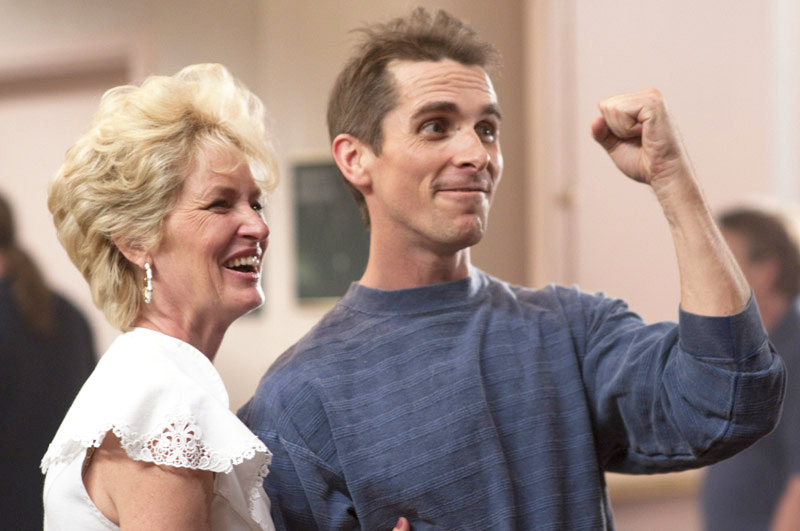
Micky and Dickie at the time of the events of the film

* The real-life Ward did much the same thing, often befriending his opponents, including Arturo Gatti, the fellow he boxed in his last three epic fights, often described as the greatest in the sport.  Ward was a dedicated, fearsome fighter, but admired his opposites in the ring, and their talents.  The two fighters, who put each other in the hospital, continue to be good friends.  I find that amazing...and admirable.

Wednesday, February 1, 2023

The Pale Blue Eye (2022)

Hidden in Plain Sight
or
The Poe-Eyed Detective ("It Will Work Out")
 
There is something ingenious, if not precious, about the conceit: a murder mystery featuring the creator of the modern detective story.*
 
Sure, every depressive knows Edgar Allen Poe as the writer of morbid, anguished poetry with repeated lines at the ends of stanzas. But, with his publication of "The Murders in the Rue Morgue" in 1841, he began a new genre of mystery story, based, not only on the dark corners of the human psyche, but it's very opposite, the power of reasoning and deduction—or what he called "ratiocination." With the success of his Dupin stories, came the inspiration for Doyle of Sherlock Holmes (he never shied from admitting it or his other sources) and, from there, the progeny of the countless numbers of problem-solving busybodies that have expanded and pushed the envelope of the Dewey Decimal System for decades.

Homage must be paid.
The Pale Blue Eye
(love the title...) begins with an image, a surrealistic scene veiled in fog, of a man handing by the neck from a tree. But, something's off. His feet are on the ground, rather than being suspended above it. The explanation for that image will take the entire movie to explain, but already you're hooked, and that image is a wonderful metaphor for a mystery. Something deadly has happened, but why, and by whom, needs to be sussed out. Only one person knows and that is the one who did the deed.
It's 1830. Retired constable Augustus Landor (
Christian Bale) lives a solitary life in his rustic, but well-libraried cabin, another in a long line of isolated men, known for "getting a confession with just a stare." His wife died many years ago, and his only daughter, whom he mourns, has disappeared—a mystery that still haunts him. One day he is greeted by Captain *ahem* Hitchcock (Simon McBurney) from nearby West Point Academy. One of their cadets has been found dead—he'd been hung, apparently, but the most grisly aspect of the deed is that his heart has been carved out of his chest.
Landor has some restrictions put on him by the Academy Superintendent, Thayer (Timothy Spall):he is to report to him and Hitchcock daily on his progress; he works for them as an employee as long as they approve of his work; interviews with cadets must be done with Hitchcock's supervision; he can't drink on the job. There is a tavern in the town, however, which he visits after hours. He runs afoul of the Academy's physician, Dr. Marquis (Toby Jones), when he proves himself unsatisfied with the doctor's autopsy—but Landor's thorough work does win him enough grudging respect that he is invited to the doctor's home, where he meets his somewhat-hysterical wife (Gillian Anderson, always great, even when she's not doing the autopsies) and his children, cadet Artemus (Harry Lawtey) and his lovely daughter Lea (Lucy Boynton).
The cadet interviews do not go well. The young men are less than forthcoming-especially under the baleful eye of Hitchcock. But, there is one young Virginian cadet who attracts Landor's attention, not only because he has an obvious intelligence and grand-if precise manner of speaking. He's also a bit of an outsider at the Academy, a frequent object of scorn among the students...and the instructors.
This is cadet E.A. Poe (Harry Melling), not the finest example of military discipline, frequently seeking permission to be excused from outside drills, citing poor health and spending his time writing poetry. When Landor first meets Poe, he is struck by his eloquence and directness, but more by his opinion that the perpetrator may have chosen a mundane way to kill the victim, but the cutting out of the heart "makes him a poet." Poe's creepiness makes him a "usual suspect" as far as murder mysteries go, but at a later meeting in a tavern, Landor suggests to him that they should work together on the case, as Poe might have opinions—and access—that Landor could use.
Then, there is Landor's mentor, Jean Pepe (
Robert Duvall), an elderly recluse, with a vast knowledge of all things ritualistic and arcane. It's always good to see Duvall in anything, and his presence reminds one of the useful—but supplementary— characters that inform and give a certain historical sub-text to many a fictional detective.
The investigation twists and turns like a speckled band—no, the story doesn't involve snakes—but, is enhanced and complicated by young cadet Poe's besotted enchantment with the doctor's daughter Lea Marquis, prone to seizures that might be due to epilepsy—or maybe it's just a family curse.
Oh, this one is a corker, with a resolution that will surprise casual mystery watchers, and inspire appreciative smiles from aficionados with its echoes of Poe's own detective fiction. There might be a bump or two in motivation, a red-herring here and there (aren't there always?), but, by the end, one will be properly sanguine with the mystification they experience.
And the cast is top-notch. Bale isn't grand-standing here with tics and business, but relies on a relaxed body language that he rarely employs, and the relationship between he and Melling's overelegant Poe is a nice study in contrasts in a mutual admiration society of two. Director Cooper keeps things moving swiftly and takes full advantage of cinematographer Masanobu Takayanagi's ability to create astounding images of nature and the unnatural. And Howard Shore's score is lovely, another wonderful example of why he should be doing more music for films these days.
It's a very well-done film, that is only undermined by the fact that it will never light—and darken—a theater screen, where it can be truly appreciated, and, although it is nice that Netflix gave it a healthy paycheck to be produced, why it should be relegated to a small screen, is a real mystery.

* When the Mystery Writers of America organization hands out their little trophies, they are dubbed "The Edgars." There are some scholars who begrudge Poe the title. But, they can't do anything about the little statues.

Wednesday, October 12, 2022

Amsterdam (2022)

"What Fresh Hell Is This?"
or
The Endurability of Good Intentions. ("He Followed the Right God Home...")
 
Who knows when it really, really started in the scheme of things, but it really started to get intense with the dead Senator in the box with no lid.
 
Just back from Europe by ship, he turns up dead and his daughter (Taylor Swift) wants an autopsy. So, she calls two guys from the former General's old integrated unit in WWI, Burt Berendsen (Christian Bale), a doctor of "experimental medicine," and Harold Woodman (John David Washington), Columbia University-trained lawyer, to oversee the procedure. To ensure that the procedure is done without prejudice, Dr. Irma St. Clair (Zoe Saldana) does the autopsy.
 
What the autopsy reveals is suspicious, but when Harold and Burt attend a pre-arranged meeting with the general's daughter to report their findings, they see her running away for their rendezvous, stricken. "He knew something. He saw something terrible," she says while she can.
 
Join the crowd.
Before the night is over, Burt and Harold are on the run from the police, accused of a murder they didn't commit, but sure of who committed it, not that it matters in the short run. They have to hide...and they have to find out who killed the General and who's behind all this...because...they're veterans. Their commander has died. And they owe him.
But, that's history. In that history, Burt found himself the medic for the 369th Infantry, an integrated unit in WWI France. Its commander was such a racist that he required the black infantry to wear French uniforms, rather than American ones due to white soldier complaints, but he was replaced by his commander General Bill Meekins (
Ed Begley Jr.), and to further cement fences, Berendsen made a pact with the most vocal soldier, Woodman, that they would always have each other's backs. Even during "The Argonne."
Berendsen and Woodman are severely wounded, requiring many operations to remove shrapnel by a diligent French nurse named Valerie (Margot Robbie), who repairs their wounds and forms a bond with the two men, eventually taking them to Amsterdam, ostensibly to take Burt to a company called Cambridge Glass (run by characters played by Michael Shannon and Mike Myers), manufacturers of the best quality glass eyes, but more to live together in peace and fellowship and recover from "the war to end all wars." They become "lost."
It is an idyll that can't last. "Choice matters over needs." Burt, finally becoming comfortable in his scarred skin, decides to return to America out of his devotion to his wife. Harold stays with Valerie, but sees no future in it ("We only exist in Amsterdam") and returns to America to pursue a law degree. Then, their General comes home in a box.
David O. Russell's Amsterdam is being marketed as a star-filled cream-puff of a movie, but it isn't that. Instead, it's a good-natured political screed on the dangers of fascism roosting in America, basing it on the "Business Plot", a little remembered attempt by conservative business interests, unhappy with liberal Franklin Roosevelt's election, to use veteran protests over delayed bonuses by the Hoover administration, to install an un-elected military official to essentially oust FDR as President. As a modern context, let's suppose that the MyPillow guy and the CEO of Overstock didn't like the results of the 2020 election and were taking aggressive actions to have it over-turned. Couldn't happen, right?
 
It's a curious little gremlin of a movie. There are going to be a certain number of people—on the far right, maybe fascist, certainly white supremacist side—that would never see this movie. And then there are others—people who are stuck in the post Nixon era cynical groove (which has only atrophied during the Trump years to the point where late-night comedians can barely keep up) who will look at it and pooh-pooh it as satire-lite, which is easy to do if you're viewing it with the same attitude as one would have now.
But, the folks depicted in this movie didn't live through Nixon. They lived through World War I and came home to depressions, both Great and small. They still believed in government and they still believed in the United States, no matter what tough times they'd been through. The same starry-eyed patriots who volunteered in droves during World War II. Because they believed in something bigger than themselves. That's not a popular sentiment these days.
And Russell's movie may be off-putting for those who want their messages obvious and with the tone of righteous indignation (that is also popular these days) instead of the quick-paced Wes Anderson whimsy that it evokes. Still, it doesn't shirk from portraying grievous war-wounds—praise must be heaped on the make-up department for their relentless consistency—on people who refuse to see themselves as victims.
These are people who, despite their quirks, walk the talk and aspire to good intentions despite the consequences. Burt, being Half-Jewish, Half-Catholic goes to war at the behest of his Park Avenue in-laws only to find that the means are more important than the ends, especially considering that their respect for the military doesn't extend to veterans. He is kicked out of his lofty office address and starts work in the streets and then in Harlem, to the point of moving out of the apartment he shares with his wife...he's so straight an arrow that he doesn't even think that's perverse. Woodburn is black in an early 20th century—he already knows the heartbreak of good intentions when your skin isn't the predominant color. Yet, he has found validity and valediction in another country fighting for a country that wouldn't consider giving it. And Verna is a rich girl considered a kook, but whose dedication in the operating room goes above and beyond the requirements and limitations of triage. Their actions all make sense in a society that ignores their sacrifices while reaping the rewards of the very things they fought to protect.
The cast is uniformly excellent with Bale coming up with a fully realized character taking advantage of the limitations of a back-brace and glass eye and turning it into a performance reminiscent of Peter Falk—and in moments of agitation, Martin Scorsese, while Washington is his most relaxed since BlacKKKlansman. Robbie has a little trouble with accents, but manages to make a performance that is both alluring and comedic, and it's all photographed with a slight sepia tone by
Emmanuel Lubezki, who manages to turn out top-tier work under technically challenging conditions.  
One has to admit, though, that Amsterdam is better in the after-glow than in the light of projection. Free from its manic energy in that post-viewing meditation, two aphorisms come to mind—for a movie that is full of them. One (that I've heard quoted so many times it defies origination) is "If you have a message, call Western Union", something that Amsterdam does with tenacity in its reckless abandon to obfuscate with comedy. The other I heard from legendary baseball announcer "Red" Barber on one of his weekly talks with Bob Edwards on the NPR Morning Edition. He said
"It's not the one with the most toys, wins. God doesn't count the toys. He counts the scars."
 
There are a lot of scars in Amsterdam. I like that.

Thursday, August 11, 2022

The Dark Knight Rises

Written at the time of the film's release.

The Bane of Our Existence

or
"Okay, What Joker Put Yeast in My Dark Knight?"


"All stories end in death, and he is no true story teller who would keep that from you"--Hemingway

"If you want a happy ending, that depends, of course, on where you stop your story"--Welles

So, Christopher Nolan's "Batman" trilogy ends in a nearly 3 hour film that neatly wraps up the story. How does it end? That would be telling. The comics went through a phase where Bruce Wayne ruminated that he was working towards a world where he wasn't needed. That's a nice little "buttoning up" of the "Dark Knight" story, but it's not complete. What of Bruce Wayne? Nolan has the opportunity in his version to really end it—he doesn't have to sell comic books next month—so, he can take it anywhere he wants to go. And one realizes (if one really wanted to end the story) that the only real happy ending that could be achieved is if Bruce Wayne became the one thing he never knew as a child—a caring, present father. Anything else makes the story a tragedy, and Bruce Wayne the last victim of the gunman's bullets that killed his parents. Given this series' downbeat tone (that of the sacrificial martyr) and of the available previews for The Dark Knight Rises, such a scenario does not seem likely. Given that, Nolan can take the tragedy of his hero in any number of directions.
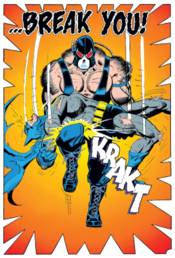
Bane (Tom Hardy here) is the perfect villain to bring into the mix. A hopped-up minor character, he is best known as the lead antagonist for the "Knightfall" storyline (that seemed to last a couple years). In "Knightfall," the drug-pumped super-villain released every criminal in Gotham's prison system for The Bat to deal with, while he hung back, biding his time. Then, when the Batman, weakened and exhausted, finally confronted him, Bane broke his back, leaving Wayne paralyzed and unable to fight on. It fell to the rest of "The Batman Family" (including the once-and-future "Robin's") to take on the mantle and continue the fight.

Nolan's canvas is a bit broader, taking into consideration the events of the two previous films to create something a bit more apocalyptic, a rumination on the fractious quality of good vs. evil and the slippery slope to Hell that ideology and good intentions can be tilted towards. Nobody's pure in this one, there's no whack-job with delusions of grandeur behind the assault on Gotham City, with avarice their sole motive. Everybody, wearing white or black, thinks they're doing the right thing. And everybody's wrong.

It's eight years since the events of The Dark Knight that resulted in the deaths of D.A. Harvey Dent, Rachel Dawes, and the subsequent disappearance of the man suspected in the killings, the Bat-man (Christian Bale). Now, Bruce Wayne is an exile in his newly-rebuilt Wayne Manor, walking stiffly with a cane due to some unknown injury (part of me wants to think it was due to him being stabbed by one of The Penguin's umbrellas). He sees no one, is a recluse, and there are rumors he's turned into a Howard Hughes-style eccentric, apparently due to a massive investment in a clean energy prototype that failed and cost Wayne Enterprises a fortune...or at least half of it.
The chief backer for the project, Miranda Tate (Marion Cotillard) tries to get past the constant guards of faithful butler Alfred (Michael Caine, putting in the most emotional performance he's done in years) and Wayne exec Lucius Fox (Morgan Freeman), who fill the functions of acting as Wayne's heart and brains (and conscience), if not as surrogate Mother and Father. A rival exec, Daggett, is trying to take over W.E., by any means necessary, in this case, employing a terrorist named Bane, who has his own bones to pick (and break) with Gotham's golden boy. At the beginning of the film, Gotham in morosely complacent (and obviously filled with exposition), having cleaned up crime by the draconian Dent Anti-Crime Act, which has incarcerated over a thousand criminals in Gotham's Blackgate Prison.

But things are percolating underground, disrupting Gotham's infrastructure.  Bane has an army of misfits and big plans that have outgrown the desires of his patron, and there's a lithe cat burglar named Selina Kyle (Anne Hathaway), who is caught with her hands in the Wayne Manor safe by the man himself ("Oops," she says, not very convincingly). Yes, she's pilfered Martha Wayne's pearl necklace, but more importantly, Bruce Wayne's fingerprints. What does she want with those?

It's only one piece in an intricate puzzle of escalating consequences that Batman must unravel if he is, once again, to save Gotham City, and he must confront his past and overcome great injury, physical and emotional, if he is to prevent a catastrophe...
one of his own devising.

That's the gist of it, but it is convoluted by elaborate set-pieces that are, frankly, jaw-dropping, and ends up with Gotham isolated from the rest of the nation, in the hands of criminals with big ideologies and little concern for how roughly they're applied. The police are paralyzed—most of them trapped in the deep infrastructure of the city (a little too conveniently) while Bane initiates a countdown to total destruction.

A countdown of five months.

To quote The Riddler:"????" Five months? How suspenseful is that? And you'd think that somebody, somewhere, would be able to unravel the plot or situation in such a time-frame. But, it's basically a set-up for what Nolan depends on to generate suspense throughout the movie—the last minute "save," that is usually explosive and comes from nowhere, because the writer-director has made motivations ambiguous enough as to be unreadable.* Everyone has got a secret that will be revealed at the most opportune moment of drama. If the mystery was revealed in a drawing room, it would feel like cheating, and the revelations almost psychic.
Speaking of unreadable, Tom Hardy's Bane is hampered by a mask of a morphine dispenser (to keep him from feeling pain), as opposed to the enhancement-juice-pumping-apparatus from the comics (This leads one to ask: if the guy can be stopped by breaking the mask, why does Our Hero employ so many body-blows?  Face-shots, man!!). He is perpetually muffled by this thing, which Hardy compensates for with an almost jolly Father Christmas speaking style, making a clever, unnerving ying-yang effect for the character. Ultimately, though, he's something of a vapor-tiger, like Darth Vader, the big bloated bloviator who's merely a "blind," a distraction for the real danger.


But...five months??**
Another thing: Nolan has come out publicly saying that he wants to make a Bond movie (and the snowbound facility infiltration in Inception is a bowler-tip to them). I would submit that he already has, this film being it. So much of it is borrowed from Bond that all one needs is a casino scene to make it complete (a costume party has to suffice
***). The opening sequence, the-villain-that-feels-no-pain, the duplicitous females, obligatory "Q" scene, the tick-tock final set-piece and other aspects can be attributable to Bond films of the past. At least someone is borrowing from the Bond series this time, instead of the other way around.
But, his world of comic-book fantasy is far more gritty and down-to-Earth than any other, and that's what makes "The Dark Knight Trilogy" good; it's relatable, it feels like it could happen, if someone had the will, the wherewithal and the wallet to do it. It also feels of our time. There's been a lot of gas about the politics in this film—uninformed, desperate gas—but the whole uprising scenario, the subjugation of the privileged with no benefit to the less fortunate, the breaking down of society and the cleaving of its people is the stuff of water-cooler vitriol and feels like the temper of the times. The Tea Party AND the Occupy Wall Streeters can both find things to point at and go:"See?"
I'm not going to speculate which side is right, and Nolan is obtuse (and politically slippery) enough to play it right down the yellow stripe of the road. But, this British director is saying something about the State of the Union with a full child-warbled rendition of The Star Spangled Banner (before a particularly horrific football game) and a shot of American flags in tatters on a city street, deep in the movie. They're there for a reason, but not for anything specific enough other than "we're a fragile alliance and we're in trouble."
And that we need heroes—selfless ones, for whom profit is not a motive—and that, "anyone can be Batman."****

* Case in point:  there's a scene where Catwoman uses a Wayne-supplied bat-bike to blow a hole in a tunnel to make an evacuation tunnel for the sealed-off city, a task initiated by the Caped Crusader.  Following it, Nolan sits on a pull-in shot of Hathaway with an enigmatic smile on her face that communicates...nothing. Except an odd complacency. It will only be resolved...if there's anything TO be resolved, later in the film. 

** There are neat touches, and a refresher of both The Dark Knight AND Batman Begins will help. One nice thing—Nolan recalls a scene from BB when a young Bruce Wayne falls down a tunnel and is subsequently rescued by his father, by having a similar scenario played out here, with the Obi-Wan presence of a dark father figure from his past. Nice touch.

*** A masked ball at which, like in Batman Returns, Bruce Wayne doesn't wear a mask.  Heh.

**** Just not Nicolas Cage, please...
What do they say at Marvel? "What a poser..."