Showing posts with label Mystery. Show all posts

Thursday, March 27, 2025

The Detective (1954)

The Detective
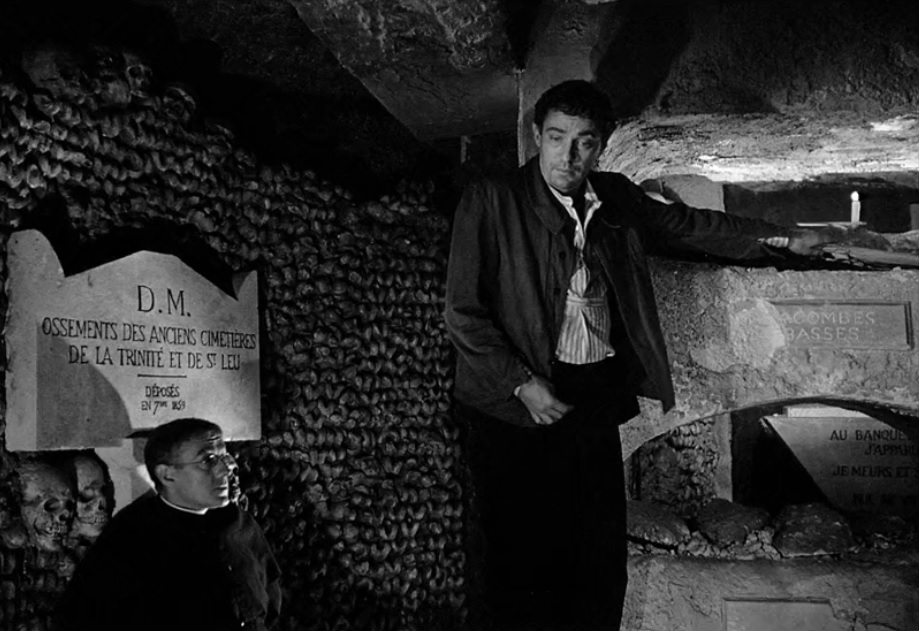
(aka Father Brown)(Robert Hamer, 1954) It's quite the scandal when Father Brown (Alec Guinness) is arrested by the local constabulary when he is caught in the act of "burglarious purposes" in front of an open safe. At police headquarters, the humble English vicker tries to explain that he was only trying to return the "swag" ("I believe that's what it's called—'swag'") for one of his parishioners (he admonishes him for being "an incompetent thief...clearly incapable of earning a dishonest living") whom he had convinced to forego a life of petty thievery and, in return, Brown would return the stolen good to the rightful place. That's when the police arrived.
 
A night in the hoosegow (which he finds "most interesting" and thanks the police for their "hospitality") and he's identified by the church authorities and sprung. So, of course, when he's hauled before the Bishop, he assumes it's for the arrest—he having a reputation in the diocese as "an odd one". But, it's of another matter entirely: it's seems that the Eucharistic Congress is soon to be held in Rome. And the Bishop has decided to send the Holy Cross of St. Augustine, which is twelve centuries old and currently resides in Father Brown's parish church. Father Brown considers the cross "not valuable...priceless," so he's alarmed when informed by a local Inspector than an "imminent criminal is intent to intercept the cross en route." The criminal's name is Gustav Flambeau* (Peter Finch) and Father Brown is only too aware of the master-thief's reputation—"a human chameleon" such an expert of disguise that no one knows what he looks like.
When Brown is informed of the precautions, the father-detective goes into a sort of distracted trance—in his mind, he's figured out three different way that the cross could be stolen. "So, if I, an amateur, can steal the cross in
three ways , one can only think what Flambeau will do!" Brown volunteers to take the cross himself—"one priest indistinguishable from hundreds carrying one cross undetectable from hundreds" But, the inspector and the Bishop are in agreement: they will have undercover men make their way to Rome in the hopes of intercepting the wiley thief. To Brown, this is "lunacy!" He makes his own arrangements to carry out his conception of a plan.
Now, as a recovering Catholic, I must confess that the closest I get to religion these days is through Father Brown, the sleuthing priest created by author G.K.Chesterton in 1910 (predating Agatha Christie's sleuths by a decade). I've watched the Mark Williams series, having seen nearly every episode, and read a few of the stories and have always found a kind of solace in the character's rock-solid faith and his unorthodox application of it when dealing with the near-occasion of sinners. He does not judge, believing not that people are good or evil, but merely people, and those that have strayed can always be moved on to the better path. He is not naive, or a cross-eyed optimist, but will argue that his faith is even more pertinent in a world where virtue is challenged. At one point in The Detective, he says: "
My son, you think that you are a man of the world and that I am not. But I assure you, my 'innocent' ears encounter every day stories of a horror that would make your sophisticated hair stand on end. Although I wear funny clothes, and have taken certain vows, I live far more in the world than you do." It's a world where his ability to pick locks, or judo-wrestle are useful tools, particularly when employed for good. He'll even pick a pocket (but only to prove a point when he returns the "swag").
When I found that there was a "Father Brown" movie, particularly to my delight that Alec Guinness played the part, I began an exhaustive search to find it. It took years, but it can now be found** And it exceeded my expectations. I've never been disappointed by a Guinness performance*** and his Brown is very much a sheep in wolfs clothing. He's as sharp as they come, if a bit idiosyncratic, and when called upon Guinness overplays the "twee" nature of Brown, his awkwardness hiding a quick-wittedness—although his humility will never allow him to admit it.
The Detective also has two of my favorite British performers: the ever-beguiling 
Joan Greenwood, (who'd starred with Guinness in a couple of his comedies) as one of Father Brown's more well-off parishioners and confidantes; and Bernard Lee (who would go on to play MI6 head "M" in the first 16 films of the Bond series) as an undercover police officer doggedly pursuing Flambeau, and who finds Brown's deft interference almost in itself criminal.
But, the surprise is Peter Finch as master-thief Flambeau. Up to this point, Finch could be rather stiff in his roles, but, here, he's light-hearted and charming, pulling off the character-work in disguise, and, when unmasked, giving off the air of a bon-vivant, quite happy in his mis-deeds. Guinness and he have a lot of dialog together and they spar winningly.
Based rather loosely on Chesterton's first Father Brown story "The Blue Cross," It's absolutely delightful and was well worth the wait.

* Interesting that they call him "Gustav" Flambeau as Chesterton gave him the christian name of "Hercule"—perhaps to not confuse him with Christie's Poirot, who debuted 10 years later—and the character is supposed to be French, and Gustav is considered a Swedish or German name.
 
** On the streaming service Tubi, but the Lord only knows how long it will remain there. 

*** Okay, there is one. It is Hitler: The Last Ten Days where I found his performance as The Führer rather dull. Time Magazine's critic said it was only useful in showing "the banality of evil." Curiously, IMDB says it's the only performance Guinness was completely happy with, having campaigned actively to play it.

Wednesday, September 25, 2024

The Critic (2023)

Critic, Critique Thyself
or
The Mystery of the Missing Curtain Call
 
To read online reviews, Anthony Quinn's mystery novel "The Curtain Call" is a cracking good read, set in 1936 London with a background in the theater-world amidst it's denizens, while at the same time being something of a manifesto on giving the downtrodden some agency. It sounds like it would make a great movie.
 
The Critic is the movie based on Quinn's book...and it isn't. A great movie, that is. I don't know what happened, but whole plots, characters, whole gists of the book have gone missing in the transition from print to screen and one can only wonder who the culprit is.
 
Or the why of it. But, someone has done a great crime to the book. And somebody's responsible.*
But, one shouldn't review what isn't there, one should review what is. What we've got is a character study with a little bit of blackmail/murder thrown in. Jimmy Erskine (
Ian McKellen) is a renowned theater critic for London's Daily Chronicle, known for his bitchy reviews scratched out with a poison pen (and typed up for submission by his assistant, played by Alfred Enoch). Jimmy relishes his job and his high-handed witticisms ("I do not enjoy the theater. I am the chief drama critic of the Chronicle!") and the perks of having his reserved seats at the theater and reserved table at the club, but his publisher, the Viscount David Brooke (Mark Strong)—having taken over the paper from his late father—has reservations of his own and would like Jimmy to "tone it down. More beauty. Less beast!"
Jimmy, though, has high standards—in everything but the "rough trade" he dabbles in—and between his lack of cooperation in kinder, gentler reviews and his frequent violation of the "morals clause" in his contract, he finds himself sacked. The Viscount has had enough of the paper's "old guard" and wants to bring in fresh blood. For Jimmy, being a pensioner is not enough to keep him in the decadent lifestyle that he's become accustomed to. So he hatches a plot.
One of the actors that he's been regularly slagging in his reviews is ingenue Nina Land (
Gemma Arterton), who is pretty and game, and wants nothing more than impress the Chronicle's drama critic—she's a fan of his taste and his writing—but one more bad notice from him and she has the pluck enough to confront the man (catching him trolling in a nearby park) and she makes her case through flattery and some implied blackmail, both of which impresses Jimmy. "There is art in you, Miss Land," he confides in her. "My disappointment is in your failure to access it." He decides then and there to take her under his wing and tutelage. She could be useful.
What he doesn't know is that Land is having an affair with the publisher's son-in-law, a portrait painter of some repute, and that complication makes things a little dicey for what Jimmy has in mind for his scheme to get his old job back. Trouble is, he's a critic, and having observed enough theater in his profession, one would think he would immediately spot a weak plot, even if it's of his own devising.
The Critic
premiered at the Toronto Film Festival last year and there was less buzz than murmuring, and so some tinkering and tailoring was done with re-shoots and another ending prepared and there's just enough dissonance in the film that the seams show. One can't fault the performers, all of whom do the job with McKellan deserving the lion's share of the praise for a performance so venal done with obvious relish.
But, it isn't enough. The plot's spread awfully thin and what's there is lingered over and emphasized, like the shot that director Anand Tucker keeps coming back to—an overhead shot that zeroes in right on the performer's forehead (to what purpose, you wonder, other than to show somebody thinking). And you wonder where it started to go south.
 
Any movie adaptation of a book should make you want to go to the source to get more of what drew you to the story in the first place. The Critic makes me want to read "Curtain Call" to see what it is I'm missing.

* Yeah, it sounds weird, but then, so is the source: Plan 9 from Outer Space, Ed Wood's notorious science-fiction opus once dubbed The Worst Film Ever Made. At one point, a detective discovers a corpse in a grave-yard and says (quite seriously) "But one thing's sure. Inspector Clay is dead, murdered, and somebody's responsible." 
 
Well, technically, that's three things, but you can't quibble with Plan 9, or you'll end up wasting your life.  As a matter of fact, it occurs to me that I don't have a post for Plan 9...yet. Well, Hallowe'en month is coming up...

Thursday, October 26, 2023

The Magician (1958)

The Magician
(aka Ansiktet or "The Face", 
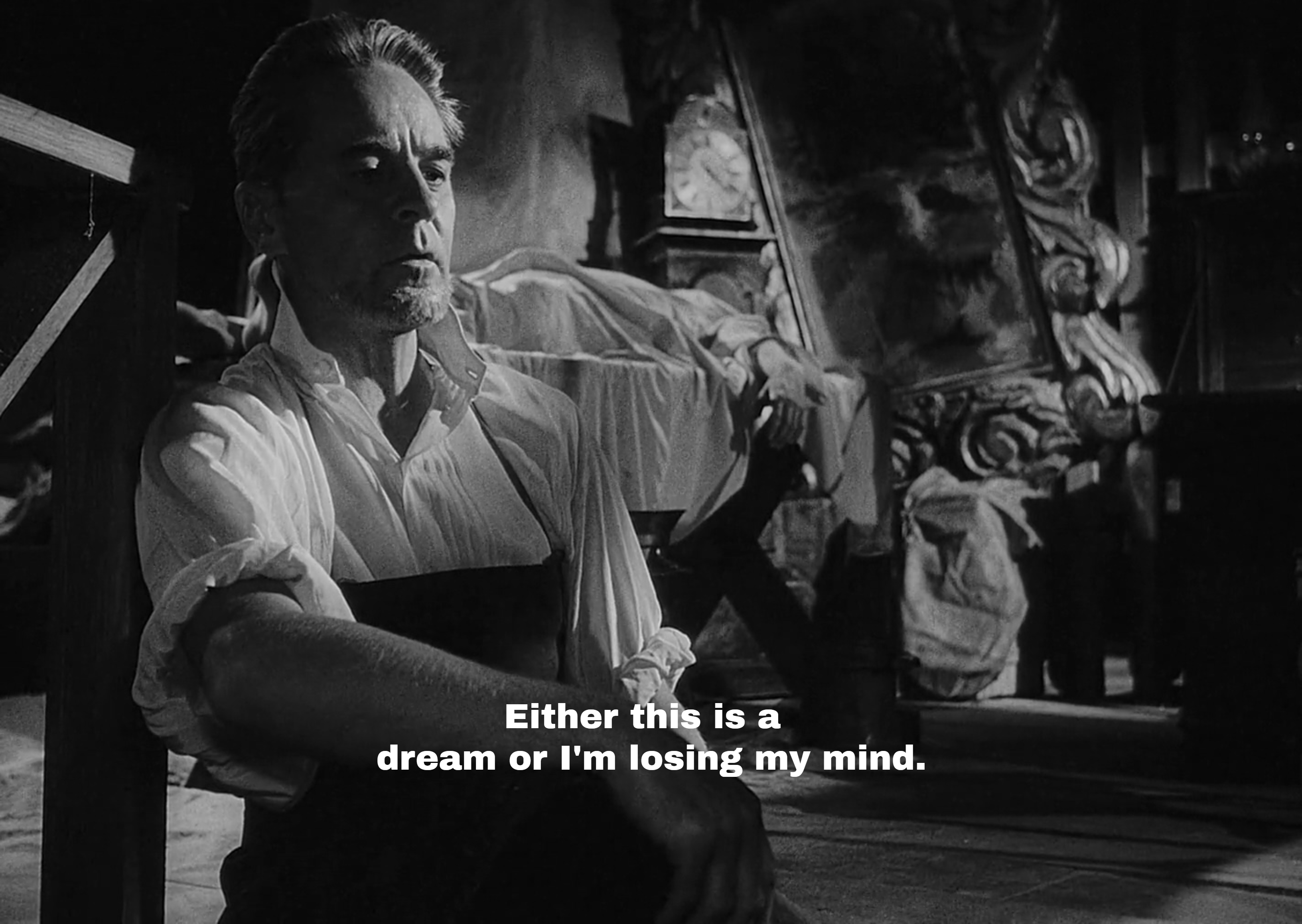
Ingmar Bergman, 1958) It is a rough day of travel for Vogler's Magnetic Health Theater, a gypsy band of performers just out of Copenhagen and carriaging to Sweden. Their reputation precedes them, having been accused of fraud and blasphemy at various stages of Europe, and some time incarcerated, but still they have a following and luckily it doesn't involve torches and pitch-forks. The troupe moves purposely on demonstrating the awesome powers of animal magnetism and selling potions for the sick and the wantonly healthy. "Sensational marvels never seen before. Magical acts derived from the philosophies of the Orient. Health-giving magnets, and spine-tingling thrills for the senses." That's what the flyers say, anyway. Whether it is true or not, the head of the troupe, Albert Vogler (Max von Sydow) will neither confirm or deny; Mr. Vogler, you see, is mute. Better to neither confirm or deny, the less said the better, and nothing is best of all.
In their travel, they come across a sickly actor, Johan Spegel (
Bengt Ekerot), who asks for some brandy as he's sure today will be the last day of his life. He is offered that and a ride, and he joins the troupe consisting of Vogler, the severes"Mr. Aman" (portrayed by Vogler's wife, Manda—portrayed by Ingrid Thulin), their assistant and spokes-person Tubal (Åke Fridell), the carriage driver Simson (Lars Ekborg) and "Granny" Vogler (Naima Wifstrand), who "may" be a witch but is skilled at potions.
The actor having a mute audience as benefactor, talks and talks, his health gradually declining, his life ebbing away with every word, knowing that Vogler will be fascinated to hear his account with death, but...just as he's about to reveal what death is like...he dies.
Against that backdrop, the troupe continues on to the first village on their way, and are invited by Counsel Egerman (
Erland Josephson) and his wife (Gertrud Fridh), both of whom are believers in the supernatural and are fascinated by the claims of the visitors, to join a party held in their behalf. Also attending—with a bit more "official" interest in the theater troupe—are Police Superintendent Starbeck (Toivo Pawlo) and the Minister of Health, Dr. Vergerus (Gunnar Björnstrand). The officials decide to have an informal bet on whether Vogler's group and abilities are frauds.
Are they frauds? There's room for interpretation: Egerson and his wife—especially the wife—lean towards belief, but Vergerus is a man of science and is disinclined to buy into any sort of mumbo-jumbo, and Starbeck's fall-back is to believe the band—given their reputation—are fraudsters, looking to separate the populace from their Krona. And given the artifice displayed by the players of the theater—Albert and his wife are both heavily made up and not what they appear to be—there's more than enough reason to think that it's all an act, mere illusion and trickery than any sort of mystic power.
One is inclined to say that there's a battle of wits between the troupe and their hosts, but it's no battle, really, merely the troupe being true to their nature as imaginative outsiders and the officials being stuck in their ways of thinking. Even if members of the troupe protest that everything is smoke and mirrors, there will always be that little suspicion with evidence to the contrary that they might not be. The evidence will be equal parts what they see with their eyes and what they feel with their hearts, and even the most pessimistic of the lot can be made to doubt, especially if their beliefs are merely a way to prop up a reputation of confidence.
One line haunts, and feels more true these days than at the time of the film's creation: At one point, the ailing actor makes a point:
Ouch. That hits you right in your superstitions. Or is it maybe the one who tells the truth needs to be put down by all the deceivers, lest they be exposed as such. But, in a world of deceivers what difference would being exposed make, especially if it's status quo?
Bergman offers no answers, just possibilities. The troupe could be fraudsters, but that fallen actor at the beginning comes back to haunt Vogler, something that only he is privy to. That must be evidence, no? But, evidence of what? Who would it convince but only another believer?
 
The Magician leaves the stage making you want more. And its questions haunt long after that point.

Wednesday, September 20, 2023

A Haunting in Venice

A Haunting We Will Go/A Haunting We Will Go/Hi-Ho-Confuse Poirot/A-Haunting We Will Go
or
"Lighten Up, Pal! You Might Have Fun!"
 
It is 1947. "World's greatest detective" Hercule Poirot (Kenneth Branagh), he of fusty ways (oh god, they haul out the "egg joke" again!) and the elaborate mustache—that looks like superimposed Aston Martin/Bentley logos—is in retirement. In Venice. "A gorgeous relic sinking into the sea" compares mystery novelist Ariadne Oliver (Tina Fey), who has skipped the long line of desperate potential clients waiting outside his door to tempt Poirot with a case which just might revivify her career after three critically-panned books. 
 
Poirot will have none of it. A veteran of the first World War (as was shown in the previous film, Death on the Nile), he has lived long enough to see that its reputation as "the war to end all wars" has proved false and, having seen too much of death, has foregone his profession to ease the strain on his little grey cells. But, Oliver is persistent, and so he joins her on Hallowe'en night to the palazzo of opera star Rowena Drake (Kelly Reilly) to witness a festive party for local Venician children, and, for an adult after-party, a seance performed by the medium Joyce Reynolds (Michelle Yeoh) to try to quell the spirits haunting the Drake place, one of whom might be Rowena's daughter Alicia, who died "under mysterious circumstances" years before.
"Under mysterious circumstances" may be overstating, as the girl drowned in a city that is nothing but waterfront property—sort of like being surprised when there's an explosion at a munitions factory ("Non-smoking? Who knew?"). I'm just saying that the Venice polizia usually don't ask "cause of death?" as they fish another tourist out of the canal. That aside, there is some question as to whether Alicia's death was a suicide or an accident or...was it murder?
Poirot, he does not care. He's there to expose the medium using his powers of observation and his absolute disbelief in the supernatural ("scary stories make life less scary"), suspecting that some grift will ensue from the proceedings. His convictions are only solidified when Alicia's former fiancee Maxime Gerard (

Kyle Allen) arrives after a mysterious invitation is sent his way so many months after the tragedy. Also in attendance is the family's doctor Leslie Ferrier and his son Leopold (Jamie Dornan and Jude Hilll, who played father and son in Branagh's Belfast) and the housekeeper Olga Seminoff (Camille Cottin), all of whom figured in the care-taking of the daughter before her death. It all seems very neat and tidy.
The seance is anything but. It's a convincing show, with Reynolds going into a trance, speaking in the dead girl's voice, spinning in place and with messages appearing on a typewriter ("I think of myself more of a secretary than anything" says Reynolds), seemingly written by "the lost girl from beyond." Nature conspires with the supernatural as a violent thunderstorm permeates the whole procedure. But, the mysteries linger on with Poirot nearly killed bobbing for apples (true!), strange voices permeating the house, flashes of the dead girl from beyond, and...a couple of grisly murders most foul.
A Haunting in Venice is based on Dame Agatha Christie's 1969 novel "Hallowe'en Party" and in much the same way that later James Bond movies are based on Ian Fleming novels—that is, not very. Scenarist Michael Green (he's done the scripts for all of Branagh's Poirot films as well as Logan and Blade Runner 2049) has retained some of the names, but murdered Christie's plot and hatched one of his own (mind you, all with the tacit approval of the Christie Estate). Although it ties up all physical loose ends, it ends up with an implicit endorsement of the supernatural (if only in sub-text, but is rather jarring when its chief detective is committed to exposing the charlatan exploiters of the belief, and a couple of glaring motivations amidst a couple of suspects.
Perhaps because he knew the weakness of the script, Branagh the director works overtime establishing an atmosphere that disorients and distracts. His compositions are full of dutch angles and high and low shots, fish-eye lenses, and full of conversations with askance sight-lines. That's not "normal" film-making (and by that I mean "professional" film-making that obeys "all the rules" and creates a comfortable-to-the-eye-and-mind viewing experience). Branagh's choices are Wellesian in their disregard for viewer comfort; discomfiture is actually key to making the film work. By setting audiences "on edge" and making things look "off" you can get away with a lot of chicanery in a burst of style over substance.
That may sound dismissive, but Branagh has typically been a director of verisimilitude—making things look real. Here, he deliberately makes things surreal, claustrophobic and, often, acrophobic (which is a lot of work!), but it breaks a cardinal rule—never call attention to your directing (a rule too often ignored by beginning film-makers.) The result is so showy and over-the-top that one just might forget the story-line for all the sights to see.
In this case, it's a good strategy. The script is a let-down, full of incident and the occasional zinger of a line, but too convenient and incredulous simultaneously to make a well-conceived plot both among the movie's conspirators and behind-the-scenes in the writer's room. Branagh's work and collaboration with cinematographer Haris Zambarloukos (he's done Branagh's last few films...AND ), however, overcompensates to a degree that one feels that one has seen a real show, full of acrobatics and elephants in the room (and one abrasive cockatoo!) to marvel at, even if the little grey cells are not entirely engaged and unconvinced.
It sure looks good, even if it's as insubstantial as a ghost. 

Tuesday, April 18, 2023

Les Diaboliques

Les Diaboliques (Henri-Georg Clouzot, 1955) Oft-imitated classic thriller from the writers of "Vertigo" (Hitchcock tried to acquire the film-rights to this book, but lost out in the bidding to Clouzot), and brought to low-key life by France's master film-maker. 
 
It's become the template for stories about duplicitous menage a trois' and twist endings, as well as a model of how to wring suspense out of an audience. And it's been remade a few times* (the last time with Sharon Stone and Isabelle Adjani and de-articled as simply Diabolique).

Clouzot starts out slowly, bringing into detail the specifics of the unhappy/unholy union of cruel school-master Michel Delassalle (
Paul Meurisse) and his weak (and weak-hearted wife) Christina Delassalle, (Véra Clouzot)and his mistress Nicole Horner, another school-teacher (played by Simone Signoret).
The arrangement has been out in the open among the parties for awhile, and everyone is vaguely dissatisfied with it, so the only way to make everybody happy (well, almost everyone) is a simple little murder-plot. Three's a crowd. And as the school-master's a beast, he's the one who has to "go".
Clouzot follows their plot with intricacy and humor, but with a disturbing eye for the horrific. His manipulation of dark-spaces (and subsequently, the audience) shows a master of technique, as well as creating amazing challenges for cinematographer Armand Thirard (whose work is simply amazing).
As with any film that sets a template, one might be able to watch and know what will happen around the corner (it's the inevitability of the film's success and experience), but Clouzot's execution of the film is still a marvel to watch, and whether one suspects the outcome or not, it still provides considerable jolts to the system, and real moments of unease.

* I remember a TV movie with and Sam Waterston, Ira Levin's Death-Trap with Michael Caine and Christopher Reeve, and Mortal Thoughts starring Glenn Headley, Bruce Willis and Demi Moore. Hitchcock borrowed more than once from this film, just as one can say that Clouzot no doubt had the British director in mind, as well.

Thursday, April 13, 2023

Tell No One (2006)

"Margot at the Funeral"
 
One is left calculating what Tell No One reminds one of–equal parts Hitchcock and Chandler, the gritty BBC procedural mysteries,with a little bit of "The Fugitive" thrown in–but it only occurs to one to tick these things off after the film's conclusion. One is too immersed in the complicated story to look for stylistic roots while its going on. Besides that, one can't seem to un-clench the chair-arms while the roller-coaster ride is going on.

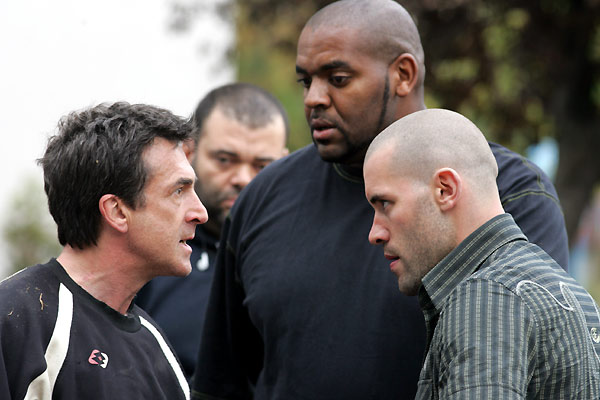
Tell No One (aka Ne le dis a personne) starts slowly enough. In its first minutes, it sets up an anniversary celebration between childhood sweethearts Alexandre and Margot Beck (François Cluzet and Marie-Josée Croze).

And then, as they say on the magazine shows, "things go horribly, horribly wrong.
Flash-forward eight years, and pediatrician Alexandre is still grieving the loss of his wife. The police are snooping around, because at the time of her murder, he was their prime suspect. But now, nearing that fateful anniversary, the gendarmes are starting to ask questions again. And the recent discovery of two buried corpses nearby only complicates the matter.

The cold case suddenly starts heating up, and making Beck quite hot under the collar.
Two sets of investigators are tracking him
. Then, he begins to get cryptic e-mails, the first one ending with the ominous phrase "Tell No One. They Are Watching." Attached to the message is a file that he's having trouble opening. Usually the hunted man has all sorts of road-blocks put in his path; the vagaries of incompatible software have now joined the mystery lexicon.

To reveal anything more is to spoil the enjoyment of the unraveling of the story, but it involves
chases, subterfuge and criminal activity in very high and very low circles, good cops and bad cops and wet-works operatives.
*

Oh, and everything he knows is wrong. But that's okay–he's a man who doesn't know too much.
Tell No One is based on Harlan Coben's 2002 novel of the same name, and the switching from Jersey to France matters not a jot. Some changes have been made to the story (with Coben's appreciation), and is well-crafted by director Guillaume Canet, and none of the seams show or give you any clue for what's coming ahead. You're carried along finding new information along with the lead, played extraordinarily well by François Cluzet. He has a quiet every-man kind of face, but Cluzet takes that quality and turns it on its ear. His performance reminds me of Bob Peck's in the excellent "Edge of Darkness," and both films have similar ways of presenting new information casually. But every character is well-etched–that's part of the film's great charm–but special mention has to be made of Kristin Scott Thomas who drops as effortlessly into this french-language role as she does into her typical "English Rose" roles. And if Croze seems somewhat familiar, you might remember her as Jean-Dominique Bauby's first language therapist in The Diving Bell and the Butterfly, and the Dutch assassin in Spielberg's Munich.
 
Tell No One tells its story with the chilly efficiency one expects from a thriller, but what is surprising is that it does it with so much feeling and heart. Highly recommended. Go tell everyone about this one.

* In fact, the one story element that doesn't jibe I can't reveal because it would give everything away!

Wednesday, February 1, 2023

The Pale Blue Eye (2022)

Hidden in Plain Sight
or
The Poe-Eyed Detective ("It Will Work Out")
 
There is something ingenious, if not precious, about the conceit: a murder mystery featuring the creator of the modern detective story.*
 
Sure, every depressive knows Edgar Allen Poe as the writer of morbid, anguished poetry with repeated lines at the ends of stanzas. But, with his publication of "The Murders in the Rue Morgue" in 1841, he began a new genre of mystery story, based, not only on the dark corners of the human psyche, but it's very opposite, the power of reasoning and deduction—or what he called "ratiocination." With the success of his Dupin stories, came the inspiration for Doyle of Sherlock Holmes (he never shied from admitting it or his other sources) and, from there, the progeny of the countless numbers of problem-solving busybodies that have expanded and pushed the envelope of the Dewey Decimal System for decades.

Homage must be paid.
The Pale Blue Eye
(love the title...) begins with an image, a surrealistic scene veiled in fog, of a man handing by the neck from a tree. But, something's off. His feet are on the ground, rather than being suspended above it. The explanation for that image will take the entire movie to explain, but already you're hooked, and that image is a wonderful metaphor for a mystery. Something deadly has happened, but why, and by whom, needs to be sussed out. Only one person knows and that is the one who did the deed.
It's 1830. Retired constable Augustus Landor (
Christian Bale) lives a solitary life in his rustic, but well-libraried cabin, another in a long line of isolated men, known for "getting a confession with just a stare." His wife died many years ago, and his only daughter, whom he mourns, has disappeared—a mystery that still haunts him. One day he is greeted by Captain *ahem* Hitchcock (Simon McBurney) from nearby West Point Academy. One of their cadets has been found dead—he'd been hung, apparently, but the most grisly aspect of the deed is that his heart has been carved out of his chest.
Landor has some restrictions put on him by the Academy Superintendent, Thayer (Timothy Spall):he is to report to him and Hitchcock daily on his progress; he works for them as an employee as long as they approve of his work; interviews with cadets must be done with Hitchcock's supervision; he can't drink on the job. There is a tavern in the town, however, which he visits after hours. He runs afoul of the Academy's physician, Dr. Marquis (Toby Jones), when he proves himself unsatisfied with the doctor's autopsy—but Landor's thorough work does win him enough grudging respect that he is invited to the doctor's home, where he meets his somewhat-hysterical wife (Gillian Anderson, always great, even when she's not doing the autopsies) and his children, cadet Artemus (Harry Lawtey) and his lovely daughter Lea (Lucy Boynton).
The cadet interviews do not go well. The young men are less than forthcoming-especially under the baleful eye of Hitchcock. But, there is one young Virginian cadet who attracts Landor's attention, not only because he has an obvious intelligence and grand-if precise manner of speaking. He's also a bit of an outsider at the Academy, a frequent object of scorn among the students...and the instructors.
This is cadet E.A. Poe (Harry Melling), not the finest example of military discipline, frequently seeking permission to be excused from outside drills, citing poor health and spending his time writing poetry. When Landor first meets Poe, he is struck by his eloquence and directness, but more by his opinion that the perpetrator may have chosen a mundane way to kill the victim, but the cutting out of the heart "makes him a poet." Poe's creepiness makes him a "usual suspect" as far as murder mysteries go, but at a later meeting in a tavern, Landor suggests to him that they should work together on the case, as Poe might have opinions—and access—that Landor could use.
Then, there is Landor's mentor, Jean Pepe (
Robert Duvall), an elderly recluse, with a vast knowledge of all things ritualistic and arcane. It's always good to see Duvall in anything, and his presence reminds one of the useful—but supplementary— characters that inform and give a certain historical sub-text to many a fictional detective.
The investigation twists and turns like a speckled band—no, the story doesn't involve snakes—but, is enhanced and complicated by young cadet Poe's besotted enchantment with the doctor's daughter Lea Marquis, prone to seizures that might be due to epilepsy—or maybe it's just a family curse.
Oh, this one is a corker, with a resolution that will surprise casual mystery watchers, and inspire appreciative smiles from aficionados with its echoes of Poe's own detective fiction. There might be a bump or two in motivation, a red-herring here and there (aren't there always?), but, by the end, one will be properly sanguine with the mystification they experience.
And the cast is top-notch. Bale isn't grand-standing here with tics and business, but relies on a relaxed body language that he rarely employs, and the relationship between he and Melling's overelegant Poe is a nice study in contrasts in a mutual admiration society of two. Director Cooper keeps things moving swiftly and takes full advantage of cinematographer Masanobu Takayanagi's ability to create astounding images of nature and the unnatural. And Howard Shore's score is lovely, another wonderful example of why he should be doing more music for films these days.
It's a very well-done film, that is only undermined by the fact that it will never light—and darken—a theater screen, where it can be truly appreciated, and, although it is nice that Netflix gave it a healthy paycheck to be produced, why it should be relegated to a small screen, is a real mystery.

* When the Mystery Writers of America organization hands out their little trophies, they are dubbed "The Edgars." There are some scholars who begrudge Poe the title. But, they can't do anything about the little statues.