Showing posts with label Timothy Spall. Show all posts

Tuesday, May 21, 2024

Wicked Little Letters

Post Pardon Depression
or
A Comedy of Ill-Manners
 
I think I've mentioned before that you can't watch a British mystery series without one episode involving the investigation of a rash of poison-pen letters (that may or may not be true) that disrupt a community. There was one major movie, Henri-Georges Clouzot's The Raven, that we mentioned previously. 
 
The origin of this particular trope came from the scandal of the "Littlehampton Letters", a Sussex incident that caused quite the scandal between 1920 and 1923. The general story is that Edith Swan, a spinsterish woman who lived with her upright Christian parents, began to receive letters of an unseemly manner and of such vulgarity that she made complaints to the police. Suspicions immediately turned to Edith's neighbor on Western Street, Rose Gooding, as Rose seemed a person of questionable character, known for causing rows and for her obscenity-laced language. It didn't help that the letters appeared to be signed by Rose. That first letter started: "You bloody old cow, mind your own business and there would be no rows. – R." That Rose had a child and was living with a man didn't help things. Nor did that the letters appeared after Rose was reported to Child Protective Services by someone in the neighborhood.
Rose was arrested and charged with criminal libel, and as she could not afford bail, she was in prison for three months. During Rose's incarceration, the letters naturally ceased. When she was released, the letters began again, expanding in scope, and Rose was again arrested, convicted and sentenced to 12 months in prison.
All neat and tidy, said the law. But the story didn't end there, through the efforts of a dogged police-womanSussex's first
Woman Police Constable Gladys Moss, who began to suspect that things weren't as neat and tidy as her male counterparts believed it to be. With the help of Scotland Yard, she was able to trace who the letters were coming from—the courts wouldn't allow writing analysis in the trials—and catch the actual culprit in the act.
Wicked Little Letters tells the story of the case, and, truly, it lives up to it's opening title: "This is more true than you'd think." Oh, there are little changes here and there, mostly for the sake of diversity in casting, and to ram home the point that those times were more prejudicious than our own (although it's ironic that they try to make the point of how good we've got it by casting non-white players to signal to us that these people are dealing with oppression and prejudice*). Actually, our times are just as bad, only less by a matter of degrees.
Edith Swan is played by 
Olivia Colman, her parents by Timothy Spall and Gemma JonesJessie Buckley is Rose Gooding and her live-in man is Malachi KirbyAnjana Vasan plays Woman Police Constable Moss, and Rose's neighborhood allies include Eileen AtkinsLolly Adefope, and Joanna Scanlan. However much kerfluffle may have been going on in Western Street in the 1920's, it couldn't have been as entertainingly chaotic as this cast makes the circumstances involved. Colman, particularly, is a study in contrasts. Initially making friends with Buckley's Rose, Colman's Edith couldn't be more thrilled—a little shocked at her raw forthrightness—as Rose is as free-spirited as Edith is repressed, belittled, and subjugated in her father's household. When the whole letter-thing is delivered at her doorstep, she becomes alternately victimized, outraged, and (once the papers get ahold of it) prideful of her role as upright citizen standing up for the decency of civilization. Her performance is a master-class of expressiveness whatever the role Edith takes on.
And Buckley holds her own with the more ostentatious part as Rose, unapologetically coarse even as she's being accused of coarseness, while fully realizing that she is just a gavel's slam away from losing her family as a consequence. But, her Rose is a scrapper, not willing to go down without a fight, even as it appears as her whole world is falling apart. And Vajan, after years of bit parts and one-line roles, pops right out of the screen as a determined copper not content to merely know her place, her eyes almost comically revealing the frustration and battling fierceness required to see justice done. 
Wicked Little Lies careens between comic (it's rated "R" for hysterically "pervasive language"), dire, and subversive—when dealing with authority figures (predominantly male)—and made with the intent of taking the mickey out of the status quo. There is just the hint of hysteria in the parties involved rebelling against their circumstances, even if the actions don't quite push through the complacency. One wants to call it a comedy of manners, if it wasn't so enthusiastically ill-mannered.
It's also rather deliciously quaint, as one can only imagine the reaction any of these characters would have if they were exposed to social media.
 
Crikey!
 
* I don't want to harp on this too much, because I'll sound like some backwards stick-in-the-mud—you cast people because they're good, not because they're a "type"—but it occurs in the same way with the writers portraying Rose Gooding as an Irish immigrant, to reinforce that she was an outsider of "low" character. Gooding was born in Lewes in Sussex, and merely moved into the neighborhood, rather than coming from Ireland. Sometimes I think these things are betraying prejudices in the act of pointing them out. Anyway, the real people were all lily-white, and the actors portraying them are damned good.

Tuesday, May 23, 2023

The Damned United

Written at the time of the film's release.

I wouldn't say I was the best manager in the business. But I was in the top one."
— Brian Clough


There are apparently two major industries in Britain that have created rabid fans: football and Peter Morgan-Michael Sheen movies. Football we know all about. What we colonists call "soccer" is an obsession carried in the hearts and minds and livers throughout the entire rest of the world (as a matter of fact, you could probably make a connection between loving this injury-inducing sport and embracing universal health-care!).

The team of
Morgan and Sheen, which started with "The Deal" and The Queen, continued with the play and film Frost/Nixon (and will continue with Sheen again playing Tony Blair in Clint Eastwood's forthcoming Hereafter
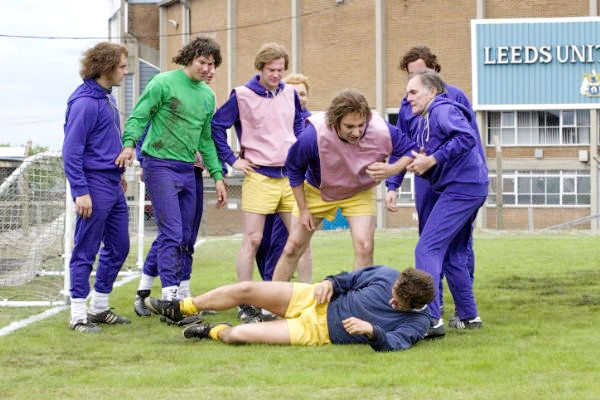
*), here takes on the insular world of FC football and the storied career of Brian Clough, who took the second division Derby County Club into the first division and then the championship, and in a fit of hubris, took on the management of Leeds Utd, the club of his arch-rival Coach Don Rievie and was fired after 44 days. Here, though, the focus is not on the playing field, but the kicking and gouging going on in the mind of Clough.
The feats Clough accomplished were done with aplomb,
ego, a big mouth and a vindictive drive to show up the other teams in the leagues, especially Leeds. But, that drive also gave him a tunnel vision when it came time to manage Leeds, which was done with a "new broom" approach, angering the players, the club's board and the fans who saw the team fall to its worst season in ten years after only six games. Consequently, he got the sack. As fast as his success was acquired, he fell ten times faster.
Morgan as screenwriter lets the mighty fall gently, depending on the grace that is shown, and whether the eyes are open during the trip.
Idi Amin and Nixon, locked in their delusions, get no sympathy. Queen Elizabeth and Tony Blair are allowed insight as they're falling. Clough gets that insight after he hits rock-bottom, and Morgan's frequent collaborator Sheen registers every triumph in flashing teeth and every hurt in darkening bags under his eyes. Sheen, as a performer who's made a living playing performers, knows the degrees to which the face can display a false-front and genuine pain.
During an introductory press interview before taking over for Rievey,
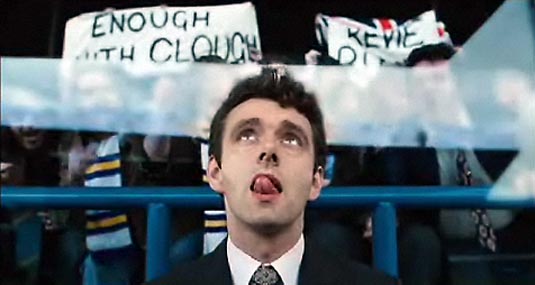
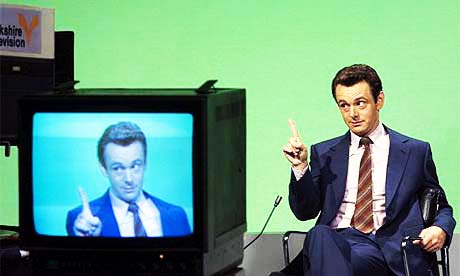
it's a cocky Clough who, with no prior knowledge, already thinks he has the team licked, with secret winks, flashing tongue and a smarmy way of laughing at his own jokes. After a dressing down from the Leeds captain, he'll maintain the same confident smirk on his face, but his eyes will dull with fear as soon as the player turns his back. If Sheen felt any disappointment in not playing the "Nixon" part of Frost/Nixon, he's compensated here for playing a personality of similar insecurities, but with an antic theatricality that the former President was never capable of. It's Sheen's show, but he's given ample opposition and support from Timothy Spall, Jim Broadbent, and Colm Meaney, who plays Coach Rievie with an irascible sense of entitlement.
Director
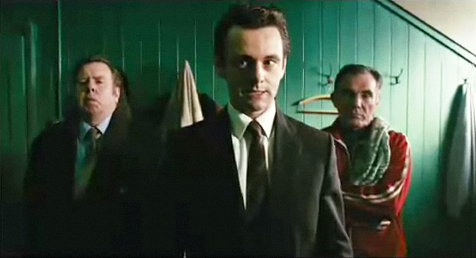
Tom Hooper keeps things low-key in a BBC vid kind of way (thankfully dropping the peculiar framing that marked "John Adams"), but it isn't too long before one notices that, more and more, he's placing his Clough in ever tightening offices, hotel rooms, and locker-room corridorsan outsider trapped in his own prison of obsession and focus. One sequence is brilliantly twisted in its scope, or lack of it: as a much-needed match goes on outside, Clough stews and twitches inside his dennish office behind the stands, listening to the crowd reactions, not daring to emerge into the light to watch. Perversely, whenever a Derby goal is scored, the crowd leaps to its feet blocking out the only outside light to his office, casting him in darkness. You know that whatever Clough wins, he's lost.

* Although it would have been logical as one of the plot-points involved a London bombing, Sheen (and the character of Blair) subsequently did not appear in Hereafter.
 
**Tom Hooper has subsequently directed The King's Speech, The Danish Girl, Les Miserables and Cats. Evidently, he's still working!

Wednesday, February 1, 2023

The Pale Blue Eye (2022)

Hidden in Plain Sight
or
The Poe-Eyed Detective ("It Will Work Out")
 
There is something ingenious, if not precious, about the conceit: a murder mystery featuring the creator of the modern detective story.*
 
Sure, every depressive knows Edgar Allen Poe as the writer of morbid, anguished poetry with repeated lines at the ends of stanzas. But, with his publication of "The Murders in the Rue Morgue" in 1841, he began a new genre of mystery story, based, not only on the dark corners of the human psyche, but it's very opposite, the power of reasoning and deduction—or what he called "ratiocination." With the success of his Dupin stories, came the inspiration for Doyle of Sherlock Holmes (he never shied from admitting it or his other sources) and, from there, the progeny of the countless numbers of problem-solving busybodies that have expanded and pushed the envelope of the Dewey Decimal System for decades.

Homage must be paid.
The Pale Blue Eye
(love the title...) begins with an image, a surrealistic scene veiled in fog, of a man handing by the neck from a tree. But, something's off. His feet are on the ground, rather than being suspended above it. The explanation for that image will take the entire movie to explain, but already you're hooked, and that image is a wonderful metaphor for a mystery. Something deadly has happened, but why, and by whom, needs to be sussed out. Only one person knows and that is the one who did the deed.
It's 1830. Retired constable Augustus Landor (
Christian Bale) lives a solitary life in his rustic, but well-libraried cabin, another in a long line of isolated men, known for "getting a confession with just a stare." His wife died many years ago, and his only daughter, whom he mourns, has disappeared—a mystery that still haunts him. One day he is greeted by Captain *ahem* Hitchcock (Simon McBurney) from nearby West Point Academy. One of their cadets has been found dead—he'd been hung, apparently, but the most grisly aspect of the deed is that his heart has been carved out of his chest.
Landor has some restrictions put on him by the Academy Superintendent, Thayer (Timothy Spall):he is to report to him and Hitchcock daily on his progress; he works for them as an employee as long as they approve of his work; interviews with cadets must be done with Hitchcock's supervision; he can't drink on the job. There is a tavern in the town, however, which he visits after hours. He runs afoul of the Academy's physician, Dr. Marquis (Toby Jones), when he proves himself unsatisfied with the doctor's autopsy—but Landor's thorough work does win him enough grudging respect that he is invited to the doctor's home, where he meets his somewhat-hysterical wife (Gillian Anderson, always great, even when she's not doing the autopsies) and his children, cadet Artemus (Harry Lawtey) and his lovely daughter Lea (Lucy Boynton).
The cadet interviews do not go well. The young men are less than forthcoming-especially under the baleful eye of Hitchcock. But, there is one young Virginian cadet who attracts Landor's attention, not only because he has an obvious intelligence and grand-if precise manner of speaking. He's also a bit of an outsider at the Academy, a frequent object of scorn among the students...and the instructors.
This is cadet E.A. Poe (Harry Melling), not the finest example of military discipline, frequently seeking permission to be excused from outside drills, citing poor health and spending his time writing poetry. When Landor first meets Poe, he is struck by his eloquence and directness, but more by his opinion that the perpetrator may have chosen a mundane way to kill the victim, but the cutting out of the heart "makes him a poet." Poe's creepiness makes him a "usual suspect" as far as murder mysteries go, but at a later meeting in a tavern, Landor suggests to him that they should work together on the case, as Poe might have opinions—and access—that Landor could use.
Then, there is Landor's mentor, Jean Pepe (
Robert Duvall), an elderly recluse, with a vast knowledge of all things ritualistic and arcane. It's always good to see Duvall in anything, and his presence reminds one of the useful—but supplementary— characters that inform and give a certain historical sub-text to many a fictional detective.
The investigation twists and turns like a speckled band—no, the story doesn't involve snakes—but, is enhanced and complicated by young cadet Poe's besotted enchantment with the doctor's daughter Lea Marquis, prone to seizures that might be due to epilepsy—or maybe it's just a family curse.
Oh, this one is a corker, with a resolution that will surprise casual mystery watchers, and inspire appreciative smiles from aficionados with its echoes of Poe's own detective fiction. There might be a bump or two in motivation, a red-herring here and there (aren't there always?), but, by the end, one will be properly sanguine with the mystification they experience.
And the cast is top-notch. Bale isn't grand-standing here with tics and business, but relies on a relaxed body language that he rarely employs, and the relationship between he and Melling's overelegant Poe is a nice study in contrasts in a mutual admiration society of two. Director Cooper keeps things moving swiftly and takes full advantage of cinematographer Masanobu Takayanagi's ability to create astounding images of nature and the unnatural. And Howard Shore's score is lovely, another wonderful example of why he should be doing more music for films these days.
It's a very well-done film, that is only undermined by the fact that it will never light—and darken—a theater screen, where it can be truly appreciated, and, although it is nice that Netflix gave it a healthy paycheck to be produced, why it should be relegated to a small screen, is a real mystery.

* When the Mystery Writers of America organization hands out their little trophies, they are dubbed "The Edgars." There are some scholars who begrudge Poe the title. But, they can't do anything about the little statues.

Wednesday, April 27, 2022

Sweeney Todd: The Demon Barber of Fleet Street

Written at the time of the film's release...

"Tim Burton turns everything into 'Sweeney Todd,' so this should be a natural"
Ken Levine, Nov. 18 2007
 
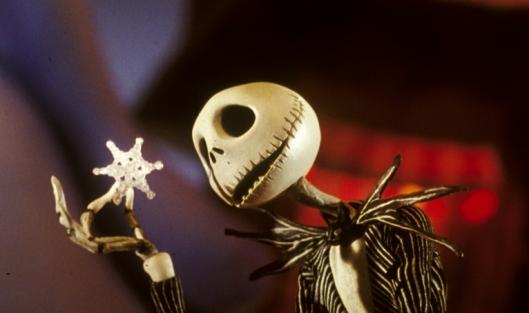
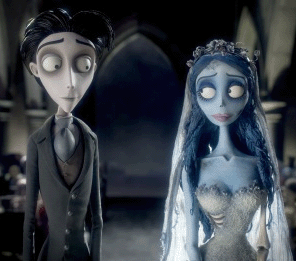
Truer words were never spoken. Tim Burton DOES turn everything into "Sweeney Todd" so there couldn't be a better pairing of director to subject matter. Burton has supervised two of the darkest animated musicals ever made (The Nightmare Before Christmas, and Corpse Bride) and turned them both into charming, imaginative films without once sugar-coating or denying the nightmarish imagery that unearthed those ideas. His favored composer, Danny Elfman (MIA from this film), is a disciple of Bernard Herrmann, whose work was the inspiration for the music lines of Stephen Sondheim's shock-opera. Burton's "usual suspects," Johnny Depp and Helena Bonham Carter , star and, though the major worry was whether they could carry their tunes, they both do exemplary jobs. Depp, especially, only achieves heights of performance in song, so interior is his Todd. And though Carter may not be quite as brassy so much as tremulous, she does more than hold her own with some of Sondheim's trickier tongue-twisters.
Where Burton's Sweeney Todd excels, though, is the design of the thing--from the Edward Gorey-ish 2-D titles to the Pieta-like coda, the film is a masterpiece of muted design and cinematography with a palette restricted to various shades of gray--the visual equivalent of music in minor chords.
With one exception, of course. The appearance of blood is always startling. Every murder produces a blood so red that it nearly jumps out of the screen. And Burton can't resist taking the Hammer Films one better. When
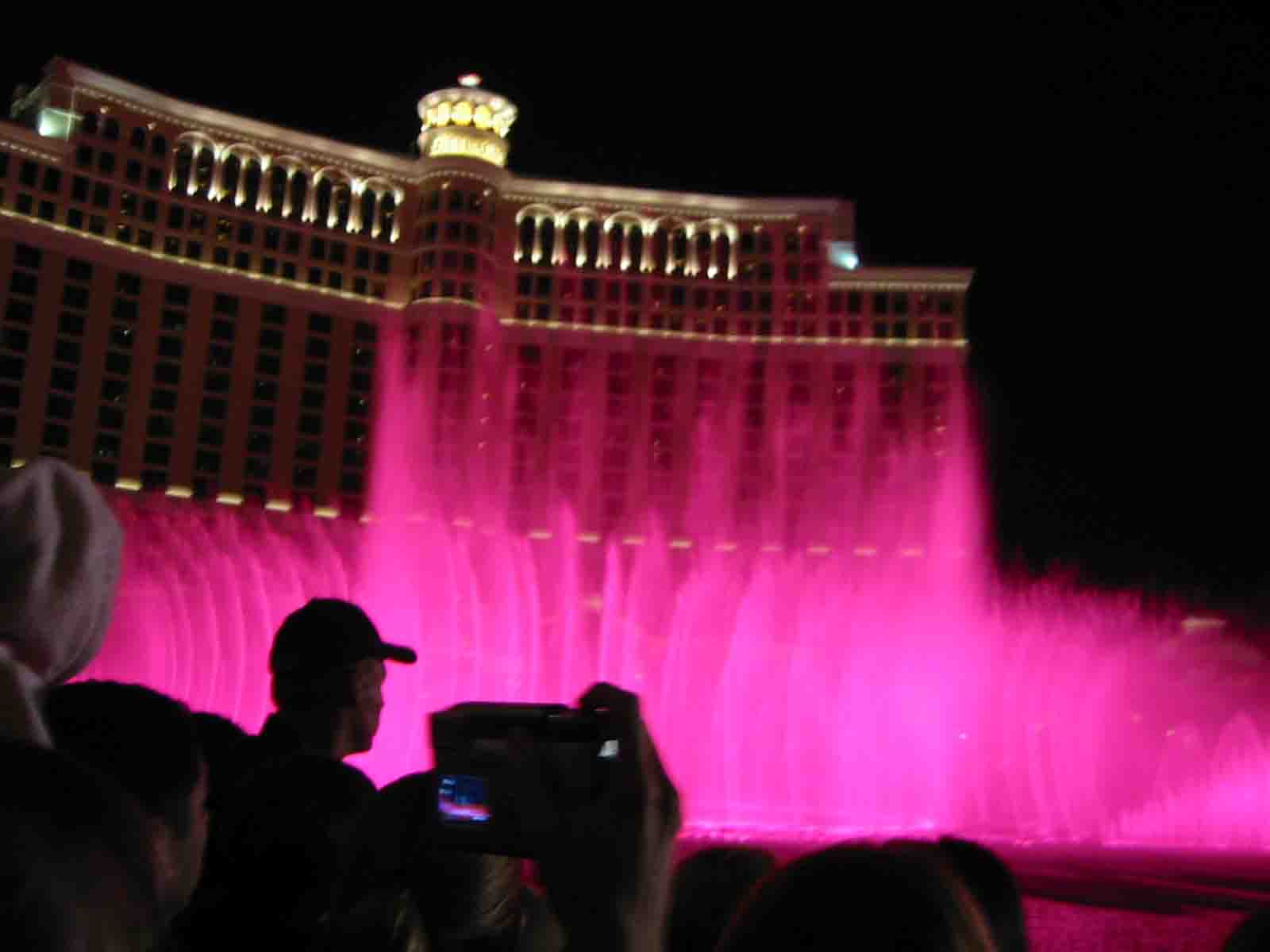
Sweeney Todd takes his razors to give his customers a once-over, there is no fanciful, theatrical whip-saw and it's over. Depp goes in and saws at the neck like he's cutting a thick roast, at which point the special-effects boys take over, producing arterial geysers of blood that spray--once, hitting the camera lens--in patterns that rival the fountains at the Bellagio
It's over-done, and in coagulating close-up as well, but given the interior-ness of
Sweeney Todd, it's about the only cathartic action in town. And the bodies really start piling up. I'm sure Sondheim was attracted to the subject matter of a swinish London so mired in nastiness, it more than figuratively begins to feed on its own, and the themes of a transformed man and his insatiable and destructive quest for vengeance was what drove Burton, but the gleefully torrential blood-shedding exposes the adolescent in Burton's tendencies--it's his darkest, grisliest film since Sleepy Hollow--and one wishes to see more of the Burton who could turn out a film like Big Fish


Thursday, March 24, 2022

The King's Speech

The Oscars are this weekend (Lord, help us!) and there are a couple of Best Picture winners I haven't re-published from "The Olde Site." So, rather than doing anything "newish" I'll opt, instead, for "timely."
 
I'm not a fan of The Oscars (like everybody), but I watch it (like everybody) and I complain about it the next day (like everybody). You can't seem to have one without the others. People enjoy complaining about them but wouldn't dare miss watching them. Everybody has some Oscar-decision that's an obscenity in their eyes...and there are some that are questionable (my Saturday "Trash" post will be one of them)*.  But, most of the time, I just don't care. The Oscars, being voted on within a year of each film's release, are always going to be short-sighted, with absolutely no chance of being able to judge a film's lasting legacy. The decisions are always factored by politicking or prestige. Maybe trendy. But probably not. They'll always be there whether one watches them or agrees with them.
 
Written at the time of the film's release. And there's some post-Oscar bashing at the end.

"Crossing Your Threshold"

or
"Let's Take it from the Top: 'In Our Darkest Hour...'"

One of my favorite observations from Jerry Seinfeld was his remark that more people are scared of public-speaking than of death: "In other words, more people would rather be IN the coffin, than delivering the eulogy..."

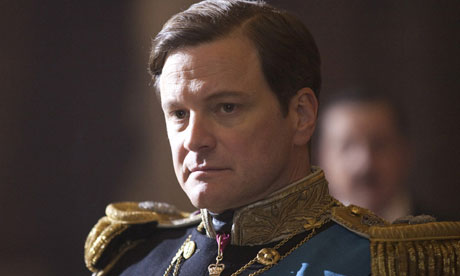
In The King's Speech, this year's Oscar-bait from The Weinstein Company, King George VI (Colin Firth, spot on, really) would rather be dead than speak in public. It's too bad, then, that his father, George V (Michael Gambon) beats him to the choired invisibule, and the next in succession, Edward (Guy Pearce, in an extraordinarily adroit performance) is too much of a self-absorbed ponce to sacrifice "the woman he loves" for such a small thing as the welfare of all of Britannia.

George VI, or Albert, the Duke of York (as he is dubbed before coronation),
has a persistent stutter, and a concurrent inferiority complex, given his heightened awareness of his condition and his responsibility—director Tom Hooper makes it clear in his direction and editing choices that we are constantly aware of his audiences' reactions to his stammers, faults and failings, even the portraits of his forebears stare in frozen, condescending judgement.*
It is up to his wife, Elizabeth (Helena Bonham Carter, bi-polarly different than her roles for Hubby Burton and Harry Potter)—"Call me 'Liz'" she sweetly says at one point late in the movie—wants to fix the problem, not because her husband is the man who could be King, but because the underlying psychological whipping he imposes on himself is making him miserable. He doesn't even have the wherewithal to blurt out a bedtime story to his two adoring princesses, Elizabeth and Margaret.

With a capricious older brother and an ailing father-king, he is not the most confidence-inspiring potential potentate who can, as his father bellows "stand between us, the jack-boots and the proletarian abyss." And given that the position is more public than ever, what with the King needing to address his subjects via radio, the air of confidence is more important than ever, and Albert's failings as such are even more readily apparent in the Theater of the Mind. Not only is the Empire shrinking for the Royals, but the world is, too, and their enemy's reach is the range of a V-2 rocket.

Presentation is all now, sometimes even more than the message. During the viewing of a newsreel, the Royal Family gets a glimpse of the Player on the Other side, Adolf Hitler at the Nuremberg Rally. "What's he saying, papa?" asks a daughter. 


"I don't know," replies the envious Albert. "But he says it rather well."
What do the simple folk do, when they have to carry the burdens of the entire Nation on their backs without hesitancy, and with grace. The short answer is, they don't—the situation is somewhat unique.

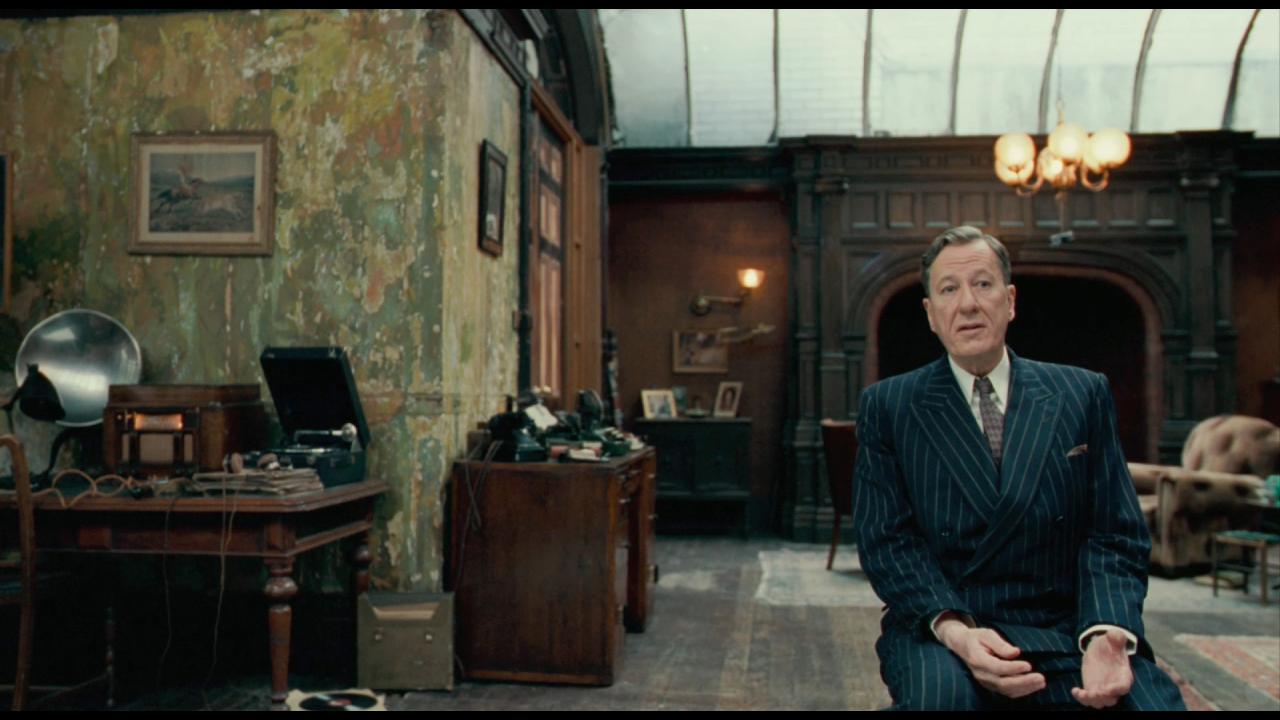
Enter Lionel Logue
(Geoffrey Rush), full-time vocal coach, hopeful actor...Australian. He is visited by one "Mrs. Johnson"—the future Queen-Mum—to enquire about services, all the royal outlets proving inefficient, taxing and embarrassing for Albert. Logue has no idea who he's really dealing with—in all senses—explaining that his methods are "unorthodox and unusual."


"Not my favorite words," she sighs.
This is a cracklingly well-done film, subtle and efficient and literate—the script (by David Seidler) leading down as many paths as Logue has techniques, but the most interesting aspect is how the two men, Lionel and Albert (who Logue insists on calling "Bertie" to allow mutual approachability) must rise and lower each other to the occasion, Logue relying on his actor's discipline to gain respect, while Albert uses Logue to gain insight to the common man, essential to his tutelage. And the actors are terrific, not only the ones mentioned, but a small delegation of familiar faces maximizing their small roles. Derek Jacobi makes an early appearance, Anthony Andrews appears as P.M. Stanley Baldwin, Claire Bloom as Queen Mary, and Timothy Spall, doing a fair turn as Winston Churchill  It culminates in a moving sequence as the new King must make a radio address to reassure the public after the declaration of war on Germany. Incongruously set to the second movement of Beethoven's Seventh Symphony, George VI, alone, with his coach conducting, must pick his way through his speech, every syllable a struggle to maintain control—the music behind him halting and building. I tell ya, I dropped tears, it's an extraordinary last act to an extraordinary movie.

Now...the rating. The King's Speech is rated "R" (in the United States) for the silliest of reasons—a short sequence where Logue badgers Albert into cursing like a sailor, including a string of "F"-bombs that kept it from achieving the lighter "PG-13," although the film really credits an ever lighter "PG." Don't be put off by the prigs of the Ratings Board. This is a fine, fine film.

* ...but in a style not as annoying as his work on the HBO series "John Adams," and less conventional than his work on The Damned United.

Post-Oscar Bashing: Best Picture? Nah. Not in that gang of 10. But a safe, respectable choice. You can't complain about the script or the performances (I could about director Hooper's win, but as was clear in his acceptance speech, without Hooper—and his Mum—there would have been no film, and the script was certainly worthy). But, ultimately, it's the Best Picture Harvey Weinstein could buy...as has been the case before. Still. Great film. But not Best Picture...not with 127 Hours, True Grit, Toy Story 3 in the running.

Friday, October 16, 2020

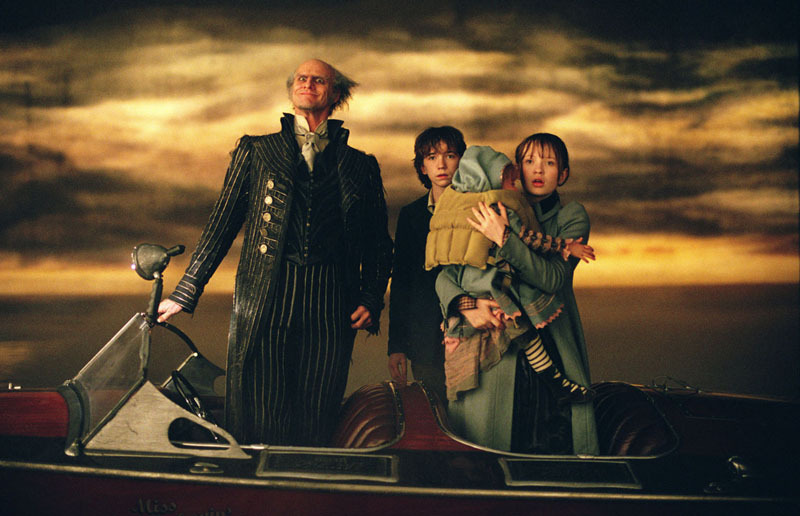
Lemony Snicket's A Series of Unfortunate Events

Lemony Snicket's A Series of Unfortunate Events (Brad Silberling, 2004) O-kayyy. So far, for Hallowe'en on this site we've featured apocalyptic religious cults, invisible men, sadistic versions of "Big Brother" and lots and lots of creepy things. I'd like to say the best is yet to come, but, no. Things are going to get worse. Much, much worse...to the point, where I have a true sense of dread about what's coming up—not just in the posting, but in the very writing of it. Dear, dear me. Oh, it's going to be awful...simply awful. Really, people should have better things to do than to make movies like the ones I'll be considering in the next couple of weeks. 

But (sigh) it is Hallowe'en Season. And one must simply get this stuff out of our systems, so that we can vote with clear consciences, and think of our fellow citizens and how they are coping with a pandemic, and social distancing, and wearing masks, and interviews from the census by bright ardent people who are only doing the right thing, as well as the intricacies of working at home while also supervising the on-line education of our precious dutiful children.
But in the warm comfort of the domicile, many flights of stairs from the garret in which this is written, the Hallowe'en movie of choice is this (to be heretofore crunched to Unfortunate Events to avoid a cramp). It might be the best movie Barry Sonnenfeld never made. It has his insensibility, his florid camera moves,* snappy editing, austere framing and live-action cartoonish gambits (lots of shots of peoples' faces gaping into the camera).

But, it didn't have enough budget and so
Brad Silberling took over the project.

Silberling is a chameleonic director; he tends to take on the characteristics of whatever project falls into his lap—handy for his long tenure as a television director of such idiosyncratic shows as "
NYPD Blue," but making him hard to pin down as a feature director. How do you explain the disparity between Unfortunate Events and his unfortunate City of Angels? Before you attempt that, let me trump it by adding the even more unfortunate Will Ferrell vehicle, Land of the Lost.

So, it's perhaps fortunate for Silberling that so much of "Unfortunate Events" depends on others. The Lemony Snicket-styled writing—a bit like "Miss Manners" without her morning pick-me-up—of dark, despairing fore-shadowing** inspires a switch-back Rankin-Bass-styled opening that comes crashing to a halt. ("This would be an excellent time to walk out of the theater, living room, or airplane where this film is being shown." says the Lemony Narrator, as read by Jude Law)
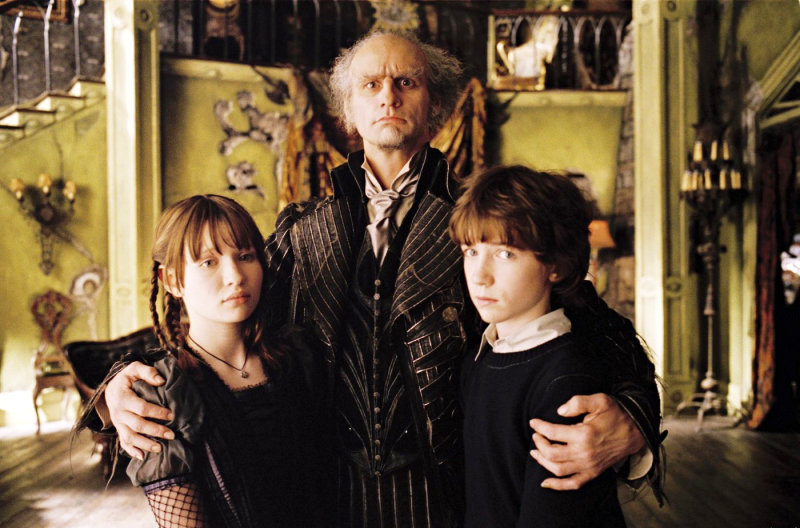
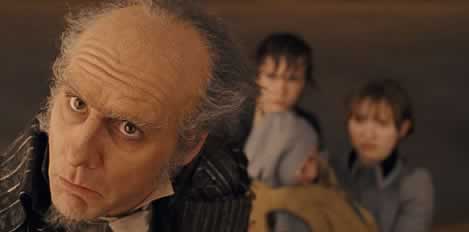
"Fade to Black" is the more appropriate phrase. Fade to monochromatic gothic steam-punk macabre, (which permeates the film, like a lighter version of "The Addams Family") as the film takes up the sad misfortunes of the Beaudelaire orphans: Violet, a voracious inventor (Emily Browning); Klaus, a voracious reader (Liam Aiken); and Sunny, a voracious biter (Kara Hoffman and Shelby Hoffman). When their parents are killed in a mysterious fire, the Estate (executed by a piggish Timothy Spall), the kids are shipped off to the cunning clutches of Count Olaf (Jim Carrey), a despicable actor who only cares for the Beaudelaire fortune. Treated as servants by the fiend, he decides to kill them off when it's determined that he'll only get the money when they're adults. And so he leaves them, locked in a car on a rail-road track with the 11:15 barreling down on them.
What to do, what to do?

Based on the first three "Unfortunate Events" books ("
The Bad Beginning," "The Reptile Room," and "The Wide Window,"***), the film is as episodic as could be with the child-endangering machinations of the Count the single unsavory thread running through it. 

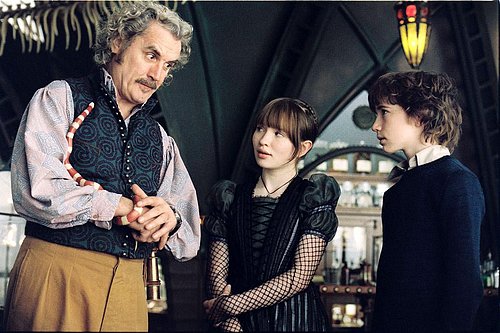
Upon Carrey's every entrance, Silberling takes the wise course of just hanging back, giving Carrey a wide shot (with distorting anamorphic lens) and keeping any other actor out of giggling range. So much of his performance is ad-libbed, you could make the case that it's Carrey who's driving the bus; things calm down considerably when Billy Connolly and Meryl Streep take possession of the children (and the movie), but gears up again when Carrey dervishes his way into the scene (Connolly stays out of his way, but Streep engages him, going eye-to-eye).
It's a good thing, too. "Unfortunate Events" could have turned excessively mordant to the point of leeching all the fun out of it, production-designed into stasis if Carrey wasn't there to break windows (and characters) in the proceedings. In that spirit, the cast is rounded out by such anarchic spirits as Catherine O'Hara, Jennifer Coolidge, Cedric the Entertainer, Dustin Hoffman, Jane Lynch, and Craig Ferguson that flit around the corners to keep things from getting too predictable, and deservedly more than a little off-kilter.

* He started out as the Coen Brothers' cinematographer.

** It's fun when doled out in tea-spoons of dread and low dudgeon, but if you want to hear it overdone, listen to the director and author Daniel Handler's commentary track on the DVD. Handler (as "Lemony Snicket") acts like your staid Aunt Petunia, who goes all-fluttery and horrified at the movie, which is funny for ten minutes, then overstays its welcome...by two hours.
 

*** Dear reader, do be careful when going to these links, for it appears this Lemony Snicket character wants your e-mail address. The cad. I would be cautious. Very, very cautious.