Showing posts with label Alan Rickman. Show all posts

Wednesday, November 6, 2024

Galaxy Quest

This was written at the time of the film's release in theaters and a cursory glance at it a couple weeks ago (in between regularly scheduled programs) revealed just as much enjoyment and admiration as the first time I watched it. "Never give up. Never surrender."

Galaxy Quest (Dean Parisot, 1999) Up until J.J. Abrams' re-boot, this 1999 release was probably the best "Star Trek" film that Paramount Studios never made.
 
Unfortunately, it wasn't "Star Trek" but a spoof of the phenomenon that Paramount inherited from the originating production house Desilu (and apparently didn't know what to do with—at the the time of Galaxy Quest's release, they were in between producing the Next Generation movies Insurrection and Nemesis, which effectively killed the series). 
 
Still, this film is an affectionate send-up with a fine cast doing good comedic...and dramatic...work, and manages to pull off something of a miracle, making one one embrace the cliches of the original while at the same time making delicious fun of them. And given the ubiquity of "Star Trek", fans still recognized the show, backwards, forwards and behind-the-scenes, even when it was in the disguise of another Intellectual Property.
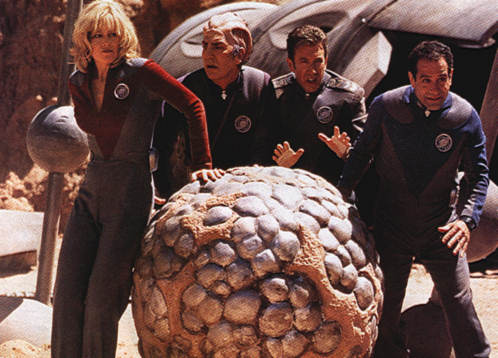
At a sci-fi convention, the cast of a long-cancelled television series "Galaxy Quest" is going through the motions of meeting their fans, even though the show has been off the air for years, and the actors are having a difficult time finding other work due to "type-casting." They squabble, each remembering personal quirks and on-set peccadilloes, either jostling for the limelight or just "doing the gig," and by happenstance, find themselves portraying their characters in a real outer-space adventure, persuaded by desperately seeking aliens who have caught transmissions of the show as it zipped through space at light-speed, and not only liked what they saw...they bought it hook, line, and beridium sphere.
It's a fun conceit, combining the background stories of actors with the characters they're playing put into a situation where their attributes as actors inform their actions in a real-life approximation of the roles they play. It stands to reason that the traits they embody to play the roles would come to the fore when reality sets in—it implies, of course, that they could do all this without "handlers," make-up assistants, or even (ya know...) decent writers and directors. It's fun to imagine.  
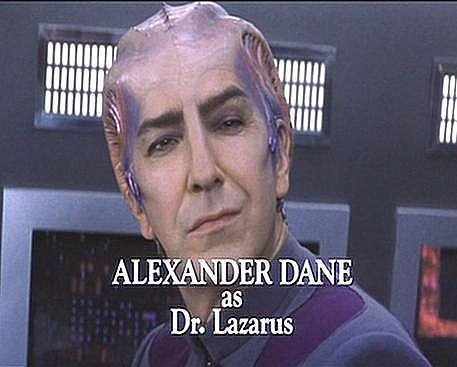
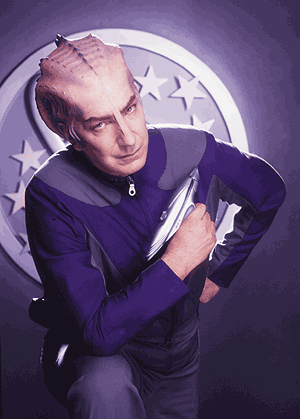
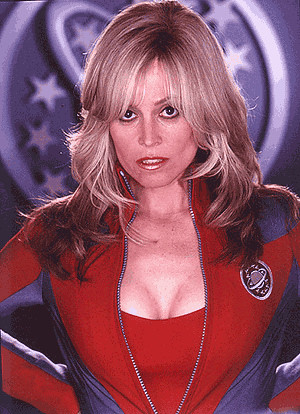
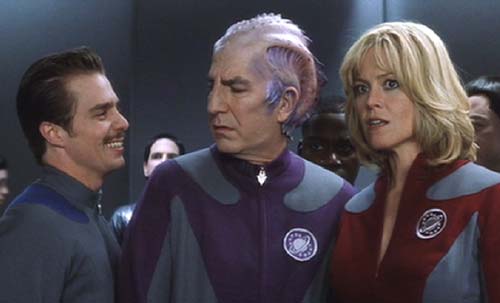
And the writers of the film have the "Star Trek" types down: the blow-hard lead actor (Tim Allen) who looks after himself until the chips are down; the second-in-command alien character—a fan-favorite—portrayed by an actor (Alan Rickman) who aspires to more prestigious roles and makes efforts to distance himself from his most popular one—until the role's inherent dignity and importance occurs to him; the actress (Sigourney Weaver, paralleling both Lt. Uhura and her "Ripley" character in Alien) trying to rise above the inherent sexism of her role, opening "hailing frequencies"; and the "also-ran's" (Tony Shalhoub and Sam Rockwell) who are stuck in their careers, forever typecast and unable to move on, bitterly watching their co-stars take better advantage.
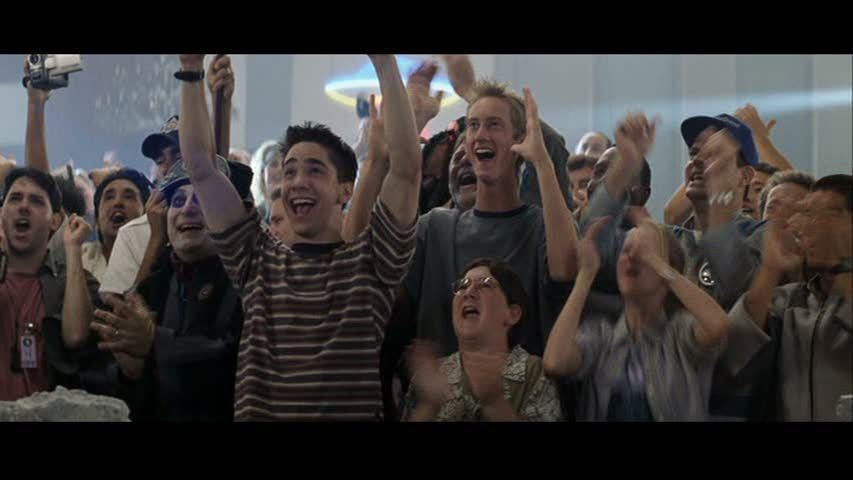
There's also a tip of the hat to the faithful fans who start out as convention geeks, then play a pivotal role in the survival of the crew and their mission—and they don't even have to do it with a write-in campaign to the network.
Fiction becomes fact becomes fiction becomes fact; Galaxy Quest is an inter-dimensional trek on a Universe that's folded in on itself, through all the frontiers influenced by TOS and its progeny that explored new frontiers on a journey that seems on-going. It's also one of the best examples of a rare film genre that usually comes off as lame, childish, or patronizing—the science fiction comedy.

Wednesday, December 21, 2022

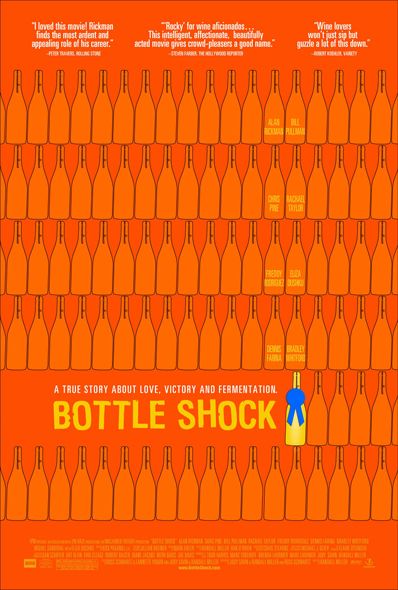
Bottle Shock

Written at the time of the film's uncorking.

Bottle Shock (Randall Miller, 2008) Miller has been making cheap, exploitation comedies (Class Act, Houseguest, The Sixth Man) for awhile now—alternating with some TV-directing work on shows with more on their mind ("Northern Exposure," "thirtysomething,") but Bottle Shock was made with his own money and he distributed it himself. One can imagine why: it's an intelligent, slightly loopy movie about pursuing your dreams despite being told (by the entire world) that you can't achieve them. It's also about wine—a sort of Rocky of the vineyards. But, it's also a fictionalized version of true events.

The occurrence was a tectonic shift in the wine industry, which was monopolized in terms of quality by the French vintners of the Bordeaux region. In 1976, a wine connoisseur and merchant Steven Spurrier, conducted a blind taste test between various products wine-producing areas. It was assumed that the French would, of course, come out on top, but when labels were revealed, the clear winner of the competition were upstarts, from, frighteningly, California. The wine-world was shocked (aghast!) that the center of the world vineyards became the neighborhood of Gallo (now owned, by the way, by Francis Coppola).
The facts are loose, and Spurrier has gone on record saying that he is less than thrilled with his portrayal—with sly, and, dare we say, dry alacrity—by
Alan Rickman (personally, I'd be honored, but then I guess my taste is questionable) and with how the film tinkers with them, but Miller managed to make an okay film about grapes, waiting, sugar-chemistry, waiting, snobbery, waiting, and...obsession.
The main subject of the film (which might have spit in Spurrier's chardonnay) is
Jim Barrett (played by
Bill Pullman), a financial guru who has tired of dollars and sense to concentrate on nose and bouquet. For the youth market, there are the required diversions of the chances-taking son (played by Chris Pine), who is not sure of following in his father's grape-stomping foot-steps, but is sure of making time with the UC Davis student (Rachael Taylor) who's decided to Summer working the fields...and playing them. While wine-inspired lust simmers in the background, Pine's restless son manages to smuggle Dad's wine into the competition, a move the father staunchly disapproves of, despite being leveraged to the cork.
It's amiable, pleasant, with no harsh after-taste (despite the squabbling that was going on in the background of the film's making among the subjects and film-makers), and will more than satisfy any film-watcher's desire to see sun-dappled vineyards in long-shot.
Grin and Barrett

Wednesday, April 27, 2022

Sweeney Todd: The Demon Barber of Fleet Street

Written at the time of the film's release...

"Tim Burton turns everything into 'Sweeney Todd,' so this should be a natural"
Ken Levine, Nov. 18 2007
 
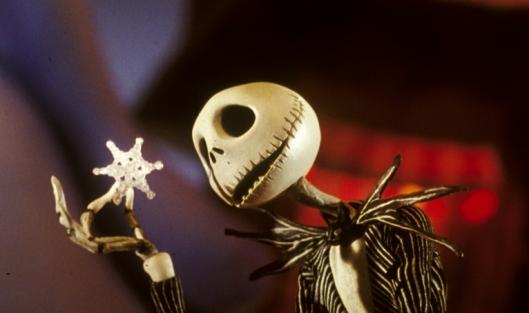
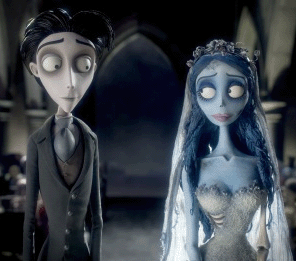
Truer words were never spoken. Tim Burton DOES turn everything into "Sweeney Todd" so there couldn't be a better pairing of director to subject matter. Burton has supervised two of the darkest animated musicals ever made (The Nightmare Before Christmas, and Corpse Bride) and turned them both into charming, imaginative films without once sugar-coating or denying the nightmarish imagery that unearthed those ideas. His favored composer, Danny Elfman (MIA from this film), is a disciple of Bernard Herrmann, whose work was the inspiration for the music lines of Stephen Sondheim's shock-opera. Burton's "usual suspects," Johnny Depp and Helena Bonham Carter , star and, though the major worry was whether they could carry their tunes, they both do exemplary jobs. Depp, especially, only achieves heights of performance in song, so interior is his Todd. And though Carter may not be quite as brassy so much as tremulous, she does more than hold her own with some of Sondheim's trickier tongue-twisters.
Where Burton's Sweeney Todd excels, though, is the design of the thing--from the Edward Gorey-ish 2-D titles to the Pieta-like coda, the film is a masterpiece of muted design and cinematography with a palette restricted to various shades of gray--the visual equivalent of music in minor chords.
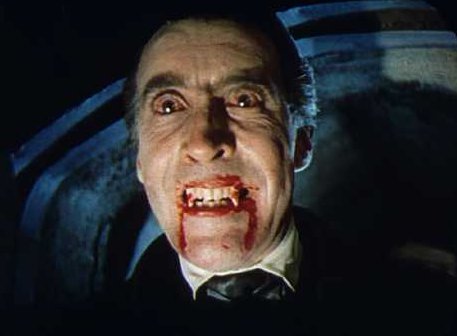
With one exception, of course. The appearance of blood is always startling. Every murder produces a blood so red that it nearly jumps out of the screen. And Burton can't resist taking the Hammer Films one better. When
Sweeney Todd takes his razors to give his customers a once-over, there is no fanciful, theatrical whip-saw and it's over. Depp goes in and saws at the neck like he's cutting a thick roast, at which point the special-effects boys take over, producing arterial geysers of blood that spray--once, hitting the camera lens--in patterns that rival the fountains at the Bellagio
It's over-done, and in coagulating close-up as well, but given the interior-ness of
Sweeney Todd, it's about the only cathartic action in town. And the bodies really start piling up. I'm sure Sondheim was attracted to the subject matter of a swinish London so mired in nastiness, it more than figuratively begins to feed on its own, and the themes of a transformed man and his insatiable and destructive quest for vengeance was what drove Burton, but the gleefully torrential blood-shedding exposes the adolescent in Burton's tendencies--it's his darkest, grisliest film since Sleepy Hollow--and one wishes to see more of the Burton who could turn out a film like Big Fish


Saturday, September 19, 2020

Perfume: The Story of a Murderer

Written at the time of the film's release...

Saturday is "Take Out the Trash" Day.


Perfume: The Story of a Murderer (Tom Tykwer, 2006) Give the director of Run, Lola, Run a zillion dollar budget and a best-seller to adapt and you get this monstrous little curiosity, with a role for Dustin Hoffman, yet. 

Unfortunately, Twyker can't meet the film's biggest challenge-communicating the sense of smell and doing it delicately, of course. The director can do little more than ecstatic shots of Ben Whishaw's Jean-Baptiste Grenouille huffing and puffing and sniffing the air--actually the other way around. And one just can't buy the novel and film's biggest conceit—that the young amateur perfumer can sense parts per million like a super-bloodhound, hours, even days after the source has passed. It's an idea at odds with the visual of a Paris in squalor that Tykwer has (quite rightly, I'd bet) presented. Young Grenouille has this incredibly sensitive snoot in a town of open sewers, outdoor markets and the thousand natural scents, both beautiful and repugnant, including the perfumery used by the citizenry to cover it all up. It doesn't read that he'd be so olfactorily fine-tuned.
That's the major hurdle. The other is the coarse rankness of the material, where women—it's always women—are killed serially, covered in animal fat to immediately preserve their scent, then the fat is scraped off and reduced down to its basic (one would presume) pheromone, and collected as an eau de copse. The plot all comes down to a...boil...when Alan Rickman's protective father suspects his daughter is being stalked by the little stinker, and highs her to the hinterlands at full gallop. Despite his precautions, Grenouille is able to track them on-foot despite the daughter's intoxicating scent being mixed with that of a sweating horse.
This is where Tykwer's inability to sell the scent works to his advantage. You're not supposed to think about that in the absence of evidence.
There are other troubling aspects to it, but let's come right to the nitty of the gritty. Perfume is just another in a series of serial killer movies which (sorry) boils down women to objects with an aspect to be coveted and destroyed for. It's not unlike House of Wax (whichever version) or the skin-suits of The Silence of the Lambs. Despite being gussied up with period detail, sophistication of technique and aspects of subject matter, Perfume: The Story of a Murderer is just another horror movie with pretensions of grandeur. Despite all the attempts to cover it up, you can't hide the basic stink.

Thursday, July 25, 2019

Alice in Wonderland (2010)

Written at the time of the film's release...


"Beautiful Soup"

Hesitant, I am, these days. Hesitant, I says.

After rushing
the review for Shutter Island and dismissing it as "minor Scorsese," I found it had stuck like a bur in my hair and remained in my thoughts and my brain for a longish time. I went back and changed my rating—it's a "Matinee" now*—but not the review, because my complaints are the same. But it's really good "Scorsese" and slots right into the body of his work, despite being unique in its qualities and unlike anything he's done before.

But, I can't tell you why. Curiously, this doesn't stop me from going on and on about it, because it's so rich, and after an essential second viewing, you realize what a dance it is with story-logic and the use of image to show you—and NOT show you—what's going on. It's a trip, and a breathless display of what a master of cinema can do with the form.

Which is why Martin Scorsese should have directed Alice in Wonderland in 3-D. Sure, your kid's head would explode. But it'd be a great movie!

I've been looking forward to
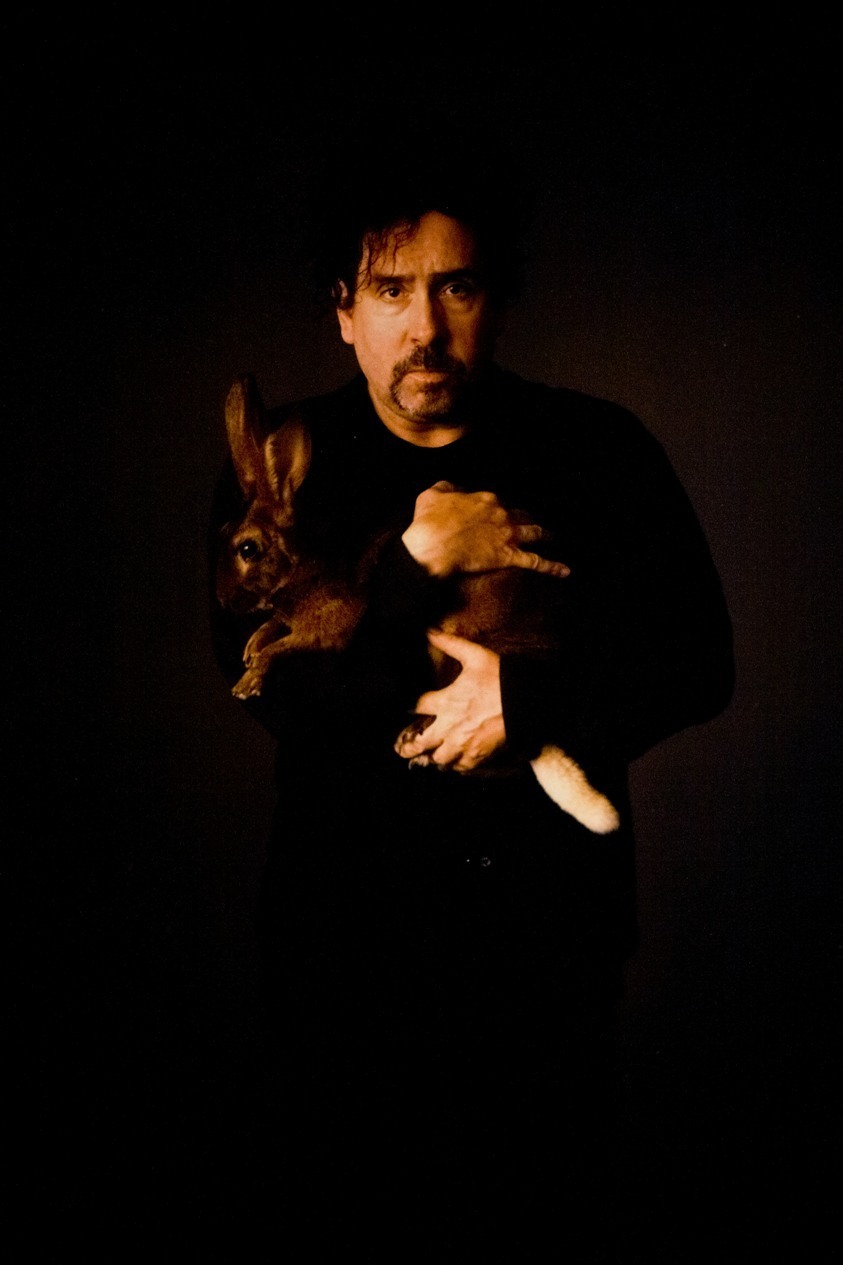
Tim Burton's take on Lewis Carroll. Seems like a match made in anyplace but Heaven. Burton's lapses in story-logic and not playing by the rules in past movies make him the perfect Carroll adapter; he's the "just go with it" director, as he frog-jumps from set-piece to set-piece. If you have to ask questions, you're going to slow the tour-bus down. And his arrested art-student sensibility is so dark that it keeps Alice exactly where it should be—underground with the muck and the weevils and the roots tearing at your extremities.

So it's a MAJOR disappointment that Disney's Alice in Wonderland in 3-D (A Film by Tim Burton) is such a wisp of a movie and—dare I say it—conventional, that it misses the mark of being a great movie (and a good representation of Lewis Carroll) by a hedgehog-croquet slice.**
Here's the problem. The "Alice" stories are stuff-and-nonsense. Charming stuff-and-nonsense that can make little girls giggle and college professors scratch their heads. Buried deep in its purple marrow is the satire of the vagaries of Society, not of adults, necessarily, but of Society—of class distinctions and petty politics—the Games People Play (when they're not playing games).
It shouldn't make sense. It is full of new words and language that fire the synapses of minds, like when Mommy talks about something called pilates, or you have to find out why you can't steal a base before the pitcher throws. It's all bright and shiny and new and simply incomprehensible, and Carroll is just as fantastical for trussed-up adults as it is for children. The glory of it is children have the upper-hand in connecting with it—they don't have so far to fall down the rabbit-hole.
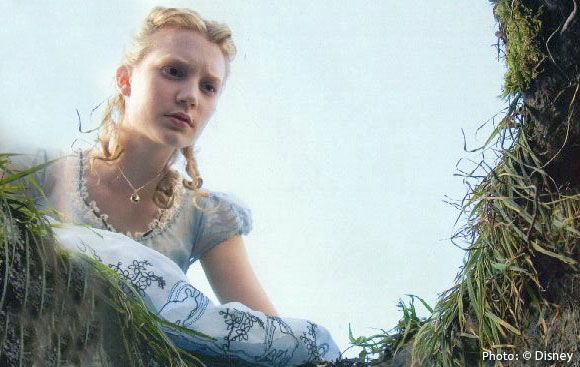
And Burton (and his screenwriter Linda Woolverton, who's worked on several Disney animations) know this to a point. When we first meet 19-year old Alice Kingsleigh (Mia Wasikowska, looking dark-eyed and sallow—a perfect Burton heroine), she has been invited to an engagement party—hers.** It's a surprise, but it's not, and it is not going well for the hostess, Lady Ascot (Geraldine James) the mother of the groom-to-be, as everything is not...perfect. And Alice has this annoying habit, besides being late, of being...unconventional...and distracted by anything. Alice likes to see the Nature of things. The party made by adults just uses Nature as a tightly-controlled back-drop. At the moment the question is popped, Alice excuses herself to the party (as they're all watching, and it's for their benefit more than hers) saying that she "needs a moment." (Did they "need moments" in the 19th?).

This is pretext to Alice wandering off from the party, in her moment of highest risk of being cosseted, to follow a white rabbit and once more stumble down a rabbit-hole, returning to "Wonderland."***
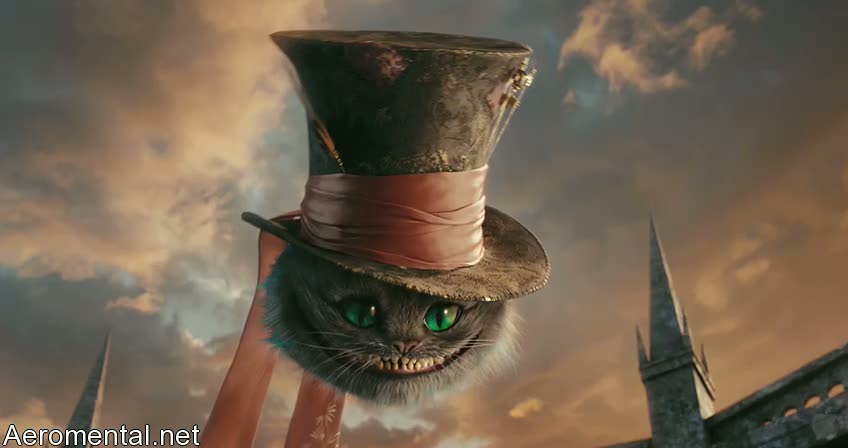
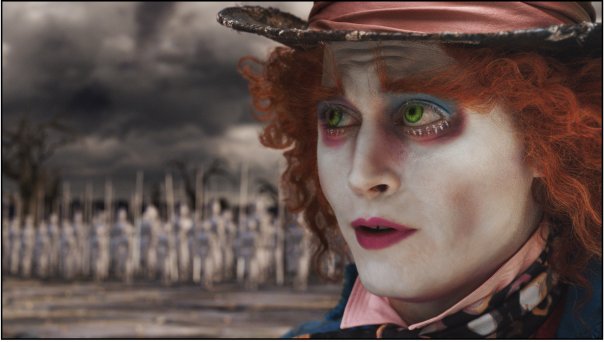
It's here, as you'd guess, that the movie takes off. The colors more vibrant, the effects-work (by four FX houses but primarily Sony) magical, even the 3-D has more depth. The characters adhere to a mixture of Burton and first edition illustrator John Tenniel, and more in that direction than the way the Disney animators drew the characters for their 1951 adaptation. The film is nicely cast with Burton's usual suspects (Johnny Depp—top-lined as The Mad Hatter, Helena Bonham Cartersimply delicious as The Red Queen, the voices of Alan Rickmanthe caterpiller, Timothy SpallBayard the hound, Christopher Lee—as the Jabberwock, Paul Whitehouse—as The March Hare, and Michael Gough—as the Dodo) New to Burton are Stephen Fry as the Cheshire Cat, Michael Sheen as the White Rabbit, Matt Lucas as Tweedles Dum and Dee, but most impressively, Crispin Glover as the evil knave Stayne, and Anne Hathaway as the White Queen. One wonders why Glover has never been in a Burton movie before—maybe Burton thought he was uncontrollable?—but he brings a hissing nastiness to what could have been a typical bad-guy role, and that Burton sets him up against Depp's Hatter is one of those movie match-up's you love to see. And Anne Hathaway proves once again that she's not afraid to explore her dark-side. Her creepy "Liza-Minelli-in-a-straight-jacket" White Queen evokes Burton's long-time exotic paramour Lisa Marie.
Quite the ingredients for a film, and with Burton doing the stirring, one salivates at the possibilities. There are lots of laughs, moments of exquisite beauty—wispy seeds occasionally enter the frame and at one point, we park in front of a dew-drop hanging underneath a mushroom (Robert Zemeckis would have shoved us through it)—the whole movie is filled with beautiful images and nice ideas to keep you in your seat. But, it has no staying power, and it might be because this "Alice in Wonderland" has the parts, but not the nonsensical sinew that has made "Alice" a classic.
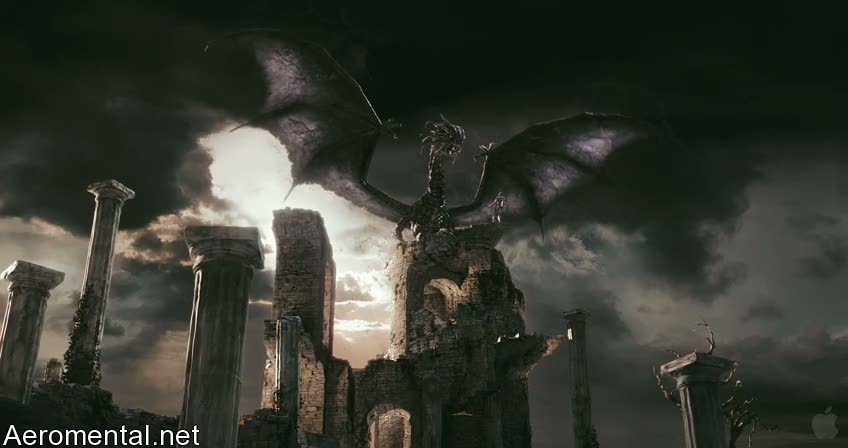
Wolverton and Burton take the essential pieces and make a typical action-adventure story-line out of it. There is some half-sized satire about political squabbling, but mostly it's a cut-and-paste job, based on "The Jabberwock Poem." That classic piece of nonsense turns into a fable "that will make everything alright." And it involves one of the characters defeating the Jabberwock in battle with "the vorpal sword" to invoke "the frabjous day" and blah, blah, blah. It's a silly poem, people, not a video-game scenario. By the time we get to the climax, there's a "Lord of the Rings" dark-sky battle between the characters, and we could just as well be in "Narnia" for all it matters. And it has an after-school special message to it, that is nice and all, but is a bit like cherry-flavored medicine.****
This is a lot of talk for a movie I'm only luke-warm about, but the bottom-line is, it's fun while it lasts, but it's like eating cotton candy in the rain. So, yeah, take the kids, it's imaginatively done (when it is), and they'll love it. But don't be surprised if they get sullen and whiny an hour after. Rich it may be, but it's mostly empty calories.****

* A word of explanation: this was written for an old movie blog of mine, now consigned to pixel dust, but written at a time when I still believed that you needed to sum up your view of a movie with a "Rating" (you know, 8 stars of 10, or, the most egregious "Thumbs Up"👍 or "Thumbs Down👎." The way I pigeon-holed films was very basic—"How much money do I think you should spend on it?" So, the ratings went like this: 

1) Full-Ticket Price. The cost of a first-run evening show. The movie is worth seeing in a theater for whatever reason, even at full price.

2) Matinee Not worth a full-price ticket, but still worth seeing on the big screen, but save some of your money because it's no Citizen Kane.
3) Rental For whatever reason, pick it up on your own terms, in your own home. Not worth making an appointment or going out of your way.

4) Cable-watcher Less than Net-flix, because cable gives you more options for viewing. Don't schedule your life around this film, in fact, there are probably better options channel-surfing. If it's a distraction, and it just happens to collide with your eye-balls, this is it.

5) A Waste of Film (or video--don't get technical!) Don't waste your life along with it. There's nothing to get from this film, and the only thing the makers got was another notch on their resume/imdb site.


** Here's the rub: Alice in Wonderland dropped out of my head very fast. One trip to the hardware store and *POOF!* it was gone like a puff of hookah-smoke (or was that diesel?). Now, I waited to write this, fearing another Shutter Island mis-take, and I found the movie shrinking away—shrinking, shrinking, shrinking, waiting for a cake to say "Eat me" to bring it back to size. Never showed up.

*** There's a subtle joke there, as it's mentioned that the party has been in the works for twenty years...but Alice is only 19!

**** Woolverton and Burton add a nice touch that Alice is constantly questioned whether she's the "real" Alice—the Alice that showed up in "Underland" when she was six. She's grown up and the residents hardly recognize her as the strange child who changed the name of the place to "Wonderland." The original story's name was "Alice's Adventure Under Ground."

***** SPOILERS AHEAD: To show you how cookie-cutter this "Alice" is, somebody gets captured and has to be rescued, there's a last-minute save from an unexpected source, a character must claim an essential ingredient by facing danger, and a foe becomes an ally. Oh! And one character's actions provides the method for their eventual freedom. And there's no place like home. I may be a little harsh here, but "Pan's Labyrinth" showed that you could do something different with this sort of myth-weaving and still make a compelling movie.

****** See it in 3-D? I dunno. It will probably be brighter in 2-D, but betray the flatness of the images, and Burton has the same problem as James Cameron of bringing non-essential things on the frame-edge, like ferns and such, too close to prevent double-images. Zemeckis, Dreamworks and the Pixar folks are the champions of 3-D so far.


Tuesday, April 5, 2016

Eye in the Sky

The Nail
or
Attack of the Drones: Showing Your Collateral

Patton loathed the modern age of warfare (circa 20th Century), not just in the movie bearing his name, but in his real life, too. Patton yearned for the era of the personal warrior, battles fought mano a mano. He learned tank strategies at West Point, devised some of them himself, but generally despaired of mechanized warfare and fantasized taking on Rommel in a one on one tank fight, like jousters. Push-button warfare, he saw no point to it, certainly no glory, certainly no triumph.

Patton was a bit crazy, but he had a point.  No triumph also means no responsibility. You can't wash your hands from a killing. Ask Pontius Pilate. Ask Lady Macbeth. No matter how far removed you may place yourself, culpability is still there. In the 40's Humphrey Bogart's characters sarcastically derided "push-button killers...killing by remote-control" especially when he was being written by
Howard Hawks. His opinion usually earned a drink thrown in his face—or worse—for the remark, as it implied cowardice, shirking off responsibility.

Modern warfare (in the 21st Century) is conducted by drones, and one could look at that as killing by remote control, if one wanted to over-simplify it. But, as the new film by Gavin Hood (X-Men Origins: Wolverine—but don't hold it against him—and Ender's Game, rather appropriately) Eye in the Sky, shows it is hardly removed from responsibility. It takes place over twelve hours, focusing on one military operation, dubbed "Operation Egret," focusing on an Al Shebaab terrorist cell in Nairobi, Kenya that has been under surveillance for several months by British military forces, the operation headed by Col. Katherine Powell (Helen Mirren). 
This particular group, made up of Kenyan, American and British fanatics with murder on their minds, is being monitored as they come from various parts of the globe to converge on one house in a small Nairobi neighborhood. What they're planning is not known, but, given their collective history, it can't be good. 
The plan is to remove them from the terror equation by capturing them and separate teams from around the globe are pressed to this purpose: In Surrey, Col. Powell heads the direct operation; at Permanent Joint Headquarters in North London the situation is being overseen by the Foreign Ministry and by Lt. General Frank Benson (Alan Rickman in what will be his last filmed performance), AG George Matherson (Richard McCabe), and observers Brian Woodale (Jeremy Northam) and Angela Northam (Monica Dolan)—their parts must have been described in the script as "insufferable bleeding hearts"; drone flight operations originate in Creech Air Force Base near Las Vegas, the pilots being 2nd Lieutenant Steve Watts (Aaron Paul) and Carrie Gershon (Phoebe Fox); charged with imaging intel at Pearl Harbor, Hawaii is Lucy Galvez (Kim Engelbrecht).
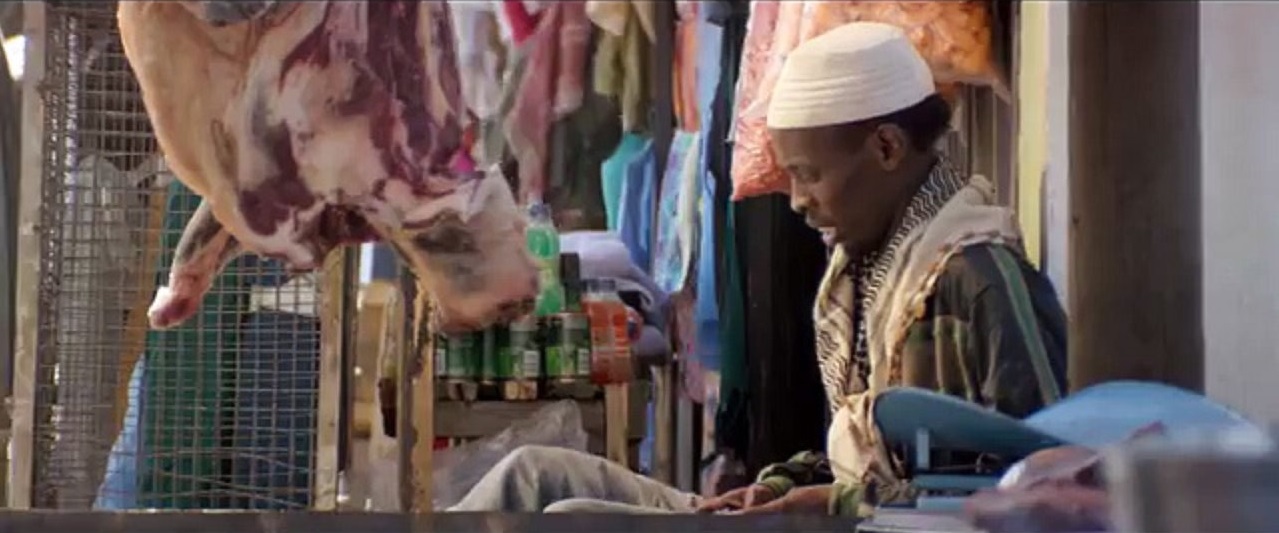
Oh, for the local angle, the "boots on the ground" are headed by Major Moses Owiti (Vusi Kunene), with close surveillance by Damisi (Ebby Weyime), she of the "hummingbird-cam" and Jama Farah (Barkhad Abdi of Captain Philips), he of the "beetle-cam," who employ these ludicrous little surveillance systems to get extraordinarily close views of the terrorists.
Then, there are the Mo'Allim family, who live in the same block as the terrorist safe-house—Fatima (Faissa Hassan), Musa (Armaan Haggio) and 8 year old Alia (Aisha Takow), who studies behind shuttered windows away from the disapproving eyes of Al Shebaab thugs. Allah knows what they'd do if they knew that she rocks a hula-hoop.
Aliah will be the focus of concern for all of the eyes in the sky, as her daily chore is to walk to a corner table and sell the bread her mother bakes. Today, her spare little stand is in a kill-zone, watched around the world and discussed in urgent tones, especially when the surveillance shows that the safe-house meeting is for the pre-blast meeting of a suicide bomber. As the C4 is unwrapped in a back bedroom, the "capture" scenario is upgraded to a "kill" scenario, the troops are ordered to stand down, and the reconnaissance drone is brought to bear as a missile launcher. The clock ticks down and the discussions go up levels of responsibility to the PM. Then the US, who is monitoring—they monitor EVERYBODY—butts in to remind that these Al Shebaabers are, after all, No's 3, 4 and 5 on the East Africa Most Wanted list, and how often do you get to pull a "hat-trick?"
The conversations turn slightly "Strangelovely" with talk of 45% versus 65% "kill probabilities," "real war" versus "propaganda war" victories, and "kill-chains," but the reality is those hovering pictures and the little girl with the bread-stand. A savage balance is weighed—her life versus the lives of the potential victims of the suicide bomber. The piloters in Vegas have their orders—if there's a 50% chance (or greater) that civilians will be killed (the "collateral assessment"), they can't launch—or, more appropriately, can go "by the book" and countermand the generals and refuse. And their evidence is on the same screen every one is looking at. That is more than a little unprecedented in modern warfare. It is certainly a far cry from "chateau generals," far removed from the repercussions of their orders. It is real. It is now. And the entire kill-chain of command must stare into the face of death, whether they're satisfied with the results or not.
I mentioned Dr. Strangelove earlier. This is more like Fail-Safe, warfare conducted in closed rooms, but, as opposed to that film, with the hand-wringing kept to a minimum (in the movie, but the film is tense enough to produce that result in an audience). Concentrated, focused, it is like a great BBC drama compressed into a taut, tense 90 minutes. Hood doesn't mess a lot with Guy Hibbert's screenplay, doesn't over-complicate it. He lets the situation and the superb crew of actors, some new, some veterans, do all the heavy lifting (one amazing bit of trivia is that the film was shot entirely in Hood's home country of South Africa).
Performances are universally good, although a bit too teary-eyed in places for professional soldiers, especially if it's more than their first week on duty. Mirren is back in her "Prime Suspect" phase with a chip on her shoulder that almost makes her hunch-backed. Paul cool and assured, even under duress, with his finger on the trigger, I was surprised by my delight at seeing Agbi, who's too keen a presence to disappear after his Oscar-nominated performance for Phillips.
And then, there's Rickman. The man died January 14th of this year and the film is dedicated to him. He also has the best, most multi-layered line (which he delivers with the cold, nuanced melancholy he excelled at), effectively ending the film as it hangs in the mind, not only because of the way it reflects on the entire film, but also in the way his reading of it complicates its wording, echoing, echoing, echoing. Eye in the Sky is provocative enough, one hopes it's not remembered solely for being his final visual bow, but he couldn't have had a better exit line.