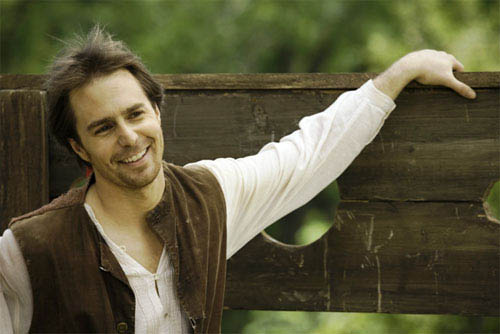
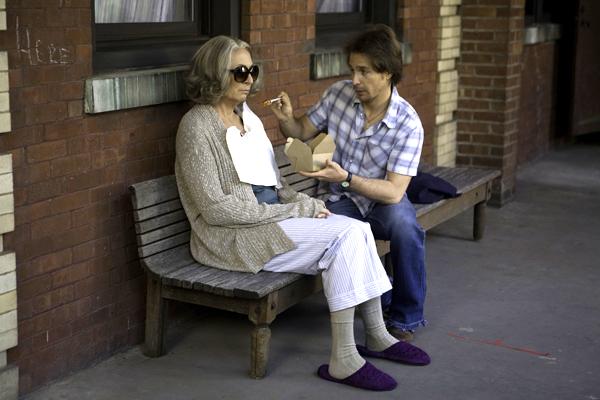
Showing posts with label Sam Rockwell. Show all posts

Tuesday, December 24, 2024

Everybody's Fine

Written at the time of the film's release...

"Everybody's Fine. But the Film? N'yeah, Not So Much!
"
 
Widower Frank Goode (Robert De Niro) has a big family reunion planned when all the kids at the last minute cancel. Assuming, as do we, that they're just avoiding seeing "the old man," he packs his bags, his keys and his pills, and buses and trains across the country to drop in, unannounced, on each and every one of them, with a mystery note. He doesn't fly, you see, as he's suffering from pulmonary fibrosis, which he's acquired from his job of weather-coating phone-cable with PCB's. It is the very nature of this movie to let no plot-detail go underutilized in this bubble-world of a movie, so, of course, that becomes important later.

When visiting each kid, he realizes that they're leading somewhat less successful lives than they and his late wife had led him to believe. And he's determined to get everybody back together for a big get-together at Christmas. It sounds like the excellent Christmas "ABC Movie of the Week," "The Gathering," in which a dying Edward Asner attempts to have one last Christmas with all his estranged adult kids before he goes to the Great Gift Return in the Sky. But this is actually based on an Italian film by Cinema Paradiso director Giuseppe Tornatore called Stanno Tutti Bene (or "Everybody's Fine") and de-cultured, simplified, sweetened and topped by an ineffectual Paul McCartney song by Kirk Jones (who made Waking Ned Devine and Nanny McPhee and should know better).
I haven't seen the original (shame on me,
I loved ...Paradiso*), but I know it wasn't as slick and as simple-minded as this version. For example, it hinges on the false premise that nobody ever talks in this family...ever.
The entire movie could have been solved in an hour by
Dr. Phil. Everybody keeps secrets, sure. But usually not very well. How long did these kids think they could keep their charades going, especially with the major life-changes they entail? The machinations that daughter Rosie (Drew Barrymore) has to go through are herculean and more than a little uncredible for what she's hiding, and also speak of a lack of feeling that the rest of her performance belies.
Added to that, the plot device of inflating your importance to your parents has been used in every sit-com ever conceived—but pulling it off on an elaborate movie budget tends to make the concept explode like shrapnel. It's especially frustrating, after seeing a mature film for adults like
Up in the Air to see froth like this, designed for the eye-candy-and-blue-hair crowd, where no opportunity for closure goes unachieved with an unsubtle slam.

The cast in uniformly great, however. De Niro (man, he looks plasticized in that poster—they airbrushed out all his wrinkles to attract a younger crowd?) schlumpfs around the country, asking, ironically, "Are you not talking to ME?" and still manages to find simple, interesting ways to be "a joe." The kids are played by Barrymore,
Kate Beckinsale and Sam Rockwelll
**, who all do fine jobs given the paucity of material, though Rockwell looks particularly frustrated with his role.

Who could blame him? This isn't a film. It's a "project," gussied up with an all-star cast of available talent who have nothing in common other than they wanted to work with De Niro; a constuct that looks good on the surface, but has no underlying thought to it that would make it legitimate in its own right, and plausible as a story. It's
Meet the Fockers done as drama, a collection of parts that don't fit for a coherent film, much less as a representation of real life. Everybody involved should be sentenced to a year of working in theater where they might stumble on some actual characters to play and thoughts to express. Their aspirations are too low, and need to be adjusted.

* That's another thing: there's no way De Niro could have had these three kids without marrying three different wives. Nobody looks like they belong in the same family. It looked good on paper on the Miramax ledger-sheet, I'm sure, but it looks like sham on the screen.

Wednesday, November 6, 2024

Galaxy Quest

This was written at the time of the film's release in theaters and a cursory glance at it a couple weeks ago (in between regularly scheduled programs) revealed just as much enjoyment and admiration as the first time I watched it. "Never give up. Never surrender."

Galaxy Quest (Dean Parisot, 1999) Up until J.J. Abrams' re-boot, this 1999 release was probably the best "Star Trek" film that Paramount Studios never made.
 
Unfortunately, it wasn't "Star Trek" but a spoof of the phenomenon that Paramount inherited from the originating production house Desilu (and apparently didn't know what to do with—at the the time of Galaxy Quest's release, they were in between producing the Next Generation movies Insurrection and Nemesis, which effectively killed the series). 
 
Still, this film is an affectionate send-up with a fine cast doing good comedic...and dramatic...work, and manages to pull off something of a miracle, making one one embrace the cliches of the original while at the same time making delicious fun of them. And given the ubiquity of "Star Trek", fans still recognized the show, backwards, forwards and behind-the-scenes, even when it was in the disguise of another Intellectual Property.
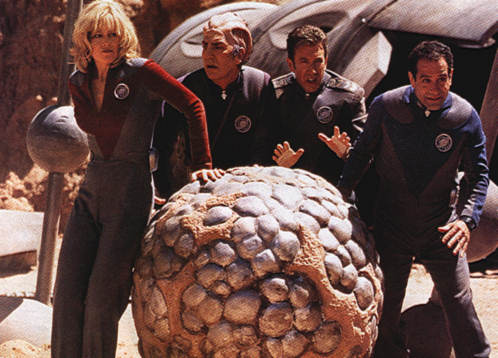
At a sci-fi convention, the cast of a long-cancelled television series "Galaxy Quest" is going through the motions of meeting their fans, even though the show has been off the air for years, and the actors are having a difficult time finding other work due to "type-casting." They squabble, each remembering personal quirks and on-set peccadilloes, either jostling for the limelight or just "doing the gig," and by happenstance, find themselves portraying their characters in a real outer-space adventure, persuaded by desperately seeking aliens who have caught transmissions of the show as it zipped through space at light-speed, and not only liked what they saw...they bought it hook, line, and beridium sphere.
It's a fun conceit, combining the background stories of actors with the characters they're playing put into a situation where their attributes as actors inform their actions in a real-life approximation of the roles they play. It stands to reason that the traits they embody to play the roles would come to the fore when reality sets in—it implies, of course, that they could do all this without "handlers," make-up assistants, or even (ya know...) decent writers and directors. It's fun to imagine.  
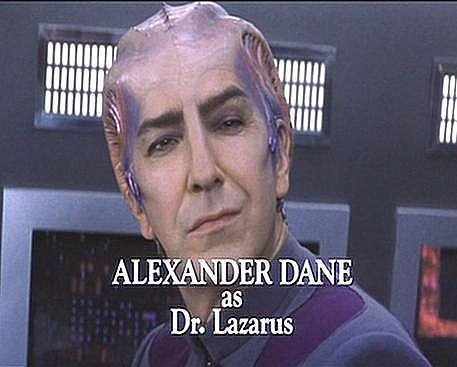
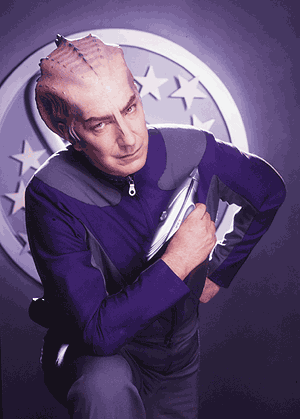
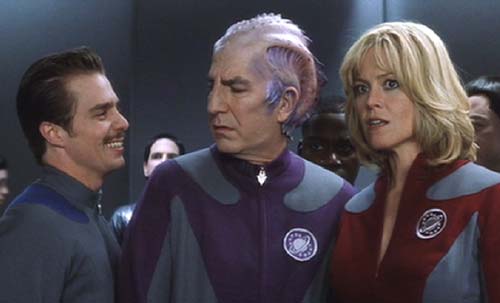
And the writers of the film have the "Star Trek" types down: the blow-hard lead actor (Tim Allen) who looks after himself until the chips are down; the second-in-command alien character—a fan-favorite—portrayed by an actor (Alan Rickman) who aspires to more prestigious roles and makes efforts to distance himself from his most popular one—until the role's inherent dignity and importance occurs to him; the actress (Sigourney Weaver, paralleling both Lt. Uhura and her "Ripley" character in Alien) trying to rise above the inherent sexism of her role, opening "hailing frequencies"; and the "also-ran's" (Tony Shalhoub and Sam Rockwell) who are stuck in their careers, forever typecast and unable to move on, bitterly watching their co-stars take better advantage.
There's also a tip of the hat to the faithful fans who start out as convention geeks, then play a pivotal role in the survival of the crew and their mission—and they don't even have to do it with a write-in campaign to the network.
Fiction becomes fact becomes fiction becomes fact; Galaxy Quest is an inter-dimensional trek on a Universe that's folded in on itself, through all the frontiers influenced by TOS and its progeny that explored new frontiers on a journey that seems on-going. It's also one of the best examples of a rare film genre that usually comes off as lame, childish, or patronizing—the science fiction comedy.

Wednesday, February 7, 2024

Argylle

Accent on the "Arrrgh"
or
Henry Cavill's Failed James Bond Audition (Part 3)

Aubrey Argyle (Henry Cavill), an agent for an intelligence division (headed by Richard E. Grant) is on a mission in Greece to find a source of information (doesn't matter what it is...it never matters). In contact with his associates, Wyatt (John Cena) and Keira (Ariana DeBose), he infiltrates a dance club where he asks the seductress LaGrange (Dua Lipa) to dance the "whirleybird," a dance where he basically wears his partner as a muffler. She reveals that the whole set-up is a trap to kill him. She exits, while everyone in the club pulls out an automatic weapon. With such a circular firing squad, Argylle escapes, but is fired upon by a waiting LaGrange. Keira pulls up in a range rover to pursue her, but is shot through the heart. He alerts Wyatt that LaGrange is making her escape, and makes the choice to leave the wounded Keira and hijacks a vehicle to pursue LaGrange himself. As she speeds off down a winding, switch-backing road, Argylle takes the shortest route, over the roof-tops of local buildings, crashing down stair-cases, causing all sorts of damage to the scenery, architecture, and his own vehicle, that, if there was any sort of local press, would create so much havoc that the term "secret mission" would no longer apply. And, it's all for not, as Agent Wyatt, reaches out to the passing LaGrange and merely plucks her off her speeding motorcycle. Okay. So, (one may ask) why the carnage? These guys are talking to each other...why didn't someone just say..."You're strong. Grab her by the designer-label and yank her off her bike?"
Cut to: a book lecture. Author Ellie Conway (
Bryce Dallas Howard) is finishing reading what we'd just seen to her rapt audience. They all applaud her awaiting her to sign her latest book, the fourth in her "Argyle" series about a fictional secret agent with a Dexter Poindexter hair-cut, who's big, strong, impossibly handsome and somehow does undercover work that nobody notices. Nobody brings up that point during her Q-and-A (maybe because screenwriter Jason Fuchs is moderating the talk).
But, after her talk she goes home to her cat, Alfie (director Matthew Vaughn's nepo-kitty, Chip), and her Argylle action figures and tries to write another chapter of her forthcoming book. But, she's stuck, so stuck that even the fantasy-Argylle in her imagination starts to get a little irritated with her. Phone-call to mother (Catherine O'Hara), who advises her that the manuscript to her latest book feels incomplete and she shouldn't end it with a cliff-hanger—why doesn't she come by for a visit and they can resolve it (Sure, that's what I always do when I'm stuck in writerly quick-sand!), and she takes a train—she hates to fly—to go visit.
She and the cat intend to spend an isolated train-trip while she researches, but the train compartment's a bit crowded—anyone wanting to take the seat across from her is rebuffed with a "someone's already sitting there." Except for this one guy (Sam Rockwell), who rather blithely sits across from her, irritates her cat (and her) and wants to make small talk. Elly nose-dives into her book and doesn't engage—he recognizes her and is a big fan of her work (swell!). But around the time she asks him what it is that he does for work—"Espionage" is his answer—she's approached by an autograph-seeker, whose pen sprouts a hypodermic needle and the guy, Aiden Wilde, takes the guy out with a few swift moves.
Aiden is not what he seems (nothing is, as we're to find out). Suddenly, everybody in the train compartment starts to attack Aiden trying to get to Elly. While she sits there, horrified—and imagining that it's her agent Argylle doing the fighting—he flails, kicks, somersaults, and uses everybody's weapons against them. This is some well-organized kidnapping that's been planned out—all those assassins with all those tickets—then, you'd think that they'd all rush at once instead of waiting until their turn at bat. And in the next car, is a bunch of guys with automatic weapons. Big automatic unconcealable weapons. Is Amtrak that lax? And is there no such thing as innocent by-standers in this movie?
Apparently not. Argylle
is one of those spy-fantasy flicks along the lines of Flint, Matt Helm, Austin Powers and Vaughn's own "Kingsman" series, that make the Bond series look like "kitchen-sink" dramas. Things happen very fast so you don't have time to consider the lack of story-logic, gravity, mass, physics and the day-to-day realities of life and the Universe that would stop this movie cold if anybody in the audience raised their hand and said "Excuse me...that makes no sense." In Matthew Vaughn's universe, that audience member would instantly be executed (with colorful smoke!) by every other audience member.
It's eye-candy, not brain-candy. It's a comedy, not an adventure, or a thriller, or a mystery, or an espionage film, or a drama...or much of anything, really. One is never engaged in any means to an end because  It's designed that you sit back, relax, eat your pop-corn, and silence your brain along with your cell-phone (as a matter of fact, it's one of those movies that you could text, make a phone-call, play a game, and not miss a detail—nothing matters and anything might be contradicted fifteen minutes later). The Elly-fantasy sequences are just as realistic as the Elly-"reality" sequences, and if you have a memory retention of more than thirty seconds, you're going to get irritated. Enjoy the popcorn; it's much more substantial.
Great cast, though. John Cena knows how to play comedy merely by timing and not by expression, Bryce Dallas Howard's quite good for what she's been given to work with. Bryan Cranston knows what the material's worth and just chews, chews, chews, and Catherine O'Hara's a bit wasted. Henry Cavill...well...the man's a poser and one wonders how many of these things he's going to do before the internet just throws up their hands and says "James Bond? Anybody but him." The film is also a bit of a bait-and-switch as Cavill and Cena's screen-time amount to about twenty minutes of screen-time. "Such small portions." The film has something to disappoint everybody.
The one thing I clung to throughout the entire movie was Sam Rockwell. From the moment he shows up to the final frame, he's invested in his character and makes it work. Where many in the cast are posturing and playing over-the-top, Rockwell's off-the-cuff insouciance and embracing of the weird feels natural and oddly charismatic. It may be too much to say that Rockwell believes the performance and sells it his manic energy, but he provides a genuineness in something that feels so faked. The one thing you come away sure of after the movie is how damned talented Rockwell is. He's a treasure, worth far more than any plot McGuffin is worth.
Thinking about the movie too much depresses me, but if you want further thoughts—and a lively panel discussion—Argylle is the subject of Episode 721 of the Lambcast (I'm the one grumbling throughout).
 
The best part of the movie (aside from Sam Rockwell) is the trailer.  Here it is. Save yourself the trouble. 

Yeeeeaah...it isn't...and it won't.
"The Bigger the Lie," indeed.

Thursday, September 22, 2022

See How They Run (2022)

The Play's the Thing...
or
"So Far, Soporific"
 
Remember the movie made of Agatha Christie's hit play, "The Mousetrap?" You don't? Well, it's no mystery—the reason why is one has never been made. Oh, there have been unofficial pastiches in foreign markets, but there has never been a filmed version of "The Mousetrap." Legal reasons: When Agatha Christie signed the deal to have it produced it was stipulated in her contract that a movie version wouldn't be made for at least six months after it closed.
 
And it's been running—at the St. Martin's Theater in London's West End—since October 6, 1952. There was an interruption starting in 2020 due to COVID, and it re-opened on May 17, 2021. It's 27,500th performance was staged on September 18, 2018. The estimation is that there have been 28,500. A running tally exists on a wooden counter in the theater's lobby. And so, because the play has never officially closed, there has never been a film of "The Mousetrap," and may never be.
That back-story is the whole raison d'
ĂŞtre for See How They Run, a Christie-like mystery pastiche centered around the play and the extraordinary circumstances that start when it celebrates its 100th performance. It is entirely fictional, although some of the actual names are not changed—for example "Dickie"—or Richard as he is better known as actor and director—Attenborough (played by Harris Dickinson) did appear in the first run of the play along with his wife, Sheila Sim (played by Pearl Chanda). And there was a film producer named John Woolf (played by Reece Shearsmith), who did indeed produce The African Queen and bought the movie-rights to "The Mousetrap," anticipating a film adaptation (which never materialized).
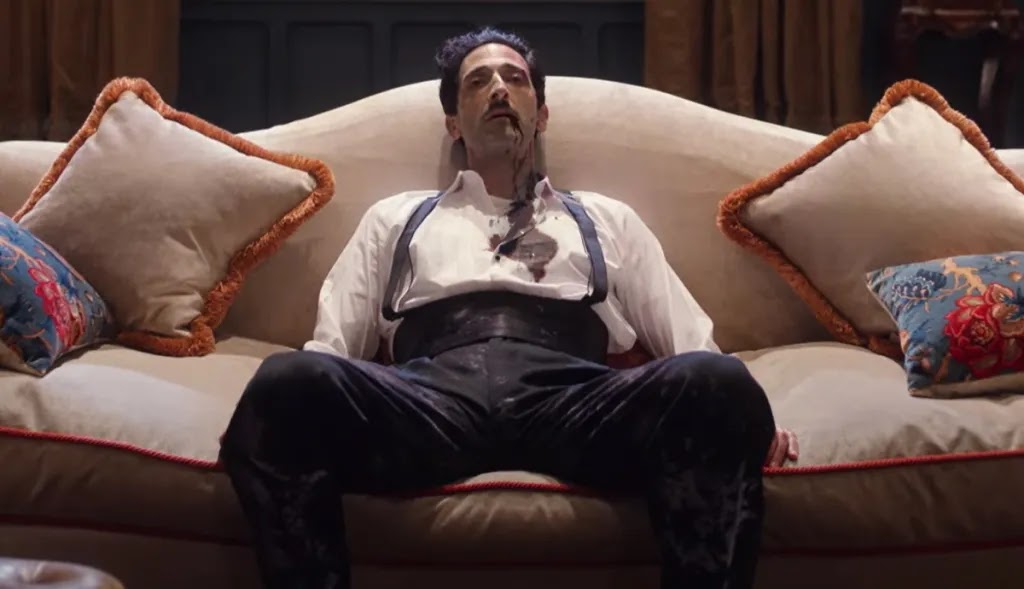
Well, on the night of the 100th performance, a celebration party takes place, at which the intended American director for the film-version, Leo Köpernick (Adrien Brody) gets drunk, makes an ass of himself and gets into a fight with (among others) Attenborough. But, he's such a louse that he makes enemies with anyone he makes eye-contact. No surprise, then, that he ends up murdered. Big surprise, though, that he's narrating the film (that is, if you haven't seen Sunset Boulevard—the neat thing about dead narrators is that they know everything, even if their opinions might be wrong).
The police show up: First, Constable Stalker (
Saoirse Ronan), who's new and nervous and by-the-book—her own notebook with which she feverishly takes notes that she sometimes can't read; then Inspector Stoppard (Sam Rockwell) bumbles in—he's the rumpled DI in a mac, designed to be underestimated by the unsuspecting suspects: the show's producer (Ruth Wilson) and the disgruntled screenwriter (David Oyelowo) and their hangers-on, the Attenboroughs, and everyone who'd been offended by Köpernick—and that includes everyone.
It appears like an open-and-shut case. Kopernick was clobbered by a ski and bludgeoned with a sewing machine in the costume room. But, who is the mysterious figure that is only fleetingly seen around the murder scene...and could be anyone? Well, that's hear-say. And it's only down to Stoppard and Stalker as Scotland Yard is over-taxed dealing with "the Rillington murders" (one of the little in-jokes that abound in the screenplay—Attenborough starred in a film about the case—that are there to tease but lead nowhere).
And that may be part of the issue I have with See How They Run. I enjoy mysteries, not necessarily the solving of them, but the cleverness of the solution—the kind that make you go back and read "that section" that you missed among the chaff of the rest of the story. And, for all its cleverness and jokiness about the form, the central mystery is not all that compelling...and neither are the investigators (despite being played by Ronan and Rockwell). There are so many red herrings—about affairs and ex-wives and duplicitous relationships—and dead-ends that by the time the solution comes out of the wings—oh, it's related to "The Mousetrap" but not relatable to anyone familiar with the play—that one is simply underwhelmed with how it's wrapped up...and in a way that has previously been excoriated earlier in the movie. And Brody's continued role as victim/narrator just makes you wish that murder was possible in the after-life.
 
There are clever touches—Stoppard's hobby is to make jigsaw puzzles—but even that's a dead end and is just a half-hearted way to give him some "character." Ultimately, I found it not clever in the spine and too clever in the details—when it should be the reverse. If one is going to make a comedy "whodunnit", it should not turn out to be a "whocares." Hoping that Glass Onion and The Menu turn out better.


Saturday, March 19, 2022

Choke

Saturday is traditionally "Take Out the Trash" Day.

Written at the time of the film's release.


or 
"The Running Gag"

 
He is not, however, impotent.

He's a sex addict. He's half-heartedly going to a support group for sex mania. And whole-heartedly failing to commit...to the group's four-step program, or any serious relationship. In fact, every time he goes to one of the meetings he ends up taking a step or two back. 
 
Understandable, as the group is full of sex maniacs!
He works as
a tour-guide at a historical reconstruction of a Revolutionary-period village ("I am the back-bone of Colonial America" he intones to the camera, as if he was reciting narration from "Fight Club"--the marketing for the film features that film's title in slightly smaller type than its own). There, he fantasizes
about ripping the bodices off of every female employee. He wants to know them in the biblical sense, if not know them in the intimate sense.
His mother (
Anjelica Huston) is in a permanent care facility suffering from dementia, not from Alzheimer's, but from repeated and systematic drug use. She now only recognizes Vincent as one of a series of dead lawyers she once knew, which is fine, except that Vincent wants to know more about his past--specifically who his father is--and that knowledge is slowly fading from memory. Vincent is desperate to know that he has some DNA not related to his addled mother's.
 
His life is so abnormal, that he craves the normal even if he wouldn't recognize it if he was hit in the head with it. As a child he was jerked from foster-home to foster-home, always rescued by Mom, for a series of runs-to-the-border interrupted by arrest and another foster home. The only love he has known is when his mother saved him from choking on a corn-dog using the Heimlich maneuver. Now, he goes from restaurant to restaurant purposefully choking on food, in the hope that someone will rescue him. And give him some money out of sympathy to keep Mom in that facility.
The story so strains to be unconventionally amusing that it is crushingly disappointing to have it become so...conventional in its resolution and the embracing of the good and the normal as the panacea for all ills. Choke plays by the old bait and switch of the Hollywood system under the Hays Code. Lure the audience in with scandal, titillation and promises of lurid behavior, then turn it into a homily about the right, true path. Choke becomes the sort of sanctimony-in-wolf's-clothing that you would find in such films as Peyton Place, Sex and the Single Girl, or any horny teen sex-comedy, combined with the basic trope of psychological films where all one's neuroses are cured with a sudden remembrance of that one key event that unlocks all the symptoms, and you have the basic dull curve that Choke slides into. Everything falls like a house of cards once the underlying truth is revealed.**
One should expect more from the author of "Fight Club," but it's not his fault. Blame writer-director
Clark Gregg for this one. He's taken all the thorns off of Palahniuk's outline and exposed the basic tawdriness of his novel to the light of day and making it shrivel like a vampire.
***
 
The only thing to recommend this film is Rockwell and Huston, who manage to breathe life into their characters--they're the best written in the screenplay. Sensitive viewers should be aware of the pervasive language, and sexual situations, which are not glamorized in the least.

* Inscribed at the Temple of Apollo at Delphi. John Huston used it in the prologue for his film Freud: The Secret Passion, as the basic tenet of psychology. In the context of Choke, I find it a rather useful and funny reference.
 
** As in the other Palahniuk adaptation. It's interesting, the whole "falling house of cards" metaphor for the psychological scale falling from one's eyes can be applied (quite literally) to Fight Club as well, and it's just as much an oversimplification of the process as Choke, or for that matter, Freud, or Spellbound. It did clue me into the conclusion that Fight Club is a completely mentally-contained movie--that is, it's all happening in the main character's head. All of it. Or it doesn't make any sense. If that is the intention, my respect for the film just doubled. Maybe the scales fell from my eyes.
 
*** One more thing: Gregg joins the group of actor-creators not content to stay behind the camera of their films, ala M. Might Shyamalan, Mike Binder, and Kenneth Lonergan. The likes of Costner and Harris and Gibson act and direct because the producers cut their losses on actors' "special projects" by keeping their legitimate box-office draws up-front. There's no financial reasons that Shyamalan or Lonergan or Gregg should be splitting their attentions acting, and writing-directing. Hitchcock made cameos in his films initially to fill in crowd scenes, then it came to be expected--a running gag lasting throughout his career. Here the "Hitchcock moments" are merely self-serving.

Friday, January 10, 2020

Richard Jewell

Acts of Domestic Terrorism
or
Getting the Story Wrong

"No Good Deed Goes Unpunished"
Unattributed, although ascribed to many

Clint Eastwood's new film, Richard Jewell, should be fairly cut and dried, seeing how it is "based on a true story" and a well-documented story at that, enough that the tag-line has been altered to "Based on the True Story of the Atlanta Bombing," as if anybody actually remembered it. But, no, it's isn't cut-and-dried, it's controversial, when it shouldn't be. 

Oh, the facts are there—the bombing of Atlanta's Centennial Park during the 1996 Summer Olympic Games; the sudden elevation of a low level security guard Richard Jewell as a hero for finding the bomb and preventing more destruction than the two deaths that were were recorded—one direct and one indirect and 111 injuries; his just-as-sudden FBI suspicion of being the one responsible for the bomb (despite a 9-1-1 call from a distant pay-phone ten minutes before the explosion when he was trying to convince police and security that there might be an actual threat); the media frenzy over the Jewell investigation leaked by the FBI, when it was based on rather hazy, and misapplied, profiling and, when that didn't work, conspiracy theories.   
Meanwhile, Jewell was put through a head-spinning change of fortunes, partially based on his own behavior characteristics and his unquestioning respect for authority. Jewell wanted to be in law enforcement, but he was physically unfit for the job and seemed to have a chip on his shoulder that others didn't hold the same respect for the law that he did. Jewell was "by the book" and held people to their word, making him contradictorily diligent and detail-oriented and yet incredibly naive. Those qualities made him the perfect guy to find the bomb—there was a LOT of security there that night that did not—over-react, and, while doing the right thing, getting people's noses out of joint.

Better than having nails explode in your face, though.
And better than the the trial-by-gauntlet Jewell faced being part of a headline story being covered 24/7 by an already entrenched media firing squad. It was the Olympics and the whole world was watching. One would think, with such attention, the idea would be to get the story right than to get the story out. But, as has been seen time and again with "Breaking News" there's a lot of mis-information that comes out initially. And there is no subsequent rush—when "news breaks"—to fix it. 
Jewell, initially hailed as a hero for his actions—in a crowded park, full of police, security and FBI (all fussing over who has jurisdiction). Jewell is trotted before the intense "up close and personal" Olympic coverage on television. Then, the investigation begins under the same glare of spotlights and confusion. Given the scrutiny from all sides, the pressure results on being first, with egos and reputations on the line.
Without any hard evidence, despite an FBI sweep of his apartment shared with his mother, and some rather dodgy techniques to trick Jewell into some form of entrapment, he is made the initial focus of the investigation and this gets leaked to the news media, particularly The Atlantic Journal-Constitution, which runs it as a headline in an Extra edition and at that point, everything escalates, with speculation, mobs of reporters outside the Jewell residence. The only thing the movie doesn't get into is the pressure from FBI headquarters to nail down the search, quickly. 
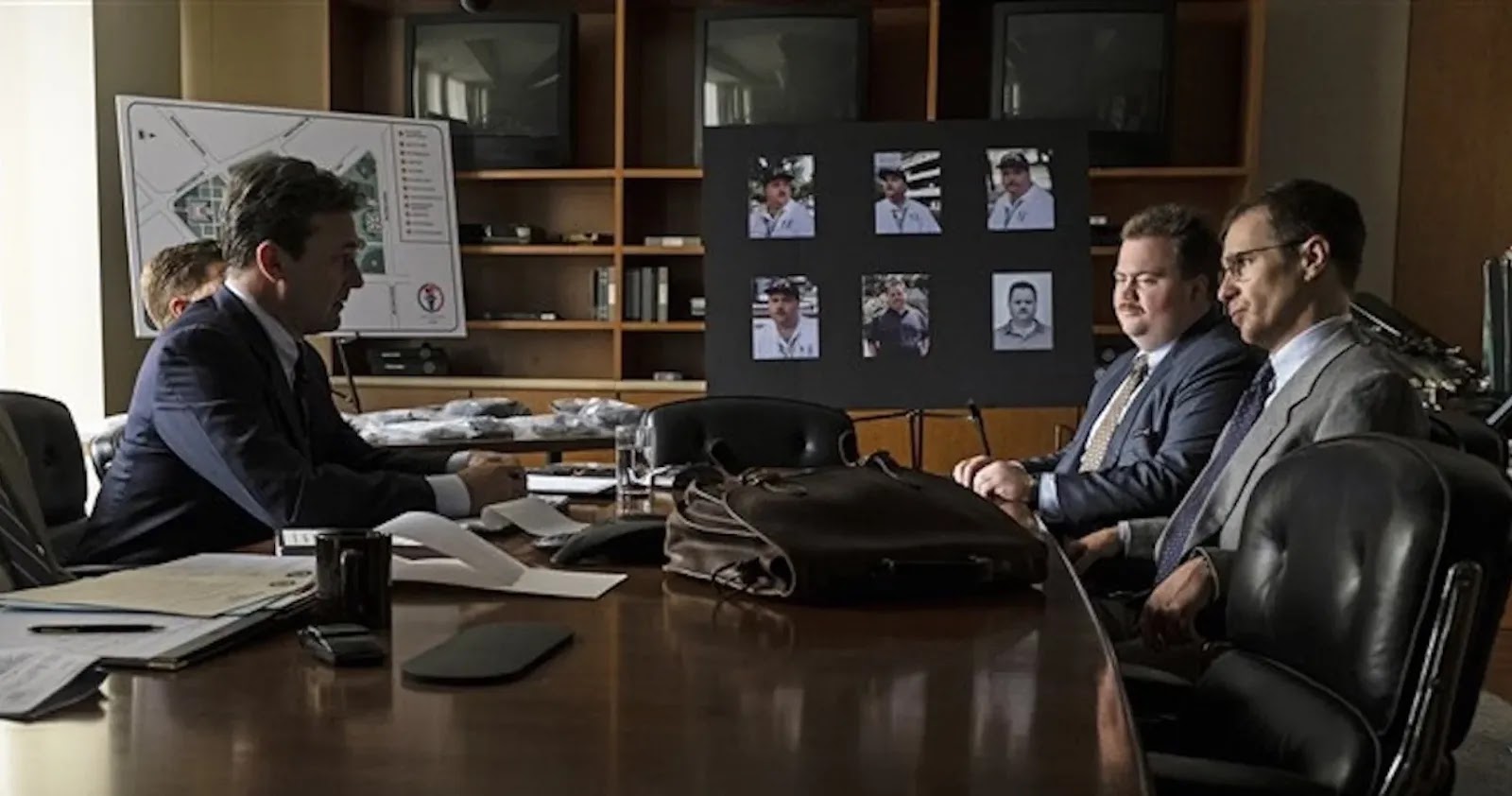
All fairly laid out as it transpired—and the best source of information is Marie Brenner's "Vanity Fair" article "American Nightmare: The Ballad of Richard Jewell," which goes into a bit more detail about the then FBI director Louis Freeh's heavy hand in it, as well as the FBI agents who have been morphed into the character of "Tom Shaw" (played by Jon Hamm), who, under pressure for results—he is even placed at the scene of the bombing, giving him a sense of guilty responsibility.
Eastwood's film is, first of all, well-acted. It's Sam Rockwell's first film with Eastwood and his role as Jewell friend and legal adviser Watson Bryant is another of his extraordinary performances that feels lived in and natural, while spicing it up with just a notch of theatricality. He's the backbone of the picture, the guy with the attitude and the perspective, he's the text of the film's view. Kathy Bates plays Jewell's mother and she's the heart of it, showing the destruction of one's psyche when everything trusted is turned against her. 
Both of these actors provide the emotional fireworks,* the outrage and sorrow not prevalent in the character of Jewell (played by the relatively unknown Paul Walter Hauser, but whose quirky turn in I, Tonya made him someone interesting to watch). Hauser makes Jewell aggravating but still sympathetic, at times prideful and pathetic, perpetually having his balloon popped—intelligent, certainly, but not above having it overwhelmed by an inferiority complex.  Hauser is amazing, but then, he always has been, infusing his roles with a dash of unglamorized normalcy. He's not theatrical, but he's quickly elastic with no irony applied. It's a naked, raw performance that makes you wonder if Eastwood just snatched up the real guy again (he didn't, of course—Jewell died in 2007).
They're the "good guys." The elephant in the internet is Eastwood's "bad guys." The one that's getting the headlines is Olivia Wilde's AC reporter Kathy Scruggs. There have been charges of sexism against an ambitious female reporter...because she's an ambitious female reporter (I've been trying to think of a female reporter in any movie that isn't) and that Scruggs is treated unfairly and inaccurately. It is harsh, but one should reiterate that it is her name on the byline of the story. It is alleged in the film that Scruggs traded sex for information from an FBI informant—more on him in a bit—but there is no evidence for that and may be the screenwriter reading more into Marie Brenner's characterizing Scruggs as "a police groupie" than there is (although most of the "police groupies" I know are male). Scruggs, in the movie, is given a redeeming character arc that implies conscience and a kind of redemption that has never been displayed by the paper in its long legal battles against Jewell's civil suits, and it is the only news organization that did not settle in its civil lawsuit, saying that their story was "factually true at the time." 
No one, however, is complaining about Hamm's FBI agent who is, even at the end of the film and despite evidence to the contrary, completely sure of Jewell's guilt. There is no ax to grind here, apparently—Eastwood, after all, made the controversial J. Edgar with one of the Richard Jewell's exec's, Leonardo DeCaprio—no need to blow up the interwebs over that. Nor, has anyone made mention of the fact that Jewell, Scruggs and the compendium "Shaw" can all be tarred with the same brush that brought Jewell under suspicion in the first place—being over-zealous. Irony doesn't play well in social media, evidently.
One shouldn't be surprised that the very entities with with reputations to tarnish should be the ones to squawk the loudest when they are put in a defensive position by something that might exert a change in the power dynamic they enjoy. But, then, an unfair power dynamic lies at the heart of the film, and has been at the heart of so many of Eastwood's films. It is amazing that in a time when film-makers are reaching down for the common denominator, that Eastwood's films still stir people up, allowing people to see what they want to see, a sort of litmus test for those who dare to take it.
Jewell's nightmare that would solve all problems—covering the bomb with his body.
The real Jewell—holding the evidence.


* Oh. Did I mention that there's an explosion in the movie? Damn, it made me and the rest of the theater patrons jump. Cover your popcorn, people!