I was worried about this one. The original "Naked Gun" series (the ones that starred Leslie Nielsen as Lt. Frank Drebin) came out of of the Z-A-Z team—the guys that made the original Airplane!—they would be David and Jerry Zucker and Jim Abrahams, who had a free-wheeling style of evergreen comedy and an impeccable sense of timing that made their movies work, despite production values that would have been suited for a Hallmark movie. That stuff's tough to duplicate—just ask anyone who saw the non-Z-A-Z sequel, Airplane 2, which was a desperate cash-grab and desperately unfunny despite writers credits by two of the geniuses behind "The Simpsons".
"The Naked Gun" films came out of a Z-A-Z TV series that lasted all of six episodes (before being cancelled) called "Police Squad!" and I remember it as being fitfully funny and not quite up to par with the laugh-a-minute styles of Airplane! or their "Elvis-fights-the-Nazis" follow-up, Top Secret! The ideas were good, playing with the tropes of television and especially cop shows, but they were slightly hampered by 1980's TV censorship and the comedic pace never matched their movie work. That changed eight years later when they revived the concept for feature films and everything went up a few notches.Three "Naked Gun" films were produced between 1988 and 1994, the last only having David Zucker involved with the writing. The complete Z-A-Z team acted as producers. There'd been talk about doing a fourth "Naked Gun" movie with Nielsen, but nothing came of it. His death in 2010 put the stopper in it.
Now, thanks to producer Seth McFarlane's clout, there's a new one, the duplicate-titled The Naked Gun, featuring Liam Neeson as Frank Drebin, Jr., the son of Leslie Nielsen's character, and he's a chip off the old blockhead. Not the most original of concepts, but Neeson does such an amazing job of playing it absolutely straight while still nailing the comic timing that it's a pleasure to see him make the Nielsen transition from drama to high comedy with nary a misstep. The review for the movie at RogerEbert.com stated that it is "legitimately" Neeson's best screen performance, and one comes out of The Naked Gun actually believing it, so deft is his way of fusing comedy with the deadly-serious "I have skills" intensity that he brought to his "action-star" phase.
What's the plot? Who cares? Surely, you don't think the efficacy of a "Naked Gun" entry lies in the carefully crafted screenplay. No, this is a matter of throwing all kinds of shit at a fan—which became a literal joke in Airplane!—and seeing what sticks. But, loosely, it's about a tech billionaire (Danny Huston, who's sounding more and more like his Dad every movie), who's into breaking things and starting from scratch...including populations. Somehow, Junior Drebin gets involved in all this, as well as getting involved with the sister (Pamela Anderson, who's actually quite good) of an "accident" victim.
One is struck by how good the movie looks, with lots of mood-lighting and leaning into noir styles (as opposed to the Z-A-Z approach of key lighting everything, lest you miss a joke in the shadows, and also aping the style of its inspiration, "'M' Squad"). That's a bit of a shock, but seeing as this one is a couple generations removed from its source, it's a good shock.
Is it funny? Comedy is always subjective (he hedged)—one man's laugh-riot is another's snooze-fest—but, the first hour or so provided some genuine howlers and some inspired bits of business...then right about the time director Shaffer cuts to a shot of the house band of the villain's "Bengal Club" (and does nothing with it), the movie coasts to the end, wasting joke opportunities, occasionally perking up, but seemingly on comedy auto-pilot until the end. That wouldn't be so discouraging if the first two acts weren't so darned good.
Hopefully, there'll be more. It's refreshing to find a movie that's funnier and sillier than watching the nightly news.
Mission: Impossible—The Final Reckoningmay well be the last of the "Mission: Impossible" movies, the series based on the espionage TV show that featured a crack-team of specialists engaged in "heist-movie" scenarios for the government.* The films had some of the tropes, the "fuse" logo, the late Lalo Schifrin's pulsating, propulsive theme, the clandestine mission briefing (that then self-destructed leaving no trace). But, in the movies it spawned, the "team aspect" always played second-fiddle to its star and champion, Tom Cruise, who increasingly dominated the films, while his character, Ethan Hunt, still remained a bit of a cypher as a character. Other than doing the hardest stuff, of course.
But this latest, maybe last, entry, given the evidence on display, indicates the series is past its self-destruct status. At nearly 3 hours in length, what could have been a lean and mean entry feels bloated with a first act crammed with flash-backs (ill-advised as they'd never connected story-lines before and even dropped connections with past movies at the drop of an un-negotiated contract) and a star who, at 62, is looking a little too doughy—in a Brad Pitt/Jerry O'Connell kind of way—to be romping around doing his own crazy stunts and skittering the world in his signature tin-soldier full-tilt run.
All the worse, because this one really leans (and leans hard) in to Ethan Hunt being the end-all, be-all "only one" whose destiny it is to save the human race from Mutually Assured Destruction at the hands of an AI "anti-god" called The Entity...which featured in the last one and, it turns out, was the undefinable McGuffin dubbed the "Rabbit's Foot" from Mission: Impossible 3.**As The Church Lady would say "Isn't that convenient"***
At the time it came out, I thought it was a nice joke that the "secret thing that everybody wants" (and spends so much time obsessing over) in M:I 3 was so much vapor-ware in the story-line. Nobody knew what it was or what it could do, but it was important enough that everybody wanted it, whatever it was. Turns out, in reality (or film-reality, anyway), it was merely the plot-line of Colossus:The Forbin Project.
"Oh, yeah, there are other people in the movie..."
It appears original, but it's merely a re-gift, just put in a new wrapper.
They also serve—briefly—watching Tom do the hard stuff...
So, anyway, the mission should you decide to accept (and I didn't) is that after the events of Mission: Impossible—Dead Reckoning Part 1, Ethan Hunt was in possession of The Cruciform Key, which would allow him to somehow destroy The Entity which is embedded in the Interwebs and is slowly but surely filling it with misinformation, turning the World Wide Web into a cesspool that has man turning against himself (as if it needed any help!) with the eventual end of taking over the nuclear capabilities of all the world's powers. What it would do then is anybody's guess, but even a digital anti-god would know that anything actually using those weapons would create a nuclear pulse and wouldn't do it any good at all, disabling any electronics throughout the world. If it's aim is murder-suicide then you need some other term than "artificial intelligence". Artificial psychosis", maybe? The Entity sounds like it's related to Monty Python's "Black Knight" ("You're a loony!")
They also serve who sit in boardrooms and clutch pearls...
Anyway, getting the thing to destroy The Entity involves two impossible missions: get to the Russian submarine Sebastopol (scuttled in arctic waters in the last movie) to use his Cruciform Key to obtain the Entity's "Podkova module" (containg its source code); then, using a "Poison Pill" developed by IMF whiz Luther Stickell (Ving Rhames), get that module to the world's "Doomsday Vault" located in South Africa—a huge mainframe designed to withstand said nuclear pulse even in a planet-wide armageddon—and plug the "Pill" into the "Podkova" thus isolating the Entity and somehow managing to contain the thing.
But, there are complications—there always are—such as the sub Sebastopol starting to roll down a continental shelf when Hunt is inside it (evidently it doesn't have a conning tower or fins or sail planes or...ya know...rudders that might impede the progress), or Hunt having to discard his hi-tech diving suit to get out of a jam and swim...in just trunks...in arctic waters...with no oxygen...and no decompression gear (except on the surface), or—a major one—the bad guy Gabriel (Esai Morales) manages to steal said "Poison Pill" making his escape on a bi-plane (...a bi-plane!), thus forcing Ethan to hijack another one and do a godawful amount of gyrating on wings and struts to get on the bad-guy's plane to get said "Poison Pill."
Now, look...the plot-line is insanely complicated and stupid...way too much so...as well as being openly subject to criticism by what Hitchcock called "The Implausibles" (I can't wait to see the "Goofs" tab on its IMDB page). Such things as Hunt being able to take out two competent goons moments after biting down on a cyanide capsule, or being able to survive "the bends" or the crushing water pressure of a deep-dive while only in his swim-trunks, then being able to do all that dangerous wing-walking the very next day boggles everything that I have left of a mind. The onslaught of implausibles tend to overwhelm such trivial matters as grabbing the barrel of a recently-fired automatic weapon without scorching your hands in the process.
Still, I can appreciate the length and breadths—in IMAX, even!—to which the cast and crew have gone to present such shenanigans. The rolling submarine set that they present is a wonderful little concept design for all sorts of mayhem, and the whole bi-plane sequence is an amazing showcase for what can be done with remote cameras and a star with a death-wish (but one with a goofy absurdist sensibility). As an actor, Tom traditionally dials it to 11, it's in these insane stunts where these proclivities really pay off.
However, the movie is a logical and editorial mess, with sporadic flashbacks that don't quite connect dots or light emotional fuses. It does provide considerable down-time between action set-pieces to make an assault on a snack-bar or sabotage a theater restroom.
If that's your aim I will disavow any knowledge of your actions. Good luck.
*Poof!* hsssssss
Ethan cares, man. He really cares.
* I'm throwing a lot of stick here, but the TV series, as great as it could be, had elements rolled eyes. For instance: why did every potential, autocratic, generalissimo, and revolutionary look like Martin Landau?
** That was, what, 4 movies ago, the one with Phillip Seymour Hoffman, which, when you see him in the flashbacks, causes actual grief.
*** Yeah, okay, M:I fans, I know that the James Bond series just wrapped up an uncharacteristically continuity-obsessive five-film arc, where everything tied together to the point where Bond super-baddie Ernst Stavro Blofeld turned out to be the step-foster-brother (or something) of Bond—in a plot-twist borrowed from (of all things) the "Austin Powers" series. Connecting the dots has a way of diluting the power of a story. In the Craig years, Blofeld wasn't so much an international criminal as a red-headed step-child. Just like in the first Michael Keaton Batman, the criminal who became The Joker was the one to kill Bruce Wayne's parents, rather than just some rando gunman. It waters things down, sometimes to an unpotable degree.
Marty(Delbert Mann, 1955) It was a strange dichotomy—the motion picture studios were fighting off the insurgency of television sets into American house-holds, competing against it by offering exotic locations, widescreen aspect ratios and other innovations like 3-D and stereophonic sound (we won't even get into what William Castle was doing!), even air-conditioning, in an attempt to get people off their convenient couches and away from the primitive flickering black and white images on their square TV sets and back into theaters for their distractions. At the same time, writers and other craftsmen were finding work in the nascent television field where home-grown stories with a less spectacular dimension requirement could be produced quickly and with less studio interference (for them, sponsors were the problem).
But, Marty was different. Marty Piletti (Ernest Borgnine) is an approaching-middle-age butcher (he's 35) in the Bronx. He makes an okay living—he gets by, has some money saved and could see himself buying his own place—but still lives with his mother (Esther Minciotti) for the usual reasons: Dad's gone, Mom's living alone (except for him), she's a bit of a noodge, and he has a severe failure to launch.
Not that he doesn't want to. He's just not the sort of man who attracts attention. "I gotta admit, whatever it is women like, I ain't got it!" He's a butcher, fercryinoutloud, he doesn't even get any respect from his customers who don't even expect a thumb on the scale when they tell him he "oughta be ashamed of himself" for not being married when his younger siblings got married long ago. He's a nice guy. But "an ugly, fat" nice guy. And "time goes on, boy" and the years pile up and before you know it, you haven't done nothing.
But, what do you expect when the weekend comes and you end up with the same crowd on the same street-corner and you say the same thing over and over again like a mantra (but a mantra that doesn't DO anything): "Whadaya wanna do tonight, Marty?" "I dunno, Anj' (Joe Mantell), whadda YOU wanna do?" His contemporary pals are basically running in place, not going forward with their lives for fear of rejection or just plain lethargy. You develop a hard skin, like an antipathy towards women, or, worse, an antipathy towards yourself. Why have your worst faults thrown in your face again and again? Why have it proven again that you don't measure up? Why get your hopes up only to have them dashed? Why risk the pain? Better to just drift with what you're used to. It may be boring, and it may even be irritating, but it's comfortable.
Marty is a movie about being alone in a city of millions, where the opposite of love isn't hate—it's indifference. People collide into each other and don't even notice the collision. But, the next day they'll notice the bruise and wonder where that came from. It's intimate. It knows people. And it recognizes how you can want the best AND the worst for someone, if it comes out a little bit in your favor. There's something a little sweet and a lot of sour about it.
There's a lot of irony there. But, the big irony is that it wasn't something in widescreen Vistavision and Hi-Fidelity sound. It wasn't even in color, but the same black-and-white you'd find on your humming television set back home (and it was in Academy ratio too, which is what the TV tube was).
And the biggest irony is that this product of television—that looked a lot like television—won The Best Picture Oscar for its year (and the Palme D'Or at Cannes!) over the movies that were being put out to compete with television. And Best Actor. And Best Screenplay. And Best Director.
Writer Paddy Chayevsky must have had a good laugh at that. The heads of the studios probably didn't get the joke.
This was written at the time of the film's release in theaters and a cursory glance at it a couple weeks ago (in between regularly scheduled programs) revealed just as much enjoyment and admiration as the first time I watched it. "Never give up. Never surrender."
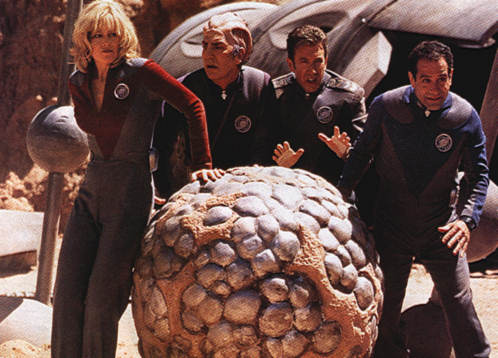
Unfortunately, it wasn't "Star Trek" but a spoof ofthe phenomenon that Paramount inherited from the originating production house Desilu (and apparently didn't know what to do with—at the the time of Galaxy Quest's release, they were in between producing the Next Generation movies Insurrection and Nemesis, which effectively killed the series).
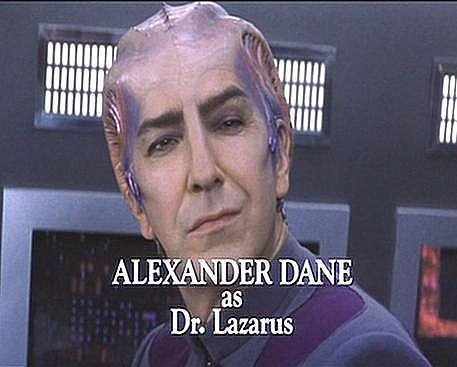
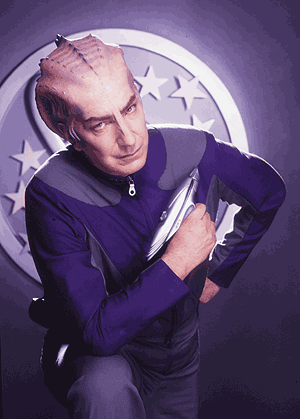
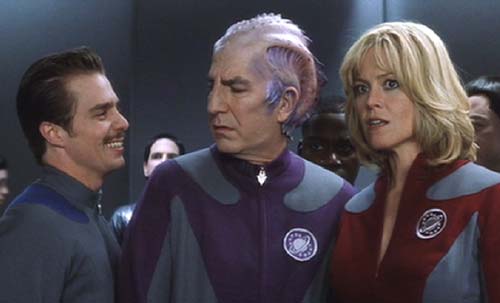
Still, this film is an affectionate send-up with a fine cast doing good comedic...and dramatic...work, and manages to pull off something of a miracle, making one one embrace the cliches of the original while at the same time making delicious fun of them. And given the ubiquity of "Star Trek", fans still recognized the show, backwards, forwards and behind-the-scenes, even when it was in the disguise of another Intellectual Property.
At a sci-fi convention, the cast of a long-cancelled television series "Galaxy Quest" is going through the motions of meeting their fans, even though the show has been off the air for years, and the actors are having a difficult time finding other work due to "type-casting." They squabble, each remembering personal quirks and on-set peccadilloes, either jostling for the limelight or just "doing the gig," and by happenstance, find themselves portraying their characters in a real outer-space adventure, persuaded by desperately seeking aliens who have caught transmissions of the show as it zipped through space at light-speed, and not only liked what they saw...they bought it hook, line, and beridium sphere.
It's a fun conceit, combining the background stories of actors with the characters they're playing put into a situation where their attributes as actors inform their actions in a real-life approximation of the roles they play. It stands to reason that the traits they embody to play the roles would come to the fore when reality sets in—it implies, of course, that they could do all this without "handlers," make-up assistants, or even (ya know...) decent writers and directors. It's fun to imagine.
There's also a tip of the hat to the faithful fans who start out as convention geeks, then play a pivotal role in the survival of the crew and their mission—and they don't even have to do it with a write-in campaign to the network.
Fiction becomes fact becomes fiction becomes fact; Galaxy Quest is an inter-dimensional trek on a Universe that's folded in on itself, through all the frontiers influenced by TOS and its progeny that explored new frontiers on a journey that seems on-going. It's also one of the best examples of a rare film genre that usually comes off as lame, childish, or patronizing—the science fiction comedy.
I like director Jason Reitman's work, whether he's swinging for the fences (Thank You for Smoking, Up in the Air) or playing it safe (Ghostbusters: Afterlife, Juno,Young Adult). I'm sure with every single one of his projects he did not believe he was "playing it safe." All of his films, I'm sure, had challenges that I'd never be privy to, that affected his decisions to make the film, or how he made them.
Maybe it's because these projects all hover around the same theme, "Lies we tell ourselves," which seems to show up in all of his work, where we're never sure if anybody's telling the truth because it's our instinct to believe the lie. That's quite a sophisticated thesis and sometimes the movie doesn't warrant the effort and sometimes it does, but it's a very American trait, and given his willingness to go back to it again and again, I don't think Reitman could ever make a movie not set in the United States. We seem to have that weakness, whether it be hope or hubris or merely sleeping through the sedative of "The American Dream".
It's hard to say where Lorne Michaels (played, again brilliantly, by Gabriel LaBelleof The Fabelmans) falls in those options. I'd wager on "hubris" these days, but back in the days when "Saturday Night" (the first title of what would become "Saturday Night Live"*), who knows what it might have been. Lorne Michaels was Canadian, for one thing, but he'd had a lot of success in the States as a writer and when NBC was in one of their little tiffs with "Tonight Show" host Johnny Carson, they decided they wanted to prove to their late night star that they didn't need him and that they didn't have to fill an empty Saturday late-night slot with another re-run of one of his past shows. NBC Late-night "suit" Dick Ebersol (played by Cooper Hoffman) was charged with filling the time.
The idea was a "live" sketch comedy show with prominent musical acts who didn't show up on the likes of "The Dean Martin Show" and more in spirit with "The Smothers Brothers Comedy Hour" (which had been canceled after many problems with the network over material deemed too controversial), but without regular hosts—initially the idea was to have rotating hosts of Lily Tomlin (Michaels had produced one of her specials), Richard Pryor and George Carlin, but Pryor made NBC nervous—and, with that spirit, aimed for a younger audience demographic and a hipper crowd than NBC was used to garnering. Michaels wanted to make a show that parodied television for an age-group that grew up watching television (and now, ironically, is making a version that for kids who grew up watching "Saturday Night Live"!)
Having read the oral history "Live from New York: The Complete Uncensored History of Saturday Night Live as Told by Its Stars, Writers, and Guests" (by James Andrew Miller and Tom Shales), and I know a lot of the stories culled for Reitman'sSaturday Night, some of which happened, some of which only happened later during the chaotic first season, and some of which didn't happen at all—the bit with Milton Berle (J.K. Simmons) dressing down Chevy Chase (Cory Michael Smith) didn't happen (although Berle did show off the size of his penis to SNL writer Alan Zweibel...at Zweibel's curious request). Yes, a lot of it is true (and Reitman goes into the whole Johnny Carson dilemma with the moment it's decided to go "live" with the show or roll the Carson tape being the dramatic high-point), but some of it is left out...like character actor George Coe's short tenure as a "Not Ready for Prime-Time Player" and an awful lot of short shrift is given the writers. But if you put all of it in, it would have been epic-length—not unlike Michaels' 3 hour dress rehearsal that has to be cut down to an hour and a half.
Even with the deletions, Reitman has to move his movie fast and it hurdles along in long tracking shots until it finds a conversation of interest or an arresting image—frequently involving a llama—then swings his camera between each side of the discussion before veering off with a passer-by who'll act as tour-guide to the next section, as sub-plots whirl in the background. It's not done in one continuous shot—something this complex would make Alfonso Cuaron's head, or Alejandro González Iñárritu's continuity director, explode—but one gets the simulation of continuous unbroken action for a good part of the film and it ramps up the tension, if the myriad disasters falling around Michaels' head—be they flaming scripts or newly-installed studio lights or a Belushi-hurled ash-tray—weren't enough.
Of course, it's tough to give this stuff any verisimilitude without threatening to turn it into caricature—Labelle assiduously avoids the Michaels-based "Dr. Evil" voice, for example**—but one wonders if the audience cares, since they know Chevy Chase from endlessly repeating "National Lampoon" movies or his "older" roles and probably don't know any of the writers at all. Some of the passing references to other "Saturday Night" bits might go over their heads. And one, rather sheepishly, admits that the movie will probably play with "the older crowd" beyond the show's originally intended demographic so that it becomes an episode of nostalgia. Yikes.
I remember "Saturday Night", initially, because it aired in rotation with NBC "Weekend", a brilliantly written news program with Lloyd Dobyns and Linda Ellerbee, that was a favorite of mine and I was always fairly irked when it wasn't on and "Saturday Night" was. It grew on me, however, when Paul Simon and then Richard Pryor hosted (in one of the best overall episodes of the show's first season). And although I think the past couple of seasons have been pretty strong, one can't help but be chagrined that the show is 50 years old and that it's audience is about the same as our folks' when they were watching "Dean Martin."
It would have been the ultimate irony if Reitman had ended the film with an acknowledgment of that fact. One would doubt it would get the approval of Michaels and his production company Broadway Video who had little to do with this movie other than to say "well, we won't say you can't can't do it" (and the "disclaimer" about "work of fiction" and "persons, living or dead" is a briar-patch of timorous legalese). Even self-described "revolutionaries" get old and stale after awhile...just as sure as "Generalissimo Francisco Franco is still dead".
The very first sketch on "Saturday Night":
Head-writer Michael O'Donahugh, John Belushi and Chevy Chase
* The reason they didn't use the the "SNL" title initially was because competing network ABC already had a variety show called "Saturday Night Live"...hosted by...Howard Cosell?
** And kudos must go to Nicholas Braun, who plays both Andy Kaufman AND Jim Henson.
Competing posters of Saturday Night
which, more, in spirit, tells of the difficulties they had.
"What's the Message of My Films?" "Nihilism is a Valid World-view?"
Watching Ryan Gosling and Emily Blunt'sprickly banter when they were presenting at the Oscars this past year made one actually think that their upcoming movieThe Fall Guymight be somewhat entertaining. Bear in mind that I'm one of those crusty souls with no heart and no sense of humor (and no taste, apparently) who is not a fan of director David Leitch. Or of producer David Leitch. I stopped watching the "John Wick" series after the first one, which I did not enjoy and I suffered through it wondering if it was, in fact, meant to be a comedy. I mean...c'mon...the stunts were only believable if you weren't considering what would logically be the collateral damage outside the frame. And Wick goes off because someone kills his dog. Really? That would be funny...if it wasn't so damned dumb. I mean, they made fun of it in Deadpool. You know, the goodDeadpool...the first one...the one David Leitch didn't direct. I figure you have to have a screw loose to really get off on these films. That they're successful and have spawned their own series of films only further makes me hang my head and despair about the future of the medium.
In this, a loosely-based spin-off of "The Fall Guy" TV show from the 1980's, Gosling plays Colt Seavers (played on TV by Lee Majors*). At the beginning of the film, he's a successful stunt-man, doubling for star Tom Ryder (Aaron Taylor-Johnson), a big box-office draw, and he is having a heating-up relationship with camera op Jody Moreno (Blunt) until he's called to repeat a stunt—a wire-drop inside a high-rise edifice—that goes wrong and he's put in the hospital with a busted back. He emerges 18 months later parking cars at an L.A. Mexican restaurant and swearing off his stunt-man career.
Besides, his phone isn't ringing, the one sure sign that nobody wants you in L.A..
Until, one day, the producer of those Tom Ryder movies, Gail Meyer, (Hannah Waddingham) calls to implore him that his services are once again needed—apparently Ryder has disappeared, whereabouts unknown (something Colt could care less about), but the signing bonus is the movie is being directed by first-time director Jody Moreno—former camera op, former flame. Colt gets on a plane to Australia where the film is shooting.
Told by Meyer that old flame Jody requested him specifically, Colt is sucker-punched when he finds out a) Jody didn't ask for him and b) she's surprised to see at all and c) she's pissed at how they broke up by not breaking up—Colt didn't return phone calls, didn't reach out, didn't do any of those things that men don't like to do, especially when they're fragile, physically and mentally. She proves her affection for him by having him repeatedly set on fire** and trip-wired to be slammed into a rock. Over and over again. Colt's way of responding to all of this is with his laconic "thumbs up" after surviving each take. Jody hates that. But, she still makes him do all that stunt work with a broken back. ("Get...on...a...plane, Colt!")
Um...you can see the crew in the sunglasses..."Props!"
So, immediately I began to question why Colt doesn't just leave as he was obviously there under false pretenses, and, if not the first thing, the second thing I would do after finding that out would be to verify if I was getting paid. Because, obviously, somebody in the front office is lying to him and if they're lying to him about that, there are probably all sorts of things they can't be trusted on. But, by this time, I had given up on the movie being any good and just hoping that it would eke out some entertainment.
It is, on occasion, because Gosling and Blunt are pro's and they can squeeze out entertainment no matter how necrotic the script is.
But, that's not how movies work these days. Entertaining as that may be, what the movie audience apparently wants, and the movie is determined to give them, is wall-to-wall practical action sequences. Things go boom, guys do gymnastic falls and fights, big puffs of smoke and dirt go up in the air for no real apparent reason, sparks fly. A lot. There are spectacular falls where Gosling pops up into the frame as if he did the stunt. Standard Operating Procedure. The movie is a professed love-letter to stunting people and, sure, I'm all for that. I'd rather see practical effects than CGI animation any day. Employ the hell out of 'stunt-people. But, pay them a living wage and make sure they have insurance, first. I mean, stunting is NOT a lost art. The only difference is it's being done in front of green-screens now.
It just doesn't look all that impressive when it's shown being filmed. Leitch doesn't exactly pull off the stunt that the story-stunts are more dangerous than the in-the-movie stunts (and they're still trying to make us believe the guy who cracked his spine a year and a half ago can do these things).
Two things did strike my mind while I was watching the thing scroll in one cortex and out the other: Movies save SO...MUCH...MONEY making a movie about making movies! You don't have to have sets, just people milling around with cameras and eating craft services, and walkie-talkies and cell-phones. You don't have to hide anything, or make believe it's real, and you can even shoot the dressing-trailers. It's so cost-effective as to be ridiculous.
The Fall Guy doesn't have a plot, so much as a thin thread to string between stunt sequences, like some of the really bad Roger Moore James Bond movies or the Mission: Impossible series...or like the Wick films. That seems so ass-backwards a way of making movies—well, of making movies that mean anything, anyway. For someone who sees movies as an art form, and its own unique form of communication, it's really a drag to see a movie like this.
The best you can say is: "Well, people were employed..."
Humor example: Blunt and Gosling are talking back and forth about story-approach,

 Now, thanks to producer Seth McFarlane's clout, there's a new one, the duplicate-titled The Naked Gun, featuring Liam Neeson as Frank Drebin, Jr., the son of Leslie Nielsen's character, and he's a chip off the old blockhead. Not the most original of concepts, but Neeson does such an amazing job of playing it absolutely straight while still nailing the comic timing that it's a pleasure to see him make the Nielsen transition from drama to high comedy with nary a misstep. The review for the movie at RogerEbert.com stated that it is "legitimately" Neeson's best screen performance, and one comes out of The Naked Gun actually believing it, so deft is his way of fusing comedy with the deadly-serious "I have skills" intensity that he brought to his "action-star" phase.
 What's the plot? Who cares? Surely, you don't think the efficacy of a "Naked Gun" entry lies in the carefully crafted screenplay. No, this is a matter of throwing all kinds of shit at a fan—which became a literal joke in Airplane!—and seeing what sticks. But, loosely, it's about a tech billionaire (Danny Huston, who's sounding more and more like his Dad every movie), who's into breaking things and starting from scratch...including populations. Somehow, Junior Drebin gets involved in all this, as well as getting involved with the sister (Pamela Anderson, who's actually quite good) of an "accident" victim.