Showing posts with label Pom Klementieff. Show all posts

Friday, June 27, 2025

Mission: Impossible—The Final Reckoning

More Implausible Than Impossible
or
Deciding Not To Accept It

Mission: Impossible—The Final Reckoning may well be the last of the "Mission: Impossible" movies, the series based on the espionage TV show that featured a crack-team of specialists engaged in "heist-movie" scenarios for the government.* The films had some of the tropes, the "fuse" logo, the late Lalo Schifrin's pulsating, propulsive theme, the clandestine mission briefing (that then self-destructed leaving no trace). But, in the movies it spawned,  the "team aspect" always played second-fiddle to its star and champion, Tom Cruise, who increasingly dominated the films, while his character, Ethan Hunt, still remained a bit of a cypher as a character. Other than doing the hardest stuff, of course.
 
But this latest, maybe last, entry, given the evidence on display, indicates the series is past its self-destruct status. At nearly 3 hours in length, what could have been a lean and mean entry feels bloated with a first act crammed with flash-backs (ill-advised as they'd never connected story-lines before and even dropped connections with past movies at the drop of an un-negotiated contract) and a star who, at 62, is looking a little too doughy—in a Brad Pitt/Jerry O'Connell kind of way—to be romping around doing his own crazy stunts and skittering the world in his signature tin-soldier full-tilt run. 
All the worse, because this one really leans (and leans hard) in to Ethan Hunt being the end-all, be-all "only one" whose destiny it is to save the human race from Mutually Assured Destruction at the hands of an AI "anti-god" called The Entity...which featured in the last one and, it turns out, was the undefinable McGuffin dubbed the "Rabbit's Foot" from Mission: Impossible 3.** As The Church Lady would say "Isn't that convenient"***
At the time it came out, I thought it was a nice joke that the "secret thing that everybody wants" (and spends so much time obsessing over) in M:I 3 was so much vapor-ware in the story-line. Nobody knew what it was or what it could do, but it was important enough that everybody wanted it, whatever it was. Turns out, in reality (or film-reality, anyway), it was merely the plot-line of Colossus:The Forbin Project.
"Oh, yeah, there are other people in the movie..."
And Ethan Hunt turns out to be as mythic a lynch-pin to world affairs as Luke Skywalker or Paul Atreides.
 
It appears original, but it's merely a re-gift, just put in a new wrapper.
They also serve—briefly—watching Tom do the hard stuff...
So, anyway, the mission should you decide to accept (and I didn't) is that after the events of Mission: Impossible—Dead Reckoning Part 1, Ethan Hunt was in possession of The Cruciform Key, which would allow him to somehow destroy The Entity which is embedded in the Interwebs and is slowly but surely filling it with misinformation, turning the World Wide Web into a cesspool that has man turning against himself (as if it needed any help!) with the eventual end of taking over the nuclear capabilities of all the world's powers. What it would do then is anybody's guess, but even a digital anti-god would know that anything actually using those weapons would create a nuclear pulse and wouldn't do it any good at all, disabling any electronics throughout the world. If it's aim is murder-suicide then you need some other term than "artificial intelligence". Artificial psychosis", maybe? The Entity sounds like it's related to Monty Python's "Black Knight" ("You're a loony!")
They also serve who sit in boardrooms and clutch pearls...
Anyway, getting the thing to destroy The Entity involves two impossible missions: get to the Russian submarine Sebastopol (scuttled in arctic waters in the last movie) to use his Cruciform Key to obtain the Entity's "Podkova module" (containg its source code); then, using a "Poison Pill" developed by IMF whiz Luther Stickell (Ving Rhames), get that module to the world's "Doomsday Vault" located in South Africa—a huge mainframe designed to withstand said nuclear pulse even in a planet-wide armageddon—and plug the "Pill" into the "Podkova" thus isolating the Entity and somehow managing to contain the thing.
But, there are complications—there always are—such as the sub Sebastopol starting to roll down a continental shelf when Hunt is inside it (evidently it doesn't have a conning tower or fins or sail planes or...ya know...rudders that might impede the progress), or Hunt having to discard his hi-tech diving suit to get out of a jam and swim...in just trunks...in arctic waters...with no oxygen...and no decompression gear (except on the surface), or—a major one—the bad guy Gabriel (Esai Morales) manages to steal said "Poison Pill" making his escape on a bi-plane (...a bi-plane!), thus forcing Ethan to hijack another one and do a godawful amount of gyrating on wings and struts to get on the bad-guy's plane to get said "Poison Pill."
Now, look...the plot-line is insanely complicated and stupid...way too much so...as well as being openly subject to criticism by what Hitchcock called "The Implausibles" (I can't wait to see the "Goofs" tab on its IMDB page). Such things as Hunt being able to take out two competent goons moments after biting down on a cyanide capsule, or being able to survive "the bends" or the crushing water pressure of a deep-dive while only in his swim-trunks, then being able to do all that dangerous wing-walking the very next day boggles everything that I have left of a mind. The onslaught of implausibles tend to overwhelm such trivial matters as grabbing the barrel of a recently-fired automatic weapon without scorching your hands in the process.
Still, I can appreciate the length and breadths—in IMAX, even!—to which the cast and crew have gone to present such shenanigans. The rolling submarine set that they present is a wonderful little concept design for all sorts of mayhem, and the whole bi-plane sequence is an amazing showcase for what can be done with remote cameras and a star with a death-wish (but one with a goofy absurdist sensibility). As an actor, Tom traditionally dials it to 11, it's in these insane stunts where these proclivities really pay off.
However, the movie is a logical and editorial mess, with sporadic flashbacks that don't quite connect dots or light emotional fuses. It does provide considerable down-time between action set-pieces to make an assault on a snack-bar or sabotage a theater restroom.  
 
If that's your aim I will disavow any knowledge of your actions. Good luck.

*Poof!* hsssssss
Ethan cares, man. He really cares. 

* I'm throwing a lot of stick here, but the TV series, as great as it could be, had elements rolled eyes. For instance: why did every potential, autocratic, generalissimo, and revolutionary look like Martin Landau?

** That was, what, 4 movies ago, the one with Phillip Seymour Hoffman, which, when you see him in the flashbacks, causes actual grief.
 
*** Yeah, okay, M:I fans, I know that the James Bond series just wrapped up an uncharacteristically continuity-obsessive five-film arc, where everything tied together to the point where Bond super-baddie Ernst Stavro Blofeld turned out to be the step-foster-brother (or something) of Bond—in a plot-twist borrowed from (of all things) the "Austin Powers" series. Connecting the dots has a way of diluting the power of a story. In the Craig years, Blofeld wasn't so much an international criminal as a red-headed step-child. Just like in the first Michael Keaton Batman, the criminal who became The Joker was the one to kill Bruce Wayne's parents, rather than just some rando gunman. It waters things down, sometimes to an unpotable degree.

Wednesday, July 12, 2023

Mission: Impossible—Dead Reckoning, Part 1

"Couldn't You Have Told Me This a Little Bit Sooner?"
or
"Is There Anyone Not Chasing Us?"
 
One can't start out a review of Mission: Impossible—Dead Reckoning (Part 1) without giving props. It is one busy movie, filled with some amazing stunt work and a dedication to craft that one shakes their head in amazement that these things were thought up and brought to some spectacular life. The immediate reaction to one of these things evokes horror and then giggles as they are pain-stakingly realized to convince you that 1) they actually happened and 2) that they actually COULD happen. And a rueful head-nod must go to "Mr. Gung-Ho" Tom Cruise for putting himself "out there" just because he could. One has to say all this, because for the most part this review will trash this entry in the franchise, surely its weakest entry since Mission: Impossible 2.
 
But, wow, those stunts sure are amazing. The trouble is that's what the movie is all about, the stunts and those alone have never made a good movie. What they show is that the characters have an abnormal survival instinct and the tenacity of pit-bulls to pull though whatever obstacle can be thrown, dropped, propelled and fired at them. And that's it for character development. Oh, there's some ret-conning about "how Ethan Hunt became Ethan Hunt" as well as other agents into the IMF, but it's as unsubstantial as...well, as the entire make-up of the IMF apparently is in the spy hierarchy if we're to believe this movie.
The mission this time (should we decide to accept it, and I, frankly, didn't) is to recover the latest "McGuffin" in the series, the two-part "Cruciform Key", which is used to power up "an active learning defense system" which is touted by its Soviet creators as "the state of the art of war." Timely, since we're all worried about AI (and this is where I insert my "written by human hands" disclosure). The Vicious Thingy was last seen on board the Soviet submarine K699, the Sebastopol, which sits at the bottom of the Bering Sea a victim of its own system's ability to present false data to the sub crew causing them to launch a torpedo attack against a ghost target and blowing themselves up. This is one nasty little AI that can wreak havoc on countries and their defenses, but the world's governments don't want to destroy it, so much as control it. World leaders tend to have a lot of hubris; who wants to bet that they learn a lesson in humility in Part 2?
IMF agent Ethan Hunt (Cruise), despite his"habitual rogue tendencies," is enlisted to find the key. Who has it? Ilsa Faust (Rebecca Ferguson), late colleague, who is not so late and has one-half of the key. Hunt and the team (Ving Rhames and Simon Pegg) decide to go after the other half of the key, where they run into an atomic bomb trap (okay) and a pick-pocket named Grace (Hayley Atwell), who manages to lift the other half of the key from the prospective seller, complicating matters. Hunt also runs into a "face from the past" (Esai Morales), who seems to have the ability to not appear on surveillance systems. But, not the ability to make one of those full-head disguises that Ethan depends on in these movies.
What happens next? Chases. Lots of chases. Ethan and Grace are chased by land, foot, wheels, by the CIA, by Morales' "Gabriel"—along with Pom Klementieff's killing machine, Paris—by the forces of arms dealer The White Widow (Vanessa Kirby), by his own IMF Chief Kittridge (welcome back to the series, Henry Czerny!) by the local constabulary, and evidently anyone with a cell-phone or police scanner, until everyone meets on the Orient Express, and everything just goes literally right off the rails. Most of this is played with deadly earnestness, but one can't help but chuckle at the "Perils of Pauline" aspect of it, some of it is right out of silent movies.
But, the plot is a clunker. And the dialog at times is so vaguely inconsequential (and delivered so seriously) that you wonder if people are speaking in spy code. So, this entry in the series—the 7th—is overwhelming in stunts and underwhelming in story—and inventiveness—even though everyone bravely battles on.
I had much the same reaction to the very stunty recent Indiana Jones movie, which was only saved by a particularly risky (and fanciful) last act. This doesn't have something like that, but it does have another fight on a train with subsequent derailment, and another smashing car chase in a vehicle not built for those things.
 
The trailer for M:I7 exposed the weakness of the film by just showing stunts and fights, as that seemed to be all it has because, for the first time, they seemed to be borrowing from the James Bond series: the train fight from Octopussy, the Citroen chase from For Your Eyes Only becomes a Fiat 500e chase here, with Cruise and Atwell handcuffed as a similar situation in Tomorrow Never Dies, the whole "world-spy-network-hijack" idea comes from SPECTRE (notice that when the "Mission: Impossible" series borrows from Bond, it doesn't borrow from very good ones?), then that very hyped motorcycle jump has echoes of The Spy Who Loved Me. Usually, it's the Bond films that borrow from other films—maybe M:I is running out of ideas.
There are other odd little issues, like that director McQuarrie
(who has done some inspired work in previous film in the series) seems to have shot some dialog scenes using three cameras, that are edited in such a way that, when edited together, seems to have the actors not addressing each other in conversation. It's odd...and a little off-putting. Given the attention to detail in the action sequences, why would something like that occur?
 
Still, despite the reservations I have about the film, I hope it has a great box-office return. The film industry needs a little help right now, and this Summer's expected blockbusters have been under-achieving. A solid box-office return could reverse that trend, and help movie-makers battle the real-world challenges of AI.

Friday, May 12, 2023

Guardians of the Galaxy Vol. 3

"The (10th) Greatest Marvel Film Since Avengers: Endgame!"
or
"The Ballad of Rocket Raccoon"
 
I notice an up-tick in the number of people who looked at my review of Guardians of the Galaxy Vol. 2. I've long since stopped trying to figure out the patterns of what people are looking at, but I suppose it had something to do withe the release of Guardians of the Galaxy Volume 3—the movie that James Gunn was working on when he got hired as the High Evolutionary of the DC Movie Universe.

But, there was no incentive to see it. I haven't watched the last couple of Marvel movies, as they've been sputtering as far as quality, depending on call-backs, cameos, or with no clear sense of where things are going—other than contracts need to be fulfilled, promises made must be delivered on, and a general running-in-place while Kevin Feige tries to come up with a follow-up to the colossal success that was the first batch of Marvel movies. It seemed like, at those times, they were taking chances, swinging for the fences, and hitting home-tuns. Now, it seems they're just counting the receipts, waiting for the Next Big Thing to happen.
 
Trouble is the fan-base is lying in wait. Disappointments among the "TrueFans" may collapse the enterprise like a stack of back-issues no one's bothered to box.
 
Still, folks DID look at the review. I made a point to see it. 
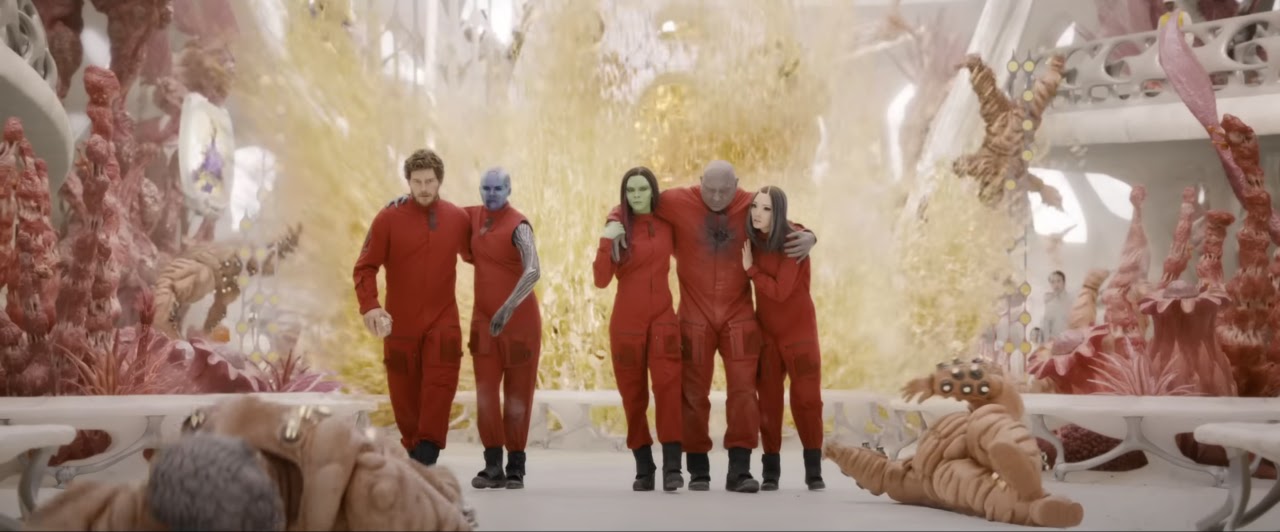
How is it? A pretty good send-off, actually, while being something different. It's an origin story of sorts—of how Rocket the Raccoon (voiced again by Bradley Cooper) came to be a wise-cracking, take-no-prisoners, but still fuzzy-funny animal came to be, mostly told in flash-back, after he is left near-death after an attack on Guardians of the Galaxy HQ (Planet Knowhere) by Adam Warlock (Will Poulter). The super-powered Warlock is on a mission to steal the mercurial mammal for his mother, Queen Ayesha (Elizabeth Debicki) of the Sovereigns at the behest of The High Evolutionary (Chukwudi Iwuji), a sort of gene-split Dr. Mengele/Dr. Moreau of Space, who's on a mission to create the perfect utopia based on his manipulating evolutionary traits.
Yeah, that trick NEVER works, but His Highness (Evolutionarily) wants Rocket—or as he designates him, Test Subject "89P13"—back, as the little varmint was the only test subject of his that displayed original thought, and may be the key to achieving his perfect utopia. Too bad that the way to get him back puts him in a coma.
The Guardians band together to try to save Rocket's life, but discover that he has an implanted kill-switch on his heart that will explode him if they trying any extraordinary efforts to save him. But, Peter "The Star-Lord" Quill (Chris Pratt), still nursing a broken heart after losing his lost love Gamora (Zoe Saldana) during the events of "The Blip"—then getting back an earlier version of her that can't stand him—determines that he's going to find the code to disable the kill-switch and save his little bandit-buddy, even if he has to travel the Galaxy, kill a bunch of multi-legged creatures and even *gulp* face his ex-girl-friend to do it.
And so, they do, over 2½ hours (which feels it, probably due to some rocky transitions that director Gunn has trouble with), meeting new friends and old friends of Gunn's in new roles (Nathan Fillion, anyone?), squeezing in Sylvester Stallone (the guy cannot handle tech-talk), Liz Debicki, and even an appearance by Howard the Duck (voiced by Seth Green, nice), and actually providing "I'm worth-being-here" arcs to Mantis (Pom Klementief) and Kraglin (Sean Gunn). Plus, we get another example of why Karen Gillan may be the most unsung-acting hero in the MCU and a "giving it 100%" performance by Pratt. Throw in a talking space-dog (voiced by Maria Bakalova—"He just called me 'a BAD DOG!'") and you have a vast cornucopia of cutesiness mixed in with Gunn's "ick" factor. Call it "Anthropro-Marvel"—the place where the studio can really get silly (even by comic-book standards).*
Take, for example, the look of the High Evolutionary's Orgosphere—an organic planet made out of meat—which is pure 20th Century Fox sci-fi tacky, ala Fantastic Voyage or Barbarella. It has the look of spareness, but the detail of something well-considered, rather than what the budget could spare. And one just knows, going along that one is missing a gazillion references stuffed into the thing with minor characters and such, but, frankly, there's enough for the non-Marvel Zombie to appreciate.
At the same time, there's a nice little message about universality and worth, where one's lab-rat could just be worth saving if only they were noticed. It's an extension of the original GotG movie, where everyone was, basically, a cast-off, but were worth more than the sum of their parts put together. Here, no one's a loser, except for the one's who never would have suspected they were in the first place. And, once again, it shows that although Gunn will always make films that feel tough-as-nails-cynical, they still have a core of sentimentality to them that puts them a notch above the usual super-hero fare.
 
It's a good movie for the series to go out on (if, indeed, it ends).

* Although judging by the Marvels trailer, they're not going to stop there.

Thursday, May 18, 2017

Guardians of the Galaxy, Vol. 2

Super-Saturation
or
A Small "s" Sequel

The first Guardians of the Galaxy movie looked like such a lame concept in the trailers (and post-credits set-up of some Marvel film or other—I've lost track*) that it was a pleasant surprise for it to be not only fresh and funny, but an oddly genre-disdainful addition to the Marvel Universe, a story of space-orphans who form a Dirty Half-Dozen and quite against their intentions become a family, a dysfunctional family, to be sure, but a family nonetheless. Indeed, more power to them as they discover they're better as a group than as individuals, no matter how good they think they are, individually.

Given the success of the first film, there had to be the inevitable sequel, called (unimaginatively) Guardians of the Galaxy, Volume 2.  Same cast with a few additions, same writer-director (James Gunn, whose Super was a damning condemnation of heroic vigilantism, comic culture and the ones who are both perpetrators and victims of it) and one would hope, given his past, that any continuation would have the same affectionately anarchic spirit and mess with the formula.
Alas, it doesn't. Alack, someone must have made him read the memo's from Marvel Studios (the animated corporate logo of which is becoming increasingly long and self-important) of the audience metrics from the last one because it starts out catering to the masses with its opening sequence.** 
The self-styled Guardians are on a job protecting a group called "The Sovereigns" (as in the coinage, I'd guess, because they are gilded from head to foot like some Goldfinger fetish-fantasy) whose "something-or-other" batteries are being threatened by a "who-the-hell-cares" squid-ish attacker from outer space that's going to drain them or eat them or replace them with cheap convenience-store-branded batteries and that just ain't right. It feels like a disposable "Men in Black" sequence where they just needed a strong open and this is as good as any to show that the group is still together and functioning as a viable team.
Now, as everyone synchronizes watches and gets ready for the attack, Rocket the Raccoon (he has a lot of good disparaging nicknames in the movie) is busy...setting up a sound system? What the...? It's because one of the delights of the first film was its use of old obscure pop as a soundtrack and the sound system is to play a track...possibly as mood music for the team, distraction for the opponent, or for soundtrack sales for Marvel Studios (my guess would be the latter). Whatever. The Main Titles run along while the Guardians are battling a big-mouthed squid, while in the foreground Baby Groot is boogieing to ELO's "Mr. Blue Sky" to the delight of the audience, while the carnage goes on around him.
Cute. But derivative, one might even say pandering. And a bit of a time-waster, even if the Titles are unwinding in the background. It's a call-back to the previous film's mid-credit sequence where "potted" Groot is grooving to the Jackson's "I Want You Back"—and freezes whenever Drax (David Bautista) notices him. This sort of "memory lane" of audience highlights is lazy writing and dilutes the good will of the original as well as its uniqueness. I keep wondering if someday a movie sequel will ever be a direct copy of its predecessor and I realize that it's been done—Back to the Future II, for most of its length follows a parallel path to its Part 1. It's a weakness of series films that they hearken back to their origins, and there's nothing anyone can say except "I've got a bad feeling about this." It is lazy writing, but at the behest of producers who know it's less risky to do more of the same than tinker with what made the coffers fill the last time.

This is concerning for someone who enjoyed the original Guardians' insouciance in messing with the uber-tone of most movies based on comics, trying desperately to be taken seriously that they take on the mantle of big-m "Myth." It's indicative of less risk-taking (which made its predecessor so enjoyable). A Guardians of the Galaxy entry that took itself seriously would be as dull as Thor...or Iron Man III. Enough on that, there's a whole rest of the movie that improves things.

Ayesha...or "Her"...or "Kismet"...anyway, she's different from the Marvel comics version...i
f she weren't she'd be the Sylvester Stallone character's mother. A-Yeesh.
But, the sequence does get the movie started and introduces us to the Sovereigns, whose Queen Ayesha (Elizabeth Debicki...in an Oscar-worthy performance because, frankly, she LOOKS like an Oscar) pays the Guardians their reward, the sister of Gamora (Zoe Saldana), Nebula (Karen Gillan), the bitter daughter of Thanos (it would be Josh Brolin if he appeared) who disappeared after commandeering a ravager ship in the last movie. Fortunately, it starts to lighten up once the G.o.t.G's move away from Main Title Land. With Nebula in tow, they have to leave in a hurry when it's discovered that Rocket has stolen some of the batteries they've been paid to protect. The Sovereigns send out an impressive number of drone-ships to stop them, but a couple of light-jumps and the battered ship, which is dragging a tethered Drax held by a straining Gamora with her hair on fire (now that's a bit more like it!), crash-lands on a far-away rock.
"Some day, son, this can be all yours..."
They've been followed. The folks in the craft are Ego (Kurt Russell) and his protege Mantis (Pom Klementieff), who make the astounding revelation that Ego is the actual biological father of Peter Quill (Chris Pratt)—his real one, not his human step-father. Quill, Drax and Gamora go to Ego's planet (well...yeah, no, I'm not going to say it...spoiler) while Rocket and Groot keep an eye on Nebula while repairing their ship. The Sovereigns aren't done yet. After Yondu (Michael Rooker) has a falling out with another Ravager, Stakar Ogord (Sylvester Stallone...mm-hmm...we're starting to recycle past super-hero stars***) over child-trafficking (he's the one who plucked Peter Quill from Earth, after all, but...keeps him...because he had tiny, stealing hands), he's approached by the Sovereigns to track down the Guardians wherever in the Universe they might be.
Ego's planet...or maybe...his ego's bigger than you think.
So, there's a lot of conflict and cross-conflict: the Guardians against the Sovereigns AND the Ravagers; factions of the Ravagers against other factions of the Ravagers; Nebula against Gamora; Quill against his team-mates who are suspicious about Ego; Quill with his own suspicions about Ego (despite his finding out the answer to one of his Big Questions). With conflicts come alliances and sometimes in the most unexpected places. Old grudges dissipate with new understandings and different perspectives and the Guardians evolve into a new team, a combination of old and new members.
"We are a pair, aren't we?"
But, the biggest conflict isn't Ravager or Sovereign vs Guardian, it's Nature vs Nurture. It seems odd but wholly appropriate that by the end of Guardians, Vol. 2, there is a perverse contradiction of "there's no place like home." DNA is less important than the strings that tie us together; sure, you may find your biological father or mother, but sometimes, in their absence, you may outgrow them or even replace them with what you need. It is not as complex as Oedipus, especially in the comic-book world filled with orphans who find themselves empowered without biology having anything to do with it. Our courts (in the real, non-fictional world) favor DNA over everything when they have to solemnize the future of a child. Guardians 2 comes down hard on the side of step-parents, mentors, and...well, guardians, who will take in a waif when there's a case of need, even if the arguments against are as a big as a planet.
....ow
It's different and that's good. For all the call-backs and deja-vu moments, it doesn't run in place until it comes up with a good idea for a third movie (which a lot of sequels do). It takes a major hanging plot-point, resolves it, and moves on. That actually builds more good will in a franchise than all the repetitions of key moments can buy.
The Ego begins inflating across the Galaxy (when its Guardians are distracted)

* Thor: The Dark World, as it turns out. I actually did some research.

** And, as if to belie that opening asterisked statement,  I am wrong in this point—there IS a prelude of sorts, set in "EARTH. MISSOURI. 1980" with a CGI'd Kurt Russell (this "de-aging" stuff DOES NOT work on conventionally handsome or beautiful actors, but seemed to work well on the recreation of the skull-like countenance of Peter Cushing in Rogue One.)

*** Next example: Michael Keaton plays The Vulture in Spider-man: Homecoming.