Showing posts with label Will Poulter. Show all posts

Wednesday, April 23, 2025

Warfare

Route Spartan
or
"Look for the Blood and the Smoke! That's Where We Are!"

Warfare just drops you into it. The film, written and directed by Alex Garland (Ex Machina, Civil War) and Ray Mendoza (who lived it) tells the story of an insignificant little troop deployment of Navy SEALS in Ramadi, Iraq in 2006 to lend support to a Marine operation nearby (in fact only 300 meters away!). Standard stuff. In and out. No mess no fuss.
 
They come in under cover of darkness, enter a strategically placed household, subdue the inhabitants, isolate them, put them out of operations' way, then monitor for any suspicious activity among the locals, any amassing, any weapons sightings, any what we call in the U.S. "assembly." Just basically "watch the backs" of the Marines. The radio contact is "5 by," they are well-armed and well-ammo'd, and they have a bird's eye view of the area from aerial surveillance that can track any warm body that comes into view. And they're frequently being updated on the mission status. Everything is nominal. From that point on, the movie runs in "real time."
Alpha One pumping up before the mission.

On top of that, they've punched a hole in the outer wall of an upstairs bedroom for Elliott Miller (Cosmo Jarvis), their lead sniper, to lay prone on a mattress for hours on end, peering through the telescopic sight of his M110 SASS rifle to take out anyone or anything that seems suspicious or out of place at a market across the street. It's maximum concentration for minimum movement, but you can't be too careful. Anything suspicious could be prelude to an attack on them, and if you have to pull a trigger to prevent yourself or your troop from dying, that's the job.

Of course, when the clock is ticking and you're just waiting for the sortie to be over, everything looks a little suspicious. But no shots are fired.  Sure, they're being watched...by people who duck so they're not being watched...and the aerial view shows there might be some amassing on the roofs, but things are merely heightened anticipation and they can be Bradley'd out of there within minutes. It's going to be fine.
Until a grenade is dropped through that sniper's nest hole into the bedroom where Miller and another SEAL are positioned. They're able to move quickly and out of the blast-radius, but the resulting explosion instantly turns the monitoring mission into an evac mission. Miller's left hand is bleeding, but treatable if they can get him back to the base quickly and so Bradley tanks are called while the crew sweats the minutes it will take to get them out of there. They are under attack, after all. And the sooner they can get Miller out the better. But, even with the best equipment American tax-dollars can buy, they are still trapped in a house (along with the civilians) and targets. They're surrounded. 
 
And things will only get worse.
The legal disclaimer ("This is a work of fiction", etc. etc) at the end of the movie is unlike any I've seen. I didn't have time to write it down and I haven't found anything that quotes it on the internet, but basically it says it's based on a true incident that was parsed from several interviews (and Mendoza was part of the SEAL team) and any inaccuracies are entirely due "to memory." And, indeed, Miller—who's a real guy—has no recollection of the incident, even though he lost a limb, received severe burns and lost the ability to speak. In part, Mendoza wanted to make the film for him and dedicated it to him.
And from what I've been reading online, a lot of Iraq vets are saying that it's brutally accurate. If true, it is harrowing what we put our fighting men through, even if the the mission depicted was only in a support capacity. There is no safe place in a war-zone (for anybody) and no action taken does not attract a reaction. And with the sophistication of the weaponry, the destruction is catastrophic. It makes you wonder why anybody does it? Why do governments launch wars knowing that the end-result is winning rubble and destroyed infrastructure? What is "gained" by that? But, over the last couple years, that's all we've seen on a day-to-day basis, escalating destruction and death over cratered territory. For what?
I've also read some online critiques that the film is "pointless." Hardly. Not if the portrait it paints is as accurate as has been said and the filmmakers have accomplished their goal, ignoring the jingoism, the cliches, the false melodrama and cheap theatrics in the name of creating drama. It's dramatic enough without inserting fudged ironies into it. The conflict is real without back-story and motivation. The real motivation is living through it, plain and simple. You can say that "war is hell", but Warfare makes it look like insanity. And as director Sam Fuller used to say the only glory in war is surviving it. Giving it to us straight, while we're sitting in our comfortable theater seats, is hardly pointless...especially if it makes us think twice.
The most telling part of Warfare is when the echoes die and the dust settles and the SEAL team gone, and the family of the occupied house come out of hiding and see the slippery blood-trails and multitudes of cartridges on the floor, the holes in the wall, and devastation left behind. Then, there's a shot of the street that moments before was a killing field as villagers come out of their doorways, some armed, some not, walking past body-parts through the smoke that has been left behind. Mendoza has enough wherewithal to include them in the aftermath of the destruction, and one can't help but think that somewhere they're thinking the same thought as you.
 
One hopes there won't be a sequel.
But hopes...and prayers...are ultimately...useless. And...finally...comes the realization that that is the one word that accurately describes the unholy act of war.

Friday, May 12, 2023

Guardians of the Galaxy Vol. 3

"The (10th) Greatest Marvel Film Since Avengers: Endgame!"
or
"The Ballad of Rocket Raccoon"
 
I notice an up-tick in the number of people who looked at my review of Guardians of the Galaxy Vol. 2. I've long since stopped trying to figure out the patterns of what people are looking at, but I suppose it had something to do withe the release of Guardians of the Galaxy Volume 3—the movie that James Gunn was working on when he got hired as the High Evolutionary of the DC Movie Universe.

But, there was no incentive to see it. I haven't watched the last couple of Marvel movies, as they've been sputtering as far as quality, depending on call-backs, cameos, or with no clear sense of where things are going—other than contracts need to be fulfilled, promises made must be delivered on, and a general running-in-place while Kevin Feige tries to come up with a follow-up to the colossal success that was the first batch of Marvel movies. It seemed like, at those times, they were taking chances, swinging for the fences, and hitting home-tuns. Now, it seems they're just counting the receipts, waiting for the Next Big Thing to happen.
 
Trouble is the fan-base is lying in wait. Disappointments among the "TrueFans" may collapse the enterprise like a stack of back-issues no one's bothered to box.
 
Still, folks DID look at the review. I made a point to see it. 
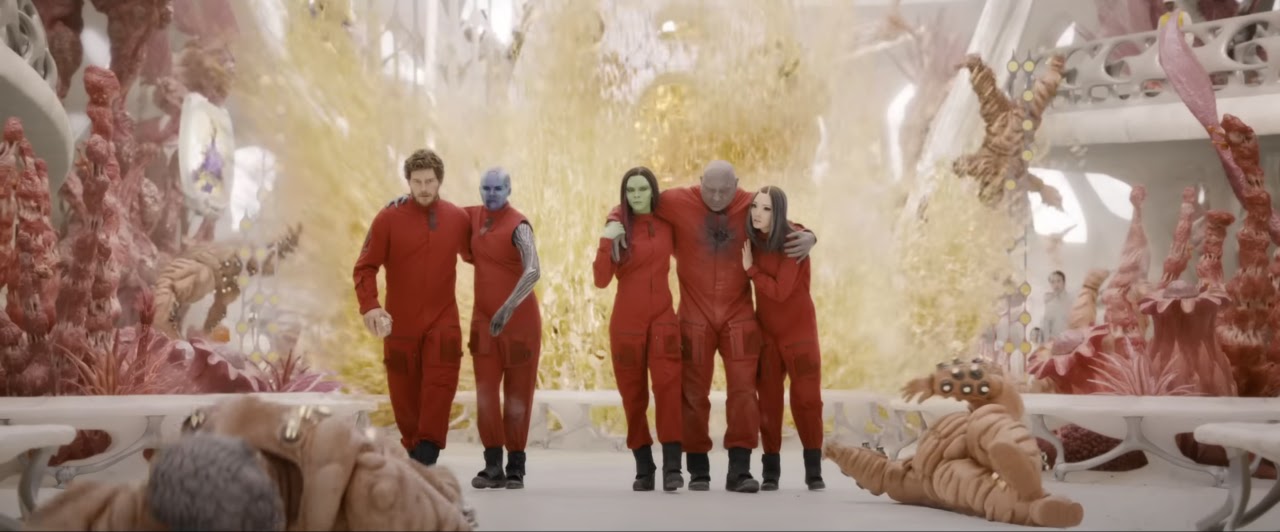
How is it? A pretty good send-off, actually, while being something different. It's an origin story of sorts—of how Rocket the Raccoon (voiced again by Bradley Cooper) came to be a wise-cracking, take-no-prisoners, but still fuzzy-funny animal came to be, mostly told in flash-back, after he is left near-death after an attack on Guardians of the Galaxy HQ (Planet Knowhere) by Adam Warlock (Will Poulter). The super-powered Warlock is on a mission to steal the mercurial mammal for his mother, Queen Ayesha (Elizabeth Debicki) of the Sovereigns at the behest of The High Evolutionary (Chukwudi Iwuji), a sort of gene-split Dr. Mengele/Dr. Moreau of Space, who's on a mission to create the perfect utopia based on his manipulating evolutionary traits.
Yeah, that trick NEVER works, but His Highness (Evolutionarily) wants Rocket—or as he designates him, Test Subject "89P13"—back, as the little varmint was the only test subject of his that displayed original thought, and may be the key to achieving his perfect utopia. Too bad that the way to get him back puts him in a coma.
The Guardians band together to try to save Rocket's life, but discover that he has an implanted kill-switch on his heart that will explode him if they trying any extraordinary efforts to save him. But, Peter "The Star-Lord" Quill (Chris Pratt), still nursing a broken heart after losing his lost love Gamora (Zoe Saldana) during the events of "The Blip"—then getting back an earlier version of her that can't stand him—determines that he's going to find the code to disable the kill-switch and save his little bandit-buddy, even if he has to travel the Galaxy, kill a bunch of multi-legged creatures and even *gulp* face his ex-girl-friend to do it.
And so, they do, over 2½ hours (which feels it, probably due to some rocky transitions that director Gunn has trouble with), meeting new friends and old friends of Gunn's in new roles (Nathan Fillion, anyone?), squeezing in Sylvester Stallone (the guy cannot handle tech-talk), Liz Debicki, and even an appearance by Howard the Duck (voiced by Seth Green, nice), and actually providing "I'm worth-being-here" arcs to Mantis (Pom Klementief) and Kraglin (Sean Gunn). Plus, we get another example of why Karen Gillan may be the most unsung-acting hero in the MCU and a "giving it 100%" performance by Pratt. Throw in a talking space-dog (voiced by Maria Bakalova—"He just called me 'a BAD DOG!'") and you have a vast cornucopia of cutesiness mixed in with Gunn's "ick" factor. Call it "Anthropro-Marvel"—the place where the studio can really get silly (even by comic-book standards).*
Take, for example, the look of the High Evolutionary's Orgosphere—an organic planet made out of meat—which is pure 20th Century Fox sci-fi tacky, ala Fantastic Voyage or Barbarella. It has the look of spareness, but the detail of something well-considered, rather than what the budget could spare. And one just knows, going along that one is missing a gazillion references stuffed into the thing with minor characters and such, but, frankly, there's enough for the non-Marvel Zombie to appreciate.
At the same time, there's a nice little message about universality and worth, where one's lab-rat could just be worth saving if only they were noticed. It's an extension of the original GotG movie, where everyone was, basically, a cast-off, but were worth more than the sum of their parts put together. Here, no one's a loser, except for the one's who never would have suspected they were in the first place. And, once again, it shows that although Gunn will always make films that feel tough-as-nails-cynical, they still have a core of sentimentality to them that puts them a notch above the usual super-hero fare.
 
It's a good movie for the series to go out on (if, indeed, it ends).

* Although judging by the Marvels trailer, they're not going to stop there.

Thursday, January 21, 2016

The Revenant

In the Country of Mann
or
"This Isn't About the Hunting, Is It?"

The Revenant does in 2 1/2 hours what Anthony Mann* used to do in a trim 90 minutes...and he'd throw in a B-actress love interest to boot. The story of Hugh Glass (played in the film by Leonardo DiCaprio), who survived a bear attack while serving as a guide for a Fort Kiowa (in what would become South Dakota on the Missouri River) pelt-hunting party (which went from 100 men at the beginning to ten at the end), then endured a 200 mile trek to the fort, it is an amazing tale straight out of legend, but has been transmorgrified into a tale of revenge for the big screen. That's not the way it actually happened (the two men who were charged with staying with Glass and left him for dead ended up with no consequences at all), but it's a movie, and the current climate of cinema seems to have demanded that it turn into an obsessive tale of revenge throughout its core.

I wish I could say that the movie thrilled me, but it did not. Perhaps I've seen too much revenge-motivation in films lately (blame those evil superheroes) that I'm a little sick of it—bored by it, even. Maybe it's not just superheroes. Maybe it's the reality show-machinations we've been inundated with or the greedy-gus corporatization of America where it's not enough to make a good life for yourself until you've kept somebody else from having it that has generated this feeling of not just "keeping up with the Joneses," but "getting even" with the Joneses. Do we have to live like a soap opera or The Godfather? I reject that handily. And I object to the real triumph of Hugh Glass in the wilderness being turned into a turf war (that, after all, is what was happening with the Natives—something Iñárritu seems to want to indict them under in this scenario, as well).

The Revenant is receiving all sorts of accolades—and garnered a mail-satchel of Oscar nominations—and one has to give it kudos for being so doggone persistent in recreating the squalor of the world of the Western trapper (credit veteran production designer Jack Fisk for that)—but I think a lot of that hyperbole is for those folks who were a little left behind by the obtuseness of Birdman, and are playing catch up for how good writer-director Iñárritu can be. Here, he's just a little more obvious and on-the-nose than usual, producing great craft, but to a story that says more in the actual truth of it than it does in his dramatization.
It is 1823 and a party of animal trappers are exploring the northern reaches of the Louisiana Purchase by the Missouri River. The group is led by Captain Andrew Henry (Domhnall Gleeson, last seen auditioning for headliner at a Nuremburg rally in Star Wars, squiring Sioarise Ronan in Brooklyn, and exploring the future of dating in Ex Machina, the guy gets around), their guide is that Hugh Glass who is aided by his son Hawk (Forrest Goodluck), when they are caught by surprise during a hunting sortee away from the group by the sound of gunfire. The group is under attack by the Arikara tribe led by Elk Dog (Duane Howard) who is looking for his daughter Powaqa, whom he believes was kidnapped by the trappers. The natives decimate the trappers—the Arikara are portrayed as being VERY good shots, with some rather wicked looking arrow-hits, and the trappers have a tendency to fall down even after a single arrow hit in the leg—and a dozen of them are able to get to their keel-boat to distance themselves with what pelts they can accumulate.
They're in a very bad way. Under pursuit and under-supplied, they have barely enough wares to make the trip worth its while. Then there's "The Griper." Every platoon has to have one, and Fitzgerald (Tom Hardy) is the self-appointed nay-sayer and whiner, the guy who thinks he should be in charge. He'll pick a fight with anybody and when challenged, backs off, complaining about his treatment. Fitzgerald does a little antler-locking with Hawk and it's only Henry's and Glass' interference that keep the two from coming to blows. Hardy, who has been so good for so long, is fiercely committed to the role, creating a sand-paper-irritating character that makes you crave his demise by any means possible. I'd give him an Oscar just so he'd shut up, already.
But, it's Glass who suffers misfortune. Separated from the troop, he unfortunately gets between a mother grizzly and her two cubs and the animal savagely attacks him (the sequence, done with special effects and CGI—of course—is a wonder, horrible and savage, while having a fascinating quality of animal logic—or illogic—to it, and just when you think it's over, it goes on and on). He's found alive, but just barely, and Henry's men do their best to patch him up—Fitzgerald, sensitive soul that he is, notes that Glass' cries of pain might lead the Arikara's right to them. Travoising Glass up steep terrain doesn't make their escape any easier, so Henry charges two men to stay with Glass until they can get a rescue team from the fort to help. Glass' son Hawk won't leave his father's side, and Fitzgerald and the youngest member of the party, Jim Bridger (Will Poulter) volunteer to stay with the guide.
Captain Henry (Gleeson) and Fitzgerald (Hardy) very much alive.
I guess when you're down to ten men, you can't be too picky about volunteers. Fitzgerald is convinced that Glass is done for and is more than willing to finish him off and move on. But Glass' son will have none of it and is the only thing keeping Fitzgerald from abandoning his post and the crippled guide.

Glass didn't have a son, historically, but inserting one into the narrative up's the ante for drama and provides one more subsequent reason for the movie-Glass to swear vengeance beyond what really happened—in reality, he just wanted answers and his rifle back, actually.  
Motivated by the movie's events DiCaprio's Glass gropes out of the sloppily constructed grave Fitzgerald has prepared for him and starts the slow trek back to the fort, evading hostile Natives (still searching), crawling initially, then trudging using a stout branch as a make-shift crutch, and using all the survival skills a lifetime has taught him. This part is true. And except for Glass' radical method for fighting infection and necrosis, it's pretty much the way legend has it. The "revenge" factor is thrown in, as is a back-story that has Glass in moments of fever and dream envisioning the spirit of his Native wife (Grace Dove), killed in a raid by soldiers of a more European military costume, letting the Cavalry off the hook this time.
One of cinematographer Emmanuel Lubezki's magnificent panoramas.
"As long as you can still grab a breath, you fight" is the chief mantra of The Revenant and so there's a lot of breathing on the soundtrack (and, in fact, the film begins and ends with that sound, disembodied from image). But, mid-way through the film another comes into play: "Revenge is in the creator's hands." If, indeed, the Creator cares. The creators of The Revenant care, obviously, but that might be to tie the film into the movie-trend of revenge at all costs. But maybe it's time for there to be a moral re-alignment in films. What made the recent Spectre interesting was its denouement on Westminster Bridge where James Bond has the drop on long-time nemesis Ernst Stavro Blofeld and is emplored by the villain to "finish it." With the authorities standing nearby, Bond merely unloads his gun and says "All out of bullets. And I have better things to do." Even Christopher Nolan took that most vengeful of super-heroes, Batman, and gave him the valuable lesson he never learned in the comics—living well is the best revenge. We have better things to do.

So do we all. Perhaps, revenge should be relegated to villains and not those we consider heroes, who would have better things to do than be compulsively vindictive. Hugh Glass, Jim Bridger, John Fitzgerald, and Captain Andrew Henry all lived without it.

The Hugh Glass marker—Shadehill Lake, SD
A portrait of the real Hugh Glass
Leo in another western
(cleans up real nice, don't he?)


* The reference to director Anthony Mann comes from a series of "psychological" Westerns that director Mann, screenwriter Borden Chase (and others) and star James Stewart made in the 1950's, which showed the deterioration that Nature and Man can cause in even the most charitable of people and showed the parallel between the "civilizing" of raw country and the "civilizing" of man's baser instincts. They're all great films: Winchester '73, Bend of the River, The Naked Spur, The Far Country, and The Man from Laramie. Oh, and there's a trick at the end that's owed to a Howard Hawks subterfuge employed by Humphrey Bogart in The Big Sleep and John Wayne in Rio Bravo. Unfortunately, the person portrayed as dying in 1823 actually died in 1832. Yeah, don't let facts get in the way of enjoying the movie...just like a political campaign.