Showing posts with label Marvel. Show all posts

Sunday, March 9, 2025

Captain America: Brave New World

Re-Heated Leftovers
or
The President's a Red Hulking Jerk (So What Else is New?)
 
The new Captain America movie—Captain America: Brave New World—has been the #1 movie of the past three weekends, so it was about time I checked it out. It's the first new "Cap" movie with the retirement of the Steve Rogers (Chris Evans) character in Avengers: Endgame, and after a Disney+ series try-out, Anthony Mackie gets to stop being called The Falcon and being called Captain America in an actual movie from Marvel Studios. 
 
Too bad he feels like a co-star in his own movie, as the character flails around trying to solve a government conspiracy involving the big dump of adamantium that's been sitting in the Indian Ocean since The Eternals (and that was—what?—four years ago?), while at the same time a villain from the past (2008, specifically, but from another Marvel movie series from a previous studio), who has supposedly been rotting in a secure jail-cell somewhere apparently isn't and has his own plans for—muah-ha-ha—revenge. Already the "Brave New World" title of the movie feels like a stretch as it seems to be recycling old dangling plot-threads from the less-than-successful Marvel movies of the past.
And speaking of recycling, 
Harrison Ford takes over for the late William Hurt (who took over from Sam Elliott) playing General Thaddeus "Thunderbolt" Ross, who has previously been a thorn in The Avengers' boots and has parlayed that into becoming President of the United States (Ford is President again? Man, we ARE recycling). And as much as Ford tends to dominate the proceedings of the film, he overshadows Mackie's Sam Wilson/Cap and (I think) to the film's detriment.
So, the film begins after the events of "The Falcon and the Winter Soldier" (which I never saw, but it apparently doesn't matter much) where Cap and the new Falcon, Joaquin Torres (
Danny Ramirez) take part in an undercover operation in Mexico to stop a mercenary named Sidewinder (Giancarlo Esposito), who works for "Serpent" guess they're bad guys—to recover some MacGuffin (which turns out to be refined adamantium that the Japanese government had secured from that Eternals thing which has now been called "Celestial Island"). Don't worry if all of that sounds new, because it is, and no, you haven't missed anything.
Anyway, mission accomplished with the help of Cap's new, improved vibranium-infused wings from Wakanda and a lot of gee-whizardry. Despite doing well in Mexico, Cap insists that Torres train with one of America's super-soldiers, one Isaiah Bradley (
Carl Lumbly, always enjoyable), who was introduced in the Disney+ series. Long story short, he was a super-soldier in Korea, but had been imprisoned by the government for the past 30 years...but isn't now. Cool.
After the successful mission, everybody gets invited to the White House to meet the President (both the U.S. and Japanese variety), but while Ross is giving a presentation on how the world should be safe-guarding and sharing adamantium for the world's benefit (unlike those Wakandans!) and doing one of those "it's-for-your-own-good" speeches that American Presidents do, phones start erupting with a song by The Fleetwoods, which turns some in the audience—including Bradley—into "attack" mode (actually, The Fleetwoods aren't that bad!) and they start firing on the President. A big melee happens and Bradley is taken into custody even though he can't remember anything about trying to shoot the President. It's back to prison for Bradley, and Cap is on the "outs" with Ross because Cap's friend tried to shoot him.
Anyway, you get the gist. An international plot (that may involve World War III!) with personal repercussions for our Captain, and it just gets so complicated with mind-controlling cell-phones, nobody trusting anybody, Ross' potential heart-problems, on top of the lamest of character motivations at this late date—how  now-President Ross feels so bad that he's estranged from his daughter Betty (Liv Tyler) because he tried to kill her ex-boyfriend, Bruce Banner, The Hulk (back before he was Mark Ruffalo) making everything a bit of a mish-mash.
That last bit—the daughter thing—undercuts the movie quite a lot, and although Ford plays it gamely, it's a bit of weak tea for motivation, especially given the higher stakes globally, and finally makes President Ross a bit of a lame character, where his ambitions as President pale to his "just wanting to get along" with his own kid. If it was really such a big deal as the movie makes it out to be, it wouldn't be resolved so soporifically as it is in the movie.
But what am I complaining about, nobody cares much for all that thin "character stuff," as what they really want to see is Ross turn into The Red Hulk because it's promised in the poster and the previews. Given the character's history with the Green Hulk, this is irony with a capital SMASH! and, frankly, has nothing to do with the rest of the movie other than that the same bad guy responsible for all the mind-controlling has been setting up the Third Act Hulkitude as well, just so that...Ross can look bad in front of his daughter, frustrating him into full chili-pepper berserker mode. Oh, and cause all sorts of damage to prominent monuments...and cherry trees.
One senses in that final Cap vs. Red Hulk confrontation that a lot of screenplay back-filling was done in order to bring it about (there are five credited screenwriters), but even given the cheesiness that goes into a lot of the funny-book verisimilitude, the  efforts here strain the goodwill needed in order to accept it.
I mean I know it's based on comic books and superheroes, but it takes a Hulk-style leap of faith to accept the ways and means it takes to get there. It takes a lot of the geek-fun out of it to know you're being played. Still, it IS good to see Tim Blake Nelson come back. He's a good actor, a good director, and a heck of a nice guy. He plays evil good, too. But, just as he was ill-served in The Incredible Hulk movie so many years back, he's ill-served by this one, too.
So, it's disappointing, especially because it's Anthony Mackie's first Captain America movie and I've always liked him. And because...legacy. Of all the Marvel properties, the Captain America series was the last of the "majors" to come out before the first "Avengers" movie, and the studio managed to work with its old-fashioned and, frankly, jingoistic tendencies and make it work well. In fact, they did their job so well that
the Captain America series was the one trilogy of movies in the Marvel stable that didn't falter in any of its three films. 
 
Now, it has. And that leaves me feeling a bit sad...and disappointed.

Wednesday, August 7, 2024

Deadpool & Wolverine

Despite Claws and Swords, Not Much of a Point
or
"Get Your Special Sock Out, NerdsThis is Going to Be Good."

It was as inevitable as the title "When Titans Clash" showing up in any Marvel comic. 
 
Around the time that X-men Origins: Wolverine was being conceived, Ryan Reynolds lobbied hard to play the character Deadpool—"The Merc with a Mouth"—a comic super-powered mercenary with regenerative powers and a meta-influenced line of snarky patter that quickly made him a fan favorite from "The House of Ideas." It would have been a nice break-through role for Reynolds (as the man can be funny...and irreverent...as hell), but, for some reason the character was revised for the movie—his mouth was fused together, therefore couldn't speak. 
 
Well, what fun was that? They wouldn't even let him make guttural sounds—which would have been funny if they'd had him trying to say words like he was perpetually eating peanut butter—But, no, "they" wouldn't even allow that. It was Wolverine's movie, Wolverine was—and always was, even in the comics—the breakout character in the "X-men" series, so Deadpool was muted, lest he actually upstage the titular character of the film.*
Ryan Reynolds on "Mute" during X-men Origins: Wolverine.
X-men Origins: Wolverine did okay at the box-office—but not enough to generate any more "X-men Origins" movies. It did generate some animus with Reynolds, who'd been trying to get a "Deadpool" movie into production** and thought X-MO:W killed it and killed it dead. Silly man. Deadpool, after all, has regenerative powers—shoot him and the bullet will work its way out, cut his arm off and it'll grow back—so after having a proposed budget slashed and a rather kicking "sizzle" reel made, the film was made and did blockbuster box-office. It also slightly regenerated the "superhero" genre of films which, at the time, was starting to lose its buy-back value.
Deadpool had no shame in its humor, lampooning superheroes, superhero movies, Marvel, DC, Reynolds, and 20th Century Fox, but seemed to take particular hyena-glee when making fun of Hugh Jackman and X-men Origins: Wolverine, setting my movie-blogger sense tingling about a possible collaboration between the two. It seemed inevitable.
Happily, it's happened in Deadpool & Wolverine, which, after a rather moribund effort with Deadpool 2, has revived the series a few deep-cut notches above its predecessor. The (this time unfunnily not written by Reynolds) synopsis goes like this:
"A listless Wade Wilson toils away in civilian life with his days as the morally flexible mercenary, Deadpool, behind him. But when his home-world faces an existential threat, Wade must reluctantly suit-up again with an even more reluctant Wolverine."

Um. Sure. That's sounds..."listless", but serviceable. But, it doesn't really talk about what's happened since the last movie, of which the most important event is that Disney bought 20th Century Fox, home of the X-men franchise, as well as Marvel Studios, which has everybody else, so that The House of Mouse can claim all things Marvel and wait for the money-truck to drive up to the receiving dock. The movie is rife with opportunity to make all sorts of in-jokes on that subject including using the old corporate logo in a Cosmic Garbage Dump called "The Void".
"Welcome to the MCU," Deadpool says at one point. "You're joining at a bit of a low point."
 
(Now, bear in mind this will be confusing) What happens is that Deadpool has been using the time-dimensional device of the Marvel mercenary Cable*** to go back in time and try to fix things to get his girlfriend (Morena Baccarin) back, right? Well, things aren't going too well on that front, so he goes to another Marvel Earth ("The Sacred Timeline" one) to join the Avengers (with just the first of many cameo's), but he's turned down...flat. But, his time-hopping has attracted the attention of the TVA (the Time Variance Authority), and its agent Mr. Paradox (Matthew Macfadyen), who informs Deadpool that his timeline is starting to unravel owing to the fact that its "anchor being", Wolverine has died (because of Logan). Paradox makes Deadpool the opportunity to be put in "The Sacred Timeline" to spare his life and help with future events.
Wade, wanting to spare his ex and friends from extinction decides he'll do something else (naturally). He transports himself to the spot where the Wolverine died, digs up his grave and finds...a metallic corpse. Not very useful to preserving the timeline, but the parts come in handy in a fight when TVA troops arrive to try and stop him. So, the next step is to find another Wolverine...a "live" one this time...so he goes multiverse-hopping to find a suitable Wolverine—there are some lovely variants, including a comics-accurate version (funny!) and one cameo by a super-hero actor in need a of a job (blink and you'll miss him), until, finally, he finds a "suitable" Wolverine.
Taking him back to the TVA, he discovers that not all adamantium-encrusted Canadian super-heroes are alike, and is told he's brought back "the worst" Wolverine (owing to a failure in his past), Paradox whisks them off to "The Void" (from the Disney series "Loki")—the place at the end of time where discarded super-heroes go to await disposal. Lots of interesting cameo's here (see the picture below for some), but the place is lorded over by Charles Xavier's twin sister Cassandra Nova (played—and quite entertainingly—by
Emma Corrin) who has her brother's head-messing-with powers and is (to put it kindly) "resentful."
Just some of the "discarded" heroes in "The Void"
There are so many "in-jokes" and references to past Marvel movies "before they were popular" that some audience-members may get lost in the mix. One merely has to "go with it" as Deadpool's running snarkiness will be providing references and laughs all along the way. Besides, there are so many variants of characters in the Void—there's a "Dogpool" portrayed by Peggy, the recently crowned "Britain's Ugliest Dog"—that details really don't matter, as something funny will be said in the next 30 seconds, anyway.
This, of course, is the film's strength—along with the R-rated "evisceration humor" exhibited in the fights (nobody gets hurt with these regenerative powers, so they're as impactful as injuries in a "Looney Tunes" cartoon)—so much so that the story really doesn't matter. At all. It's all played for laughs, and if the film twists itself in gordian knots trying to generate plot-points, it's going to become a punch-line anyway—maybe because of the lengths the writers have to go through to get there. The Deadpool series has its own wall of incredulity to run interference on "the Plausibles" in the audience trying to see plot-holes in the movie as that's the character of Deadpool himself. He's a one-man "Mystery Science Theater," poking holes (often literally) in everything.
Cassandra Nova's "headquarters" is the corpse of Ant-Man/Giant-Man
Deadpool's comment: "Huh. Paul Rudd finally aged..." 
I guess the poor box-office of Ant-Man and the Wasp: Quantumania had ramifications.
But, then, nobody really cared what happened to Hope and Crosby after each "Road" movie, or to the Marx Brothers, or Laurel and Hardy. People just came for the laughs. So let it be with Deadpool. And if things in the movie end merely to the default state at the beginning, at least it insures that another one will come along after awhile, that's okay, too. That's entertainment. Sometimes you have to let go of the continuity consciousness and not expect transformative story-lines and major changes to the characters, as long as they're having a good time and taking us along with them.
 
Now, that's a real regenerative power.

* Never mind that the scenario might have spawned another movie tent-pole series with Deadpool—a pretty good bet in hindsight because that is exactly what happened, due to Ryan Reynolds' persistence.
 
** Reynolds loved the comic, especially when it described Wade Wilson as looking like "a cross between Ryan Reynolds and a Shar Pei." 
 
*** Cable was in Deadpool 2...you know...played by Josh Brolin (No, not Thanos...the other...*siiigh*...(this is going to take a long time...) Look, just go with it, okay? You probably don't believe in multi-verses anyway! ("Did you know Dr. Dre's "Nothing but a 'G' Thang" has the most verses?") That's NOT what I'm talkin....just keep reading, okay? No more questions.

Tuesday, January 2, 2024

The Amazing Spider-Man

Written at the time of the film's release.

Don't worry. New stuff tomorrow....


Spider-man v. 2.0
or
"With Great Power Comes Sequels, Re-Boots, Etc....(A Spider-man's Work is Never Done)"

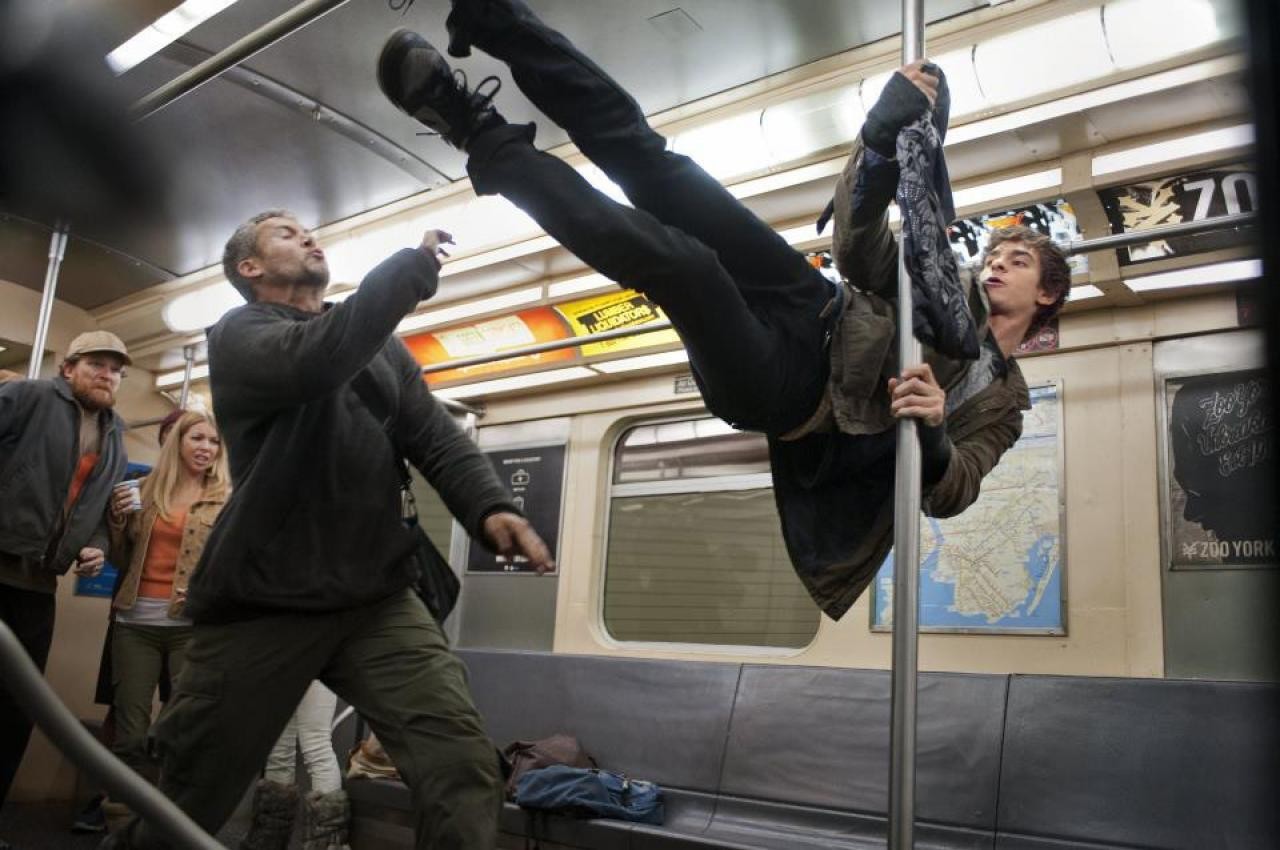
It may be a web-strand too soon to be doing a re-boot of the "Spider-man" franchise, but The Amazing Spider-man does do one thing that justifies its existence—it's better than the Tobey McGuire/Sam Raimi first film in the original trilogy, and right off the ledge manages to have the fun, energy, pop-soapishness, and inventiveness of the second film in that series, the one with Dr. Octopus. We have to go through the origin story again (but that's okay, we seem to have to with every "Superman" film, and evidently will with the next one).

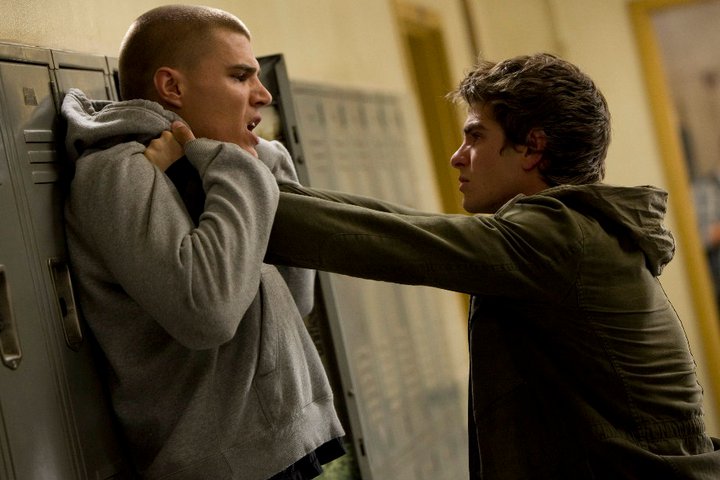
The story is basically the same—Peter Parker (Andrew Garfield) is a smart high school geek with a photog' hobby, and his first encounter with an industrial science lab manages to put the bite on him, arachnidally-speaking, then strange things start happening as he does whatever a spider can, conflicts, conflicts, conflicts (of the physical and angst variety), "with great power comes great responsibility," yadda yadda yadda. But there's a lot of "Spidey"-history to draw on, and the writers (James Vanderbilt, Alvin Sargent—who added a lot to Spiderman 2—and Steve Kloves—who mentored Harry Potter) have tinkered and brought a lot of missing pieces to the table. 
This time the love interest is Gwen Stacy (Emma Stone, who appears to be the oldest person in school, but that may be part of the appeal of the character, certainly to Parker), daughter of an NYPD captain (Denis Leary, who plays it straight, tough, and with impeccable comic timing), and bowing to the fan-boyish, his web-powers are not so organiche's got the little web-shooters now, although interestingly, he doesn't develop the web-goo. Oscorp is still around, although we never see its CEO (or do we?), so's the Daily Bugle—but Parker doesn't have a job there yet, so there's no J. Jonah Jameson (how could replace or improve on J.K. Simmons' interpretation?). The villain is another industrial bio-scientist, Curt Connors (played as if was Peter O'Toole by Rhys Ifans and he's terrific), who—not giving anything away here—eventually turns into the Lizard.

What's different is motivation and sub-text. Echoing the Potter series, attention and emphasis is paid to what happened to Peter's parents (Campbell Scott and Embeth Davidtz) that put him in the care of Uncle Ben and Aunt May (Martin Sheen and Sally Field, both extraordinarily good) and indications are that is the story which will run throughout this movie-arc (as well, I suspect, as the consequences of keeping secrets (as I said, there's a lot of history to drawn on).
 

What's also different and good is how everybody's perfected the formula, including director Marc Webb (who made the, to me, extraordinarily fine
(500) Days of Summer): Garfield's Parker is more in line with the comic character, mood-swinging as well as web-slinging, and his Parker is awkward, stammering, frequently inarticulate and perceived outwardly as something of a jerk, a simp, or worthless* (hey, wow, they got the character of a misunderstood teenager down), and the fights, which in the past have been rushed and often unfollowable, now flow and, frequently—thanks to CGI—in one continuous shot that swoops, loops and parallels Spider-man's flight patterns.
The pace is still there, but thanks to stunt arranger and second-unit director Vic Armstrong (a few of the Bonds and Indiana Jones), it's not all a blur. Also, under Raimi, some of these fights were brutal and sadistic, and, don't get me wrong, these are no less savage, and take more of a toll on the participants.
** But the desperation is there, and the "wrong-ness" of the abuse of power, which kept my moral compass (or is it "Spidey"-sense?) from peaking out in the red zone.  

So, yes, it's the same story, but more sure-footed (by having its hero less so), and also intriguing for what it might hold in the future. The first trilogy seemed to be a little wobbly as it went along, searching for story. This one already feels like it knows where its going, and will find the best and most opportune path to get there.
***

* And—a nice touch—he's thin and ungainly, not buffed-out, like the typical "strong-man" super-hero, which is the way he was when Steve Ditko first drew him.  Nice.

** This does bring up something that will be difficult to sustain: Parker is frequently shown battered, bruised, and slashed from these fights, which makes his encounters post-fight with Aunt May a little illogical.  And at some point, when will she clamp down on him, or child-protective services step in? 

*** A couple more things: there's no interpretation of the "Spider-man" theme from the 60's cartoon ("Hey there, there goes the Spider-man!") but James Horner's score is his most inventive in a long time—if a little needlessly bombastic in rare instances; there is a "coda" of sorts, but early in the credits (so you won't be missing anything if you don't stay for the full credit roll); and the Stan Lee cameo actually made me smile and feel affectionate towards the man.  Now, that's amazing.

Friday, June 2, 2023

Spider-Man: Across the Spider-verse

Whenever There's a Gang-Up/You'll Find the Spider-Man/Woman/Thing/Concept
or
Every Spider-Thing Everywhere All at Once

At the end of Spider-Man: Across the Spider-verse, I imagined a camera floating up to the theater-rafters, while I looked heavenward, my hands gripped into fists and screaming: "Noooooooooooo!"

It didn't come out of nowhere. During the last 45 minutes of the film (it's 2 hours, 20 minutes), I felt a mild panic coming on; the movie didn't feel like it was rounding third and starting to wrap things up—if anything, it was getting MORE complicated without any impending resolution. The reason? There isn't one. The movie ends with a terrible situation for hero Miles Morales (Shameik Moore), who's left beside himself, and the formation of a new Spider-group to save the day—led by Gwen Stacy (Hailee Steinfeld)—and another group—led by Spider-man 2099 (Oscar Isaac) hunting him with the intent to...well, I don't know what their intent is, but the very presence of Miles Morales and the events from the previous film put everything (and I mean everything) in danger. 
 
Then there's a "To Be Continued" graphic.
DAMN!

My absolute love for the previous film, Spider-Man: Into the Spider-verse, is readily apparent to anyone who read that review. I still maintain that it's the best Spider-Man movie brought to the screen*, and (unfortunately) I still do.
Oh, not that this new one is bad. It still has the verve and the audacity of its eclectic visual style, its almost brilliant vision of blending-in classic comic-book traditions in its story-telling, as well as exceptional voice-acting, and at a slightly quicker pace than its predecessor (as we've come to expect the visual tricks that are second-nature in this new one). It also is very smart, thinking outside the box-frames, while also slightly dismissive of standard super-hero tropes and jabbing (lightly) at them. It knows that you can't have a Spider-man film without the shadow of soap opera looming over it and that tragedy is attracted to the character, like, well, like goofy super-villains.
So, what is the tangled web of Across the Spider-verse? It starts out with a challenging thesis statement: "Let's do things differently this time. So differently." It's Gwen Stacy, the Spider-Woman/Ghost-Spider/Spider-Gwen of alternate Earth-65, contemplating her back-story of her gifted life being over-turned by being bitten by a radio-active spider giving her spider-powers, shouldering "great responsibility," vilified by the press and the police (one of whom is her father) and how her crime-fighting career led to the death of her best friend, the brilliant student Peter Parker (Earth-65's Peter Parker). Parallel universes have pretty narrow parallels. While fighting an alternate-Universe version of the Vulture at her New York's Guggenheim Museum, she is aided by two other spider-heroes: Miquel O'Hara (Isaac)—Spider-man 2099 of Earth-928 and Jessica Drew (Issa Rae), the Spider-woman of Earth-616. O'Hara is in charge of an elite corps, the "Spider-society" whose mandate is to keep a stable multi-verse. With me so far? Good, let's go to Earth-1610.
Earth-1610 is where "The Ultimate" Spider-man, Miles Morales, lives. It's been a year since the events of Into the Spider-verse, and the experience has changed him. He's an established Spider-man in his New York—even the police (including Miles' father) like him. He is the epitome of a friendly, neighborhood Spider-man, but his folks—despite his high grades at school—think he's a bit of a flake and are worried about him and his future. For example, he's late for everything, his attendance in class is kind of spotty despite the high grades, and they're really thinking about whether he should move home rather than applying for that big fancy New Jersey college to learn about particle physics. They want him to be more "grounded"—and he does get grounded in ever-increasing amounts throughout the movie.
And speaking of "spotty" there's a weird new super-villain in town. He's Dr. Jonathon Ohnn (Jason Schwartzman), who got caught up in the big particle accelerator/collider explosion of Into the Spider-verse and has turned into a being who can create holes—or "spots"—in space in order to transport himself to other locations on Earth-1610. Spidey encounters him trying to transport an ATM from a convenience store while on his way to his college evaluation with his folks and leads Miles on a "holey" confusing and disorienting fight throughout New York-1610 before making one trip to many and transporting him self to a "void"—let's call it "The Holy Sea" like in Yellow Submarine—where he plots his escape by using another collider to increase his powers across space...and other dimensions.
Such a being can be quite a disruption to the fabric of time and space, so the "Spider-Society" recruits Spider-Gwen to travel to Earth-1610 to track this "Spot" guy and capture him before he can do any significant damage. Gwen (rather unwisely) shirks her duties as "spot-remover" to set up some automatic detector-gizmo, and instead goes to see the neighborhood Spider-man, whom she knows is "friendly." As Miles and Gwen have feelings for each other that haven't been awkwardly expressed yet, it's a "best of/worst of both worlds" parallel universe situation.
Well, Gwen's negligence causes an emergency and Jessica Drew contacts her to get her spider-self to Earth-50101—and the island of Mumbattan—where Spider-man Pavitr Prabhakar (
Karan Soni) and the Spider-Punk Hobie Brown (Daniel Kaluuya) have their hands full while The Spot successfully increases his powers with that Earth's particle accelerator. Unbeknownst to Gwen, Miles hitches a ride on her dimensional transport.
So, how are you doing so far? Head hurt a little? Getting a little tough to tell Spider-person from Spider-person and Earth from Earth? Okay, I'm going easy on you, because here's where it gets really difficult to parse: Miles' transport-hitching causes an anomaly, as he saves an important personage who would have died if he wasn't there, and that created something called a "Canon Alert" (which I found hysterical) over at Earth-928 with the "Spider-League".
Miles disrupted a key event that's supposed to happen to every Spider-man—a personal loss that will define their character—and poor Spider-India is set on a parallel track that is essential for every Spider-man story (and apparently they can't just go rogue and kill Pavitr's Aunt Maalai (or whatever) in order to set the trajectory right. This is not good, and it gets worse...and more complicated.
But, I'll spare you, and not spoil anything else. Believe me, there are a load of surprises in Across the Spider-verse from cameos and funny details to just the whole concept of the thing that takes a lot of Into the Spider-verse and re-weaves its web into something quite beyond the standard Spider-fare...although I do suspect that Miles is going to have a "Spider-man No More" moment (but against his will this time). I mean...it's "canon!"
That whole "Canon Alert" concept is just mind-bogglingly funny (even if it's treated so seriously). There are certain comic-book stories and ideas that creators just don't touch because they are "canon"—Krypton exploded (you can't bring it back), Bruce Wayne's parents were shot in an alley (you can't say "just a flesh wound"), and Uncle Ben and Gwen Stacy have to die...and stay dead. Oh, they can be "cloned" (when the comic publishers get desperate), but you can't have Peter Parker (or what-Spider-ever) wake up one day, hold his aching head and go "it was all just a horrible dream" and go have a breakfast of Uncle Ben's converted rice. After all, these things take place in Manhattan, not "Dallas."
But, as you can tell, this thing is complicated. In fact, it's so complicated, it's almost an assault, and when you add in the creators' visual dynamism, their tendency to throw a joke into every dead space, and general pace of the thing, your brain could approach synaptic anarchy. It might have to contain a warning—not the "flashing lights" one, but the "do not see while pregnant" "may cause seizures" "do not see if allergic to spiders" warnings on TV (or movie, for that matter) pharmaceutical commercials.
I'm just saying that the experience is in-to-the-tense, and not for the faint of heart or the faint of sight. It is a certainty that one is going to miss a lot on the first viewing in a theater, and although it sounds heretical for me to say, I think that both Across the Spider-verse and its predecessor are more intended (by their creators) for repeat-viewing by disc or streaming than in the theater (although one can't discount the level of detail that can one can appreciate in the massive viewing experience**). I say that reluctantly, as I think the theater experience for watching a film can't be topped, despite noisy neighbors, restless kids, and rattling food-wrappers.***
So...I say "go." Guardedly. Just don't come back in the comments section blaming me for the migraine or PTS-ADHD or the adrenal jitters—or your "spidey-sense" on over-tingle—as a result of seeing this (my reaction was to crave a hamburger). Blame it on the tangled web woven by Spider-Man: Across the Spider-verse.
 
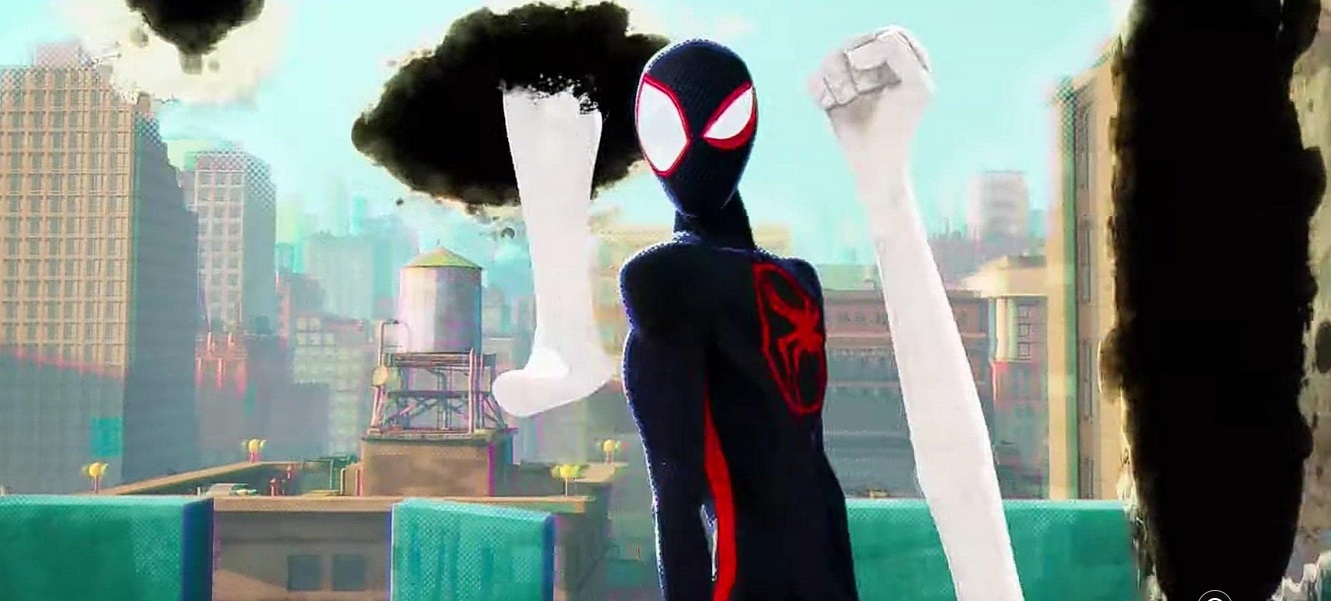
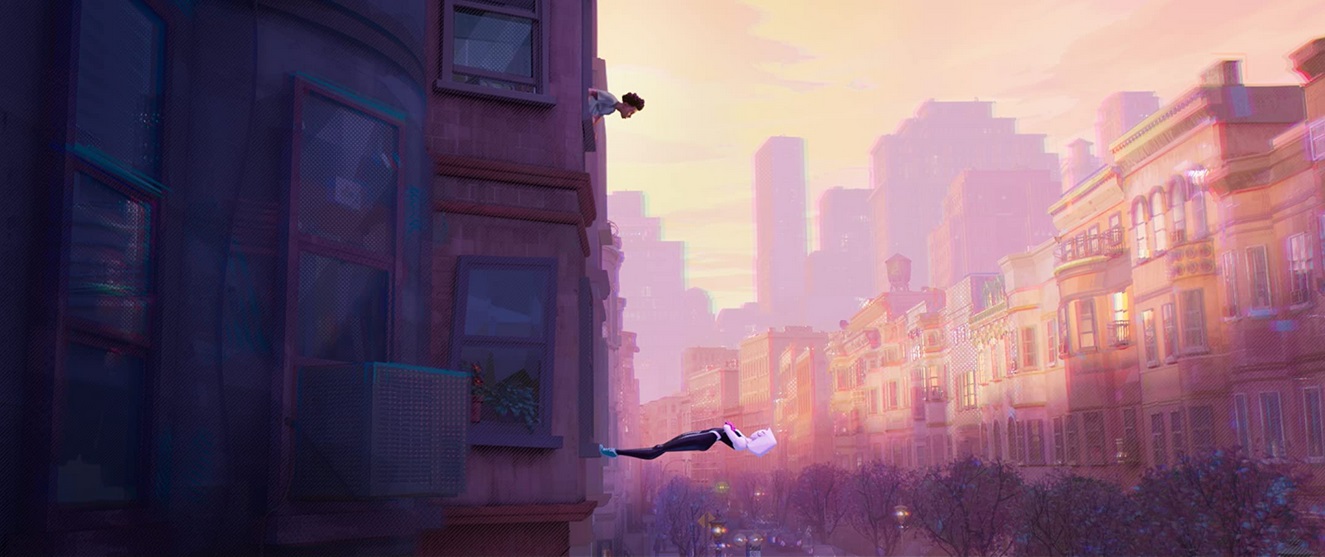
 As usual, with these animated sorts of things, I just have to share some frames from the film 
that just stuck out at me as particularly beautiful and that I didn't have room for in the text.
*...and one of the best super-hero movies ever.
 
** I saw it in XD, which was impressive, especially if one is appreciating things like the weave in Miles' Spidey-mask, or the half-tone shading of colors simulating the look of old comic-books.

*** Oh. And Maria Menounos. She really annoys me.