Showing posts with label Andrew Garfield. Show all posts

Tuesday, April 23, 2024

Never Let Me Go

Alex Garland, who wrote and directed Civil War, adapted the Booker-winning tome the film is based on.

Written at the time of the film's release...


"Ménage à Triage"
or
"My Clone Sleeps Alone"

"The breakthrough in medical science came in 1952. Doctors could now cure the previously incurable. By 1967, life expectancy passed 100 years."

Never Let Me Go, the film, makes you wonder what all the fuss was about. A slight "Twilight Zone" bit of story, hinging on one theme—the central conceit being the showing of life from the point of view of sheltered, cloned organ donors who will live out their short lives being harvested for spare parts—but taking the concept and going nowhere with it, serving almost solely for the metaphorical revelation that "life is short."
 
I know that. I read the papers.
The book the film is based on, written by Kazuo Ishiguro (who wrote "The Remains of the Day"), was nominated for the Booker Prize for fiction in 2005. It is faint praise to say the film makes you want to read the book, as it must be Ishiguro's writing style that garnered the acclaim, and the majesties and mysteries of his prose and story-telling capabilities that inspired the making of this film that betrays those intentions. Because other than that central conceit, and some interesting acting choices by the participants, the film fails to generate anything other than a melancholy malaise. And whether one wants to use it as a tract against Britain's private school system, a cautionary tale of "science gone wrong," the ultimate pointlessness of Faith, or the horrific extensions of animal experimentation, the fact is that we're all one synaptic event away from becoming a squishy spare parts warehouse, as revealed on our own personal Id's, something done as an act of charity, the giving of our last full measure.
So, the mixed signals sent by the film of the book, and its clumsy way of revealing the particulars of the plot, do no service to its source, merely revealing the surface highlights, and not delving into more meaty psychological or motivational matters, turning the film into merely a digest, a palimpsest, or more appropriately, a cadaver of the book.

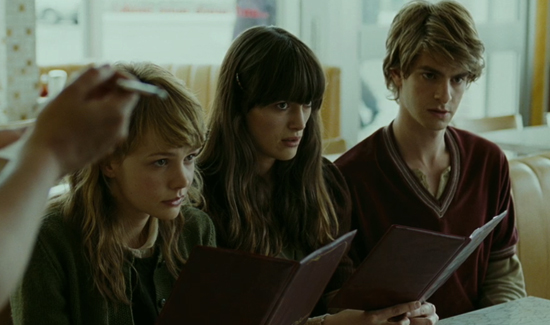
It focuses on a trio of children—Kathy (
Carey Mulligan), Ruth (Keira Knightley) and Tommy (Andrew Garfield)—raised in a private boarding school, one of many that is, in fact, more of a farm. The children attending know nothing of the outside world, raised in a bubble of perfect manners, good health, docility, and fear of what lies beyond the fence surrounding the grounds. There is no need to prepare them for life as we know it, because they won't be participating in it. Only contributing to it.

They are carefully groomed and kept in the dark about their purpose, and within the cliques that inevitably occur there, rumors and speculation swirl among the kids about what happens when you go outside the fence (nothing good), and eventually, about ways to get deferments from donor status by proving their worth by displaying artistic skill...or, cruelly, falling in love.

They cling to these beliefs
, like rosaries, with no basis in fact, but only the strength of their hopes, and in the absence of all evidence. Kathy and Tommy grow close, become empathetic friends, but as they grow older, Ruth becomes the object of Tommy's affections, and Kathy goes her own path, choosing to become a "carer," in service of the donors on the short path of their careers, delaying her fate, watching as those less fortunate are taken away from her, piece by piece. 

It's frustrating watching
. Oh, the actors are fine, and actually more than fine, given the material. Mulligan's crooked half-smile speaks volumes of a life only partially lived, and Knightley is completely unafraid of looking sadly decrepit.  But, it is still painful to watch these clueless kids, marginalized and compartmentalized, pursuing fruitless hopes in an effort to live a full life. One would feel more sympathy if they would just be a bit more their own advocates, or even a bit more revolutionary. It is extraordinarily facile to compare this one to other "low shelf-life" movies on the order of The Island, or Logan's Run, sci-fi action films on the theme. Never Let Me Go has the same built-in planned obsolescence of adolescents conundrum—given the acquisition of some knowledge, wouldn't some of them choose to fight it? It doesn't have to be with space-guns and chase scenes, but...something. And despite their role in the food-chain, don't the administrators of these schools (Charlotte Rampling plays the main one here), especially the ones portrayed here, have some sort of empathetic identification with their charges, especially given the revelations they profess (rather hollowly)? That these questions pop up during the viewing of the film, when one should be riveted to the screen and it's reflected situations, only points out that the film-makers haven't done their work perfecting their illusions, in pursuit of their allusions. 

To further extrapolate the somewhat cruel comparison of the film to a cadaver of the original piece, the spirit of the thing is missing, however ardently it is played. Ultimately, one's appreciation of the film lies in its performances in the service of a flawed interpretation and one's own interest in the players, which is as superficial as this film feels.

Wednesday, February 21, 2024

The Social Network

Written at the time of the film's release...(although, here, outdated links have been deleted and more relevant ones have been inserted...and then, I'll post the thing on "Facebook"...which is so "Meta")

"Saving Facebook" ("Every Creation-Myth Needs a Devil")
or
"There's Somethin' Happenin' Here (What It Is Ain't Exactly Clear)"

"O wonder!
How many goodly creatures are there here!
How beautious mankind is!
O brave new world,
That has such people in't!" (The Tempest, Act V, Scene 1)


Maybe it is too early to make a movie about Facebook (out of MySpace and Friendster) and the ramifications of our Brave New World of cyber-relationships. Maybe it is a little too "street-corner sage" to predict The End of the World As We are Sorta Familiar With it (But Not Really...More Acquaintances, Really). But, it is interesting to see a story about the Frankenstein behind the Monster, if only to see how each reflects the other.

And even though we're secretly rooting for The Monster.
And, at this point in time, there isn't a better team to make
The Social Network
than Aaron Sorkin and David Fincher. Sorkin, the mad savant behind some of the better TV shows of the past decade and a half, has always written about people and their "issues," and how personality impacts policy. Fincher has matured from an ILM tech (who was happy to fly cameras through coffee-maker grips**) to an intricate observer of societal pressures on the psyche. For the two of them to make this particular story is a Friend Invitation made in Hollywood Heaven.  "Accept" it. But, you can't "Ignore" it.
The movie begins with a date going badly between Mark Zuckerberg (Jesse Eisenberg, late of many movies with "...land" in the title) Harvard wall-flower, and Erica Albright (Rooney Mara—she'll play Lisbeth Salander opposite Daniel Craig in Fincher's big-budget version of The Girl with the Dragon Tattoo), an acquaintance. Anyone familiar with the machine-gun dialogue that writer Sorkin is known for, had better duck for cover—or wait for this on DVD so you can...play...it...slooooowly—for he now has an automatic weapon for a word-processor, and a co-conspirator in Eisenberg who can milk every nuance out of a line, despite hyperventilating it at debate-competition speed. His Zuckerberg is a "no Dolby/no squelch" type of unreadable conscience, and Eisenberg plays it with a deadness behind the eyes that interprets the world as a problem, if not necessarily a challenge. He's a bit too candid for a first date, and she stomps off, which sends him on a mission, simultaneously trashing her on his blog (LiveJournal) and culling the pictures of every woman on campus to create a "Who's Hotter" web-competition that becomes so popular so instantly that it crashes Harvard's web-infrastructure.
He becomes both famous and infamous for the stunt,
guaranteeing he'll never get a date in college, and attracting the wrath of the college's board, and the interest of two preppies attempting to create an exclusionary social network on the web. He goes them several steps better, making a system open to everyone on campus that trumps their attempts, and as it gains "friends," expands throughout the college system.
Hindsight is 20/20, and Sorkin constructs the film as a series of depositions after the fact (of Facebook's success) as everyone who thinks they've been burned by Zuckerberg testifies to his vague promises and dealings under the table.*** Of course, they have every right to sue—but they'd only sue if "The Facebook" was a success—and the underpinnings and double-dealings don't resemble a fight for satisfaction, or a Noble Quest, so much as resembling a snake eating its own tail. ****
Which brings us back to Frankenstein and his Monster. The film itself is expertly done—it is a complicated story of hidden motivations and the presentation of masks before public faces—
and Sorkin and Fincher manage to navigate us through the maze of the story, even though one feels there is no cheese at the end. The experience is a bit hollow, which may be a part of the point.
Because the Facebook experience is hollow, as well.
As hollow as Zuckerberg, as portrayed in this film, is. While it is nice that one has the opportunity to "re-connect" with old friends in a virtual environment and satisfy everyone's need to (as one friend commented on blogging) "talk about what you had for lunch," one wonders why one has to re-connect at all...especially if the relationship wasn't maintained in the first place. Not enough time in the world to meet? Because a "real" relationship takes time, takes effort, "gets messy?" Facebook provides the illusion of "staying in touch," without actually touching. Like Zuckerberg's abortive "date," a lot of time is spent broadcasting, but not interacting.
There are, of course, exceptions. But the fact of the matter is Facebook's cyber-community is not a "Brave New World" at all. Just the opposite. It provides a substitute in lieu of commitment. A panacea in a life thought to be full to bursting and without risk. The most precious commodity we can give is time—slices of our lives and our selves. Facebook is a pacifier—a mass-Hallmark card that we can spend a few heart-beats picking out, and send away without a thought and not even sweat the cost of a stamp.

It soon becomes a numbers game—a collection, like the celebration of the 1,000,000th friend portrayed in the film. But who are those million people?  Facebook doesn't know or care. It's just a number. A number of casual relationships, that may lead to something else, but probably won't. A collection, nice to look at, but more often, ignored. Trophies, and ones that don't need to be polished or buffed up.

It's a new world of blithely arrested development, in the image of its creator, where love and commitment do not compute, and the only thing close to it is "hope"—translatable as keystroke F5.

* Except for some dodgy freezing breath-work, the biggest special effect will be invisible to you until the closing credits.  Nice.

** Personally, I'd like to get back all those hours spent on "ZooWorld."

*** An image that kept coming to mind every time I thought of writing this review, where it would subsequently be published...on B/C-L's's Facebook page.

Tuesday, January 2, 2024

The Amazing Spider-Man

Written at the time of the film's release.

Don't worry. New stuff tomorrow....


Spider-man v. 2.0
or
"With Great Power Comes Sequels, Re-Boots, Etc....(A Spider-man's Work is Never Done)"

It may be a web-strand too soon to be doing a re-boot of the "Spider-man" franchise, but The Amazing Spider-man does do one thing that justifies its existence—it's better than the Tobey McGuire/Sam Raimi first film in the original trilogy, and right off the ledge manages to have the fun, energy, pop-soapishness, and inventiveness of the second film in that series, the one with Dr. Octopus. We have to go through the origin story again (but that's okay, we seem to have to with every "Superman" film, and evidently will with the next one).

The story is basically the same—Peter Parker (Andrew Garfield) is a smart high school geek with a photog' hobby, and his first encounter with an industrial science lab manages to put the bite on him, arachnidally-speaking, then strange things start happening as he does whatever a spider can, conflicts, conflicts, conflicts (of the physical and angst variety), "with great power comes great responsibility," yadda yadda yadda. But there's a lot of "Spidey"-history to draw on, and the writers (James Vanderbilt, Alvin Sargent—who added a lot to Spiderman 2—and Steve Kloves—who mentored Harry Potter) have tinkered and brought a lot of missing pieces to the table. 
This time the love interest is Gwen Stacy (Emma Stone, who appears to be the oldest person in school, but that may be part of the appeal of the character, certainly to Parker), daughter of an NYPD captain (Denis Leary, who plays it straight, tough, and with impeccable comic timing), and bowing to the fan-boyish, his web-powers are not so organiche's got the little web-shooters now, although interestingly, he doesn't develop the web-goo. Oscorp is still around, although we never see its CEO (or do we?), so's the Daily Bugle—but Parker doesn't have a job there yet, so there's no J. Jonah Jameson (how could replace or improve on J.K. Simmons' interpretation?). The villain is another industrial bio-scientist, Curt Connors (played as if was Peter O'Toole by Rhys Ifans and he's terrific), who—not giving anything away here—eventually turns into the Lizard.

What's different is motivation and sub-text. Echoing the Potter series, attention and emphasis is paid to what happened to Peter's parents (Campbell Scott and Embeth Davidtz) that put him in the care of Uncle Ben and Aunt May (Martin Sheen and Sally Field, both extraordinarily good) and indications are that is the story which will run throughout this movie-arc (as well, I suspect, as the consequences of keeping secrets (as I said, there's a lot of history to drawn on).
 

What's also different and good is how everybody's perfected the formula, including director Marc Webb (who made the, to me, extraordinarily fine
(500) Days of Summer): Garfield's Parker is more in line with the comic character, mood-swinging as well as web-slinging, and his Parker is awkward, stammering, frequently inarticulate and perceived outwardly as something of a jerk, a simp, or worthless* (hey, wow, they got the character of a misunderstood teenager down), and the fights, which in the past have been rushed and often unfollowable, now flow and, frequently—thanks to CGI—in one continuous shot that swoops, loops and parallels Spider-man's flight patterns.
The pace is still there, but thanks to stunt arranger and second-unit director Vic Armstrong (a few of the Bonds and Indiana Jones), it's not all a blur. Also, under Raimi, some of these fights were brutal and sadistic, and, don't get me wrong, these are no less savage, and take more of a toll on the participants.
** But the desperation is there, and the "wrong-ness" of the abuse of power, which kept my moral compass (or is it "Spidey"-sense?) from peaking out in the red zone.  

So, yes, it's the same story, but more sure-footed (by having its hero less so), and also intriguing for what it might hold in the future. The first trilogy seemed to be a little wobbly as it went along, searching for story. This one already feels like it knows where its going, and will find the best and most opportune path to get there.
***

* And—a nice touch—he's thin and ungainly, not buffed-out, like the typical "strong-man" super-hero, which is the way he was when Steve Ditko first drew him.  Nice.

** This does bring up something that will be difficult to sustain: Parker is frequently shown battered, bruised, and slashed from these fights, which makes his encounters post-fight with Aunt May a little illogical.  And at some point, when will she clamp down on him, or child-protective services step in? 

*** A couple more things: there's no interpretation of the "Spider-man" theme from the 60's cartoon ("Hey there, there goes the Spider-man!") but James Horner's score is his most inventive in a long time—if a little needlessly bombastic in rare instances; there is a "coda" of sorts, but early in the credits (so you won't be missing anything if you don't stay for the full credit roll); and the Stan Lee cameo actually made me smile and feel affectionate towards the man.  Now, that's amazing.

Tuesday, May 3, 2022

The Imaginarium of Dr. Parnassus

Written at the time of the film's release...
 
And...at the time Avatar had come out and marching towards becoming the "#1 Box Office Champion of All Time." I was underwhelmed by it—there's a link to my review buried down there if you even care. On the other hand, nobody was going to see this film, which, as you can tell if you read it, I found a shame. One can advocate, but people are going to see what they want—it's their money, after all—and it's all a part of the free market (or as some would label it, "cancel culture"—the Supreme Court seems to think what you do with your money is free speech, even if you're paying for it). But, just as I quixotically advocated for The Imaginarium of Dr. Parnassus, I would also urge people to see the wonderful Everything Everywhere All at Once, which, in a multi-plex of less imaginative offerings has far more bright ideas and film-making brio than the rest of the offerings in said multi-plex combined.

"Ladies and Gentlemen, This World is Full of Wonderment for Those with Eyes to See it."
 
 
One must consider the momentum of publicity when one talks about James Cameron's Avatar. The tsunami of NewsCorps force-fed publicity and societal group-think has done its job on the populace and the majority are of one mind. At this point, I've heard too many smart people saying that nobody will ever make movies the same way again, that it's ground-breaking, and (okay) the story isn't much, but the visuals are so spectacular it compensates for the stunning more-of-the-sameness of the blah-blah-blah.
 
You don't know what you're missing. There is more imagination, thought and, gosh, genuine wit going on in the "mirror" sequences of The Imaginarium of Dr. Parnassus than in anything in Avatar. Hell, even the non-CGI "live" sequences are amazing to look at.
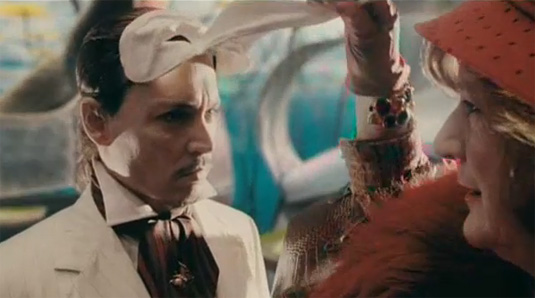
But...nobody's lining up to see Imaginarium. And that's a shame. For, if you want a fantasy film brimming with ideas, some of them quite provocative, it is this one, directed by that most snake-bit of directors, Terry Gilliam. It has been abundantly documented ad nauseum the tragic story of this film: how star Heath Ledger died in the middle of filming, and how a corps of Ledger-Gilliam supportersJohnny Depp, Jude Law, and Colin Farrell—stepped up to play the visages of Ledger in the "Imaginarium" sequences (actually it seems perfectly natural the way Gilliam does it), but what isn't reported is that Gilliam was hit by a bus and broke his back during the filming.* Despite these alarming developments that would halt anyone other than a crazy "Monty Python" alum, the film is rich in detail, bursting with context, and doesn't have that "scrimping" footage-stretching feel that so many films-in-trouble give off.
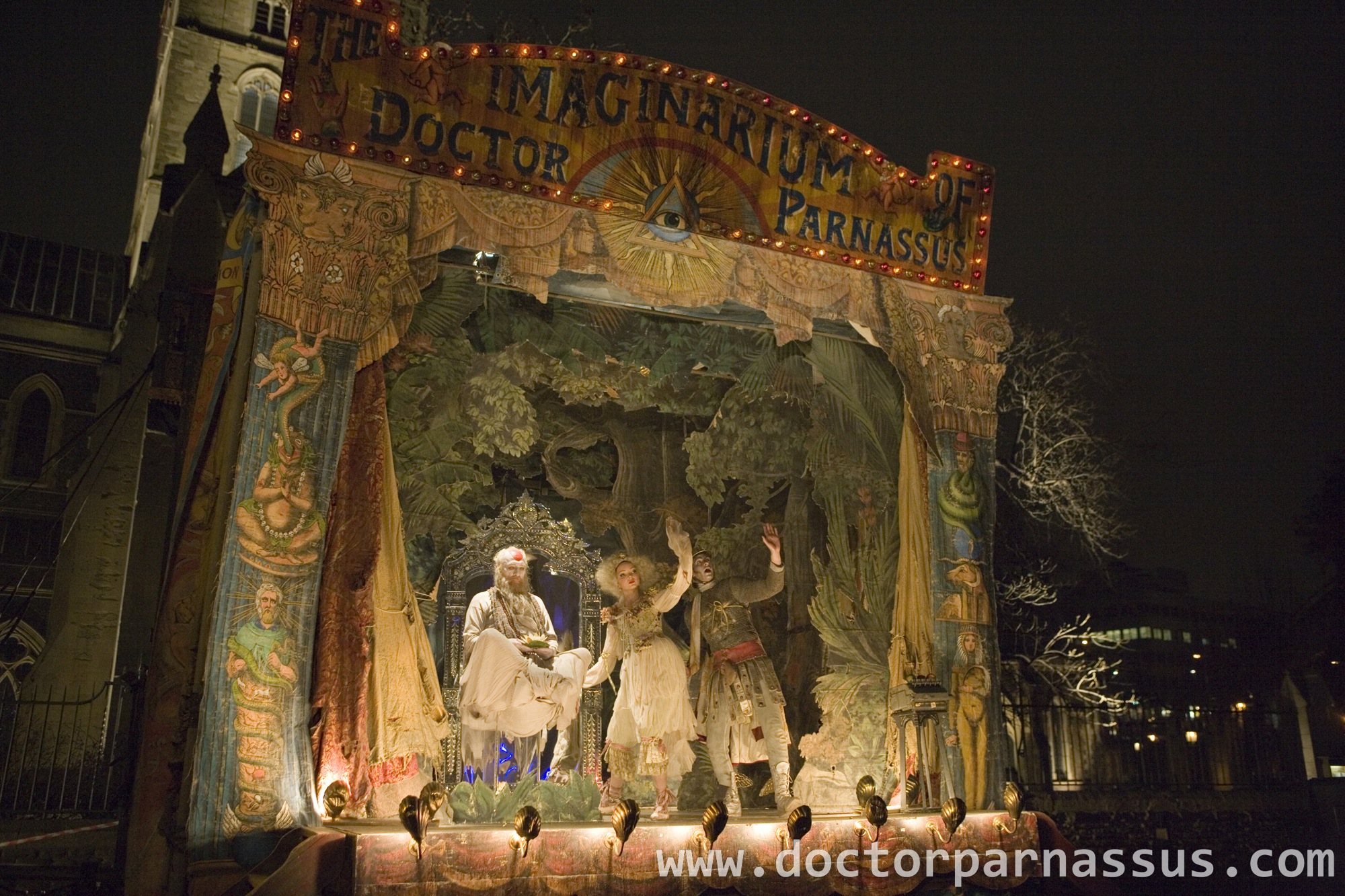
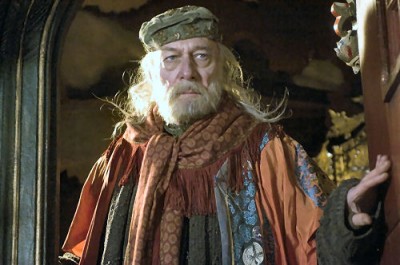
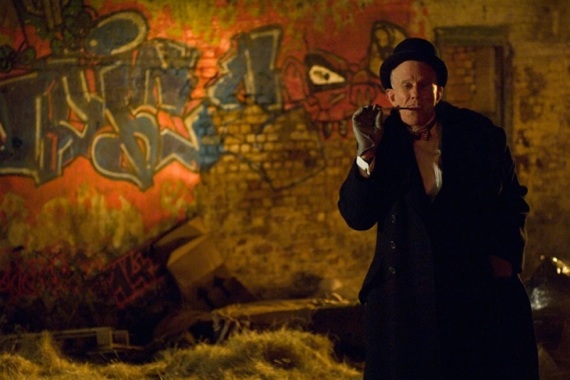
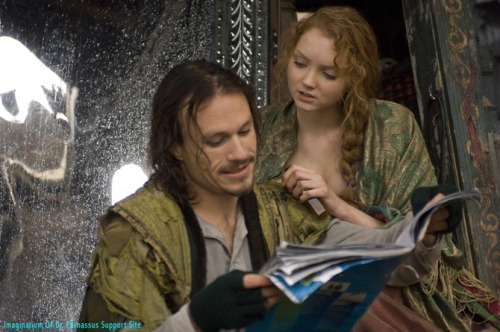
It's basically a fairy-story set in our world (or a delirium dream, not sure) where Dr. Parnassus (Christopher Plummer) is an immortal, who, with his rag-tag theater troupe—assistant Percey (Verne Troyer), barker Anton (Andrew Garfield) and daughter Valentina (model Lily Cole, whose alarming face is that of an alabaster porcelain doll)—travels in an out-sized Bergman-crossed-with-Joad horse-drawn wagon/convertible stage, enticing marks to enter his "Imaginarium," a mirror that sucks the hapless into Parnassus' bizarre mind-scapes, where they either live...or die. Parnassus, you see, has made a deal with the Devil. Inhabiting the old man's mind, as he does most of ours, is Mr. Nick (Tom Waits...of course), who has his own lures to the impure of heart. Enter one of Nick's speak-easy's or one-night-stand motels that stick out like sore toad-stools in the landscape and BOOM! the Devil takes your soul. And the bottom line of the Devil's deal is a certain number of souls before Valentina's sweet 16th birthday ("The age of consent" she trills) or her day of freedom becomes her day of imprisonment, as the Devil claims her for her own. A situation as Grimm...and familiar...as can be.
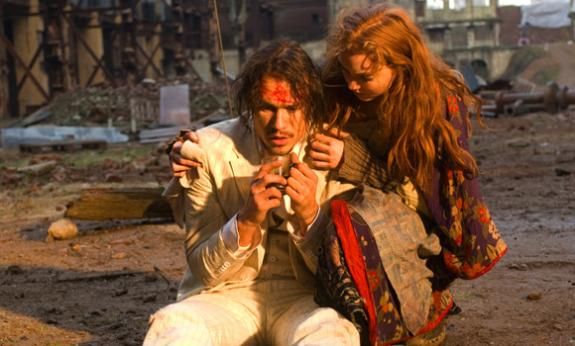
But Gilliam's Devil is in the details. The little band are aided in their quest by an amnesiac named Tony (Heath Ledger) whom they save and who, in turn, tries to save them, but whose past comes back to haunt and threaten them. Ledger is at his quick-silver best here, his accent wavering through several dialects, his eyes darting (all qualities picked up by his capable alter-ego's), for Tony is a chameleon, a huckster, the trickster of Myth—which Gilliam uses to savage satiric effect—and is a devil of his own, capable of destroying what he seeks to save. The battle between Good and Evil, Duty and Temptation turns complicated, and Parnassus must bargain again, at great sacrifice, to save that which he loves most, whether it's wished for or no.
The Devil's in the details for the look of the film, too. The "real-world" that the "Imaginarium" wagon trundles through is our world, but it's a world of extremes: back-alley garbage-lands with trash-fires that litter the scene (where the rag-tag group seems to fit most) and vast temples of commerce-malls, where Tony, with a marketer's zeal attempts to bring new customers. Each of these victims have their own "Imaginarium" realms: a wealthy dowager emerges into a vision of giant fashion-shoes, another a 2-D pop-up book forest. At one point, a falling "Imaginarium" customer takes an incredible fall, and Gilliam cuts to an improbable "Python" joke—a giant thumb-tack—sitting in the middle of nothingness (Gilliam mercifully, for the moment, has the hapless mark miss the point). And even outside the mirror, there are wonders of movie-making brio. In a scene where Percey walks away from Parnassus with his usual bluster, Gilliam shoots the diminutive Troyer at a heroic looking-up angle—the camera had to be scraping the street.
Now, a confession. It may sound like I'm gushing about Gilliam here, but I've always had a problem with his films: I fall asleep through them. It's not that I'm bored, but there's something about the richness of detail, the constant flow of new things to look at, and the murky lighting that induces narcolepsy in me. Before seeing a Gilliam film, I try to load up on coffee and sugar to get through it. I have no idea why this occurs (maybe it's
Rapid Eye Movement caused from the orbs darting about the screen), but it is inevitable—it occurred here through the Jude Law sequences
—but I managed to keep my eyes open throughout the whole thing this time.
If the film is flawed, it is that it tries to do too much. Even with a simple story, derived from old fairy-tale tropes, Gilliam again attempts to fit 10 pounds of story into a 5 pound film. Complications begin to pile up, revelations are delayed, little troubling details are revealed—there's a convenient pitch-pipe here—and everything becomes resolved in an ambiguous and hasty manner. Like most Gilliam films, a second viewing may make murky matters clearer. 
Plus, the overall story has a premise open to interpretation...
is it a "God versus Devil" story, or merely a fairy tale? The Christian Science Monitor's Peter Rainer thinks it may even be autobiographical with Parnassus a mask for Gilliam, "a mad dreamer forever riven between his imagination and the necessity to sell it."** And like his "Python" fraternity, there's a streak of dark running through this, as with all Gilliam films (remember how Kevin's parents are killed at the end of Time Bandits?), that may be off-putting for some viewers. Fans of Gilliam's films should expect it, but those who prefer their fantasy milkier may not like the taste of the dark stuff. Avatar is far less subtle, more a punch "on the nose," and although dark, gives the impression of a happy-ish ending.
So, it is doubly appropriate that Imaginarium brings me back to Avatar. For what is Gilliam's film but a re-working of the caution "You can fool some of the people all the time, and all the people some of the time," and that includes the Devil, but the Devil gets his own.
What's Gilliam's next movie? Well, he's determined to go back and film his
Don Quixote movie, come hell or high water.*** It is only appropriate for this most quixotic of film-makers, forever charging against the impossible odds at realizing the incredible visions wind-milling in his head.

* Here, the endlessly inventive Gilliam made lemonade—convincing the bus company to provide transport rather than face a law-suit, thus saving lots of production money. And, if all of this wasn't enough, producer William Vince died right after filming. The film is dedicated to Ledger and Vince, and credited as "A Film by Heath Ledger & Friends." 
 
** Nice observation, that. But Rainer also thinks Ledger looks "dispirited" in the film--well, yeah, the character's just gone through a painful transition, but Ledger's performance of it is never less than audacious and energetic. I'm guilty of it, too, but critics shouldn't try to read actor's minds--they're chameleons, after all, when they're doing it right, and we should speculate cautiously when ascribing motivations to surface appearances on film.
 
*** He did. The Man Who Killed Don Quixote was released in 2018.

Friday, December 17, 2021

Spider-Man: No Way Home

If You Break the Universe, You Have to Buy It
or
"It Looks Like We Have Some Competition" (Pete, Re-Pete and Amazing Re-Pete)

I've seen every Spider-Man movie—the 3 Tobey Maguires and the 2 Andrew Garfields and the 2 Tom Hollands (and that helps if you're going to enjoy Spider-Man: No Way Home and appreciate its cleverness). A couple of them have been good. My personal favorites were 2004's Spider-Man 2—the one with Dr. Octopus (Alfred Molina) and the best of them, the animated Spider-Man: Into the Spider-verse.
 
So, even though I thought the first Spider-Man movie was only sub-par, the third a mess, and the Andrew Garfield ones slight improvements, and the Tom Holland ones enjoyable, No Way Home is aimed right at my tingling spider-sense. It plays deep into my nostalgia for what was good about the various series and manages to improve on what I thought were their deficiencies. It's enough to make me think that No Way Home is a fun, great movie.
 
I'm not so sure that anyone without my slavish history (despite reservations) will come away with so unequivocal an evaluation. Without the back-story (or stories) a lot of things are going to fall a little flat—will anyone but a Marvel reader "get" what's going on with Peter's lawyer (for instance)?**
Fortunately, there's not a lot of catching up to do since Spider-Man: Far From Home: The Daily Bugle vlogger J. Jonah Jameson (J.K. Simmons...again) had just revealed the taped message left by Mysterio exposing Peter Parker (Tom Holland) as Spider-Man and labeling him as "Public Enemy #1". This makes things uncomfortable in Parker's life, including girlfriend Michelle "MJ" Jones-Watson (Zendaya), pal Ned (Jacob Batalon), and his Aunt May (Marisa Tomei). Soon, news helicopters are hovering outside their windows and the Department of Damage Control has everybody hauled in for questioning. Stark Industries' Happy Hogan (Jon Favreau) moves then to an ultra-secure Stark property to escape the scrutiny. Things finally become intolerable when Peter, MJ, and Ned all are not accepted to MIT because of the "recent controversy."
Peter seeks the help of fellow Avenger Dr. Strange (Benedict Cumberbatch) to cast some spell that will make people forget that Peter Parker is Spider-Man. "Can do," says the magician and starts casting—except Peter has some hedges because Aunt May needs to know, and MJ and Ned...and ultimately it gets changed six times, which makes for a messy spell, which isn't very stable and might have some consequences. "The problem isn't Mysterio," says a piqued Strange. "It's you living two lives." Off into the messy Universe, Peter goes to try to convince an MIT official to reconsider, but he's stopped by Dr. Otto Octavius (Alfred Molina, again) who stops Peter only to discover...it's not a Peter Parker he recognizes. Spidey is able to defeat Doc Ock using nano-technology in his suit, when suddenly they're transported back to Strange's Sanctum Santorum. The mage tells him that the forget-me spell has caused a rift in the multi-verse and is letting in anybody who might know that Peter is Spider-Man. Octavius and the Lizard (Rhys Ifans from Amazing Spider-Man 1) are imprisoned, but there are others out there, including Electro (Jamie Foxx from Amazing Spiderman 2), The Sandman (Thomas Haden Church from Spider-Man 3) and Norman Osborn (Willem Dafoe from Spider-Man 1 and 3). They set about capturing the villains from other worlds and finding a way to send them back. The moral quandary is that all these villains died fighting Spider-Man (in their movies); if they send them back, they'll be sending them back to their doom.
Okay. Enough with the story-line. Just the number of links in that much description tells you that things are getting complicated—they'll get even more complicated. It also tells you that all these villains were in past Spider-Man movies and they're being played by the original actors (Makes you think). The surprise is they're all doing a better job of it,
especially Dafoe...or they're being written better. Whichever solution, it works. As over-stuffing the movies with villains was a problem with the past series, that's rather interesting, plus they're squeezing Dr. Strange into the scenario, so it's even more crowded. It's no wonder the movie is 2 hours 28 minutes.
But, it never feels like it. Director Jon Watts (and the series writers Chris McKenna and Erik Sommars) keep the film fast and loose, constantly moving and the characters perpetually speaking in Marvel-snark. There are 3½ action set-pieces (the ½ being that fight on the bridge). There's another trippy one with Strange and Spidey fighting over a doo-hickey in Strange's "Mirror Universe," a fight between Spidey and the villains in that security building—it doesn't stay secure for long—and the big final brouhaha with the kids fighting the villains with an assist by Strange and a couple of guest heroes. I'll say nothing else except that it's the best part of the movie. 
There are two guys missing in this shot...*
 
It's just plain fun. And satisfying. And as "gee-whizzy" as reading a good comic book as a teen-ager. The title of the movie is No Way Home and, as they say, you can't go home again. But, this feels close to it, and, against all sense, it might just leave your spidey-sense tingling.

* Okay, I'll tell ya: Peter's lawyer is "Mr. Murdock" who happens to be blind...and also happens to be the superhero Daredevil, who has enhanced senses and reflexes...which is why he catches the brick thrown through the window. Matt Murdock is played by Charlie Cox, who starred on the Netflix series of Daredevil. All these series tie together like...they're a shared Universe or something.
 
** Sh'yup...here they are: