Showing posts with label Colin Farrell. Show all posts

Wednesday, March 5, 2025

The Way Back (2010)

Written at the time of the film's release. 
 
This is the last film directed by Australian director Peter Weir. On March 17, 2024 saying that he had "no more energy," Weir announced he was retiring from directing and that "for film directors, like volcanoes, there are three major stages: active, dormant and extinct. I think I've reached the latter! Another generation is out there calling "action" and "cut" and good luck to them."
 
"Strangers in a Strange Land"
or
"Every Journey Begins with the First Steppe"

A new Peter Weir film is something of an event. The Aussie director of Picnic at Hanging Rock, The Year of Living Dangerously, Gallipoli, The Truman Show, Witness, and Master and Commander makes meticulous, thoughtful films of ambiguity and great beauty, throwing civilized men and women into clashes of culture (frequently more primitive) exploring the impact, with an eye towards the rough, otherworldly beauty of this world. Along the way, you learn a lot even if the movie does not draw to a dramatic or philosophical conclusion.
So, with little fanfare, here is The Way Back, Weir's latest film, one that has been optioned many times since its source book, Slavomir Rawicz's "The Long Walk: The True Story of a Trek to Freedom," was published in 1956. The veracity of the tale has been questioned a lot in that time, but the evidence is clear: four emaciated men walked into an Indian village, saying that they had walked from a Communist gulag in Siberia across the Gobi Desert and the Himalayas to freedom, a journey on-foot of 4,000 miles.
One could speculate—for the length of such a journey—why it had never come to the screen before: too depressing—but think what it would do for soda and popcorn sales! Elvis wasn't interested, indeed, what star would take on such a rugged movie, Burt Lancaster's brief interest notwithstanding; the movie has a lot of explaining to do about socio-political situations; the Russian market might not be too pleased with the film, and on and on. Weir made it (reportedly for less than $30 million, which seems incredible), but so few studios were interested in it that it almost went straight to video...which would have been a shame, as this is one of those movies demanding to be seen on a big screen.
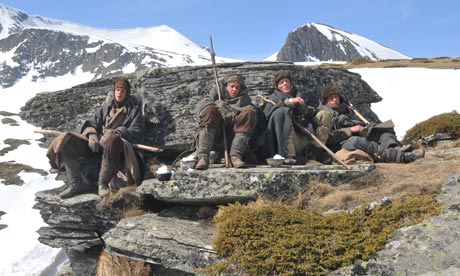
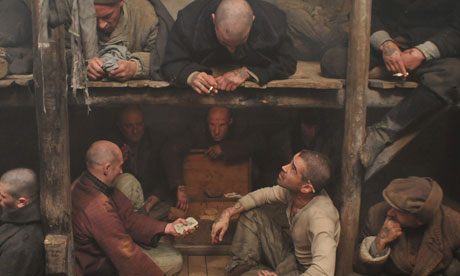
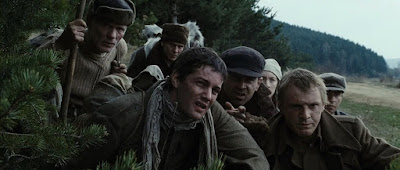
Janusz (Jim Sturgess) begins the film under interrogation in occupied Poland. The year is 1940.  He has been turned in (reluctantly) by his wife under torture, and he is sent to a Soviet gulag in the mountainous regions of Siberia. After a period of learning the ropes (and the whips of the guards and the barbed wire of the camp), he becomes a part of a loose group of prisoners of differing skills and supplies to make a fast surgical escape from the gulag and make their way to Mongolia. Based on a loose plan of prisoner Khabarov (Mark Strong), they plan to make it to Lake Baikalfollowing it to the Sino-Russian railway. Their supplies will run out in mere days, but Janusz is convinced they can live off the land, walking the entire way. Among the group of escaping stragglers are "Mr. Smith" (Ed Harris)—"First name: Mister"—a particularly mysterious American (he tells Janusz, "you have a weakness I can use: kindness"), and, as it seems all movie escape attempts must have, a plays-by-his-own-rules maybe-criminal named Valka (Colin Farrell). The group begins suspicious of each other, but soon forms a close-knit, surprisingly democratic structure, sharing ideas and resources, voting when they're at a crossroadsdespite the occasional individual insurrection.
Watching the movie is a slog. At 2 hours, 20 minutes, with the principal characters pushed to their endurance, the film feels longer than its running time, but one is never tempted to do a watch-check. The Way Back is one of those films that keeps you guessing, intrigued and involved every minute, like you were involved in the long walk, craning to see what is around every corner. Weir keeps the pace moving quickly, cutting scenes briskly from one episode to the next, so the film develops a natural rhythm.
But, it's the director's eye for detail—as always—that is striking, with scenes of stark, natural beauty that astonish: taking refuge in ancient caves, the camera pans up, following a bedraggled Mr. Smith's gaze, to two large holes in the ceiling, like the angry eyes of God; walking up a scrabble hill, Weir directs our view up and over the weary travelers to a screen-stretching shot of the expansive Gobi desert; at one point, they find a single solitary structure—a gate with no walls—absurdly marking their goal, while announcing another set-back.
It is a grueling adventure story with fine performances all around, interpreted through Weir's talent for keeping things real, even when they turn startlingly surreal. Go prepared for a tough movie, but a satisfying one, that, like all escapes, becomes a journey of the individual will and spirit, covering all manner of obstacles in physical space, mental discipline, and the longest journey...of time.

Saturday, May 27, 2023

Horrible Bosses

Saturday is traditionally "Take Out the Trash" Day. Written at the time of the film's release.

"That 'Strangers on a Train' Shit"
or
"It's Like a Douchebag Museum...!"

Office politics can get mean. Office politics can make you crazy. Office politics can get very, very messy (now, we have a movie that has all three!) However, I don't know many offices (outside the Post Office) where the politics can make you homicidal. Not even Congress.

But that's the situation in Horrible Bosses, which given the tough economic times, the high unemployment rates, and the relative lack of power suffered by your disappearing middle class, almost seems plausible. Documentarian/director Seth Gordon (The King of Kong: A Fistful of Quarters) has made a film that follows three rather hapless worker-buddies (who seem competent at their jobs, the events of the movie notwithstanding), as their job situations drive them to considering murdering their higher-ups. All three are unmarried (although Charlie Day's dental technician is engaged), so we're talking some arrested development here, especially considering Jason Bateman is one of the three and SNL's Jason Sudeikis is the third).

Bateman's Nick is up for a promotion, so he's been tolerating some abusive grooming tactics by his boss Dave Harken (Kevin Spacey, recycling his role in Swimming with Sharks), but doesn't get it when Harken takes the position himself.
Sudeikis' Kurt is also expecting advancement as an account manager at the chemical factory run by
Donald Sutherland, when Sutherland's character dies, and the company is taken over by his "Dipshit Cokehead Son", played by Colin Farrell (in a nicely over-the-top skeezeball performance, which seems to have been cut a bit—he's not in it much.
And Day's Dale is a tech for an
extremely aggressive cougar of a dentist (Jennifer Aniston, bless her) who is determined to seduce him (for some reason), and is incapable of anything more complicated than single entendres.
 
They decide that, rather than "Best Practices," going to "H.R.," or finding another situation, they'll merely cut through the red tape and go straight to the yellow—they're going to kill their bosses. So much for negotiating skills and being a "people person." This is what commiserating in a bar can lead to. The next bar leads them to Dean Jones (Jamie Foxx—playing it straight and dead-pan), an ex-con who goes by a common vulgarism, because "Dean Jones" reminds too many people of The Love BugNo wonder they want this guy to plan the executions.  Jones' suggestion is that each of the guys does the murder of someone else's boss (and dutifully, Alfred Hitchcock's Strangers on a Train is mentioned, as is Throw Momma From the Train, which is the red-headed step-child of the Hitchcock film...which reminds me that today is recycling day).
This cannot go well, and despite some laugh-out-loud moments, it does not, succumbing to "easy answers," and a "Deus ex machina." God's gotta be watching these guys, because they're so incompetent, they can't do anything right*...which leads us back to the recycling bin. Rummaging through, it is not too hard to see that this is The Hangover which itself is a new version of a Three Stooges movie, especially in the psychology of the three leads. Bateman plays Moe the strong one, Day is Larry the weak whiner, and Sudeikis is so meat-headed he can only be Curly. And while no eye-poking or face-slapping occurs, you just know that the insults and slow burns between the three are the passive-aggressive equivalent. And a lot less fun.
There are good moments—Aniston and Farrell are clearly having fun playing broad—and one of my favorite actor-characters shows up at the end (a little too briefly), but all in all, the face I wanted to slap was my own.
* This shoots down the premise of the movie: if these guys are so ham-fisted doing...everything...maybe they don't deserve the promotions they think they've been cheated out of. 

Tuesday, January 31, 2023

Crazy Heart

I'll have a review of Scott Cooper's direct-to-Netflix film tomorrow—the review of Cooper's Hostiles is one of the most looked-at articles on this blog (I've never known why—except for maybe the D.H. Lawrence quote about the American character that's mentioned in it). But, here's one—written at the time of this Cooper film's release, and there's a bunch of preamble about Oscar strategy (which seems to be spending too much time in the news-feeds lately).

"Breaking Bad"
or
I Used To Be Somebody, Now I'm Somebody Else
 
At the end of each filmic year, theaters are filled to their google-plexes with all sorts of movies. Because of the Holidays, there's plenty of people wandering around major areas of assembly with the occasional two hours to kill, so Christmas is as profitable a time to the studios as Summer. Every conglomerate pushes and shoves to squeeze in one more blockbusting crowd-pleaser to blacken the year-end red ink.

Then there are the films that have been positioned to impress the critics' societies and are launched into Los Angeles and New York, so they can be eligible for awards, most pointedly The Oscars. And in that sub-category, there are the waifs—the ones that open in those markets and take a little longer to reach Biloxi, because, frankly, the studios would rather launch heavier weights during the Holiday Crunch, then release the films they feel will have only a niche market, that might have a respectable run in the projection booth, before reaching a more sizable audience in the rental market. The reason they're there is for the Awards, and usually for an acting honor to someone who does consummately good work, but has never played a "disease" role, or worn heavy make-up to win. 
I'm talking about films like, recently,
Venus
with Peter O'Toole, Being Julia with Annette Bening, even last year's The Wrestler with Mickey Rourke. Earnest films with Oscar "buzz" for their stars, the kind that were mocked by Christopher Guest's For Your Consideration.
 
This year's it's Crazy Heart.
The story of an alcoholic country singer-songwriter, on a Southwest tour of what they call (in the biz) "toilets," merely reflects the downward spiral "Bad" Blake (Jeff Bridges) has put himself into. Perpetually boozed up, touring in the same old station wagon (old "Bessie") he used in the early days when he was more successful, his life is comprised of using things up and tossing them away—cigarettes, bottles of booze, ex-wives (five of them, maybe four, he can't seem to remember), he still has the talenthis reporter-inquisitor, a single mother (Maggie Gyllenhaal) from a Santa Fe newspaper that he begins a relationship with, says he can still toss off a song instantaneously that most people would struggle years to write—hasn't completely left him. But, that may be the last thing to go. He hasn't written a new song in years—the writing skills are there, but the inspiration has long ago moved on. It's one more thing taken for granted in a career that brought easy success that couldn't be maintained in the living of it.
The fur-bellied snark in me would say I'd been to this rodeo before in a fine film two decades back called
Tender Mercies, which spotlighted Robert Duvall (and in a mirror reflection, he has a small role in, and executive produced, this feature), and had more of a spiritual nature to it. There's no God in Crazy Heart (scripted and directed low key by Scott Cooper), as reality and responsibility is tough enough to fathom for Bad.
But it's a good movie for Jeff Bridges, who is always so good—his small part in The Men Who Stare at Goats was a comedic and dramatic gem, he being the only actor in it to quietly evoke deep sympathy, let alone belief—that he's always in danger of being taken for granted in the periphery of other folks' vehicles. This time, though, the spot-light's on him, and he's buttressed by a solid cast of actors lending their own mega-wattage to the brightness surrounding him. That includes Colin Farrell, buried deep in the credits to not attract attention, in a terrific performance that reflects kindly on his "mentor." Another nice thing is that T Bone Burnett and the late Stephen Bruton have composed clever, old-style country songs in the keys of both Farrell and Bridges, so they never seem less than authentic on-stage.
That extends to the story, too, which resists the epiphany lesser hands might have constructed. But like an old country song, the emphasis is on transitioning, rather than succeeding, maintaining rather than overcoming, in being rather than having dreams come true.
Sometimes the triumph is in recognizing what one's taken for granted for so long
 
Hope he gets that Oscar.*

* 2023 Update: He did. And Crazy Heart won for Best Original Song.

Wednesday, November 23, 2022

The Banshees of Inisherin

The Best of Enemies and the Worst of Friends
or
A Tall Tale About Small People Giving Their Neighbors the Finger...
 
Banshee—"hence bean-sĂ­ghe, plural mnĂĄ-sĂ­ghe, she-fairies or women-fairies, credulously supposed by the common people to be so affected to certain families that they are hears to sing mournful lamentations about their houses by night, whenever any of the family labours under a sickness which is to end by death, but no families which are not of an ancient & noble Stock, are believed to be honoured with this fairy privilege"
 
The island of Inisherin sits off the West Coast of Ireland, close enough to hear the cannons from the Irish Civil War over the expanse of water that separates the conflict from its citizens (at least in 1923, when the film, The Banshees of Inisherin, takes place). One would think it was a peaceful respite for its denizens, which contain many Irish folk and the animals in their keep and their trades. But, as close as they are to the fighting that couldn't be further from the truth.
Take PĂĄdraic SĂșilleabhĂĄin (Colin Farrell), for instance. A local milk-man, he has a stable farm with cows, a horse, and a donkey named Jenny on whom he dotes and allows too much domestic privileges. At least in the mind of PĂĄdraic's sister, Siobhan (Kerry Condon), who has shared the farm's duties since their mother and father passed many years ago. PĂĄdraic makes the rounds, then, like clock-work goes to see his neighbor Colm Doherty (Brendan Gleeson) promptly at 2 pm, where they will proceed to O'Riordan's pub to quaff a pint (or three) and Colm entertains with his fiddle. At least, that's the way it's always been for as long as things have been.
Except for today.
PĂĄd goes down to Colm's shack of a place and sees him inside smoking. He tells him he'll meet him at the pub later, but Colm doesn't even acknowledge him. He goes home and Siobhan is surprised he's not gone off drinking with Colm. PĂĄd tells her what's transpired and immediately has a question and an answer: "You been rowin'?" "I don't tink we've been rowin'! We was fine yesterday!" "Well, maybe he doesn't like you anymore!" she scoffs. He blusters back to Colm's and sees the door's open, Colm's gone and, well, there he sees him, off in the distance, heading for the pub. By himself.
At O'Riordan's,
PĂĄd sees Colm and confronts him. "Sit somewhere else," Colm says without looking at him. It's a clear rejection, and PĂĄd schlumpfs off to an outside table to stew in his beer. Colm finally has enough pity to come out and explain the situation, but it's no comfort. "I just don't like you no more," he puts it bluntly. He finds PĂĄd dull, talking about the minutiae of his life that Colm just isn't interested in...at all...not at this point in his older life. He's concerned now about legacy and his fiddle-playing and PĂĄd's harping on his donkey and his life is just on another plane of existence now...a far lower plane, and as his days get shorter, he has fewer hours to waste.
PĂĄd just doesn't understand. "How am I different from yesterday?" And it being a small isolated island, everyone starts to get involved, even PĂĄd's sister. "He's ALWAYS been dull!" she shouts at Colm. "But ya live on a feckin' island off the coast of Ireland! What are ya hopin' for?" Colm starts to get it from all sides, even the local priest—who's just as prickly and easily offended as the rest of them. Finally, Colm has had it. He draws the red line. He has a pair of sheep shears. "Each day you talk to me, I'll cut a finger off and give it to you." Which is madness; he's a fiddle player and his fiddling is uppermost in his mind right now.
But,
PĂĄd just can't...and won't...let it go. He's a man who keeps chewing long past he's swallowed and he's lost in the squirrel-cage of his mind. On a small "feckin'" island what else does he have to do? Alcohol doesn't help with any restraint. And PĂĄd starts to see himself in a different light. "I thought I was one of the nice guys!" he grieves when a confrontation sees Colm cut off index of his fingering hand and throw it at the SĂșilleabhĂĄin door. And he is. But, outside forces are starting to change him and his behavior and his opinion about his behavior.
If only he'd consider the lilies of the field. Or better yet the animals that co-habit with the Inishereens. McDonagh, the director, has them as a silent chorus throughout the movie, doing their jobs and not complicating matters. Like the singular deer in Three Billboards Outside Ebbing, Missouri, they are silent witnesses going about their business while the bi-pedals mess things up. Even the gun-reports from the Civil War don't phase them. I found myself in sympathy with the animals, especially a random shot of goats with one facing the camera as if asking "What the...?"
The Banshees of Inisherin may well have been inspired as a result of the Covid-19 pr
ĂĄcĂĄs and its long periods of forced isolation and the fevered carousels of people's minds running without brakes (or consideration) without any one around to slow down the ponies. Little things become big issues and they can escalate to the point of irony and beyond to the absurd. Self-fulfilling prophecies and being our own worst enemies should have been among the list of symptoms for humans who either don't think or think too much. Even with disaster looming like some hectoring banshee because we think we know so much, when we don't even know what we don't know.
So,
The Banshees of Inisherin is going to stay with me for a good long while—even if it sounds depressing and dark, one should see it for the brilliant performances, particularly of Farrell and Gleeson and Barry Keoghan's turn as the village not-quite-so-idiot ("i'm agin' 'em—wars and soap"), with its O. Henry sense of black irony of how red lines can be as thin as skin and how crossed swords turn quickly to crossed purposes. But, also, how even in the worst circumstances, there can be small moments of grace like a rainbow piercing a cloudy day.

Tuesday, May 3, 2022

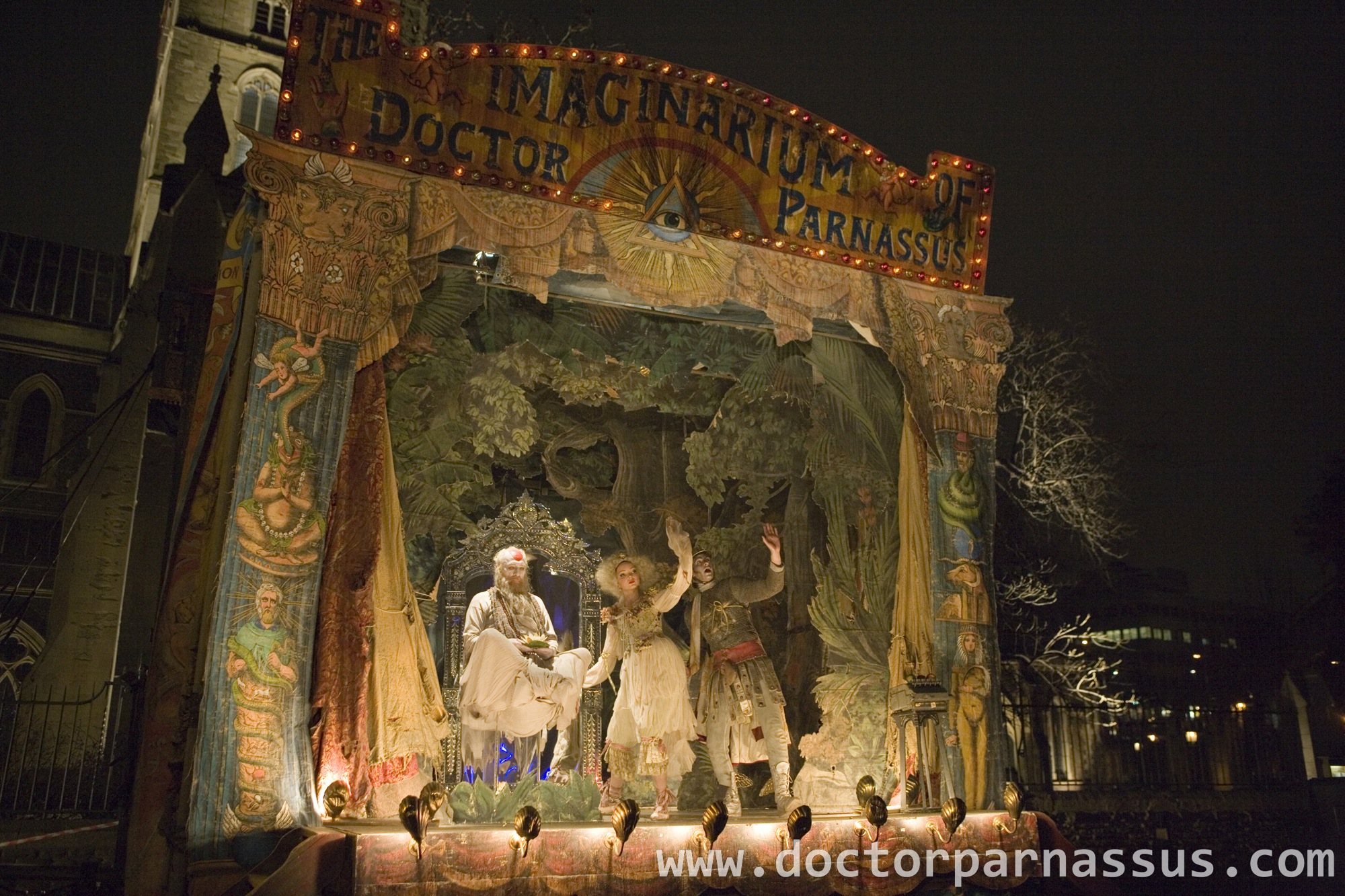
The Imaginarium of Dr. Parnassus

Written at the time of the film's release...
 
And...at the time Avatar had come out and marching towards becoming the "#1 Box Office Champion of All Time." I was underwhelmed by it—there's a link to my review buried down there if you even care. On the other hand, nobody was going to see this film, which, as you can tell if you read it, I found a shame. One can advocate, but people are going to see what they want—it's their money, after all—and it's all a part of the free market (or as some would label it, "cancel culture"—the Supreme Court seems to think what you do with your money is free speech, even if you're paying for it). But, just as I quixotically advocated for The Imaginarium of Dr. Parnassus, I would also urge people to see the wonderful Everything Everywhere All at Once, which, in a multi-plex of less imaginative offerings has far more bright ideas and film-making brio than the rest of the offerings in said multi-plex combined.

"Ladies and Gentlemen, This World is Full of Wonderment for Those with Eyes to See it."
 
 
One must consider the momentum of publicity when one talks about James Cameron's Avatar. The tsunami of NewsCorps force-fed publicity and societal group-think has done its job on the populace and the majority are of one mind. At this point, I've heard too many smart people saying that nobody will ever make movies the same way again, that it's ground-breaking, and (okay) the story isn't much, but the visuals are so spectacular it compensates for the stunning more-of-the-sameness of the blah-blah-blah.
 
You don't know what you're missing. There is more imagination, thought and, gosh, genuine wit going on in the "mirror" sequences of The Imaginarium of Dr. Parnassus than in anything in Avatar. Hell, even the non-CGI "live" sequences are amazing to look at.
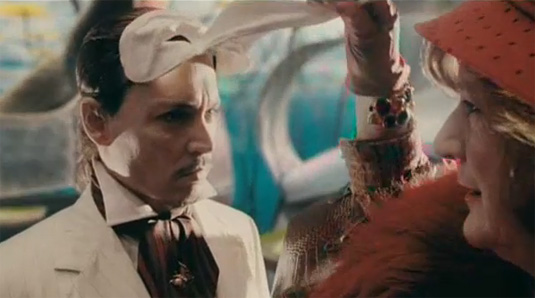
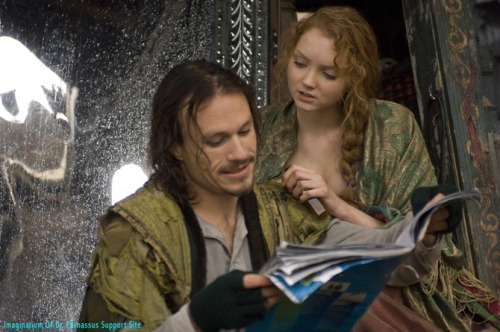
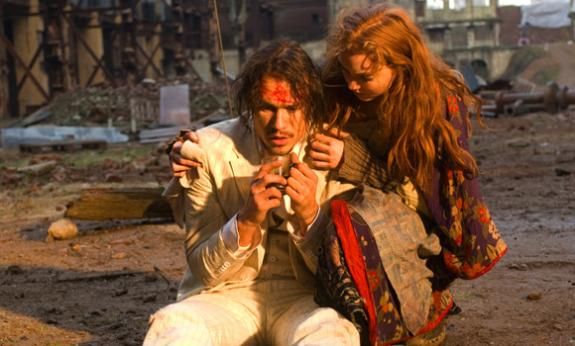
But...nobody's lining up to see Imaginarium. And that's a shame. For, if you want a fantasy film brimming with ideas, some of them quite provocative, it is this one, directed by that most snake-bit of directors, Terry Gilliam. It has been abundantly documented ad nauseum the tragic story of this film: how star Heath Ledger died in the middle of filming, and how a corps of Ledger-Gilliam supportersJohnny Depp, Jude Law, and Colin Farrell—stepped up to play the visages of Ledger in the "Imaginarium" sequences (actually it seems perfectly natural the way Gilliam does it), but what isn't reported is that Gilliam was hit by a bus and broke his back during the filming.* Despite these alarming developments that would halt anyone other than a crazy "Monty Python" alum, the film is rich in detail, bursting with context, and doesn't have that "scrimping" footage-stretching feel that so many films-in-trouble give off.
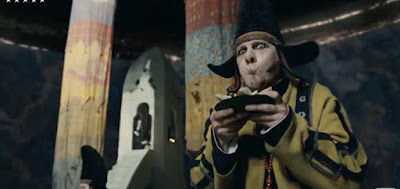
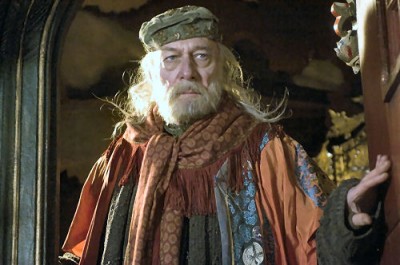
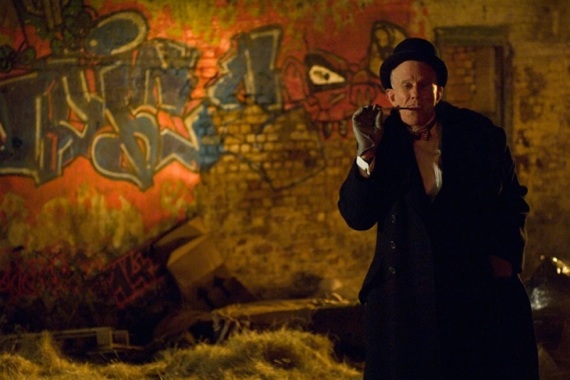
It's basically a fairy-story set in our world (or a delirium dream, not sure) where Dr. Parnassus (Christopher Plummer) is an immortal, who, with his rag-tag theater troupe—assistant Percey (Verne Troyer), barker Anton (Andrew Garfield) and daughter Valentina (model Lily Cole, whose alarming face is that of an alabaster porcelain doll)—travels in an out-sized Bergman-crossed-with-Joad horse-drawn wagon/convertible stage, enticing marks to enter his "Imaginarium," a mirror that sucks the hapless into Parnassus' bizarre mind-scapes, where they either live...or die. Parnassus, you see, has made a deal with the Devil. Inhabiting the old man's mind, as he does most of ours, is Mr. Nick (Tom Waits...of course), who has his own lures to the impure of heart. Enter one of Nick's speak-easy's or one-night-stand motels that stick out like sore toad-stools in the landscape and BOOM! the Devil takes your soul. And the bottom line of the Devil's deal is a certain number of souls before Valentina's sweet 16th birthday ("The age of consent" she trills) or her day of freedom becomes her day of imprisonment, as the Devil claims her for her own. A situation as Grimm...and familiar...as can be.
But Gilliam's Devil is in the details. The little band are aided in their quest by an amnesiac named Tony (Heath Ledger) whom they save and who, in turn, tries to save them, but whose past comes back to haunt and threaten them. Ledger is at his quick-silver best here, his accent wavering through several dialects, his eyes darting (all qualities picked up by his capable alter-ego's), for Tony is a chameleon, a huckster, the trickster of Myth—which Gilliam uses to savage satiric effect—and is a devil of his own, capable of destroying what he seeks to save. The battle between Good and Evil, Duty and Temptation turns complicated, and Parnassus must bargain again, at great sacrifice, to save that which he loves most, whether it's wished for or no.
The Devil's in the details for the look of the film, too. The "real-world" that the "Imaginarium" wagon trundles through is our world, but it's a world of extremes: back-alley garbage-lands with trash-fires that litter the scene (where the rag-tag group seems to fit most) and vast temples of commerce-malls, where Tony, with a marketer's zeal attempts to bring new customers. Each of these victims have their own "Imaginarium" realms: a wealthy dowager emerges into a vision of giant fashion-shoes, another a 2-D pop-up book forest. At one point, a falling "Imaginarium" customer takes an incredible fall, and Gilliam cuts to an improbable "Python" joke—a giant thumb-tack—sitting in the middle of nothingness (Gilliam mercifully, for the moment, has the hapless mark miss the point). And even outside the mirror, there are wonders of movie-making brio. In a scene where Percey walks away from Parnassus with his usual bluster, Gilliam shoots the diminutive Troyer at a heroic looking-up angle—the camera had to be scraping the street.
Now, a confession. It may sound like I'm gushing about Gilliam here, but I've always had a problem with his films: I fall asleep through them. It's not that I'm bored, but there's something about the richness of detail, the constant flow of new things to look at, and the murky lighting that induces narcolepsy in me. Before seeing a Gilliam film, I try to load up on coffee and sugar to get through it. I have no idea why this occurs (maybe it's
Rapid Eye Movement caused from the orbs darting about the screen), but it is inevitable—it occurred here through the Jude Law sequences
—but I managed to keep my eyes open throughout the whole thing this time.
If the film is flawed, it is that it tries to do too much. Even with a simple story, derived from old fairy-tale tropes, Gilliam again attempts to fit 10 pounds of story into a 5 pound film. Complications begin to pile up, revelations are delayed, little troubling details are revealed—there's a convenient pitch-pipe here—and everything becomes resolved in an ambiguous and hasty manner. Like most Gilliam films, a second viewing may make murky matters clearer. 
Plus, the overall story has a premise open to interpretation...
is it a "God versus Devil" story, or merely a fairy tale? The Christian Science Monitor's Peter Rainer thinks it may even be autobiographical with Parnassus a mask for Gilliam, "a mad dreamer forever riven between his imagination and the necessity to sell it."** And like his "Python" fraternity, there's a streak of dark running through this, as with all Gilliam films (remember how Kevin's parents are killed at the end of Time Bandits?), that may be off-putting for some viewers. Fans of Gilliam's films should expect it, but those who prefer their fantasy milkier may not like the taste of the dark stuff. Avatar is far less subtle, more a punch "on the nose," and although dark, gives the impression of a happy-ish ending.
So, it is doubly appropriate that Imaginarium brings me back to Avatar. For what is Gilliam's film but a re-working of the caution "You can fool some of the people all the time, and all the people some of the time," and that includes the Devil, but the Devil gets his own.
What's Gilliam's next movie? Well, he's determined to go back and film his
Don Quixote movie, come hell or high water.*** It is only appropriate for this most quixotic of film-makers, forever charging against the impossible odds at realizing the incredible visions wind-milling in his head.

* Here, the endlessly inventive Gilliam made lemonade—convincing the bus company to provide transport rather than face a law-suit, thus saving lots of production money. And, if all of this wasn't enough, producer William Vince died right after filming. The film is dedicated to Ledger and Vince, and credited as "A Film by Heath Ledger & Friends." 
 
** Nice observation, that. But Rainer also thinks Ledger looks "dispirited" in the film--well, yeah, the character's just gone through a painful transition, but Ledger's performance of it is never less than audacious and energetic. I'm guilty of it, too, but critics shouldn't try to read actor's minds--they're chameleons, after all, when they're doing it right, and we should speculate cautiously when ascribing motivations to surface appearances on film.
 
*** He did. The Man Who Killed Don Quixote was released in 2018.

Saturday, April 16, 2022

Total Recall (2012)

Saturday is traditionally "Take out the Trash" Day

Written at the time of the film's release...


You Don't Know Dick (Philip K.)
or
I Can Misremember It For Your Wholesale

The reviews that I've seen for the new version of Total Recall have not been kind. Rotten Tomatoes, that fine aggregator/cuisinart of opinion, put it on "puree" when it said "While it boasts some impressive action sequences, Total Recall lacks the intricate plotting, wry humor, and fleshed out characters that made the original a sci-fi classic."

Huh? What the wha...?
 
Maybe I'm in Rekall right now and this is all some elaborate alternate reality, but my vivid memories of the Schwarzenegger Total Recall (made 22 years ago by that "master" of intricate plotting, wry humor and sub-tle human interactions*, Paul Verhoeven) was of an R-rated Sci-Fi gore-fest, light on "Gee-Whiz" and heavy with Cheese-Whiz, that seemed to mark the limit to how much Arnold could contort his face.** The one thing I remember being amusing was Sharon Stone as Doug Quaid's wife, in an arch performance that basically made her a star.***
This "re-imagining" (if you will) has Colin Farrell as Quaid,**** working on an assembly line for synthetic security forces—robo-cops (although they more resemble—and collapse just like—the battle-droids in the Star Wars prequels).   The elaborate set-up has the world decimated by chemical weapons making the world inhabitable on only two islands, Britain and Australia. The most precious commodity, thus, is living space, and the commute from one to the other is a tough one, a high-speed transport through the Earth's core—the shortest distance between two points being a straight line (would really have hated to be a construction worker on that project!). 
Anyway, Quaid is beset by dreams of running, chasing, shooting and loss, waking up in a cold sweat to find himself sleeping next to Lori (Kate Beckinsale, a fine actress—remember her in Branagh's Much Ado About Nothing—who is going to be stuck in kick-ass roles as long as Keira Knightley, Michelle Williams, and Carey Mulligan are alive), who works for security for the United Federation of Britain, and its leader Cohaagen (Bryan Cranston), which begs the question: Where's the Queen? And begs the question: she's married to a factory worker?
But if we start picking nits we'll be here until the time the movie's set in. Leave it that there are plot-holes larger and deeper than the one running through the planet, and it all begins when Quaid decides to go to the Rekall facility in his local city (which I believe is Great Britain, but owes a lot to Ridley Scott's Los Angeles in Blade Runner...and Spielberg's D.C. in his own version of Dick's Minority Report), a divey section of town with a yen for Chinese decor. Basically, he wants a spy fantasy, where there are double identities, secret plots and no one can be trusted.
He gets it, but whether it's reality or a drug-induced fantasy he has no way of knowing.  Something goes horribly (horribly) wrong, and by the end of his session, all the Rekall technicians are dead, as well as a dozen security forces, who burst in (pretty quickly, too) and whom Quaid overcomes in a single-shot, digitally-tracked shot that resembles a first-person shooter game.
Which is what this movies is, essentially—game scenarios, one after the other, trying to get to the next level. It's not that this Total Recall is anything less than competent. It truly is, and the cast is fine and all. But, it's never anything more than that, there's nothing very inspired...except from other sources, movies and video-games, mostly,
***** and tangential stuff at that.
But, although attempts have been made to make it sleeker and faster-paced, there is no attempt to make it better or develop themes that the first film dropped for kinetic thrills. When you're dealing with alternate realities, why leave it at one? Why not keep the audience on edge on what's true? Why not make the stakes a little bit higher, so there are more consequences (like what this movie hints at in an early scene) for Rekall users, so there's more at risk than physical pain? This is Inception-material, but on only one level, and it's a sub-level at that. The potential was there to do more, but, instead, it's more of the same.
And Len Wiseman, the director of this, and the "Underworld" films, seems not to have much ambition for the "new." It's a few films in now, and one can say that he's not aspiring to much, other than keeping both the budget and the pace high. It's not so much directed, as art-directed, full of detail to distract from the lack of depth—highly finished, but with a sub-standard foundation. There was so much that anyone could do with this material to make it rise above the first one, rather than just make it worse.
"But, I don't WANT to be in a bad Schwarzenegger movie!"
"Vhich one: Jingle All the Vay or Last Ahction Hero?"

* ...usually involving fists, but in this case involving anything that could penetrate a human torso or face. This one was a particularly nasty exercise in excess, and I remember Schwarzenegger shilling it on Entertainment Tonight: "Yah, It's a GREAT FAMILY moo-vie, Bring the KIDS!" I was horrified to see that some idiot-parents actually did, and those kids have probably been in therapy for a couple years now.

** ...without  special effects, anyway.

*** It put her on the path, anyway, as Verhoeven was so impressed with her that he cast her in Basic Instinct, then she was a star in a flash.

**** A better match, I think, than Schwarzenegger. Farrell is more relatable, and you could see him as a factory worker, which makes the concept—which is telegraphed and anticipated to the Nth degree in both films—work a bit better. Schwarzenegger can't be believed as a factory worker—he's too much of a "800-pound gorilla in the room" to be hiding in such plain sight. The original concept...and casting...had someone like Richard Dreyfuss in the role. Now, THAT would have been fun, and surprising.

***** A lot from the first film, of course, but it's weird stuff—the plaid pattern that Quaid wears at some point, the woman in the transport station—there to fake out only the audience that had seen the first film—and the triple-breasted prostitute (probably because it's what the geeks remember...and want). All of which will bring me to an up-coming point...