Showing posts with label Sci-Fi. Show all posts

Tuesday, July 22, 2025

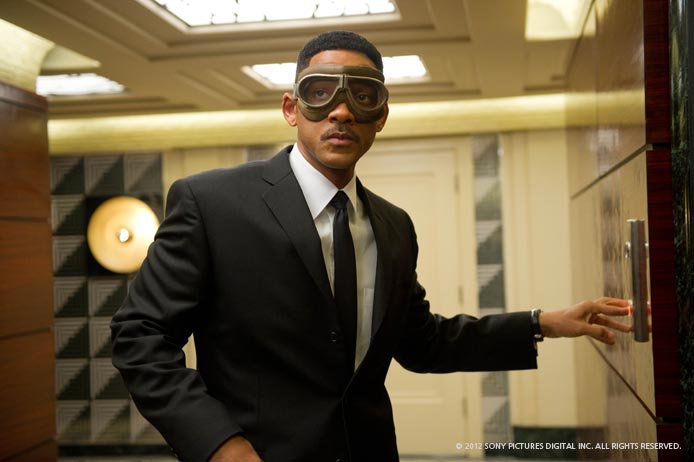
Men in Black III

Sunday was International Moon Day (yes, that's a "thing") commemorating the date that human beings first put boot-treads on the Moon. That historic mission figured fictionally in this movie.

Written at the time of the film's release. 

Time Wounds All Heels
or
"Don't Ask Questions You Don't Want to Know the Answer To..."

The third "Men in Black" film had to go somewhere else but up. The first two films were variations on the "illegal alien" theme about a government organization that monitored the activities of extraterrestrials in the world and specifically New York City, and revolved around alien invasions and the containment of said aliens. And when you've seen one alien invasion directed by Barry Sonenfeld, you've seen them all, and hyper-kinetically at thatAnd once it's been established that "aliens can be anywhere" the joke runs a bit dry pretty quickly, especially when the sub-species can contain pug-dogs and large cockroaches. The second film tried to expand on those concepts and felt a bit thin in the process, concentrating a bit too much on the secondary characters rather than the basic plot and the character interactions.

So, where does Men in Black III go from there?
One of the nice aspects of the series has been its ability to still think outside the box, while expanding the horizons of just what that box might contain, be it variations of scale and dimension, even if only in afterthought. With the infinite reaches of space seemingly exhausted, the group (based, supposedly on an idea by Will Smith) has the series going back in time. Naturally. It ostensibly revolves around an Earth-takeover plot by another alien (one must ask at some point "why always us?"), "Boris the Animal" (who seems based on the DC Comics "Hell's Angel in Space" Lobo and is played with growly gutteral responses by Jemaine Clement from "Flight of the Conchords") who escapes from his maximum (and we mean maximum) security prison to find the man who sent him there 40 years ago—Agent K (Tommy Lee Jones). When he's unable to kill him here, the Boglodite finds another means to do so, and Agent J (Smith) wakes up the next morning, the only one with any memories of K past July, 1969. Agent K has been killed by Boris in the past, and J must journey back to try and save him.*
Once back there, J negotiates his way through a 1960's era way of doing things. Everything's a little less high-tech (a little less), but the MIB Agency is still there, as is the much younger Agent K (Josh Brolin, doing a bang-on interpretation of Jones) and J must solve the puzzle of saving the Earth (of course), while keeping K safe. The past sequences are greatMen in Black has exploited the "fish-out-of-water" angle perpetually—and new corners are being thrown out the whole time (My favorite being a brief glimpse of a "Barbarella"-type being escorted around MIB, and although Smith is a bit too "Red Bull" throughout the entire movie, check out his understated reaction to some Black Panthers). 
Great cast, too. Rip Torn is gone, but David Rasche plays him in the past, Emma Thompson is on hand as the new MIB head, Will Arnett makes a brief appearance as does Bill Hader. Toss in the chameleon-like Michael Stuhlbarg as an alien able to read multiple time-lines and there's always someone to deflect the eye, or hand things off from Smith.
But, the best thing about this "Men-in-Black" installment is resonance. The other two were fine, the first better than the second just for its novelty, but had a shelf-life of three minutes. Part of it is Sonenfeld's way of comically undercutting any meaning to the thing, by changing perspective—"you think you got a handle on it yet? Well, let me throw THIS at you!" The whole "the Universe is so big and cosmic that there's no way you can understand it because there's so many mysteries, so nothing is real" concept, which is the backbone of the series (and the source for most of its humor) leaves one with a feeling of "meh"—nothing matters in a vast uncaring, unfathomable Universe. 
Not here. The cold of Space has nothing to do with the leavening of Time, and, in this case, the franchise plays it straight, without a wink, a nod, a reveal, or a goo-spraying splat. For once, something really means something in the "Men in Black" Universe, and that venturing into uncharted territory makes the third time the charm.

  * I'm not saying anything here that isn't revealed in the trailer.

Saturday, March 15, 2025

Marooned

Saturday is traditionally "Take out the Trash" day.

Marooned
(
John Sturges, 1969) Martin Caidin's book "Marooned" presented the dilemma of an astronaut stranded in Earth orbit in a Mercury capsule whose retro-rockets—designed to slow its speed and have it fall back to Earth—failed to fire. That astronaut was doomed to remain in space—although eventually, in years, its orbit would decay enough that it would re-enter the atmosphere on its own—until his meager supply of oxygen ran out and he suffocated. As a book, it was merely okay, taking into account the logistics of actually spending the money and disrupting testing schedules and safety protocols over one man's life. 

There have been some close calls. The accidents of both the American and Soviet space programs are well-documented, and Apollo 13 came within a cat's whisker of skipping off the atmosphere on its return journey after an explosion disrupted their oxygen and power supply. But, no being—since the days of testing capsules with animals—has ever been stranded in space. Technically, it happened June 2024, when two astronauts, who were supposed to only spend 8 days up at the International Space Station, had to abandon their return, and have been up there ever since. Supposedly, the new "rescue" mission was supposed to launch this week...but it's been postponed.
Now, a movie was made in 1969 based on author Caidin's book, but, by the time of its release, the space program had advanced enough that there had already been one manned landing on the Moon with another scheduled days away. So, they looked at future NASA plans—one of which would be called Skylab, a low-tech space station using a spare third stage rocket casing as the orbiter—and based the fictional "Ironman One" mission of Marooned on that. Three astronauts (
Richard Crenna, James Franciscus, and Gene Hackman) go up in their capsule to rendezvous, dock and spend seven months on their ersatz, roomy space station, but when Hackman's character gets a little space-woozy after just five months, everybody decides it's time to come home and *pfft* the retro-rockets don't work. Oh, the little green-light that says they're working is on ("We're gonna decorate it for Christmas!" the commander cracks). 
Now, the easiest solution is to get back to their little crude space-station which has plenty of oxygen—their space capsule having a limited supply—but since their big engine won't work, it makes it a little out of reach, space-wise. They have maneuvering thrusters, but they don't have the oomph to do anything but spin the space-craft around. So, NASA has to figure out a way to get their astro-boys back before the air runs out in 42 hours. And that's where the proverbial pooches really get screwed. Oh, NASA's good at schedules, and launch-windows, and prepping enough Tang, but when it comes to seat-of-your-pants Hail Mary plays, well...let's have a meeting about that.
Thank God, that Charles Keith (
Gregory Peck) is, as he likes to tell everybody "head of Manned Space," and as soon as you say "Houston, we've got a problem" it's his problem, too. The thing is, after looking at all the read-outs and not being able to repeat the problem with a similar retro-rocket on Earth, he's ready to give the "it's a risky business, and we will go on in their name" speech, he's told by Astronaut Lead Ted Dougherty (David Janssen)—who's "head of Space Man," I guess—that they should launch a rescue mission with an unproven booster, an untested vehicle prototype and with a hurricane bearing down on Florida and do it in 42 hours. What could go wrong?
But, before you can say "hand me those frozen "O"-rings, Keith shoots it down as being too risky and could only make a bad situation worse. That's when he gets a call from the President—it was Nixon, at the time—who says "Make a bad situation worse? I'm all for it!" Daugherty starts training for the mission—it should be the remedial lesson to save time—but, God turns the hurricane towards Florida, delaying the launch, which leads to the decision to launch when the eye of the hurricane is over the cape. That's some precise hurricane. But, the delay will mean that the trapped crew's oxygen supply will run out.
That is, the oxygen supply for three astronauts. Two might just make it. So, Keith gets to make one of the most cringe-worthy conversations in the history of space movies:
 
Charles Keith: Jim... how do you uh... how do you evaluate... the oxygen situation? 
Jim Pruett: Um... Well, we have whatever oxygen's left in the spacecraft system. And, there are only, uh... two bottles of emergency oxygen on board, five minutes each, that's uh... ten man-minutes. Um... my backpack, and uh... Lloyd's and Stone's, but um... there's not much oxygen left in them.
Charles Keith: Well, you'll have to save your backpacks for the EVA transfer.
Jim Pruett: Yeah I know that. 
[pause] 
Jim Pruett: 55 minutes, 
[longer pause] 
Jim Pruett: we'll be dead by then. 
Charles Keith: Well, only if you... continue to use oxygen at the present rate...
Jim Pruett: Well, uh, we can't cut down. 
Charles Keith: Let's... think about that... 
Jim Pruett: Do, uh... do you want us to lower the partial pressure again? 
Charles Keith: No, we've examined that, it won't work... 
Jim Pruett: Well we're lyin' here like corpses now... uh... what else can we do?
Charles Keith: You must... think... 
[astronauts exchange glances, realizing the unspoken implication of Keith's statement] 
Jim Pruett: Yeah, we're... thinkin'... 
Charles Keith: Are we talking about the same thing? 
Jim Pruett: Yeah. 
Charles Keith: Why don't you... talk it over. If you could... work out something... it would be of great help... 
Jim Pruett: Yeah we'll talk it over.
Charles Keith: I must point out Jim, that any *effective* action must be taken immediately... 
Jim Pruett: Look, don't tell me what to do! We've been takin' your god damned orders and where the hell are we? From now on WE'RE gonna make all the decisions! Whatever we do, you're OUT OF IT! 
Charles Keith: Oh I uh... appreciate what you're saying Jim... and I agree with you... You're exactly right...
  
MAD Magazine (#138, October, 1970) had a field-day with that dialog:
As a "space-kid" growing up, eyes glued to the television every time a space mission happened, this seemed absolutely ludicrous (we hadn't had a death in space yet, only during training, and NASA's lucky streak on their space-flights was nothing short of amazing, but you couldn't tell me that). I was already sitting in my seat, arms folded tightly across my chest with a scowl on my face as the depictions of the vehicles in orbit around the Earth wouldn't have passed muster as a "simulation" the networks always used when they didn't have "picture" for what was happening during their coverage (and that was pretty dicey, even though it inspired the movie Capricorn One and hundreds of resultant conspiracy theories).
Look, I was 14 and that's an age when "fair" is a foreign concept. But, Marooned was released a full year after 2001: a Space Odyssey, with its pristine special effects, and I considered this movie one giant leap backwards. Nothing looked right, or even realistic. The space hardware was pristine, no wads of aluminum foil hanging off the ships (used to reflect sunlight and heat at the time), no wear-and-tear, and they resembled the older Aurora models I used to cement together, in fact, I could have sworn at the time I saw glue on the obvious seams of the Marooned ships. These days, I'm more charitable, but back then, I considered the movie "a travesty"—big word for 14!—but, I told my Dad I liked it...hey, he took me to the movie. I was a punk but I wasn't an ingrate.
And the thing won an Oscar for special effects. Granted, it's only competition was Krakatoa: East of Java (and, as we all know, Krakatoa was WEST of Java, so those were some pretty special effects!). You think you've got a gripe with your favorite picture not winning an Oscar? I've got you beat. I'm torqued because this one DID win an Oscar.
David Janssen flying out of the eye of a hurricane.
Marooned has one big Legacy feature: it's the most expensive, star-filled movie ever to have been featured on "Mystery Science Theater 3000" (albeit in a truncated form entitled "Space Travelers") as the first episode of their fourth season. This is the version of the movie that I prefer to watch.
So, the stranded astronauts still in orbit dredged up the memory of this movie. And I've read a lot of pearl-clutching and rending of garments over their fate, being stuck in orbit floating around Earth with plenty of food, water, oxygen, and the best view in the Solar System. You want to know how the astronauts who've been marooned on the ISS feel about having to stay when they were only scheduled for 8 days? NPR interviewed another member of the astronaut corps and her reply was telling: "Well, I can tell you what the rest of us astronauts down here feel—we're jealous!"
 
Now, that's The Right Stuff. 

Mickey 17

Essential Worker
or
"Go Ye Forth and Multiply"

Mickey Barnes (Robert Pattinson) has a sketchy past-he has an issue with a loan-shark-and so he wants to get off-planet as soon as possible. Fortunately, there's a private mission to the planet Niflheim that has been spear-headed by a former Senator Kenneth Marshall (Mark Ruffalo) to form a colony where he's the Supreme Leader (Marshall has lost his last two elections and no doubt wants to leave democracy behind). Mickey, seeing the long lines of potential volunteers for the exploration flight, volunteers to be an "expendable"--a low-level worker position that no one wants, mostly because the fine-print is egregious, saying that he can be assigned guinea-pig positions that will probably kill him, at which point he will be "re-printed" body and mind, his memories downloaded into the new Mickey. In the 4.5 years it takes to get to Niflheim, he's died and been re-manufactured 11 times. Once land-fall occurs, Micky dies a few more times testing the environment and the various vaccines for the planet's endemic diseases, before anyone else is allowed out in the glacial environment. And, at the time of the movie's start, he is Mickey 17.
But, at the movie's start, that won't last long. 17's fallen into a crevasse in the freezing cold, nothing's broken, but there's no way he can get out. His co-hort from Earth, Timo (
Steven Yeun), has a job as a pilot and he could rescue him from his predicament...but, hey, why bother? They're just going to make another one, anyway. He leaves with a genuine "Hey, nice knowing you. Have a nice death." And a question everyone asks, "Hey...what's it like to die?" After all, Mickey's had experience.
I won't give too much away, but 17 survives the fall and the cold and is only too happy to get back to the base-camp where he gets a bit of a shock. Despite the lack of protocol and general laxity of safety conditions—especially in the science department—it seems they're very johnny-on-the-spot (or one should say Mickey-on-the-spot) for replacing their expendable: another Mickey has already been re-printed, who, of course, is Mickey 18. Because cloning is not an exact science, 18 is a bit more aggressive and less forgiving than his predecessor (hey, he's young, having only a few hours of life to his credit). But, the two have an immediate problem: duplicates are illegal in the colony and so, they it's a literal case of there not being room enough for the two of them, which makes both Mickeys beside themselves.
One of them, then, has to go. Although they basically have the same brain, they are of two minds on the matter. 18, of course, says that because 17 is considered dead, he's overstayed his welcome and he needs to die; 17 considers 18 to be unnecessary and superfluous and so he should be the one to die. Neither one of them wants to have a twin—do they split their rations?—and, besides, Mickey 17 has a girlfriend, Nasha (
Naomi Ackie), who's one of the base's security forces, and although she's intrigued with the possibilities, neither one of the Mickeys are into open relationships.
The problem is, the question of who lives and who dies is out of all of their hands—duplicates are illegal and if it's one thing former Senator Marshall is consistent at it's in following the rules that he's put in place (and that's just about the only thing he's consistent about other than maintaining absolute power over the colony). This puts Nasha and the two Mickeys in conflict with the social order and their functions, but, hey, movies need conflict and there's quite a lot of it in Mickey 17.
It's clever, entertaining, and adaptor-director Bong Joon Ho (he of Parasite, Mother, and The Host) has created another of his intricate little "trap" movies where you wonder where he might be going with it, but it's less devious then his previous films, and suffers from a "Chekhov's gun" situation which makes the resolution of the film feel slightly telegraphed and less of a surprise than in previous work. There are a couple superfluous characters (besides the extra Mickey) and one sees a trope (let's be kind and call it "inspiration") from an early "Star Trek" episode that makes it seem overly-familiar. That's a slight disappointment. 
And he gets entertaining work from his cast—Pattinson plays dual roles, of course (actual multiple versions of the same character), and, dang, if you can't tell the two of them apart merely by his playing of them, and Ackie has never been more kinetic as she is here. Ruffalo and Toni Collette (playing Marshall's Lady MacBeth of a wife) play it broad, but then, the characters are broad, as most autocratic figures are before they fall into the self-destruction of self-parody.
That broadness will, no doubt, raise hackles in some quarters, but those hackles are always on the alert, anyway. Best to look at the more subtle statement Mickey 17 is making about the irony of "essential workers" being regarded as the most disposable in business and governmental circles. Twas ever thus, whether it's in war, shirtwaist factories, or food-processing plants during a pandemic, this "dammit-I-can-have-it-both-ways" canard of the powerful sees far less exposure than it should. I'd like to see more of it, if only in the public interest.
 
The novel on which Mickey 17 is based has a sequel called "Antimatter Blues", but if it gets made into a movie, I'm sure they'll call it Mickey 19.

Wilhelm Alert @ 01:17:00
 

Sunday, March 2, 2025

The Substance

Substance Abuse: An Exercise in Horror
or
"Oh, That This Too Too Solid Flesh Would Melt, Thaw and Resolve Itself Into a Dew! Or That the Everlasting Had Not Fix'd His Canon Against Self-Slaughter. Oh God!"
 
Submitted for your approval one Elizabeth Sparkle (Demi Moore), a flickering fitness guru for the "beauty-is-only-skin-deep" believing house-bound. A body-suited drill sergeant, who kills with kindness and only for your own good. Every stretch, every kick, every high-step is designed to make you as good as you can be because, after all, it works for her and she's shy a half-century. 

But Time waits for no man...or woman, for that matter, and Elizabeth Sparkle is about to learn something that will shock her down to her leg-warmers and trainers. It's a little lesson in Inevitability, in Life and the Television Industry, and it will take her the way Ponce deLeon traveled for the fabled Fountain of Youth. It's a little known path between Desperation Street and the Avenue of Self-Deception, which are all just detours that spill out...into The Twilight Zone.
Apologies to Rod Serling

The DNA of The Substance is very much that of a typical episode of TV's classic "Twilight Zone" in that it takes a mercurial person comfortable with their situation and up-ends it to which they have to act in an atypical way, even fantastic way, which then, ironically, comes back and bites them in the ass.
Elizabeth Sparkle is the host of a television work-out program that she has been doing for years and years, long after her career as an Academy Award-winning actress. On her 50th birthday, she is given a card, a present, red roses...and the pink slip. She has been sacked. Her network (run by her cartoonish producer, Harvey, played by 
Dennis Quaid) is (of course!) appreciative of her and her "long run" but, now, is another day and they're looking for a new host. A younger host. A sexier host. And, at 50, Elizabeth is not considered either of those things. She has lost some of her sparkle.
Most celebrities would consider product endorsements, a line of cosmetics or scents, maybe a tell-all book (how about a pod-cast?), but not Elizabeth. She stews. Then, a car accident—from which she emerges miraculously unhurt—lands her in the hospital, but bereft and in tears. A young orderly slips the sobbing Elizabeth a flash-drive with a note that says "It changed my life." The flash-drive has a presentation for "The Substance" and it's pitch is intriguing:
Have you ever dreamt of a better version of yourself? Younger, more beautiful, more perfect. One single injection unlocks your DNA, starting a new cellular division, that will release another version of yourself. This is the Substance. You are the matrix. Everything comes from you. Everything is you. This is simply a better version of yourself. You just have to share. One week for one and one week for the other. A perfect balance of seven days each. The one and only thing not to forget: You. Are. One. You can't escape from yourself.
That last bit probably serves as the warning of side-effects.
Elizabeth calls the number on the flash-drive and orders. She receives an address and a key-card and rushes to a run-down, seemingly abandoned site that discourages investigation. Inside, she comes to a pristine locker-room (it's amazing how the Substance organization runs like Amazon—except they answer the phone faster) and eagerly rushes back home to her posh condo to sample her wares.
The Substance kit has everything she'll need but it's an odd mix of syringes and tubing (lots of tubing), bizarre containers of "food" and sutures and bandages and vials, lots of vials. It's a bit intimidating, but Elizabeth takes the stuff to her "panic room" of a bathroom and injects herself with the "Activator," tripping out and falling like a dead lump to the floor.
Like most drugs, The Substance should come with warnings. Like, watch it somewhere in a chair that has something to grip onto. Because "The Activator" sequence is a horrific exercise where Elizabeth's naked body starts to roil and heave and mutate until the skin of her back starts to split like a busted seam and from it's zippered wound emerges..."Sue" (Margaret Qualley)
—as she will call herself—who is literally "Born Sexy Yesterday." Sue stumbles about the bathroom, taking it all in, but once she reaches a mirror and sees herself, she calms down, stretches, and gets down to business. She has work to do.
Like clean up the mess. She sutures up Elizabeth's back (filmed in excruciating detail), hooks her up to the "food matrix" package—Elizabeth's going to be unconscious for a week—and experiences some head-spins and nose-bleeding, so she instinctively goes to the "Stabilizer" package, pulls out the hypodermics and inserts a needle into Elizabeth's spinal column and withdraws some liquid from the "matrix". Once she injects herself with it, she is good to go.
That is, go to the audition for Sparkle's old job, which she wins handily. Producer Harvey agrees that she can be allowed to work every other week (she explains that she has to take care of her elderly mother, which is true in a way), and everyone starts prepping for the new exercise show that will be flashier, sexy, and more provocative with other things on its mind than just body management. Elizabeth's happy. Sue's happy. Even Harvey is happy. What could go "worng"?
Everything, if you believe the altered cliché of "Nothing exceeds like success." Although Elizabeth and Sue "are one" they are experiencing different realities and so become of two minds about the situation, which results in bent rules, missed deadlines, and adverse effects on their twin. Things turn nasty very quickly, and given "The Activator Sequence" (which will seem tame in awhile) that nastiness is going to become bloody, gooey, and, at times, painful to watch.
Yet, you giggle throughout The Substance, not because it's inherently funny—maybe ironic—but because of the sheer verve of the thing...and the nerve. The twisted nerve. Writer-director Coralie Fargeat is not playing subtle here, but her playbook is spot-on with some arresting images and a boldness that you can't help but admire. It will ultimately fall apart (heh) as the third act will descend into a frothing, spewing gore-fest that is so over-the-top, you'll feel the need to shower afterwards. But, before it goes down the drain, it revels in its satire and makes its point about society's age-adverseness and obsession with form over substance. And the lesson that even fitness gurus should know something about karma.
Fargeat settles the look of the film directly and comfortingly in the sci-fi realm with a steely one-person perspective with wide-angle lenses, emulating Kubrick, but more directly from John Frankenheimer's similarly-themed Seconds. For some reason, that made me feel all warm and fuzzy. And, thematically, she has aspects and far-away echoes from dissimilar films as
All About Eve and Whatever Happened to Baby Jane?. The reverberations of past films are all over this, but Fargeat keeps it fresh and innovative.
And the performances are quite good—Quaid's over-the-top, but I think that was deliberate, with Qualley providing just enough of that Manson-girl predatoriness that she seems to inhabit. And Demi Moore does some of the bravest image-flagellation since Gloria Swanson in Sunset Boulevard. Kudos. Brava.
We should all be so brave. But, like any pharmaceutical ad, we should probably end with some warnings. The Substance is not for the squeamish. The Sunstance is not for those who are offended by extensive nudity, whether attractive or not. Or react to needles, or open wounds, or festering sores, or a vast amount of red-colored Karo syrup being sprayed like a fire-hose, use caution. Or if you don't like being taught "lessons" in movies that run the danger of changing your encrusted attitude (but don't worry, there's a lot of scary stuff at the end).
 
Always read the label and make sure you read the possible side-effects. Do not take The Substance if you're allergic to The Substance. Nor, should you take it if you don't know yourself very well. And, of course, you should always take it...with a grain of salt.


Wednesday, November 6, 2024

Galaxy Quest

This was written at the time of the film's release in theaters and a cursory glance at it a couple weeks ago (in between regularly scheduled programs) revealed just as much enjoyment and admiration as the first time I watched it. "Never give up. Never surrender."

Galaxy Quest (Dean Parisot, 1999) Up until J.J. Abrams' re-boot, this 1999 release was probably the best "Star Trek" film that Paramount Studios never made.
 
Unfortunately, it wasn't "Star Trek" but a spoof of the phenomenon that Paramount inherited from the originating production house Desilu (and apparently didn't know what to do with—at the the time of Galaxy Quest's release, they were in between producing the Next Generation movies Insurrection and Nemesis, which effectively killed the series). 
 
Still, this film is an affectionate send-up with a fine cast doing good comedic...and dramatic...work, and manages to pull off something of a miracle, making one one embrace the cliches of the original while at the same time making delicious fun of them. And given the ubiquity of "Star Trek", fans still recognized the show, backwards, forwards and behind-the-scenes, even when it was in the disguise of another Intellectual Property.
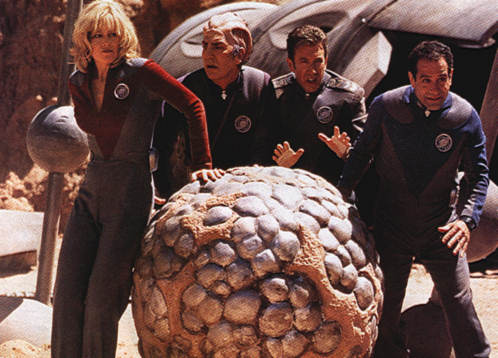
At a sci-fi convention, the cast of a long-cancelled television series "Galaxy Quest" is going through the motions of meeting their fans, even though the show has been off the air for years, and the actors are having a difficult time finding other work due to "type-casting." They squabble, each remembering personal quirks and on-set peccadilloes, either jostling for the limelight or just "doing the gig," and by happenstance, find themselves portraying their characters in a real outer-space adventure, persuaded by desperately seeking aliens who have caught transmissions of the show as it zipped through space at light-speed, and not only liked what they saw...they bought it hook, line, and beridium sphere.
It's a fun conceit, combining the background stories of actors with the characters they're playing put into a situation where their attributes as actors inform their actions in a real-life approximation of the roles they play. It stands to reason that the traits they embody to play the roles would come to the fore when reality sets in—it implies, of course, that they could do all this without "handlers," make-up assistants, or even (ya know...) decent writers and directors. It's fun to imagine.  
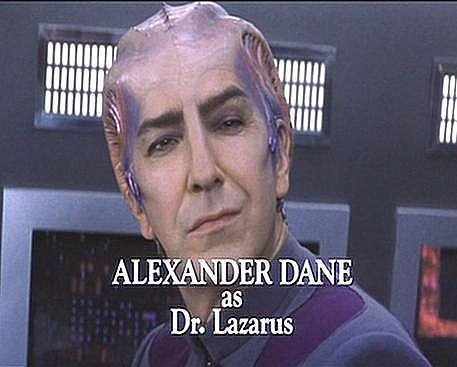
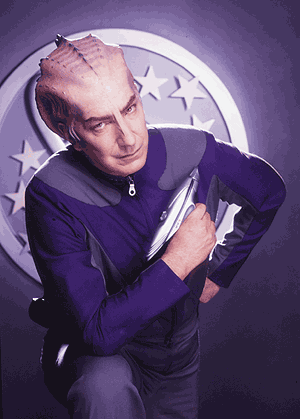
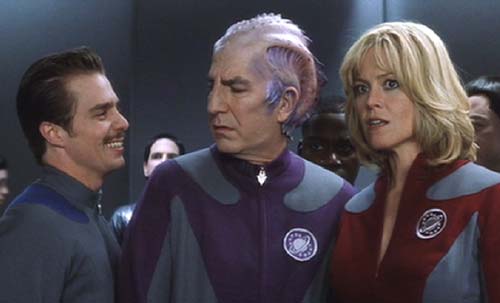
And the writers of the film have the "Star Trek" types down: the blow-hard lead actor (Tim Allen) who looks after himself until the chips are down; the second-in-command alien character—a fan-favorite—portrayed by an actor (Alan Rickman) who aspires to more prestigious roles and makes efforts to distance himself from his most popular one—until the role's inherent dignity and importance occurs to him; the actress (Sigourney Weaver, paralleling both Lt. Uhura and her "Ripley" character in Alien) trying to rise above the inherent sexism of her role, opening "hailing frequencies"; and the "also-ran's" (Tony Shalhoub and Sam Rockwell) who are stuck in their careers, forever typecast and unable to move on, bitterly watching their co-stars take better advantage.
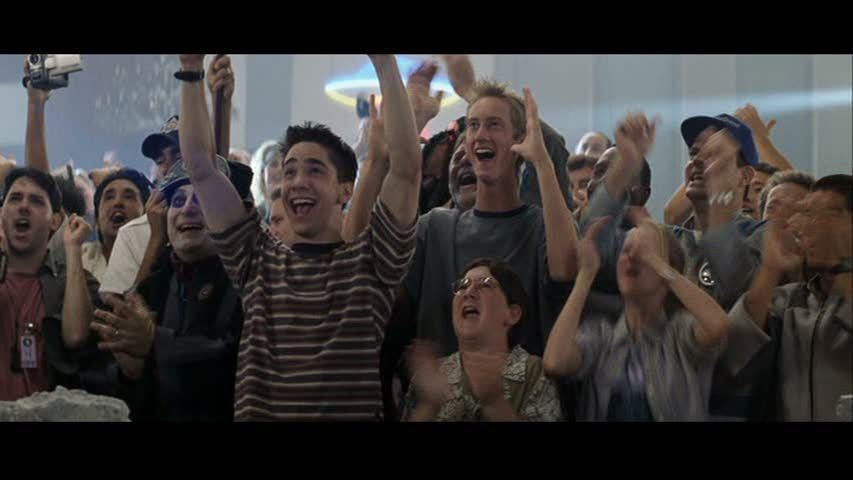
There's also a tip of the hat to the faithful fans who start out as convention geeks, then play a pivotal role in the survival of the crew and their mission—and they don't even have to do it with a write-in campaign to the network.
Fiction becomes fact becomes fiction becomes fact; Galaxy Quest is an inter-dimensional trek on a Universe that's folded in on itself, through all the frontiers influenced by TOS and its progeny that explored new frontiers on a journey that seems on-going. It's also one of the best examples of a rare film genre that usually comes off as lame, childish, or patronizing—the science fiction comedy.