Showing posts with label Michael Stuhlbarg. Show all posts

Tuesday, July 22, 2025

Men in Black III

Sunday was International Moon Day (yes, that's a "thing") commemorating the date that human beings first put boot-treads on the Moon. That historic mission figured fictionally in this movie.

Written at the time of the film's release. 

Time Wounds All Heels
or
"Don't Ask Questions You Don't Want to Know the Answer To..."

The third "Men in Black" film had to go somewhere else but up. The first two films were variations on the "illegal alien" theme about a government organization that monitored the activities of extraterrestrials in the world and specifically New York City, and revolved around alien invasions and the containment of said aliens. And when you've seen one alien invasion directed by Barry Sonenfeld, you've seen them all, and hyper-kinetically at thatAnd once it's been established that "aliens can be anywhere" the joke runs a bit dry pretty quickly, especially when the sub-species can contain pug-dogs and large cockroaches. The second film tried to expand on those concepts and felt a bit thin in the process, concentrating a bit too much on the secondary characters rather than the basic plot and the character interactions.

So, where does Men in Black III go from there?
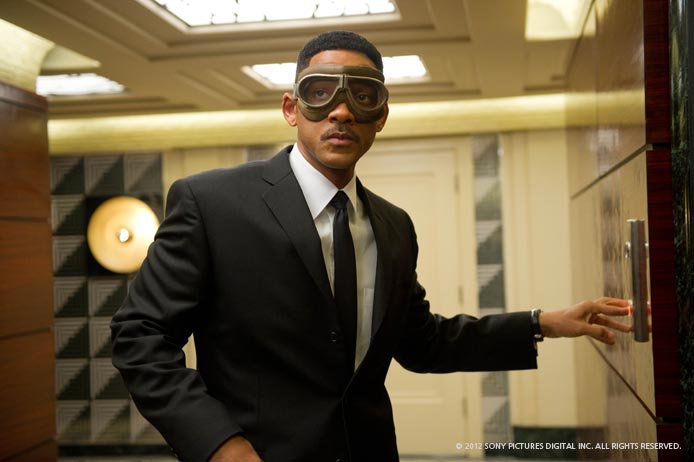
One of the nice aspects of the series has been its ability to still think outside the box, while expanding the horizons of just what that box might contain, be it variations of scale and dimension, even if only in afterthought. With the infinite reaches of space seemingly exhausted, the group (based, supposedly on an idea by Will Smith) has the series going back in time. Naturally. It ostensibly revolves around an Earth-takeover plot by another alien (one must ask at some point "why always us?"), "Boris the Animal" (who seems based on the DC Comics "Hell's Angel in Space" Lobo and is played with growly gutteral responses by Jemaine Clement from "Flight of the Conchords") who escapes from his maximum (and we mean maximum) security prison to find the man who sent him there 40 years ago—Agent K (Tommy Lee Jones). When he's unable to kill him here, the Boglodite finds another means to do so, and Agent J (Smith) wakes up the next morning, the only one with any memories of K past July, 1969. Agent K has been killed by Boris in the past, and J must journey back to try and save him.*
Once back there, J negotiates his way through a 1960's era way of doing things. Everything's a little less high-tech (a little less), but the MIB Agency is still there, as is the much younger Agent K (Josh Brolin, doing a bang-on interpretation of Jones) and J must solve the puzzle of saving the Earth (of course), while keeping K safe. The past sequences are greatMen in Black has exploited the "fish-out-of-water" angle perpetually—and new corners are being thrown out the whole time (My favorite being a brief glimpse of a "Barbarella"-type being escorted around MIB, and although Smith is a bit too "Red Bull" throughout the entire movie, check out his understated reaction to some Black Panthers). 
Great cast, too. Rip Torn is gone, but David Rasche plays him in the past, Emma Thompson is on hand as the new MIB head, Will Arnett makes a brief appearance as does Bill Hader. Toss in the chameleon-like Michael Stuhlbarg as an alien able to read multiple time-lines and there's always someone to deflect the eye, or hand things off from Smith.
But, the best thing about this "Men-in-Black" installment is resonance. The other two were fine, the first better than the second just for its novelty, but had a shelf-life of three minutes. Part of it is Sonenfeld's way of comically undercutting any meaning to the thing, by changing perspective—"you think you got a handle on it yet? Well, let me throw THIS at you!" The whole "the Universe is so big and cosmic that there's no way you can understand it because there's so many mysteries, so nothing is real" concept, which is the backbone of the series (and the source for most of its humor) leaves one with a feeling of "meh"—nothing matters in a vast uncaring, unfathomable Universe. 
Not here. The cold of Space has nothing to do with the leavening of Time, and, in this case, the franchise plays it straight, without a wink, a nod, a reveal, or a goo-spraying splat. For once, something really means something in the "Men in Black" Universe, and that venturing into uncharted territory makes the third time the charm.

  * I'm not saying anything here that isn't revealed in the trailer.

Thursday, May 2, 2024

Blue Jasmine

Depending on the Kindness (Enabling) of Strangers
or
Being Entitled to Your Opinion

Blue Moon/You saw me standing alone/
Without a dream in my heart/Without a love of my own/
Blue Moon/You know just what I was there for/
You heard me saying a prayer for/Someone I really could care for/
And then there suddenly appeared before me/

The only one my arms will hold/
I heard somebody whisper please adore me/
And when I looked to the Moon it turned to gold
Blue Moon/Now I'm no longer alone
Without a dream in my heart/Without a love of my own


Woody Allen's 21st century version of Tennessee Williams' "A Streetcar Named Desire," Blue Jasmine, is a contemporary version of the play's tragedy in an unsympathetic post-Bernie Madoff/Wall Street Bail-Out world, turning it into a moralistic comedy. It may seem a little misogynistic to be so mocking to someone as Williams' Blanche DuBois who has suffered a cataclysm, but when the someone is as cluelessly entitled and myopic as Allen's Jasmine (nee Jeanette) Francis (Cate Blanchett), there is a very real glee to see them get their, as the term is used in The Magnificent Ambersons, "comeuppance."
It's a brilliant conceit, combining Allen's love for classic literature and forms, tossing his own hang-dog spin onto it, while, for once, being refreshingly contemporary—something Allen hasn't really done of late, as he's had a depressive's obsession with the past for the past couple of decades (no matter how fresh the cast may be).

Allen starts his film (after the standard black background with white credits backed this time by '30's depression era rhythm and blues) with an (unusual for him) CGI shot of a jet approaching the camera, sailing by and moving away. Jasmine Francis ("I fell in love with the 'Jasmine.' 'Jeanette' has no panache") is on that jet flying from New York to San Francisco to move in with her sister Ginger (Sally Hawkins—her second film for Allen) for a fresh start after losing everything in her life. They're both adopted and couldn't be more different (As Sally says "She got the good genes."); Jeanette is all high cheek-bones and au couture, while Sally is low class and all teeth, surrounded by Guido's and roughnecks. Jasmine has suffered a reversal of fortune as her husband Hal (Alec Baldwin) has been caught wheeling and dealing in real estate schemes, ending up in prison, and committing suicide. Her extended visit delays Ginger's boyfriend Chili (Bobby Cannavale) moving in with her and her two kids by Augie (Andrew Dice Clay), her ex-husband. There's a bit of a sandpaper quality to Ginger and Jasmine's relationship; when Ginger and Augie were married, they lost a lottery nest-egg investing in one of Hal's "get-rich-quick" investment schemes, something Jasmine forgets when she drama-queens over her own plight, and dismisses entirely when confronted with it.

Jasmine (Blanchett) and Ginger (Hawkins)
So it rankles when Jasmine pulls a Mrs. Madoff and claims victim-hood about the money she's lost. Jasmine has no plans, no prospects, and there are hints of a nervous breakdown after she was found wandering the streets talking to herself. Now, she's popping Xanax with a vodka chaser and barely keeping ahead of anxiety attacks and comatose fugue states as she barrels through the lower echelons of San Francisco, trying to latch onto opportunities.
She decides to go back to school, learning computers so she can go "into" interior design, taking a job at a dentist's (Michael Stuhlbarg)—for which she is totally ill-suited (anything with the words "customer" and "service" in any combination would be)—to fund the courses. In the meantime, from her lowly status, she lords it over the family and friends she finds beneath her. That meaning everyone.

The flip-side to this is that people still find her attractive, as she puts up a great, if shallow, front, speaking of her glory days—which segue into flashbacks of her privileged happy life, only to find that once the flashback has ended, that she's still carrying on the conversation inside the flashback, and whoever she was talking through previously has left.
* It's a clever use of flashback as psychosis, a clever, nearly invisible off-shoot of the film-star (played by Jeff Daniels) stepping out of the film in The Purple Rose of Cairo. Where Allen has been living in the past the last few films, Jasmine is doing the same thing, to her detriment, as, whether in flashback or real life, it comes back to haunt her and take her away from the present and any future she might aspire to.

It's a return to near perfect form without the tricks and conceits that Allen used (during his "earlier, funny" films) and nicely merges the bi-polar extremes of comedy and tragedy that the more mature filmmaker in Allen has aspired to.  It also feels less fussy and musty than the after-taste some of the lesser Allen films have left of late. After a lifetime of making good films, some classic and some merely pedantic, and eschewing his earlier stylistic tricks, one wonders if, at the age of 78, Allen's best films might still be ahead of him and that's an exciting prospect.

Jasmine in her "fugue" state

* It's a bit like the Larry David monologues-to-the-camera in Whatever Works, only there's no child around to ask "Who's that man talking to, Mommy?"

Thursday, May 12, 2022

Dr. Strange and the Multiverse of Madness

The Mother of All Evil
or
Night of the Walking Stranges
 
Dr. Strange (Benedict Cumberbatch) is not having a good night. In another of those loopy dimensions he goes into every so often that tumble and disorient you, he is trying to get to a mysterious glowing pedestal that will solve all of their problems. 
 
They? Yeah, he has with him a 'tween (Xochitl Gomez) in a star-patched jeans jacket, who supposedly has powers but currently is just having issues keeping her feet. They are being pursued by some "thing" or other (standard Marvel description: "it sure is BIG!") and Strange is hanging on by his pony-tail (he has a pony-tail?) in the fight and makes the decision to sacrifice the kid's powers in order to tray and get them out of it. Woops, bad move. It doesn't work and Strange is killed and the kid gets thrown into another Universe and it looks like the movie, Dr. Strange and the Multiverse of Madness, is over before it even gets started.
 
Damn "in media res," anyway! 
No, sorry. It was all just a terrible dream. Yeah. He's a wizard. They don't just have "dreams." Something's going on, and it's not until the good doctor attends the wedding of former flame Dr. Christine Palmer (
Rachel McAdams), which is a real nightmare for him, that he begins to think there might be something more to this. Christine cuts him down a peg or two by telling him "You always have to be the one with the knife" (which will have some significance later on), and then the reception is crashed by a one-eyed octopus causing a ruckus out in the streets of NYC.
Strange and the Earth's Sorcerer Supreme Wong (
Benedict Wong) do battle with the thing and dang if the focus of cycloptopus is the 'tween in a star-patched jeans jacket whose name is America Chavez—this creates a synaptic issue whenever someone says "We've got to save America" and I think we're about to see some canvassing of neighborhoods. A post-octopicide talk with America reveals that she's from another part of the multi-verse, another dimensional version of our space-time, and her super-power is that she can travel between those dimensions, with, she confesses, little control about where she ends up—GPS being on the fritz or something. Strange deja vu's that this was the kid from his dream and they find the body of the other-dimensional Strange and the strange doctor concludes that "dreams are merely windows into our multi-versal selves." Before they can question whether that has been peer-reviewed, they discover markings on the calamari shards of the creature, which are recognized as rune markings and Strange decides to visit another Marvel mage, Wanda Maximus (Elizabeth Olsen), former Avenger, who has been going through her own crises on "Wandavision."
At this point, the exposition should stop or it'll turn as spoilery as Strange's spell in Spider-man: No Way Home. Leave it that things get complicated and that the opening to other Earths and other existences provide motivations, certainly to issues that remain unresolved, and complications. To its credit, the movie does a good enough job of expositioning that you don't feel you HAVE to have seen "Wandavision" or subscribe to Disney+. We get to meet a couple of other distinctive Strange's, another Wanda, a planet that has their own sort of Avengers called The Illuminati (which contains some giddiness-inducing fan-service of what comprises that group and who they are portrayed by—just don't get attached), and there's a marvelously done scene—reminiscent of Spider-man: Into the Spider-verse—that has Strange and America portaling through meta-verse after meta-verse that is marvelously creative for the 45 seconds or so that it lasts.
The best thing about the movie, though, is that director Sam Raimi is back. No, he didn't do the first one—
did that—but Raimi did the first three live-action Spider-man movies and basically wrote the template for the Marvel movies, which they would do well to study if they want to make films of innovation and energy. 
It's apparent very early in the film that his style is missed—his movies, be they action or horror, always had a delirious edge to them that would invoke responses of either horror or humor, a cinematic glee embedded in their mise en scène and montage. It's an added zhuzh to the proceedings, just a propulsive nudge with a wink, a comedic snap, that other Marvel movies just don't have. It's at once an acknowledgment of the goofiness behind the super-hero concept (and that we should take it SO seriously), while also trying to push the peril and make it visceral (so that we DO take it seriously).
It's a hold-over from Raimi's origins in horror (as is a cameo from
Bruce Campbell!) where the purpose is to make the "horrible" entertaining, but not so entertaining that you dismiss the darkness and the threat that the film-maker means to describe. You can have the "giggle", but it's better that you have it after a jolt, the directorial "gotcha" rewarded by the communal admission that the audience is vulnerable ("yeah I'm only human—you got me") and can be won over. 
Every movie—every theater-piece—is like that. It's a battle to win over the audience. And one can do that either by playing it safe with fan-service (and this movie is guilty of that, certainly) or by challenging—not placating—the audience in order to win its respect. Raimi is still very much of that old school (oh, he'd hate that term!) and after his box-office disappointments with Spider-Man 3 and Oz The Great and Powerful, he hasn't had a feature film made and released for 9 years. And as much as I trashed those movies, I have to say, it's good to have him back.
For all the plot contrivances, and the attempts to gin up emotional drama, DrS&MOM (oh, that's funny...) is a good ride where you don't think about those things while you're being manipulated so well. It helps that Elizabeth Olsen is a scary-good actor and that there's a good cast of great thesp's lending support all along the way.
 
It's a big improvement over the first one.
"Eyes will pop out of your brain...when you're Strange"

Tuesday, May 18, 2021

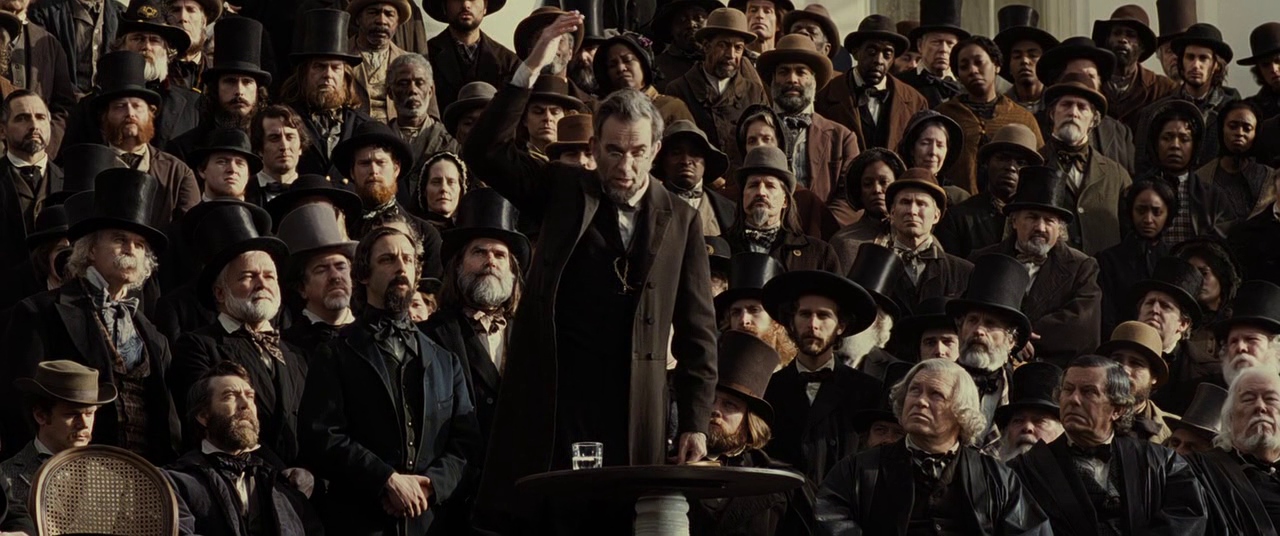
Lincoln

Noisy and Messy and Complicated
 
or 
WWLD?

At the end of John Ford's Young Mr Lincoln, "the jack-legged country lawyer" (as played by Henry Fonda) walks up a blighted horizon in the darkening gloom, as thunder rolls in the background, the rough-hewn fence he trudges along taking on the look of military barricades, as the young Lincoln walks with his long stride into the storm of history awaiting him. Steven Spielberg's Lincoln starts where Young... left off—with the sound of thunder over credits, which evolves into cannon-fire before placing us straight on in the middle of the Civil War, blue-on-gray, white-on-black (and the reverses) amid the blood and the mud of the Earth. The shots of the battlefield are tight, confusing, with no sense of place, no horizon—just a frame filled with humans killing each other by any means. No glory. No higher purpose. Just the immediacy of conflict. 
War is the point at which politics breaks down, and politics is where Spielberg's film is concerned to compare and contrast with today's stew of chicanery, graft, and playing fast and loose with the facts to the purpose of getting your way.  'Twas ever thus, and it was no different in Lincoln's time—they just didn't have cameras documenting everything then.

Young Mr. Lincoln: walking into a History still to occur.

\The approach is as good a starting place as any—that is, ending with Ford's last gambit—linking the two, as both films' main goal is to take the monument out of the man, and put him within reach of attainability, wart and all. The canonization of Lincoln began at the moment of his death with the pronunciation "now he belongs to the ages" and his visage, homely, homespun, ragged sunken and contemplative, has been preserved in nickel, bronze, marble, granite to the point where one can hardly imagine it as flesh and blood anymore. 
As portrayed by
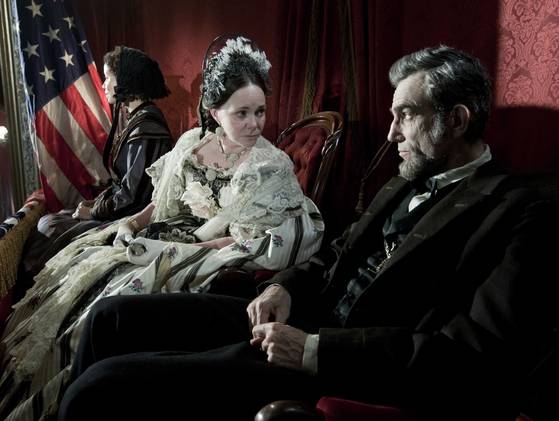
Daniel Day-Lewis, Lincoln is pitch-perfect, not only in his make-up, but his high tenor rasp of a voice, and—the remarkable part for me—in his still-legged gait that kicks and plants itself on the earth, not too steps away from the ragged dance of Wyatt Earp (Fonda, again) in My Darling Clementine. It's a big, robust cast—I had error alerts for all the names I tried to cram into this article's meta-data labels—but the hub of it all is Day-Lewis' Lincoln. Soldiers (including Lukas Haas) quote his Gettysburg Address back to him (which the President tries to staunch: "Been there, delivered that."*) His wife (Sally Field) constantly badgers him—but then she consistently badgers everybody, his cabinet is frequently frustrated by him, by his prevarications, his story-telling that constantly derails conversations to his agenda, and his thought processes which annoy them. "Actually," says Secretary of State Seward (David Straithairn) after Lincoln quotes verse, "I have no idea what you mean by that."
What he means may be too pragmatic for them, it's just how he expresses it that confounds. In one exceptional scene—Tony Kushner worked on this script for a long time and it shows—Lincoln explains in minute, often harsh, detail how he employed his newly granted War Powers Act and it comes down to what he thought he could get away with, legally.
His concern, in the waning days of the war, is to pass the 13th Amendment, thereby abolishing slavery, and it takes every trick, every dodge, every promise and appointment in the middle of a lame-duck Congress before the war could end. The timetable is critical: Lincoln has just been re-elected and is riding a wave of popularity; a crucial number of Congressmen are in their last days of their jobs and are looking to their futures and not to the wishes of their constituents; and, if the war ends, the urgency to pass the Amendment will dwindle, amidst the rebuilding of the Nation. Lincoln's Republicans will vote for it, but they need to tone down their rhetoric. The Democrats are dead-set against it, but getting Democrats to agree on anything is like herding cats and Lincoln wants to exploit the party's fractures into fissures.  
So, the problem is attacked from several fronts (if only the war had started that way): Preston Blair (Hal Holbrook), prominent Republican and journalist, is sent to the South to negotiate a Southern settlement, which the South is anxious to do (although Lincoln is reluctant). Meanwhile, he wheels and deals with the largesse of power, offering appointments, threats, anything to curry votes, and unleashes a trio of stooge-lobbyists (James Spader, John Hawkes, and Tim Blake Nelson) to press the flesh and pass the greenbacks (not "officially," though). Votes are critical. On the home-front, Lincoln's son Robert (Joseph Gordon-Levitt) is back from college, but feeling the weight of his kinship with the President and wants to enlist, which sends wife Mary Todd into another accusatory tailspin as she has barely survived the death of their son, Tad.
Throughout, Lincoln keeps his counsel. but sometimes erupts into spasms of frustrationwith "Molly" (as he calls her), the congress and his cabinet, choosing his moments and pressing his advantage, knowing no peace except what he can create for himself.
As good as Day-Lewis is, he's matched by Tommy Lee Jones as House Republican Thaddeus StevensIn chambers, Stevens sits and fumes, then reaches his limit and bursts out in loud insulting harangues, just in control enough to get his point across, and even smiling tightly—very tightly—when when dressed down by Mary Lincoln over his tight reins over The White House purse strings. Jones finds different ways to make his speeches crackle, while never betraying any sense that the words haven't sprung originally from his head. And Spielberg has given special attention to casting key roles with the like of great character actors like Bruce McGill, Michael Stuhlbarg, and Lee Pace who make their relatively small parts punch out and become memorable.
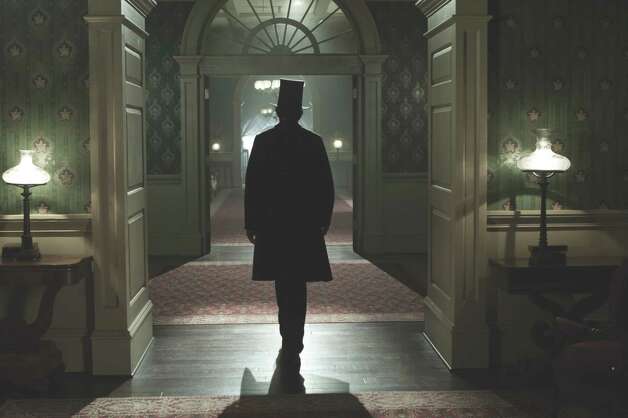
And Spielberg's eye for painterly detail shines, as Lincoln moves through the gloomy corridors of The White House or sets up an eerie dream sequence for the President. And in one lovely scene, between Lincoln and Ulysses S. Grant (Jared Harris), where the war's toll on Lincoln is expressed in Day-Lewis' exhausted eyes and the shadows of a long rank of soldiers trudging in front of a setting sun play across his face.  
You can't see the moving shadows

Spielberg's regular team of artists: Kaminski, Kahn, Carter, and Williams construct a great quilt of imagery and dynamics, making Lincoln a fascinating display of historical intimacy writ large.  It would make a superb triple bill sandwiched between Young Mr. Lincoln and The Conspirator.


* There's a nice contrast of Lincoln delivering a dedication at a flag-raising ceremony that lasts a measly few lines.  "That's my speech" he says as he tucks his paper back into his stove-top hat. They can't all be gems.

Thursday, October 18, 2018

Hitchcock

Hack-job
or 
Making Everyone a little Psycho

Making a movie is a boring enterprise. Boring and thrilling at the same time. Lots of sitting around, wasting time, waiting for the crew to be ready for that moment when you can't waste any time, the adrenaline is pumping, and things have to go right...over and over and over again until they do.

For Alfred Hitchcock, the thrill of movies wasn't in the filming (which lots of directors like because it's so social and a "rush"), or in the editing (where so many directors "find" their films), it was in the planning, the story-writing and the story-boarding—making the blueprint for the film that could be followed easily and by-the-numbers. The best parts of his movies were not in performances (although they could be great*), but in the ideas that shape the film and make it worth watching...and worth watching again. Watching that process, however, would probably not make a very compelling movie.
The trials and tribulations of the making of his landmark horror film Psycho was detailed in Steven Rebello's fun little read "Alfred Hitchcock and the Making of Psycho," and are now derailed in Hitchcock, a fictional adaptation of the book, which has as much to do with the events of making Psycho, as the film Psycho has to do with the book it was based on, which, truth to tell, Hitchcock never read.**

Well, few people have read Rebello's book, either (which is a shame, really) and so the chief "scenarist" James McLaughlin (who wrote Man of the House and co-wrote Black Swan...hmmm) and director Sacha Gervasi (who co-wrote The Terminal for Spielberg and whose only previous film was the documentary Anvil! The Story of Anvil!) have "written to silence"—as so may of the actual participants are dead—relying on "conventional wisdom" rather than facts to make their odd little combination of docu-fantasy. Partially, this is because when it comes to movie-making (as opposed to life) truth is duller than fiction, but it is also more complicated and takes longer to explain and so we depend on a futzy short-hand to get to the point faster. "Conventional Wisdom" in Hollywood is the same as "Based on a True Story."
Oh, don't get me wrong.  There are instances where the facts are there: Hitchcock's wife and collaborator Alma Reville did spot the "blink" (actually it was a throat swallow) in the pull-out from Janet Leigh's face after the murder (requiring a cut to the shower-head) and the "nudity" (which was solved with a black bar at the bottom of the screen); resistance was high to Psycho which Hitchcock chose to fulfill his contract for Paramount Studios—they did want something like North By Northwest, which made a lot of money for M-G-M—but not so much when Hitchcock revealed he was going to do it "for cheap" with his television crew—it's always about return for investment; he did come up with the brilliant advertising campaign for the film (like he'd previously done with his other films); much is made of the financial failure of Vertigo*** (ironic as it's—this year—considered "the greatest film ever made") as well as Hitchcock's insecurities and frailties (which were legion and they're all up there on the screen in his movies) and there are dribs and drabs of trivia sprinkled throughout the film.  But, they are far out-weighed by what is wrong.
What's wrong with this picture?  Oh, where to start?
What it gets wrong would fill another book by Rebello.  The film's obsession with Ed Gein—that is more attributable to author Robert Bloch than Hitchcock—feels wrong and wrong-headed, more to do with the screenwriter's issues than the subject's (I doubt that Hitchcock had the elaborate Gein fantasies that are imagined here).  The emphasis of Alma's collaboration with writer Whitfield Cook (Danny Huston)—who contributed to one good Hitchcock adaptation, Strangers on a Train, and one bad one, Stage Fright—is blown completely out of proportion from a mere consulting gig.  And the twist of the knife is the Hitchcock pathology, especially his treatment of women (the "Hitchcock Blondes," the grey suits, the make-overs, the favorites—Kelly and Bergman) despite the fact that Hitchcock always gave the more interesting parts and special attention to his actresses ("Hitch always threw the picture towards the girls" was Cary Grant's summation), not only for himself...but also his audience.
But what Hitchcock valued was loyalty. So he'd work with the same craftsmen over and over again out of loyalty, out of trust, out of convenience—past collaborators were one less complication to worry about. And if they failed to deliver, he wouldn't work with them again, without a word of explanation as he hated confrontation. "He was a coward," as Suzanne Pleshette opined. Of course, he was. His movies are naked displays of his phobias, foibles and fantasies.

And the films endure, because his frailties are just like ours.

Hitch is no longer alive to defend himself, but quite a few collaborators are. One wonders why Pat Hitchcock, Alfred and Alma's daughter, who usually runs defense for the Hitchcock Family Legacy, is silent while so many the current gaggle of films—this one and HBO's "The Girl"—are starting to piss on his grave. But, then, the evil that men do lives after them, the good is oft interred with their bones. So, let it be with Hitchcock. His films are a testament to both good and evil, and our ability to rise above.  The films have lived on, decades after the man, and show no signs of falling out of fashion. That's his lasting legacy.

For fans of the director, there is no such thing as bad news, but this movie truly is.  The performances are winning, though, as Scarlett Johansson occasionally convinces you she's studied up on Janet Leigh's mannerisms, although James D'Arcy plays Anthony Perkins as if he was playing Norman Bates and there was more to the man than that (reflecting the film's focus on rumor and gossip, rather than facts), we don't know what Alma Reville was like, as she stayed mostly behind the camera, but Helen Mirren's performance is fun and winning. Anthony Hopkins' Hitchcock, however, is problematic—although it's not entirely his fault.  Hopkins is a brilliant mimic, and his own rich voice disappears in the deliberate cadence and sibilance of Hitchcock's own. But (like much of the film), the portrayal is a bit too dependent on Hitchcock's public persona as a droll dead-pan. This Hitchcock never smiles—perhaps it would have cracked the elaborate make-up Hopkins must wear to even resemble the director—and is entirely too mordant and lines up with "conventional wisdom" about the man, a view that, as Hitchcock himself cultivated it, he's a little responsible for. As such, the portrayal comes across as a bit one dimensional, and one-sided.
One could get exercised about these things (and I obviously have), but as Hitchcock himself would say, "...it's only a mooo-vie."

Just not a very good one. The best that can be said about Hitchcock (the movie) is that Alma's influence and great work is now a part of conventional wisdom, instead of the director's best-kept secret.

Yeah, that Hitchcock could be a tyrant on the set, alright...
Hitchcock's Best-Kept Secret: the incomparable Alma Reville


 * Hitchcock was often misquoted as saying "Actors were cattle" as if they were just a commodity to be "herded," when what he SAYS he said was that actors "should be treated like cattle." Friend and Hollywood cut-up Carole Lombard responded by setting up two bovine pens on the set of Mr. and Mrs. Smith (1941), one for her and another for her co-star Robert Montgomery.

** In his near-definitive interview book "Hitchcock/Truffaut," Francois Truffaut spends a lot of time—too much time, really—going on about how lousy Robert Bloch's novel, "Psycho," is, and Hitchcock dismisses his comments by saying "I never read it. I read the studio synopsis (the plot summary by studio "readers"), and the only thing I was interested in was the shower sequence and killing off the star half-way through the movie..."  

*** Funny thing. Tippi Hedren has made what my father used to call "a big stink" about Hitchcock destroying her career after the financial failure of Marnie—never working with her again—and supposedly bad-mouthing her to other directors, producers, and all of Hollywood.  But, after Vertigo "tanked" at the box-office, Hitchcock never worked with James Stewart again, feeling like it was partially Stewart's presence in the film that caused the poor turn-out. Stewart very much wanted to work on North By Northwest, but Hitchcock made every effort to lure his old collaborator Cary Grant out of his on again/off-again retirement to star in the film. It was all part of Hitchcock's own ambivalence about hiring "name" actors for "his" projects, as often the dictates of producers and studios did not match the needs of the part. But, again, that takes a long time to explain...and so we get stuck with "conventional wisdom."