Showing posts with label Emma Thompson. Show all posts

Tuesday, July 22, 2025

Men in Black III

Sunday was International Moon Day (yes, that's a "thing") commemorating the date that human beings first put boot-treads on the Moon. That historic mission figured fictionally in this movie.

Written at the time of the film's release. 

Time Wounds All Heels
or
"Don't Ask Questions You Don't Want to Know the Answer To..."

The third "Men in Black" film had to go somewhere else but up. The first two films were variations on the "illegal alien" theme about a government organization that monitored the activities of extraterrestrials in the world and specifically New York City, and revolved around alien invasions and the containment of said aliens. And when you've seen one alien invasion directed by Barry Sonenfeld, you've seen them all, and hyper-kinetically at thatAnd once it's been established that "aliens can be anywhere" the joke runs a bit dry pretty quickly, especially when the sub-species can contain pug-dogs and large cockroaches. The second film tried to expand on those concepts and felt a bit thin in the process, concentrating a bit too much on the secondary characters rather than the basic plot and the character interactions.

So, where does Men in Black III go from there?
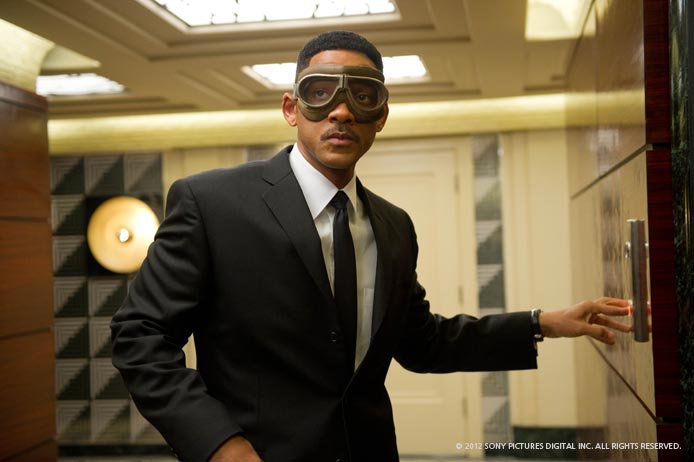
One of the nice aspects of the series has been its ability to still think outside the box, while expanding the horizons of just what that box might contain, be it variations of scale and dimension, even if only in afterthought. With the infinite reaches of space seemingly exhausted, the group (based, supposedly on an idea by Will Smith) has the series going back in time. Naturally. It ostensibly revolves around an Earth-takeover plot by another alien (one must ask at some point "why always us?"), "Boris the Animal" (who seems based on the DC Comics "Hell's Angel in Space" Lobo and is played with growly gutteral responses by Jemaine Clement from "Flight of the Conchords") who escapes from his maximum (and we mean maximum) security prison to find the man who sent him there 40 years ago—Agent K (Tommy Lee Jones). When he's unable to kill him here, the Boglodite finds another means to do so, and Agent J (Smith) wakes up the next morning, the only one with any memories of K past July, 1969. Agent K has been killed by Boris in the past, and J must journey back to try and save him.*
Once back there, J negotiates his way through a 1960's era way of doing things. Everything's a little less high-tech (a little less), but the MIB Agency is still there, as is the much younger Agent K (Josh Brolin, doing a bang-on interpretation of Jones) and J must solve the puzzle of saving the Earth (of course), while keeping K safe. The past sequences are greatMen in Black has exploited the "fish-out-of-water" angle perpetually—and new corners are being thrown out the whole time (My favorite being a brief glimpse of a "Barbarella"-type being escorted around MIB, and although Smith is a bit too "Red Bull" throughout the entire movie, check out his understated reaction to some Black Panthers). 
Great cast, too. Rip Torn is gone, but David Rasche plays him in the past, Emma Thompson is on hand as the new MIB head, Will Arnett makes a brief appearance as does Bill Hader. Toss in the chameleon-like Michael Stuhlbarg as an alien able to read multiple time-lines and there's always someone to deflect the eye, or hand things off from Smith.
But, the best thing about this "Men-in-Black" installment is resonance. The other two were fine, the first better than the second just for its novelty, but had a shelf-life of three minutes. Part of it is Sonenfeld's way of comically undercutting any meaning to the thing, by changing perspective—"you think you got a handle on it yet? Well, let me throw THIS at you!" The whole "the Universe is so big and cosmic that there's no way you can understand it because there's so many mysteries, so nothing is real" concept, which is the backbone of the series (and the source for most of its humor) leaves one with a feeling of "meh"—nothing matters in a vast uncaring, unfathomable Universe. 
Not here. The cold of Space has nothing to do with the leavening of Time, and, in this case, the franchise plays it straight, without a wink, a nod, a reveal, or a goo-spraying splat. For once, something really means something in the "Men in Black" Universe, and that venturing into uncharted territory makes the third time the charm.

  * I'm not saying anything here that isn't revealed in the trailer.

Tuesday, January 14, 2025

Last Chance Harvey

Most of this was written at the time of the film's release. I saw this in a theater because the cast was so good, how could I not?

 
Last Chance Harvey (Joel Hopkins, 2008) Consigned to forgotten corners of the internet amid the dark alleys of the streaming services, this amiable and genial little semi-romantic semi-comedy boasts a fine casting of plucky players trying to make more of it than it is. Maybe it's only on the lists of those completists who want to see every single movie that Dustin Hoffman or Emma Thompson starred in (and certainly those are good goals), but I would be surprised if anybody had ever heard of this movie, which seems a shame. You read the reviews and practically everyone says is that Hoffman and Thompson are magical together, and if it was just them...the movie would be amazing.

The titular Harvey Shine (Dustin Hoffman) is a musician working for ad agencies writing commercial jingles, but he's always wanted to be a jazz pianist. He's been hired to write yet another innocuous ear-worm, but he's on his way to London for his estranged daughter's wedding (he at least feels the absolute need to be there). He's told, rather cruelly by his boss (Richard Schiff) to take his time, enjoy himself...because he won't have a job when he gets back.

Hey...Mazel tov!
Add to that, his estrangement from his family (his ex-wife, played by
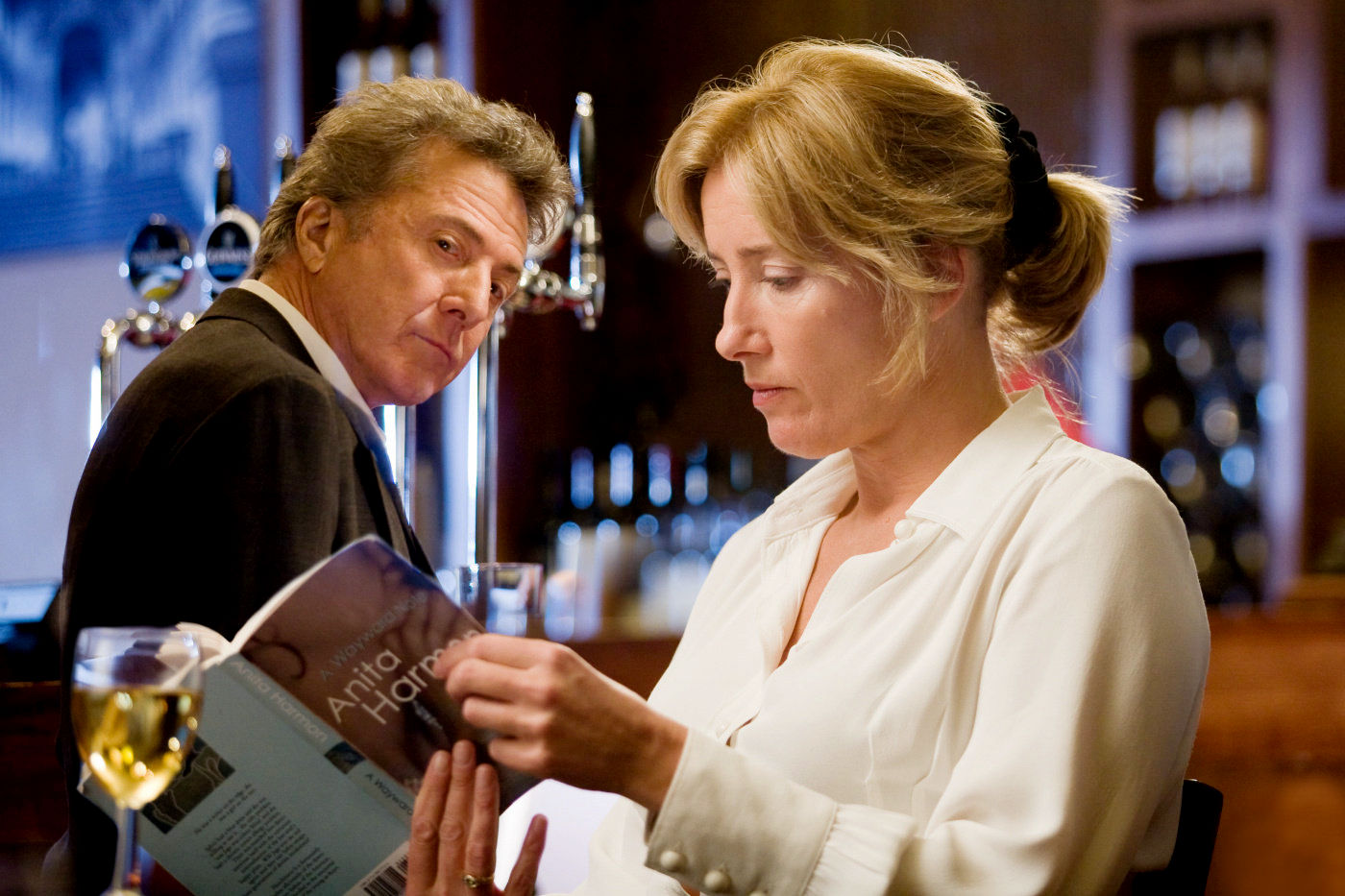
Kathy Baker, is now married to James Brolin's character) his awkwardness with social situations in general, and that dear daughter wants her step-dad to give her away, Shine is having a very bad time of it. He spends the wedding at the back of the church (at least he's there), but he's determined to skip the reception and just slink home, until he finds his flight delayed with a long layover. Only thing to do is hit the bar, and once there, he has a strained conversation with Kate Walker (Emma Thompson, always exactly right), an airline worker he previously had blown off while she was just doing her job.
She wouldn't be there if a connection didn't happen
...not merely back to the U.S., but between the two characters...and as I said it's amiable and genial and you probably already know where it is heading. Hoffman is such an adept spur-of-the-moment actor and Thompson is such a quick wit and sharp writer that it's like seeing your two best friends spark off each other and say what you will about the rest of it, but that is a joy.
There is a complication or two of the An Affair to Remember variety—don't worry, no one gets hit by a bus—and we get to witness what may be
the longest wedding reception in history. The slight story-line is fleshed out with Kate's eccentric mother (the wonderful Eileen Atkins) who thinks that there's a Rear Window-style murderer living next door. Hilarity ensues.


Still, you could do worse than this one to kill a little time, especially with such a good cast.

Tuesday, November 5, 2024

Merchant Ivory

Merchant/Ivory
(Stephen Soucy
, 2023) The name of "Merchant Ivory" has long been prejudiciously associated with a certain type of Oscar-bait movie, long on dialogue, high on landscapes, and attracting English actors of such a high caliber that they usually end up on Oscar short-lists for their performances. They have such a high pedigree that you'd never know that the films were lower budgeted than what was evident on-screen, and that the films were made by the skin of the teeth of Merchant Ivory Productions, sometimes risking scuttling the projects before they could be finished, and leaving the actors with a malevolent "Never again..." ("It required an immense amount of stamina" says Emma Thompson "to work for Merchant Ivory") only to be entranced, seduced, cajoled and convinced by either Merchant or Ivory to come back for another go-'round. And despite suspicions that they were being flim-flammed (once again), they did come back. Because to be in a "Merchant Ivory" film was a prestige gig.

The team (which wasn't just producer Ismael Merchant and director James Ivory, but screenwriter/novelist Ruth Prawer Jhabvala and composer Richard Robbins) wasn't afraid to buck current movie trends, go its own way, and chart its own course, self-assured that there was no down-side to going high-brow. And the new documentary Merchant Ivory quite giddily tells the story of the mess in the kitchen that provides the elegant meal. "It'll probably be something you're wildly proud of" says costumer Jenny Beavan of each MP project, "but...."
The beginning of the story involves the meeting of James Ivory (from Klamath Falls, Oregon) and Ismail Merchant (born in Mumbai—although it was Bombay at the time) at the Indian Consulate in New York, where there was a reception for a documentary Ivory had made in India. The two became partners, personally and professionally, their first project together an adaptation of Ruth Prawer Jhabvala's "The Householder"—her husband told her not to get involved with them, but she became enchanted with Merchant's Bali-hoo and "I liked the razzmatazz." It was not the smoothest first film of the partnership as the money ran out, but Ivory hated shooting in the Delhi heat, and when it came time to edit the film, they turned to Indian filmmaker Satyajit Ray to put it together. Merchant sold it to Columbia Pictures "by some miracle" and used the profits to make their next film Shakespeare Wallah.
They made four films in India and then went international with some weird choices: Savages, The Wild Party, but then settled down with such high-brow fare as 1979's The Europeans, 1983's adaptation of Jhabvala's Heat and Dust, and 1984's The Bostonians, until things exploded (mind you, it was an elegant, mannered explosion) with 1985's A Room With a View, which not only received tremendous critical acclaim and great box office, but also was nominated for the Best Picture Oscar. Rather than sign with any studio, Merchant Ivory chose to stay independent and in 1987 took the company public.
Produced by Cohen Media Group (which now owns the entire Merchant Ivory catalog) Merchant Ivory tells the story of the film-making team: Ismael the producer, James the director, but also, essentially and unquestionably, in what one of the participants calls "the Merchant Ivory vortex," Ruth the writer and Richard the composer. The four of them, each with a different personality—Ismael voluble and hyperbolic, James "quietly determined," and "unneurotic," Ruth the arbiter of taste and Richard the musical soul—formed a social and working club-house of essential ingredients, each with their specialty, but in close collaboration that influenced their projects and shaped the direction of the company and the films produced by it.
It's divided into six chapters, but, like the company itself, doesn't seem to adhere to each chapter's subject matter, cascading into other stories that spring to mind, but essentially telling the overview of the story in a chronological order, with particular asides for projects that garnered particular attention. They are:
 
Chapter One The Wandering Company: how two opposites in temperament and origins joined forces as independent film-makers—each had made documentaries by that time—and as a couple and began making relatively inexpensive films in India, the first of which brought Ruth Prawer Jhabvala into the mix (she adapted her own novel for them) as Muse, Arbiter of Taste, and the Book-Cracker, who would boil things down to essentials and if something wasn't up to her standards, she'd fix it.
Merchant's first visa to the U.S.: notice how he scratched out "Profession"
 
Chapter Two: the Mystic Masseuse: the story of Ismael Merchant, a man of Big Dreams and wide contradictions—gay, Muslim, a wheeler-dealer and con-man ("Yeah, sure, he was" says Ivory), extravagant in his ideas and juggling deals in order to achieve them, but never selling out to a studio in order to maintain independence over his company's work. Crew members talk of his being on the set constantly imploring Ivory—"Shooot, Jim! Shooot!"—shaking their head in astonishment "This rascal has done it again!" Hopkins ruefully smiles as he says "He can talk the birds out of the trees."
 
A Room with a View (1985) A water-shed moment for the company when international success comes to them after years of defying expectations and scraping by financing their films. Their dedication to authors like Henry James and E.M.Forster pays off and brings them critical and audience acclaim as well as much attention from the many awards groups. They are still financially rocky, but are no less dedicated to their favorite authors.
Chapter III: The Unspeakable Vice of the Greeks James Ivory, being the last survivor of the Merchant Ivory core, talks about his growing up as something of an outsider—adopted, intellectual, closeted—but collaborators and actors talk about how he's the least problematic director they've ever worked with and he comes across as easy-going, honest, unapologetic, with no regrets and certainly no resentfulness.
Maurice (1987)
Ivory wanted to make an adaptation of Forster's posthumous novel of homosexuality and class, which Merchant had qualms about—after the success of A Room with a View, why risk it—but "the vortex" went ahead with it with Jhabvala begging off, calling it "sub-Forster" but coming back to fix a crucial plot-point.
Chapter IV Only Connect
The film looks at the life and accomplishments of Ruth Prawer Jhabvala, winner of the Booker Prize for her own work, and her essential partnership with Merchant Ivory—she garnered the most Oscars for her work of the group (along with the costume departments) and her ability to write illuminating dialog for any character, no matter how repressed—and her screenplays are notably free of descriptions—made her the foundation of so much of what was great about Merchant Ivory.
Howard's End 1992 It was Jhabvala who raised the challenge to the team that this Forster work was "a mountain you have to climb" and the film garnered multiple Oscar nominations and an Oscar for Emma Thompson and she and Helena Bonham Carter and Samuel West go into vivid detail about the challenges and memories of working on the film, which was immediately followed up by
 
The Remains of the Day 1993 Most of the people being interviewed agree that this was the apex of the Merchant Ivory group and quite a few focus on Anthony Hopkins' performance for special mention, with Thompson calling out a particular scene with how Hopkins set up the tone and flabbergasted her with his performance. At one point Hugh Grant says "If someone said to me show me perfect film acting, I'd show them Tony Hopkins in Remains of the Day and, in fact, The Remains of the Day is one of the best films I've ever seen let alone been in.
 
Chapter V You Mean a Great Deal to this House This segment focuses on the life and career of Richard Robbins, who was something of a musical savant and began composing for the Merchant Ivory films with The Europeans and worked on every score up until The White Countess in 2005. As is stated in the film, his was probably the most notable director/composer collaborations since Herrmann and Hitchcock or Rota and Fellini.

Chapter VI Head and Heart The last segment talks about the Best of Times, The Worst of Times: Merchant Ivory began to work with big-time studios and working with bigger budgets, which made what they could do a bit easier, but the team began to splinter—Merchant began directing his own films (with Ivory ever-present as an advisor)—and then, time took its toll: Merchant died in 2005, Robbins in 2012, and Jhabvala in 2013. 
 
Only Ivory survives to tell the tale, and he's still working—he's the oldest recipient of an Oscar for his screenplay of Call Me By My Name, directed a film in 2022 (at the age of 94) and he's executive produced four films that are coming out in the next year. It's a fascinating story, with ample amounts of clips, and interviews with some of the finest raconteurs in entertainment. And it does exactly what Cohen Media Group wants it to do—it makes you want to seek out these films and the books they're based on.

Saturday, June 29, 2019

Men in Black International

MIBI. MIBI Not.
or
"...Some Next-Level Shit Going On"

The economics of the "Men in Black" series required some sort of re-boot; if they'd gone with previous stars, they'd have had to save on a cosmically scoped series by restricting their location work to Will Smith's voluminous trailer.

Besides, the series needed it. The "Men in Black" organization in the previous three films had a galaxy-wide perspective, but we never got to know anybody but the two leads, that film's chief antagonist, and the organization's leader, which it it feel like director Barry Sonnenfeld's perspective-warping visual-joke-tags. It was seriously about time to expand the series' event horizons and give it a little breadth. That they've done with Men in Black International by introducing a new recruit. Call her Molly (the charming Tessa Thompson), but she's agent M in MIB (Do they have only 26 agents?? Then they can't even get a decent group-rate insurance discount!), whose encounter with an alien (and the actions of the MIB organization during it) inspires her to become an agent with the super-secret agency as an adult. She's farmed out—by MIB head O (Emma Thompson, the only past cast to return—at least they're keeping the best)—to the foreign exchange to learn the ropes of alien wrangling and memory wiping.
O sends her to the London office where she meets former agent T (Liam Neeson) who has become the head of the department—he's now referred to as High-T (so precious).** He pairs her with Agent H (Chris Hemsworth), his former partner on a Paris mission to intercept and neutralize a group of aliens called "The Hive." H is well-regarded in the organization, but he is a kind of a Bondish Man in Black with a sloppy work ethic and walks around like he's coated in black teflon.  
The plot—such as it is—involves a version of the assassination of Archduke Ferdinand, who, with his dying exhalation entrusts M with a cosmic McGuffin that can be transformed into a powerful weapon capable of creating a Grand Canyon in any state without benefit of a a large river and millions of years. There could be details detailed that would expand the synopsis, but, they're exceptionally un-clever and we've seen them before. Aliens invade, assume human form, are looking for something with a power far greater than its tiny size would indicate, and...oh, yes, they're helped by an alien who has suffered at the hands of the invaders. This isn't writing, this is word-processing and the Ctrl, C, and V keys are getting a bit worn.
And that's it. This is going to be a very short review for a movie that doesn't deserve any more scrutiny, merely due to its lack of effort. Hemsworth and Thompson were delightful together in Thor: Ragnarok and they are not throughout this one, although Thompson tries mightily hard. They just don't seem to mesh, probably because Hemsworth's H isn't hamstrung and is allowed to lord it over the obviously more competent M, which rankles and flies in the face of what worked in the Marvel film. 
Or, it just might be that that film's director, Taiki Waititi, had a better sense of how to keep the two actors bouncing off each other, than this film's F. Gary Gray** does (although his work here is a fair imitation of Sonnenfeld's loopy roller-coaster ride that threatens to go off the rails at any second) and that seems to extend to the rest of the cast, including Rebecca Ferguson, who's great in the "Mission: Impossible" films, but is utterly charmless here.
Capitalizing on past glories in MIBI
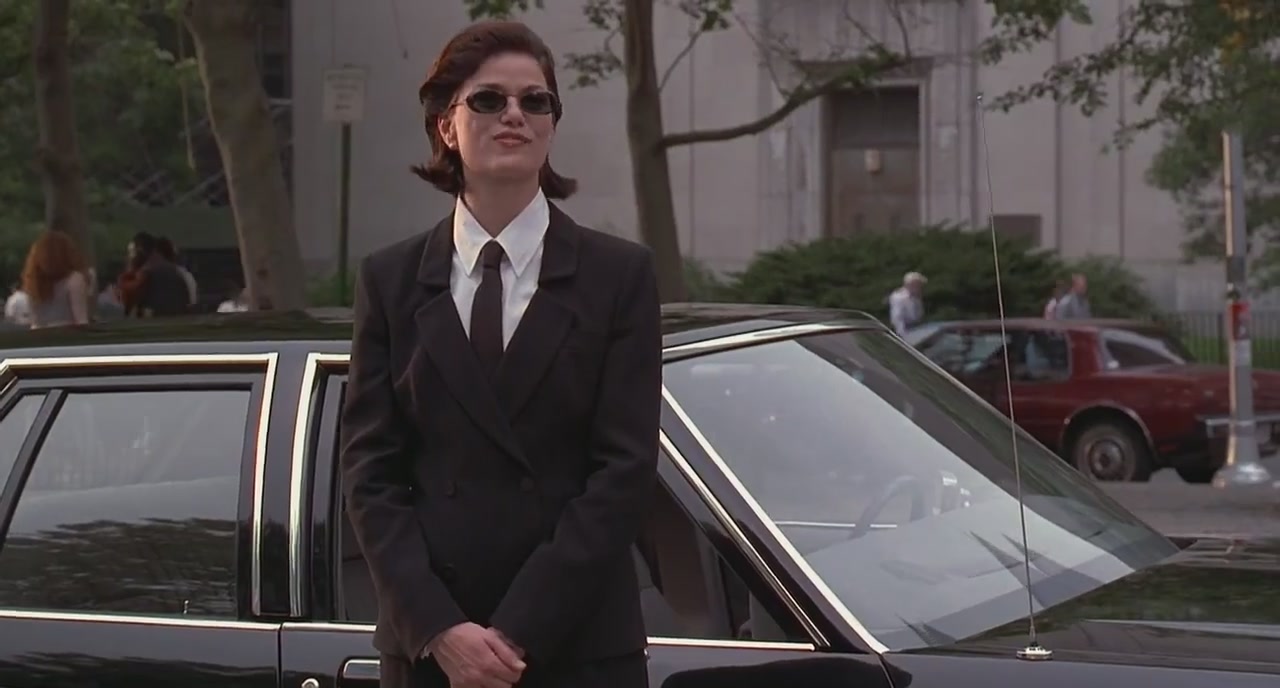
In a Universe of ideas and the expectation that science-fiction might go somewhere where no writer has gone before, why would anyone settle for this re-tread that doesn't even try hard to do something new or think a little differently. Geez, they couldn't even try to do a compare and contrast with the American version, the film being based in Europe and all? But, no, that might be doing something beyond anyone's scope, micro-or tele. Hey, guys, maybe bring back Linda Fiorentino's Agent L from the first movie? I mean...anything?

I don't think the franchise could stand another one like this: been there, zapped that.
Ya really didn't like it, huh?
* Hey, maybe they could do a cross-over with Taken, and this time, his daughter could be abducted by aliens—c'mon, it's as believable as the LAST one.

** Gray tried to leave the project, supposedly, as the film suffered from Studio "regime-Change" confusion, and its producer Walter Parkes re-wrote the script that Thompson and Hemsworth signed up for, and he even directed parts of it. Geez, maybe the next movie should have a race of incompetent aliens trying make sense of an invasion plot when their leader dies.
Just look here and let's forget it ever happened.

Tuesday, April 4, 2017

Beauty and the Beast (2017)

There's Something There That Wasn't There Before...
or
Be Our Grist

Okay, a big confession out of the gate: I didn't like it.

Now, big back-pedal: I'm a huge, huge fan of Disney's animated version of Beauty and the Beast, thinking it a near-perfect movie and a damn near perfect musical—you can't argue with the wit and artistry of song-writers Alan Menken and Howard Ashman in their prime, and the two men had a strong hand in the production of the film, the construction of it, and the Disney animators, emboldened by their work on The Little Mermaid, stretched their imaginations and the medium's potential, creating what was literally the strongest animated film of that golden era of Disney's resurgence as the preeminent producer of animation in the world.


So...I kinda liked the original, as you can tell. So, my ambivalence to the live-action of it—even the idea of it—has nothing to do with the material.


It is entirely due to presentation.


For example, compare the animated version of "Little Town" ("Belle")...
 
...with the "live" version:

Now, my impression when I watched the film on the big screen was that the song had been slowed down. You look at the two together here and they're actually close to the same tempo...but the presentation is slowed down, parsed, and robbed of momentum in the live-action version. The cartoon version pranced. This one kinda ambles. It feels longer than its 129 minutes (by contrast, the animated version zips by at 84 minutes). It costs more to create a minute of animation as opposed to a minute of film, even in this CGI-laden production world. So, it was to the animation team's advantage to make things quick, quick, quick. But, the pace helped the film, as well.
Emma Watson "Julie Andrews" it as Belle
But, Bill Condon's direction of the live action version is a bit leaden (it works for Gods and Monsters and the "Twilight" films, but destroys musicals like Dreamgirls), as if he wanted you to notice all the ornateness that went into the making of the film. That's nice when it comes to Technical Oscar-time, but it sure makes Beauty and the Beast a little turgid. Early on, I began to worry that the "Beauty and the Beast" sequence, the weakest part of Disney's animated version, would be interminable in this one...and it is...but there were some other changes not to the film's betterment.
1. Padding: Some songs are streamlined, some are shortened or have replaced lyrics ("And every last inch of me's covered in hair!" is Naired out of "Gaston"). But, there are new songs, the most significant of which is "Days in the Sun," by Menken and lyricist Tim Rice, an "I Want" song sung by the ensemble in which the transformed castle staff remember what life was like as humans (which, story-wise, replaces the Menken-Ashman song cut out of the original—"Human Again" which is too bad). The thing about this and the other new songs is that you can immediately tell it's not Menken and Ashman because Rice's lyrics are so godawful uninspired. Where Ashman took chances with humor, subject matter, and a complexity of vocabulary, Rice's libretto is as bland as vanilla. In "Gaston," Ashman ended lines with "intimidating," expectorating," "decorating," and "anticipating," Rice stops at single syllable words, the most egregious song of which is an uninspired "Farewell" song sung by the Beast, "Evermore," where the title is the most complex word of the piece. Other new songs include: "Aria"—an unnecessary performance piece for a ball sequence in an equally unnecessary prelude showing the Prince's pre-Beast narcissism; a song for Belle's father "How Does a Moment Last Forever?"; "Home" for a diversion to see Belle's house growing up; and that "Days in the Sun" thing, which adds a good sub-text to the story, but brings up story issues that we'll get to later.
2. The Beast: Here's where the animated Beast has it all over the CGI Beast—expression. Disney animators, especially Glen Keane, gave the transformed Prince a bullish bear look that had a malleable range of expressions from rage to gob-smacked delight. The CGI folks must have been trying to concentrate on realism and making the thing look fearsome because the "live-action" Beast barely cracks a smile.
When he does, it's a wan thing that reminds me more of George C. Scott (who actually played The Beast in a 1976 Hallmark Hall of Fame version with his wife Trish van Devere) when he wanted to smile charmingly without exposing his teeth (which could be pretty frightening). Perhaps that's the way Dan Stevens played it in his motion capture suit, but it makes The Beast a bit "johnny-one-note" and, more than that, makes you wonder what Belle would see in this glum mountebank. I mean, geez, let's see what might appeal to her, so she doesn't seem like someone who'd "settle." 
As it is, this Beast has none of the range of the animated one. It is hard to see his potential, and, frankly, hard to see what Belle sees in him, so dour and morbid he is. In fact, the only reason she might think him beyond appearances is his decision to let her escape to try and save her father (Kevin Kline), who is also a little down in the dumps the whole movie. Hm. Maybe that's what she sees in him. "Daddy issues."
3. Gaston: The villain of the piece in Beauty of the Beast is a piece of work, a boorish, uber-male who's an exaggerated portrait of the worst tendencies of the male animal: vain-glorious, destructive, clueless, and not thinking too many inches away from his own needs. He's what Tom Wolfe called a "Master of the Universe" in his "The Bonfire of the Vanities" and he's just some degrees separation from the standard square-jawed "hero" type—"He's such a tall, dark, strong, and handsome brute." It's just that the only "love-interest" for him is himself, as he sings of "Belle" "Here in town, there's only she/Who is beautiful as me...", missing her passing-by due to his gazing at himself in a mirror.
It's hard to think of any actor who might be able to play such a cartoon without injecting him with some ballooning steroids. Henry Cavill, the current "Superman," maybe, but that causes a problem because you want Gaston to, at least, be entertaining. Luke Evans has the attitude (if a bit more petulant), but not the girth to play Gaston and he's a light bass at best, when Gaston's voice should be as deep as Tony the Tiger's. Gaston is such a victim of high-T and 'roid rage, it's hard to see him as anything but a buffoon. But, Luke Evans just won't go there, treating Gaston as relatably human instead of a figure so ridiculous, he's dangerous. And, speaking of Gaston...
4. The "Gay" Thing: Anybody above the age of 12 knows that the character of Lefou is such a fawning victim of his bro-mance with Gaston that there must be something more than friendship going on. It's such a dysfunctional relationship it reminds one of the abuse-fest between Harley Quinn and The Joker...or Abbott and Costello. Gay? Yeah, and the way Josh Gad plays him, well, denial's not just a river in Egypt, honey. Unless you're in Alabama, where denial's a bloody flood-plane.

Because Gad would be in traction if he did the slapstick of the animated version, Lefou's swishy behavior in the live version is the replacement for the comedy. I don't know what Alabama is worried about, you'd think the LGBTQ community would be the one's protesting. The whole made-up "controversy" is a bunch of hooey, blown up out of promotion by a bunch of bigots who claim to be doing it "for the children." Nah, they're doing it for themselves, and the publicity will only help this movie and may damage them. Live by the sword...

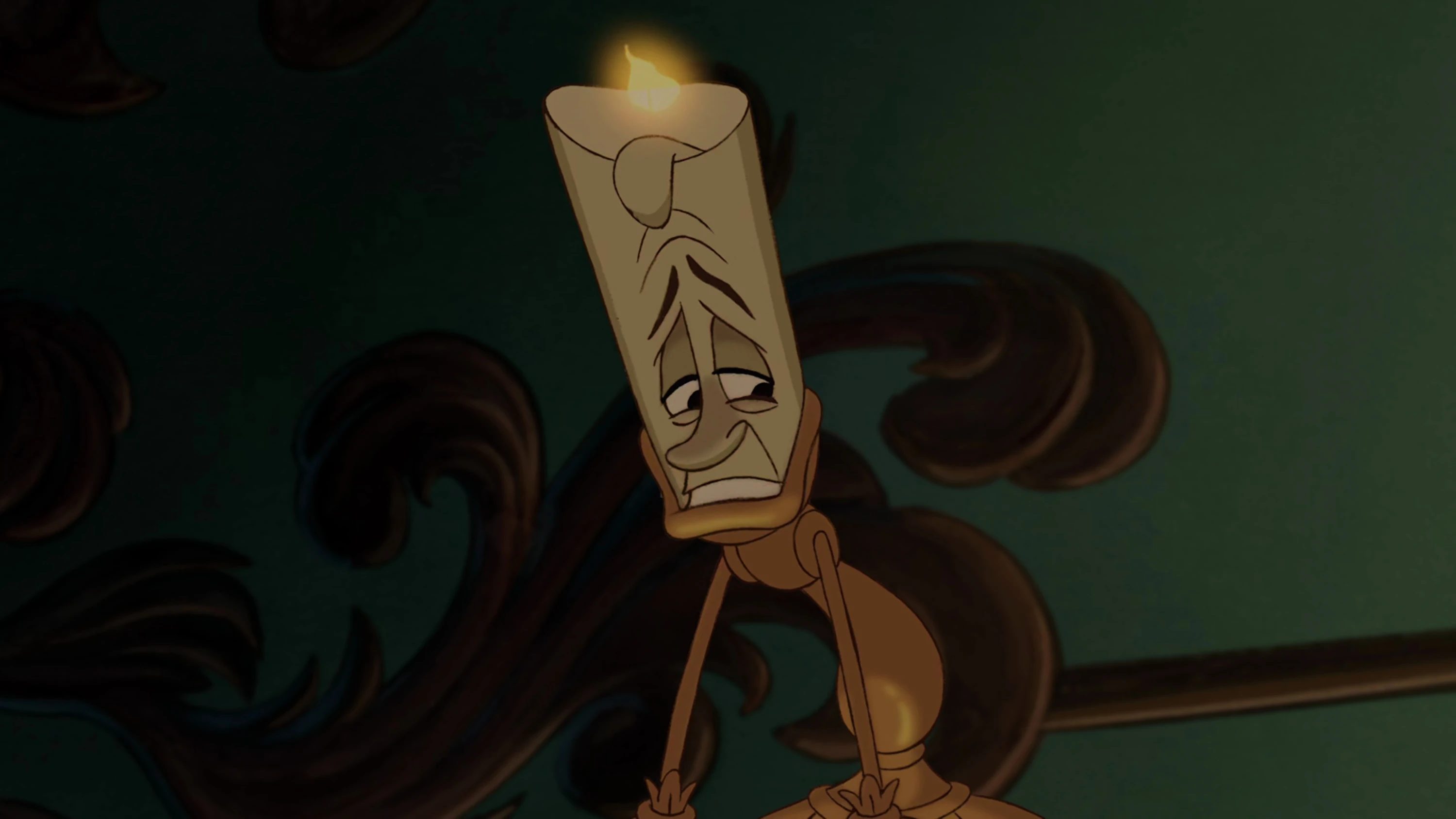
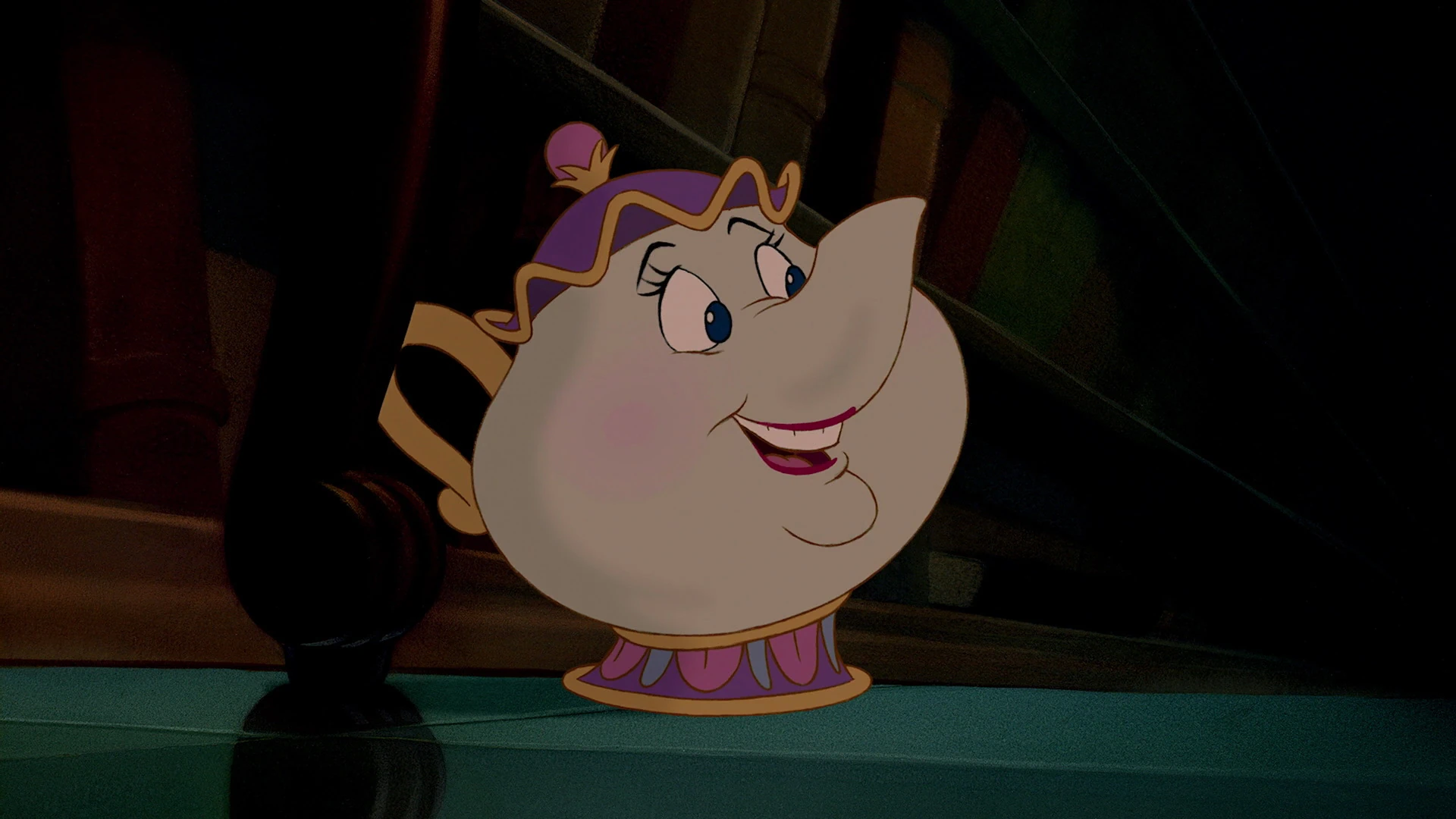
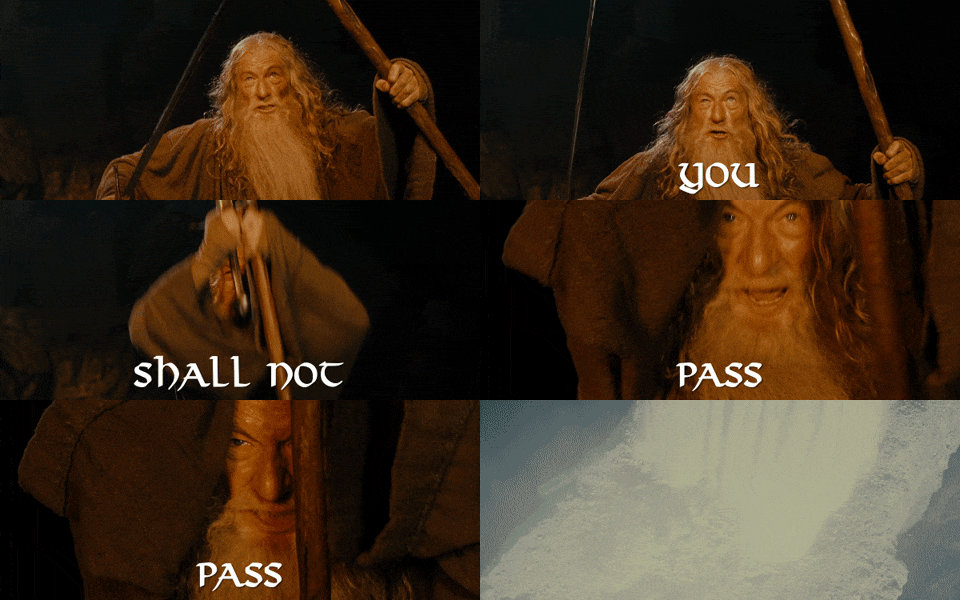
5. The Furniture: The one aspect of the "live" Beauty and the Beast that really complicates things is the supporting players. Trapped in The Beast's castle, consigned to their fate as knick-knack's, kitchen utensils, tchotchkes, and anything common in a Bed, Bath and Beyond, they are tied to his curse if he fails to find or give love. Lumiere (a candlestick), Cogsworth (a mantel clock), Mrs. Potts (a teapot) and the rest are played by name-celebrities who are surprising to see once they take on human form (although I guessed one of them, a veteran of a couple Condon films, and was glad to see the writers didn't give him an in-joke-line "YOU shall not...PASS!"). In this version, they are re-united with  their loved ones in the village. This light-bulbs a question: Didn't anyone realize they were missing...for years? I didn't see any flyers posted...or pictures on milk cartons. It's nice for these characters to have a more complex history than as indentured servants, but it doesn't make any sense at all if one thinks about it.
And that may be the biggest problem with this Beauty and the Beast—the makers know it is what it is, one of the best products of "The Disney Version." As they're doing these live-action versions of their past features—Alice in Wonderland, Cinderella, Jungle Book, Maleficent (can't wait for what they're going to do with Dumbo and Song of the South and, yes, that is sarcasm)—it might be a bit too soon at 25 years, to go back to this well. But nothing can stop Disney once they get dollar-signs in their eye like Scrooge McDuck. It makes you realize that everything, every childhood memory is merely grist for the Disney mill—maybe they should have that as their corporate symbol rather than a castle.