Showing posts with label Vanessa Redgrave. Show all posts

Tuesday, November 5, 2024

Merchant Ivory

Merchant/Ivory
(Stephen Soucy
, 2023) The name of "Merchant Ivory" has long been prejudiciously associated with a certain type of Oscar-bait movie, long on dialogue, high on landscapes, and attracting English actors of such a high caliber that they usually end up on Oscar short-lists for their performances. They have such a high pedigree that you'd never know that the films were lower budgeted than what was evident on-screen, and that the films were made by the skin of the teeth of Merchant Ivory Productions, sometimes risking scuttling the projects before they could be finished, and leaving the actors with a malevolent "Never again..." ("It required an immense amount of stamina" says Emma Thompson "to work for Merchant Ivory") only to be entranced, seduced, cajoled and convinced by either Merchant or Ivory to come back for another go-'round. And despite suspicions that they were being flim-flammed (once again), they did come back. Because to be in a "Merchant Ivory" film was a prestige gig.

The team (which wasn't just producer Ismael Merchant and director James Ivory, but screenwriter/novelist Ruth Prawer Jhabvala and composer Richard Robbins) wasn't afraid to buck current movie trends, go its own way, and chart its own course, self-assured that there was no down-side to going high-brow. And the new documentary Merchant Ivory quite giddily tells the story of the mess in the kitchen that provides the elegant meal. "It'll probably be something you're wildly proud of" says costumer Jenny Beavan of each MP project, "but...."
The beginning of the story involves the meeting of James Ivory (from Klamath Falls, Oregon) and Ismail Merchant (born in Mumbai—although it was Bombay at the time) at the Indian Consulate in New York, where there was a reception for a documentary Ivory had made in India. The two became partners, personally and professionally, their first project together an adaptation of Ruth Prawer Jhabvala's "The Householder"—her husband told her not to get involved with them, but she became enchanted with Merchant's Bali-hoo and "I liked the razzmatazz." It was not the smoothest first film of the partnership as the money ran out, but Ivory hated shooting in the Delhi heat, and when it came time to edit the film, they turned to Indian filmmaker Satyajit Ray to put it together. Merchant sold it to Columbia Pictures "by some miracle" and used the profits to make their next film Shakespeare Wallah.
They made four films in India and then went international with some weird choices: Savages, The Wild Party, but then settled down with such high-brow fare as 1979's The Europeans, 1983's adaptation of Jhabvala's Heat and Dust, and 1984's The Bostonians, until things exploded (mind you, it was an elegant, mannered explosion) with 1985's A Room With a View, which not only received tremendous critical acclaim and great box office, but also was nominated for the Best Picture Oscar. Rather than sign with any studio, Merchant Ivory chose to stay independent and in 1987 took the company public.
Produced by Cohen Media Group (which now owns the entire Merchant Ivory catalog) Merchant Ivory tells the story of the film-making team: Ismael the producer, James the director, but also, essentially and unquestionably, in what one of the participants calls "the Merchant Ivory vortex," Ruth the writer and Richard the composer. The four of them, each with a different personality—Ismael voluble and hyperbolic, James "quietly determined," and "unneurotic," Ruth the arbiter of taste and Richard the musical soul—formed a social and working club-house of essential ingredients, each with their specialty, but in close collaboration that influenced their projects and shaped the direction of the company and the films produced by it.
It's divided into six chapters, but, like the company itself, doesn't seem to adhere to each chapter's subject matter, cascading into other stories that spring to mind, but essentially telling the overview of the story in a chronological order, with particular asides for projects that garnered particular attention. They are:
 
Chapter One The Wandering Company: how two opposites in temperament and origins joined forces as independent film-makers—each had made documentaries by that time—and as a couple and began making relatively inexpensive films in India, the first of which brought Ruth Prawer Jhabvala into the mix (she adapted her own novel for them) as Muse, Arbiter of Taste, and the Book-Cracker, who would boil things down to essentials and if something wasn't up to her standards, she'd fix it.
Merchant's first visa to the U.S.: notice how he scratched out "Profession"
 
Chapter Two: the Mystic Masseuse: the story of Ismael Merchant, a man of Big Dreams and wide contradictions—gay, Muslim, a wheeler-dealer and con-man ("Yeah, sure, he was" says Ivory), extravagant in his ideas and juggling deals in order to achieve them, but never selling out to a studio in order to maintain independence over his company's work. Crew members talk of his being on the set constantly imploring Ivory—"Shooot, Jim! Shooot!"—shaking their head in astonishment "This rascal has done it again!" Hopkins ruefully smiles as he says "He can talk the birds out of the trees."
 
A Room with a View (1985) A water-shed moment for the company when international success comes to them after years of defying expectations and scraping by financing their films. Their dedication to authors like Henry James and E.M.Forster pays off and brings them critical and audience acclaim as well as much attention from the many awards groups. They are still financially rocky, but are no less dedicated to their favorite authors.
Chapter III: The Unspeakable Vice of the Greeks James Ivory, being the last survivor of the Merchant Ivory core, talks about his growing up as something of an outsider—adopted, intellectual, closeted—but collaborators and actors talk about how he's the least problematic director they've ever worked with and he comes across as easy-going, honest, unapologetic, with no regrets and certainly no resentfulness.
Maurice (1987)
Ivory wanted to make an adaptation of Forster's posthumous novel of homosexuality and class, which Merchant had qualms about—after the success of A Room with a View, why risk it—but "the vortex" went ahead with it with Jhabvala begging off, calling it "sub-Forster" but coming back to fix a crucial plot-point.
Chapter IV Only Connect
The film looks at the life and accomplishments of Ruth Prawer Jhabvala, winner of the Booker Prize for her own work, and her essential partnership with Merchant Ivory—she garnered the most Oscars for her work of the group (along with the costume departments) and her ability to write illuminating dialog for any character, no matter how repressed—and her screenplays are notably free of descriptions—made her the foundation of so much of what was great about Merchant Ivory.
Howard's End 1992 It was Jhabvala who raised the challenge to the team that this Forster work was "a mountain you have to climb" and the film garnered multiple Oscar nominations and an Oscar for Emma Thompson and she and Helena Bonham Carter and Samuel West go into vivid detail about the challenges and memories of working on the film, which was immediately followed up by
 
The Remains of the Day 1993 Most of the people being interviewed agree that this was the apex of the Merchant Ivory group and quite a few focus on Anthony Hopkins' performance for special mention, with Thompson calling out a particular scene with how Hopkins set up the tone and flabbergasted her with his performance. At one point Hugh Grant says "If someone said to me show me perfect film acting, I'd show them Tony Hopkins in Remains of the Day and, in fact, The Remains of the Day is one of the best films I've ever seen let alone been in.
 
Chapter V You Mean a Great Deal to this House This segment focuses on the life and career of Richard Robbins, who was something of a musical savant and began composing for the Merchant Ivory films with The Europeans and worked on every score up until The White Countess in 2005. As is stated in the film, his was probably the most notable director/composer collaborations since Herrmann and Hitchcock or Rota and Fellini.

Chapter VI Head and Heart The last segment talks about the Best of Times, The Worst of Times: Merchant Ivory began to work with big-time studios and working with bigger budgets, which made what they could do a bit easier, but the team began to splinter—Merchant began directing his own films (with Ivory ever-present as an advisor)—and then, time took its toll: Merchant died in 2005, Robbins in 2012, and Jhabvala in 2013. 
 
Only Ivory survives to tell the tale, and he's still working—he's the oldest recipient of an Oscar for his screenplay of Call Me By My Name, directed a film in 2022 (at the age of 94) and he's executive produced four films that are coming out in the next year. It's a fascinating story, with ample amounts of clips, and interviews with some of the finest raconteurs in entertainment. And it does exactly what Cohen Media Group wants it to do—it makes you want to seek out these films and the books they're based on.

Wednesday, May 18, 2022

Venus

Roger Michell died last year at the age of 65, before his latest film The Duke was released. It is out now and I recommend seeing it, especially in a theater, where it will do the most good. Michell's most popular film is probably Notting Hill, but he also made The Mother and Enduring Love (for you Daniel Craig fans), Hyde Park on Hudson (with Bill Murray as Franklin Roosevelt), and Morning Glory (with Rachel McAdams, Harrison Ford and Diane Keaton)—which we'll be looking at tomorrow. To sum up, he made movies that are usually placed in "art-houses" where films of a limited budget and less than frivolus subject matter, unsullied by hyperbolic press and saturation campaigns go to die...and merit consideration during Awards Season, where sometimes their fortunes are favored, but mostly forgotten. And he was darned good at it. 
 
Here's a look at one of his films—featuring another amazing performance of Peter O'Toole. It was also the feature film debut of Jodie Whitaker, who made history as the 13th Doctor Who. This was written at the time of the film's release on DVD.
 
Venus (Roger Michell, 2006) Peter O'Toole, in an interview in the special features section of the Venus" DVD sums it up as a story between "a dirty old man and a slutty young woman." Exactly, and if it had been sold like that it would have made much more money at the box-office. As it is, the film has to stand on its own merits, which are considerable. Hanif Kureishi's script is literate but low-down, full of humanity in all its frailties, both young and old, well-played by a stellar cast. And that's where the elements of specialness occur:
1) O'Toole--he plays an elderly thespian who, these days, "specializies in corpses," who has lived an impulsive romantic life, and in the winter of his discontent, still does. O'Toole makes the most of the words, but, more than any other actor, knows what to do between the lines. O'Toole is frail, but not THIS frail, and his tremulousness is a stunning act of craft over pride. He's not alone.
2) Playing the ex-wife he abandoned with three kids ("under six," she reminds him) is Vanessa Redgrave, the greatest actress extant, who does the part sans make-up, unglamourously and brilliantly. To see O'Toole and Redgrave play a scene together for the first time is a great event, and should be required viewing for all aspiring actors. These two actors, once coltish and prancing, now old and playing broken down is heart-breaking, but exciting (I'm starting to sound like bloody James Lipton!)
3)
Jodie Whittaker, in a seemingly artless way, matches them. That is not an insignificant thing. Picked, no doubt, because she resembles the young Vanessa Redgrave, one waits for the scene where the two meet. The viewer is not disappointed.

4) A scene where O'Toole, humiliated, goes for a walk and finds himself at a small, humble proscenium--the benches covered and strewn with leaves and garbage, as the soundtrack becomes awash with O'Toole's voice from past performances of different eras and different fidelities that's as fine as any piece of film I've ever seen
5) A waitress at the old actor's favorite eating hole sees a picture of the young actor in the paper. "Gawd, he was GO-geous, wasn't he?" Someone should make another starrer for O'Toole and call it "Give The Man The Friggin' Oscar He So Richly Deserves, Already" and be done with it.
2022 Update: Peter O'Toole was nominated for 8 Best Actor Performances and received an "Honorary Award" in 2003.

Friday, April 15, 2022

Agatha (1979)

Agatha
(Michael Apted, 1979) The disappearance of Agatha Christie in 1926 is one of those black holes of history that intrigues history buffs, mystery aficionados, conspiracy theorists, and speculative fiction writers. There is the delicious irony that one of the great writers of mystery fiction would also have a mystery in her own life, one that would interest the gossipy impulses of Miss Marple and the behavioral insights of Hercule Poirot, two of her better known creations. 
 
There was a book about the "missing days" published last year—"The Mystery of Mrs. Christie" by Marie Benedict—but, before that, a screenplay focusing on the matter had been written by Kathleen Tynan, at the instigation of producer David Puttnam, after suggesting that her explorations for a Christie documentary might make a better fictional film. Michael Apted (known for the "Up" documentaries and Stardust) was chosen to direct and, after casting Vanessa Redgrave and Dustin Hoffman (Hoffman was also a producer), a re-write was done by Arthur Hopcraft and—at Hoffman's instigation—an uncredited Murray Schisgal, causing Hoffman enough tsuris that he sued the production for breach of contract after the fact. The Christie Estate also sued to prevent the film being made—Christie had died in 1976—but, the film continued on, estate approval or no.
Agatha postulates—it opens with a title that says
"an imaginary solution to an authentic mystery"— the writer (played by Redgrave) confronting a crisis in her marriage to Colonel Archibald Christie (Timothy Dalton in full "bastard" mode), who tells Christie that he is divorcing her with the intention of marrying his mistress Nancy Neele (Celia Gregory). In an earlier sequence, we've seen his disdain in the marriage and his seething impatience with Christie's fame from her writing career, a trait noticed by an American newspaperman Wally Stanton (Hoffman), who has arranged an interview with the author.
 
But, before he can meet her, she goes missing. Her car is found, wrecked, abandoned, and the Colonel is decidedly blasé about her disappearance, and is no help to the police in the matter. "She'll turn up" is his taciturn reply and makes plans to return to his mistress.
Stanton, meanwhile, instead interviews Mrs. Christie's secretary, who tells him that her employer had left her a note in code. Stanton is able to deduce from it where Agatha has gone. That would be the Harrogate Hydropathic Hotel for a two week stay under the name of Theresa Neele—the choice is not coincidental. While the police are embroiled in a nationwide search and the nation is reading of her disappearance on the front page, Agatha is taking treatments, awaiting the arrival of her husband's mistress, who she knows has also booked herself at the baths.
Stanton checks in, as well, also under an assumed name and observes and ingratiates himself with Christie, never acknowledging that he knows who she really is, or he himself is not what he pretends to be. What he finds is a vulnerable, guarded, somewhat fearful woman not sure of what she's doing herself, but as she indulges in treatments she becomes fascinated with a hydro-electricity therapy using a Bergonic chair and takes an interest in rheostats. What doe she have in mind...and how does it involve her husband's mistress?
The story is intriguing—one could even say shocking—but for all the loveliness on display thanks to Vittorio Storaro's photography,* the film is strangely bloodless, and for the very reason it stands apart from most period films. It's entirely true to its period, all the characters being very British and undemonstrative because...well, that just wouldn't do, of course. Unseemly, don't you know. Lips are upperly stiff and not even trembling under the strain of socially unacceptable behavior. We, as contemporary audiences, expect a bit of mannered stuffiness to pass (and pass judgment) for rectitude under all conditions. But, here the players aren't panto-ing melodrama, they are playing people playing by the rules of decorum and playing it very close to the vest. All the while, in bromidic anonymity, lest they give themselves away. Redgrave can be just as fascinating playing passivity as anything else, but Hoffman gives the least "ticky" performance of his career, his Stanton maintaining a straight-backed chivalry, even to those he considers cads. Speaking of which, Dalton comes off the best as the arrogant Archie, all diffident entitlement.
So, Agatha is an intriguing misfire. It's just interesting enough to keep you engaged, but so cosseted as to prevent one from being satisfied...or entertained.


* His next film would be shooting Apocalypse Now in the Phillipines.


Tuesday, September 22, 2020

Evening (2007)

Written at the time of the film's release...

Evening (Lajos Koltai, 2007) Okay, before we say anything about this movie, look at the cast--that'd be the reason people would be drawn to this movie: Vanessa Redgrave, Meryl Streep, Glenn Close, Eileen Atkins, Claire Danes, Natasha Richardson, Toni Collete. That is some heavy-duty fire-power and far eclipses the male contingent of Patrick Wilson, Hugh Dancy and Barry Bostwick.

Add in the stunt-casting: Natasha Richardson plays the daughter of Vanessa Redgrave's character, which should be easy to do as she's Vanessa Redgrave's daughter. Then there's Mamie Gummer, whose character's wedding is the centerpiece of the flash-backs for this film, and who is played in the present-day by Gummer's real-life mother, Meryl Streep.* All nice for a little conversation-starter at the coffee-klatsch.
But the reason to see this film is late in the proceedings: it's a scene between the two old friends played by Streep and Redgrave, both very old, and the latter, dying. And it's amazing. Redgrave is always good--surprising in how she can breathe life into any kind of scene. To see Streep and her play off of each other, is one of those rare moments of seeing two great actors at the top of their game combining their talents, even if the movie is no great shakes.** Upon finding out who her visitor is, Redgrave's arms fly out, reaching for her, a girlish gasp in delight escaping from this bed-ridden woman of no strength, but for that moment, she's young again, in memory and reality. And the two become gossipy friends again, though Streep's character is held in check somewhat by reality, and Redgrave's has no time for holding back. Great actresses. Great scene.
But the rest of the film is lacking. Whenever the film is off of Redgrave (her nurse is played by Eileen Atkins, who is Streep's counterpart in England), the film lags. Claire Danes plays the younger version in the flashbacks for the better part of the film, and though Danes can make her character dither at the drop of an impulse, that part feels soapy and over-written, and not as felt. And the present-day conflicts of the Redgrave character's children seem far less interesting than the flights of fancy of their dying mother, who flickers in and out of fantasy and reality. In the end, her obsessions are passed off as not amounting to much, though they're important to her, and the lesson of the film--there are no mistakes--comes off as hopelessly banal as saying "It is what it is."
Still, it's an impressive cast, but it's a mired chick-flick, that tested the patience of some chicks I know.

*"Nepotism," I hear you cry. And it is. Funny thing is, Gummer was cast first, and then and only then was Streep, who'd been in screenplay-writer Cunningham's The Hours, approached to play the older part. On the DVD, Gummer cracks: "Nice to be able to find my Mom a job!"

**I'm thinking here of DeNiro and Brando in The Score, or Brando and George C. Scott in The Formula, or Hepburn and Wayne in Rooster Cogburn or Hepburn and Fonda in On Golden Pond. These are events couched in humble films of limited means, and it's just fun to watch legends work together, even if you have to suffer through the rest of the movie to do it.

Tuesday, May 8, 2018

Julia (1977)

Julia (Fred Zinnemann, 1977) I won't get into the actual veracity of the story behind Julia (other than this article isn't tagged with "Based on a True Story" (not that any movie that claims that distinction is probably being very truthful). But, the movie (and Hellman in her book, "Pentimento") hedges its bets by opening with an atmospheric shot of Lillian Hellman (and, according to entertainment myth, it actually IS Lillian Hellman in that boat) and Jane Fonda's voice-over narration:

“Old paint on a canvas, as it ages, sometimes becomes transparent. When that happens it is possible, in some pictures, to see the original lines: a tree will show through a woman's dress, a child makes way for a dog, a large boat is no longer on an open sea. That is called pentimento because the painter "repented," changed his mind. I'm old now and I want to remember what was there for me once and what is there for me now." 

Cut to memory of days gone by: Lillian Hellman (Jane Fonda) is writing...or trying to, anyway. It's a struggle.  She chain-smokes, stabs at the typewriter in frustration, and, even goes so far as to throw the damned contraption out the window. All of this is not lost on her lover, Dashiell Hammett (Jason Robards), himself a writer (currently living on royalties) who goes about his day keeping up their New York coast beach-house and observing the recalcitrant chaos which is "Lilly" composing. "You know you don't have to do this," he rather sarcastically counsels. "It's not like you've written anything before. No one'll miss you. It's a perfect time to change jobs." 
He suggests that if she's blocked, she should do something else, another job, a vacation, go to Paris, see her friend Julia. "Just don't go crying about it!" he scolds. "If you're gonna cry about it, go stand on a rock!" But, she doesn't leave, just retreats to her memory. Her childhood friend Julia (Lisa Pelikan as a child, Vanessa Redgrave grown up)she remembers with absolute clarity, how she was a restless spirit, raised by her entitled grandparents (who tell her when she sees some injustice "don't look at it") and finally escapes when she is accepted at Oxford to study medicine and does graduate studies at the University of Vienna. She decides to go to Paris, re-purposes herself to write her play...and to see Julia. After many missed phone-calls, she gets a mysterious phone-call that Julia is in hospital, injured from an attack from fascist demonstrators on campus.
Once in Vienna, she find her friend badly beaten, unable to talk, and she is told that she has a reservation for her stay at the Hotel Imperial, provided by an "Herr von Fritsch" who is not staying at the hotel and cannot be reached. Julia disappears from the hospital and her records expunged, leaving Lilly confused, searching, frustrated, and unable to finish her play. She returns home and resumes writing.
But, the memory of the events in Vienna haunts her. She finishes her play, but finds Hammett in the morning, reading it, and more than critical. "You want to be a serious writer," he says. "I don't know what happened, but you better tear that up." A long torturous second draft produces "The Children's Hour," high praise from "Dash" and interest from Broadway, where she becomes the toast of the town. But, there is no word from Julia, although Lilly writes her regularly.
On a goodwill trip to Russia (along with Hal Holbrook's Alan Campbell and Rosemary Murphy's Dorothy Parker), Hellman is contacted in Vienna by a "Mr. Johann" (Maximillian Schell), who carries a message and a request from Julia—come see her in Berlin on the way to Moscow, in that way, with her help, anti-Nazi organizations can smuggle in $50,000 of Julia's money to bribe the release of some fellow dissidents. The mission is, of course, not a little dangerous; she will be detouring, travelling to Nazi Germany and Lillian Hellman is Jewish. Although she is warned that, as in childhood, she is "afraid of being afraid," she is cautioned by Julia's message not to be a hero, if she thinks she cannot do it.
Of course, she does it, although it attracts the curiosity of Campbell and Parker, and Hellman boards a train for a tense journey to Berlin, where, unbeknownst to her, she is being kept under watch by the Nazi's and under wing by the sympathizers, who anonymously supervise her every nervous move for a rendezvous she can't begin to imagine.  
The film won the BAFTA that year for Best Picture. It also won three Academy Awards: Vanessa Redgrave's supporting performance as Julia (frankly, every time Redgrave acts she should win an Oscar); Jason Robards won for Best Supporting Actor for his wry romanticized portrayal of Hammett (Schell was nominated as well) and Alvin Sargent's spare, episodic screenplay that, although it never stays in one place for very long, is nonetheless amazingly rich in detail. I also think this is probably Jane Fonda's most relaxed, most versatile and least mannered performance of her entire career—she was nominated for a Best Actress Oscar, but lost to Diane Keaton's Annie Hall. Her portrayal is "scrappy" (as described in the screenplay) but also vulnerable, tremulous, but never weak, and Fonda takes major advantages of those moments for subtle drama and opportunities for comedy.
Fred Zinnemann was 70 when he made Julia and was approaching his fourth decade making movies (this would be his second to last film). His direction is meticulous, but like much of the director's work over the years, not so much as to be stodgy—he frequently punctuates the steadiness of the compositions with ones that are "catch-as-catch-can" to bring life to the story-telling. He is aided by editor Walter Murch—doing his first editing work outside the USC Mafia film-making tent—who is positively brutal in his cutting, but creates a dramatic tension through it that might not be there if he weren't so fastidious. George Delerue's score is uncharacteristically unromantic, relying more of the tension he employed in his work for The Day of the Dolphin. If there is any weakness to the film, it's in Douglas Slocombe's too-veiled photography, which looks like a bad imitation of Geoffrey Unsworth's fine-grained work. It may be a film of memory, but, if so, it's awfully fuzzy.
The film has been criticized for its emphasis less on Julia, but on Hellman's story, which seems odd. It is Hellman's story, and if hers is less dynamic, more flighty, and a bit specious in her pursuit of fame and fortune (and acceptance), then so be it. That's what her story was. "Julia" (if she existed) was out of sight, a creature of moments and not continuity, and ultimately, a mystery as unknowable as one of Hammett's femme fatale's. And she was a reflection of what Hellman wanted to be—worldly, passionate, committed, and independently wealthy. In some form, Julia existed, if only in a case of need.
I can't tell you how many times I've seen Julia, but I saw it a lot. It was the favorite film of a gal I was going out with at the time, and it was the "go-to" movie on date night. But, personal history aside, the film still resonates for its unresolved story, the questions, the regrets, the "what-could-have-been's" at its end and the sense of unreality that the world was drenched in during the 40's before, in our fear, paranoia, and triumphalism, we produced our "Scoundrel Time" in the 1950's. It's a deftly handled film of flawed individuals trying to do the right thing and falling short.


Lilly and Dash (left)
Lillian Hellman in 1939 (right)


Julia was also the film debut of an actress with the unlikely name of Meryl Streep
(wonder whatever happened to her?)

Wednesday, January 3, 2018

Atonement

Written at the time of the film's release.


"See You Next Thursday..."

Atonement is Joe Wright's masterful film of Ian MacEwan's novel about the responsibilities of authorship and ownership. A tricky novel to adapt, it manages to become just as valid as a film as it does on the printed page. Wright's last film was the umpteenth adaptation of Pride and Prejudice and both he and Keira Knightly managed to make the adaptation relevant and seem needed, though Wright, in an effort to breathe life into it, would sometimes go a bit overboard in his camera tricks.

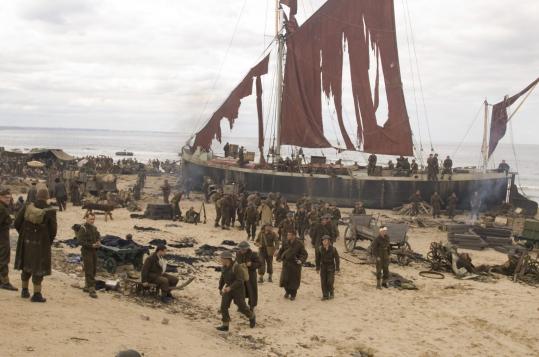
Here he's much more assured, still suffusing the film with a restless energy, but also getting out of the way of the actors when the drama goes quiet. His "big trick" this time is a five minute continuous shot of the beach at Dunkirk that keeps time with the soldiers, dodges the vehicles in a panic, the muck and the mire, winds around a choir and gives you a hint of the simmering panic of the soldiers stuck on the last patch of land between the enemy and salvation
But, as he proves a master of space, Wright also plays with time and memory in Atonement, sometimes starting the movie again a reel back to give you an added detail, another viewpoint, a fuller story than one unreliable narrator can provide. His camera snakes along with the participants meeting them stride for stride in their careless haste, and eking out humor in the frailties and shows of civility. And if Wright's work isn't enough to bring home the point, Dario Marianelli's chattering, propulsive score provides a sonic counter-point, blending seamlessly with the sound design and characterizations.
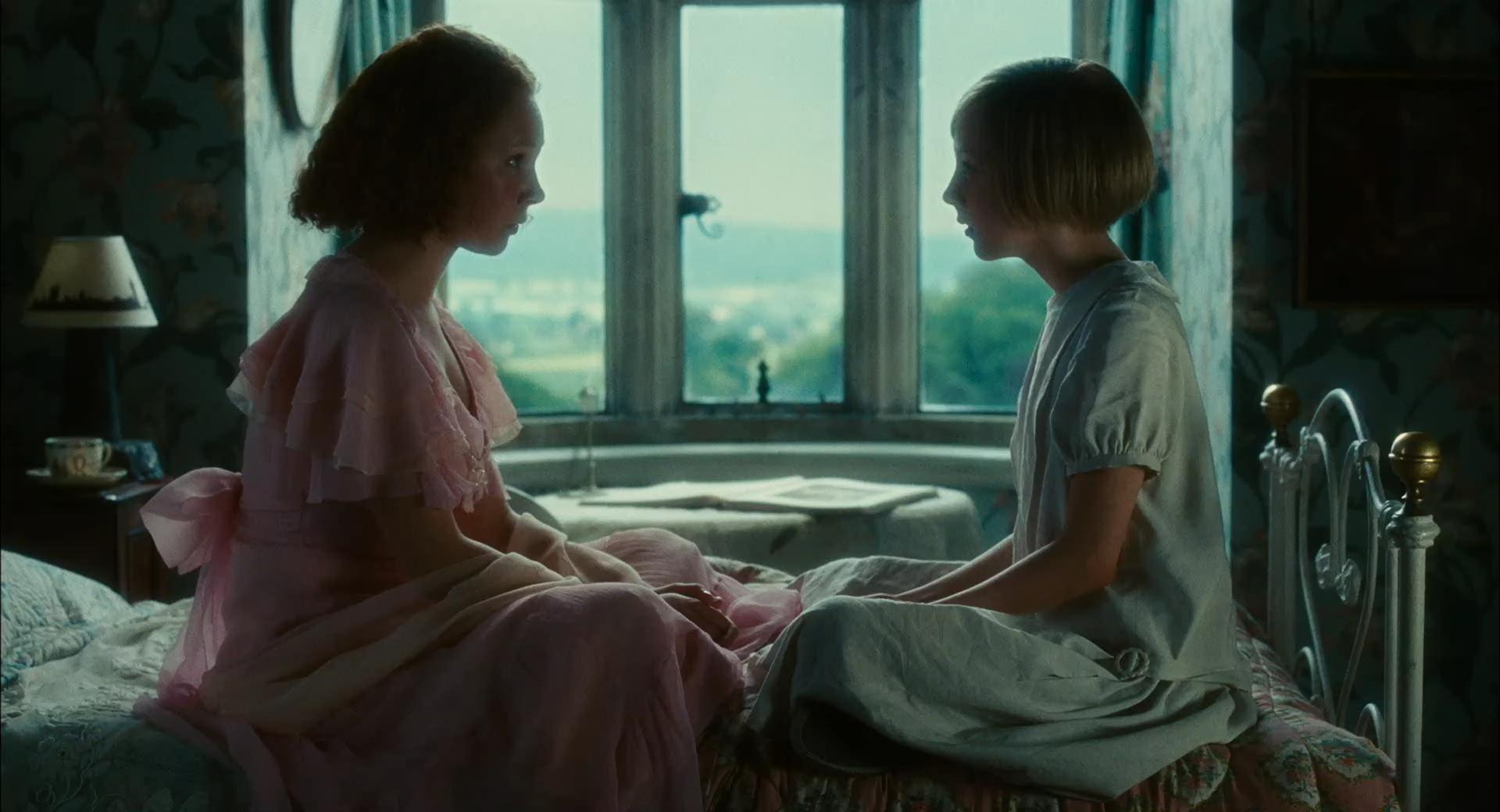
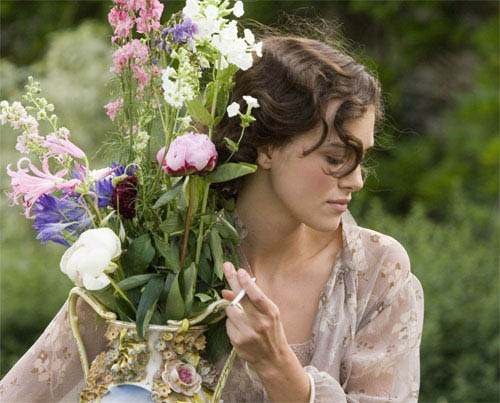
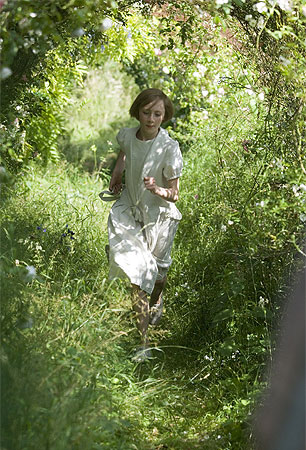
Keira Knightley and James McAvoy (he's never been better) are getting the lion's share of acting accolades, but the true miracle of this movie are the trinity of actresses playing authoress Briony Tallis--Saoirse Ronan, Romola Garai, and Vanessa Redgrave--at various stages of her life. They are united by their haunted eyes, seeking out the truth, desperate for comprehension...or what they accept as comprehension. Those eyes grow more feeble with age, more unsure and tremulous, and garners an empathy that helps leaven sympathies for the characters involved, and in doing so Wright provides an "Atonement" of his own.