Showing posts with label A. Show all posts

Wednesday, April 16, 2025

The Alto Knights

De Niro 17 (And Just Beside Himself)
or
Keep Your Friends Close and Your Enemies Closer (Tough to Do When They're One and the Same)
 
It wasn't the stunt-casting of Robert De Niro in the two lead roles that made me want to see The Alto Knights. It was that this property had been "in the works" since the 1970's (when it was known as "Wise Guys"), being produced by legendary producer Irwin Winkler (who is now 93), with a script by Nicholas Pileggi (he wrote the screenplays and source-books for Goodfellas, Casino, as well as writing City Hall and executive producing American Gangster) and directed by Barry Levinson—who started out writing for Tim Conway, "The Carol Burnett Show", Mel Brooks, and directed such films as Diner, The Natural, Rain Man, Good Morning, Vietnam and his previous gangster movie, Bugsy. Levinson was the draw for me and considering the amazing work he's done in the past—he also executive-produced "Homicide: Life on the Street", a personal favorite—that was more than enough reason.

The Alto Knights tells the story of the Luciano mob family that went from bootlegging during Prohibition to gambling, and controlling criminal activities in Manhattan's Lower East Side. It concentrates on the relationship between Frank Costello, Luciano's consigliere and Vito Genovese, the gang's underboss, who grew up as friends but became bitter rivals once they achieved higher status in the Mafia. And it covers the time from when Costello ran the mob to the helter-skelter Apalachin meeting, the "mob convention" so flagrant that even the FBI's J. Edgar Hoover finally had to admit that organized crime actually existed (why he never had before has been an unexplained mystery).
If you've seen The Godfather, the story will have echoes of the same gun-fire—author Mario Puzo used details and scrambled them for his novel—but, at one point, Genovese (who'd been put in charge of Luciano's mob after its head was sent to prison for running a prostitution operation) fled to Sicily to avoid a murder charge, and was replaced with Costello. Costello and Luciano had deep contacts with New York politicians, and, with Costello in charge, it was easier to get away with murder. 
But when Genovese returned to America in 1945—witnesses to the murder had been very conveniently murdered before any trial could take place—the re-patriated mobster assumed that Luciano would put him back in charge, but, instead, Costello kept himself as the mob's boss, making him an enemy in the mercurial, less steady Genovese's eyes and for the rest of their lives the two stayed bitter rivals. 
The film chronicles that rivalry—from Costello's point of view, so it's more than a bit prejudiced—picking through pages of Mob history back and forth in time in flashback, beginning with the most obvious example of their rivalry, the botched assassination of Costello by Genovese's son on his Dad's orders (Genovese was never said to be subtle). It's that act that convinces the more strategic Costello to retire from the mob, but not without some manipulation of the volatile Genovese. Of course, it's all from Costello's self-sympathetic view of things. But, the film also has Genovese's wild divorce trial, the killing of Costello's hand-picked successor Alberto Anastasia, the Senate hearings of Estes Kefauver, and that ill-fated Mob convention.
Pileggi and Levinson keep it moving and some of the set-pieces are nicely conceived, with the director sometimes evoking Edward Hopper paintings (as he has done in the pas) this time with the aid of 81 year old cinematographer Dante Spinotti
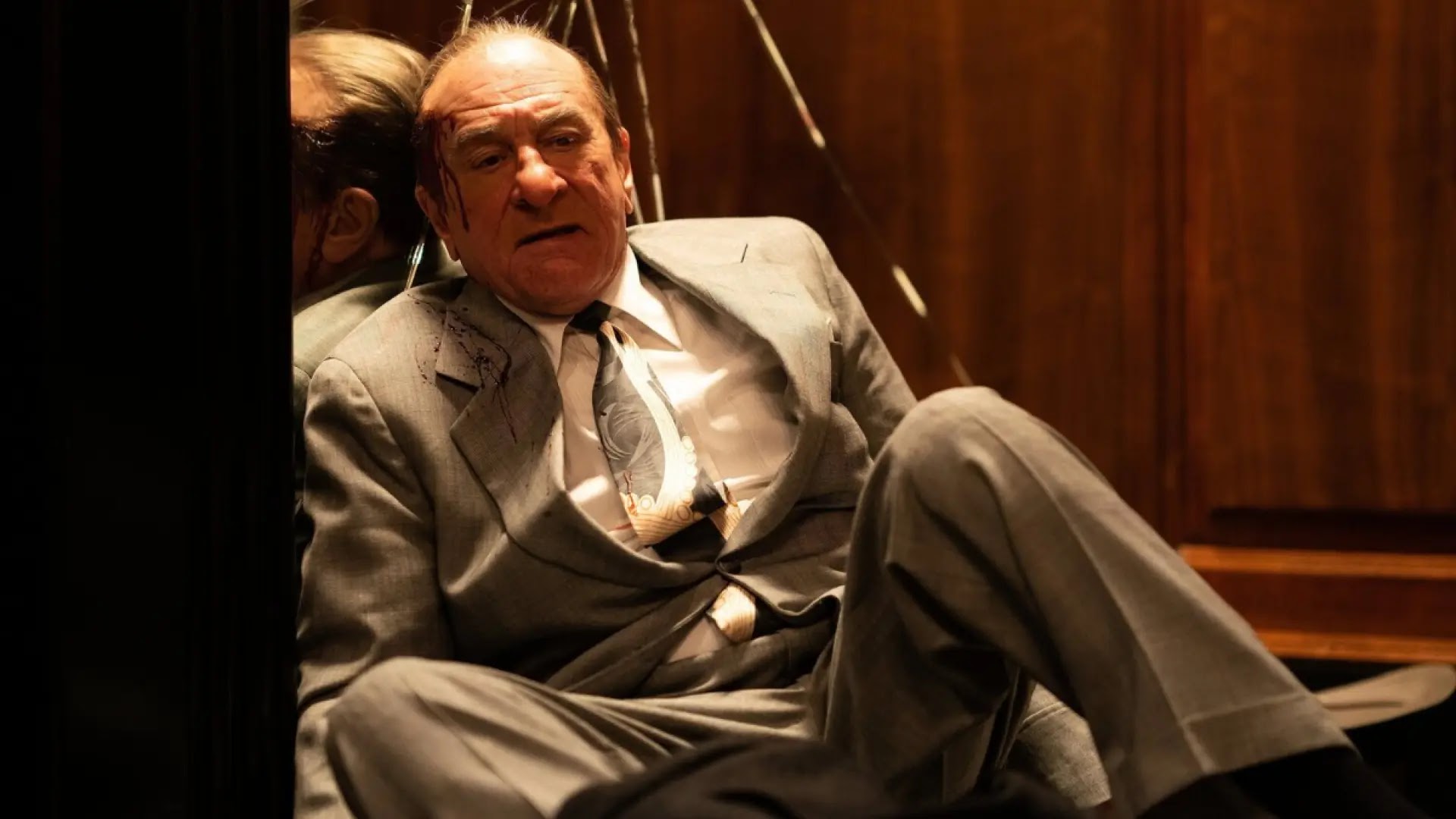
So, since he's all over the movie, is De Niro any good? I mean, at playing two different characters in the same movie? Yeah, it's quite the show. Early on in the movie De Niro takes pains to separate the two personas—his Costello is more soft-spoken and cagey-eyed, while his Vito Genovese spits out his dialog and has a nervous energy (it's almost like De Niro is doing an impression of Joe Pesci). And the few scenes where the two characters are together and De Niro is literally beside himself, it's something of a wonder as the dialog flows naturally but the two characters interrupt each other, react to the others' accusations and gives the impression that, hey, this is two different guys here having a rather diffident conversation with each other (but it's the same actor doing both parts!). I have no idea why they did this (I've read that it was Warner CEO David Zaslav's), but it's an amazing to see. 
And, really, who is De Niro going to play against? Who has the caliber to go toe to toe with him? Pacino, maybe (but they've made a pact that they're not going to do anything together unless it's really good). Alec Baldwin would have been an interesting choice and quite capable. But, watching De Niro play two different characters...with two different energies...is a fascinating exercise. That he pulls it off (despite never fully convincing us that it isn't a "twins" act) impresses. "Molto rispotto."
But, any gangster movie is going to have that weird quality of upside-down absurdism (Costello wants to retire and lead a "normal" life...really?), which Levinson, with his comedy background, leans into heavily. The thing that's missing is any sense of moral outrage. These were gangsters, after all. Their day-to-day illegal activities are mentioned ("just business") and prominent assassinations are portrayed (because "if it bleeds, it leads"), but like Levinson's Bugsy, there isn't the sensibilities of penance being paid that you'd find in Catholic filmmakers like Scorsese or Coppola. For the criminal record, Genovese died in prison, while Costello died in his retirement penthouse at the Waldorf Astoria. A lot of their victims, we'll never know.
Frank Costello and Vito Genovese mug shots
 

Friday, February 28, 2025

Anora

The Girlfriend Experience (and Transactional Relationships)
or
"She Happened..." ('Tis a Pity...)
 
Anora—"Call me 'Ani'"—Mikheeva (Mikey Madison) is a Brooklyn stripper working in "The Tenderloin" section of Manhattan. She's very, very good at her job working as a "hostess" getting to know the clientele, encouraging their drinking and their desires, even going so far as to escorting patrons to the nearest ATM when they run out of cash. If the "mark" is really friendly, the "VIP" treatment might be suggested to an area upstairs where the stripper can do a lap dance to make some extra dollars. There's no touching during the lap dances, although given the near-privacy of the area, rules can slip as easily as a halter-top.
 
We learn a lot about "Work-place Ani" in the first few minutes of the film, which is short on exposition but long on nudity. We see her backstage where she has little patience with bullshit. She has one good friend, Lulu (Luna Sofía Miranda), but has a somewhat competitive relationship with the other girls. And she's good at acting: acting interested, acting sensual, acting like she cares, finding the weak spot, using rapier-like flattery, and is quite creative at it. You have to be to score a buck.
But it's only acting. Once the club-wear is off and she's out the door of the HQ Club, she's a dead-eyed street urchin in hoodie and sweats making her way back to her home in the Russian-American community of Brighton Beach, where she rooms with her sister (
Ella Rubin)—their relationship can best be described as passive-aggessively strained—and her hobbies appear to be...sleeping. Being a sex-worker in Manhattan is exhausting work. 
So, she's less-than-thrilled when the owner of the club, Jimmy (
Vincent Radwinsky) wants her to pay special attention to a "high-roller." This turns out to be 21 year old Russian student Ivan "Vanya" Zakharov (Mark Eydelshteyn), who is in the United States for a college education, but that he spends, largely unsupervised, drunk, stoned, obsessively playing video games and shacking up at the huge Brighton Beach mansion owned by his Russian oligarch father. "Vanya" is a child with little impulse control and he falls head over heels for Ani, who, once she sees how free the kid is with Dad's money and doing a little negotiating, agrees to a week-long extracurricular activity at his place for $15,000 cash upfront.
Ani is rarely impressed, but she's awed by the Zakharov complex and the kid is putty in her hands. He gives her clothes, jewelry, the best wine, the best food, and she's charmed by "Vanya's" drunken joie de vivre and his generosity towards her—she could get used to this. She meets his friends, becomes part of a group, all bankrolled by "Vanya", who—impulsively, again—decides to take his posse to Las Vegas on a private jet.
The group stay at a high-end suite, living the highest of lives, when "Vanya" does the craziest thing yet—he asks Ani to marry him. She scoffs. But, he's serious; if they get married he can get a green card and stay in America—he won't have to go back to Russia and work for his father. They can live at his father's American property, and things will just go on as they have been. Ani agrees and they go to a Vegas wedding chapel and seal the deal. He buys her a very expensive wedding ring.
They return home and Ani quits her job at the Club; the other girls are thrilled, but there is the underlying suspicion: "give it two weeks." Things like this, they only happen in the movies. But, the two are clearly besotted with each other and they set up house at the mansion. Life is good.
Until...
 
Until, "Vanya's" parents get wind of the marriage all the way from Russia through social media, and they decide to travel to the States to take their son home. A frantic mother Galina (Darya Ekamasova) calls "Vanya's" Armenian godfather Toros (Karren Karagulian) to get the marriage anulled, get the ring back, kick "the prostitute" out and get their kid ready to get on a plane. Toros is the Zakharov lap-dog—he's been keeping "Vanya" out of trouble and being the family "cleaner" for any mis-deeds—so he sends his henchmen, his brother Garnik (Vache Tovmasyan) and Igor (Yura Borisov), to get the ball rolling and Ani out.
And that's when things start to go South. "Vanya" won't let in the bodyguards, but he's so slight that they manage to get in, anyway. Ani begins to protest and Garnik and Igor try to cool things down, but still get things done...which doesn't actually happen. "Vanyas" lamely protests and fusses that he's not getting his way; Ani protests they're married and there's nothing anybody can do about that, then "Vanya" runs out of the house and Ani starts attacking the bodyguards, who, though they outweigh her by two can't seem to corral her—while doing some physical damage to the living room. Finally, Ani just screams and the two guys get so freaked out that they end up tying her up and gagging her.
 "Everything's going to be alright....Yeah."
And that's what the "godfather" sees when he manages to show up at the mansion. Everything's a disaster. They don't have his godson (and they need him to have the marriage annulled) and they have the most uncooperative person in the world as their only hope of finding him before the Zakharov's arrive (which won't be good even if Toros and crew manage to accomplish everything the parents want).
Anora is several things but running in ironic circles. It's funny, it's anarchic, it's dramatic, and it's a bit of a tragedy. It's also a character study. Because as finely drawn as the cluster of characters is, the whole thing revolves around Ani—Anora—and how she copes (and doesn't) with the situation while losing what she considers a good situation. She wants the fairy-tale (okay, he's an oligarch's son and not a king's, so the world's not perfect, okay?) and fights for it, even when she's way over her head. She's not a "hooker with a heart of gold" except for this one guy, and as cynical and worldly as she appears she's a sucker for her own happy ending. She's not helpless, not by a long shot, but she won't be anybody's victim, either. And as coarse and as conniving as she can be, you root for her all the way. Madison's performance goes a long way in accomplishing that.
This isn't Pretty Woman—it's a much more raw world, where few things are implied and the language is "persistent" (I think it gives The Wolf of Wall Street a run for its money in "f" bombs), not is it coy about sex, or even romantic about it. But, it has the verve and the sting of a Preston Sturges movie that pokes at your assumptions and makes you laugh at them at the same time. It's a comedy with the DNA of a drama and you may be questioning why you're laughing at what's being portrayed, but Sean Baker has made the kind of movie that keeps you on the fence while wondering about what could happen next.
 
Anora hooks you.
"Really? You ended with THAT line?"

Tuesday, July 30, 2024

Alfie (1966)

Alfie
(
Lewis Gilbert, 1966) This is the film that catapulted Michael Caine to the A-list of stars—a bit of a wonder, that, as he essays the titular lead in this character study of a complete rotter of a misogynist, a taxi-driver/chauffeur whose relationships with women are as transitory as any fare. 
 
One shouldn't be too surprised by this, I guess, as audiences have always had a tendency to gravitate to, and even admire, villains, be they "Scarface" or Darth Vader or Brando's "Wild One" or "The Godfather." Maybe it's the nature of film to be a spectator sport and with the safety of being removed from any hurtful fall-out, we can choose to imprint on "bad guys" and their assertive natures to do harm. Maybe it's just wish-fulfillment on audience's parts—"I wish I could get away with that in my own life" and especially nowadays as there's no Hays Code strictures requiring just punishments be meted out by the end of the picture. There don't need to be ramifications anymore, and in this brave new world, the heroes and villains get all mixed up. Here, the term "anti-hero" need not apply.
"I suppose you think you're gonna see the bleedin' titles now.
Well, you're not, so you can all relax..."
Caine's Alfie Elkins is no anti-hero. He's a bloke trying to make do for himself and making no apologies for it ("You've got to live for yourself in this world, not for others."), certainly not to his conquests, and certainly not to the audience, whom he addresses directly from the get-go, in mid-assignation with a married woman (he may be misogynistic, but he doesn't discriminate). In his first-person discourse* he's as cheekily blunt as he is with his ladies in question (and their questions usually revolve around commitment, something Alfie is adamant he'll have no part of—"I don't want no bird's respect - I wouldn't know what to do with it.").
So, we watch as he tramples over hearts in his own memorial parade: There's that married woman, Siddie (
Millicent Martin) cheating on her husband, while Alfie goes back to his cheated-upon girlfriend Gilda (Julia Foster) who lives with him for a time, quite unhappily as he refuses to even consider "settling down" with her ("I told Gilda from the start that I ain't the marrying sort." he says by way of explanation. "And do you know what?" he continues cluelessly, "She don't mind. She's a stand-by and she knows it. And any bird that knows its place in this world can be quite content."). That must include—in addition—the manageress of his dry-cleaners, a "foot-comfort" technician, a woman named "Dora", "the odd bird that came by chance" like Carla (Shirley Anne Field)—the nurse at his convalescent home when he's diagnosed with "spots" on his lungs, the girl he picks up on the motorway (Jane Asher), the wife (Vivien Merchant) of a fellow patient (Alfie Bass) at the convalescence, and a woman, Ruby (Shelley Winters), who he chats up while taking photographs as a side-hustle.
"My understanding of women only goes as far as the pleasure. When it comes to the pain I'm like any other bloke - I don't want to know." And he doesn't want to know; if there are complications, inconveniences—like a couple pregnancies—he'll lay down the law of how it's going to be and any reluctance just spells (for him) merely the end of any consistency in his hook-up schedule. He's a hit-and-run heart-breaker, not sticking around to see the damages. Alfie...and Alfie...show the dark underbelly of "the Swingin' 60's" and what happens when the swinging stops—you're left twisting in the wind, basically; things don't look so "gear" when people are chewed up in them.
Caine plays this cad as charmingly as he can, speaking breezily without much change of expression and little irony betraying any self-awareness. For all the winking at the camera that could have been, Caine avoids it with a mostly passive expression that is betrayed by a speech-ending toothy grin or a darkness around the eyes when the situation—and they're usually those rare instances when he's not totally in control—calls for punctuation. That lack of countenance betrays an empty heart inside.
One of the themes I keep harping on throughout these posts through the years is that love is a form of insanity. It's not a disparagement, just an observation that love—and its inherent selflessness—is the one thing that can circumvent the tendency of our alligator-brains to favor self-preservation above all else. Alfie is a movie that leans into that argument to a horrific degree; his predisposition to his wants and needs (as if he needs anything or anyone) lines up with his absolute disdain for anything resembling a caring regard for other human beings. People are opportunities to be taken advantage of, not fostered. And, for awhile, that's suitable.
But, the armor around his heart does have some dents in it. When his girlfriend Gilda gets pregnant, she decides to keep the child—despite Alfie's initial reluctance—and, for a time, Alfie, uncharacteristically, accepts his role as father to little Malcolm, taking pride in his son and devoting time to him (notwithstanding that a baby in a baby carriage helps attract women). But, Gilda grows weary of his fair-weather fatherhood and leaves him to marry another man. Later, he has to actually confront the consequences of his actions, and, in trying to find another path, gets a comeuppance...of sorts...as he finds himself on the receiving end of his past behavior, leading to some soul-searching and
to the film's final "What's it all about?" (Cue Burt Bacharach, sung by Cher...produced by Sonny** at least in the States-side release).
It's a tough, funny—in a black-hearted kind of way—film that breaks barriers of subject matter while also shaking its cane at the unraveling moral fabric of its society, both teasing and admonishing with the same strokes, and drives home the scrambled cliche that "Time Wounds All Heels."

* Of, course, it's in first-person—Alfie doesn't think of anybody but himself.
 
** I'm glib about it, but Burt Bacharach's end-credits song is (to my ears) the best of his song-book (reportedly, he thought so, too), providing an "on-the-nose" counter-point to everything that has gone before, with clear-eyed "let-me-spell-it-out-for-you" lyrics by Hal David. Something even non-believers can believe in.

Wednesday, March 13, 2024

Avanti!

Avanti! (Billy Wilder, 1972) Based on a play by Samuel A. Taylor (who wrote Vertigo and Sabrina), Avanti! has been updated to the Nixon 70's by Billy Wilder and I.A.L. Diamond, as a slightly smutty comedy of manners, where a business-stiff, Wendell Armbruster, Jr. (Wilder muse Jack Lemmon) travels to Ischia, Italy to identify and claim the body of his father (Wendell Armbruster, Sr.). Turns out the son is stiffer than the dead father. He is shocked...shocked!...to find that dear old Dad, who supposedly went to Ischia for the therapeutic baths, was carrying on an torrid affair with a British mistress. This produces a prolonged hissy-fit—Lemmon excelled at these—where everything and everyone seems to be in a conspiracy to make claiming his father's body an unpleasant experience. The idea!

It's a clever idea, actually: Armbruster is such a stifled, constipated American with such a large stick wedged that he can't think of any way but his way in which to do things. And he's in Italy...heck, he's in Europe...which operates on a different clock, and respects things that Americans dismiss nowadays. Like Sundays.

 
And people. 
 
What a "backwards" place.
Before long, if you're anything like me, you start to hate everything American, and want to take an extended vacation...anywhere but in this movie..with this guy! And there's only so much one can take. For gung-ho Americans, it's an extended dig at the Motherland, and for self-loathing liberals, it's preaching to the choir. Either way, it's not an awful lot of fun to watch.
There has always been this quality to the later Wilder films—even The Apartment has it to an extent—a superior attitude that hammers points home far beyond the level of the wood, a decidedly cruel streak given to the characters not yet clued in to their own cluelessness. No empathy. No affection for the character. There's a decided lack of charm imprinted on the Armbruster character (and this from Taylor and Wilder?*) And if I can carry the carpentry metaphor a little further, it makes what could have been an elegant finish look pretty banged up.
What saves the film—setting aside the forward progress of the story and the character of Armbruster—are the performances of
Clive Revill as the flusterily accommodating concierge of The Grand Hotel Excelsior, and by Juliet Mills, who plays the mistress' daughter, who has also made the journey to claim her mother's body.
You probably already know what happens, even before you see the film. And that may be why audiences didn't go to see it. That, and it takes so long to get there.  You may have some spark of affection for a retch, but you may not give them too much time, either.
The reason Wilder did this one? Producer-agent Charles Feldman saw it as a play (it ran 28 performances) and bought it for Wilder to make. Feldman, who'd made the disastrous 1967 James Bond spoof Casino Royale, passed away soon after, and Wilder, perhaps out of loyalty and affection for the man who'd given him The Seven Year Itch years earlier, saw it through to the screen. If only more of that grace and affection could have made it into the movie it inspired.
 
* In retrospect, those same charm-less qualities are given to Linus Larabee in Sabrina and the distraught "Scottie" Ferguson in Vertigo.  At points, they are hateful characters, displaying attitudes that challenge an audience.  

Thursday, March 7, 2024

An Angel at My Table

An Angel at My Table (Jane Campion, 1990) Incredible tale of the New Zealand author who was institutionalized for schizophrenia, and narrowly avoided a leucotomy procedure* by winning a prestigious book award. Talk about your narrow escapes. But escapes were what Janet Frame specialized in, from her "magic realism" writing style to her globe-trotting adventures that took her to England and Spain, while keeping herself locked inside her own creative mind.

Partly due to her diagnostic history, and partly due to her "odd duckishness" Frame had a ying-yang non-relationship with Society. The film portrays her as "odd man out" in various capacities, the one Campion seems to relish most is that while she is being socially shunned by a group of boorishly egotistical literati, she is the only one of them that has been critically acclaimed...or, for that matter, even published, already achieving what the full-of-themselves coffee klatsches only hope to accomplish. They dismiss her for her dowdy clothes and chia-pet hairstyle out of hand, not bothering to consider that they couldn't tell a book (they hadn't written) by its cover.
Made for television, the film is more conventionally framed than most Campion films, known for their stark use of isolating empty space, and sometimes fractured story-telling style, but Campion gets compelling performances from the three women playing Frame—Karen Fergusson, Alexia Keogh, and finally, settling on Kerry Fox for the second half of the film exploring the author's wandering adulthood. As an introduction to Campion's work, this is a good start, with a compelling true story with a straight-forward approach to the aspects of magic-realism that infuse her work.
My favorite shot of An Angel at My Table: Janet "does the twist" by herself
in the dark by the light of her camper/writing-garret.
 
* A leucotomy was a specific form of lobotomy back in the dark ages when the practice was given enough medical credence to actually give a unique name to it rather than calling it what it was—hammering an ice-pick behind someone's eye-ball to sever neural connections in the brain. I'm wondering if insurance companies covered that.
Author Janet Frame "framed" by
Karen Fergusson, Alexia Keogh, and Kerry Fox
 

Wednesday, January 24, 2024

American Fiction

And Everything Looks Worse in Black and White
or
"The Dumber I Behave, The Richer I Get!"
"It's Why My Parents Moved Here from Puerto Rico!"
 
One of the films selected for the National Film Registry last year was Spike Lee's 2000 film Bamboozled, which had its African-American television writer protagonist—after being told his material wasn't "black" enough—write a television pilot that is so racist (entitled "Mantan: The New Millennium Minstrel Show"), that he is taken aback when the show is accepted by his network and, when aired, becomes a big hit. Taking a script-page from Paddy Chayevsky's Network, where a middle-aged newscaster has a breakdown on television only to see the ratings go up and his network play up his insanity, Bamboozled takes a look at how extreme stereotypes in the form of entertainment—whether it's "Amos n' Andy" or gangsta videos or just satirical in its intent—can be equal in their power to reinforce prejudices, and even if the people getting paid to make the stuff are of that same minority. It says simultaneously that mass-entertainment appeals to the lowest common denominator, and that a conscienceless pursuit of money and prestige is a form of back-stabbing. It seems pretty obvious—did the popular "All in the Family" promote racism? Why are African-American television shows mostly comedies? Just because a minority is "represented" on a television show, does it have pander? The old "Candid Camera" had a line in its theme song that said "It's fun to laugh at ourselves." It never mentions that most people would rather laugh at others.
Or, "The Other." So, here we have American Fiction (based on the 2001 novel "Erasure" by Percival Everett) that does basically the same thing with a similar plot, but instead of being a blistering satire on the subject pushing the bounds of credulity, it feels all too real. Instead of a rant, it's a melancholic, ironic meditation. Sure, it's still satire, but instead of outrage, it produces an chagrined "Yeah, probably..."
Which is fine, especially when you have 
Jeffrey Wright doing the chagrinning. He plays Thelonious Ellison (call him "Monk"—everybody else does), a literature professor and author, whose books are still in print but also still on most store shelves. He writes great stuff, just not stuff that sells. After a classroom incident involving a particular Flannery O'Connor title ("With all due respect...'Brittany'...I got over it. You should be able to."), it's suggested that he take a breather for awhile and let things settle down. Fortuitously, his agent—who's a little lukewarm to his new book being a modern take on Aeschylus—suggests he go to a Book Festival in Boston for a panel discussion. "I hate Boston. My family's there," grouses Monk. But, he goes. The panel is less than rewarding. And considerably less than standing room only.
But, another panel is packed. Curious, Monk walks in to a discussion by author Sintara Golden (
Issa Rae), author of the new best-seller "We's Lives in Da Ghetto" and is a bit dumbfounded when a reading from the book is all ebonics and 'hood-slang, greeted adoringly by the mostly-white audience for "giving voice to the African-American experience." He gets the same expression on his face that I get when I see good directors aspiring to make B-movie grinders.
Then, it's off to visit his family. He's picked up by his Sister Lisa (
Tracee Ellis Ross), who works at a reproductive clinic and it's not as bad as all that. She admonishes him for not keeping in touch ("Everybody's busy. You drift away.") and they spend in the family home, still occupied by her and their mother, Agnes (Leslie Uggams), who is fading away to Alzheimer's—she has her "good" days and her "she's not there" days—and Lisa's the one doing the caretaking...because "the boys"—Monk and his L.A. based plastic surgeon brother Clifford (Sterling K. Brown)—aren't there and "let it happen." Monk promises to be more in touch, and the circumstances dictate that it happens.
But, Mom needs more care and that's expensive. So, one night Monk, in an alcoholic funk, sits down and starts to write. He calls it "My Pafology" under the nom de plume "Stagg R. Leigh" and—as Mario Puzo said about "The Godfather"—he "writes below his gifts" churning out a story about drugs and errant fathers and violence, always in the back of his mind thinking that he's writing a screed-parody and nobody'd touch it.
Wrong. He gets an advance of $750,000. His agent (
John Ortiz) is ecstatic—it's a hot property and Hollywood is already circling around to buy the rights. Really? It was supposed to be a joke, a parody, a protest...but this gets bought?...and bought big? But, the publishers want to know who "Stagg R. Leigh" is, and Monk and his agent have to come up with a story of why the author doesn't want to meet them. They come up with the idea that "Leigh" is a fugitive from justice—the idea of which makes the book so much "authentic", so much more "real" (when it's anything but!).
American Fiction is lovely. Funny, bitter, with a protagonist who's a bit of a jerk (and never really loses that quality), but learns that he is that way and can get better. In that way, he's a bit like his reading audience—yeah, it's really too bad about slavery and "the black experience" and all, but, maybe, I can be better by "embracing" the African-American voice (or as another character says "white people think they want the truth, but they just want to be absolved."). That is, if we want to set it down in monolithic black and white.
This is Cord Jefferson's first feature as writer and director (he's previously worked on HBO's "Watchmen" and "Station Eleven" series) and the writing is sharp, clever and well-considered. It's also, in places, damned funny and he knows how to make an ironic point without painting it in neon. That he's cast it so faultlessly probably made the job easier. Wright, as he always is, is the best—without being a poser about it—and it's nice to see him finally carrying the weight of a movie, instead of merely buttressing it. Plus, 
Leslie Uggams—who everybody knows is a very fine actress—finally gets another part to shine in, and Sterling K. Brown manages to make Monk's prodigal brother a best worst sibling in the world.
Very impressive for a first feature. And it's way-past time that Wright was top-lined in a project. But...you know progress, even when it's such a sure thing, always seems to take too long. But, this is a good project for him, fitting right in with his ability to make you feel like you could meet this guy on the street. It's light satire, nerf parody, that doesn't make you feel so bad even if you're in on the joke...and maybe part of it. Maybe it is fun to laugh at yourself.