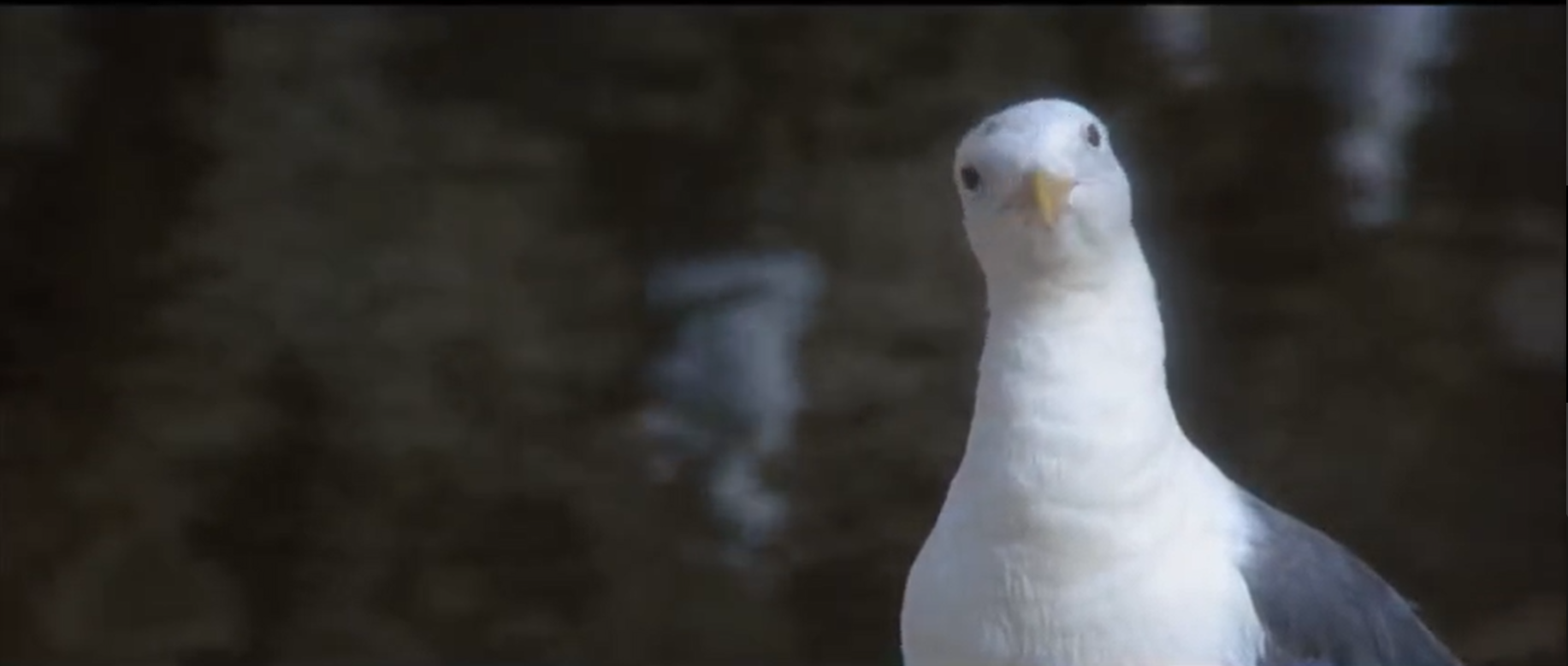
Saturday is typically "Take Out the Trash" Day. Hope the birds don't pick at it.
Then, an even slimmer tome (144 pages, many of them black and white photographs)hit the racks in 1970 with a limited run of 3,000 books. "Jonathan Livingston Seagull," sold out, but didn't become a "thing" until 1972, where it seemed ubiquitous, not just in bookstores, but in places where "notions" and tchotchkes were sold. It remained on the NYT Bestseller List for 37 weeks.
As a book, it was an "odd bird," seemingly born out of the "love generation" but with a metaphorical slant towards enlightenment through self-improvement at the same time that things like Dale Carnegie, Scientology, and EST were gaining a mind-grab on the consciousness along with the multi-verse of belief systems that sprang up out of the 1960's. The book tells the story of Jonathan—a seagull—who has become dissatisfied with his lot of fighting over food sources (usually garbage) and, instead, concentrates on flight—its possibilities, its mechanics, and the conquering of its limitations. This puts him at odds with the rest of his flock and he is cast out for his beliefs, to continue his process on his own, which he finds to be rather rewarding without the constant squawking and fighting.
Finally, Jonathan is led by a couple of other gulls to "a higher plane of existence" where he meets the seagull Obi-Wan Kenobi, Chiang, who helps Jonathan realize that he can be anywhere he wants in the Universe if he only apply himself and "begin by knowing that you have already arrived" (which sounds suspiciously like "no matter where you go, there you are"*). Finally, Jonathan decides that, rather than wander the Universe by himself, he'll return to terran roots and teach what he's learned to other gulls. There are those who say that the best movies are made from novellas, rather than novels, because it allows you to stretch out the ideas, rather than try and condense the book for a two hour presentation. But, the film that director Hall Bartlett (he made Zero Hour!, which was the serious inspiration for Airplane!) has a hard time expanding the slight story-line into a 99 minute movie, even padded as it is with VERY serious songs by Neil Diamond. It doesn't help that it is basically a Nature film—of seagulls—where they talk to each other in voice-over (by the likes of James Franciscus, Juliet Mills, Richard Crenna, Dorothy McGuire, Hal Holbrook, and Philip Ahn), when one suspects it would be better to just feature a narration by David Attenborough—that man makes fossils fascinating. Not sure what he could do with this, though. The film, while boasting excellent cinematography is just ham-strung by a slim story, disconnected dialogue, opaquely expressive seagulls and so many endless (and one must say) loosely interpretive and pretentious songs.** I remember watching it in the theater and being so thoroughly unimpressed that I wanted to fly out the nearest exit (something I've only done once) whether on this plane or any other. I consoled myself by watching the screen and cynically repeating the line of the woman concierge in The Producers: "Boids!, Dirty, disgusting, filthy, lice-ridden...boids!" Maybe a little humor would have helped. Maybe it should have been animated. You could do wonders with it these days with CGI and maybe a little more imagination.
But, no. The problem is the story. Look, I've been moved by efforts of self-actualization and improvement by Larry Darrell from The Razor's Edge and even from Remy the rat from Ratatouille. But, somehow, in this context, the message just doesn't squawk through. There is nothing about a seagull trying to break the air-speed record/time-space continuum that isn't risible, physically and spiritually, and treating it so religiously with such heavy-handed profundity makes it an easy target for the Doubting Thomases, like me. There should have been something celebratory about this, not something torturous. And if I can be just as obnoxiously obvious and "on-the-nose," Jonathan Livingston Seagull is..."for the birds."
** Diamond ended up suing the producer-director for not using ENOUGH of his music, and that he had to share a music credit with composer Lee Holdridge. Richard Bach ended up suing, also, saying that Bartlett's screen-story deviated too far from the book and his screenplay. The movie crashed and burned in theaters, so I guess you have to make your money SOME way!
 Avanti! (Billy Wilder, 1972) Based on a play by Samuel A. Taylor (who wrote Vertigo and Sabrina), Avanti! has been updated to the Nixon 70's by Billy Wilder and I.A.L. Diamond, as a slightly smutty comedy of manners, where a business-stiff, Wendell Armbruster, Jr. (Wilder muse Jack Lemmon) travels to Ischia, Italy to identify and claim the body of his father (Wendell Armbruster, Sr.). Turns out the son is stiffer than the dead father. He is shocked...shocked!...to find that dear old Dad, who supposedly went to Ischia for the therapeutic baths, was carrying on an torrid affair with a British mistress. This produces a prolonged hissy-fit—Lemmon excelled at these—where everything and everyone seems to be in a conspiracy to make claiming his father's body an unpleasant experience. The idea!
 Before long, if you're anything like me, you start to hate everything American, and want to take an extended vacation...anywhere but in this movie..with this guy! And there's only so much one can take. For gung-ho Americans, it's an extended dig at the Motherland, and for self-loathing liberals, it's preaching to the choir. Either way, it's not an awful lot of fun to watch.