Showing posts with label Michael Caine. Show all posts

Tuesday, July 30, 2024

Alfie (1966)

Alfie
(
Lewis Gilbert, 1966) This is the film that catapulted Michael Caine to the A-list of stars—a bit of a wonder, that, as he essays the titular lead in this character study of a complete rotter of a misogynist, a taxi-driver/chauffeur whose relationships with women are as transitory as any fare. 
 
One shouldn't be too surprised by this, I guess, as audiences have always had a tendency to gravitate to, and even admire, villains, be they "Scarface" or Darth Vader or Brando's "Wild One" or "The Godfather." Maybe it's the nature of film to be a spectator sport and with the safety of being removed from any hurtful fall-out, we can choose to imprint on "bad guys" and their assertive natures to do harm. Maybe it's just wish-fulfillment on audience's parts—"I wish I could get away with that in my own life" and especially nowadays as there's no Hays Code strictures requiring just punishments be meted out by the end of the picture. There don't need to be ramifications anymore, and in this brave new world, the heroes and villains get all mixed up. Here, the term "anti-hero" need not apply.
"I suppose you think you're gonna see the bleedin' titles now.
Well, you're not, so you can all relax..."
Caine's Alfie Elkins is no anti-hero. He's a bloke trying to make do for himself and making no apologies for it ("You've got to live for yourself in this world, not for others."), certainly not to his conquests, and certainly not to the audience, whom he addresses directly from the get-go, in mid-assignation with a married woman (he may be misogynistic, but he doesn't discriminate). In his first-person discourse* he's as cheekily blunt as he is with his ladies in question (and their questions usually revolve around commitment, something Alfie is adamant he'll have no part of—"I don't want no bird's respect - I wouldn't know what to do with it.").
So, we watch as he tramples over hearts in his own memorial parade: There's that married woman, Siddie (
Millicent Martin) cheating on her husband, while Alfie goes back to his cheated-upon girlfriend Gilda (Julia Foster) who lives with him for a time, quite unhappily as he refuses to even consider "settling down" with her ("I told Gilda from the start that I ain't the marrying sort." he says by way of explanation. "And do you know what?" he continues cluelessly, "She don't mind. She's a stand-by and she knows it. And any bird that knows its place in this world can be quite content."). That must include—in addition—the manageress of his dry-cleaners, a "foot-comfort" technician, a woman named "Dora", "the odd bird that came by chance" like Carla (Shirley Anne Field)—the nurse at his convalescent home when he's diagnosed with "spots" on his lungs, the girl he picks up on the motorway (Jane Asher), the wife (Vivien Merchant) of a fellow patient (Alfie Bass) at the convalescence, and a woman, Ruby (Shelley Winters), who he chats up while taking photographs as a side-hustle.
"My understanding of women only goes as far as the pleasure. When it comes to the pain I'm like any other bloke - I don't want to know." And he doesn't want to know; if there are complications, inconveniences—like a couple pregnancies—he'll lay down the law of how it's going to be and any reluctance just spells (for him) merely the end of any consistency in his hook-up schedule. He's a hit-and-run heart-breaker, not sticking around to see the damages. Alfie...and Alfie...show the dark underbelly of "the Swingin' 60's" and what happens when the swinging stops—you're left twisting in the wind, basically; things don't look so "gear" when people are chewed up in them.
Caine plays this cad as charmingly as he can, speaking breezily without much change of expression and little irony betraying any self-awareness. For all the winking at the camera that could have been, Caine avoids it with a mostly passive expression that is betrayed by a speech-ending toothy grin or a darkness around the eyes when the situation—and they're usually those rare instances when he's not totally in control—calls for punctuation. That lack of countenance betrays an empty heart inside.
One of the themes I keep harping on throughout these posts through the years is that love is a form of insanity. It's not a disparagement, just an observation that love—and its inherent selflessness—is the one thing that can circumvent the tendency of our alligator-brains to favor self-preservation above all else. Alfie is a movie that leans into that argument to a horrific degree; his predisposition to his wants and needs (as if he needs anything or anyone) lines up with his absolute disdain for anything resembling a caring regard for other human beings. People are opportunities to be taken advantage of, not fostered. And, for awhile, that's suitable.
But, the armor around his heart does have some dents in it. When his girlfriend Gilda gets pregnant, she decides to keep the child—despite Alfie's initial reluctance—and, for a time, Alfie, uncharacteristically, accepts his role as father to little Malcolm, taking pride in his son and devoting time to him (notwithstanding that a baby in a baby carriage helps attract women). But, Gilda grows weary of his fair-weather fatherhood and leaves him to marry another man. Later, he has to actually confront the consequences of his actions, and, in trying to find another path, gets a comeuppance...of sorts...as he finds himself on the receiving end of his past behavior, leading to some soul-searching and
to the film's final "What's it all about?" (Cue Burt Bacharach, sung by Cher...produced by Sonny** at least in the States-side release).
It's a tough, funny—in a black-hearted kind of way—film that breaks barriers of subject matter while also shaking its cane at the unraveling moral fabric of its society, both teasing and admonishing with the same strokes, and drives home the scrambled cliche that "Time Wounds All Heels."

* Of, course, it's in first-person—Alfie doesn't think of anybody but himself.
 
** I'm glib about it, but Burt Bacharach's end-credits song is (to my ears) the best of his song-book (reportedly, he thought so, too), providing an "on-the-nose" counter-point to everything that has gone before, with clear-eyed "let-me-spell-it-out-for-you" lyrics by Hal David. Something even non-believers can believe in.

Tuesday, March 28, 2023

The Wrong Box (1966)

The Wrong Box* (Bryan Forbes, 1966) Bryan Forbes is a British director not known for a light touch, nor as a writer (and—in the few instances I saw him, not as an actor, either!). So to see him in charge of a comedy leaves one a bit nonplussed as opposed to amused (which should be the bloody intention!). The same can be said for this film, which tries very, very...veddy... hard to be funny, but ends up evoking feelings of something akin to pity (which just won't "do" for a comedy, much as Chaplin liked to use it in his bag of tricks).

The story of a tontine—a trust created for a clutch of privileged school-boys that will go to the last man standing (and the controversies that ensue—The Wrong Box should have the same breakaway, mean-spirited greediness of, say, It's a Mad, Mad, Mad, Mad World (And one should say that with Stanley Kramer, you wouldn't think of being able to do a comedy, either, but look at that result!), Those Magnificent Men in Their Flying Machines, or The Great Race, but instead has a leaden lethargy sometimes punctuated by awkward transitions, ill-timed (and rather unnecessary) close-ups, and the frequent appearance of title cards (to explain something the direction does not adequately provide) in a black-out format that recalls silent movie transitions. However, they come in at souch odd times, they're more interruptions that transitons (Odd that one can even mis-time interstitials!)
It's Bryan Forbes imitating Richard Lester making an Ealing Comedy, but without Alec Guiness, and as slap-dash as the Lester's direction could be at times, he at least could tell a story, and give it the momentum so it would never flag or falter. As it is it's one of those 95 minute movies that seem to last forever.
Great cast, though: Michael Caine, Peter Cook and Dudley Moore, John Mills and Ralph Richardson; Peter Sellers has an extended cameo as a fraudulent doctor that starts slowly but finally picks up a weird head of steam. And there's an odd love story between Caine and Forbes' actress-wife Nanette Newman that seems unconvincing.
The screenplay is by Larry Gelbart and Burt Shevelove, who wrote the book for the Broadway musical "A Funny Thing Happened on the Way to the Forum" (Lester's film of which was released the same year—coincidence?) John Barry's galumphing score works overtime to make it frothy, but this is one granite souffle. What is missing is whimsy, rather than desperate manicness, and it fortunately is found in Sellers' work, and in the odd performance of Wilfrid Lawson as the harried (not that you'd know) butler, Peacock.

John Barry's ultra-light waltz is lovely but at odds with the material.
* The asterisk is used so that it isn't confused with the silent version of Robert Louis Stevenson's novel (with Lloyd Osbordone i913—not that a lot of people have seen it.

Saturday, February 18, 2023

Youth (2015)

Play On
or
"Hum a Few Bars and I'll Fake It"

Where do you go when the music stops?

Switzerland, evidently. Composer Fred Ballinger (Michael Caine) is at a luxurious swiss spa with some other artists dealing with crises in their careers: film-maker Mick Boyle (Harvey Keitel) is working on his "testament" film—the one that will last as a classic—with a scruffy team of writers, actor Jimmy Tree (Paul Dano) who is chilling out and contemplating the route to his next role (he's worried because all people-on-the-street know him as is a favorite sci-fi character). Also, there are a famous sports figure, Diego Maradona (Roly Sorrano), the current Miss Universe (
Mãdãlina Ghenea), and a parade of habitué's who are taking "the cleanse." Also, there's Fred's daughter Lena (Rachel Weisz), who is also his assistant, and who has issues with Dad about the "every-day" of being his employee and the lifetime of being his daughter.
Fred, see, is stuck. He hasn't written a thing in years, and has no real desire to. He's "retired." Retired, but remembered. He has been asked (by the Queen's stuffy emissary) to conduct one of his pieces, "Simple Song #3," at Prince Phillip's birthday concert. There's even a knighthood for him thrown into the deal. He refuses for reasons he won't reveal, other than "he doesn't perform anymore." Nor does he compose. If anything, he's "decomposing."

This is the problem. Fred won't "reveal" anything. It's why he's a composer. Music doesn't require words—it simply "is," reflecting feelings more akin to the real emotions than just mere words can express. Not that Fred can't express himself—he does and frequently, but just not about his own feelings. That's where the music is, and he's not writing it down on paper and he's not having it performed. But, the music is still there. In his head. Where it will remain. He'll broach no argument about it. And that is the way he conducts himself.
Such an interior existence is, of course, not unsocial, just selective. Mick has been his friend for years and the two can talk about anything or anyone, and they have shared boundaries that they do not cross to make the exchanges easier to navigate smoothly. They understand each other, which is a goal of Lena's, which she's having trouble negotiating. She doesn't understand anything these days, as he husband has just left her for some pop-star—"the most obscene job in the world"— (Paloma Faith) who makes music-videos. Was it her? Is it him? It can't be...the other her—so shallow!
Fred has very specific reasons why he's retired, all deeply personal and not to be revealed,  until later in the film. But, Fred has the luxury of choice. Everybody else at the spa...at least, the prominent ones, the celebrated ones...are equally stymied and stuck in place. Mick has a concept, a grand scheme for his next film, but is dependent on a gaggle of screenwriters (Sorrentino doesn't even give them names, just attributes, Disney dwarves!) out of whom he tries to coach some profundity and there's also his on-screen muse (Jane Fonda) that he must coax into appearing in it. He is entirely engaged in the process, even if he might not know what movie he's making.
Maradona is retired from soccer, but he's dealing with the cost of his fame and the lifestyle it has afforded him. He is very overweight, unhealthily so, and has grown accustomed to being indulgent and indulged.
Miss Universe is spectacularly unapproachable, but worldly enough that she can cut down approaching suitors with a withering honesty.
And Jimmy? He's stuck in his own typecasting, looking to prove himself capable of more sophisticated roles and indulges in eccentric behaviors to express his depth. He wants to be perceived as deeper than his previous roles, which he thinks are shallow and puerile—he'll find out that those roles touched lives and have his crisis solved. Contrast that actor with Fonda's aging diva, who's far more practical—her choice is whether to take a role in Mick's magnum opus or to take on a television role for a fat paycheck.
I was a big fan of Sorrentino's La Grande Bellezza—which had its own issues of aimlessness—but, one couldn't argue with the beauty of the images. I sought out seeing Youth in a theater in 2015, but struggled with my opinion of it—I hadn't written a review of it because I, frankly, didn't understand it and if I can't bring anything of value to any discussion of the film, best to say nothing at all. When when is stuck—as so many of the people in the film are—one can either blame themselves or the movie. And I'm reluctant to say that Sorrentino didn't have a solid concept to base his film around.
 
But, I think that's the case. In looking at the theme of age, self-worth, and self-perception, I think he found it wasn't enough to just concentrate on an inarticulate composer (I kept think of Ballinger as a stand-in for Jerry Goldsmith—a brilliant composer, but a terrible communicator about his "process," constantly saying "I just hear it in my head!"), and so took an Altman-esque approach, making a collection of short stories on the theme, rather than one over-all novel.
Mick lines up a shot for his proposed movie;
The movie he sees in his head, scattered individuals unrelated in a landscape.
As such, Sorrentino could have used the Mick-director character as a stand-in, looking for a story to fit the images he sees, rather they're related to each other or not. As such, I'm all for that. People are not monolithic—as much as the media, pollsters, statisticians, and business metrics want to pigeon-hole us. We all react to a given situation differently, we all have our ways of coping—some good, some bad, some effective, some utterly worthless. We learn that way. We grow, hopefully, even as we grow older and hopefully wiser.
 
Ultimately, the film feels very random. Much like life. Much like youth.
 
But, those images, though. Sorrentino has a particular "eye"—which I think is part of my point. I'm glad I saw Youth, as fleeting as it ultimately was.

Thursday, August 11, 2022

The Dark Knight Rises

Written at the time of the film's release.

The Bane of Our Existence

or
"Okay, What Joker Put Yeast in My Dark Knight?"


"All stories end in death, and he is no true story teller who would keep that from you"--Hemingway

"If you want a happy ending, that depends, of course, on where you stop your story"--Welles

So, Christopher Nolan's "Batman" trilogy ends in a nearly 3 hour film that neatly wraps up the story. How does it end? That would be telling. The comics went through a phase where Bruce Wayne ruminated that he was working towards a world where he wasn't needed. That's a nice little "buttoning up" of the "Dark Knight" story, but it's not complete. What of Bruce Wayne? Nolan has the opportunity in his version to really end it—he doesn't have to sell comic books next month—so, he can take it anywhere he wants to go. And one realizes (if one really wanted to end the story) that the only real happy ending that could be achieved is if Bruce Wayne became the one thing he never knew as a child—a caring, present father. Anything else makes the story a tragedy, and Bruce Wayne the last victim of the gunman's bullets that killed his parents. Given this series' downbeat tone (that of the sacrificial martyr) and of the available previews for The Dark Knight Rises, such a scenario does not seem likely. Given that, Nolan can take the tragedy of his hero in any number of directions.
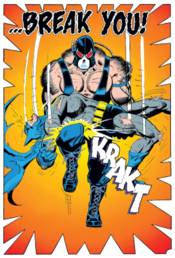
Bane (Tom Hardy here) is the perfect villain to bring into the mix. A hopped-up minor character, he is best known as the lead antagonist for the "Knightfall" storyline (that seemed to last a couple years). In "Knightfall," the drug-pumped super-villain released every criminal in Gotham's prison system for The Bat to deal with, while he hung back, biding his time. Then, when the Batman, weakened and exhausted, finally confronted him, Bane broke his back, leaving Wayne paralyzed and unable to fight on. It fell to the rest of "The Batman Family" (including the once-and-future "Robin's") to take on the mantle and continue the fight.

Nolan's canvas is a bit broader, taking into consideration the events of the two previous films to create something a bit more apocalyptic, a rumination on the fractious quality of good vs. evil and the slippery slope to Hell that ideology and good intentions can be tilted towards. Nobody's pure in this one, there's no whack-job with delusions of grandeur behind the assault on Gotham City, with avarice their sole motive. Everybody, wearing white or black, thinks they're doing the right thing. And everybody's wrong.

It's eight years since the events of The Dark Knight that resulted in the deaths of D.A. Harvey Dent, Rachel Dawes, and the subsequent disappearance of the man suspected in the killings, the Bat-man (Christian Bale). Now, Bruce Wayne is an exile in his newly-rebuilt Wayne Manor, walking stiffly with a cane due to some unknown injury (part of me wants to think it was due to him being stabbed by one of The Penguin's umbrellas). He sees no one, is a recluse, and there are rumors he's turned into a Howard Hughes-style eccentric, apparently due to a massive investment in a clean energy prototype that failed and cost Wayne Enterprises a fortune...or at least half of it.
The chief backer for the project, Miranda Tate (Marion Cotillard) tries to get past the constant guards of faithful butler Alfred (Michael Caine, putting in the most emotional performance he's done in years) and Wayne exec Lucius Fox (Morgan Freeman), who fill the functions of acting as Wayne's heart and brains (and conscience), if not as surrogate Mother and Father. A rival exec, Daggett, is trying to take over W.E., by any means necessary, in this case, employing a terrorist named Bane, who has his own bones to pick (and break) with Gotham's golden boy. At the beginning of the film, Gotham in morosely complacent (and obviously filled with exposition), having cleaned up crime by the draconian Dent Anti-Crime Act, which has incarcerated over a thousand criminals in Gotham's Blackgate Prison.

But things are percolating underground, disrupting Gotham's infrastructure.  Bane has an army of misfits and big plans that have outgrown the desires of his patron, and there's a lithe cat burglar named Selina Kyle (Anne Hathaway), who is caught with her hands in the Wayne Manor safe by the man himself ("Oops," she says, not very convincingly). Yes, she's pilfered Martha Wayne's pearl necklace, but more importantly, Bruce Wayne's fingerprints. What does she want with those?

It's only one piece in an intricate puzzle of escalating consequences that Batman must unravel if he is, once again, to save Gotham City, and he must confront his past and overcome great injury, physical and emotional, if he is to prevent a catastrophe...
one of his own devising.

That's the gist of it, but it is convoluted by elaborate set-pieces that are, frankly, jaw-dropping, and ends up with Gotham isolated from the rest of the nation, in the hands of criminals with big ideologies and little concern for how roughly they're applied. The police are paralyzed—most of them trapped in the deep infrastructure of the city (a little too conveniently) while Bane initiates a countdown to total destruction.

A countdown of five months.

To quote The Riddler:"????" Five months? How suspenseful is that? And you'd think that somebody, somewhere, would be able to unravel the plot or situation in such a time-frame. But, it's basically a set-up for what Nolan depends on to generate suspense throughout the movie—the last minute "save," that is usually explosive and comes from nowhere, because the writer-director has made motivations ambiguous enough as to be unreadable.* Everyone has got a secret that will be revealed at the most opportune moment of drama. If the mystery was revealed in a drawing room, it would feel like cheating, and the revelations almost psychic.
Speaking of unreadable, Tom Hardy's Bane is hampered by a mask of a morphine dispenser (to keep him from feeling pain), as opposed to the enhancement-juice-pumping-apparatus from the comics (This leads one to ask: if the guy can be stopped by breaking the mask, why does Our Hero employ so many body-blows?  Face-shots, man!!). He is perpetually muffled by this thing, which Hardy compensates for with an almost jolly Father Christmas speaking style, making a clever, unnerving ying-yang effect for the character. Ultimately, though, he's something of a vapor-tiger, like Darth Vader, the big bloated bloviator who's merely a "blind," a distraction for the real danger.


But...five months??**
Another thing: Nolan has come out publicly saying that he wants to make a Bond movie (and the snowbound facility infiltration in Inception is a bowler-tip to them). I would submit that he already has, this film being it. So much of it is borrowed from Bond that all one needs is a casino scene to make it complete (a costume party has to suffice
***). The opening sequence, the-villain-that-feels-no-pain, the duplicitous females, obligatory "Q" scene, the tick-tock final set-piece and other aspects can be attributable to Bond films of the past. At least someone is borrowing from the Bond series this time, instead of the other way around.
But, his world of comic-book fantasy is far more gritty and down-to-Earth than any other, and that's what makes "The Dark Knight Trilogy" good; it's relatable, it feels like it could happen, if someone had the will, the wherewithal and the wallet to do it. It also feels of our time. There's been a lot of gas about the politics in this film—uninformed, desperate gas—but the whole uprising scenario, the subjugation of the privileged with no benefit to the less fortunate, the breaking down of society and the cleaving of its people is the stuff of water-cooler vitriol and feels like the temper of the times. The Tea Party AND the Occupy Wall Streeters can both find things to point at and go:"See?"
I'm not going to speculate which side is right, and Nolan is obtuse (and politically slippery) enough to play it right down the yellow stripe of the road. But, this British director is saying something about the State of the Union with a full child-warbled rendition of The Star Spangled Banner (before a particularly horrific football game) and a shot of American flags in tatters on a city street, deep in the movie. They're there for a reason, but not for anything specific enough other than "we're a fragile alliance and we're in trouble."
And that we need heroes—selfless ones, for whom profit is not a motive—and that, "anyone can be Batman."****

* Case in point:  there's a scene where Catwoman uses a Wayne-supplied bat-bike to blow a hole in a tunnel to make an evacuation tunnel for the sealed-off city, a task initiated by the Caped Crusader.  Following it, Nolan sits on a pull-in shot of Hathaway with an enigmatic smile on her face that communicates...nothing. Except an odd complacency. It will only be resolved...if there's anything TO be resolved, later in the film. 

** There are neat touches, and a refresher of both The Dark Knight AND Batman Begins will help. One nice thing—Nolan recalls a scene from BB when a young Bruce Wayne falls down a tunnel and is subsequently rescued by his father, by having a similar scenario played out here, with the Obi-Wan presence of a dark father figure from his past. Nice touch.

*** A masked ball at which, like in Batman Returns, Bruce Wayne doesn't wear a mask.  Heh.

**** Just not Nicolas Cage, please...
What do they say at Marvel? "What a poser..."