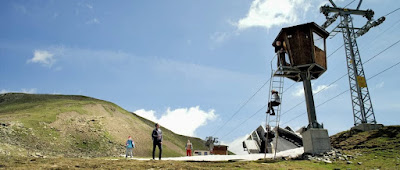
Julia (Fred Zinnemann, 1977) I won't get into the actual veracity of the story behind Julia (other than this article isn't tagged with "Based on a True Story" (not that any movie that claims that distinction is probably being very truthful). But, the movie (and Hellman in her book, "Pentimento") hedges its bets by opening with an atmospheric shot of Lillian Hellman (and, according to entertainment myth, it actually IS Lillian Hellman in that boat) and Jane Fonda's voice-over narration:
“Old paint on a canvas, as it ages, sometimes becomes transparent. When that happens it is possible, in some pictures, to see the original lines: a tree will show through a woman's dress, a child makes way for a dog, a large boat is no longer on an open sea. That is called pentimento because the painter "repented," changed his mind. I'm old now and I want to remember what was there for me once and what is there for me now."
Cut to memory of days gone by: Lillian Hellman (Jane Fonda) is writing...or trying to, anyway. It's a struggle. She chain-smokes, stabs at the typewriter in frustration, and, even goes so far as to throw the damned contraption out the window. All of this is not lost on her lover, Dashiell Hammett (Jason Robards), himself a writer (currently living on royalties) who goes about his day keeping up their New York coast beach-house and observing the recalcitrant chaos which is "Lilly" composing. "You know you don't have to do this," he rather sarcastically counsels. "It's not like you've written anything before. No one'll miss you. It's a perfect time to change jobs."

He suggests that if she's blocked, she should do something else, another job, a vacation, go to Paris, see her friend Julia. "Just don't go crying about it!" he scolds. "If you're gonna cry about it, go stand on a rock!" But, she doesn't leave, just retreats to her memory. Her childhood friend Julia (Lisa Pelikan as a child, Vanessa Redgrave grown up)she remembers with absolute clarity, how she was a restless spirit, raised by her entitled grandparents (who tell her when she sees some injustice "don't look at it") and finally escapes when she is accepted at Oxford to study medicine and does graduate studies at the University of Vienna. She decides to go to Paris, re-purposes herself to write her play...and to see Julia. After many missed phone-calls, she gets a mysterious phone-call that Julia is in hospital, injured from an attack from fascist demonstrators on campus.

Once in Vienna, she find her friend badly beaten, unable to talk, and she is told that she has a reservation for her stay at the Hotel Imperial, provided by an "Herr von Fritsch" who is not staying at the hotel and cannot be reached. Julia disappears from the hospital and her records expunged, leaving Lilly confused, searching, frustrated, and unable to finish her play. She returns home and resumes writing.
But, the memory of the events in Vienna haunts her. She finishes her play, but finds Hammett in the morning, reading it, and more than critical. "You want to be a serious writer," he says. "I don't know what happened, but you better tear that up." A long torturous second draft produces "The Children's Hour," high praise from "Dash" and interest from Broadway, where she becomes the toast of the town. But, there is no word from Julia, although Lilly writes her regularly.

On a goodwill trip to Russia (along with Hal Holbrook's Alan Campbell and Rosemary Murphy's Dorothy Parker), Hellman is contacted in Vienna by a "Mr. Johann" (Maximillian Schell), who carries a message and a request from Julia—come see her in Berlin on the way to Moscow, in that way, with her help, anti-Nazi organizations can smuggle in $50,000 of Julia's money to bribe the release of some fellow dissidents. The mission is, of course, not a little dangerous; she will be detouring, travelling to Nazi Germany and Lillian Hellman is Jewish. Although she is warned that, as in childhood, she is "afraid of being afraid," she is cautioned by Julia's message not to be a hero, if she thinks she cannot do it.

Of course, she does it, although it attracts the curiosity of Campbell and Parker, and Hellman boards a train for a tense journey to Berlin, where, unbeknownst to her, she is being kept under watch by the Nazi's and under wing by the sympathizers, who anonymously supervise her every nervous move for a rendezvous she can't begin to imagine.

The film won the BAFTA that year for Best Picture. It also won three Academy Awards: Vanessa Redgrave's supporting performance as Julia (frankly, every time Redgrave acts she should win an Oscar); Jason Robards won for Best Supporting Actor for his wry romanticized portrayal of Hammett (Schell was nominated as well) and Alvin Sargent's spare, episodic screenplay that, although it never stays in one place for very long, is nonetheless amazingly rich in detail. I also think this is probably Jane Fonda's most relaxed, most versatile and least mannered performance of her entire career—she was nominated for a Best Actress Oscar, but lost to Diane Keaton's Annie Hall. Her portrayal is "scrappy" (as described in the screenplay) but also vulnerable, tremulous, but never weak, and Fonda takes major advantages of those moments for subtle drama and opportunities for comedy.

Fred Zinnemann was 70 when he made Julia and was approaching his fourth decade making movies (this would be his second to last film). His direction is meticulous, but like much of the director's work over the years, not so much as to be stodgy—he frequently punctuates the steadiness of the compositions with ones that are "catch-as-catch-can" to bring life to the story-telling. He is aided by editor Walter Murch—doing his first editing work outside the USC Mafia film-making tent—who is positively brutal in his cutting, but creates a dramatic tension through it that might not be there if he weren't so fastidious. George Delerue's score is uncharacteristically unromantic, relying more of the tension he employed in his work for The Day of the Dolphin. If there is any weakness to the film, it's in Douglas Slocombe's too-veiled photography, which looks like a bad imitation of Geoffrey Unsworth's fine-grained work. It may be a film of memory, but, if so, it's awfully fuzzy.

The film has been criticized for its emphasis less on Julia, but on Hellman's story, which seems odd. It is Hellman's story, and if hers is less dynamic, more flighty, and a bit specious in her pursuit of fame and fortune (and acceptance), then so be it. That's what her story was. "Julia" (if she existed) was out of sight, a creature of moments and not continuity, and ultimately, a mystery as unknowable as one of Hammett's femme fatale's. And she was a reflection of what Hellman wanted to be—worldly, passionate, committed, and independently wealthy. In some form, Julia existed, if only in a case of need.

I can't tell you how many times I've seen Julia, but I saw it a lot. It was the favorite film of a gal I was going out with at the time, and it was the "go-to" movie on date night. But, personal history aside, the film still resonates for its unresolved story, the questions, the regrets, the "what-could-have-been's" at its end and the sense of unreality that the world was drenched in during the 40's before, in our fear, paranoia, and triumphalism, we produced our "Scoundrel Time" in the 1950's. It's a deftly handled film of flawed individuals trying to do the right thing and falling short.
Lilly and Dash (left)
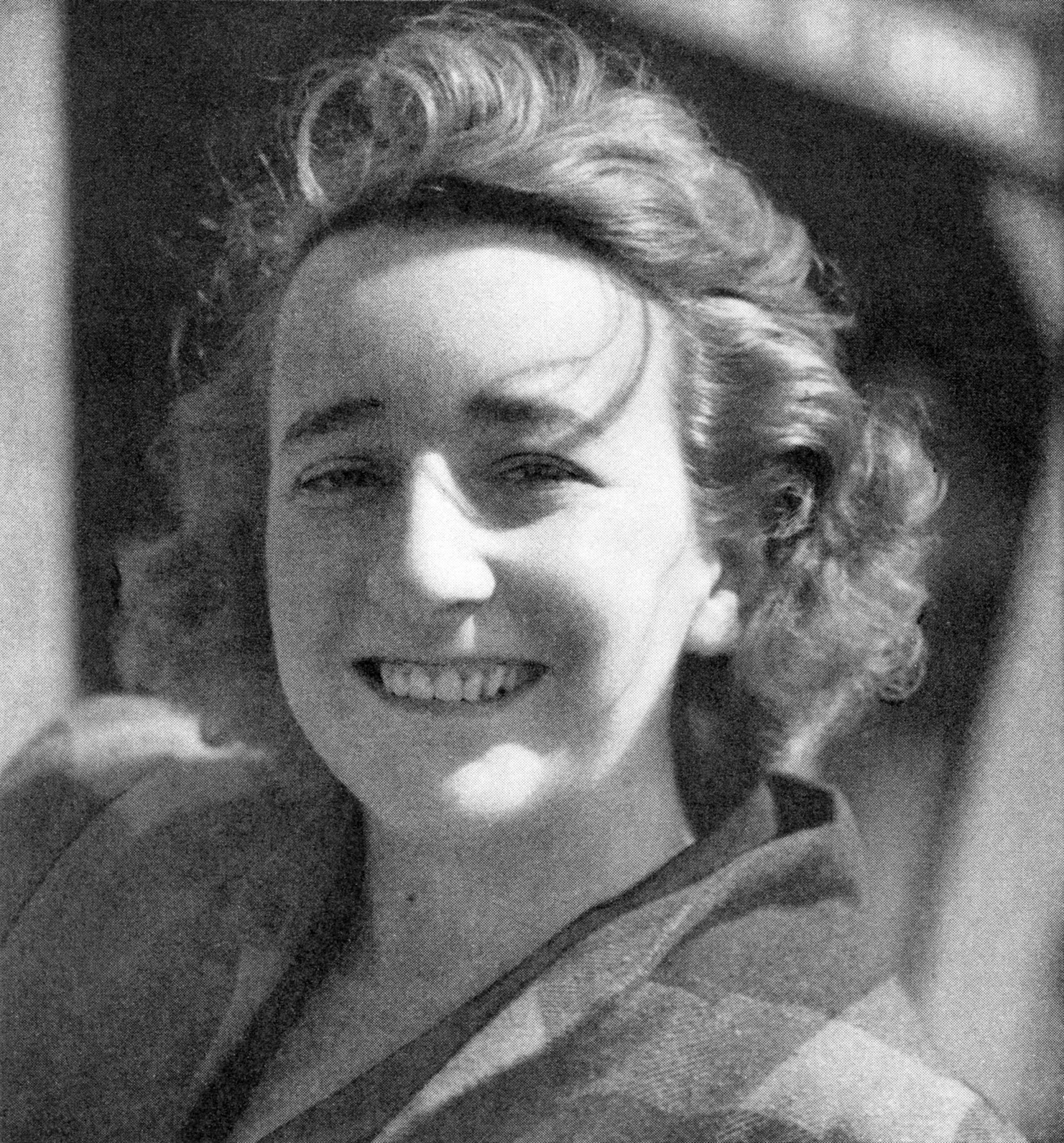
Lillian Hellman in 1939 (right)
 |
Julia was also the film debut of an actress with the unlikely name of Meryl Streep
(wonder whatever happened to her?) |