Showing posts with label Jane Campion. Show all posts

Friday, March 29, 2024

Bright Star

Every so often you get bored with writing reviews—and I don't have a supervisor or editor (that should be obvious by a scan of the material) and I do this as a hobby and a form of preserving some space in my brain. But, one gets tired of writing Thesis/Description/Particulars/Summation on a perpetual basis. One gets in a rut, which isn't good for me (the writer) and you (the reader, one hopes). So sometimes, one experiments.

This was one of those times.

Looking back on it, I find it amusing, not exactly helpful as far as details, and the writing almost as tortured as the doomed romance portrayed.

Eh. "You win some, you lose some"...just like love.

Composed at the time of the film's release...
 

"Perish the Thought"*

There are many artists I would put inside the director's pantheon,
But of all those chaps, among my faves is
Jane (the Aussie) Campion.

Her heroes (mostly female) both imbue and fight the schisms
that go along (as well they might) with social ostracism,

maintaining self, their specialness, not merely as statistic
that goes against the status quo
of things paternalistic.

Campion works in
mythic films, the types you can get lost in,
But this one takes some pages from
that other Jane (Ms. Austen).

For though her films have, in the past, explored romantic themes,
I'd call them cautionary, "
love's not always what it seems."
But
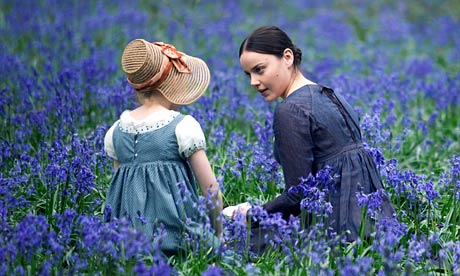
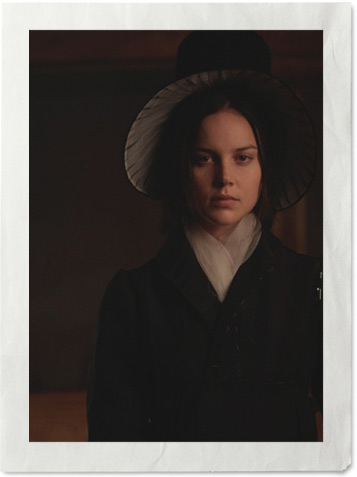
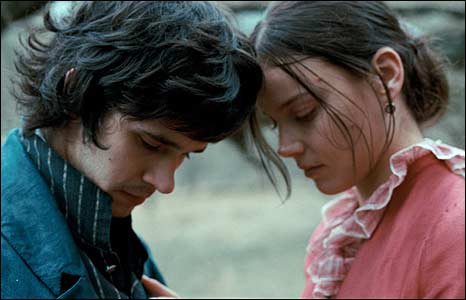
this tale of Miss Fanny Brawne and lovin' bard, John Keats
shows a more impassioned love, although keeping it discreet.

It's not like modern movies where the sex is done to death
The most explicit this one gets is int'mate shuddering breaths.
The costumes are exquisite
, the period details, right
Abbie Cornish and Ben Whishaw make you feel their love's delight.

It truly is amazing the director took this chance
to realize, to dramatize unmodernized romance
I wouldn't be surprised to find this one in Oscar's thicket.

That's why I grant
Bright Star a most deserv'd "Full Price Ticket."**

* Shall I review Bright Star in verse?
(I don't know. I could do worse)

** My old blog—from where this thing comes—had a rating system (which I now don't do because I hate them and hate the parsing—3 stars or 4 stars? Hmmm), which based movies on the amount of money you should spend on it, which went (from highest to lowest):


Full Price Ticket
Matinee
Rental ("Rental? What's THAT?!")
Cable-Watcher
A Waste of Time 


When I started B/C-L, I abandoned the rating system entirely, as I've reconsidered the monetization of worth, but, at the time, I thought it was a good idea, as it was inspired by the quote from Alfred Hitchcock: "A good film is when the price of the dinner, the theatre admission and the babysitter were worth it."

Thursday, March 14, 2024

The Piano

The Piano (Jane Campion, 1993) This award-winning film by New Zealand's High Priestess of Ostracism is an off-putting drama that slowly seduces and mesmerizes.

We first meet Ada McGrath (
Holly Hunter in her Oscar-winning role) in a way that no one else does—in her own words. Purposefully mute since the age of six, she finds herself sold by her father after an affair in her native Scotland and bought as a wife to a set-in-his-ways settler, Alisdair Stewart (Sam Neill) in a rain forest territory of Kiwi natives, a tribe of Māori. Think of it as a counter-clockwise Western of sorts, Down Under rather than Out West and Campion's themes start to come into focus. Ada and her child, Flora (Anna Paquin, in her Oscar-winning role) arrive by boat in widow's clothes and immediately stand out from the New Zealanders like...well, like a piano stranded on a beach.
Just as she carries her grief in the past with her muteness, she also carries her most prized possession—a grand piano—along on her semi-circumnavigation to the Outback. Seemingly an albatross, the piano is ultimately her most effective means of expression and also her passage to letting go of that past.
Dismissed as pointless by husband Alisdair, the piano is rescued and settled in the home of Baines (Harvey Keitel), who has forsaken civilization and lives with the Māori people. Baines barters with Alidtair, first for the piano, and then for lessons from Ada. Attracted to her, Baines then barters advances for keys of the piano—one key for a touch, two for a kiss. Thereby, Ada can buy back her piano, notes at a time, but there is more in the bargain.
What she's buying back is her soul. What she's buying back is her self. What she's buying back is her sexuality and everything that actually has been bought like a commodity in her arranged marriage to Alisdair. But the piano only reinforces burgeoning ties to Baines, and compromises whatever shaky freedom she attains with it. Alistair and his marriage are a prison that holds her against her will, when she already is so self-contained, of her own accord. That Baines takes possession of it, then acquiesces by offering the freedom of it back is too much for Ada to resist. And so, to have her soul, she must give some of her freedom away. It's a bittersweet rebellion that doesn't take into account her oppressor. When Alisdair hears of her infidelity, his revenge is to sever her connection to the piano in the most intimate way possible.
Campion is a lyrical film-maker who buries her messages as deep as a Kiwi rain-forest, but the films always ring true with a stark brutality that cuts through any mawkishness. In The Piano, her metaphors are more obvious than her past films. When, at one point, Ada is nearly taken to the bottom of the ocean by the piano, one can't help but think of the implications of materialism.
But, one is ultimately led to the thought that a woman needs a piano, like a fish needs a bicycle. And if one so chooses and loses one, there are plenty in the sea.

Thursday, March 7, 2024

An Angel at My Table

An Angel at My Table (Jane Campion, 1990) Incredible tale of the New Zealand author who was institutionalized for schizophrenia, and narrowly avoided a leucotomy procedure* by winning a prestigious book award. Talk about your narrow escapes. But escapes were what Janet Frame specialized in, from her "magic realism" writing style to her globe-trotting adventures that took her to England and Spain, while keeping herself locked inside her own creative mind.

Partly due to her diagnostic history, and partly due to her "odd duckishness" Frame had a ying-yang non-relationship with Society. The film portrays her as "odd man out" in various capacities, the one Campion seems to relish most is that while she is being socially shunned by a group of boorishly egotistical literati, she is the only one of them that has been critically acclaimed...or, for that matter, even published, already achieving what the full-of-themselves coffee klatsches only hope to accomplish. They dismiss her for her dowdy clothes and chia-pet hairstyle out of hand, not bothering to consider that they couldn't tell a book (they hadn't written) by its cover.
Made for television, the film is more conventionally framed than most Campion films, known for their stark use of isolating empty space, and sometimes fractured story-telling style, but Campion gets compelling performances from the three women playing Frame—Karen Fergusson, Alexia Keogh, and finally, settling on Kerry Fox for the second half of the film exploring the author's wandering adulthood. As an introduction to Campion's work, this is a good start, with a compelling true story with a straight-forward approach to the aspects of magic-realism that infuse her work.
My favorite shot of An Angel at My Table: Janet "does the twist" by herself
in the dark by the light of her camper/writing-garret.
 
* A leucotomy was a specific form of lobotomy back in the dark ages when the practice was given enough medical credence to actually give a unique name to it rather than calling it what it was—hammering an ice-pick behind someone's eye-ball to sever neural connections in the brain. I'm wondering if insurance companies covered that.
Author Janet Frame "framed" by
Karen Fergusson, Alexia Keogh, and Kerry Fox
 

Friday, December 31, 2021

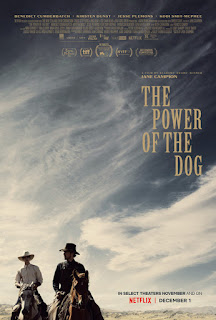
The Power of the Dog

Gloves Off
or
"Well, Well...I Wonder What Little Lady Made This?"
 
Jane Campion knows her Westerns. You can tell that with an opening shot of The Power of the Dog, tracking along the windows inside a house, the interior black, but the outside bright with sunlight, focusing on the outsider walking along parallel to the side of the house, but not a part of it, echoing John Ford and echoing The Searchers, but in her own way.
 
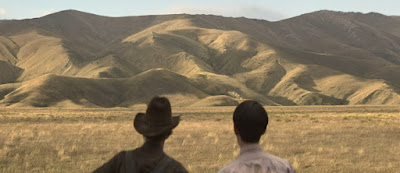
Like Ford, she will play with light and shadow in her western, even depending on it for a visual motif that will form a sub-text in the film, and she will pay particular attention to landscapes that separate people and must be conquered if anything resembling civilization is to take root in that wilderness. Ford's westerns were all about that and the land he photographed was itself a character in that/those stories, not merely a back-drop, not location-for-location's sake. 
 
But, that's what she takes from Ford and goes her own, entirely different way, leaving him and the dream of civilization in the dust. For Campion, the world-building of westerns is as much a myth as the westerns themselves. Civilization is about what people decide to agree on, and if the point of rugged individualists is to play by their rules, there won't be much agreement. Or very little civil.
The man in the window is Phil Burbank (
Benedict Cumberbatch), who, with his brother George (Jesse Plemons) is part of a well-to-do family with a cattle ranch in 1925 Montana. Both brothers—"Romulus and Remus" Phil calls them—are college educated with George knowing the law and Phil the classics of English literature. But, the two couldn't be more different, from each other and their educations. Phil is rough in speech and manner and does most of the work around the ranch, while George is sensitive and does the paper-work. Where Phil is coarse and brutal, George is quiet and empathetic.
They've been working the ranch for a long time, with George leavening the coarseness and conflicts the acerbic Phil causes in whatever he does. At the end of their cattle drive, the crew stops into an inn run by Rose Gordon (
Kirsten Dunst) for drinks and chow. They're served by Rose's son Peter (Kodi Smit-McPhee), who is slight, effeminate, and shy. Peter becomes an easy target for Phil's malice, making fun of everything the boy does, including using the artistic center-pieces that Peter has meticulously created to light his cigarette. Rose breaks down over this and George tries to apologize, since Phil wouldn't think of it, nor would he were it suggested to him.
But, this starts a series of events that drives a wedge between Phil and George, starting with the gentler brother marrying the Gordon woman—Phil considers her (as he says to her face) "a cheap schemer" only after the family money, and once she sells the inn and moves to the Burbank ranch-house, he begins a campaign of intimidation and hostility towards her that drives her to drink—a habit that she had previously disdained. George has paid for Peter to go away to college, but when he comes back, he finds his mother a wreck, and an open hostility against him from the cowboys working the ranch.
Campion breaks with Ford in the portrayal of women as revered stabilizers in the wilds of the West—Rose doesn't have the strength to take command and be the influence that Ford's women are in the isolation of the prairie—and Phil's cunning brute is too entrenched in his "man's world" view to allow any sort of control out of his grasp. The presence of a woman is just too intrusive to his staked-out territory.
But it's more complicated than that. And to say anything more would be to take away some complexities and motivations that might spoil the bumps and shocks that the movie has in store and could ruin its journey for audiences. Let's just say this: Campion has made a Western in locale (and borrowed some tropes from the genre), but she has other influences as well, taken from psychological thrillers and even thrown a shade of Hitchcock, making The Power of the Dog a definite hyphenate. It starts out as one thing—which may make some reconsider if they want to watch something that dark—and eventually changes into something else—something much darker.
But, one cannot parse just how beautiful The Power of the Dog is. Campion, working with cinematographer
Ari Wegner, has created images of vistas and landscapes that at times take the breath away, sometimes mimicking iconic shots from previous Westerns, at times taking their cue (as in the shot above) from the paintings of Frederic Remington—as previous directors had done. Sometimes you just want to hold on an image before it inevitably movies on, wondering at how it managed to be lit by a single match, or how it captures the troubling disquiet of twilight.
It's a good watch, that will inspire questions and cast a refraction on past examples of the Western—whether the winning of the West wasn't as much a loss, and whether in bringing European culture to the frontier, we didn't drag along something horrible in the process, something that only seemed tame, in our taming of the frontier.