Showing posts with label Keith Carradine. Show all posts

Friday, December 31, 2021

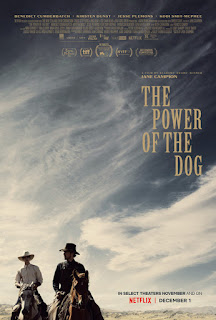
The Power of the Dog

Gloves Off
or
"Well, Well...I Wonder What Little Lady Made This?"
 
Jane Campion knows her Westerns. You can tell that with an opening shot of The Power of the Dog, tracking along the windows inside a house, the interior black, but the outside bright with sunlight, focusing on the outsider walking along parallel to the side of the house, but not a part of it, echoing John Ford and echoing The Searchers, but in her own way.
 
Like Ford, she will play with light and shadow in her western, even depending on it for a visual motif that will form a sub-text in the film, and she will pay particular attention to landscapes that separate people and must be conquered if anything resembling civilization is to take root in that wilderness. Ford's westerns were all about that and the land he photographed was itself a character in that/those stories, not merely a back-drop, not location-for-location's sake. 
 
But, that's what she takes from Ford and goes her own, entirely different way, leaving him and the dream of civilization in the dust. For Campion, the world-building of westerns is as much a myth as the westerns themselves. Civilization is about what people decide to agree on, and if the point of rugged individualists is to play by their rules, there won't be much agreement. Or very little civil.
The man in the window is Phil Burbank (
Benedict Cumberbatch), who, with his brother George (Jesse Plemons) is part of a well-to-do family with a cattle ranch in 1925 Montana. Both brothers—"Romulus and Remus" Phil calls them—are college educated with George knowing the law and Phil the classics of English literature. But, the two couldn't be more different, from each other and their educations. Phil is rough in speech and manner and does most of the work around the ranch, while George is sensitive and does the paper-work. Where Phil is coarse and brutal, George is quiet and empathetic.
They've been working the ranch for a long time, with George leavening the coarseness and conflicts the acerbic Phil causes in whatever he does. At the end of their cattle drive, the crew stops into an inn run by Rose Gordon (
Kirsten Dunst) for drinks and chow. They're served by Rose's son Peter (Kodi Smit-McPhee), who is slight, effeminate, and shy. Peter becomes an easy target for Phil's malice, making fun of everything the boy does, including using the artistic center-pieces that Peter has meticulously created to light his cigarette. Rose breaks down over this and George tries to apologize, since Phil wouldn't think of it, nor would he were it suggested to him.
But, this starts a series of events that drives a wedge between Phil and George, starting with the gentler brother marrying the Gordon woman—Phil considers her (as he says to her face) "a cheap schemer" only after the family money, and once she sells the inn and moves to the Burbank ranch-house, he begins a campaign of intimidation and hostility towards her that drives her to drink—a habit that she had previously disdained. George has paid for Peter to go away to college, but when he comes back, he finds his mother a wreck, and an open hostility against him from the cowboys working the ranch.
Campion breaks with Ford in the portrayal of women as revered stabilizers in the wilds of the West—Rose doesn't have the strength to take command and be the influence that Ford's women are in the isolation of the prairie—and Phil's cunning brute is too entrenched in his "man's world" view to allow any sort of control out of his grasp. The presence of a woman is just too intrusive to his staked-out territory.
But it's more complicated than that. And to say anything more would be to take away some complexities and motivations that might spoil the bumps and shocks that the movie has in store and could ruin its journey for audiences. Let's just say this: Campion has made a Western in locale (and borrowed some tropes from the genre), but she has other influences as well, taken from psychological thrillers and even thrown a shade of Hitchcock, making The Power of the Dog a definite hyphenate. It starts out as one thing—which may make some reconsider if they want to watch something that dark—and eventually changes into something else—something much darker.
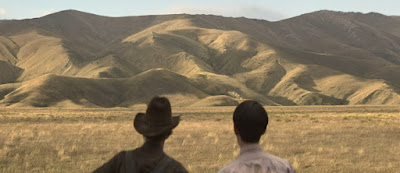
But, one cannot parse just how beautiful The Power of the Dog is. Campion, working with cinematographer
Ari Wegner, has created images of vistas and landscapes that at times take the breath away, sometimes mimicking iconic shots from previous Westerns, at times taking their cue (as in the shot above) from the paintings of Frederic Remington—as previous directors had done. Sometimes you just want to hold on an image before it inevitably movies on, wondering at how it managed to be lit by a single match, or how it captures the troubling disquiet of twilight.
It's a good watch, that will inspire questions and cast a refraction on past examples of the Western—whether the winning of the West wasn't as much a loss, and whether in bringing European culture to the frontier, we didn't drag along something horrible in the process, something that only seemed tame, in our taming of the frontier.


Thursday, July 23, 2020

Cowboys & Aliens

Written at the time o' the film's release...

"This Galaxy Ain't Big Enough for the Both of Us"
or
"Just My Ray-Gun, Pony and Me..."

Good idea, this. Two genres that have been around as long as there've been movies* and have served the same purpose—taking a theme that might be controversial if played in modern street-clothes, but dress it in rawhide or spandex and it takes some of the "edge" off. You'd think the two would go together as well as Zero-G and sawdust, but there have been already some tentative steps in anti-gravity cowboy boots: There have been westerns with a touch of fantasy—The Valley of Gwangi—and Sci-Fi with a western foundation (Outland was High Noon in space suits) but the two haven't really been combined as equal parts as in Cowboys & Aliens (the ampersand is required).
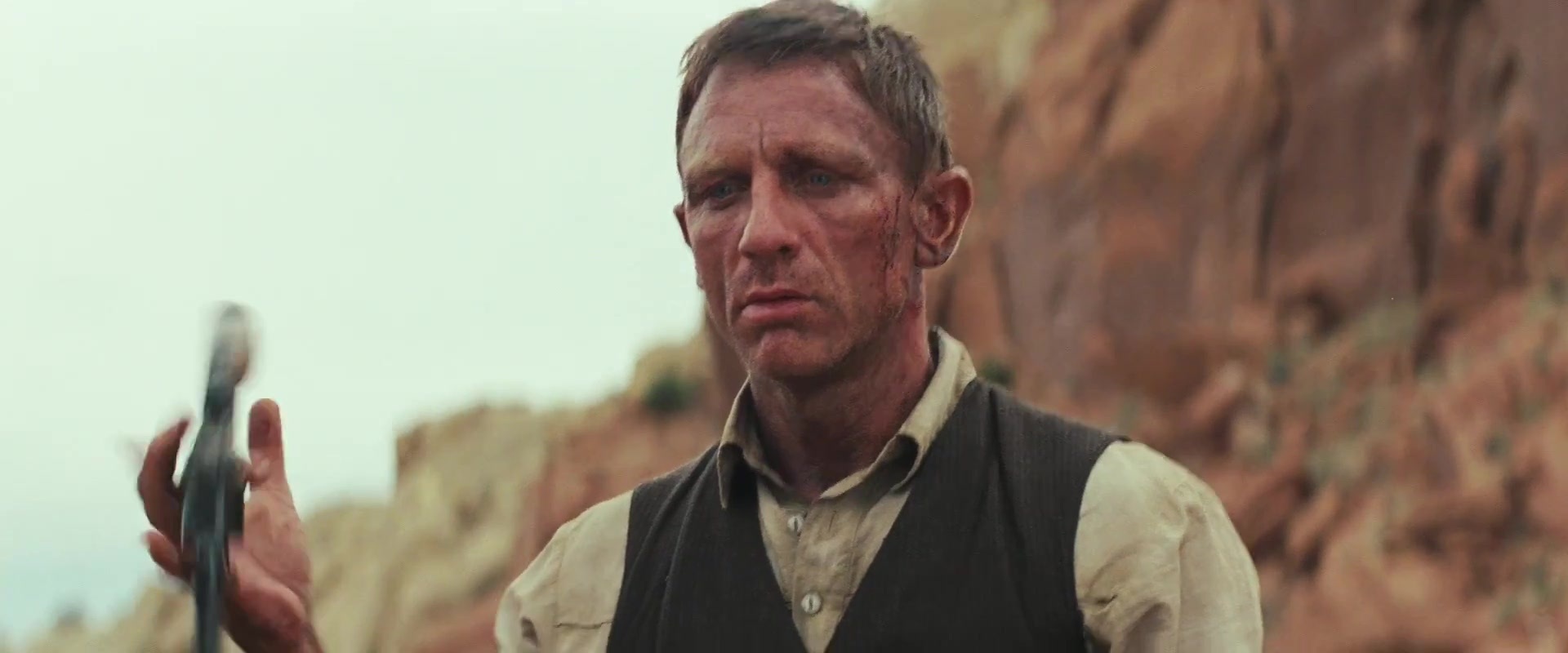
Loosely based on its comic source, it starts in familiar territory—a desert landscape, ancient river-beds long-since dried up and now sun-blasted bluffs and scrub.  Suddenly, a Man With No Name (Daniel Craig) lurches up into frame, sun-burned, bootless, bloodied with a wound in his side.**  He has no memory of who he is, where he is or why he's there (at one point a townie asks him "What DO you know?" "English" is the laconic reply). One odd thing—a thick manacle from wrist to forearm on his left armSmashing it with a rock would work with hand-cuffs, but this thing won't budge. He's set upon by riff-raff that he dispatches in a whirlwind of flying fists and gun-fire. So much for outfitting.  With newly acquired boots, shirt, vest and hat, he climbs on top of a pilfered horse and rides to a nearby town...with a loyal dog in tow. All the elements are in place.
A stranger in town (and everywhere, one assumes), he gets noticed and in trouble—mussing up the son (Paul Dano, really good) of the requisite town rich-guy-fascist (Harrison Ford, low and husky), and getting landed in the hoosegow by Sheriff John Taggart (Keith Carradine, whose Daddy appeared as a gambler in the granddaddy of Westerns, John Ford's Stagecoach). That's sounding like Howard Hawks' Rio Bravo, but about the time Ford's Colonel Dolarhyde (nice name for a rancher) arrives with some hired rough-necks to spring his boy, new arrivals appear in town—blue lights in the sky, which turn into flying ships—they recall fighter-jets in the daylightthat start blowing things up and (in a neat touch) lasso people and yanking them into the skyThe attack sets off The Stranger's fancy bracelet, which starts to "queep," pops up a sight, and knocks one of the ships out of the sky.

Suddenly, The Stranger gets a lot more interesting.
Because the invaders have been nicely particular about who they took—Dolarhyde's son, the Sheriff, the wife of the town's doc/bar-keep (Sam Rockwell, not used well enough, sadly), a posse is formed to find the kidnapees and at this point the movie turns decidedly conventional. It should. It's The Searchers, which begat Close Encounters of the Third Kind. And along the way, the posse manages to accumulate allies in a criminal gang, a tribe of Apaches (who are polite enough not to mention that "an invasion by strange aliens with weapons to take our resources" sounds vaguely familiar), and, for all I know, The Outlaw Josey Wales—who also accumulated an unlikely army that turned into family.  This is useful, because for the big battles with the Invaders, there needs to be a large number of red-shirts and red-bandanas to eliminate, so we don't lose the strays that make up the posse, which include a dog, the Sheriff's grand-son (Noah Ringer), and as Clancy Brown's Preacher (gotta have one of those, too) grouses, "We gotta dog and a kid, we might as well have a woman, too"   
That woman is Olivia Wilde, who spends most of the movie looking enigmatically sultry, while doing things that make you go "eh?" throughout the movie, beyond just the fact that as Craig gets more and more beat-up, her make-up never gets smudged. As welcome as Wilde's presence is in all this testosterone, her character is the most problematic, running inconsistently throughout the film—she's either "capable" or she isn't, and ultimately you realize that she's just a "device" that gets the screenwriters (a squad of them including the two that wrote Star Trek and the "Transformers" films—as opposed to the two who wrote the "Pirates of the Caribbean" movies) out of trouble. Mention should also be made of Adam Beach, who keeps getting better every movie, and Craig who does "the Eastwood thang" real good. Director Favreau (he of Iron Man fame, his chief skill seems to be impeccable casting), manages to direct it absolutely straight, with just enough of a hitch in the standard cliches to make things interesting, rather than well-trod.
Nothing is made of the irony of these new aliens making life difficult for "the natives," save for some terse nods of collaboration between members of the extended posse. That doesn't sadden me too much as most movies these days seem to want to beat you over the head with their "message," in case you don't get it. But, in so doing, Cowboys & Aliens manages to fulfill both the Western and Sci-Fi genre's abilities to put things in unique perspectives to throw a light onto our world. 

As I said, good idea.  A bit fun, too.

But, only a bit.


* As in The Great Train Robbery (1903) and A Trip to the Moon (1902). 

** It's not too unlike the beginning of Silverado where Paden (Kevin Kline) is found by Emmett (Scott Glenn), alone in the desert, robbed of everything but his skivvies.

Tuesday, November 6, 2018

The Old Man and the Gun

The Last Ride of the Sundance Kid
or
"Brother, I'm Not Talkin' 'Bout Making a Living"

It's the smile you notice. Forrest Tucker (Robert Redford) walks into a bank and if there's no women behind the teller-stations, he'll ask to see the manager. Then, invited to the manager's office, he'll sit down, smile, and open his coat showing the manager that he has a gun, and (very reasonably) ask for an emergency withdrawal of some weight to keep him from using that seen gun in a way injurious to that manager. He never says that the gun is loaded—psychologically, that is irrelevant—it achieves its purpose without getting into details. And he never has to demonstrate. It rarely doesn't work, and he'll leave the banking institution several thousand dollars richer.

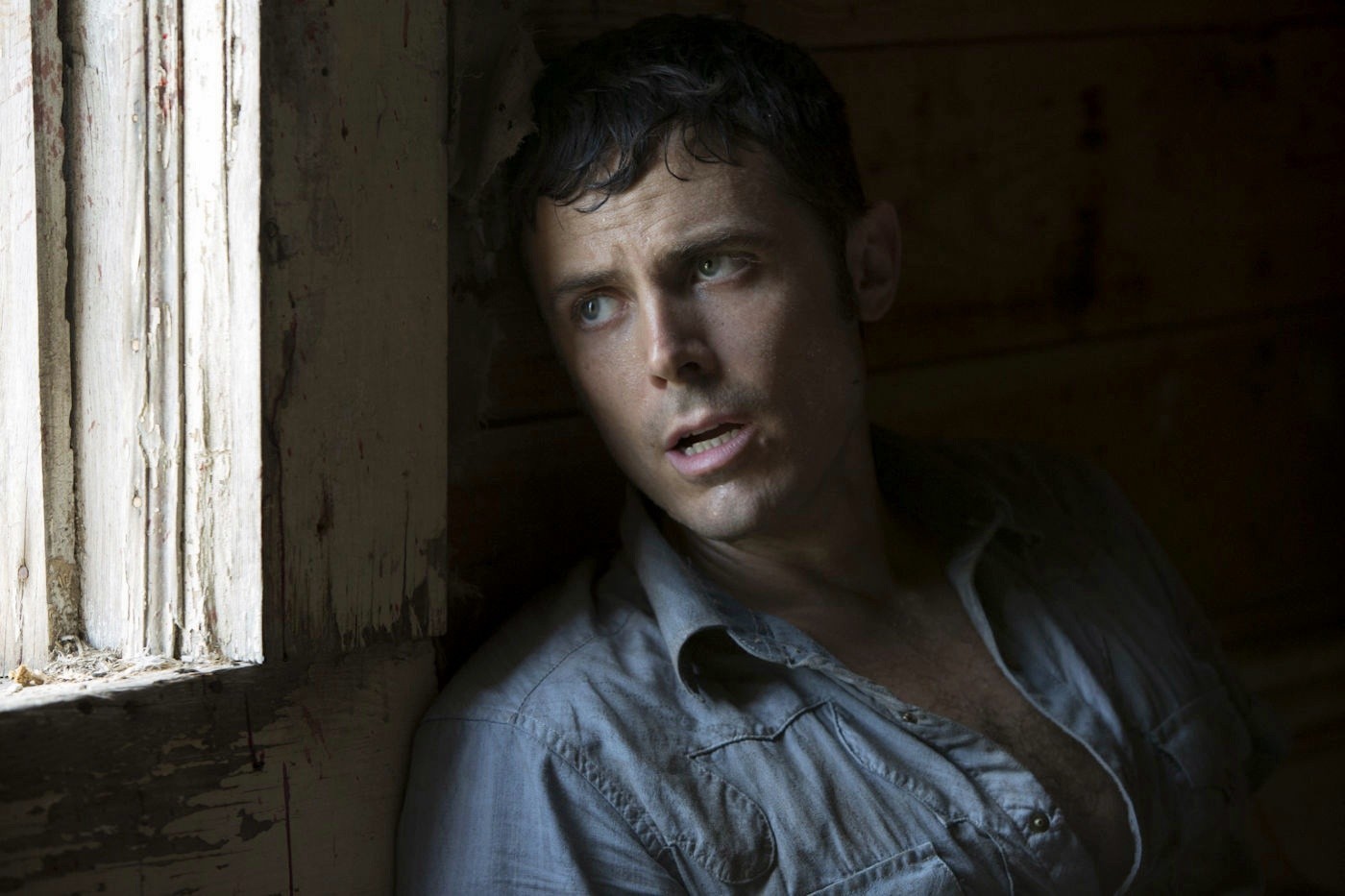
Detective John Hunt (Casey Affleck) interviews employees post-robbery and when he gets to motivation, he strives to keep incredulity out of his voice when he re-states what he's been told: "So, you did what you did because he said he had a gun..." "Yes. And also, he was sort of a gentleman."
Robert Redford doesn't direct The Old Man and the Gun, but he does some producing chores on it, and it is David Lowery (who worked with Redford on his miraculous un-tuned version of Disney's worst musical, Pete's Dragon) who is calling the shots, making a breezy film based on David Grann's* New Yorker article on Tucker**, who became known as "The Gentleman Bandit" cutting a swath through Southern banks in the 1980's. Tucker usually worked alone, and on tougher jobs that needed more co-ordination and a fast getaway, with two long-in-the-tooth associates Teddy (Danny Glover) and Waller (Tom Waits), who became known in law-enforcement circles as "The Over-the-Hill Gang."
When we first meet Tucker, he does a job ("Belmont Texas, July 26, 1991" we're told to give the film some authenticity by place/time-stamps as well as a first title that states "The story, also, is mostly true."***), a hearing aid in his ear (which is tuned to police frequencies), and as he makes his escape, he passes a motorist, Jewel (Sissy Spacek), who has broken down on the highway. He stops to help, and as, after police cruisers have raced by, he pulls his head out from under the hood. "Do you know anything about cars?" Jewel asks. "No," he replies. "Not really."
A tow truck is called, as he knows nothing about cars. They're a means to an end, just like lunch at a diner with Jewel while the police are running around outside, looking for this "gentleman bandit." She's trying to figure him out. He introduces himself as "Bob...Bob Kelly." "I like that truck of yours," she mentions. "Yeah," he says casually. "I stole it." But his eyes twinkle when he says it. "Hey, I'm just pullin' your leg." When he's a little vague about what he does, she presses, and he asks for her phone number. She writes it down and slides it across the table. He writes down what he does and slides it back. She looks at him in shock. "What's worse—if I'm lyin' or telling you the truth?" More talk, and he talks about his list of "things I want to do, but haven't done yet."

"Better hurry up," she smirks.
It's probably as good as time as any to talk about Robert Redford's face. There's no longer a hint of the smooth, angelic planes that made his initial days of acting so problematic—finding roles that would play against type than as "the nice boy"—that he finally roughed it up with various facial hair until folks could look past...his looks. His face, now, is a complicated map of wrinkles that crinkle with every expression, going beyond the weathered look he's had in the last couple decades and becoming more expressive and more open in conveying what his character is feeling. It's like Redford's movie-star mask has dropped. And we're starting to see him in his own skin. More on that at the end.
Hunt actually has contact with Tucker, when he's inside a bank that gets robbed by him right under the detective's nose. The bank goes into lock-down and all he can think of is his kids in the car, who are probably wondering that's going on with daddy in the bank; they'll be panicking when they see the police cars showing up. Try as he might, he can't convince the bank officials that he IS a police officer and he doesn't NEED to wait for the police to show up. Somewhere in there, he must be frustrated that he's less convincing to the bank officials than the robber.
Hunt had been frustrated with police work, maybe even quitting, but Tucker's spree energizes him (despite the ribbing his fellow officers give him for chasing a senior citizen bank robber). He WANTS to catch this guy, even goes on television saying that he WILL catch him—a broadcast that Tucker sees, and when the next job happens, the Gentleman Bandit leaves a present of a $100 bill saying "Detective John Hunt: Good Luck! 'The Over-the-Hill Gang'."

Oh. It's on.
Meanwhile, Jewel and "Bob" start seeing more of each other. She invites him out to her farm, introduces him to her horses, tells him she's keeping the place, despite her kid's protestations that she should get herself a condo with little up-keep. "Now's the time to be a little selfish." "Bob" likes the idea of her keeping the place, being independent, but he's not smiling when he looks out at the place. At a mall, they look at a bracelet Jewel likes, and Bob grabs her by the arm and they walk out without paying for it. He's all smiles. She looks at him...and stops in her tracks. She turns to go back to the store, and he, sheepishly, follows her.."sorry, we totally forgot..he's paying for it."
The FBI steps in when the Gang pull a job across state lines, leaving Hunt to merely look on in frustration, while somebody else handles the leads. Then, he gets a letter: a young woman named Dorothy (Elizabeth Moss) writes him a letter, saying that the robber, from his description and from stories her mother told her about her absent father makes her suspect that the two might be one and the same. Her father's name: Forrest Tucker. Background work on Tucker shows a lifelong criminal history, with a penchant for escaping whatever prison thought might hold him. A chance encounter between the two men in the bathroom of the local diner just confirms what Hunt has begun to suspect—and the two men now know each other—by sight.
"Lookin' sharp makes you look like you know what you're doin'
...even if you don't."
Lowery's direction is low-key and efficient, less concerned for the striking image (as he has in the past), but keeping an eye for the magic that his cast can deliver at the drop of a smile, and the energy transference between a scene between an old pro like Redford and a "bury-it-deep" performer like Affleck manages to bring out sparks in both actors. Working with Redford seems to invigorate Affleck with just that much more wattage, as Spacek does the same for Redford. The story lends itself to making one wonder what makes a character like Tucker tick, and the answer lies in the very longevity that belies a high-risk occupation. This is some of Redford's more subtle work in his career and it's helped by the etching carved into his face that allows the slightest of smiles shine through with satisfaction. It is a melancholy acknowledgment of damage along the way, which might be apparent to those around Tucker, but he wouldn't be aware at all.

One can't help but smile, albeit sadly, in return.

If this is Redford's last film performance (I'm highly skeptical of that), it's a great one to go out on.


* Grann also wrote the book The Lost City of Z.

** January 23, 2003, if you're checking or looking for it at the old magazine store.

*** One should remember that Butch Cassidy and the Sundance Kid started with the title "Most of what follows is true." The "also" of The Old Man and the Gun hearkens back to it. The film is a sly little tribute to Redford in places; at one point there's a clip of the young Redford from The Chase (1966), and there's a sweet little nod to The Sting, that I won't spoil by pointing it out.

Thursday, July 5, 2018

Olde Review: McCabe and Mrs. Miller

This was part of a series of reviews of the ASUW Film series back in the '70's. Except for some punctuation, I haven't changed anything from the way it was presented, giving the kid I was back in the '70's a bit of a break. Any stray thoughts and updates I've included with the inevitable asterisked post-scripts.

McCabe and Mrs. Miller (Robert Altman, 1973) It is very rare when two examples of great artistic achievement can be combined to make something greater than the sum of the parts--where the two complement each other, instead of distracting from each other. But in the first sequence of McCabe and Mrs. Miller, director Robert Altman achieves such a moment. While Altman and master cinematographer Vilmos Zsigmond float their camera onto the form of John McCabe (Warren Beatty) riding through a wintry landscape, Leonard Cohen's "The Stranger Song"* mystically describes the scene and the man. You know when you see this inspired piece of film that Altman has a special kind of vision as regards this project and he pursues this vision throughout with the result that McCabe and Mrs. Miller is Altman's finest film. I'm adamant about this, despite the number of Nashville fanatics who try to convince me otherwise.*
After doing the frenetic M*A*S*H, Altman felt that he was financially secure enough to try artistic projects. McCabe... was his first.** It is a slowly paced, beautifully photographed, acted and edited film about the formation of a western town, a town whose foundations are two rather dubious persons: McCabe, a gambler by trade, and Mrs. Miller (Julie Christie), a madam. It is their vision that gives birth to the town and turns it into a self-sustaining community, a town that will soon displace their once-prevalent position and grow over them, just as surely as the snows accumulate over time. 
But if Altman were to show the growth of the town as that, the growth of a town, what sort of movie would that be?*** So, as it does with more traditional westerns (a term I'm not too comfortable with), the interest of the story falls on the people, in this case, the cornerstones of the community, McCabe and Mrs. Miller. And like most Altman films, there are many characters, many occurrences, but all in the whole of the community--it's a very satisfying film, by a sometimes exciting, sometimes exasperating, but certainly the most innovative of current directors, Robert Altman.

Broadcast on KCMU-FM on Novermber 19th and 20th, 1975.

Altman would continue to be innovative and sometimes exasperating, but never less than assured in the tricks he'd play with the camera and with the perspective he allowed us to see, right up to his final film. And McCabe and Mrs. Miller continues to be (after a recent re-viewing) a wonderfully dreamy frontier film, despite the usurping of some of Altman's strategies in various TV shows since its debut in 1971. Certainly, it feels like a more realistic film about building a community—the town of Presbyterian Church, its most prominent structure, in isolation in the West than most Western films would have you believe. And Vilmos Zsigmond
's innovative cinematography set a high standard that most film-makers can only achieve with CGI and post-gradation.
I find it amusing that this movie didn't find that much of an audience, especially in the West, where the story probably mirrors the origins of every town out in these parts. It certainly does Seattle, where larceny and luck...and women imported from the East Coast...were part and parcel of the city's foundation.

But, as in this review, is it his best film? That would be hard to say. Altman was an iconoclast and rebellious, attempting to subvert film genres and even the organized standards for making films, being more free-wheeling and improvisational, even with a script that was as focused as, say, The Player or Gosford Park.


* And yet I just found a glowing "Olde Review" of Nashville that I'll be putting up in a couple weeks. Nashville certainly has more reach and is a more ambitious project than McCabe... But I did love the dreamy aspect of this revisionist western. Thinking about it the last few minutes I'd be hard pressed to pick "the best" Altman film, or even to a lesser degree, my favorite. How can you compare such disparate films as M*A*S*H, McCabe..., Nashville, Short Cuts, Gosford Park, The Player, and on and on right up to A Prairie Home Companion? Like comparing apples to sweet potatoes.

** I think I might have forgotten the quirky Brewster McCloud in there, and who's to say that M*A*S*H or that film aren't artistic?

*** "Deadwood," frankly...


*


Tuesday, August 23, 2016

Ain't Them Bodies Saints

Written at the time of the film's release

Dear Ruth
or
"Goin' a direction that ain't been invented yet."

David Lowery's independent study of love on the run, Ain't Them Bodies Saints, is a romantic's view of criminal activity in the same spurting vein as Bonnie and Clyde, Badlands, and Thieves Like Us, where the romantic glow of need and obsession have a tendency to blind a body from the rest of the world and what's considered normal.

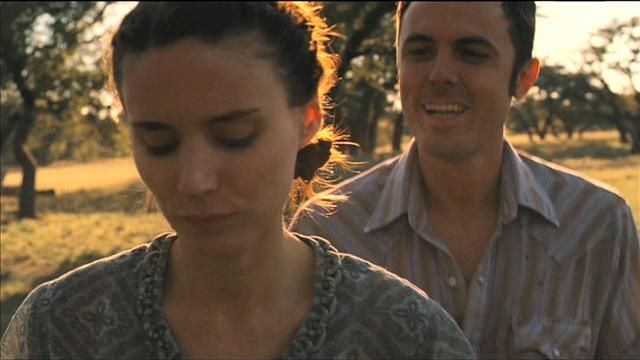
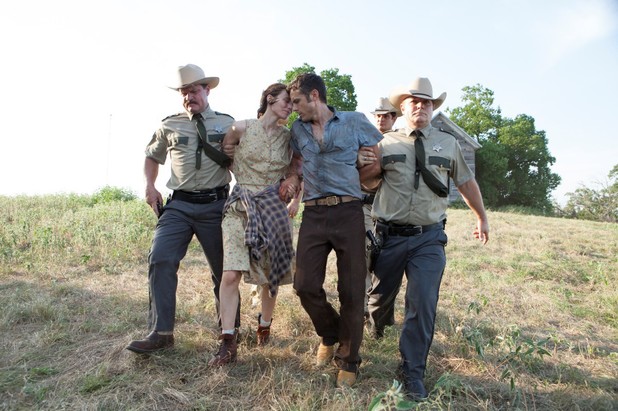
Ruth Guthrie (Rooney Mara) and Bob Muldoon (Casey Affleck) are young and in love, and Bob's in the employ of Skerritt (Keith Carradine), who runs a hardware store in town, but a has a nice little underground thievery ring keeping it afloat. Bob and Freddy (Kentucker Audley—what a great name) do the deeds, then run back to the abandoned farm that was their grandfather's before it went bust to hide out and wait for Skerritt's pay out. But, when we first meet them, Ruth and Bob are young, in love, spatting, she's pregnant and practical, and he's a moony-goony kid with nothing going for him in the long term. 
Except for the prison sentence. The cops get wind of where the outlaws are hiding, and it looks like it's going to be one of those barn-burners where everyone gets killed. Freddy dies first, then Ruth shoots Officer Patrick Wheeler (Ben Foster), and Bob devises that he'll say he shot Wheeler, so that Ruth can go free, he'll take the prison stretch, and he'll come back to his family when his time is up.

Best laid plans.
Ruth has her child, a girl, which Bob finds out about in prison, but he's not the the practical one—he's the impulsive one—and before long he's on the run with five other prisoners, presumably to get back with his family. The police and Skerritt are both on high alert, figuring that they know that Bob's headed in their direction.  But a lot has changed. Skerritt proves he has a conscience by setting up Ruth and her child in a place (across the street from him, so one wonders if the reason is totally altruistic or simplified reconnaissance). And Wheeler starts calling on Ruth, ostensibly to see if she knows anything about Bob's whereabouts, but also because he finds he starts to have feelings for her, not knowing that she's the one who shot him, and not knowing that she knows.
Four people, with an awful lot of shared history, but none of them know very much about the others. But all are in an agitated state of anticipation and uncertainty and trying to take pains to head off what could be disaster. Doesn't sound like much. story-wise, but it is far from mundane, and all four leads have a way of maintaining masks of dis-information, while acting as if everything's normal, really.  And that's something of a small miracle.
Where Lowery excels, though, is (with cinematographer Bradford Young) in creating beautiful images—again, out of pretty mundane things—and letting those images tell the story (it has to, the reason being that the dialogue is useless, except to let you know that everybody's lying and/or hiding something) and that's a considerable challenge for someone's first feature. Those issues also complicate the acting, but between Affleck, Mara, and Foster, you have three excellent actors who acquit themselves at playing "opaque." Keith Carradine (who starred in Thieves Like Us, by the way), though excellent, is a little more obvious in his intentions, although he's an actor who can apply both comedy and drama masks to his face.
It's an interesting study and makes one wonder what other subtle things Lowery is capable of pulling off.