Showing posts with label Olde Review. Show all posts

Thursday, October 31, 2024

Olde Review: Rosemary's Baby

This was part of a series of reviews of the ASUW Film series back in the '70's. Except for some punctuation, I haven't changed anything from the way it was presented, giving the kid I was back in the '70's a break. Any stray thoughts and updates I've included with the inevitable asterisked post-scripts.

This Saturday's ASUW films in 130 Kane are Roman Polanski's Rosemary's Baby, and Robert Wise's The Haunting.

Rosemary's Baby (Roman Polanski, 1968) Rosemary's Baby opens with this theme:* it's a lullaby, sung charmingly off-key by Mia Farrow, its star, but underscored with even more off-key, sometimes baleful accompaniment. And as this lullaby oozes out on the soundtrack, the image we see is of a line of New York apartments--not an unusual opening shot for the beginning of a movie, in fact, it's pretty much of a cliche. 
 
And so is the opening situation--two young newly-weds-in-love house-shopping. We've seen it hundreds of times. It's an everyday occurrence. The apartment is lovely, the couple buys it, and everything is quite normal. 
 
Until a new-found friend of Rosemary's commits suicide, and Rosemary's relationship with her eccentric neighbors turns rather familial, and a bizarre fate befalls the fellow who got her husband's job. Now, that it looks like success for them, they decide it's time to have a kid...and see, there's this chocolate mousse...
Well, I don't have to go any further for I'm sure the legend of Rosemary's Baby has preceded it. 
 
But what separates Rosemary... from other gothics is the perverse outlook of its director, Roman Polanski. Yes, everything's normal, and it is that very normalcy that makes the intrusion of Demonic Forces so doubly terrifying. One can accept odd happenings on a dark and stormy night on a cliff-top castle, but on a sunny day in a New York apartment complex?** 
It makes the horror so much more palpable to be surrounded by normalcy for it increases the possibility of something happening to you. And thus, Polanski places threats in such "normally" innocent and reassuring things as a chocolate mousse, or
Ralph Bellamy (who had hawked aspirins for years on the tube) playing a "witch" doctor, if you'll excuse the pun. 
It's an unorthodox approach to the Gothic Horror Story...at least it was in 1968, when it was released, and to paraphrase an ad for Polanski's latest film,
The Tenant, "No one does it to you like Roman Polanski."***--not William Friedkin in The Exorcist, or Richard Donner in The Omen. Polanski's Rosemary's Baby is head and shoulders...and horns, above them.
 
Broadcast on KCMU-FM on October 22 and 23, 1976 
 
Still true, but, my God, after Polanski's conviction of child-rape, that's one hell of a movie tag-line on The Tenant! Polanski's arrest, trial and conviction would come later, two years after The Tenant was released, but it sure is the ultimate sick joke.
As for Rosemary's Baby, it still tops the lists of "Movies No Pregnant Woman Should Watch" and it still takes the prize as the best "Devil Walks Amongst Us" movie (sorry, Damien and Regan), and it's no small part due to Polanski's sick sense of humor—Orson Welles, in one of his conversations with Peter Bogdanovich, referred to him as "one of those morbid boys"—and his way of mixing the mundane and the sacrilegious. 
The most entertaining parts of Rosemary are the elderly and uncomfortable neighbors—the "legacies" of the Bramford Hotel, and the best of them is sprightly Ruth Gordon, who won an Oscar for her role. It resurrected Gordon's career, and she went on to star in a long list of films in her twilight years. But, there are others, like Patsy Kelly, Ralph Bellamy (the joke in his early roles was that he was always the dullest of leading men and Polanski makes full use of that reputation here), Elisha Cook, Jr. (a favorite of producer William Castle), Hope Summers, and Phil Leeds (he would end up a fixture on "Seinfeld"), all semi-familiar faces that, in other circumstances, might provide comfort, all part of a conspiracy to make an anti-domestic situation to welcome the Anti-Christ.
Add to it the presence of Mia Farrow, the urchin break-out star of TV's "Peyton Place" who'd just married...Frank Sinatra!...and had a quality that could charitably be called "odd." You're not sure if she's going crazy, has a pre-postpartum depression, or if something weird is actually going on, and it keeps audiences on a tightrope tension of sympathy for/suspicion of Rosemary, the yin and yang of our sympathies and cynicism. And, of course, Polanski (out of Ira Levin, who cloned Hitler and roboticized housewives in other thrillers) turns that into your worst nightmare.
Producer William Castle had a carnival-barker-showmanship to him, gimmicking customers into screenings of his goofy-creepy thrillers and horrors and after Hitchcock (inspired by Castle's box-office receipts and asking "what if someone good did it?") managed to best his efforts with Psycho, he wanted to do the Master of Suspense one better. With the solid story-ideas of Rosemary's Baby, head and tails above what he could conceive, he was able to get that much better and gain some industry clout, although he ultimately had to cede most of the creativity to Polanski, and his Paramount studio-bosses. He would always be a B-movie-maker, but Rosemary's Baby made him see the promised land of the A-list.


* Yeah, there's nothing wrong with your computer--there is no song. I usually backed my radio-reviews with an appropriate piece of music, and for this one, I used the actual theme on the soundtrack (that I recorded on cassette from a TV broadcast...I used to do that).

Here it is:

 
** Ironically enough it's the high-end and rather exclusive Dakota building, standing in for the "Bramford." John Lennon would be shot in front of the Dakota a decade later.
*** EEE-Yikes!
 
Legendary producer-showman William Castle appears outside the telephone booth for a cameo.
 

Tuesday, February 6, 2024

Olde Review: Fires on the Plains

This was part of a series of reviews of the ASUW Film series back in the '70's. Except for some punctuation, I haven't changed anything from the way it was presented, giving the snarky, clueless kid I was back in the '70's a break. Any stray thoughts and updates I've included with the inevitable asterisked post-scripts and, here, it's in the familiar, gray, non-oxidized font.
 
This is a companion piece to "Forbidden Games" broadcast on KCMU-FM.
 
This Saturday's ASUW films in 130 Kane at 7:30pm are the last of the Fall series, and they are Rene Clement's Forbidden Games and Kon Ichikawa's Fires on the Plains. They look at the effects of war on children and men.

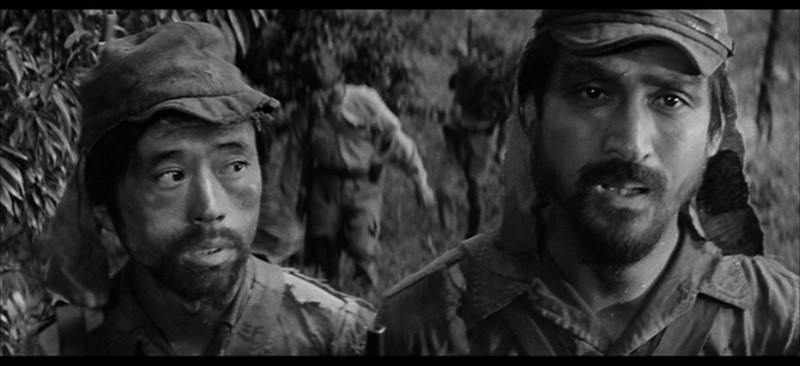
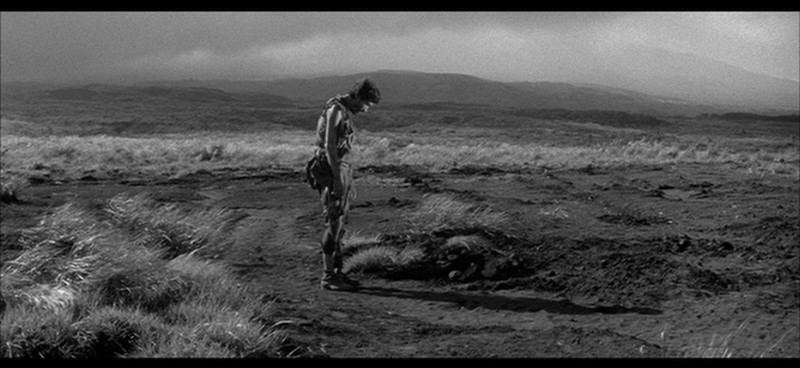
Fires on the Plains aka "Nobi" (Kon Ichikawa, 1959) Kon Ichikawa's Fires on the Plain is not so gentle as Forbidden Games — it is something that pretty much has to be endured. It deals with the final days of World War II and the ravaged Japanese Army—disorganized, suffering heavy losses, and losing its humanity. The conditions under which they fight are unbearable: disease is rampant, there is no food and no loyalty and no real reason to keep fighting but to survive. Ichikawa focuses on one soldier who, too, is trying to survive, but survive as a moral being, for he is already doomed by tuberculosis.
 
On his trek through the war-zone, the atrocities he sees become greater, the desperation he sees heightens until there are no sides. The war becomes one to survive, each on his own against everyone else. There is no meaning to the war, and also, no meaning to life for all morality, if it can exist in war, is lost. The ending of Fires is horribly shocking and if your are in no mood, or cannot take such strong stuff, I would advise you to avoid seeing the film. The total effect is somewhat devastating and probably Fires on the Plain is the most excruciating indictment of war and the effect on the men caught up in it.
It is interesting to set this film up against Ichikawa's beautiful The Burmese Harp, which looks at the same section of the war for the Japanese. But one gets the impression that, for Ichikawa, The Burmese Harp didn't express enough of the outrage he felt for war. The Burmese Harp looks positively sublime next to Fires on the Plain, and even though they touch on the same themes, the two films could not be more different. Just looking at stills from Fire is a bit grueling, but this review whets my appetite to see it again, especially in light of another, similar film, Clint Eastwood's Letters from Iwo Jima, and in the light of encountering The Burmese Harp and appreciating its artistry.
As I tended to do, I truncated these reviews as they were the final ones for the quarter, and I wanted to make room for closing thoughts:
"Forbidden Games" and "Fires on the Plain" are the last films in the Fall ASUW Film Series, and so, too, this is my last movie review. At this point, KCMU is in a state of flux so I have no idea whether I will be back next quarterwith the Winter ASUW Film reviews, or whether we will have film reviews at all. It's pretty much up in the air right now. I would like to see things continue. I have had fun doing them: seeing new films that I might have missed, allowing myself to express my raves and my gripes about them. The toughest thing about writing them is to distill what you want to say about a film into five minutes, two and a half minutes, or even one minute; time is always the biggest enemy in radio work and that proved to be the case not only writing in writing them, but in producing them, as well. I felt that something else had to be included besides my droning on—at least music, maybe an actuality now and then—and that was time-consuming. A few times my reviews would be late (once it just never went on) and again, time—my time—will be the biggest consideration of whether they will continue. But whatever the fate of the reviews next quarter, the films will continue. And this is the line-up for Winter Quarter....

...I would like to thank the DJ's on the air for even playing the damn things: Tim Hunter, Don Zwicker, Steve Flume, John Windus, and Abby Goldman. I would like to thank Diane Jotautus of the Audio-Visual department who put up with me all these weeks, for letting me see the films, and I'd like to thank Rajeeve Gupta of the Film Showings Committee for giving me the opportunity. Lastly, I'd like to thank you, for these reviews do no good unless someone is out there listening. And so, that's the Last Movie Review Show.

I felt compelled to say all that because 1) I felt a great deal of responsibility for these things, and 2) I had enough ego to think anybody gave a rip. I still have trouble compressing my thoughts into a cogent, pithy review that manages to touch on all the issues a film brings up. But, I've also learned that there's just so much of this stuff a person can tolerate (and how long has this one gone on?) The comment about my droning on is on-the-beam—back then, I didn't know how to speak on the radio,it was all just a flat monotone in desperate need of some character. 
The names I remember fondly. Tim Hunter went on to a successful career as "the funny one" on a morning DJ team locally, John Windus ended up working in radio in the Portland area. Everyone else...long-lost, though I still remember them in my mind's eye. I remember after a while I started calling Abby, Abby "Gold-person" as a joke, which she picked up and used on the air. Diane Jotautus was a great supervisor—I worked for her in the A-V Department, and gave it up to concentrate my time doing radio—and more often than not, would watch the films with me to break up the monotony of the office-work. It was also a quick way to check the prints that were showing.
And I did do the Winter series. Some of them have already appeared, and I know there are others...but the notebook I have of all these old reviews doesn't contain them. I've done a thorough search for any loose-leaf versions, but I have yet to find them. It's amazing how long I've kept these things I've written 32 years ago....scratch that, make it nearly 50 years ago.
 
That's a lot of time spent in the dark.

Friday, January 12, 2024

Olde Review: Ramparts of Clay

This was part of a series of reviews of the ASUW Film series back in the '70's. Except for some punctuation, I haven't changed anything from the way it was presented, giving the kid I was back in the '70's a break. Any stray thoughts and updates I've included with the inevitable asterisked post-scripts.
 
Ramparts of Clay aka "Remparts d'argile" (Jean-Louis Bertuclucci, 1968) Ramparts of Clay was on John Hartl's ten best list this year—that doesn't mean anything, it's just a fact—also a fact that a co-worker at KCMU thought it was an extremely oppressive film, and I respect his opinion, as well.
Okay, this is just to tell you that the opinions vary, and my opinion is just one in the crowd's. Ramparts of Clay is oppressive; its narrative moves at a snail's pace, and there is almost no truly-defined dialog (what there is, is elliptical at best).

Depressing prospect for ninety minutes' viewing, isn't it?

But there are many other films with these qualities: Nicholas Roeg's (Walkabout), Richard Lester's Petulia, Stanley Kubrick's 2001: A Space Odyssey. The burden of these film's story-telling abilities falls on the shoulders of the images, and you have to be damned talented with your camera to pull it off. Jean-Louis Bertucelli is awful-damned talented, and so is his camera person Andreas Winding. It's a shame the print being shown on Saturday has so many scratches that distract from the beauty of the images. But you can glean some satisfaction from it, if you concentrate and let your eyes tell you the story, and let Bertucelli's elemental film-making—the way stories were told in silent (film) times—give you the information and direct your mind to what's going on.
On the other hand, you may find the film dull, but that is your opinion and it is the last one—and the one that's most important.

 
Cee-ripes! Way to "commit," Mr. "Reviewer!" Could we be any more vague? 
One of two things are happening here: either I didn't see the film (or fell asleep during it--not unlikely, although I do remember Ramparts of Clay and being moved by it) and I'm tap-dancing, or I didn't want to hurt that co-worker's feelings by saying they were "full of it" and a "film-weenie" just because the film was being told solely by images, which they considered "oppressive."

I'm way over that these days.

These days I don't quibble, or consider other people's opinions--I just tell them they're wrong, and, quite possibly, an idiot. Then, I'll compound the problem by telling them WHY they're wrong, and expect that to convince the poor soul that, yes, they truly are an idiot, thank you, thank you, James, for opening my eyes to that fact, woe is me.

Yeah, that doesn't happen much.

But I will say that any film drawing comparisons to 2001, Walkabout, or Petulia, is in august company, and worth another look-see.
2024: I'm older. These days I don't quibble. I say "Uh-huh" and leave it at that. If the argument "for" and "against" is valid (and I've seen the film), I'll weigh it against my own and it might alter. I consider opinions "grist for the mill" now. If I haven't seen a film, it goes on "The Must-See List" that I will probably never complete. 

John Hartl, by the way, was the film reviewer for The Seattle Times at the time. He died in 2022.

Tuesday, November 7, 2023

Olde Review: Love and Anarchy

This was part of a series of reviews of the ASUW Film series back in the '70's. I should say, the "1970's". Last century. Except for some punctuation, I haven't changed anything from the way it was presented, giving the kid I was back in the '70's a bit of a break. Any stray thoughts and updates I've included with the inevitable asterisked post-scripts.

In celebration of the shroud of smog that envelops Seattle, the ASUW will continue to show "Thrillers" on Saturday night in 130 Kane and the particular films are Lina Wertmüller's Love and Anarchy, and Bernardo Bertolucci's The Conformist.

Love and Anarchy aka "Film d'amore e d'anarchia, ovvero: stamattina alle 10, in via dei Fiori, nella nota casa di tolleranza..." (Lina Wertmüller, 1974) First of all, I have to say that I approached Lina Wertmuller's film with some wariness. I have a built-in prejudice about movies and directors that are praised to the skies by critics, fawned over by the press and I tend to go to that particular movie with an attitude of "All right....prove it!" That's a terrible way to go see a movie; you should be completely unprejudiced (which a lot of critics aren't). Your mind should be a complete blank (which is easy for a lot of critics). You can't be unprejudiced in any endeavor you try. So...that, for what it's worth, is my apology for not being at all thrilled by Wertmüller's Love and Anarchy to everyone who was.*

On the debit side of the ledger,** Ms. Wertmüller tends to stress very arty-looking shots in her work but at times when the movie isn't really doing anything. When the movie takes a lull in the action, we are given very striking, if obvious compositions. Why? Her dialog is, at times, very unoriginal. Directors should at least come up with new cliches for their characters to spout (and this is a questionable point, as the film is subtitled, so the translations may be a little rough--and again, with both of the Saturday night films, they are subtitled--sometimes invisibly super-imposed over white objects--so go early, as the best place to read them, if you can at all, is on the main floor of 130 Kane). Ms. Wertmüller's portrait of a high-echelon Fascisti is badly caricatured, turning him into an Italian Colonel Klink. Also, easy irony turns me off, as when a light little theme is used to accompany a character's death by bludgeon. Nothing much there to praise.
What there is, is in the performances. Giancarlo Giannini is someone to praise to the skies, a more likable sad-sack I have never seen since Buster Keaton, and there is an immediate identification and sympathy for him when he first appears on the screen. He is a delight, and he keeps the film above water for quite awhile.
Lina Wertmüller is still making films, but the critical parade has moved on. When her
Swept Away... was re-made by Guy Ritchie a few years ago, featuring Mrs. Ritchie in the lead, the film was attacked for her screeching, unpleasant performance, probably forgetting the fact that it was in keeping with the original. Lina Wertmüller was (and is) a challenging film-maker, exploring her themes with a none-too-subtle hand, and making points that polarized film-goers, except for the fawning. Lovers didn't love Love and Anarchy and neither did anarchists--a San Francisco anarchist group picketed and distributed leaflets denouncing the film and Wertmüller during its initial run. Perhaps they didn't know she was making a tragedy. (I wonder if anarchists picket in an orderly manner...or if they just make it up as they go....Hmmm. best not to think too much about that).
The cinema needs movers and shakers like Lina Wertmüller, if only to challenge the complacent. Then again, the complacent probably wouldn't seek out one of her films.
The view from 2023: Lina Wertmüller died December 9, 2021 at the age of 93. She was the first female director to be nominated for an Oscar—in 1976 for her film Seven Beauties. Someone has to be first, even if it is late. And Wertmüller, whose work was seemingly omnipresent in the 1970's, could not be ignored.

Her last film was 2004's Too Much Romance...It's Time for Stuffed Peppers, which starred Sophia Loren and F. Murray Abraham.


* Whatever thoughts one has about Lina Wertmüller or any director, the best policy is to go into any film with an open mind, thereby allowing yourself the luxury of appreciating what is there, without being hampered by predilections towards negativity. One makes one's own reality. If you walk into a movie expecting it to be a bomb because of "X," chances are you will walk out convinced it's a bomb (because of "X"). And in the work of confirming your own opinions by ticking off your personal check-list of dislikes, you will be more than likely to miss something that might change your mind. I don't believe "Once a hack, always a hack." Every film is a learning experience, for creator and viewer. I've seen too many good films by directors I haven't liked, to believe, or trust, in prejudices.

** See what I mean about ticking off a checklist of dislikes?


Thursday, October 19, 2023

Olde Review: Persona

This was part of a series of reviews of the ASUW Film series back in the '70's. Except for some punctuation, I haven't changed anything from the way it was presented, giving the kid I was back in the '70's a bit of a break. Any stray thoughts and updates I've included with the inevitable asterisked post-scripts.

This is a companion piece to The Fire Within
 
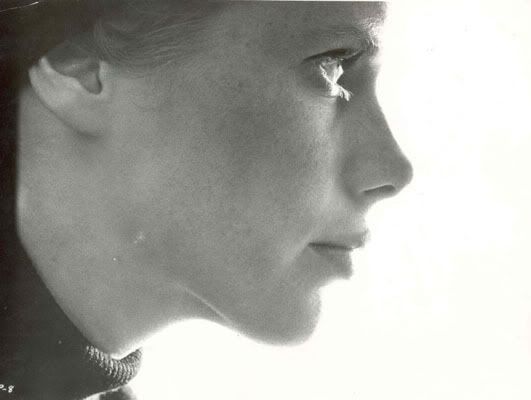
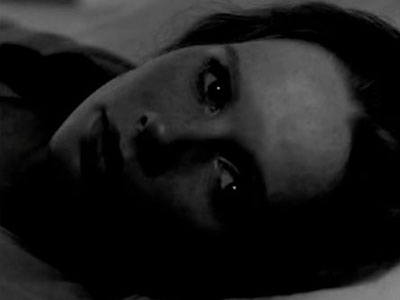
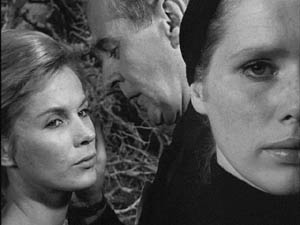
Persona (Ingmar Bergman, 1967) As opposed to the approach Malle takes with The Fire Within, Bergman takes a totally different tack--he lets you know right from the start that Persona is only a movie, not reality at all (and as an ex-projectionist, my sympathy to the fellow who has to show it Saturday night!*). It is another Bergman film dealing with the supernatural. But for Bergman the supernatural does not come from beyond, it exists within us, within our personalities.

An actress
(Liv Ullmann) is admitted to a hospital when she falls silent, unwilling to speak. A nurse (Bibi Anderssonn) is put in charge of the actress' care. For therapy, the two women live at a house on the seaside, and it is at this point that the supernatural forces of the soul take over.
The two women--the nurse, talkative and light; the actress, silent and brooding--begin to resemble each other, to merge psychically, take on each other's characteristics...and I find that I really can't go on with a synopsis of the story. For at this point, what one sees in the film is almost totally subjective. You have to explain what goes on to yourself. I can't do it for you, even if I were to try.**
Bergman can be a light and breezy film-maker as is evident in The Magic Flute and his '50's comedies. But at other times, his films can be claustrophobic and suffocating almost beyond endurance (and I think Bergman realized this in Persona, for at one point he lets up, forgets the story just for a moment, and explodes the creen with fast, fleeting, and irrelevant images***--a filmic explosion to relieve this build-up in tension).
William Bayer in his book "The Great Movies"
**** says this about Persona and its creator, Ingmar Bergman.
"It is not his obscurity that is so frightening about Bergman. It is his intensity. there is such tension in "Persona" that it comes at times to be an almost unbearable experience. One senses a man revealing his anguish at the furthest extremes of cold fire, compelling attention by the blazing sting of total chill. In "Persona," the faces of Liv Ullmann and Bibi Anderssonn are incandescent with this intensity. Their interchange is so intimate that at times we want to avert our eyes." "The Great Movies" (p. 190)

It is all very heavy stuff. And I'm not sure the majority of UW students will be able to understand,be able to deal, with "The Fire Within" and "Persona."

But they are there...as a challenge.
Broadcast on KCMU-FM October 29, 1975 
A little condescending there at the end, I think. Perhaps I should have said I HOPE the majority of UW students would be able to understand or deal with the movies. They're disturbing films, and they resonate more, the older one gets and the closer one gets to the Edge of the Abyss. Perhaps I should have said that. Who knew?
As for what happens in the film: is it an empathy,
a Jungian merging of souls, a familial bond, a lesbian love, possession, a psychic experience? Is it like pet-owners resembling their dogs? Is it the two women influencing each other so much that it becomes impossible to tell where one begins and the other ends?

There's a line from the wonderful Tucker: The Man and his Dream. I've always loved the dialog where Abe Karatz (Martin Landau), Tucker's financier semi-explains why he stays with the visionary auto-maker despite the financial risks: his mother, in her poor English, tried to communicate that you shouldn't get too close to people "or you'll catch their dreams. She meant germs. But she said 'you'll catch their dreams.'"

Maybe it's as simple as that.
 

The view from 2023: Well, good for "the kid." You can tell I'm dancing around it, dispensing possibilities—all that could be legitimate if you're going for metaphors—but, as someone who has "care-taken" since the writing of this, it's seems that Persona's talking about how one can lose oneself in one's charge. Empathy begats symptoms. There are support groups for those taking care of Alzheimer's patients who can succumb to depression. It happens. And then there's always "Student's disease" where you can read about symptoms and go "That sounds familiar..." and begin to think you have the same malady. 

We take on burdens and...and...there's nothing further to say...we "take them on." The concerns of the person we care for or about become our concerns...and we change accordingly. We sacrifice a bit of ourselves for what we care for.

Or...it could be possession. Your viewing is as good as mine.

* That joke's a little "inside"
** It sounds like a cop-out (in the language of that day), but it really isn't--Persona is such a personal film, that one's life-experiences, even one's fleeting subconscious thoughts, will influence what one sees in Persona: is it an empathy, a merging of souls, a familial bond, a lesbian love, a psychic experience? Quite literally, your guess is as good as mine. Bergman could have come out and said something preposterous like "this is based on the Norwegian folk-tale of the two sea-nymphs who become one with nature--of warring clans who find that they have more in common with what separates them, and when you attempt to care for a tyger, you become the tyger!," but what fun would that be? We all bring something unique to the table. Isn't that what a smorgasbord is all about?

*** Irrelevent? I actually doubt that, now. Film is edited together for a reason.

**** Sadly out of print, and not to be confused with Roger Ebert's series of collected essays. I can't even find it mentioned at Amazon.com
.

Wednesday, October 18, 2023

Olde Review: The Fire Within

This was part of a series of reviews of the ASUW Film series back in the '70's. Except for some punctuation, I haven't changed anything from the way it was presented, giving the kid I was back in the '70's a break. Any stray thoughts and updates I've included with the inevitable asterisked post-scripts.

This Saturday's ASUW films in 130 Kane are billed under the theme "The Tragedy of the Spirit" and the two films are Louis Malle's The Fire Within and Ingmar Bergman's Persona.*

The Fire Within
aka Le Feu Follet
(Louis Malle, 1963) The Fire Within was advertised as "a psychological thriller," which is a totally mis-leading label. It is not a thriller at all, but a study. A study of a man cured of alcoholism and, of his past life. I tell you this only because if you go to The Fire Within expecting something along the lines of a Marnie, you are going to be sorely disappointed, and such a reaction does not allow a fast shift of the emotional gears in order to appreciate what is there. Just a warning to put you in a proper frame of mind.


Anyway, through a long stay at a rest clinic the man has dried out, sheltered from the environment that had led him to the irresponsibility of his previous life, but clinging to that shelter, fearing to leave it for fear of what he would find outside. After some bolstering he does go out in search of friends, of companionship, of the past he has lost. Life is moving too slowly for him, with too much mediocrity and too little love, and as he goes from friend to friend, his spirit slips away from him, beyond his control.
Louis Malle
who directed The Fire Within, also directed the documentary Phantom India which was shown a couple weeks back, and he shoots this film in much the same way--no real sets are used, but the odd little details of life around us are focused upon, giving the film a sense of reality, of it actually happening.
 
Broadcast on KCMU-FM on October 29th, 1975

Okay. Confession time. What I'm not saying in this review--trying very hard not to say--is that I hate sitting through Louis Malle films. I just despise it. I haven't seen one in 20 years (the man died in 1995), but each of his films was a bit of a drag--Lacombe, Lucien, Phantom India, Pretty Baby. I just finished watching Night Moves in which detective Harry Moseby begs off going to see the new "Roehmer film" because he says "it's like watching paint dry." That's how I feel about Malle. I remember at this time (1975), I went around joking that "the perfect Louis Malle film would be two guys sitting in a room talking, one camera." And in 1981, Malle made essentially that (though with more than one camera) with My Dinner with Andre (which I actually liked, come to think of it).
One day, I need to be sat down in front of the TV with a strong drink, strapped down and made to watch
Atlantic City or The Lovers, or Crackers, Vanya on 42nd Street--I'd like to see that, actually, or Damage or Au revoir, les enfants. Maybe the years will have mellowed me, or given me life-experience or patience enough to appreciate his work. But with so many films I haven't seen, and my past experience, Malle always gets pushed to the bottom of the pile.


C'est la vie.
* Persona tomorrow...

Tuesday, February 9, 2021

Olde Review: Love and Death

This was part of a series of reviews of the ASUW Film series back in the '70's. Except for some punctuation, I haven't changed anything from the way it was presented, giving the kid I was back in the '70's a break. Any stray thoughts and updates I've included with the inevitable asterisked post-scripts.

Love and Death
 (Woody Allen, 1975)
 Let no one get the idea that I don't like Woody Allen. I really do. There was a time in my life that I was completely absorbed in the Allen "persona." For a time I was even writing term papers in his style (luckily I was a freshman and no one knew the difference). But even though I like Allen a great deal, it doesn't prevent me from not being too enthralled with Love and Death, for there are too many times when Allen forgets that he is making a moving picture, and does a monologue much like the ones he did in his old night-club days. Indeed, there are times, when "Love and Death" becomes merely an illustrated version of his writings in "Getting Even" and "Without Feathers." *

The best
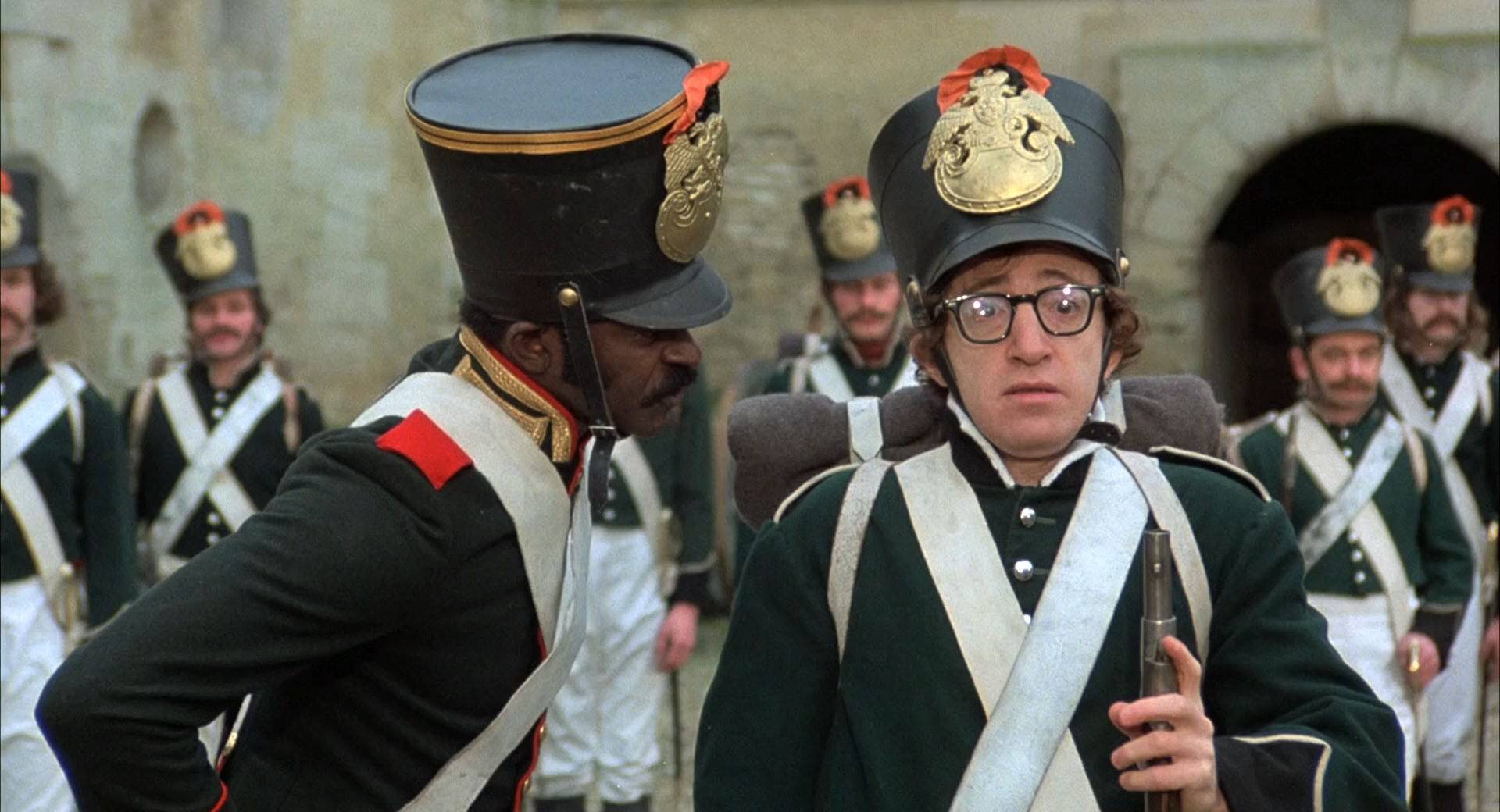
Allen movie is still Play it Again, Sam which, coincidentally, is being broadcast by CBS Friday night). Allen wrote it, based on his hit stage play, but Herbert Ross directed it. And one of the reasons that it is more successful is because the Allen "schlemiel" character is rooted to the present time. In "Love and Death," the movie takes place at the time of the Napoleonic Wars and the jokes come easily...too easily. All Allen has to do is put together an anachronistic scene--very easy to do and he still gets the yoks! (Cheerleaders on the battleground, indeed!**) Play it Again, Sam and its current scene forced Allen to come up with genuine funnies, not anachronistic ploys. Sleeper was successful because it worked with our knowledge of the present with our ignorance of the future. Love and Death is less so because it worked our knowledge of the present against our knowledge of the past. The two don't work together.
***
Broadcast November 4th and 5th, 1976
Love and Death would prove to be the last of what Allen cheekily labeled "his earlier, funny ones" (in Stadust Memories). At the time this review was written, Allen was polishing the edit of what was at that time called "Anhedonia," which would become the Best Picture Oscar-winning Annie Hall, and Allen would never go back to making his anachronistic "easy-laughs" kind of film, and started taking the craft of making films a lot more seriously. Love and Death was Allen's "Long Goodbye" to that style of sketch-comedy film-making.
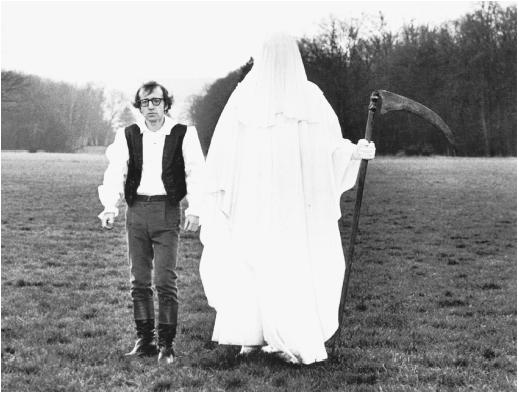
Actually, Love and Death was his "transition" film, a bridge between those two styles--for example, how Allen shot a couple things became the joke—his classically framed "lions-roar" that he ripped from Eisenstein's Potemkin, for example. His camera set-ups began to take on the spare look of an Ingmar Bergman film (he also took the Death figure from The Seventh Seal). The script was a mess (as all his early films were)--this time an amalgram of Dostoevsky, Chekhov, Tolstoy and Sleeper, but it was funny stuff, and a lot less episodic than Bananas, or Everything You Wanted to Know about Sex***** One dismisses the craft of comedy in film at one's own peril, because there are enough well-shot comedies that can't eke out a laugh to save their box-office lives. If one is looking at the photography more than enjoying the jokes is that anhedonia
The bottom line is, though, "is it funny?"

After Love and Death, Allen began to take the films—and himself—more seriously, burying the schtick and overt clownishness and embedding the jokes in the material, leaving them unsupported by buffoonery; he was getting older and the mugging at some point would look childish. He also stopped hiding behind satire to make his points. Oh, the influences were still there—they are there for every film-maker—he just wouldn't call attention to their sources so nakedly. When one does that, one's work has nothing to hide behind and leaves it open to all sorts of criticisms, charges of pretension, and the usual huffiness of the professional (or non-professional) critic. One can no longer just slip on a banana peel and wink "just kidding..."
So, I was wrong here, but not as wrong as I would be, and Allen would leave the blandly Ross-directed Play it Again, Sam (which is offensive now with its casual "rape" jokes) behind, with such classics as Annie HallManhattanHannah and Her Sisters, and Crimes and Misdemeanors, and a lot of gems along the way. Every economically-made five or six films or so, Allen will make a great film. That's a fine batting average in the Biz.

* These are collections of Allen's essays for "The New Yorker."

** I guess I forgot the scene where the hot-dog vendor is yelling "Red Hots!" on the battle-field.

***Crap! Of course, they can work together!

***** But were Afraid to Ask!