This was part of a series of reviews of the ASUW Film series back in the '70's. Except for some punctuation, I haven't changed anything from the way it was presented, giving the kid I was back in the '70's a break. Any stray thoughts and updates I've included with the inevitable asterisked post-scripts.
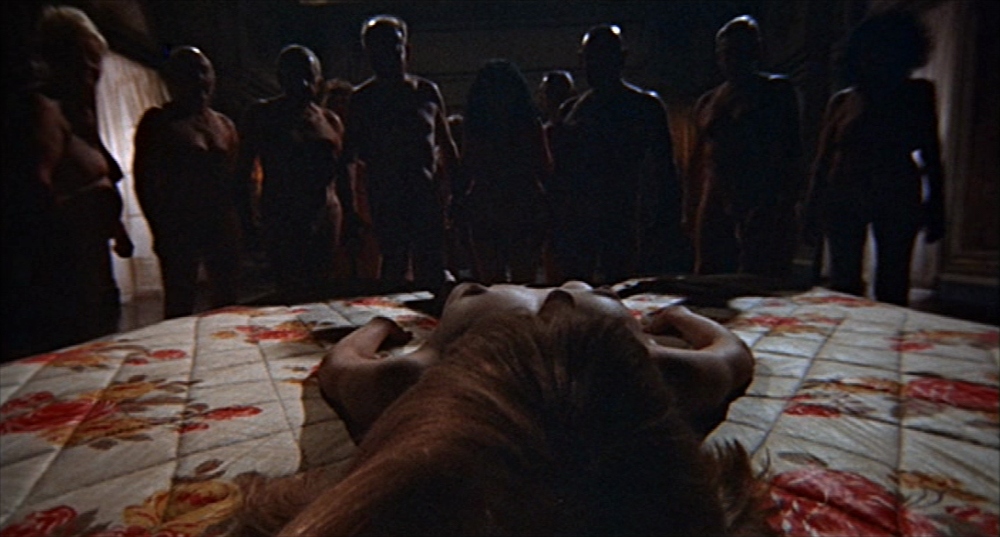
Rosemary's Baby(Roman Polanski, 1968)Rosemary's Baby opens with this theme:* it's a lullaby, sung charmingly off-key by Mia Farrow, its star, but underscored with even more off-key, sometimes baleful accompaniment. And as this lullaby oozes out on the soundtrack, the image we see is of a line of New York apartments--not an unusual opening shot for the beginning of a movie, in fact, it's pretty much of a cliche.
And so is the opening situation--two young newly-weds-in-love house-shopping. We've seen it hundreds of times. It's an everyday occurrence. The apartment is lovely, the couple buys it, and everything is quite normal.
Until a new-found friend of Rosemary's commits suicide, and Rosemary's relationship with her eccentric neighbors turns rather familial, and a bizarre fate befalls the fellow who got her husband's job. Now, that it looks like success for them, they decide it's time to have a kid...and see, there's this chocolate mousse...
Well, I don't have to go any further for I'm sure the legend of Rosemary's Baby has preceded it.
But what separates Rosemary... from other gothics is the perverse outlook of its director, Roman Polanski. Yes, everything's normal, and it is that very normalcy that makes the intrusion of Demonic Forces so doubly terrifying. One can accept odd happenings on a dark and stormy night on a cliff-top castle, but on a sunny day in a New York apartment complex?**
It makes the horror so much more palpable to be surrounded by normalcy for it increases the possibility of something happening to you. And thus, Polanski places threats in such "normally" innocent and reassuring things as a chocolate mousse, or Ralph Bellamy (who had hawked aspirins for years on the tube) playing a "witch" doctor, if you'll excuse the pun.
It's an unorthodox approach to the Gothic Horror Story...at least it was in 1968, when it was released, and to paraphrase an ad for Polanski's latest film, The Tenant, "No one does it to you like Roman Polanski."***--not William Friedkin in The Exorcist, or Richard Donner in The Omen. Polanski's Rosemary's Baby is head and shoulders...and horns, above them.
Broadcast on KCMU-FM on October 22 and 23, 1976
Still true, but, my God, after Polanski's conviction of child-rape, that's one hell of a movie tag-line on The Tenant! Polanski's arrest, trial and conviction would come later, two years after The Tenant was released, but it sure is the ultimate sick joke.
As for Rosemary's Baby, it still tops the lists of "Movies No Pregnant Woman Should Watch" and it still takes the prize as the best "Devil Walks Amongst Us" movie (sorry, Damien and Regan), and it's no small part due to Polanski's sick sense of humor—Orson Welles, in one of his conversations with Peter Bogdanovich, referred to him as "one of those morbid boys"—and his way of mixing the mundane and the sacrilegious.
The most entertaining parts of Rosemary are the elderly and uncomfortable neighbors—the "legacies" of the Bramford Hotel, and the best of them is sprightly Ruth Gordon, who won an Oscar for her role. It resurrected Gordon's career, and she went on to star in a long list of films in her twilight years. But, there are others, like Patsy Kelly, Ralph Bellamy (the joke in his early roles was that he was always the dullest of leading men and Polanski makes full use of that reputation here), Elisha Cook, Jr. (a favorite of producer William Castle), Hope Summers, and Phil Leeds (he would end up a fixture on "Seinfeld"), all semi-familiar faces that, in other circumstances, might provide comfort, all part of a conspiracy to make an anti-domestic situation to welcome the Anti-Christ.
Add to it the presence of Mia Farrow, the urchin break-out star of TV's "Peyton Place" who'd just married...Frank Sinatra!...and had a quality that could charitably be called "odd." You're not sure if she's going crazy, has a pre-postpartum depression, or if something weird is actually going on, and it keeps audiences on a tightrope tension of sympathy for/suspicion of Rosemary, the yin and yang of our sympathies and cynicism. And, of course, Polanski (out of Ira Levin, who cloned Hitler and roboticized housewives in other thrillers) turns that into your worst nightmare.
Producer William Castle had a carnival-barker-showmanship to him, gimmicking customers into screenings of his goofy-creepy thrillers and horrors and after Hitchcock (inspired by Castle's box-office receipts and asking "what if someone good did it?") managed to best his efforts with Psycho, he wanted to do the Master of Suspense one better. With the solid story-ideas of Rosemary's Baby, head and tails above what he could conceive, he was able to get that much better and gain some industry clout, although he ultimately had to cede most of the creativity to Polanski, and his Paramount studio-bosses. He would always be a B-movie-maker, but Rosemary's Baby made him see the promised land of the A-list.
* Yeah, there's nothing wrong with your computer--there is no song. I usually backed my radio-reviews with an appropriate piece of music, and for this one, I used the actual theme on the soundtrack (that I recorded on cassette from a TV broadcast...I used to do that).
Here it is:
** Ironically enough it's the high-end and rather exclusive Dakota building, standing in for the "Bramford." John Lennon would be shot in front of the Dakota a decade later.
*** EEE-Yikes!
Legendary producer-showman William Castle appears outside the telephone booth for a cameo.
Parole Girl(Edward S. Cline, 1932) Sylvia Day (Mae Clarke of Frankenstein and The Public Enemy) is a rookie grifter working scams on department stores—when her partner accuses her of being a pick-pocket in public, she threatens the store with legal action, which the managers are only too willing to avoid by writing a compensatory check ("We don't hold people up! We got a racket!" says her partner, Tony, played by Hale Hamilton)—when she is caught and thrown in prison for a year, after the store's manager won't let her go on directions from the store's insurance agency. As she's carted off she vows vengeance on the man, Joe Smith (Ralph Bellamy), saying she's going to ruin his life the way that he's ruining hers. In the slammer she meets Jeanie (Marie Prevost), who's in for being an accomplice ("Can you beat a hold-up? Me? I wouldn't do anything as crooked as that! There's too many honest ways for a girl to make a livin': blackmail, forgery and just plain framing a guy in a hotel room...").
With dialog like that, you know it's a Pre-Code film, that era in movies when gangster and socially-minded films told stories of the wages of sin and the value of redemption by openly exploiting the very licentiousness they were warning against in order to attract audiences. They "got away" with a lot in that time before the Hays Code was established. The exploitative aspects of the film were ballyhooed to attract the rubes who were expecting flashes of the seamier side of life, only to be served conventional outcomes and moralistic preaching to keep the Protectors of Society at bay. It's a bit of a shell-game, hearkening back to the roots of hucksters trying to attract a crowd.
Sylvia devises a way to get out. Her old crony on the outside smuggles matches to her, and when assigned to the soft-works factory manages to stage a fire (one should note that this is only 22 years after the Triangle Shirtwaist Factory fire in 1911) and while the other women panic, trying to get out of the locked door, Sylvia grabs the nearest extinguisher she spies and puts out the worst of the fire, then passes out (or pretends to) to get sent to the prison hospital. A grateful warden awards her clemency and she's sprung to seek her revenge on the store executive who had her sent away.
Fortunately, for her, he's all too susceptible: he's just received a promotion, and while he's out celebrating, she finds him and encourages his binge. Fade to black-out.
Smith wakes up with a massive hang-over and a woman's pump in his bed. Sylvia's in the bathroom, ready to give him a chaser—she announces that the two of them are now married, for better and probably worse. No matter that her partner posed as the judge—Smith doesn't know that—and she begins to spend Smith's money like it's going out of style. Plus, there may be an issue of bigamy—Joe might be married, and therefore in trouble with the law. It's a nice little honey-trap and Smith has no idea whether it's true or he's being bamboozled, all he can do is protest that Fate is against him and she must be a woman.
Parole Girl is rather crudely directed with smart, sassy performances and an eye towards moving the show as quickly as possible to keep people from poking holes in the plot. It would inspire a whole sub-genre of noir where the female component has the upper hands over the males and we'll be looking at a few of them—some, the originals and their more recent remakes—in this month of Valentine's.
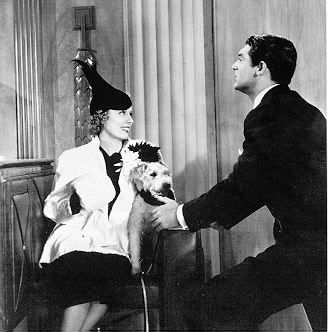
The Awful Truth(Leo McCarey, 1937) When Leo McCarey accepted his Oscar for Best Director for The Awful Truth, (which also won "Best Picture" that year) he famously said in his acceptance speech "You gave it to me for the wrong one!" Having not seen Make Way for Tomorrow(the other one he did that year), one has to content oneself with the reputation of the Award-winner, which I was familiar with because of an in-joke Howard Hawks inserted into Bringing Up Baby a year later* But The Awful Truth was the crowd-pleaser (allowing Cary Grant to become a top-billed star--as opposed to here, where Irene Dunne leads), whereas Make Way... was a box-office disappointment.
McCarey kept things moving briskly and encouraged the actors to ad-lib to increase the pace (McCarey also
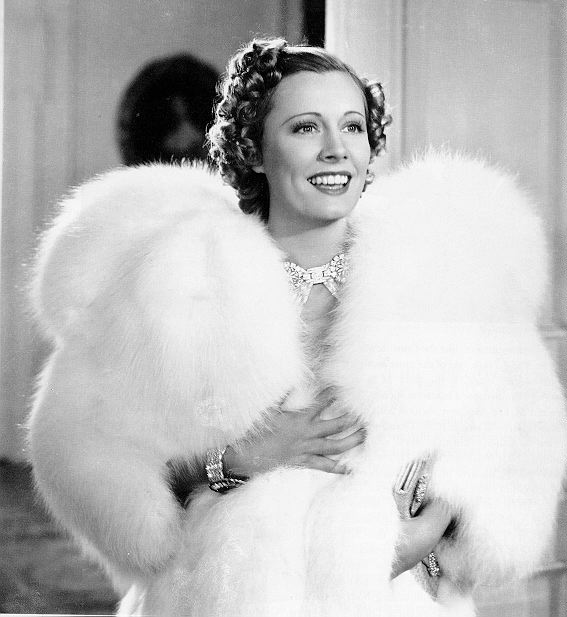
directed pictures featuring the Marx Brothers, where ad-libbing didn't need to be encouraged and, practically, couldn't be prevented!) Grant took to the technique particularly well--he wasn't comfortable in his role, and would have preferred to play Ralph Bellamy's part.*** His Jerry Warriner became a template for Grant's light comedy roles to follow. He's matched by Irene Dunne "the best actress to never win an Oscar," who may not excell at the off-hand remark, but knew how to fill space with a sarcastic faux-laugh. She could also effortlessly play foolish while maintaining a glamorous veneer--a trick she uses to great advantage in The Awful Truth.
Like the best of the "Much Ado.." comedies, The Awful Truth has a cynical bite to it, extolling the virtues of marriage, while acknowledging the way the new wine of romance turns to vinegar with time...and inattention. It also employs the comedy-generator of how taken away, one fights even harder to gain it back.The comedy of The Awful Truth also has a buffered side to it. Everyone remains very genteel while seething a bit inside, and no one goes for a hay-maker remark, but are satisfied that the recipient feels the wind of the passing blow. Time and society would allow the knives to come out later, but for The Awful Truth, just the suggestion of insult was enough.
Entertaining and a crowd-pleaser, The Awful Truth pales a bit in comparsion with its more savage progenitors, but to contemporary audiences it must have seemed like a roller-coaster ride.
Tomorrow: Make Way for Tomorrow * In Bringing Up Baby, Susan (Katherine Hepburn) with most of the cast in jail, pretends to be a wise-cracking moll and refers to the hapless David as if he's a mob-boss named "Jerry The Nipper," which is a laugh-line regarding Grant's character in The Awful Truth. Orson Welles also mentions McCarey's Oscar remark in his recorded remarks in "This is Orson Welles." **Besides, "Much Ado...," such films in the sub-category include The Philadelphia Story, Private Lives, His Girl Friday,Mr. and Mrs. Smith, etc. Cary Grant excelled at them
*** Which provided another joke for Hawks in His Girl Friday. When Grant's character is asked to sum up his ex-wife's (Rosalind Russell) fiancee, says "He reminds me of that actor...Ralph Bellamy," apt because Bellamy played the part!
 Rosemary's Baby opens with this theme:* it's a lullaby, sung charmingly off-key by Mia Farrow, its star, but underscored with even more off-key, sometimes baleful accompaniment. And as this lullaby oozes out on the soundtrack, the image we see is of a line of New York apartments--not an unusual opening shot for the beginning of a movie, in fact, it's pretty much of a cliche.
 Rosemary's Baby opens with this theme:* it's a lullaby, sung charmingly off-key by Mia Farrow, its star, but underscored with even more off-key, sometimes baleful accompaniment. And as this lullaby oozes out on the soundtrack, the image we see is of a line of New York apartments--not an unusual opening shot for the beginning of a movie, in fact, it's pretty much of a cliche.
 Well, I don't have to go any further for I'm sure the legend of Rosemary's Baby has preceded it.