Showing posts with label Cary Grant. Show all posts

Wednesday, January 22, 2025

The Philadelphia Story

The Philadelphia Story
(George Cukor, 1940) "The prettiest sight in this fine pretty world is the privileged class enjoying its privileges
."
 
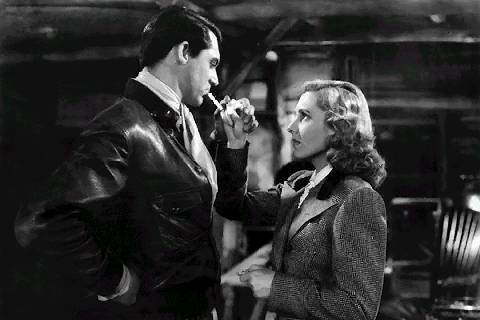
So says Macauley "Mike" Connor (James Stewart), cynical reporter with romantic notions about nobody but himself, as he and photographer "Liz" Imbrie (Ruth Hussey) are given the enviable task of reporting on the biggest marriage event of the season—or should we say "re-marriage season"—the Lord-Kittridge affair, she of the Philadelphia Lords, Tracy Samantha Lord (Katharine Hepburn), to be precise—formerly married to one C.K. Dexter Haven (Cary Grant), an upper class yacht designer—and for her second go-'round, she is marrying George Kittridge (John Howard), a "man of the people" who raised himself from the lower classes to achieve parity (without the legacy or provenance, mind you) of the Main Line of Philadelphia. Newsies Mike and Liz are given permission to "witness" the impending nuptials for a gossip rag (under the subterfuge that they're "distant relatives"), as an arrangement that said tabloid won't be publishing lurid stories about Tracy's father (John Halliday) having an affair with a dancer (of all people). This tit-for-tat has been arranged by a former runner for the mag, that personage being one...C.K. Dexter Haven, the ex (if you'll recall) of the bride-that-was and is to-be. How gauche it all is. How lurid. How delightfully sordid.
The Lord's are trying to manage this hullabaloo without much ballyhoo, thus their agreeing to the limited press coverage. But, they're not going to make it easy for them, no sir. Tracy is determined—with the help of precocious sister Dinah (Virginia Weidler)—to put up a discouraging wall of "airs", acting all hoity-toity...which is just what reporter Connor expects them to be. Tracy sees through their subterfuge just as easily as photographer Liz sees though theirs—just as she also sees through Connor's contempt for them (he protests a bit too much). As a photog' she seems to "read" people better than Connor, which is why she's biding her time with her colleague. She's in love with him, not that he'd ever stop concentrating on himself and his deathless prose to notice.
C.K. is also inserting himself into the affair, much to the delight of the Lords and to the dismay of his ex, Tracy. Their marriage broke up a couple years previously because, as an alcoholic, he did not measure up to her high standards. Tracy is a bit judgey as a rule, and decisively so, which led to tossing Dexter out ("She's generous to a fault" he says, "except for other people's faults") as well as the ostracism of her father from the family (His opinion of her: "You have everything it takes to make a lovely woman except the one essential: an understanding heart. And without that, you might just as well be made of bronze." That one hurts).
Tracy is all too aware of the criticism ("
Oh, we're going to talk about me again, are we? Goody."), but she is absolutely sure of her paragoness—reflecting well on the parents as it may have begun, but it has rigored into an expectation that anyone in her orbit should be beholden to the same courtesy. Her stubbornness is so ram-rod straight that it has appeared to reach her spine, as evidenced by her switch-blade dives into pools or even—in the oft-replayed silent opening sequence—when she's face-palmed back into her own home after kicking out Grant's Dexter Haven. It's amazing that she can be so stiff while performing the herculean task of having one's head up their ass.
She may have grown up, but she's still her parents' child—not that that's their fault. She's just stuck in her dutiful child-role despite long having passed its maturity date. Now, even her parents are annoyed with it (by contrast, youngest daughter Dinah—played by the incomparable
Weidler—seems to have skipped her childhood to become Thelma Ritter) and wish that "the phase she's going through" was over.
But, it's unlikely, even on the eve of the second of her how-many-future-marriages. The first one didn't work out because from her lofty perch, the faults, owing to his drinking, were all on him. This second has a much-better-manufactured future husband so she glides in with confidence, secure that Kittridge is just as stalwart and inflexible as her own reflection of herself—she's found her spine-mate.
Tracy emerges from a drunken night into the light of a new day
—and reacts to it like a vampire.
But, after a night of pre-wedding jitters—no doubt brought on by her being unable to cope with the intricate machinations of "everything is going according to plan" while confronting the failures of others in her past (like Dexter Haven and her prodigal father, who both have the temerity to judge her ("I'm going crazy. I'm standing here solidly on my own two hands and going crazy!")—she ends up drunk and with the appearance of being in a compromising position and in the vulnerable position of seeing herself being judged rather than judging. 
And despite rapt descriptions of her as a "marvelous distant queen" or "the golden girl," this paragon of taste, breeding and virtue who could walk into any room and do so with style can never manage to do it with "grace"
, and when her weak night of drinking has her stumbling through what feels like a "perp walk" under scrutiny, she learns a little of what she's been dishing out...and doesn't like the taste of it. But, you can't have a hangover without some shame in the mix. And despite the bleery eyes, she starts to see things more clearly.
This was Hepburn's project—she'd been labeled "box-office poison" after films like Mary of Scotland and Bringing Up Baby and Holiday bombed (despite the last two eventually gaining reputations of being cinema classics for decades) and helped writer Philip Barry to create it and make it a hit on Broadway. Then, as she owned the rights to it, she personally took it to M-G-M and its head, Louis B. Mayer, to have it made with the director of her choosing (Cukor) and maybe with Spencer Tracy and Clark Gable as the leads. Mayer substituted Grant and Stewart who were more readily available and the deal was made. The movie was her first box-office hit in a couple years. But, there was a little bit of a price to pay for its success.
 
It was the first of Hepburn's movies where she had to have a serious  "comeuppance" moment. Oh, her Jo March in Little Women had to suffer loss and rejection before she achieved any path-way to true happiness, and in her breakout film-role in Stage Door she had to suffer another character-changing tragedy in order to make her "complete" and deserving of success, but here the knives are out for Hepburn's 
"tall poppy" to be "dead-headed" and reduced from imperious competence to crumbling vulnerability.

And that's apparently what audiences liked. Katherine Hepburn seemed to always have to be "taken down a peg" for the customers, even in her many movies with Spencer Tracy (their first pairing, Woman of the Year, had its ending changed and re-shot to end with a humiliating kitchen scene due to the negative remarks on preview cards by female audience members). She wasn't allowed to maintain her dignity, or achieve some sort of parity with her male co-star, but, to insure commercial success, she had to have her characters' weaknesses and failures made manifest and her dependence on male supremacy made apparent despite any evidence that was shown before that she could act independently from her own efforts. Katherine Hepburn, the actress, having already been shown the consequences of bad box-office reputation, conceded the point that emancipation wasn't "a thing" in the make-believe world of the movies and "played the game." Sometimes (like in Woman of the Year) it was grating and and embarrassing. In The Philadelphia Story (which, remember, she helped develop), it's a little easier to digest and becomes the crux of the movie.
It's not a bad lesson to learn, either. Everybody in the movie (unless they've been humbled in some way) is a little "judgey" and before things play out, minds are changed instead of made up and calcified into permanent prejudice. Everybody bends a little bit without the fear of snapping holding them back. Things become malleable, negotiable...why, it almost becomes the euphemism of "polite society". It's why the use of the term "yar" in the film is so apt. "Yar" (in sailboats or yachts) means "easily maneuverable" but it can also be
"agile, quick, nimble"—something C.K. Dexter Haven always aspires to. The mast must be sturdy and strong, sure, but it's the sail that gets you anywhere. You just have to bend with the wind.


Tuesday, October 10, 2023

Topper

Topper (Norman Z. McLeod, 1937) Amazing that this one hasn't crossed my path before. The original author, Thorne Smith, was responsible for the source of I Married a Witch, which was an odd twee dip into the supernatural, dark cauldron division. Topper is considerably lighter—airier in spirit—much more screwball comedy-oriented, especially given its send-up of the privileged class.  

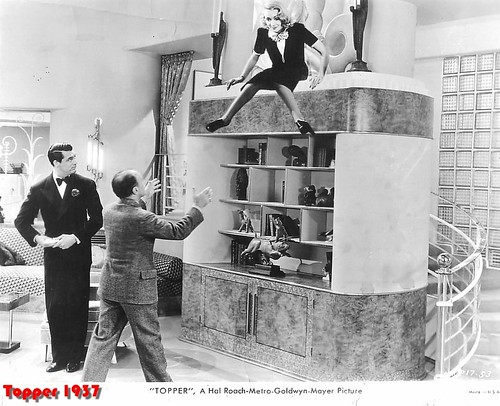
George and Marion Kirby (Cary Grant, Constance Bennett) are idle-rich folk, who after a night and day of irresponsible living cannot escape an irresponsible death by taking a corner too fast in their roadster and crashing into a tree. They don't survive, although they do walk away from the accident, but merely as ghosts, fading in and out of reality—a sort of supernatural version of an extended drunk. "Well for once in our ... Well, for once, we're stuck," says George with clarity and a little regret. 
The couple decide then and there to do a good deed—taking on, as guardian angels, their banker Cosmo Topper (played by scene-stealer Roland Young), hen-pecked by his restrictive wife (Billie Burke). He lives a carefully-managed, tightly-scheduled life of quiet desperation, yearning to breathe free, or at least have a little fun now and again. The Kirbys provide him with the ghost of a chance and, although initially stumbling with the opportunity, he learns to embrace it, dealing with the disappearances, the levitation's and the other miracles that his ambassadors to a better life provide him.

It's from 1937, but the effects work is still pretty amazing—combinations of split-screens, double exposures, fade-in's, crash-edits, blue-screen and invisible wire-work. Even though the ghost-tricks have been done (and...done to Death), some of them are still startling (how DID they do that thing with the dogs?!). Clever and fun, and variations of the theme, so they don't over-use the same effect over and over again.

Nice cast, too. Hard to believe this was Grant's first foray into the light comedy stance that would be his signature style for the rest of his career (Hollywood hadn't discovered this yet?) and studio stalwarts like the frog-voiced Eugene Pallette, Alan Mowbray, and Arthur Lake (he'd become Dagwood in the "Blondie" movie series) making the most of their scenes. There's even a brief musical interlude with Hoagy Carmichael!


Inventively realized by Norman Z. McLeod, who (having directed the Marx Brothers) knew how to get out of the way of performers and tighten things up for the movies, Topper is delightful, smart of concept and word, ingenious in execution, and a genuine crowd-pleaser...in this life or the next.

Wednesday, May 10, 2023

I Was a Male War Bride

I Was a Male War Bride (Howard Hawks, 1948) Hawks doing what he does best in a comedy—taking the finely chiseled speci-man that is Cary Grant and reducing him to a frustrated, humiliated wreck, robbing him of everything—dignity, decorum, manhood and sleep...mostly sleep.

In this one, Grant plays a Belgian in the French Army (in the same way he plays an American...as Cary Grant) in post-war Germany (it's actually based on a memoir—"I Was an Alien Spouse of Female Military Personnel en route to the United States Under Public Law 271 of the Congress" by the fellow this happened to) trying to break a black market operation with the help (and frequent hindrance) of Ann Sheridan. They have history and start out loathing each other. Along the way, he suffers bumpy rides in a motorcycle sidecar—in a rainstorm, no less—is nearly vaulted and scrunched by a barricade, paddles on the brink of a waterfall, climbs a pole (only to find that the sign, in German, says "Wet Paint"), is knocked off an awning from the second floor of a hotel, tossed in jail, and, in general, is made to suffer every indignity known to Man.
War is Hell, with several levels of humiliation, and its an everyday occurrence in this man's (and this woman's) Army. If it's not a battle of the sexes. its a battle with bureaucracy, or the everyday battle with being a stranger in a strange land. It is constant frustration, and Grant, outwardly so unflappable, is the master of its comic opposite (as evidenced by such Hawks-Grant pairings as His Girl Friday, Bringing Up Baby, and the non-Marx Monkey Business. Grant was the perfect test-subject for emasculation and the break-down of the cool customer.
As is typical Hawks, the camerawork is nothing fancy; set the camera up at chest-level and let the actors go and just try to keep up with everyone jumping over roadblocks, whether made or wood or red tape. Typical situation—getting married. She's American. He's Belgian. They're in Germany. So, there are three wedding ceremonies and so many "I do's" that there's no time for a honeymoon—leaving him with one big "I don't" ("Get some sleep" says one of the hoteliers to him, to which he replies "That's ALL I'm getting," which is a pretty racy comment for the time, but Hawks always liked to push the envelope and tweak the censors)—plus, she's getting re-assigned to America, while he's fresh out of the Army, something that he'd been looking forward to but is now complicated by...all the complications. But the mark of a professional in the Hawks world is the ability to punt, to improvise, and heal quickly...and move on, or around. It was a constant with this director, in front of and behind the camera. To persevere, do the job, despite set-backs and soldier on was the measure of a man...or a male war bride.

Friday, June 4, 2021

Anytime Movies #4: - Only Angels Have Wings

While I catch up on the reviews still in "Draft" phase here, I'll re-run a feature I ran when I first started this blog seven years ago,* when it was suggested I do a "Top Ten" List.

I don't like those: they're rather arbitrary; they pit films against each other, and there's always one or two that should be on the list that aren't because something better shoved it down the trash-bin.

So, I came up with this: "Anytime" Movies.


Anytime Movies are the movies I can watch anytime, anywhere. If I see a second of it, I can identify it. If it shows up on television, my attention is focused on it until the conclusion. Sometimes it’s the direction, sometimes it’s the writing, sometimes it’s the acting, sometimes it’s just the idea behind it, but these are the movies I can watch again and again (and again!) and never tire of them. There are ten (kinda). They're not in any particular order, but the #1 movie IS the #1 movie.


While in college, I worked as a movie projectionist, and had an opportunity to show many great films for the various film courses being taught. But one film left a distinct impression—over the course of five days I had to show it eight times. I got to know it pretty well. Its name is -Only Angels Have Wings and it was directed by one of the great director-producers, Howard Hawks.

Hawks directed all types of movies, many of them classics of their genre: westerns (
Rio Bravo, Red River); mystery/noir (The Big Sleep); adventure (To Have and Have Not, Hatari!) and comedy (Bringing Up Baby, His Girl Friday). He even produced one of the first truly classic science fiction films (The Thing! [From Another World]), and an iconic musical (Gentlemen Prefer Blondes). Despite the genre, and despite the decade in which it was produced each film is unmistakably a Hawks film – a group of men (and women, but usually men) of diverse talents must come together to achieve a singular goal, be it to drive a huge herd of cattle to Missouri, or contain the alien threat, or capture a live rhinoceros, or get the bad guy to the Marshall (alive if possible) or ferry the refugees to safety, or find the dinosaur clavicle, or land a millionaire.

Conflict is achieved by introducing a newcomer to the mix who doesn’t understand the synergy of the group and who must learn “the code” to belong, and that keeps the group in cohesion. And so much the better if they do it without talking about it much.

That’s the Hawks formula, and he was able to create enough variations in the design that his films all seem different, even though they’re always telling the same basic story—a story that’s a metaphor for movie-making.
**

“Hello, professional”

Why -Only Angels Have Wings out of all those classics? It is the ultimate Hawks movie. Watch any of those others and you’ll hear similar lines and see similar situations, but in Angels, everything is distilled to the basic essence of the tale to become the best Hemingway story Hemingway never wrote. Distilled? The majority of the film takes place in one set! For this band of professionals, the goal is to fly the mail from the port city of Barancca through a narrow passage in the Andes utilizing one of a number of prop aircraft, all in need of repair. The men realize they’re merely links in a chain getting the mail…or a doctor…or a shipment of nitro-glycerin…to its destination with the threat of death flying right alongside. So hazardous is the job for these civilian-pilots that their base is a revolving door for the new blood who have to prove themselves. It’s "The Right Stuff” twenty years before Tom Wolfe popularized the phrase.
Grant, Barthelmess, and Mitchell play one of a few triangulations in -Only Angels Have Wings

And it’s prime Hawks. For instance, watch the cigarettes. In a Hawks film, they’re visual short-hand for relationships—who’s in need and who can provide, who’s giving, who’s dependable, giving, taking, reading other's thoughts. More than any other Hawks film, except perhaps Rio Bravo, the flame that’s there when you need it is a gambit that crams twice the information into the film, and reveals more about the characters than their deliberately circumspect dialog—what
Frank Capra called Hawks’s “three-corner dialog”—was allowed. To come right out and say things point-blank, well, not only would it be corny and unbelievable…it just wasn’t done in Hawks's circles.

Hawks also liked to use music to convey mood. But it usually isn’t a Hollywood background score, as it's indigenous music—in this case, the bar band at Dutchy’s bar/mercantile and air terminal (this is a couple of years before
Casablanca). They set the mood, provide a little extra entertainment value, some local color for a set-bound movie and when the time is right and there’s a meeting of minds it’s reflected in a musical number in which everyone participates. Again, no one has to come out and say ”We’re all thinking the same way.” They’re all singing the same song, so it’s understood.

"Boy, things happen fast around here, don't they?"

There’s also the unspoken ethos of the professional—you do your job to the best of your ability and you don’t talk about it. You don’t brag. You don’t cut corners and you don’t dwell on it. You do your job, you move on. You do your job right and people will notice. Do your job wrong and everyone suffers. In this way the group can depend on each other while staying out of their debt. In this movie-atmosphere, bit-players are allowed to shine. Yeah, the movie revolves around
Cary Grant (and the only role where he would be more stoic than he is here would be playing the icy spy Devlin in Hitchcock’s Notorious) and the delightful Jean Arthur—she could turn on a dime from tragedy to comedy and give you change back with a toothy smile—but even the lowliest of character-actors get great moments of screen-time. Also of note are a very young Rita Hayworth at the start of her career and Richard Barthlemess—a former silent screen star who didn’t make the transition to “talkies.” He plays a pilot who must prove himself to the others and that he can “cut” it in their world. Art imitates life.

And then there’s
Thomas Mitchell, who might well be the greatest character actor to never achieve name-above-the-title status. A veteran of many a Frank Capra comedy—and whose most prominent role would be as Scarlett O’Hara’s father in Gone with the Wind—here he plays a character with the title “The Kid,” even though he’s the oldest of the pilots. So much of the movie centers on him that his one character fulfills every plot device except love interest, although with Hawks one could never be too sure of that, either. ***

Ultimately it’s Mitchell’s Kid who provides the means for Grant’s character to express his feelings, which, typically, he does without really having to, and in a way that makes it obvious to everybody involved. And as if anybody missed the point how dependent everyone is on each other, most of the pilots wind up injured, “winged” so that by the end of the movie, two pilots have to perform the job of one to fly each mail-run. Perhaps the better title may have been “-Only Angels Have Two Wings.”

It’s all done so economically, so breezily and with so little in the way of “action” that one may get through the entire movie before realizing that mostly everybody just talked…without really coming out and saying what they mean. Everything is shot at eye-level. There’s nothing fancy in the camera-work. The story is the King, and everyone is working towards making the whole thing work…like professionals.

Cary Grant needs a match. Jean Arthur carries a torch.

Anytime Movies:
The Searchers
* And, on Sunday, we'll put up a "Don't Make a Scene" feature from each week's film.

** Hawks was well-known for taking different stories and turning them into the Hawks formula, sometimes rewiting the entire film on a day to day basis to get there. The most extreme example of this is El Dorado, which after ten minutes of one story suddenly veers into becoming a remake of the earlier Hawks-John Wayne western Rio Bravo. When Hawks called John Wayne to ask if he’d star in yet another western, Rio Lobo, Wayne knew exactly what he was getting into. “Do I get to play the drunk this time?” he drawled.

*** Someday, someone far more intelligent than I is going to go through the Hawks filmography with an eye towards sexual politics—whether it’s the leering banter between 
Montgomery Clift and John Ireland in Red River, or Cray Grant in drag in Bringing Up Baby (“I went GAY all of a sudden!!”) and I Was a Male War Bride, or some of the more bizarre stagings of musical numbers in Gentlemen Prefer Blondes.  And then there’s the long line of husky-voiced women in his movies who are one of “the boys,” from Rosalind Russell to Lauren Bacall all the way up to future Paramount Studios exec Sherry Lansing. For all the macho posturing exhibited in his movies, there are hints that Hawks never completely “bought” into it and is enjoying winking at it. He may well be second only to James Whale in sneaking so much gay subtext into his movies.

Wednesday, February 26, 2020

An Affair to Remember (1957)

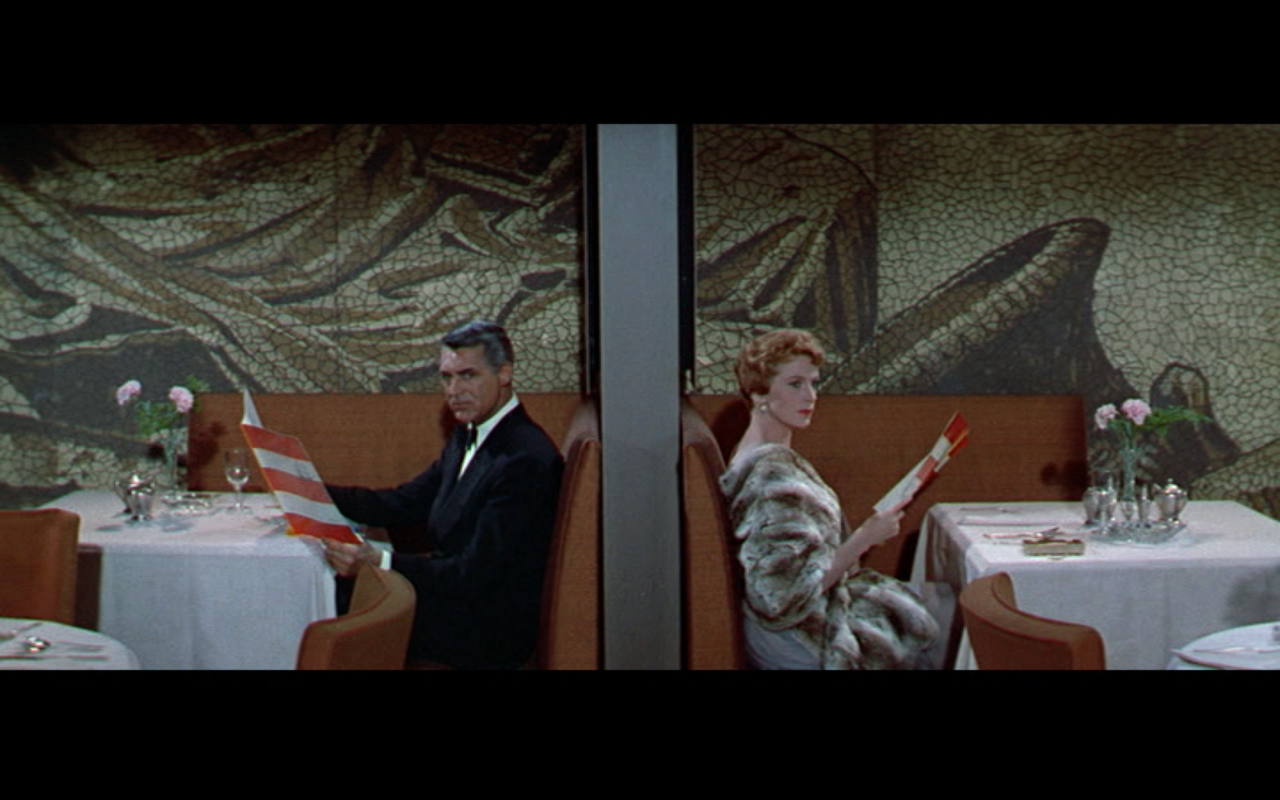
An Affair to Remember (Leo McCarey, 1957) I'm of two minds about An Affair To Remember, which is as it should be, as it's two movies: the deft romantic comedy on-board ship and the maudlin tragedy with musical numbers (by a kid's chorus)—not one of my favorite genres! The first part is terrific, and the second part is insufferable, at least to me, and shows the best and worst of director Leo McCarey.

Let's start with the good stuff, shall we?
Two co-dependents, a gigolo and a "kept woman," meet on board a cruise that in practicality and the metaphoric sense represent escape from a pair of disastrous relationships. They "meet cute," and spend the rest of their cruise trying to avoid each other in public, as he's an infamous playboy and she's just trying to maintain her reputation. It's a neat little cinematic problem (filmed in cruise-ship-length Cinemascope). They resolve to 1) jilt their lovers and their dependent life-styles and 2) vow to meet at the top of the Empire State Building in six months or once they're on their feet (ironic turn of phrase, that).

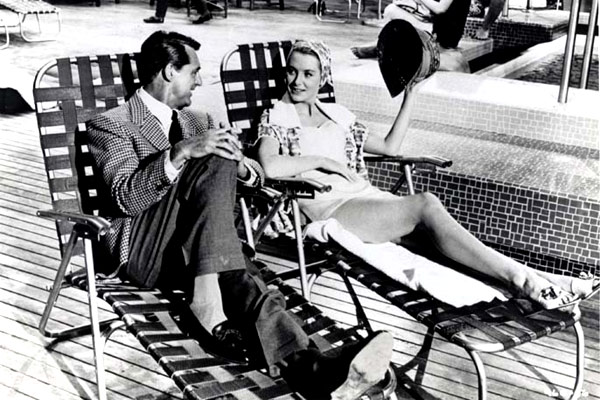
This part of the film is great fun because it's light and airy and features two performers who could do romantic comedy like no other (McCarey solidified Cary Grant as "Cary Grant" in the film The Awful Truth), and reflected the circumstances of filming. Grant is perfectly matched with Deborah Kerr, whose reputation as a comedienne has historically been given short-shrift. Here, the two characters conspire to meet in the close quarters of the ship, while avoiding detection by the nosey passengers. In real-life Grant and Kerr got on like a house-afire: Grant was nursing a broken-heart at the time of filming, and Kerr was a fellow British ex-pat with his sense of home and humor. You can see the chemistry between the two—at one point, Kerr flubs a line and the two don't break the scene, leaving Grant with a delighted look on his face, and Kerr making it feel like real-life. When they're separated as they leave the boat, the movie no longer floats, but founders with melodrama and tragedy.
McCarey (who directed Duck Soup) falls back on an old Marx Bros. solution: to give the audience a little breathing room, throw in a few songs (a tactic that Groucho famously harpooned in Horse Feathers when he addresses the audience: "I have to stay here, but there's no reason you folks can't go to the lobby 'til this blows over.").
I'm even more cynical about this section of the film for a number of reasons, both having to do with McCarey. An Affair To Remember is a remake of McCarey's earlier Love Affair (1939, starring Irene Dunne and Charles Boyer),* and except for the wide-screen color photography and the songs nothing much changed, although it's easier to see Boyer as a European playboy (trying to pass off Cary Grant as Italian, is about as successful as passing him off as an American). Watching the film, McCarey's first after a couple of anti-communist propaganda pieces (You Can Change the World and My Son John), one begins to see it as McCarey's Pension Guarantee. He wears all the hats: co-writer, producer, director and—the part that rankles a bit—lyricist for all the Harry Warren songs in the film's last half. Nice gig that he hired himself for. And if any of those songs became a hit, he had money from the residuals for life.
I don't begrudge McCarey's double-dipping—this happened quite a bit in Hollywood when a producer could get away with it,** but one wonders--with a co-lyricist credited--just how much McCarey contributed to the songs. Me, I want to head for the lobby when the orchestra starts up (especially for such enduring classics as "TomorrowLand" and "The Tiny Scout," which lie at the bottom of Warren's prolific, accomplished output). They're padding, and prolong the wait to the inevitable reunion (which is given remarkably short-shrift) at the movie's end.
Also, there is a moment of revelation in An Affair to Remember that, hard to admit, is just beyond the considerable acting abilities of Cary Grant to pull off. McCarey blows that moment by leaving his camera on Grant the entire time when a cut-away (to what he's looking at) might have provided more dramatic weight (merely by the editing) to Grant's angst. Long takes are great, but there's an absence of information here that hurts the scene and what it's trying to convey. That we are also unprepared for that revelation by any fore-shadowing compounds the error.
And it is a mistake. In planning and execution.***
One still seeks out McCarey films...especially the chance to see the film that didn't win the Academy Award for Best Picture (and he felt should have) the year The Awful Truth did—the sad and melancholy Make Way for Tomorrow (which Orson Welles called "the saddest movie ever made"—and this was said in the complimentary way possible). You want a movie that's a love story that tugs at your heart-strings? That one is it. Criterion released it in 2010, after it had languished in obscurity for decades.


* It was remade again, using the original title, by producer Warren Beatty and director Glenn Gordon Caron with Beatty, Annette Bening and Katharine Hepburn (in her last role) as Beatty's grandmother. The material about a lifelong lothario meeting the woman whom he chooses to settle down with, only to be separated by tragedy must have seemed particularly poignant to Beatty.

** Here's a nasty one: "The Theme from Star Trek." Written by Alexander Courage for the original series, producer Gene Roddenberry then penned completely unnecessary lyrics (beyond the South Sea Island "Aaa-aah's"), merely to skim half the proceeds from Courage's pay-check to himself. Nice guy. But he had the power to do it...so he did.


*** Looking at it again—could it just have been that the Cinemascope frame ratio didn't allow for the standing Grant to share the frame with the prone Kerr without it looking awkward with a lot of negative space in the frame? Yeah, let's be nice and go with that.

Wednesday, February 19, 2020

Sylvia Scarlett

Sylvia Scarlett (George Cukor, 1935) This one can't be considered a movie of the libertine, free-and-wheelin' "Pre-Code" era of movie-making, but it takes mild chances (if only teasingly), but hardly enough to account for its reputation as one of the most financially disastrous movies on the 1930's despite a good script, solid direction by George Cukor and the pairing of Cary Grant and Katherine Hepburn (though it being their first—Hepburn had met Grant at Paramount and recommended him to Cukor—no one could anticipate their subsequent chemistry). The film's lack of success labeled Hepburn as "box-office poison" and she didn't become bankable again until she bought herself the rights to "The Philadelphia Story" and revived her career with it...also with Grant in the movie version.

But, it looks tame today, even quaint. And it wouldn't so much as cause a pursed lip among the blue-haired old ladies who went to see Victor, Victoria or Shakespeare in Love. It was just before its time, although Cukor—who was euphemistically esteemed throughout his career as "a woman's director"—enjoyed depicting the sexes in sometimes challenging ways, often as satire, often as comedy. Sylvia Scarlett is a light-hearted drama (until it turns dark) and a comedy of manners (if those manners only tease but don't commit, and Judith Martin would certainly not call that "manners"). It's a little bit of everything, but more soufleé than stew. 
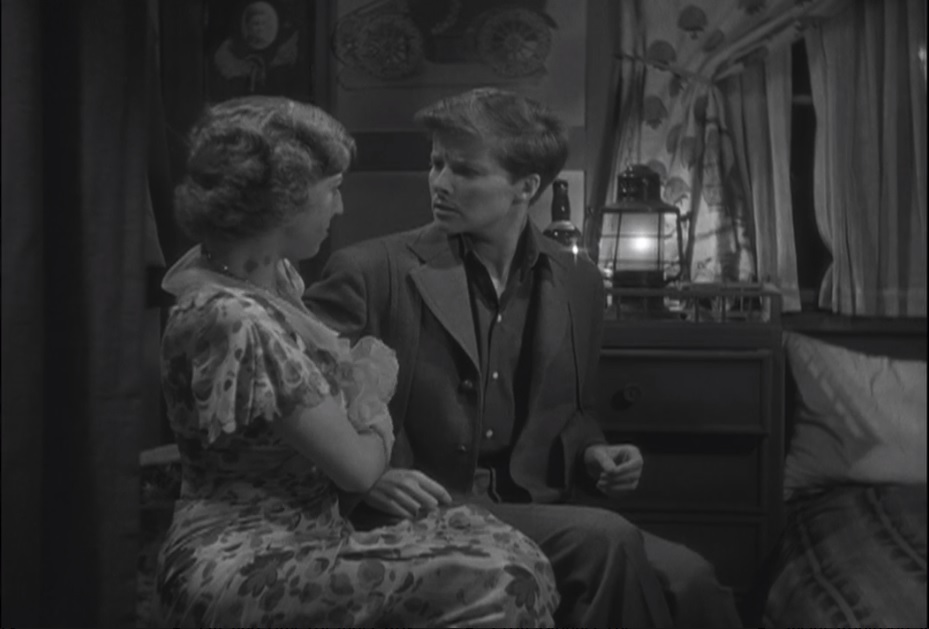
In Marseilles, when the seamstress wife of Henry Scarlett (Edmund Gwenn) dies, he becomes desperate to flee the country from French officials. He's been embezzling funds from the lace factory where he was employed as a bookkeeper, and lost all the funds to gambling. With some lace that he has stolen, he decides to head back to England to start anew, but tells his daughter Sylvia (Hepburn) that he will go alone and send for her later. She will have none of that, and so cuts off her hair and tells him that if she travels with him as a boy, the police will be confounded in their search for a man and his daughter.
While ferrying across the channel, they make the acquaintance of one Jimmy Monkley (Grant), a charming Cockney con artist and grifter, who uses his acquaintance with the Scarlett's to throw suspicion off himself when they go through customs (he rats out Henry's lace so as to distract from the diamonds he's smuggling in his shoe). Despite the seeming betrayal (and the £100 Monkley gives the Scarlett's for their trouble), the three decide to hook up as con artists using Monkley's contacts in London. The living arrangements are a bit problematic, as Monkley can't seem to figure out while "Sylvester"—the name Sylvia goes by in her disguise—is nervous about sharing a room with him, and gets downright agitated about dressing down for the night. What is wrong with the boy?
The first scam attempt involves Maudie Tilt (Dennie Moore), a lady's maid whom Monkley tries to seduce to steal her lady's expensive pearl necklace. The escapade doesn't pan out but it does manage to hook Maudie up with the band, partially because she's attracted to "Sylvester" which worries Sylvia, but not as much as when her father starts to fall for Maudie. Sylvia/Sylvester, having a crisis of conscience, insists they give up the dangerous grifter life, and instead become travelling show-people, "The Pink Pierrots," a cavorting harlequin troupe caravaning from small town to small town entertaining the villagers.
In one town, they meet bohemian artist Michael Fane (Brian Aherne), who is enchanted by the group, but, curiously, most by Sylvester—who, in turn, is attracted to him—prompting Fane to gasp the most famous line to pass the censors: "I say, I know what it is that gives me a queer feeling when I look at you..."
pause for effect
"...There's something in you to be painted!" 

Of course. That must be it. Artistic inspiration. While Sylvia Scarlett (the movie) flirts and teases with the gay mystique, there is nothing beyond girl-on-girl pecking (mistaken or otherwise) that produces something akin to horror in Hepburn's character. Even Aherne's outburst is provincially couched in Sylvia's subterfuge—he's attracted to her because she's a woman, though dressed as a man. Safe enough. And when "Sylvester", smitten with Fane, borrows ladies' gear to appear all flowery and girly, he is charmed but ultimately dismissive once learning the truth of Sylvia, going back to his un-British—in fact, Russian-European—mistress.
The sexual politics is flummery—just a tease—because once things settle—and people settle—things are safely hetero, but, at least, they take one chance: the pairings are not based on Hollywood archetypes of who should be with whom (we've all seen disastrously mis-paired types in many a final fade-out), but rather in personality types; the romantics are together and the churlishly cynical are as well, being matches of the soul, rather than the romantic heart.
At least that is a bit different; the couples deserve each other, for good or ill. It's not much of a revolution, certainly not enough to inspire a reprisal at the box-office. In fact, it's merely common sense, but that's something rarely found in romantic films.

Or in romance, for all that.

Wednesday, December 20, 2017

Mr. Lucky

Mr. Lucky (H.C. Potter, 1943) Based on a 1936 story in Cosmopolitan Magazine, "Bundles for Freedom" by Milton Holmes (and a script credited to Adrian Scott, but earlier fingerprints on the typewriter belonged to Dudley Nichols and Charles Brackett) , Cary Grant plays Joe Adams a perpetual gambler—"Never give a sucker an even break. But don't cheat a friend. I believe in that. I live by it." Joe's trying to bankroll a gambling ship of his own with his partner Zepp (Paul Stewart) when they receive news that could torpedo the whole deal—they've both received draft notices. But, Joe has a couple plans to deal with it.

First, the little business of the War. One of Joe's "guys," Joe Bascopolous, has wound up dead, but unlucky Joe is luck for his boss, Joe—Bascopolous was 4F, and Adams bets Zepp for his draft card. Adams wins, and for the rest of the movie he'll pass himself off as Joe Bascopolous, allowing him to put his second coup in place.
To get the dice rolling on his gambling ship idea, Adams/Bascopolous approaches a local war relief organization (headed by Gladys Cooper) to set up a "charity" casino to fund a relief ship for the European theater. Adams charms the head of the group, but gets a stink-eye reception from her second, a socialite Dorothy Bryant (Laraine Day), but Adams manages to win her over, as well.
What is great about the movie is its danger. During the middle of a war, the movie dares to have a character so selfish and downright greedy that he is willing to purloin charitable dollars for a relief effort—he might be more sympathetic if he was just stealing candy from babies. The screenplay is credited to Adrian Scott, but to perform this tightrope act five other writers contributed to the script—probably just to keep the lead actor from being so hissably evil. Sure, he's a charmer, but if he carries out the plan, he's a snake and so much of one, you'd suspect even Cary Grant couldn't pull it off. 
Fortunately, there's enough contrivance of plot that the character has a bit of a change of heart (it's 1943, after all, and nobody was ready for something along the lines of the cynical The Third Man—that would be in 1949—yet), apart from the fact that another character actually does want to steal the money, setting up Adams as his antagonist. But, the character's actions are close to his gambling instincts and so the transition is not so much of a stretch.
But, the title is what made me want to see this. Back when I was a youngster, there was a replacement television series on CBS called "Mr. Lucky," developed by Blake Edwards in the same spartan style—the production company was called Spartan Productions—as his hit series "Peter Gunn." "Lucky" told the story of a gambler who, in the series pilot episode, was run out of favor of the Latin American country that tolerated his gambling ship, "The Fortuna," from making its trade off its shores. "Lucky" had to come to America...or in international waters off-shore of America...in order to run his ship and partake in the many adventures that the operation caused him to cross paths with. The series was fun (at least to the four year old me) until sponsor interference forced the gambling theme to be dispensed with and "The Fortuna" became a floating restaurant. The series folded soon after that. The series isn't based on the film although it shared the same title...and its source, the original Milton Holmes story.