Showing posts with label Paul Stewart. Show all posts

Thursday, June 15, 2023

The Window (1949)

The Window
(Ted Tetzlaff
, 1949) Film noir is that darkened crusty under-belly of American cinema made in the jaded post-World War II era of film-making, where the pre-war rose-colored glasses were slapped off people's faces exposing the corruption of power (no matter how menial their power is) and how common folks with a conscience might become prey to the whims of Fate. Those films were suspicious of innocence (somebody's always guilty of something) and sneered at respectability because no fortune was ever made without a little larceny. The ambiguous Raymond Chandler phrase describing them that I always loved was that they took place where "streets were dark with more than Night." Some corruption of the Soul and Nature lurked where the halogen-lights couldn't reach and permeated them beyond the fact that they were B-movies that didn't have the budget for a lot of fancy studio-lighting.
 
They were usually black and white, but the subjects were always shades of a dusky gray.
 
The darkest of these that I hold dear to my heart is Kiss Me Deadly, where even the hero is such a low-life degenerate that the Universe conspires to destroy the world in a purifying nuclear fire-ball.
 
But, the sickest, most twisted one is this new one to me, RKO's The Window, made in the streets of New York's Lower East Side during the winter months of 1947-1948, but not shown in theaters until 1949 (because new studio owner Howard Hughes considered it "unreleasable"). When it was finally allowed to see the light of the projector, it became a huge hit for the cash-strapped studio.
Nine year old Tommy Woodry (
Bobby Driscoll) is what the spin-doctors would call "a fabulist." And what the internet would call "an entrepreneur." He lies. Well, he makes things up...just like an entrepreneur. His latest whopper is that the family is moving out "way out West" "Texas" "Tombstone" "to a ranch", but when the Landlord suddenly shows up at dinner to show the apartment to prospective renters, Tommy's parents (Barbara Hale and Arthur Kennedy) know the score. Tommy's been lying again, telling his lurid tall tales of cops and robbers and cowboys and indians. The parents severely reprimand him and he's sent to bed. It's Summer, he's out of School, and New York simmers with a heat wave. He sleeps...barely...with the window open and the constant awareness that one boy's ceiling is another man's floor; the movements of the upstairs Kellersons (Paul Stewart and Ruth Roman) are constantly creaked and groaned to him in his room.
It's too hot to sleep in there, so he decides to sleep out on the fire escape, but climbs to the next level to take advantage of a rare breeze and he wakes up when there's some activity in the window of the Kellersons. What he sees is a guy seemingly passed out on the kitchen table and Mrs. Kellerson taking cash out of the guy's wallet. The guy wakes up out of his supposed slumber and attacks her, only to be caught up in a fight with Mr. Kellerson. Soon, the guy falls to the floor, stabbed in the back by a pair of nearby scissors administered by the Mrs.
Seems the Kellersons are in a not-so-neat little game of bait-and-switch-blade with the Mrs. luring sailors to their place, knocking them out before they get too demanding, and either rolling them, or—if they're too much trouble—killing them. Tommy has just enough time to tell his Mom what he saw—she tells him to go back to sleep, he had a nightmare—before he goes back to retrieve his pillow below the murderous couple take the body up the fire escape and across the roofs to dump it in the abandoned tenement next door.
Tommy is scared to death. He knows the Kellersons are bad, but when he tells what he saw to his Dad (as Mom was no help!), who has just come home from his night-shift, he gets another lecture and a useless case of the guilts. All the while, in his bedroom alone, he hears the Kellersons' footsteps on his ceiling, and he's left thinking: "I'm the only one who knows. As long as the Kellersons don't know that I know, then I'm safe. But, I need to tell someone." So, the next morning, he climbs out of his bedroom window, goes down the fire escape, and tells the police.
And they don't believe him, either! But, there is one detective (Anthony Ross), who decides to get the story, so he decides to see the Woodrys and see what he can discover. What he finds are frustrated parents, who are embarrassed that their kid has dragged the authorities into his little white lie that is getting bigger and darker by the hour. Something needs to be done about this, and if time-outs won't do it, some advanced shame may be the key to stopping Tommy's lying ways.
But, detective Ross isn't done digging yet. He goes a flight up and talks to the Kellersons, posing as a building inspector, which puts both the upstairs neighbors a bit on edge: the husband just casuals his way through it, but she's visibly jittery. Ross concludes it's just a false alarm, even though there's a suspicious stain on the carpet. And the Kellersons are starting to feel that things are starting to close in on them.
But, the damage has been done: what Tommy knows has gotten out of the bag, and he no longer has control of the information. Suddenly, everything he thought he knew about his parents and cops has been proven absolutely false, and as the situation starts to get out of control, Tommy realizes that his life may be in serious jeopardy, and to his terror finds out that it is absolutely true. He must rely on himself to get out of trouble, as the adults (with all the power) are doing nothing to help him, and—in their efforts to work out what they perceive as problems—end up putting him in harm's way.
For Tommy, it's a right of passage (one could say this is also a perverse kind of "Coming of Age" movie) as he has to grow up, and take matters into his own hands. Even so, for all the lessons learned, ultimately the only way he can get out of his nightmares is—ironically—to take a leap of faith and trust that a group of adults will do the right thing...for the first while in a long while.
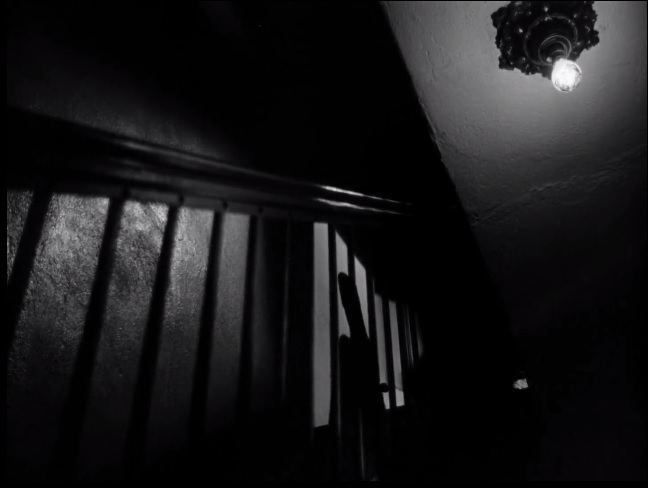
Watching The Window, I was constantly amazed how cynical it was, how relentless and mean-sprited, but also how diabolically smart. It sets up a trap for its young protagonist (Bobby Driscoll is brilliant in this, with a child's eyes, but an adult's questioning eyebrows) and keeps making it worse and worse, until he is forced to take action for himself, and not go running for the aid of his immediate authority figures. It's a shadowed lesson in self-actualization when everything around you is turning against you.
And here's another thing: The Window not only has the adult themes of murder, deceit, and sociopathy, but dares to invade the protected space of kids, and adding to the usual suspects of noir sins on the rap sheet, it includes child neglect and child abuse, leaving one particular bowery boy with nowhere to run to—his parents don't believe him, the police don't believe him, and all his authority figures let him down. The only adults who live up to his view of them are the murderers, who have no qualms about murdering a child to save their own skins.
And, as opposed to other film-noirs, it rather boldly includes the purest form of shame—which Tetzlaff shows with the kid's face away from the camera. All noirs have an element of shame to them—all those black silhouettes must have SOME use. The folks in them know they did something wrong, they compromised their ethics, their standards, or their conscience, and are just self-aware enough that they don't need an audience judging them—they mutely judge themselves. But, in young Tommy's case, it's like some hellish retribution for his fibs, putting him through an adult version of Hell, far beyond his years to comprehend.

Even though I watched it with a growing sense of horror, it's become one of my favorite film noirs, and also one of my favorite films.

Thursday, October 27, 2022

In Cold Blood (1967)

In Cold Blood
(
Richard Brooks, 1967) The slaughter of the Clutter family of Holcomb, Kansas in 1959 by two random ex-cons was considered note-worthy—and shocking enough—that The New Yorker wanted to do a story about it. It was one of two story ideas offered to Truman Capote to write for the magazine. Capote's trip to Holcomb, accompanied by childhood friend Harper Lee, led to many interviews, 8,000 pages of notes and an escalating goal that Capote labored with until the publication of his book "In Cold Blood" seven years after the murders.* The publication became one of the best-selling books of the ghoulish genre and sparked debate over something that was called "New Journalism" where stories were written with the practices of fiction in mind, and what Capote, stoking his own embers, dubbed a "new art form, a nonfiction novel." Certainly it was different than a "just the facts, ma'am" account, but it was the first spurt in an increasingly lurid form of publication and presentation, where a moral center is replaced by an almost teasing glee for all the gory details. Just watch "Dateline" sometime ("Coming up, next...").
Richard Brooks, coming off the films Lord Jim and The Professionals, was reading drafts of Capote's novel, owing to their mutual friendship. Brooks bought the film rights for $400,000 and began the process of turning it into a film with an eye towards verisimilitude, noir theatrics, and, with the help of cinematographer
Conrad L. Hall, a look of neo-realism—as much as possible, the filmmakers tried to film in the actual locations, including the house where the multiple murders took place.
Perry Smith (
Robert Blake), newly released from prison, meets up with an old prison buddy Dick Hickox (Scott Wilson), who has word of "a big score" in Kansas, even though traveling there will break their paroles. Hickox has been told by another prisoner that $10,000 is being held in a safe by farmer Herbert Clutter, that prisoner's former employer. The film follows two parallel paths—of the day-to-day activities of the Clutters, and Smith and Hickox's travels up until the fateful night.
The next day, there's no answer at the Clutter household, but upon entering the house, a friend of one of the daughters' finds the family murdered. FBI Agents Alvin Dewey (
John Forsythe) and Roy Church (John Gallaudet) arrive at the scene, stunned that the murders took place, with no fingerprints and only bloody footprints at the scene. They reveal that Clutter never kept large sums of money at the house, only writing checks in his business.
The film then follows the investigation, while tracking the path of Hickox and Smith as they make their way to Mexico and then, running out of money, back to California and eventually to Kansas. As Dewey and Church follow leads, particularly one from Hickox's old prison pal, they are joined by a reporter Bill Jensen (Paul Stewart), as they talk to family members and try to follow disparate reports to try and track down the two ex-cons. Eventually, the two are arrested, stand trial and eventually executed.
The film, in wide-screen black and white, manages to fit into the genre of noir—the things Hall does with the monochrome textures is amazing, but even though the film strives for authenticity to the point of ghoulishness, there is still something just a little "off" in the way Brooks presents it. The angles are too showy, too precise, and except for a couple of shots, does not give you a "You Are There" quality ala neo-realism. It feels staged and artificial, rather than gritty and naturalistic.
The film is also a bit off-center morally, too. Although much time is spent with the Clutter family before the murders take place, and the investigators are shown as diligent and professional, where the most work on the film is in the depiction of the lives of Smith and Hickox. They're the ones given the most focus and I'm not going too far and saying that they're given the most sympathy, as well. No one tries to "explain" the Clutters. No one dives into the histories of the FBI men. But, the perpetrators, the murderers, are given long sequences showing their bad backgrounds and their dysfunctional parents. At least, Brooks rejected the original casting ideas for Smith and Hickox—Steve McQueen and Paul Newman. As it is, Brooks saw fit to cast the parts with two relatively unknown actors, who still managed to make the most of their roles.
Conrad Hall's "lucky break" of the rain reflection.
 
Brooks saw the film as a damnation of capitol punishment, as it is. One cannot contemplate the title In Cold Blood without it reflecting both the killing of the Clutters and the state-sanctioned murders of those responsible. The death penalty's record of deterrence is only good for those that are killed, but looks mighty feeble when atrocities on the order of the ones by Hickox and Smith show up on the news every month when some wacko with a gun decides to make a name for himself (the choice of pronoun is deliberate—it's always a "him"). Bad guys should not be celebrities, no matter how low the bar for "celebrity" has sunk these days. And the justice system, built on politics, is so corrupt that one doesn't need "The Innocence Project" to speculate on how many innocent people have been killed in the name of justice. But, where's their justice? The system either works 100% of the time or we don't take actions that can't be taken back. Nobody is so infallible they can play God. That applies to good and bad alike.
 
In Cold Blood was voted into the National Film Registry in 2008.
Remembering the victims: the Clutter family

 * Two movies about Capote with the Holcomb murders serving as the centerpiece were made, as well. Capote and Infamous
.

Friday, June 18, 2021

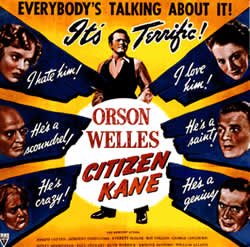
Anytime Movies #2: Citizen Kane

While I catch up on the reviews still in "Draft" phase here, I'll re-run a feature I ran when I first started this blog seven years ago,* when it was suggested I do a "Top Ten" List.

I don't like those: they're rather arbitrary; they pit films against each other, and there's always one or two that should be on the list that aren't because something better shoved it down the trash-bin.

So, I came up with this: "Anytime" Movies.


Anytime Movies are the movies I can watch anytime, anywhere. If I see a second of it, I can identify it. If it shows up on television, my attention is focused on it until the conclusion. Sometimes it’s the direction, sometimes it’s the writing, sometimes it’s the acting, sometimes it’s just the idea behind it, but these are the movies I can watch again and again (and again!) and never tire of them. There are ten (kinda). They're not in any particular order, but the #1 movie IS the #1 movie.


So obvious a choice.

Yet Citizen Kane (or RKO 281) has been fielding off re-appraisals and critical backlash since the day of its premiere. Is it really "the greatest American film ever made?"

Yes.

So far….

Part of the argument against it is that it can’t be since it was the product of a 26 year old who had never made a film before. But
Orson Welles was a 26 year old who grew up pampered and precocious—who read Shakespeare at an age when other kids are reading Seuss. As a teen he made his way in the world by his brio and his considerable talents and his nerve to try just about anything. He was an artistic sociopath who staged alternative Shakespeare productions and avant-garde radio plays for years before being given, as Kane puts it, the candy store”—a carte blanche contract with a film studio to make any film of his choice, any way he wanted with final cut and a stipulation that said no one could alter it in any way in perpetuity (This is the reason why Turner Broadcasting in its rush to colorize movies could never put so much as a pink pixel to Citizen Kane. Some contract!). With it, he gathered his seasoned Mercury Theater actors (some of whom would go on to major Hollywood careers), one of the most innovative and painterly cinematographers, Gregg Toland, young, daring editor Robert Wise, the arrogant and brilliant composer Bernard Herrmann, and the amazing technical crew at RKO who produced such amazing feats as King Kong and the Astaire-Rogers musicals and turned them loose on Herman Mankiewicz’s long-in-the-planning screenplay that he believed could never be produced.

Out of all that talent at the top of its game, Welles produced the best American movie ever made, and as a reward he was never allowed that freedom again. Ever. No good movie goes unpunished.
His next film, The Magnificent Ambersons was a more mature and accomplished–looking film, but RKO chopped it up, re-shot the ending giving its albeit happy finale a certain incomprehensibility and threw it on the bottom of a cheesy double bill. Welles always thought it would have been his best film and the evidence certainly indicates it might have been.  He then barely worked in Hollywood again, except as an actor, and used the funds to make films dear to his heart or sensibility (which veered from Shakespeare to pulp) on a catch-as-catch-can basis. Welles’ Falstaff movie The Chimes at Midnight was the project closest to his heart, and might be better if not for the logistical and technical hurdles Welles had to jump in order to make it.

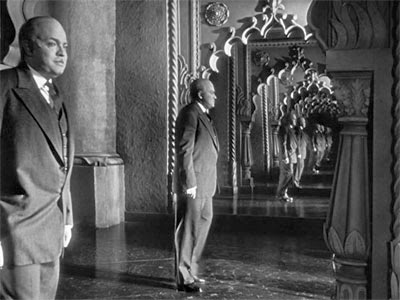
But Kane is the grail—the stuff of legend, and has been looked on ever since with avarice by would-be auteurs with more guts than talent, and therein lies the danger. That reputation could make Kane as cold and lifeless as one of the statues in Xanadu’s basement. It’s actually more like one of Susan Alexander Kane’s puzzles—intricate and maybe unsolvable without a lot of effort. There’s one shot where Welles shows his hand. It occurs after Susan has left him, accompanied by the screeching cockatiel superimposed on the screen (“I wanted to wake the audience up at that point,” Welles joked. Really, Orson? Right there?) and right after he trashes her room—destroying the acquisitions of her life and his—Kane picks up the snow-globe that will fall from his hand at his death. “Rosebud,” he murmurs (both times) and then walks as in a daze out of her room, into the hall, and past his servants. He then crosses through a mirrored hallway that reflects an endless line of Kanes that recede and disappear. After Kane (and his many reflections) has passed, the camera then pushes into the mirror and out, back to the sequence's surrounding reverie of the butler (“Sentimental fella, aren’t you?” “Mmm. Yes and no.”)
That shot is the exit from the worlds of memory through which we have seen many reflections of Kane—the house of mirrors that makes up the bulk of
Citizen Kane, the movie. It is also our last image of Kane, himself, in the film. He’s talked about through to the end, of course, but that splintered mirror-shot is our final impression of him (Kane—and Welles—are not even seen in the End Credits review of actors). At that point it becomes clear (as crystal) that the entire film is like that hall of mirrors that reflected back the aspects of Kane important to each narrator—a process that began with the newsreel that quickly jumped through the highlights of Kane’s life as a public figure and set up the film’s surface mystery—what is the meaning of Kane’s last word (and so serves as a stand-in for “who was Kane, really?”).
In the course of the various reflections there are all sorts of legerdemain—little tricks and in-jokes—that Welles, who was an amateur magician, clearly loved pulling off even if an audience didn’t immediately “get” them. One of my favorites is the craning shot through the model of the “El Rancho” nightclub where ex-wife Susan Alexander performs and drinks herself into a stupor every night. The night of the first attempt at an interview by newsreel reporter Thompson, it’s storming outside and flashes of lightning hide the camera’s passage through the roof sign and through the glass transom into the nightclub inside. When, half the movie later, we again travel through that transom it’s broken—presumably by our first trip through it. In the film’s original framing (unfortunately not in the DVD presentation) there is the slightest nudge of the camera to the right in the rather severe shot of Mrs. Kane signing little Charles away to the banker, and we see, just on the edge of the frame, that significant snow-globe that keeps popping up in dramatic moments. In the newsreel there is a shot of a newspaper of the entire Kane family. Later in the film, we actually see that shot being taken. Another is the way Kane’s hectoring “Sing-Siiiiing!” to “Boss” Jim Gettys is cut off by a shutting door, but it is continued by a braying car-horn out on the street. These are little filigrees to the grand architecture of lighting, framing and editing tricks that Welles and his crew pull off.** 
But that central question “who was Kane?” is purposely never answered, not by a word, not by an object, and not by a person. In the end, the film says that it can’t solve the problem, that it can only present it, and leave us with the acknowledgement of its complexity.

So what are we left with as the remnants of Kane and his life fly up from the furnace of Xanadu? An answer to the mystery of "Rosebud," but not an answer to the man. For Kane was many things to many people, but as Kane himself passed judgment on himself, he was never great. Given gifts that many of us will never ever have, he ultimately squandered them. Insular, wasteful, in his house of mirrors, he is left alone to contemplate himself.

We all have our gifts. What do we do with them? Citizen Kane is like that glass globe that we can peer inside and see the illusion of life…and consider our own lives. And in the end we are left with its final image to contemplate, and one may consider in that contemplation that Kane was a master illusionist himself, pretending greatness where there was none, and utilizing the very same tools used by those other illusionists—magicians and very young film directors—to create those illusions.

Those tools being smoke…and mirrors.

Anytime Movies:
Citizen Kane
Once Upon a Time in the West
-Only Angels Have Wings
The Searchers


* And, on Sunday, we'll put up a "Don't Make a Scene" feature from each week's film.

** Orson Welles is unique in the group of directors of movies that I’ve seen in that every time I exit from a new film of his, I come out looking at the world with new eyes…or with a new perception of the old world--one that seems filled with possibilities.

Friday, November 16, 2018

The Other Side of the Wind

Our Revels Now Have Ended
or
Tonight is for the Freako's and the Snoops, Lady

There is a story, but it might be apocryphal. What is definitely true is that Steven Spielberg bought the "Rosebud" sled from Citizen Kane for $60,5000. What is also true is that Orson Welles was a master film-maker always looking for money. It is said that Spielberg's purchase galled Welles that someone would buy memorabilia from one of his films, but not invest in a new one, but not enough that he couldn't strike back: "But" I said "Steven, we burned the sled!"*

Enough re-hashing of the process that brought about the release of The Other Side of the Wind—the film Orson Welles was working on since his return to Hollywood in 1970. The story's been told enough and we now have the product streaming on Netflix (with a limited release in theaters), so it's now possible to see what all the fuss—and the wait—was about.

The Other Side of the Wind is the story of the last day—July 2nd to be exact—in the life of a well-regarded film director, J.J. "Jake" Hannaford (John Huston), which takes place at a 70th birthday party for him, while he is filming—and trying to save—his current production, entitled "The Other Side of the Wind", an attempt to make a "with-it" youth film as his comeback.

Oh, very. It's the sickest story I've ever thought up in my life.

If Welles had completed his film as intended, it would have been celebrated for the radical way it was filmed and edited. Almost defying continuity issues, it was filmed in a variety of formats—35 mm color for Jake's film-in-progress, and a combination of color and black-and-white in different formats and grains for the party sequences—the conceit being that it's all "found footage" from different sources documenting the party for Jake—and for promoting the film.
For the most part, it works, although there are some intimate conversations that seem devoid of cameras in the vicinity that throws some cold water on the concept, and the film (as is) doesn't take much advantage of reactions to the cameras as an invasion—perhaps it can be explained away as ego by the participants, but you'd think some of them would be careful of what they're saying...or doing when they know they're being watched...and recorded.
The "found footage" is just one aspect of the film, its spine, as it were. The fact of the movie is that it is full-to-bursting with plot, sub-plot, and sub-text, so that it must have seemed a daunting task to corral so much...everything. It is chaos in the making and is at its best when it flies by in Welles' quick (even by today's standards) editing of the sequences. There are other segments where the cutting is respectful, even gingerly, to make sure that points are made. Whether this is part of Welles' blue-print or of the subsequent editors, one shouldn't speculate. One can't really know.
According to a young American critic, one of the great discoveries of our age is the value of boredom as an artistic subject. If that is so, Antonioni deserves to be counted as a pioneer and founding father. His movies are perfect backgrounds for fashion models. Maybe there aren’t backgrounds that good in Vogue, but there ought to be. They ought to get Antonioni to design them.
It's even difficult to decide what to focus on in one's appraisal of it: should one make more of its film-within-a-film, which Welles was using to parody the formless art-house flicks of the late 1960's-early 1970's? Dialogue-less (except for overheard direction by Hannaford via bullhorn) and nearly plot-less, and completely voyeuristic, it follows a woman of supposedly Native American descent (Oja Kodar playing "The Actress") as she leaves a steam-room, is seen by a guy on a motorcycle (Bob Random, playing actor "John Dale") and is followed into a discotheque, then into a car that turns into an erotic episode and finally follows the two onto an abandoned film-set. 
"The movie" is noticeable for its gratuitous nudity, mostly of "The Actress," but also of the "Dale" character—Welles did much the same thing with Kodar on F for Fake, his camera ogling his longtime companion, who was lover, co-conspirator, and muse (Welles gives her a co-screenwriting credit on The Other Side of the Wind)—and as much as Kodar's nudity is a reflection of Welles' fixation—and love—one must also consider the "Dale" character's nudity as also a fixation of sorts, but of Welles' subject, the director Hannaford, who "rescued" his star from the ocean and decided to make him a star of his film...as he has (we learn) with many other male actors...all of whom have decided to not show up for Hannaford's tribute.
He is all the big, macho, hairy-chested fellas...basically Ford, Huston, maybe with some Hemingway thrown in...it's all this big macho thing, you know, which I'm so fed up with, you know. Although I love it, I'm very ambivalent about it, you know, I love Ford and all, but I also think it's a lot of shit that he hit (Fonda)and I love Hemingway and I think it's a lot of shit. It's all that (laughs)You know. And I love this man.And I hate him. And that's what I think is so great about this story—I want to love him and hate him and show him in all that thing.
Hannaford's character is commented on a lot in reviews as auto-biographical (and Hannaford's professional circumstances can be compared to Welles), but he's really a combination, a polyglot of different people—as Charles Foster Kane was, really—of different artists with a macho bent: Hemingway, certainly (his death by suicide was also on July 2nd in the year 1961), but also John Ford, Howard Hawks, and others of the "old" directors whose behavior was overtly macho, while leaning more to the female side of things by nature. Ford's treatment of women was extremely sentimentalized and his favorite actress, Maureen O'Hara, had her suspicions about him, while many of Hawks' works has interesting threads of homosexuality through them, with his many women who were "one of the boys," his frequent emasculation of his male stars (particularly Cary Grant), and...well...ever seen Gentlemen Prefer Blondes
Hannaford is a man's man, but he doth protest too much. The story is that he sleeps with his actor's girl-friends to gain some control over them, but is that the reason...is that really the story...? The reason the picture is in some trouble is because it's in a shambles that might be unrecoverable. The reason? Hannaford's treatment of Dale has caused him to walk off the set and not return to work—they either have to re-shoot, with the film already in financial trouble—or carry on with work-arounds (one of the jokes of the film is all the many "Dale" mannequins being carted around as stand-ins for the film—Hannaford ends up shooting them...with a rifle...not a camera).
The hope is that Hannaford's reputation as a great director can secure finishing funds for his experimental film, even though it appears to be in trouble and not on a par with his previous work that is studied, written about, and lectured on by academics, film-buffs and students and by contemporary film-makers who emulate him, and, ironically, overshadow him in the film-marketplace. One of those is Brooks Otterlake (Peter Bogdanovich), a former critic-now-turned-successful director, who enjoys a revered reputation in the new Hollywood, surpassing his idol and mentor. But, who turns him down when he is outright asked for money. Hannaford eventually sees all of his partners and apologists leave him for other opportunities and abandon any sense of loyalty to him, like a mass-reflection of the turning of Prince Hal against Falstaff when he is made King, and refuting what he says earlier in the party: "We imitation Hannaford's have got to stick together."
I was thinking last night about what you told me about these old directors who can't get jobs. And I was thinking of those great conductors...who were at the height of their power after 75.It's why Lear is my favorite play. I think it's just terrible what happens to old people...and the public isn't interested in it. That's always been why Lear is a play that people hate. The only thing that keeps people alive in their old age...is power.
Hannaford puts up a good act, playing the part of the sage. But, his fear is that he's playing the Fool. As a director, he has absolute control—over those who choose to give it to him. But, the money-men are beyond his grasp, and once the money is unattainable, his control is, as well. He has contempt for the scholars and syncophants who fawn over him and use their cameras on him, as much as he uses his camera on others—Welles has sometimes talked about the effect that filming a location brings, that he considers it dead, empty, and no longer of use. These hangers-on are nostalgists, endlessly cataloging the past, with no regard for the future...or the present.
And that's intolerable for Hannaford. He has no truck with being held as a symbol, a relic, a legacy, a thing of the past, with far more yesterdays than tomorrows. Over the night, he puts on the show of the Great Director, but as the scotches are drained, and his choices become fewer as hope is lost, he cracks, becoming "Lear in Hollywood," trapped by his own character and the actions that stem from it.
The one member of the cast and crew who sticks it out for the showings of Hannaford's work in progress (the final site of which is a dilapidated drive-in theater) to the end is The Actress, who's still there when the dawn washes away the image on the screen. Is she there out of loyalty, out of vanity, or what? What is it? The movie engages the mind and leaves things ambiguously, other than Hannaford's fate (and even that leaves questions), but also the remanants or evidence left behind that is the film in its entirety.
One aspect of Welles' work has always been the startling way he makes you look at the world anew, (for me, anyway) as if seeing it with new eyes. That doesn't happen with The Other Side of the Wind. It's world is one of decay and destruction. But, it does stick in the memory and doesn't fade away, in a threadbare skein of ambiguity. It's been on my mind constantly, as I've been trying to unravel its complexities and aspects. In total, it does not seem to be a great work, a failed attempt—how much of this is due to Welles' conception or the ultimate piecing together of it is impossible to say. But, the details are vast in number and mysterious in implication. It cannot be ignored, dismissed or forgotten.

And its message is, as so many of the stories that Welles has told over the years,  a melancholy one: that art, career, life may be a temporary thing, as bright, brief and transitory as fireworks. 

Beautiful in its moment, yes, but fleeting.

* Quotes in the review are from Peter Bogdanovich's recordings of Welles that he made from 1968 to 1973 for his book "This is Orson Welles." What's neat about it is the audio-book presentation of it is the actual recordings.