Showing posts with label 1941. Show all posts

Tuesday, June 13, 2023

The Bride Came C.O.D.

The Bride Came C.O.D.
(
William Keighley, 1941) Supposedly, the idea was that Cagney wanted to do something lighter than his typical tough-guy gangster act, brought in his brother to produce, hired the sharp twins-writing team of Julius and Philip Epstein and started casting about for the romantic lead to play opposite him. Ann Sheridan, Ginger Rogers, Rosalind Russell, and Olivia de Havilland were all in the mix at some point. But, somehow, Bette Davis got the part. Evidently, she wanted a change of pace from her dramatic roles and she and Cagney got on famously making Jimmy the Gent seven years earlier, so...why not?
 
But, did anybody consider the trouble that might come from putting the two biggest rabble-rousers on the Warner lot starring together in the same movie? One or two of the studio brothers might have been asleep at the switch, but the film did get made with neither of the stars being "suspended" but up-staged by some of the wiliest character actors ever in supporting roles.
The story is alarmingly close to Capra's It Happened One Night: A socialite, Joan Winfield (Davis) is sand-bagged with a marriage proposal in front of a night-club audience by her bandleader boyfriend, Allan Brice (
Jack Carson), who is prodded into making the announcement by gossip columnist (Stuart Erwin) under deadline. Under pressure, she agrees, but California having a 72 hour waiting period before they can get hitched creates a problem. It's decided—by the scandal-monger—that they can fly to Vegas to tie the knot sooner. When her father (the booming Eugene Pallette) finds out he's apoplectic; he doesn't want the wedding to go through at all!
That's where cash-strapped pilot Steve Collins (Cagney) makes a landing in this mess. He's about to have his plane repo'd, but makes a deal with "Pater" Lucius K. Winfield to make a unscheduled stop from Las Vegas to Amarillo, Texas (where the father will pick her up), but with Joan only and it's been negotiated for his standard freight rate—$10 a pound. When the wedding party shows up at the local air-strip, the bridegroom-to-be and the mouth-piece are coaxed off the plane by Collins' mechanic Pee Wee
(George Tobias, remembered best as neighbor Mr. Kravitz on the "Bewitched" TV series) and the pilot takes off with the prospective bride much to her protest. Technically, it's kidnapping, even if it's for hire.
But, Joan is a fierce fighter and once she gets ahold of a parachute, she'd determined to jump out of the plane en route, foiled by Collins banking the plane and throwing her—repeatedly—back into the cabin. But, all that maneuvering causes the plane to stall, and they end up crashing in the desert, close to the ghost-town of Bonanza that had sprung up around the old Enterprise mine. Hilarity ensues. The comedy is broad, bordering on slapstick, what with prat-falls and Joan constantly falling into cactus plants ("Oh, there must be something magnetic to a cactus that attracts me right to it...or vice versa!"). And Davis plays it broadly, trying to eke out the last drop of humor from any given situation...while Cagney just reacts to what she's doing, with either exaggerated laughter or venom.
In Bonanza, things get more complicated, what with search-parties looking for the pair under the command of William Frawley, and the town's only existing citizen (Harry Davenport) a mass of eccentricities and a way of changing sides at the drop of a plot-point. Soon, Collins is in jail, Joan goes on a wild desert ride in a flivver, and both end up lost in that abandoned mine, all the while waiting for either the fiancee or the father or both to show up before anything can get resolved. Cagney's character remains a bit stalwart, but Davis' changes her mind every ten minutes of movie-time. Things are further confounded with the minutiae of state law, matrimonial provisions, and some dubious reverse psychology. If everything was under federal law things would be a lot simpler, but the plot wouldn't go anywhere. State laws are funnier and more suited for comedy.
The movie was popular when it came out, and, as something changes every few minutes, one can see why audiences found it entertaining. And while Davis is out of her element, she is amusing, and Cagney doesn't fall easy victim to caricature until his laughing scenes. The only one who really disliked the film, in fact, was Davis, who didn't like the script, hated the desert heat of Death Valley, and was no fan of cactus, as she evidently did fall into one while filming. It's a light-weight vehicle pushed by two powerful steam-engines, so it's a bit of a mismatch. But, seeing the two play off each other rather seamlessly is the film's greatest strengths.

Tuesday, October 25, 2022

The Devil and Daniel Webster (1941)

The Devil and Daniel Webster (aka All That Money Can Buy) (William Dieterle, 1941) I've known about this film for years, because it was the film that won composer Bernard Herrmann his only Oscar for Best Score ("of a Dramatic or Comedy Picture"), over 19 other scores nominated that year, including his own music from Citizen Kane
 
The score is the stand-out element of the movie, with Herrmann accompanying the presence of "Mr. Scratch" with a particularly saw-toothed violin jig that raises the hair on the back of your neck. It is for sure that Academy voters had never heard anything quite like it, even if it did include some American folk-tunes (including "Pop Goes the Weasel!"). I was well acquainted with the music before I could track down the actual film.
It tells the story of Jabez Stonr (James Craig) a farmer, not making it in 1840 New Hampshire, who sells his soul to the Devil (Walter Huston) for seven years of prosperity, which he gets, along with a swelled head, the enviousness of the community, and a reputation as a cruel businessman and a cool husband. Still, he is prominent enough to make the acquaintance of Daniel Webster (Edward Arnold), famed orator, lawyer and politician—who has (so far) resisted Scratch's offer to make him President of the United States. But, as the contract date comes near, Mr. Scratch doubles down on the offer, tempting Jabez for the soul of his new-born son. Stone turns to Webster for legal help with the Devil, naturally.
The Devil and Daniel Webster, adapted from the Stephen Vincent Benet's 1936 short story published in The Saturday Evening Post, had a checkered history at the studio, though. After doing less than blockbuster business, RKO Studios cut it by 20 minutes and released it with a sexier, less folksy ad campaign (see right) under the name All That Money Can Buy, which would seem  to celebrate the profligate life-style its protagonist comes to regret wishing for in the film, rather than the altruistic, socialist one ultimately preached.
It seems that Jabez Stone only really finds redemption until he's joined the Grange. I may be revealing the ending here, but, really, the outcome is inevitable considering the extraordinarily heavy hand that is used to show the tyrannies of wealth, lust, and greed that are the by-products of selling your soul to the Devil. Fortunately, the great orator
Daniel Webster is around to plead the case for the defense when a breach of contract occurs. Usually these scenes are the highlights, but in this film it's a disappointment. 
Even though played vigorously (by the least likely actor,
Edward Arnold, well-known for playing power-brokers and fascists in many a movie) the Webster homilies that are spun are so much sentimental goo and would curl the lip of Aimee Semple McPherson, much less the hardened denizens of Hell that make up the jury in the matter. Even Frank Capra must have rolled his eyes. But Dieterle seems to have shirked those sections to go all-out for his scenes with The Devil. Mr. Scratch's entrances are extravaganzas with light and smoke, he has the best lines (of course), and a truly creepy performance by Walter Huston (John's dad) with maliciously twinkling eyes, and a smile that's so broad that it may turn feral at any moment. Huston is the thing to see in this film, although Jane Darwell (Ma Joad from The Grapes of Wrath) and Simone Simon (just before she became big with Cat-People) do wonders with their material as well.

Tuesday, August 23, 2022

Tobacco Road

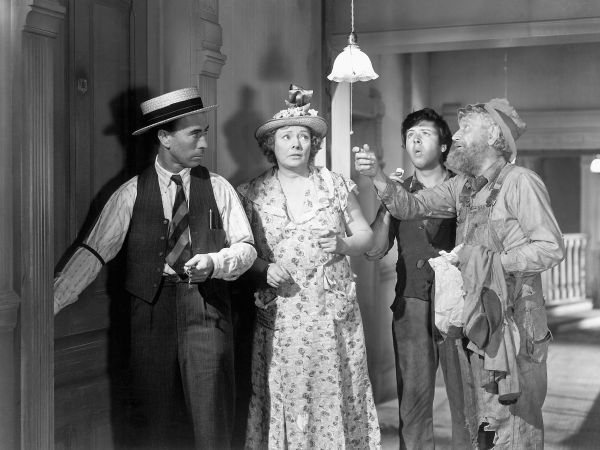
Tobacco Road (John Ford, 1941) The same year that Ford made the magnificent How Green Was My Valley (which won the Best Picture Oscar over Citizen Kane, a decision I'm still surprisingly ambivalent about) and after he'd made The Long Voyage Home, he made this oddity, an adaptation of the hit play that, itself, was an adaptation of Erskine Caldwell's scandalously bleak novel about the (to put it mildly) dysfunction among the Georgia poor. I'm not familiar with either, but the material is so venal and hard-scrabble that with each level of the airing of its dirty laundry, compromises had to be made to reach the stage and the screen so as to meet "community standards". By the time producer Darryl Zanuck and Ford got hold of it, it was a bizzarro version of their collaborative effort on The Grapes of Wrath, an out-and-out comedy of the "Kettle" variety, with much slapstick and hee-hawing, the novel's displays of greed, selfishness, shiftlessness and hypocrisy and (let's call it what it is) its animalistic depiction of rural poor life, neutered by low comedy and high over-acting. And to pass the censors and the Board of Review (not to mention the Catholic Legion of Decency), Caldwell's malicious intentions with its 13 year old brides, dead grammas, and apocalyptic "Wrath of God" fire (and no one would think of Gene Tierney possessing a cleft palate) is left by the way-side for lunk-headed males, religious loons, and the wholesale destruction of property. The effect is to take Caldwell's metaphorical screed...and turn it into "L'il Abner."
It's a little dispiriting
. The material is so compromised as to be toothless, with no bite at all (although one might fear rabies), but any more mean-spirited and one couldn't see Ford—who could have trouble tackling tough subject matter head on—directing it. It's a bit like how Ford started handling the production of Mister Roberts as a service comedy, rather than a barnacled "rust-and-all" look at the war-Navy. But here, the strategy was sanctioned by Zanuck and the powers that be, not only at Fox, but at the Breen Office, just to get a hot property on the screen, even if lukewarm.
Compromise is not new to the movies, it's an integral part, actually (unless you're ideologically fundamentalist on the auteur theory). But, as it was, the only reason to make this version of the film was to make hay, cashing in on the notoriety it had generated, while still getting away with it, something that must have appealed to the huckster-showman in Zanuck. The producer loved a good story, liked to push the envelope, but also knew what chances he could take, before bringing down the ire of the blue noses. And Ford could do comedy—he was better at it when it provided a relief from drama, or as texture inside of it—but he could do it, and economically, in a minimum of footage.
So Tobacco Road was made a comedy, curdled and dusty, and if some of Caldwell's malice got into it, so much the better, better than none at all. Such compromise brought Maugham to the screen and Faulkner and Hemingway and Fitzgerald. Not unadulterated, but some of it. 

One could make a case for Ford trying to desanctify his image of "the people," away from the respectful, earnest portrayals of The Grapes of Wrath, but Ford never painted with a wide brush and not all of his "po' folk" were saints. Far from it, in fact. So, there has to be some back-story to this one, some vital piece of information, but for now, the "get-it-on-the-screen-any-way-you-can" theory fits Occam's razor.
However, it has had one effect on me. It's going to be tough to watch Ford's westerns with their solemn funerals with ragged voices singing "Shall We Gather at the River" after seeing what's done with it in this film.


Like I said, "compromise."


Ford still makes it look gorgeous, though.

Sunday, May 22, 2022

Don't Make a Scene: How Green Was My Valley

Another repeat this week because of one image: the empty chair.

Last week, another (another!) mass-shooting took the lives of innocent grocery shoppers in Buffalo, and we noted the passing of the 1,000,000,000 mark in Covid Deaths (this pandemic has surpassed the Civil War as the biggest single-cause of mass death in the United States, and there is, of course, a war going on in Ukraine.

Empty chairs. So many empty chairs.

The Set-Up: We present a scene from a film that had 20th Century Fox studio head Darryl F. Zanuck grousing that he was being forced to make a "pro-union" film. But Zanuck bought it, and hired leftist screenwriter Phillip Dunne to adapt it. Then hired Roosevelt Democrat John Ford to direct. What did he expect?

Richard Llewelynn's 1939 novel is the melancholy remembrance of a Welsh coal-mining community, and specifically of the Morgan family, who's patriarch Gwilym Morgan is the miner's spokesman with the owners of the colliery. The scene today comes early in the film, when the four mining sons take issue with their father's stance regarding the owners, and pledge a willingness to strike, a move strongly disapproved by the father.

Ford stages this scene quickly. He has already established the Morgan routine of the family dinner table, so this scene, coming on the heels of a shot of Old Gwylim suffering the humiliation and health dangers of a day spent in the pouring rain, rapidly contrasts with the peaceful order of things. Just as the boys are eager to challenge the authority at the colliery, they must first contend with their father's authority, which is autocratic—modern film-goer's may blanch at the women's subjugated roles at the dinner table, but they are as subjected as the sons. It should be pointed out that throughout this scene, the voice of Gwylim Morgan, never rises above normal conversation level and is measured. He does not countenance the up-rising (literally) of his sons, but throughout the scene, he is always willing to be conciliatory...until the end. And, with the leave-taking of the four boys, Ford repeats the shot of that long dinner table--now empty, save for the Father and the youngest, Huw (played by the recently-arrived-to-the-U.S. Roddy McDowell, sent by his family from London to be spared the blitz—the same reason the film was shot in Malibu, California rather than Wales). It is as quiet, and as potent, an image of loss as any in cinema (and Ford compounds it on the last angle of Crisp with a view of an empty chair--presumably the one that accommodated his already-married-and-left son—in the down-scene living room—the father is surrounded by loss and echoes of it).

How Green Was My Valley won the 1941 Academy Award for Best Picture in a competition that also included The Maltese Falcon, Sergeant York, and...Citizen Kane.* Despite all that, it's hard to argue with the quality of the choice. How Green Was My Valley was, and is, an exceptional film, full of character and incident and spoke of on-going issues that would only be interrupted by the on-coming war. Orson Welles' next film, the studio-sabotaged The Magnificent Ambersons, contained many of the same themes as ...Valley: of the shattering of tradition and family, the crushing march of progress, and its subsequent scarring of the earth.

How Green Was My Valley was selected in 1990 for the National Film Registry.

The Story: The dinner table of the Morgan household is usually a warm place. Tonight, it's seething. The family of Welsh miners are divided as the head of the household, Old Gwilym Morgan (Donald Crisp), also the head of the miners' negotiating committee, has been punished for his stance by being transferred to a position that has seen him standing in the middle of a torrential down-pour. His sons are determined to call a strike to protect the old man, but he will have none of their "socialism." Observing the dinner discussion are Mrs. Morgan (Sara Allgood), daughter Angharad (Maureen O' Hara), and youngest son, Huw (Roddy McDowell).

Action!


Davy Morgan: Do you think I'll let them make my father stand like a dog in the rain and not raise my hands to stop it?
Beth Morgan: Hush, Davy.
Mr. Morgan: Who gave you permission to speak?
Davy: This matter is too important for silence. They're trying to punish you for...
Mr. Morgan: Is that more important than good manners?
Ianto Morgan: Then, what are we going to do about it? You'll die of the cold when it comes to snow!
Ianto: Let us all stand together and see how they'll act then!
Gwilym: Right! The men will come out if we say the word. All the pits are ready.
Mr. Morgan: You will not make me a plank for your politics. I will not be the excuse for any strike.
Ianto: But if they learn they can do things like that to the spokesman, what will they try and do to the men?
Mr. Morgan: We will see. Be silent now. Finish your supper.
Ianto: But, Father...
Mr. Morgan: Enough now!
Angharad: But...
Beth: On your work....
Owen Morgan: It is not enough!
Mr. Morgan: Owen!
Owen: I am sorry, sir....
Mr. Morgan: Hold your tongue until you have permission to speak!
Owen: I will speak against injustice anywhere, with permission or without it!
Mr. Morgan: Not in this house.
Owen: In this house and outside, sir!
Mr. Morgan: Leave the table.
Owen: I will leave the house!
Beth: Owen! Tell your father you're sorry.
Owen: I am not sorry!

Gwilym: I am with you. We can find lodgings in the village.
Beth: Gwilym!
(Ianto, the oldest, slowly stands)
Mr. Morgan: All of you, then?
Mr. Morgan: For the last time, sit down. Finish your supper. I will say no more.
Ianto: We are not questioning your authority, sir. But if manners prevent us from speaking the truth, we will be without manners.
Mr. Morgan(resignedly): Get your clothes and go.
Angharad: I'm going with them to look after them.
Beth: Hold your tongue, girl. Get on with your dishes.
(The mother goes after the boys.)(Huw eats a bite, then drops his cutlery loudly on the plate. No reaction from the father, who sits despondently at the head of the table.)(Huw drops it again, then loudly clears his throat.)
Mr. Morgan: Yes, my son. I know you are there.

How Green Was My Valley

Words by Phillip Dunne

Pictures by Arthur C. Miller and John Ford

How Green Was My Valley is available on DVD from Fox Classics Home Video.


* And, in the small circle of critics, "the buzz" is all about how Citizen Kane has been "dethroned" by Vertigo in the No. 1 spot of Sight & Sound's "50 Greatest Films of All Time" poll (after being in the top spot for fifty years).  Sight and Sound's poll, although it enjoys the reputation of being the most watched (a distinction that I'm sure will also fall at some point, given the vagaries of fashion), has the same effect on individual tastes as any poll—none—and merely offers a list for comparison and the occasional (and only occasional) "new" idea.  Tastes and reputation change over time, as the only inevitability in life is change.  I stay away from polls and "Ten Best" lists, only giving them a cursory glance, but if one wants to see what my favorite films are (if such a term can be used), I would refer them to the "Anytime Movies" series of articles here for the films that have such a hold on me that if I start watching them, I must stay with them to their conclusion—no matter how many times I've seen them.  A quick summation is in the left-hand column of the B/CL Index, a handy guide to what's archived on this blog.