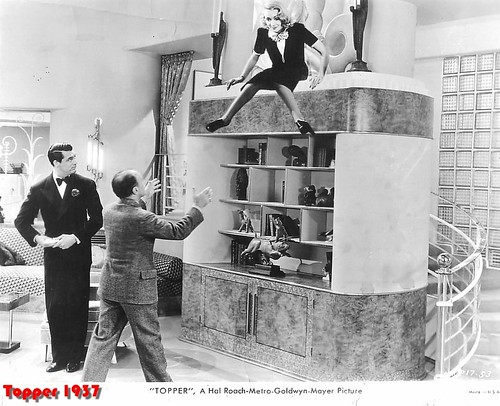
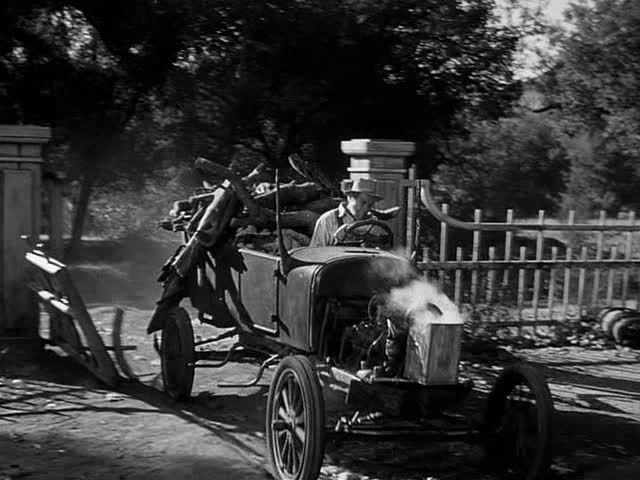
Topper(Norman Z. McLeod, 1937) Amazing that this one hasn't crossed my path before. The original author, Thorne Smith, was responsible for the source of I Married a Witch, which was an odd twee dip into the supernatural, dark cauldron division. Topper is considerably lighter—airier in spirit—much more screwball comedy-oriented, especially given its send-up of the privileged class. George and Marion Kirby (Cary Grant, Constance Bennett) are idle-rich folk, who after a night and day of irresponsible living cannot escape an irresponsible death by taking a corner too fast in their roadster and crashing into a tree. They don't survive, although they do walk away from the accident, but merely as ghosts, fading in and out of reality—a sort of supernatural version of an extended drunk. "Well for once in our ... Well, for once, we're stuck," says George with clarity and a little regret.
The couple decide then and there to do a good deed—taking on, as guardian angels, their banker Cosmo Topper (played by scene-stealer Roland Young), hen-pecked by his restrictive wife (Billie Burke). He lives a carefully-managed, tightly-scheduled life of quiet desperation, yearning to breathe free, or at least have a little fun now and again. The Kirbys provide him with the ghost of a chance and, although initially stumbling with the opportunity, he learns to embrace it, dealing with the disappearances, the levitation's and the other miracles that his ambassadors to a better life provide him.
It's from 1937, but the effects work is still pretty amazing—combinations of split-screens, double exposures, fade-in's, crash-edits, blue-screen and invisible wire-work. Even though the ghost-tricks have been done (and...done to Death), some of them are still startling (how DID they do that thing with the dogs?!). Clever and fun, and variations of the theme, so they don't over-use the same effect over and over again.
Nice cast, too. Hard to believe this was Grant's first foray into the light comedy stance that would be his signature style for the rest of his career (Hollywood hadn't discovered this yet?) and studio stalwarts like the frog-voiced Eugene Pallette, Alan Mowbray, and Arthur Lake (he'd become Dagwood in the "Blondie" movie series) making the most of their scenes. There's even a brief musical interlude with Hoagy Carmichael! Inventively realized by Norman Z. McLeod, who (having directed the Marx Brothers) knew how to get out of the way of performers and tighten things up for the movies, Topper is delightful, smart of concept and word, ingenious in execution, and a genuine crowd-pleaser...in this life or the next.
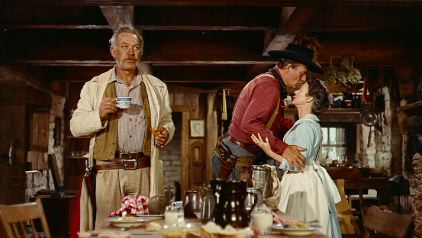
The Quiet Man(John Ford, 1952) "Trooper" Sean Thornton (John Wayne), ex-prize-fighter, comes back to the land of his birth, Innisfree, to reclaim his father's property in Ireland. Considered an outsider and a "Yank" he makes his peace with the locals—a pint is usually good enough to prove one's charity—and settles down for a simpler life than the one he knew.
And maybe forget.
There's just one hitch—it's "Red" Will Danaher (Victor McLaglen)—his neighbor on one side of his property is not interested in "easements." He has been looking balefully at that property for years, hoping to make it his own in pursuit of marriage with the widow Sarah Tillane (Mildred Natwick), who will have nothing to do with the brute. In spite, she sells the property to the green-horn Thornton and that is settled. Settlement is just what Thornton intends. But, it isn't easy, and he finds he has to go a few rounds with various opponents on their home turf. In Innisfree, it's war until there's peace.
It doesn't help that he's hit by "the lightning bolt" when he catches sight of a ginger sheep-tender and becomes instantly smitten. As the Luck of the Irish would have it, she's Mary Kate Danaher (Maureen O'Hara), the sister of the one man in the emerald glow of Innisfree who despises him. Mary Kate makes him feel like he's gone 10 rounds in the ring without a decision, and their besottedness is mutual, but for Kate there are issues before romance that Thornton thinks are just damn archaic, having come from The New World.
But...when in Rome (with Roman Catholics)... He's fine with the whole town knowing about it and he's reluctantly okay with the rituals—as Mary Kate prevaricates: "Well, we just started a-courtin', and next month, we, we start the
walkin' out, and the month after that there'll be the threshin' parties,
and the month after that..."—of the very chaste chaperoned traditions in the country ("No patty-fingers, if you please!" warns squire Michaleen Oge Flynn—Barry Fitzgerald—"The proprieties at all times!"), even if the two adults are a bit long in the tooth to be treated as children, they can't help rebelling by jumping the buggy and setting off on their own, unsupervised. All well and good; they're two healthy adults with a rebellious streak that seems compatible—to which the ever-watchful community tacitly agrees. There's just that Danaher matter.
And that other Danaher matter: Mary Kate will not jump into marriage with Thornton without her dowry, which is being withheld by her lout of a brother. Now Squire Danaher objected to the marriage from the get-go, but some village conniving put the canard out there, that the widow Tillane would be more agreeable to marrying him if Mary Kate were out of the house. He consented to the marriage, and then was refused by the widow. In spite, he has decided to withhold Mary Kate's dowry and she won't get married without it.
And that's the last straw for Thornton, setting him down for the count. He came to Ireland to settle down—the consequences of a death at his hand in the ring—and has sworn to fight no more forever and leave the States and his past behind. But, for all the blarney and the twee village-life that he'd been expecting, all he gets is conflict. And, now, must fight again—gloves off this time, but the same Marquis of Queensbury rules—to fight for the woman he loves and against the old-school precepts and covenants that would keep them apart. To him, they're the same as the sheep-droppings that litter the countryside. And he's not the kind to count to 10.
Ford had wanted to make this movie for years—being romantically sentimental about the land of his parents (he was born in the state of Maine)—and made one of those "devil's bargain" deals with Republic Pictures—who didn't think the movie would be profitable and fought like Beelzebub to shoot it in black-and-white to cut costs—and put down some collateral to make a couple of Westerns beforehand in order to secure a promise to make this odd romantic comedy, which seemed way out of the captain's chair for the veteran director.
But, Ford's passion for Ireland comes through in every frame (even the ones shot in the studio), and it allowed him to cast some fine Irish actors (he'd do more with the community in later years) as well as his traditional stock company—his brother Francis, Ward Bond, Arthur Shields, McLaglen—and his two trusted key players, Wayne and O'Hara, to make a movie that was a little out of lock-step with what was "big" in the States (isn't defying lock-step what the movie is about?). He gets some of the best career-performances out of his cast—Wayne is particularly remarkable and nuanced—with moments that are very broad and some that are just economically and full-throttled perfect—think of Fitzgerald's line: "Impetuous! Homeric!"
That's the other thing about this movie. Although it's about adults acting like children, it also—for want of a better word—damned sexy. Wayne and O'Hara were friends—life-long pals, in fact, but never romantically interested in each other—but, their on-screen chemistry, nurtured by Ford in previous appearances together, is electric. Sparks fly between the two, because both were tough acts, head-strong and opinionated, challenging and supporting each other on-stage and off (they were quite different politically), but the two of them together made the most of every scene. They're just made for each other, at least on-screen. There are better actors, of course, but chemistry is magic, and has something more to do than technique and style.
It's Ford's love-letter to Ireland (of course, he had to shoot it in Technicolor!), acknowledging the "ditriments" along with the glories of his father's land. He'd make more movies in Ireland, (a couple quite remarkable) but nothing has the off-kilter swagger that Ford at full steam could bring. And some of the images are just beautiful...museum-quality...and you get the full effect of why Ford referred to himself as "a picture-maker." That the frame is also bursting with drama, humor and corn, means that he had more than an artist's eye. He had the blarney down cold, and the magician's economy to both wow and startle.
He wanted Ireland to be proud of him. How could they not be?
The "Quiet Man" statue located in Cong, County Mayo...where parts were filmed.
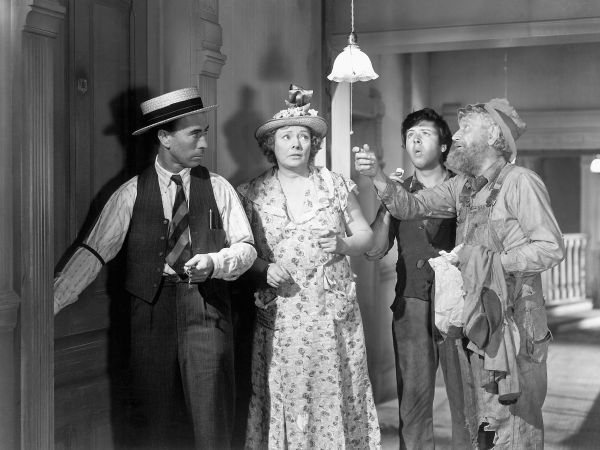
Tobacco Road(John Ford, 1941) The same year that Ford made the magnificent How Green Was My Valley (which won the Best Picture Oscar over Citizen Kane, a decision I'm still surprisingly ambivalent about) and after he'd made The Long Voyage Home, he made this oddity, an adaptation of the hit play that, itself, was an adaptation of Erskine Caldwell's scandalously bleak novel about the (to put it mildly) dysfunction among the Georgia poor. I'm not familiar with either, but the material is so venal and hard-scrabble that with each level of the airing of its dirty laundry, compromises had to be made to reach the stage and the screen so as to meet "community standards". By the time producer Darryl Zanuck and Ford got hold of it, it was a bizzarro version of their collaborative effort on The Grapes of Wrath, an out-and-out comedy of the "Kettle" variety, with much slapstick and hee-hawing, the novel's displays of greed, selfishness, shiftlessness and hypocrisy and (let's call it what it is) its animalistic depiction of rural poor life, neutered by low comedy and high over-acting. And to pass the censors and the Board of Review (not to mention the Catholic Legion of Decency), Caldwell's malicious intentions with its 13 year old brides, dead grammas, and apocalyptic "Wrath of God" fire (and no one would think of Gene Tierney possessing a cleft palate) is left by the way-side for lunk-headed males, religious loons, and the wholesale destruction of property. The effect is to take Caldwell's metaphorical screed...and turn it into "L'il Abner."
It's a little dispiriting. The material is so compromised as to be toothless, with no bite at all (although one might fear rabies), but any more mean-spirited and one couldn't see Ford—who could have trouble tackling tough subject matter head on—directing it. It's a bit like how Ford started handling the production of Mister Roberts as a service comedy, rather than a barnacled "rust-and-all" look at the war-Navy. But here, the strategy was sanctioned by Zanuck and the powers that be, not only at Fox, but at the Breen Office, just to get a hot property on the screen, even if lukewarm.Compromise is not new to the movies, it's an integral part, actually (unless you're ideologically fundamentalist on the auteur theory). But, as it was, the only reason to make this version of the film was to make hay, cashing in on the notoriety it had generated, while still getting away with it, something that must have appealed to the huckster-showman in Zanuck. The producer loved a good story, liked to push the envelope, but also knew what chances he could take, before bringing down the ire of the blue noses. And Ford could do comedy—he was better at it when it provided a relief from drama, or as texture inside of it—but he could do it, and economically, in a minimum of footage.
So Tobacco Road was made a comedy, curdled and dusty, and if some of Caldwell's malice got into it, so much the better, better than none at all. Such compromise brought Maugham to the screen and Faulkner and Hemingway and Fitzgerald. Not unadulterated, but some of it.
One could make a case for Ford trying to desanctify his image of "the people," away from the respectful, earnest portrayals of The Grapes of Wrath, but Ford never painted with a wide brush and not all of his "po' folk" were saints. Far from it, in fact. So, there has to be some back-story to this one, some vital piece of information, but for now, the "get-it-on-the-screen-any-way-you-can" theory fits Occam's razor.
However, it has had one effect on me. It's going to be tough to watch Ford's westerns with their solemn funerals with ragged voices singing "Shall We Gather at the River" after seeing what's done with it in this film. Like I said, "compromise."
The Fugitive(John Ford, 1947) Not the 1993 Harrison Ford movie based on the classic TV series (for that, go here) This John Ford-directed film is based on Graham Greene's "The Power and the Glory," adapted by Dudley Nichols (although when Ford got to Mexico to film, he basically threw out the script, and let his images do most of the talking) and starring Ford cast-stalwarts as Henry Fonda, Ward Bond, John Qualen, Jack Pennick, and Pedro Armendariz, and with a crew made of indigenous film-craftsmen. It took Ford out of his comfort zone, but also inspired him—finding what he had with cameraman Gabriel Figueroa—to make a film of shadows in a sun-blasted environment, more in line with the kind of film Ford was making when he was trying to make a statement.
One of the pervasive criticism's of Ford's body of work is its occasional moments of sentimentality, and for a tone inconsistency that interrupted drama for comedy (or "hi-jinks"). The Fugitive is one of those instances where Ford's tone is relentlessly consistent and low comedy is completely shorn from the narrative, and everything is played in deadly earnest. And, because their is no consistency in the world, especially the world of criticism, this one is often criticized for its consistent tone of religious fervor. You can't please everybody, no matter how hard you pray.
You know when someone is making an "art film" when they get a little hazy on the details, not wanting to nail down time and place, but planting it in some metaphorical zone that won't get anyone's back up, and The Fugitive begins with this narration:
"The following photoplay is timeless. The story is a true story. It's also a very old story that was first told in the Bible. It is timeless and topical, and is still being played in many parts of the world. This picture was entirely made in our neighboring Republic, Mexico, at the kind invitation of the Mexican government and of the Mexican motion picture industry. It's locale is fictional. It is merely a small state a thousand miles north or south of the Equator - who knows."
The film follows an unnamed Catholic priest (Fonda), who is trying to avoid arrest and execution in a Mexican State run by a tyrannical despot who has told his police to eradicate all religious practices in the state. Being the last priest left alive and dressed in peasant clothes and without the trappings of a priest, he is on the run, but is consistently called upon to practice his faith among the people surreptitiously. Discovered hiding in an abandoned church by a village woman (Dolores Del Rio), he makes a promise to baptize her illegitimate child and all the children who have not been baptized.
The Lieutenant of Police for the State (Armendariz)—who just so happens to be the father of that illegitimate child—lets it be known that he will take a hostage from every village to execute until the last remaining priest turns himself in. At the same time, a bank robber (Bond) has arrived in town but is able to avoid capture, due to attention being diverted to the priest. The two men run parallel paths to avoid being captured, but their fates become joined as the search intensifies.
The film differs quite a bit from Greene's book—the priest was originally the father of the child, but that wouldn't have passed the Hays Office—and Ford, once he got to Mexico, diverged so much from Nichols' script that the two—who had been a team for 30 years—decided to never work together again. To be fair to Nichols, there are a couple places where Fonda's priest could have easily been captured by the Lieutenant, but for the fact that he doesn't recognize him as the man in the wanted posters plastered around town. It seems a little far-fetched, considering that Fonda tends to stand out from the other peasants.
However one views the script or what Ford did with it, one aspect of The Fugitive makes it essential viewing—the miracles of cinematography that Ford pulled off with Figueroa. Evocative of Ford's work in The Grapes of Wrath, The Informer, and The Long Voyage Home, the images contain some of the blackest blacks in cinema history contrasting with the bleached exteriors of the Mexican landscapes. Ford's painterly eye was never so evident as here*as he photographically shows a Dark Age being pierced by enlightenment.
While I catch up on the reviews still in "Draft" phase here, I'll re-run a feature I ran when I first started this blog seven years ago,**** when it was suggested I do a "Top Ten" List.
I don't like those: they're rather arbitrary; they pit films against each other, and there's always one or two that should be on the list that aren't because something better shoved it down the trash-bin.
So, I came up with this: "Anytime" Movies. Anytime Movies are the movies I can watch anytime, anywhere. If I see a second of it, I can identify it. If it shows up on television, my attention is focused on it until the conclusion. Sometimes it’s the direction, sometimes it’s the writing, sometimes it’s the acting, sometimes it’s just the idea behind it, but these are the movies I can watch again and again (and again!) and never tire of them. There are ten (kinda). They're not in any particular order, but the #1 movie IS the #1 movie.
It’s a film that chills me right down to my bones and makes me cry every single time.* It throws itself into the deepest pits of despair and within moments, prat-falls into low comedy. It’s a western…about race relations, and in the house of mirrors of a “genre” piece deflects the self-righteous tone of a sermon. It stares into the soul of people at their worst, and exults in their best.
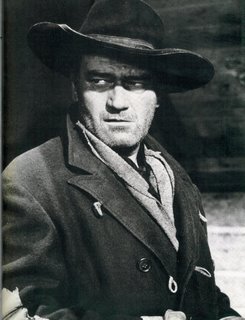
It is arguably John Ford’s best film (and he made many great ones). It is inarguably John Wayne's finest performance on-screen, while completely working against the image that Marion Morrison had built as “John Wayne,” American Hero.
Oh no. We’re talking about The Searchers—a “western” made during the somnambulant 50’s …and with John Wayne, ferchrissakes! How corny can you get?
Back up, pilgrim.
The Searchers has just been re-released (to mark its 50th anniversary**) in a gloriously re-mastered DVD, and has come under critical reviewfor being too corny, too obvious, and more than a little dated.
Worse still, it has been branded a “film-school darling” that has skated too long on an undeserved reputation as a masterpiece.
Bullshit.
LikePauline Kael’s faulty detective work dissecting Citizen Kane and Elvis Mitchell’s naïve un-analysis of 2001, the work in Slate smacks of a critic either looking for something to write about or make a name for themselves bucking “conventional wisdom.” Having to spend a summer reviewing the third X-Men movie, the fifth “Superman” opus AND an entirely superfluous “Pirates of the Caribbean” sequel is bound to make anyone crabby. But it shouldn’t lower one’s standards, and there’s enough slip-shod work in the article to indicate that’s the case. At the very least, it’s a terrible gloss-over.
At the worst, it displays a film reviewer who hasn't even seen the film he was supposedly watching for the prejudices and pre-conceived notions that he would rather cling to rather than objectivity.
The Searchers is a masterpiece—the culmination of decades of film-making experience that John Ford had accumulated since the silent era—while crystallizing Ford’s growing disenchantment with the Myth of the West. In a time when westerns were still basically built around the simplistic formula of “Cowboys vs. Indians,” Ford was starting to speak out more explicitly for the latter sixteen years before such accepted “consciousness-raising” films as Little Big Man or Soldier Blue. Like any masterpiece, it displays the sum of a body of work and breaks new ground, paving the way for the future.
The Searchers tells the story of an obsessive 10 year hunt for a lone family member taken in a violent Comanche raid. It’s led by the worst person possible: the child’s uncle--a hate-obsessed confederate soldier, self-exiled from his family, who still carries his saber on his hip, bitterness in his soul and his heart on his sleeve. Mix in a venomous race-hatred for all non-whites and you have the most flawed anti-hero to appear in movies. Ethan Edwards starts his search to bring his niece back alive, but as the years pass and she matures into womanhood, he gives her up as one of the Enemy, and sets out to kill her. At the center of the film’s black heart is that most archaic and useless word: miscegenation. It’s rough stuff. Rougher still are the attitudes of the settlers towards the Indians that border on hysteria. There’s a haunting scene late in the film where Edwards and his fellow traveler (played by future "Star Trek" Captain Pike and “Teenage Jesus,” Jeffrey Hunter) ride into a fort on the Trail of Tears to inspect some kidnapped white women who have been re-captured—"rescued" they would say—by the Cavalry.
“It’s hard to believe they’re white” a sergeant says. “They ain’t white,” spits Edwards, and at the sound of a shriek from one of the women, he turns to look at her. Ford trucks in the camera fast onto Wayne’s face (mirroring the shot he used to introduce Wayne in their first film together, Stagecoach) and it’s amazing. Wayne was always blessed with a mug that the camera loved***—it could read every emotion that played across it—and in a performance minus the “hero façade” and that turns on the full after-burners that usually blew his co-stars off the screen, this one quiet moment radiates a combination of hate, disgust…and abject fear. No words need to be said to make the point. No words could.
It's what made Ford a great director and Wayne a great actor.
"No, Ethan! No, you don't!"
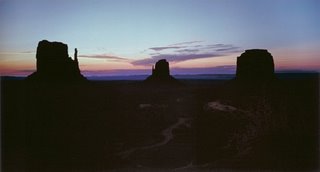
And yet, for all its depths of despair amid bloodshed and the race-hysteria, Ford tries to balance it with entertainment. That’s quite the tight-rope walk. But then, it’s not a sermon. It’s a Western. Ford was never so pretentious to be caught lecturing. He’d say if you want to send a message, use the Pony Express. Better to sneak the lessons into the fabric of the story, and distract with shenanigans about wayward lovers, goony old men, and green cavalrymen with pointy swords. One of the incidents involves the unintended marriage of Hunter’s character to a portly Indian maid. It’s the source of raunchy comedy in the vein of Ford’s The Quiet Man—all roughhouse and bad taste. But when Ford’s good guys “The Cavalry” decimate a Native village and the luckless character along with it, Hunter is left to ask “What’d they have to kill her for? She never hurt anybody!” The question hangs in the air with indictments all around. The Searchersbegins and ends with a black screen. In the beginning, the blackness gives way to the vast magical vista of Monument Valley (which figures in two of my anytime movies. If God lives anywhere on Earth, I think it’s on that vast acreage of land overseen by the Navajo) that to Garry Wills suggests an irising lens, but to these eyes seems more of a proscenium arch. At the end it shuts out Ethan Edwards who is left out of the warmth of a family embrace to wander the desert (Of course, Wayne’s character is going to come in eventually and eat…but Ford chooses to leave Edwards outside). His prejudice does not belong with home and hearth...and society…and Civilization. Yet it is also Ford’s choice to leave the character alive, the wolf always at the door.
It’s as if having made his plea for tolerance, Ford cautions us that it will always exist, somewhere.
Will we ever...finally...lose the hate?
“That’ll be the day.”
Robert McGinnis' portrait of Wayne in The Searchers.
* A comment on this post and movie—when it was stationed at another blog—asked: "The Searchers makes you cry?!?!? Is it because of all the dead Indians?" Sure. Go with that. But, a lot of settlers are killed, too, and the hunt in The Searchers is precipitated by one such massacre, the matriarch of which is the one woman that Ethan Edwards loves. It's what entwines his search into one of need and of vengeance.
No, the thing that makes me cry is the act that comes right before the line "Let's go home, Debbie." That line. From that character. At that time. Despite all evidence to the contrary. It's what gives one a small tiny quantum of hope that belies the sentiment of "That'll be the day..."
** And now, it's a few years shy of its 70th. I wasn't even a year old when it was released. It's like an old friend that's grown up with me. *** Screenwriter Robert Towne has a better term for it, the "camera-love" phrase implying a happy accident that doesn't give enough credit to the actors, their craft and experience. He says that actors like Wayne, Henry Fonda, and Gary Cooper are "ruthlessly efficient" in that they can communicate differing emotions with an economy of expression. Those words are particularly apt for Wayne's performance in The Searchers.
**** And, on Sunday, we'll put up a "Don't Make a Scene" feature from each week's film.
Gentleman Jim(Raoul Walsh, 1942) It's all background in this Errol Flynn vehicle, as the audience focuses on Flynn portraying boxer "Gentleman" Jim Corbett as he serves as point-man (chin variety) for the gentrification of the pugilistic sport. As we fade in the first rule of the fight game is "nobody talks about the fight game." Not in polite society anyway. As it is, floating boxing matches are staged hectically before the police can find out and they regularly end, not with the sound of a bell, but the sound of a gavel in a courtroom. Once "Johnny Law" gets wind of the fight (or hears the sound of one, they're fairly rambunctious affairs), they descend, the crowd scattering as they round up fighters and fans alike. It's all strictly word-of-mouth, grudge matches, really, the only civility being those of the Marquis of Queensbury—and anybody who's seen Wilde knows what a toad he was.
It's a natural extension of Flynn's persona as a cavalier, being the winking bad boy who's naughty to all the right people, but especially to the really bad ones—the jaunty trickster with a gleam in his eye, who'll find a way to get ahead...by left hook or by crook, the competent high-wire artist in marked contrast to buddy Walter Lowrie (Jack Carson, one of my favorite character actors), the lovable schlub who plays pilot-fish to Corbett's shark, never able to achieve success, but omnipresent to enjoy it for him.
On Dangerous Ground(Nicholas Ray, 1951) Big city detective Jim Wilson (Robert Ryan) is a one-man "good cop/bad cop" shake-down. Of all the detectives on his night-time beat, he's the one who takes the work home, studying mug-shots, knowing the rules, keeping his nose clean. One little problem—he's taking his work home with him. The job's weighing on him, poisoning his mind. All he sees are the mean city-streets, and the nighthawks who scurry through it. It's being noticed. "All we ever see is crooks, murderers, wino's, stoolies, dames—all with an angle." muses his new partner. "You get so you think everybody's like that. 'Til you find out different, it's kind of a lonely life...Jim just takes it harder than the rest of us." There's been a cop-killing recently—Wilson's partner, in fact—and it's gone unsolved. He knows why: "Everybody hates cops," he tells his captain (Ed Begley). "On either side of the law."
He's not helping the image: When a guy running down the street matches the description of a robbery suspect, he gets pulled over, gets cleared, he starts squawking about "Dumb cops" and Wilson's ready to take a poke at him before he gets held back by his partners; and when he finds an associate of the more likely cop-killers, he beats the information out of him. "Why do you make me do it?" he yells at the guy before laying into him. "You're know you're gonna talk. I always make you punks talk! Why do you make me DO it?"
Well, now the guy's got a ruptured bladder from the beating and Wilson's captain has an ulcer from another civil suit, not Wilson's first. And he's not showing any remorse or any inclination to change. He gets results. He's got a medal. "For being judge, jury and executioner?" grumps his captain. "Make up your mind to be a cop. Not a gangster with a badge."
So, Wilson gets sent up-state for awhile—"Siberia" he calls it—as there's been a murder of a little girl up there. He needs the space. He needs to get out of the city. And, although he doesn't suspect it, he's going to be particularly well-suited for the job, as he has no pity. And he'll find himself in the odd position of not being the worst thing that could happen.
Once he gets to the county, he finds a scared populace with a mob mentality. Visiting the Brent family, whose daughter is dead, he finds few leads as the girl's sister is too traumatized to offer any help identifying the killer. And the victim's father, Walter Brent (Ward Bond, playing the role with all the reactionary fervor natural to the actor) finds the detective's presence and questions just a delay to vigilante action: "No trial by jury. No sob-sisters. I'm just gonna empty my gun into his belly. Anybody try to stop me'll get the same thing." Up there, Wilson actually finds himself a voice of reason.
A snowy chase into the back-country causes both cars to spin out and ditch. And Brent and Wilson must continue the pursuit on foot following tracks in the snow. The way leads to a cabin with only one light on. The inhabitant is Mary Malden (Ida Lupino) who welcomes the men into her house and it's a few minutes before Wilson realizes that Mary is blind and has been for some years. Brent is suspicious and goes out to track Danny, leaving Wilson and Mary alone in the cabin, where she gets tea for the two of them. Wilson just observes.
She notes this, suspecting she's not the first blind person he's known. When Wilson asks why, she says he didn't offer her help and there's no pity in his voice. She asks him what it's like to be a cop, and he says you get to where you don't trust anybody.
"You're lucky," she says. "You don't have to trust anyone. I do. I have to trust everybody."
For Wilson, out of his element and having to deal with nuance and honesty, the case becomes one of negotiation, between two individuals—without angles—who either want the culprit alive or the culprit dead, and his understanding the cases for both sides. The extremes must coalesce if justice must be served...if only one can trust.
On Dangerous Ground (it's original title was "Mad With Much Heart", as per the original novel by Gerald Butler) boasts a great script by director Ray and A.I. Bezzerides**(one of the better noir screenwriters), which was originally a three-act structure, with the upstate scenes bracketed by the city action with a downbeat ending. But Howard Hughes, in charge of RKO at the time, was in a tinkering mood, and moved the last episode, earlier in the picture, so any inspiring words have to be recalled in echoed memory, rather than told to him for the first time, making Ryan's Wilson a cop who doesn't listen too good. And a tacked-on happy ending doesn't help things as far as a consistent tone, which makes it tough for both Lupino and Ryan, who does some mighty subtle work on a character who doesn't go in for subtle. The film already treads the noir landscape of cynicism, paranoia and naive romanticism, but, in the ecstatic ending, it doesn't remain true to the characters and their core souls. The film also has a great score by Bernard Herrmann which gives a hastily shot scramble up a bunch of rocks that are standing in for a mountain a sense of urgency and largeness; it foreshadows his work on North By Northwest. It elevates the film several notches above its roots and has the verve of another movie entirely.
Just the music from the chase scene On Dangerous Ground
 Topper (Norman Z. McLeod, 1937) Amazing that this one hasn't crossed my path before. The original author, Thorne Smith, was responsible for the source of I Married a Witch, which was an odd twee dip into the supernatural, dark cauldron division. Topper is considerably lighter—airier in spirit—much more screwball comedy-oriented, especially given its send-up of the privileged class.






.jpg)








.jpg)