Showing posts with label Dolores Del Rio. Show all posts

Wednesday, January 8, 2025

Flaming Star

Today would have been Elvis Presley's 90th birthday.

Flaming Star
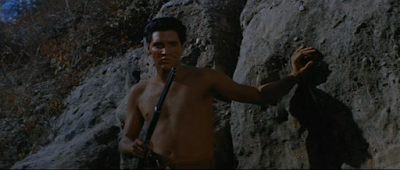
(Don Siegel, 1960) So, not seeing many Elvis Presley movies—a fan of his music, and his stage performance, but not so much of the "programmers" that Col. Parker insisted he make—I've always wondered about his potential as an actor. He was a great admirer of James Dean, and there's "talk" about how good he was, but there isn't much proof of that in his movies, where he's given songs to sing every ten minutes or so and he's given a persona that comes down to "Elvis with a job," merely. Not much to work with, and certainly no room to grow beyond the parameters of what was expected, and though he kept working on them (at the Colonel's insistence), he grew tired of them—they weren't challenging and were basically fluff for fans. They still have fans to this day—those movies crop up on "Elvis festivals" all the time—but nobody (except those same fans) would consider them great films. What's great about them is Presley and frequently the only reason to see them. Him and the songs.
But, Flaming Star was a chance to break the mold. Elvis sings a couple songs at the beginning and that's it—they're disposed of quickly. This one has a story, a good "theme" backing that story, and a terrific director, Don Siegel, who was still making B-pictures, but good ones that would become classics like Invasion of the Body Snatchers, and he would make The Killers, Coogan's Bluff, Madigan, The Beguiled, Dirty Harry, Escape from Alcatraz, The Shootist. He was a quick filmmaker and "cut in his head," imagining just the camera-angles and enough footage to make the splices go by unnoticed (a skill he'd honed working for the Warner studio in the editing department—you can see his name in the credits for "montage" on Casablanca, Now, Voyager, They Drive By Night and Edge of Darkness). 
The setting is Texas in 1878 and two brothers, Clint (
Steve Forrest) and Pacer Burton (Elvis Presley) are approaching their family cabin warily as all is quiet and dark even though it is still evening. There is tension in the air as the nearby Kiowa tribe has a new chief, Buffalo Horn (Rodolfo Acosta), having replaced the old chief of the tribe, and there have been aggressive attacks to take back their traditional hunting grounds, now "settled" by whites. But, despite drawn guns and quickening pulses, they find that the lights are out for a surprise birthday party for Clint (belated though it is).
Of course, the party is hosted by Clint's father Sam (John McIntire) and his step-mother Neddy (Dolores Del Río), a Kiowa woman and mother of Pacer, but also in attendance are Clint's fancier (Barbara Eden replacing a dismissed Barbara Steele), as well as characters played by Richard Jaeckel
and L.Q. Jones (briefly).
Briefly, because after the party breaks up for the night, three of the returning party are killed by Kiowa warriors when "the Howard place" is attacked in the middle of the night. Being isolated, the Burtons don't hear of it until Clint and Pacer ride into town for supplies and are nearly set upon by the Pierces (Jaeckel and Eden) for even setting foot in their place—Pacer being half-Kiowa. They manage to get what they need, but the hatred towards Pacer by association lets them know that the entire Burton clan is not going to have an easy time of it, from the settlers in town or from the Kiowas (Buffalo Horn already having made a nighttime visit to their homestead to palaver with Pacer).
It's only emphasized when a posse hunting Buffalo Horn visit the Burtons with one question—whose side are they on? Tempers are high with the men referring to Clint as "the only white man in the family" and shots are fired when things get too heated. The next morning, Pa and Clint find that the posse has stampeded their cattle and shot them all down out of spite, prompting Clint to vent that the white are worse than the Kiowas—"An Indian will rob you blind if he can but this is all waste and meanness." The Burtons are in an extreme situation, but where Pa says they've always been, "folks in the middle."
This is an atypical Elvis vehicle (which were basic celebrity vehicles) but not an atypical Western for the time in which it was made, on the cusp of a society-changing civil rights movement, where hearts and minds were in a process of retrospection of the country and what it's ideals really meant. Considerate directors who had moved beyond the early tropes of "cowboy movies" and considered not only the challenges of the European western expansion, but also its costs...and it's crimes. History is more complex than the dictates of a popular entertainment, and Flaming Star slots perfectly well in the genre's still-early reappraisal.
But not for an Elvis vehicle. But, Presley, fresh out of his military service, rises to the challenge. In his previous movies...and future ones...he wasn't required to do much but be a version of his star persona. If anything the range only required a befuddlement over who his next dance-partner would be.
But, this role requires a stretch, far beyond the dictates of a musical format...he's embattled, hated, conflicted, and constantly challenged, all of which comes through without an audience having to compensate for his celebrity. And, although helped by a fine crew of stuntman, he's also good in the action sequences (especially in a vigorous and violent third act). It's a terrific performance, far beyond what you'd come to expect from one of his similarly mononomic contemporaries. For a similar performance, look at the best movie-work of Dean Martin, Bobby Darin, or Sinatra. It was what he aspired to, and though he may be best remembered for his rock n' rollin' higher profile films, this was him at his dramatic best.

Thursday, September 23, 2021

The Fugitive (1947)

 The Fugitive (John Ford, 1947) Not the 1993 Harrison Ford movie based on the classic TV series (for that, go here) This John Ford-directed film is based on Graham Greene's "The Power and the Glory," adapted by Dudley Nichols (although when Ford got to Mexico to film, he basically threw out the script, and let his images do most of the talking) and starring Ford cast-stalwarts as Henry Fonda, Ward Bond, John Qualen, Jack Pennick, and Pedro Armendariz, and with a crew made of indigenous film-craftsmen. It took Ford out of his comfort zone, but also inspired him—finding what he had with cameraman Gabriel Figueroa—to make a film of shadows in a sun-blasted environment, more in line with the kind of film Ford was making when he was trying to make a statement.

One of the pervasive criticism's of Ford's body of work is its occasional moments of sentimentality, and for a tone inconsistency that interrupted drama for comedy (or "hi-jinks"). The Fugitive is one of those instances where Ford's tone is relentlessly consistent and low comedy is completely shorn from the narrative, and everything is played in deadly earnest. And, because their is no consistency in the world, especially the world of criticism, this one is often criticized for its consistent tone of religious fervor. You can't please everybody, no matter how hard you pray.
You know when someone is making an "art film" when they get a little hazy on the details, not wanting to nail down time and place, but planting it in some metaphorical zone that won't get anyone's back up, and The Fugitive begins with this narration:
"The following photoplay is timeless. The story is a true story. It's also a very old story that was first told in the Bible. It is timeless and topical, and is still being played in many parts of the world. This picture was entirely made in our neighboring Republic, Mexico, at the kind invitation of the Mexican government and of the Mexican motion picture industry. It's locale is fictional. It is merely a small state a thousand miles north or south of the Equator - who knows."
The film follows an unnamed Catholic priest (Fonda), who is trying to avoid arrest and execution in a Mexican State run by a tyrannical despot who has told his police to eradicate all religious practices in the state. Being the last priest left alive and dressed in peasant clothes and without the trappings of a priest, he is on the run, but is consistently called upon to practice his faith among the people surreptitiously. Discovered hiding in an abandoned church by a village woman (Dolores Del Rio), he makes a promise to baptize her illegitimate child and all the children who have not been baptized.
The Lieutenant of Police for the State (Armendariz)—who just so happens to be the father of that illegitimate child—lets it be known that he will take a hostage from every village to execute until the last remaining priest turns himself in. At the same time, a bank robber (Bond) has arrived in town but is able to avoid capture, due to attention being diverted to the priest. The two men run parallel paths to avoid being captured, but their fates become joined as the search intensifies.
The film differs quite a bit from Greene's book—the priest was originally the father of the child, but that wouldn't have passed the Hays Office—and Ford, once he got to Mexico, diverged so much from Nichols' script that the two—who had been a team for 30 years—decided to never work together again. To be fair to Nichols, there are a couple places where Fonda's priest could have easily been captured by the Lieutenant, but for the fact that he doesn't recognize him as the man in the wanted posters plastered around town. It seems a little far-fetched, considering that Fonda tends to stand out from the other peasants.
However one views the script or what Ford did with it, one aspect of The Fugitive makes it essential viewing—the miracles of cinematography that Ford pulled off with Figueroa. Evocative of Ford's work in The Grapes of Wrath, The Informer, and The Long Voyage Home, the images contain some of the blackest blacks in cinema history contrasting with the bleached exteriors of the Mexican landscapes. Ford's painterly eye was never so evident as here* as he photographically shows a Dark Age being pierced by enlightenment.

* And here's another couple images...