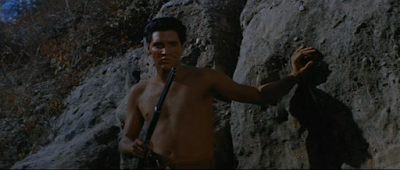
Today would have been Elvis Presley's 90th birthday. Flaming Star (Don Siegel, 1960) So, not seeing many Elvis Presley movies—a fan of his music, and his stage performance, but not so much of the "programmers" that Col. Parker insisted he make—I've always wondered about his potential as an actor. He was a great admirer of James Dean, and there's "talk" about how good he was, but there isn't much proof of that in his movies, where he's given songs to sing every ten minutes or so and he's given a persona that comes down to "Elvis with a job," merely. Not much to work with, and certainly no room to grow beyond the parameters of what was expected, and though he kept working on them (at the Colonel's insistence), he grew tired of them—they weren't challenging and were basically fluff for fans. They still have fans to this day—those movies crop up on "Elvis festivals" all the time—but nobody (except those same fans) would consider them great films. What's great about them is Presley and frequently the only reason to see them. Him and the songs. But, Flaming Star was a chance to break the mold. Elvis sings a couple songs at the beginning and that's it—they're disposed of quickly. This one has a story, a good "theme" backing that story, and a terrific director, Don Siegel, who was still making B-pictures, but good ones that would become classics like Invasion of the Body Snatchers, and he would make The Killers, Coogan's Bluff, Madigan, The Beguiled, Dirty Harry, Escape from Alcatraz, The Shootist. He was a quick filmmaker and "cut in his head," imagining just the camera-angles and enough footage to make the splices go by unnoticed (a skill he'd honed working for the Warner studio in the editing department—you can see his name in the credits for "montage" on Casablanca, Now, Voyager, They Drive By Night and Edge of Darkness). The setting is Texas in 1878 and two brothers, Clint (Steve Forrest) and Pacer Burton (Elvis Presley) are approaching their family cabin warily as all is quiet and dark even though it is still evening. There is tension in the air as the nearby Kiowa tribe has a new chief, Buffalo Horn (Rodolfo Acosta), having replaced the old chief of the tribe, and there have been aggressive attacks to take back their traditional hunting grounds, now "settled" by whites. But, despite drawn guns and quickening pulses, they find that the lights are out for a surprise birthday party for Clint (belated though it is). and L.Q. Jones (briefly).Briefly, because after the party breaks up for the night, three of the returning party are killed by Kiowa warriors when "the Howard place" is attacked in the middle of the night. Being isolated, the Burtons don't hear of it until Clint and Pacer ride into town for supplies and are nearly set upon by the Pierces (Jaeckel and Eden) for even setting foot in their place—Pacer being half-Kiowa. They manage to get what they need, but the hatred towards Pacer by association lets them know that the entire Burton clan is not going to have an easy time of it, from the settlers in town or from the Kiowas (Buffalo Horn already having made a nighttime visit to their homestead to palaver with Pacer). It's only emphasized when a posse hunting Buffalo Horn visit the Burtons with one question—whose side are they on? Tempers are high with the men referring to Clint as "the only white man in the family" and shots are fired when things get too heated. The next morning, Pa and Clint find that the posse has stampeded their cattle and shot them all down out of spite, prompting Clint to vent that the white are worse than the Kiowas—"An Indian will rob you blind if he can but this is all waste and meanness." The Burtons are in an extreme situation, but where Pa says they've always been, "folks in the middle."This is an atypical Elvis vehicle (which were basic celebrity vehicles) but not an atypical Western for the time in which it was made, on the cusp of a society-changing civil rights movement, where hearts and minds were in a process of retrospection of the country and what it's ideals really meant. Considerate directors who had moved beyond the early tropes of "cowboy movies" and considered not only the challenges of the European western expansion, but also its costs...and it's crimes. History is more complex than the dictates of a popular entertainment, and Flaming Star slots perfectly well in the genre's still-early reappraisal.But not for an Elvis vehicle. But, Presley, fresh out of his military service, rises to the challenge. In his previous movies...and future ones...he wasn't required to do much but be a version of his star persona. If anything the range only required a befuddlement over who his next dance-partner would be. But, this role requires a stretch, far beyond the dictates of a musical format...he's embattled, hated, conflicted, and constantly challenged, all of which comes through without an audience having to compensate for his celebrity. And, although helped by a fine crew of stuntman, he's also good in the action sequences (especially in a vigorous and violent third act). It's a terrific performance, far beyond what you'd come to expect from one of his similarly mononomic contemporaries. For a similar performance, look at the best movie-work of Dean Martin, Bobby Darin, or Sinatra. It was what he aspired to, and though he may be best remembered for his rock n' rollin' higher profile films, this was him at his dramatic best.
 Winchester '73 (Anthony Mann, 1950) One in a thousand. That's how many perfect Winchester rifles were produced. One in a thousand so perfect of bore and rifling that a man using it need not compensate for anything except that thrown at him by God. Men would fight for one. Men would kill for one. And the Winchester '73 that Lin McAdam (James Stewart) wins in a marksman's contest probably ends up a little less than perfect as it goes from hand to hand, and is even used as a shield and a club in the long circuitous route of the movie. But, as the repeating rifle has become the difference between life and death in the heady days after Little Big-Horn, the Winchester is the weapon of advantage in skirmishes on the plains.
The first of five westerns Stewart made with Anthony Mann in the 1950's that deepened and darkened the Stewart persona from the "aw, shucks" townie to a complex, psychologically challenged character who could be pushed to undisciplined anarchy, Winchester '73 has more going on in it than most of the other Stewart-Mann films, which had more straight-forward story-telling through lines. This one is practically episodic, as McAdam and fellow-traveler "High-Spade" (the terrific Millard Mitchell*) start in Dodge City with run-ins with Wyatt Earp (Will Geer, before the blacklist got him), Bat Masterson and a stranger-in-town named Dutch Henry Brown (Stephen McNally) before winning the perfect Winchester in a shooting match.

He doesn't have it for long as the stranger beats McAdam up and steals it from him. From there, it falls into the hands of an unscrupulous Indian trader (John McIntire), a Sioux warrior (Rock Hudson--you read that right), briefly in the hands of horse-soldiers Jay C. Flippen and Anthony—soon to be Tony—Curtis), then to an untrustworthy homesteader (Charles Drake) and finally, the possession of desperado Dan Duryea. Quite the cast (where's Harry Morgan?), and add in Shelley Winters as the saloon-girl trying to make good, and even if you didn't have Mann's steady hand with action, you'd have a movie full of good character parts.

Duryea is at his hipster best, playing an outlaw determined to out-laugh all of his opponents, McIntire is nicely droll as the Indian giver/trader, and Shelley Winters gives off an "I'll deal" vibe that endears you to her immediately. In one of the little authentic touches Mann inserts to show how rough the West really was, Winters nearly bounces off a buck-board dangerously careening through the desert, and when McAdam hesitates when giving her a gun to defend herself during a Native attack, she gives him a toothy grin and says, "I understand what the last one's for..." I want that girl on my side.

It is capped with a mountain shoot-out between old-antagonists-with-a-past McAdam and Brown that is a primer for any action director to clue an audience to the strategies and complications that a fight for advantage in the mountains can entail. Add to that Mann's experiments with light in landscape that were far outside and past the urban noir settings he had bathed in shadow and slivers of light in the post-war 40's.

But in the same year as Stewart and Delmer Daves dared make a western that showed the First Peoples' side of things (Broken Arrow), Mann and Stewart** (and Stewart and other directors) began a decade-long exploration of the cracks in Western civilization's veneer that showed the fragility of the individual—how, in a so-called "decent" society, there's only an angel's breath of morality distinguishing a maverick and a psychopath. Everyone can be pushed over the edge. And the only advantage is how many rounds you can fire off before the other guy feels the first one. The repeating fire-arm was the great leveler when it came to fighting. But it was also what prevented letting cooler heads prevail. Cooler heads don't have a chance against hot lead fired by a cold heart. It's how the West was taken...and still is. The chances of surviving it to build something decent?
Probably one in a thousand.

* Mitchell has a great stoved-in character face and a likable self-deprecating manner that are also on display in one of his other prominent movie roles-in Singin' in the Rain. He died in 1952.
** One of the joys of the current DVD version of Winchester '73 is a rare commentary track by the elderly Stewart who goes into detail about the filming and his working relationship with Mann and the other actors. It's done without the "Stewart persona"--he's just watching the film and answering questions--but at the end, you can't help but smile when he blurts "Ya know, I'm just really impressed with this laser-thing."