Showing posts with label Religion. Show all posts

Saturday, November 16, 2024

Heretic (2024)

The One True Religion (Stop Me If You've Heard This One)
or
A Reading from the Book of Iterations...(And Voltaire Never Said It)

Two Mormon missionaries, Sister Barnes and Sister Paxton (Sophie Thatcher and Chloe East) are doing door-to-door evangelizing for the Church of Jesus Christ of Latter-Day Saints (LDS) on a not-too-weather-friendly day in Colorado, in Heretic, the new film from the team that gave you 65 (and wrote A Quiet Place). A storm's a-comin'. But, despite that, they take their bicycles for a requested "knock-knock" from an inquiry made by a Mr. Reed (Hugh Grant) at his out-of-the-way house in the woods. After some wait as he comes to the door, he welcomes them eagerly, assuring them that his wife (who is very shy) is in the back, baking. Reassured that there will be a female present during their visitation, the two young women enter the house and accept the hospitality...even after he casually informs them that the walls and ceilings have metal in them (that's no problem, is it? Oh, good, good). He then takes their coats like a good host and goes behind a door to fetch the Mrs. It is then that the two women remember that they have the key to their bicycle lock in one of those coats. They're going to have to get it back if they intend to leave. With their suspicions heightened due to a couple of other things, they try to make a cellphone call...they can't (metal, you know) and they find that the front door cannot be opened...know matter how hard they try (and one has to admit, they don't try very hard as they never consider destruction of property...lawsuits, I guess). But, the long and the short of it is...they're trapped. And they can't leave except through the largess of Mr. Reed, who has disappeared deeper into the house. Interestingly, one thing they don't do...is pray.

Maybe they should have.
I don't like horror movies as a rule (despite the seeming obsession with them during Hallowe'en month). I do think they're valuable in instances, certainly in film. It's where a lot of young directors learn their craft in how to levitate people out of their seats in popcorn explosions (think Carnival of Souls or Night of the Living Dead). Even great directors will dabble in instances of horror. I just stay away from them as a rule because so many of them of late, especially during my formative movie-watching years, are (literally) hack-jobs. The slasher-movie craze left me cold after the first John Carpenter Halloween, and those series devolved into repetitive gore-fests with indestructible purveyors that kept coming back sequel after sequel after sequel (nothing new in the horror genre—how many Frankenstein, Dracula and Wolfman movies did Universal crank out?).But, the main reason I don't watch them of late is that so many are based on the element of cruelty...and casual cruelty where the moral compass has gone astray. Frankly, if I wanted to watch that, I could watch the news.
But, getting back to Sister Barnes and Sister Paxton, clearly they are in a dangerous situation. They are stuck in a house with Mr. Reed—there's no sign of this "Mrs. Reed"—and even though he's curious and quite amiable (in that Hugh Grant "twitchy" way), it becomes quite clear that he doesn't need much evangelizing. He claims to be a theology student, and even has a well-annotated Book of Mormon on his shelf. And he explains that he's always wanted "a" religion in his life, but he couldn't settle for second-best (equating it with favorite fast-food franchises in a discussion with the Sisters), that he was on a life-long quest to find The One True Religion to devote to. He peppers them with questions about LDS and their beliefs and how their life-experiences fit into a belief system that's a bit late "in the game" and had its share of waffling on tenets.
But, the discussion becomes deeper the deeper they get into the house. By this time, the ruse that there's a "Mrs. Reed" is way-past accepting, just as Reed is way-past accepting that Sisters B and P (as he calls them) are not above being dishonest in their words as well. There's no cellphone call they feign accepting—cell service doesn't work—and they can't call out (even though an elder (
Topher Grace) knows that they're out on a call and to whom) and the front door is on a timer and it won't unlock until the morning. He tells them they can leave at any time...but they have to go through the back door. And there are two doors in the room: which of them goes to the back door he's not saying.
But, first he has a little speech (of course he does). And it's all about "iterations" and how the Big Three Religions can be compared to the game of Monopoly or (more towards the Sister's younger spheres of culture) the case of a song that might be "inspired" by earlier songs. The Big Three Religions have as their basis previous theologies, and Protestantism, Calvinism, LDS, Scientology (what have you) are all further iterations of The Big Three. It's as if the latest prophet should start his religion with "Stop Me If You've Heard This One Before." But, they don't...because they have "the one true religion." And Reed isn't interested in copies.
But, there's the matter of those two doors—both lead to dark stairs leading downwards—neither of them seeming too appealing, and Mr. Reed has already demonstrated that he's not the most honest of people, and the Sisters, if they want to leave the house (he says), must choose between them if they do want to leave (and they truly do). And he ups the ante by marking them "Belief" or "Disbelief". Which of the doors will they choose?
But, before you think this will be an examination of Faith and its repercussions, one should recall that it's a horror film. A rather icky, grisly one, and one that takes a step or two back from the post-feminism horrors like Silence of the Lambs or even, say, Ready Or Not, and for all the intriguing aspects of the theological arguments, the film slides relentlessly downhill once those doors are opened. And however much some of the talking brings up some salient points (and a couple of attribution gaffs) it never builds on them or resonates through them, but turns into a simple gore-fest.
 
Slate Magazine calls Heretic "mansplaining as horror," which is a good line (and to be expected as the film is about religion where, outside of the world of Dune, women are tolerated, not elevated), but, unfortunately, that mansplaining is the best part of the movie (a lot of it due to Hugh Grant's performance, building on past roles as "man-monsters"). Once we start entering the house's sub-floor the movie never rises to the same level as those opening 45 minutes. The writer-directors Scott Beck and Bryan Woods make movies that have wonderful first acts—great concepts that can "sell" a movie to studios—but they fall apart and start regurgitating on cruise-control for the remainder of the film. There're no epiphanies or revelations at the end.* Nothing's earned. They just stop. 

But, movies should be more than their elevator pitches. I have faith that someday Beck and Woods will get that. But, for now, they're stuck in the basement.

* The film has two good lines of dialogue at the end, but to show you what a big blood-soaked nothing burger the movie becomes, it could have been said an hour earlier and it would have made as much of an impact then as in its current place.

Thursday, September 23, 2021

The Fugitive (1947)

 The Fugitive (John Ford, 1947) Not the 1993 Harrison Ford movie based on the classic TV series (for that, go here) This John Ford-directed film is based on Graham Greene's "The Power and the Glory," adapted by Dudley Nichols (although when Ford got to Mexico to film, he basically threw out the script, and let his images do most of the talking) and starring Ford cast-stalwarts as Henry Fonda, Ward Bond, John Qualen, Jack Pennick, and Pedro Armendariz, and with a crew made of indigenous film-craftsmen. It took Ford out of his comfort zone, but also inspired him—finding what he had with cameraman Gabriel Figueroa—to make a film of shadows in a sun-blasted environment, more in line with the kind of film Ford was making when he was trying to make a statement.

One of the pervasive criticism's of Ford's body of work is its occasional moments of sentimentality, and for a tone inconsistency that interrupted drama for comedy (or "hi-jinks"). The Fugitive is one of those instances where Ford's tone is relentlessly consistent and low comedy is completely shorn from the narrative, and everything is played in deadly earnest. And, because their is no consistency in the world, especially the world of criticism, this one is often criticized for its consistent tone of religious fervor. You can't please everybody, no matter how hard you pray.
You know when someone is making an "art film" when they get a little hazy on the details, not wanting to nail down time and place, but planting it in some metaphorical zone that won't get anyone's back up, and The Fugitive begins with this narration:
"The following photoplay is timeless. The story is a true story. It's also a very old story that was first told in the Bible. It is timeless and topical, and is still being played in many parts of the world. This picture was entirely made in our neighboring Republic, Mexico, at the kind invitation of the Mexican government and of the Mexican motion picture industry. It's locale is fictional. It is merely a small state a thousand miles north or south of the Equator - who knows."
The film follows an unnamed Catholic priest (Fonda), who is trying to avoid arrest and execution in a Mexican State run by a tyrannical despot who has told his police to eradicate all religious practices in the state. Being the last priest left alive and dressed in peasant clothes and without the trappings of a priest, he is on the run, but is consistently called upon to practice his faith among the people surreptitiously. Discovered hiding in an abandoned church by a village woman (Dolores Del Rio), he makes a promise to baptize her illegitimate child and all the children who have not been baptized.
The Lieutenant of Police for the State (Armendariz)—who just so happens to be the father of that illegitimate child—lets it be known that he will take a hostage from every village to execute until the last remaining priest turns himself in. At the same time, a bank robber (Bond) has arrived in town but is able to avoid capture, due to attention being diverted to the priest. The two men run parallel paths to avoid being captured, but their fates become joined as the search intensifies.
The film differs quite a bit from Greene's book—the priest was originally the father of the child, but that wouldn't have passed the Hays Office—and Ford, once he got to Mexico, diverged so much from Nichols' script that the two—who had been a team for 30 years—decided to never work together again. To be fair to Nichols, there are a couple places where Fonda's priest could have easily been captured by the Lieutenant, but for the fact that he doesn't recognize him as the man in the wanted posters plastered around town. It seems a little far-fetched, considering that Fonda tends to stand out from the other peasants.
However one views the script or what Ford did with it, one aspect of The Fugitive makes it essential viewing—the miracles of cinematography that Ford pulled off with Figueroa. Evocative of Ford's work in The Grapes of Wrath, The Informer, and The Long Voyage Home, the images contain some of the blackest blacks in cinema history contrasting with the bleached exteriors of the Mexican landscapes. Ford's painterly eye was never so evident as here* as he photographically shows a Dark Age being pierced by enlightenment.

* And here's another couple images...

Saturday, September 5, 2015

Olde Review: The Seventh Seal

This was part of a series of reviews of the ASUW Film series back in the '70's. Except for some punctuation, I haven't changed anything from the way it was presented, giving the snarky, clueless kid I was back in the '70's a break. Any stray thoughts and updates I've included with the inevitable asterisked post-scripts.

The Seventh Seal aka "Det Sjunde inseglet" (Ingmar Bergman, 1957)

An odd combination of films await those in
130 Kane this Saturday night: Ingmar Bergman's The Seventh Seal and Ken Russell's The Devils.

For those of you whose only experience with
Ingmar Bergman is his wildly splintered and heavy film Persona from last quarter's ASUW series, The Seventh Seal will seem to be made by another man. At this time, Bergman wasn't so experimental, so strange. He was, as he is now, alive and vibrant with the charm of film-making and his '50's films (The Magician, Wild Strawberries, Through a Glass Darkly) although dealing with "heavy" subjects of God and Death and self still possessed a lightness in the telling, a lightness that carried over from his beginnings in films and was lost in the dark broodings of his late '50's and '60's films. There was a time for comedy, and time for deep-think in the space of the best Ingmar Bergman films.

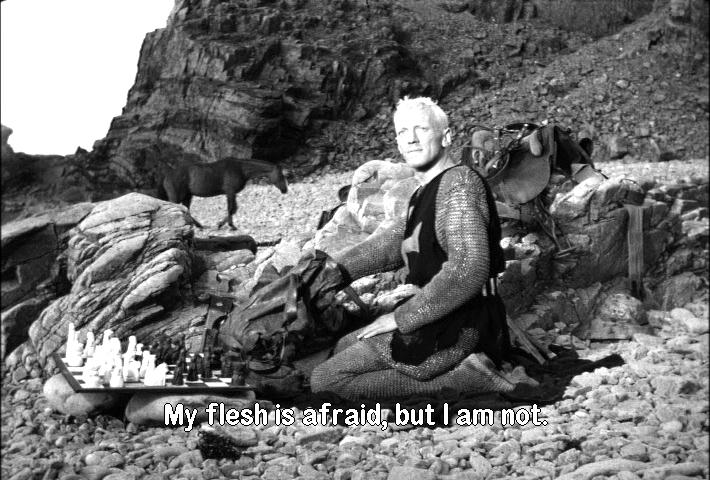
There are many characters in The Seventh Seal, but at the film's hub are two. The most important is The Knight, who is played Max von Sydow, the supreme brooding actor. The Knight is home from the religious wars where the quest for God has been fruitless—where the point of the quest, after the year's ox-killing has been lost. But the quest for God continues. It has to. God can't be in the war, but can he be found outside amidst plague, witch-burnings and ignorance?
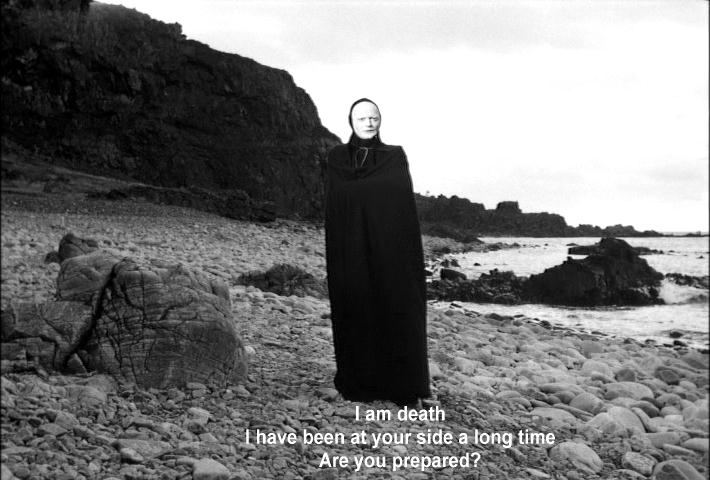
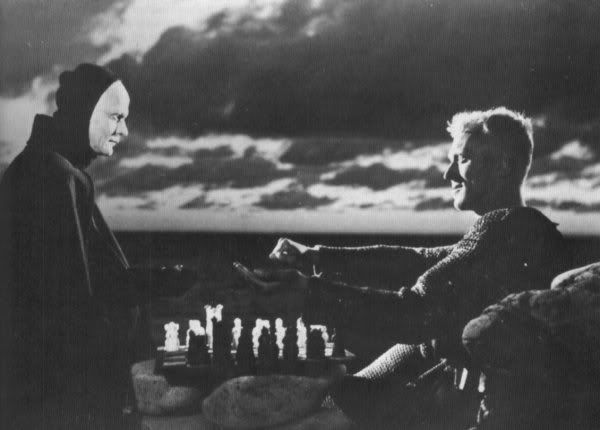
The answers are hard to come by, and even harder to come by while being pursued by another hold-over from the wars, the second most important character being Death. Death pursues the Knight and they engage in continuing battles of wits and of chess. The two opponents are only the hub of the story. There are others: the Knight's man-servant whose musings are concerned more with life that what is beyond; a troupe of actors; a wood-cutter and his adulterous wife. Bergman combines them all in a film that wheels between light and heavy in tone, but always excellent in quality.

Broadcast on KCMU-FM on January 8th, 1976 

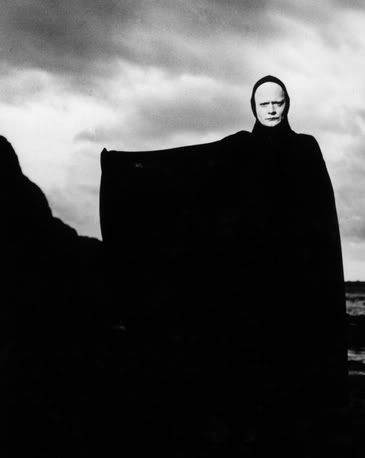
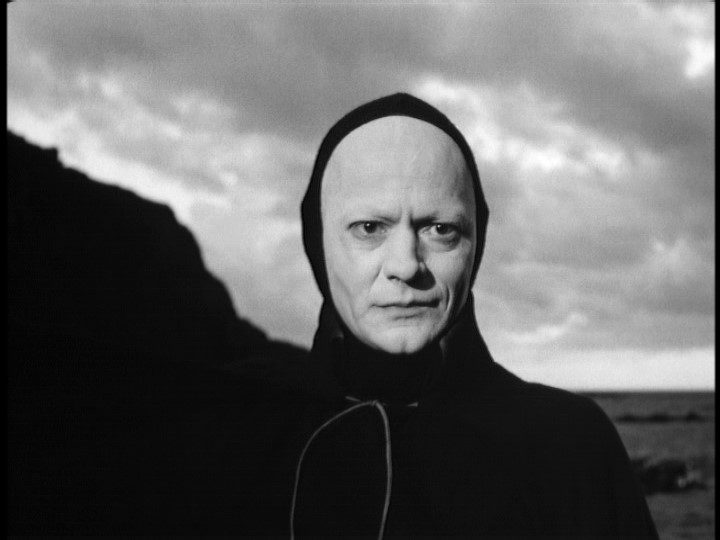
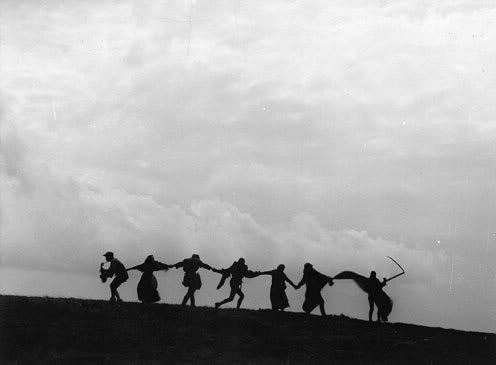
Sounds like I ran out of time there at the end--I usually only had two or three minutes per film to talk. So, I didn't even mention the stark black-and-white photography that has become so iconic, along with Bergman's simple personification of Death--an actor dressed entirely in a black cassock, with just his face appearing...in sharp contrast. And the image of The Knight playing chess with Death has been copied, parodied, purloined and done...well, to death. In Bill and Ted's Bogus Journey, they played "Battleship."

It sounds bleak, and it is—it is the Plague-Years, after all. But the film ends with a touch of hope and sacrifice, that even after all the Knight has seen—and not seen, as in the form of God—he can still cling to ideals. 
One last thought inspired by the film after a recent viewing (again): Is religion a balm for the weak and superstitious as so many think, or is faith an act of bravery in a world of tangible horror? If God has an answer, he's not telling. Wise.


Thursday, February 19, 2015

Black Narcissus

Black Narcissus (Michael Powell and Emeric Pressburger, 1947)  God in heaven, this is one of the most beautiful movies ever made.   In fact, this might be the contender that beats Gone With the Wind as the most gorgeous movie ever to be made from trashy material.* 

I haven't read the book "Black Narcissus" by Rumer Godden, so it's premature and ignorantly judgmental to call it trash, but the evidence from the film—a lust triangle between a pair of nuns and the only white man in the Himalayan neighborhood is soapy to the point of leaving rings around your eyes.  It does bring up the conflicts of those devoted to faith when confronted with Earthly desires, and how tough it is for physical beings to be married to Christ when he's an absentee husband.  It's just that, dramatically, the conflict is presented so turgidly as to approach the giggle reflex, despite being performed by (rather bravely, I think, or foolhardedly) the former lover of the director, Deborah Kerr, and his current lover, Kathleen Bryon (interestingly, she played the wife of elderly James Ryan in the Framing sequences in Spielberg's Saving Private Ryan), who present subtlety and hysteria (the latter, approaching Exorcist-like possession).
There is that contrast, front and center, but there are also the ones between Western  faith and Eastern spiritualism in the parallel stories of the nuns (and their duties and desires) and the demands of a local girl (Jean Simmons—uh, yeah, Indian by way of Crouch Hill, London) and her arranged marriage to a young prince (Sabu), and in marked contrast to a monk who lives his life, hermit-like and with no distractions to his faith.  There is some validity to the total for that, although the nuns and their belief system come out poorly in the comparison.
What is NOT in conflict (and makes it a must-see no matter the subject matter) is that Black Narcissus is one of the most beautiful movies ever made, in large part due to director Powell, production designer Alfred Junge, the amazing cinematographer Jack Cardiff, but also process shooter W. Percy Day and a young up-and-comer by the name of Peter Ellenshaw, who would create a lot of legendary magic for Disney over the years).
The photo-chemical wonders accomplished by these men is mesmerizing—one of those rare films (like The Leopard or Barry Lyndon) that you could take any frame and hang it on a wall.
The Technicolor palette pops and not subtly, and images are rich and lush, evoking a sensuality far beyond what the script calls for or evokes.  Powell once said, "Sometimes in a film its theme or its colour are more important than the plot."  That's certainly true of Black Narcissus.  There is a sumptuous quality to the images whether they suggest the bare asceticism of the nun's cloister or the natural wildness of the Himalayan landscape (incredibly, the film was shot at Pinewood Studios and Leonardslee Gardens, West Sussex, the home of a retired Indian Army officer), the planes of the faces (Cardiff could photograph women like no other), reflected in love or contorted in hate, the warm peace of a Himalayan glade, or the terrifying verticality of the nun's cliff-side perch.
That cliff telegraphs events in the film like a deus escarpment, which manages events and resolves conflicts in a very (shall we say?) orthodox manner.  Let's just say that "falling" is a major theme of the film, which manages to maintain its own balance by the strength and audacity of its images.
* Ya know?  It's odd.  Look at movies like Gone with the Wind, Black Narcissus, The Godfather.  Really, really garbage material out of whose sow's ears were pulled the silk purse equivalent of classic and artistically great movies (although I'm not a great fan of GWTW—too much reading).  Makes you wonder why anybody would want to remake a classic film, when they could be remaking the bad ones to make them classics.  Anyway, it's something to ponder.