Showing posts with label Flora Robson. Show all posts

Wednesday, March 17, 2021

Young Cassidy

Young Cassidy (Jack Cardiff, 1965) The titles say "Metro-Goldwyn-Mayer presents a John Ford Film." But John Ford only completed five minutes of it. Ford was 71 when he tackled what would be his last "Irish" film, based on "Mirror in My House", the autobiography of Irish playwright Sean O'Casey (Ford had directed a film of his The Plough and the Stars in 1938—the result of which, due to studio interference, neither the director or author liked—and Hitchcock directed Juno and the Paycock the same year). For the film's purposes, the author's name is changed to John Cassidy (O'Casey was born John Casey, but Gaelicized his pen name to Seán Ó Cathasaigh), but it's O'Casey's story, and first, Richard Harris, and then, Sean Connery were in line to play him in a cast that also included Julie Christie (ever so briefly, despite her prominence in the release poster), Edith Evans, Sian Phillips, Michael Redgrave (as W.B.Yeats), Maggie Smith and previous Ford players Flora Robson and Jack McGowran. Connery, however, was in the midst of his Bond commitment (between Goldfinger and Thunderball) and barely had time to squeeze in Hitchcock's Marnie. So Rod Taylor, an actor too under-appreciated for his consistently good work, took the role instead (and probably contributed a more accurate accent than Connery's Scottish burr), turning in what may be his best performance.
It's a good film with a great cast, and an unconventional script, and one wonders what it would have looked like if the septuagenarian Ford had not fallen ill and been replaced by The Archers' favorite cinematographer Jack Cardiff.* Ford prepared the film, after all, doing the location scouting all in advance of shooting, so there are touches here and there—shots of mourning women, lots of colorful townsfolk, a brutally rapacious pair of undertakers, and a subtle death scene all feel like Ford, even if the painterly framing is missing, replaced with something a little more fussy: for example, there's a worker's strike that Ford would have probably shot using a few master shots, whereas Cardiff's style is all inserts and quick shots ala Eisenstein. Still, the man got it completed at a moment's notice, something of a miracle. And as some of the film is centered around The Abbey Theater—whose company Ford used when casting his Irish films, the film is steeped in Ford's sense of Irishness.
The film follows Johnny Cassidy (Taylor)—laborer by day and pamphleteer by night, caring for his elderly mother (Robson) trying to improve their lot through hard work and political action, training with revolutionaries in the hills, but leaving when the concern is more about uniforms than tactics in fighting the British. Pubs are the center of activity for drinking and for the airing of grievances which can result in fisticuffs. At least it's in the neighborhood, as in the streets, the fighting gets serious and deadly. Cassidy takes solace in books, though his rough appearance is out of place in book-stores, which leads to a relationship with a clerk, Nora (Smith), who finds a living example of a book worth more than its cover indicates.
Through it all, Cassidy writes, both to celebrate and inspire the Irish working class, from pamphlets to newspaper articles and poems, getting published and then turning his attention to theater-plays, where he attracts the attention of The Abbey Theater and its artistic director, W.B. Yeats (Redgrave). But, Cassidy is conflicted: he wants to be a success as a writer, but as his world and his ambitions grow, they take him further and further from his roots. And that conflicts with his romance with Nora, who sees Cassidy's true spirit, but fears she may never be a part of it...not in a lasting way. 
The story, the cast, the locations are amazing. There is just a slight lack of lyricism to the enterprise that might have been readily apparent if things had been different on-set. There's just that element of magic that's missing that would have made this a must-see, instead of a pleasant movie-watching experience.
* Ford would complete one more film, the studio-bound 7 Women (featuring Anne Bancroft in a gender reversal of "the John Wayne role"), before Hollywood put him out to "Awards Pasture" where they say they honor you, but don't hire you ("We love ya, Pappy, and you made us a lotta money and Oscars, but we don't think you should make films anymore. Have a plaque.").

Ford said after this scene: "You son of a bitch Aussie," he said. "You made me cry. That's a wrap!"

Wednesday, October 26, 2016

Eye of the Devil

Eye of the Devil (aka 13, J. Lee Thompson et al., 1966)
Going in cold to Eye of the Devil—its end-credits say that "13" is presented by M-G-M and that was the name of it when released in Europe—you wonder what were the filmmakers trying to achieve. 

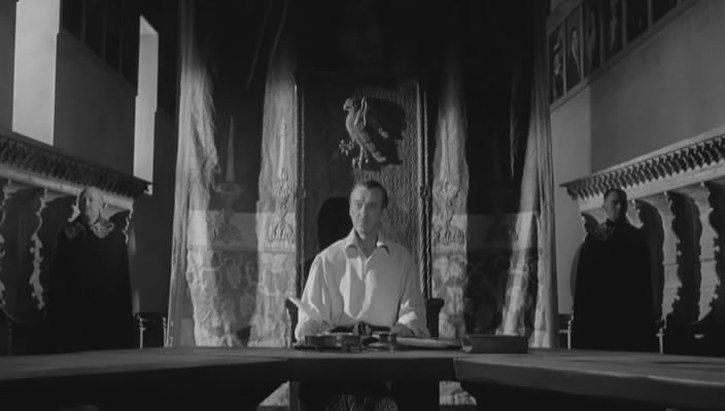
The film sports a great cast, and is a middling occult story (although the dialogue is a bit "highfalutin'"), presents a rather amazing location in the Chateau de Hautefort, but undercut by direction that one can only describe as "odd" and off-kilter, and editing that follows a particular beat for no apparent reason, then when it comes to shock moments, cuts away just too soon, so that one can't register what they're seeing. Eye of the Devil is frustrating on very many levels

But probably more for the producer.  More on that later. First, the film.

You start off watching the film by asking the question "why does Deborah Kerr have two children under the age of six?"  It was physically possible, of course (she was 45 at the time of filming), it's just that...well, in movie terms* it doesn't quite skew.  Then, the editing has an odd rhythm, allowing you to hear all the words people are saying, of course, but the natural beats are slightly "off." The camera glides along, cat-like, and BOOM there's an edit that feels uncomfortable or unnecessary given what's transpiring on-screen.

Things unravel as the mysteries deepen and people start to do "movie-logic" things.  For example, David Niven's marquis Phillipe de Montfaucon is called away at a dinner party; it seems the vineyards at his estate are dying and he must make one of his infrequent trips to the old stomping grounds of Bellenac. He explicitly tells his wife Catherine (Kerr) to keep the home fires burning while he goes to tend to things. Trusting him implicitly, she bundles up the kids and drives all the way out there, where she is greeted with all the welcome you'd give to a burning bag of poop at the front door.
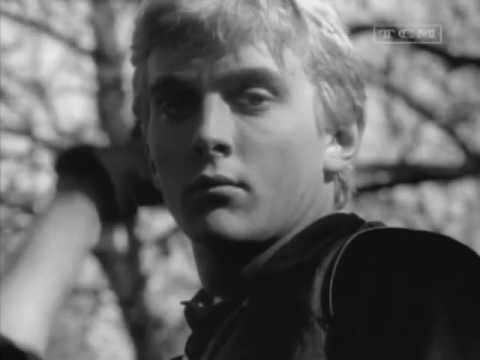
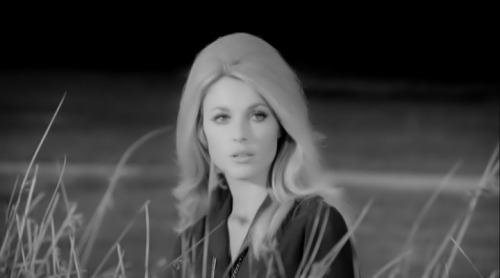
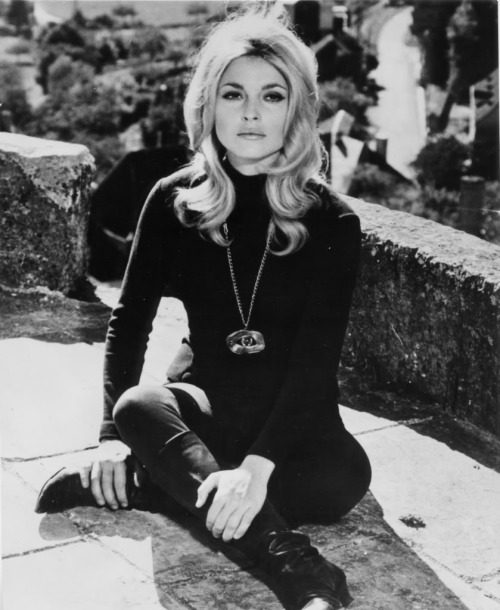
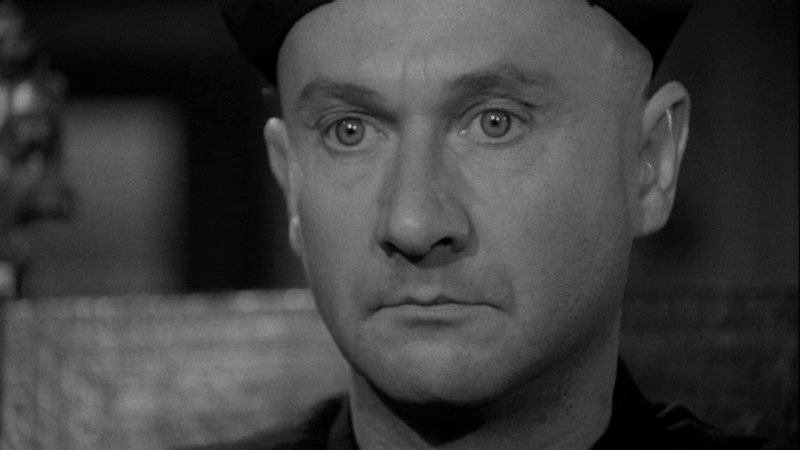
Phillipe's Aunt Estell (the wonderful Flora Robson) is outward-smiles, but suggests that all things are fine (dear), why don't you go home? Then, there are the strange kids hanging around, Christian and Odille de Caray (David Hemmings and "introducing" Sharon Tate, dubbed). Christian thinks nothing of bow-skewing a dove in front of the wife and kids and Odile is all heavily-made-up blond-thing-in-a-black-catsuit (Were they able to watch "The Avengers" in Bellenac?). Then, there's the unwelcome presence of Father Dominic (Donald Pleasence, whose name rhymes with "unwelcome presence," especially in the 1960's), who has the gaze of a psycho and looks like if he ran out of wine, he'd skip a step in the Mass and just serve blood to the parishioners, instead. Plus, Mrs. de Montfaucon has creeping "Rebecca" disease, where the uneasy mistress of the house can't stop poking around all the dark corners and shuttered rooms of the castle. One night, she finds a conclave of robed visitors surrounding her husband in a circle, and frightened, she runs into a mysterious man who tells her to go far, far from here.
Does she?  Nope. Not even when the kids are encouraged to play near the edge of the castle's high parapets by Odile, not when she is nearly sent over the edge herself, and not when she decides to take an impromptu trip to the family mausoleum and finds herself surrounded by those 12 hooded...who-evers. She doesn't get a clue when she finds the word "DEMON" chiseled into the mausoleum's wall.
It's a mess of a film, trying to emulate the Hammer style of occultish films—long entrance to the story, heavy atmospherics, and heaving starlets—and it probably would have been this messy even with the original players. The first director attached was Michael Anderson, then Sidney J. Furie (probably where a lot of the confusion came in, even though it worked well with The Ipcress File), then, briefly Arthur Hiller, then J. Lee Thompson came in to pick up the pieces. When filming started, the cast was in place, but Kim Novak was playing the role of Niven's suspicious wife, and left the production weeks into filming.** Kerr was quickly hired and any frame involving Novak had to be re-shot. There's only so much work-around you can do, and that's why Eye of the Devil looks so odd in presentation. It's a patch-work affair with a good cast and good intentions, but a Frankenstein monster of a script and a completion cut. 

Maybe it belongs in the "Horror" category, after all.

No, really, honey, what was your first clue?


* And when I say "movie terms" I mean the ageist and sexist tropes that go along with film entertainment (and not just Hollywood, folks)—that an older woman can't have younger children, or that older men can't have wives that are older than, say, 20.  Or that older film stars can have mothers who are two years older (or younger) than they are

** "Creative differences." Let's call it that. It was explained away as a back injury from a horse riding scene (Novak is an excellent equestrian and lives with her vet-husband on a horse ranch these days) for insurance purposes. These things are always "he said/she said." Kim Novak is an extremely talented actor, who manages to make the most of material, good, bad and indifferent. She was particular in how she wanted to come across on-camera for the character and that could rankle the front office. But, it is also tough to negotiate the "boy's club" of the picture making industry, and if you want to take control at all, you're considered "difficult."  I'm sure that leaving the production was a difficult decision.  I found this interesting web-site that tells the changing story.  


Wednesday, April 13, 2016

The Sea Hawk

The Sea Hawk (Michael Curtiz, 1940) Back in the day before Captain Phillips or Johnny Depp made them popular for Disney, there was a very romantic notion about the nautical mercenaries who had no loyalties to anything except themselves. But, there were also those who plundered for governments and they were called "privateers."  

Captain Geoffrey Thorpe (Errol Flynn) is the captain of The Albatross, part of the Sea Hawks, a private fleet of Queen Elizabeth I (Flora Robson), taking "reparations" from the Spanish fleet of King Phillip II (Montagu Love—my new favorite actor name), who has plans to (dare I say it?) rule the World.


Well, not if Thorpe (rather loosely based on Sir Francis Drake in the Howard Koch-Seton I. Miller screenplay that has nothing to do with the Rafael Sabatini novel) can fire across their bow. On a diplomatic mission to see the Queen, the ship carrying Don José Alvarez de Cordoba (Claude Rains) and his daughter Doña Maria (Brenda Marshall) is intercepted, fired upon and boarded by Thorpe and his all-too-eager crew. Once there, they see that the oarsmen for the Spanish are former English sailors, who are then freed and taken back to home and family. Don José is allowed to keep his meeting with the Queen, but all puffed up and protesting about it, and he and the Queen's adviser, Lord Wolfingham (Henry Darnell) demand that Thorpe be arrested and thrown in the dungeon, or the brig, or the tower, or whatever gray-bar hotel they had in 16th century England. The Queen puts on a stern public face, but is only too happy to let Thorpe command his ship to the isthmus of Panama to commandeer supplies from South America to the Spanish Armada.

But, the Queen's court has divided loyalties and Wolfingham is working with Don José to intercept Thorpe's plans, and the crew, once on land, and in a tinctured yellow setting, is trapped by Spanish forces and imprisoned as oarsmen on an enemy ship on its way back to Europe. Can Thorpe and his men escape their fate and warn the Queen about the oncoming attack by the Spanish Armada?
What do you think?

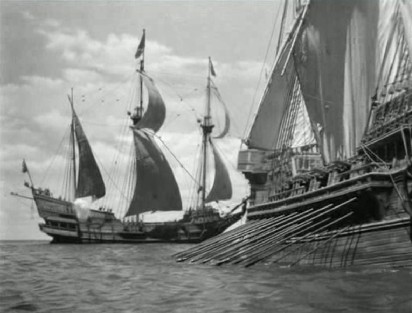
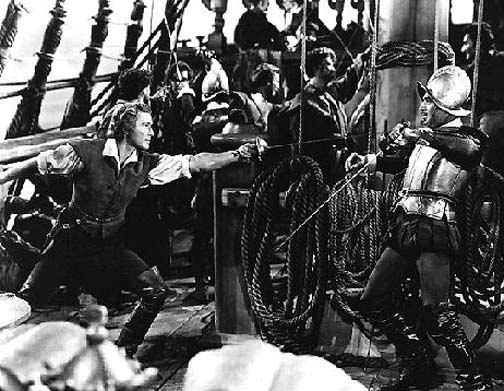
It's a grand epic, and director Curtiz, accustomed to filling the film-frame with detail, has a lot of scenery to use. The ships are big and impressive sets (especially when there are two next to each other), and the sea battles, some shots culled from Captain Blood (which is why this one is black and white and not Technicolor), are rousingly busy affairs starting with the chases, the cannon lobs,
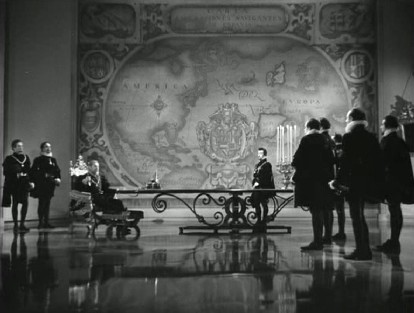
the swinging from ship to ship, then the sword-fights. They're frenetic and fun, the stuff of our pre-Johnny Depp cultural memories, and blood-shed is kept to a minimum. Curtiz and his designers also make the film feel a bit more gritty than one associates with a Hollywood studio film of the type (except of course in the Queen's court where everything is vast, spotless, and polished to the point of reflection). But compare Curtiz's slave galley to the one Charlton Heston occupied in Ben-Hur, and although the effort displayed by the rowers in the latter seem more strenuous, the conditions in the former are far more depressing. And Curtiz keeps it moving, no dawdling over the ironic dialogue or key sequences, as there's another just around the cut to get to. The cherry on top is one of Erich Wolfgang Korngold's greatest film-scores, which in itself has an awful lot of swash-buckling just in the playing.  
Try to see the longer version, though. For awhile, The Sea Hawk had its final scene plucked—The Queen's speech before the attack of the Spanish Armada, which may be the strangest speech a Queen has even been given: 
And now, my loyal subjects, a grave duty confronts us all: To prepare our nation for a war that none of us wants, least of all your queen. We have tried by all means in our power to avert this war. We have no quarrel with the people of Spain or of any other country; but when the ruthless ambition of a man threatens to engulf the world, it becomes the solemn obligation of all free men to affirm that the earth belongs not to any one man, but to all men, and that freedom is the deed and title to the soil on which we exist. Firm in this faith, we shall now make ready to meet the great armada that Philip sends against us. To this end, I pledge you ships - ships worthy of our seamen - a mighty fleet, hewn out of the forests of England; a navy foremost in the world - not only in our time, but for generations to come. 
"The earth belongs not to any one man, but to all men , and that freedom is the deed and title to the soil on which we exist." What do you  mean "we," Queen E? Fact is, Elizabeth didn't say this.* But, as this film was released in 1940, it serves as its own little shot across the bow to another "one man" who wanted the map, not to be of Spain, but of the Third Reich—Herr Hitler. The film, when first released, had that bit of rallying to it, in the days before The Blitz. After the war, prints had that speech removed as unnecessary (and probably anachronistic, and not in a Queen's spirit.   
"...vast, spotless and polished to the point of reflection."


* She ACTUALLY said this: "My loving people, we have been persuaded by some that are careful of our safety, to take heed how we commit ourself to armed multitudes for fear of treachery; but I assure you, I do not desire to live to distrust my faithful and loving people ... I know I have the body but of a weak and feeble woman, but I have the heart and stomach of a king, and of a King of England too, and think foul scorn that Parma or Spain, or any Prince of Europe should dare to invade the borders of my realm."  "My" realm.  See that?  "My".

Thursday, February 19, 2015

Black Narcissus

Black Narcissus (Michael Powell and Emeric Pressburger, 1947)  God in heaven, this is one of the most beautiful movies ever made.   In fact, this might be the contender that beats Gone With the Wind as the most gorgeous movie ever to be made from trashy material.* 

I haven't read the book "Black Narcissus" by Rumer Godden, so it's premature and ignorantly judgmental to call it trash, but the evidence from the film—a lust triangle between a pair of nuns and the only white man in the Himalayan neighborhood is soapy to the point of leaving rings around your eyes.  It does bring up the conflicts of those devoted to faith when confronted with Earthly desires, and how tough it is for physical beings to be married to Christ when he's an absentee husband.  It's just that, dramatically, the conflict is presented so turgidly as to approach the giggle reflex, despite being performed by (rather bravely, I think, or foolhardedly) the former lover of the director, Deborah Kerr, and his current lover, Kathleen Bryon (interestingly, she played the wife of elderly James Ryan in the Framing sequences in Spielberg's Saving Private Ryan), who present subtlety and hysteria (the latter, approaching Exorcist-like possession).
There is that contrast, front and center, but there are also the ones between Western  faith and Eastern spiritualism in the parallel stories of the nuns (and their duties and desires) and the demands of a local girl (Jean Simmons—uh, yeah, Indian by way of Crouch Hill, London) and her arranged marriage to a young prince (Sabu), and in marked contrast to a monk who lives his life, hermit-like and with no distractions to his faith.  There is some validity to the total for that, although the nuns and their belief system come out poorly in the comparison.
What is NOT in conflict (and makes it a must-see no matter the subject matter) is that Black Narcissus is one of the most beautiful movies ever made, in large part due to director Powell, production designer Alfred Junge, the amazing cinematographer Jack Cardiff, but also process shooter W. Percy Day and a young up-and-comer by the name of Peter Ellenshaw, who would create a lot of legendary magic for Disney over the years).
The photo-chemical wonders accomplished by these men is mesmerizing—one of those rare films (like The Leopard or Barry Lyndon) that you could take any frame and hang it on a wall.
The Technicolor palette pops and not subtly, and images are rich and lush, evoking a sensuality far beyond what the script calls for or evokes.  Powell once said, "Sometimes in a film its theme or its colour are more important than the plot."  That's certainly true of Black Narcissus.  There is a sumptuous quality to the images whether they suggest the bare asceticism of the nun's cloister or the natural wildness of the Himalayan landscape (incredibly, the film was shot at Pinewood Studios and Leonardslee Gardens, West Sussex, the home of a retired Indian Army officer), the planes of the faces (Cardiff could photograph women like no other), reflected in love or contorted in hate, the warm peace of a Himalayan glade, or the terrifying verticality of the nun's cliff-side perch.
That cliff telegraphs events in the film like a deus escarpment, which manages events and resolves conflicts in a very (shall we say?) orthodox manner.  Let's just say that "falling" is a major theme of the film, which manages to maintain its own balance by the strength and audacity of its images.
* Ya know?  It's odd.  Look at movies like Gone with the Wind, Black Narcissus, The Godfather.  Really, really garbage material out of whose sow's ears were pulled the silk purse equivalent of classic and artistically great movies (although I'm not a great fan of GWTW—too much reading).  Makes you wonder why anybody would want to remake a classic film, when they could be remaking the bad ones to make them classics.  Anyway, it's something to ponder.