Showing posts with label David Hemmings. Show all posts

Friday, October 5, 2018

Juggernaut (1974)

Juggernaut (Richard Lester, 1974) Made in the shock-wave of such star-culling epics as Airport, The Poseidon Adventure, Earthquake, and The Towering Inferno that had the gall to ask: "Who Will Survive?" in its posters, Juggernaut played the same game. See? All the stars are lined up like ducks in a gallery reading to be pinged, just like those other all-star slaughter fests.

Juggernaut plays the game differently, though, while maintaining the conventions. This film is as soapish as the others in terms of interpersonal relationships. But in other disaster movies, people are collateral damage to the epic depiction of crumbling masonry. Lester's film is all about character—the "disaster" is man-made, the people at-risk are portrayed intimately, if not by stars, by strong character actors (
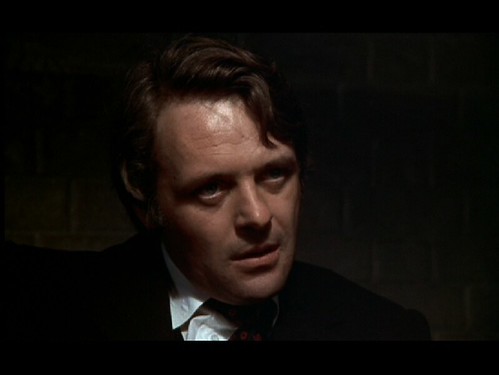
Clifton James, Shirley Knight, Michael Hordern, Cyril Cusack, Julian Glover, Roy Kinnear—Lester's favorite buffoon is given a part to shine in this film—Ian Holm, a pre-fame Anthony Hopkins) you begin to care about. 


The cast is filled with faces who would become more familiar in later roles, but the two leads are Omar Sharif at his dyspeptic best as the Captain of the threatened ship and Richard Harris, who was never better than he is in this movie.
The cruise ship SS Britannic is half-way across the Atlantic Ocean when the line's president (Holm) receives a phone call from "Juggernaut" saying there are seven barrels of high explosive rigged to go off the next day at a predetermined time. Unless a ransom is paid, the bombs will go off and the ship will sink. With the ransom, instructions to defuse the bombs will be sent. Any attempt to defuse the bombs will cause them to explode. Holm's president wants to pay the ransom quickly, but the British government threatens to pull his operating subsidy if he negotiates with terrorists. While Hopkins' Scotland Yard detective attempts to find "Juggernaut," bomb expert Tony Fallon (Harris) and his crew are sent out to the Britannic, dropped in the ocean, and clamber onto the boat.
The focus shifts to Fallon, who sees all defusing jobs as a form of psychology—he's not trying to figure out the bomb, he's trying to figure out the man who made the bomb, and the tense scenes of Fallon examining one bomb to relay instructions to his crew are a whispered monologue of a man on the edge of death attempting to read the mind of the puzzle-maker in a battle of wills.
For director Lester, who is fond of games and puzzle solving, the film is one of his obsessions brought to life with the bomb design being particularly devious. Given its nature, one is put immediately into the Fallon mind-set that he is battling a man and not a bomb. And it is this interplay, where one man must rely on his skills and his knowledge, rather than the tides of Fate, that makes Juggernaut sail past the other films in the sub-genre.

Wednesday, October 26, 2016

Eye of the Devil

Eye of the Devil (aka 13, J. Lee Thompson et al., 1966)
Going in cold to Eye of the Devil—its end-credits say that "13" is presented by M-G-M and that was the name of it when released in Europe—you wonder what were the filmmakers trying to achieve. 

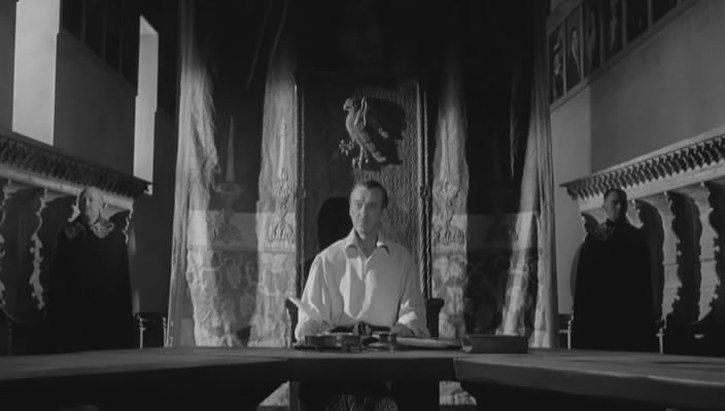
The film sports a great cast, and is a middling occult story (although the dialogue is a bit "highfalutin'"), presents a rather amazing location in the Chateau de Hautefort, but undercut by direction that one can only describe as "odd" and off-kilter, and editing that follows a particular beat for no apparent reason, then when it comes to shock moments, cuts away just too soon, so that one can't register what they're seeing. Eye of the Devil is frustrating on very many levels

But probably more for the producer.  More on that later. First, the film.

You start off watching the film by asking the question "why does Deborah Kerr have two children under the age of six?"  It was physically possible, of course (she was 45 at the time of filming), it's just that...well, in movie terms* it doesn't quite skew.  Then, the editing has an odd rhythm, allowing you to hear all the words people are saying, of course, but the natural beats are slightly "off." The camera glides along, cat-like, and BOOM there's an edit that feels uncomfortable or unnecessary given what's transpiring on-screen.

Things unravel as the mysteries deepen and people start to do "movie-logic" things.  For example, David Niven's marquis Phillipe de Montfaucon is called away at a dinner party; it seems the vineyards at his estate are dying and he must make one of his infrequent trips to the old stomping grounds of Bellenac. He explicitly tells his wife Catherine (Kerr) to keep the home fires burning while he goes to tend to things. Trusting him implicitly, she bundles up the kids and drives all the way out there, where she is greeted with all the welcome you'd give to a burning bag of poop at the front door.
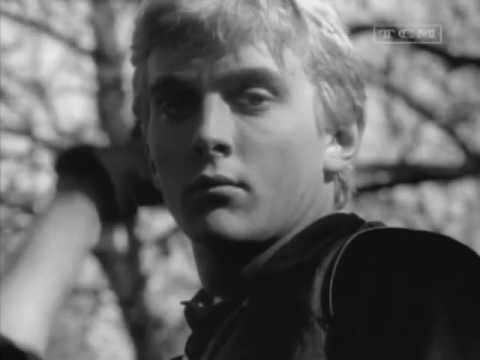
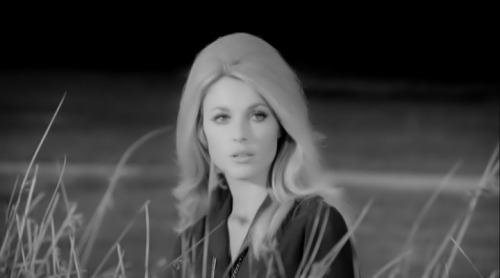
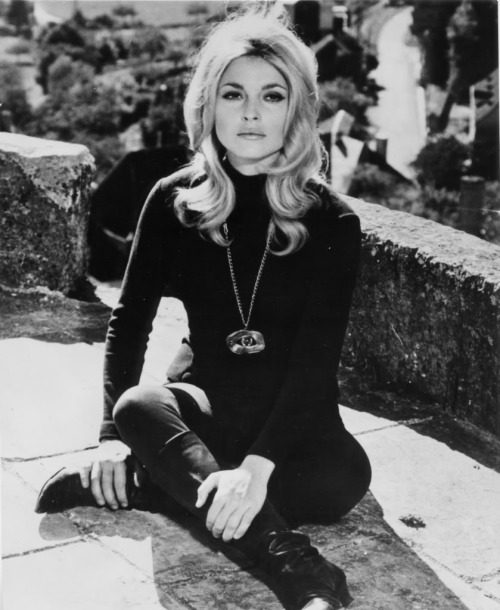
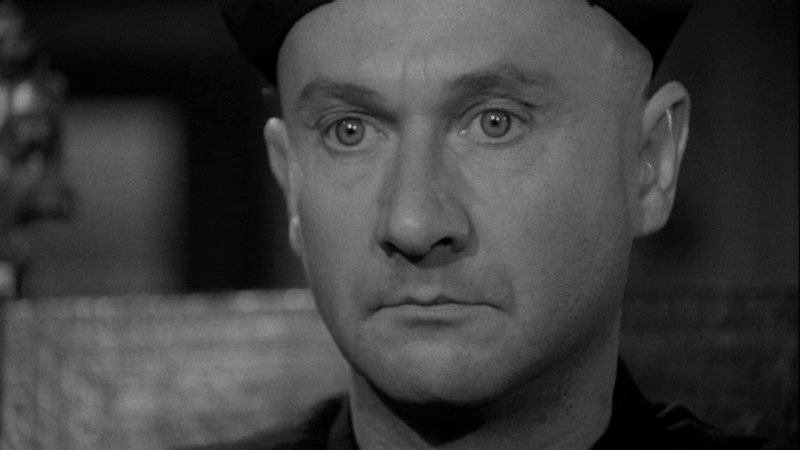
Phillipe's Aunt Estell (the wonderful Flora Robson) is outward-smiles, but suggests that all things are fine (dear), why don't you go home? Then, there are the strange kids hanging around, Christian and Odille de Caray (David Hemmings and "introducing" Sharon Tate, dubbed). Christian thinks nothing of bow-skewing a dove in front of the wife and kids and Odile is all heavily-made-up blond-thing-in-a-black-catsuit (Were they able to watch "The Avengers" in Bellenac?). Then, there's the unwelcome presence of Father Dominic (Donald Pleasence, whose name rhymes with "unwelcome presence," especially in the 1960's), who has the gaze of a psycho and looks like if he ran out of wine, he'd skip a step in the Mass and just serve blood to the parishioners, instead. Plus, Mrs. de Montfaucon has creeping "Rebecca" disease, where the uneasy mistress of the house can't stop poking around all the dark corners and shuttered rooms of the castle. One night, she finds a conclave of robed visitors surrounding her husband in a circle, and frightened, she runs into a mysterious man who tells her to go far, far from here.
Does she?  Nope. Not even when the kids are encouraged to play near the edge of the castle's high parapets by Odile, not when she is nearly sent over the edge herself, and not when she decides to take an impromptu trip to the family mausoleum and finds herself surrounded by those 12 hooded...who-evers. She doesn't get a clue when she finds the word "DEMON" chiseled into the mausoleum's wall.
It's a mess of a film, trying to emulate the Hammer style of occultish films—long entrance to the story, heavy atmospherics, and heaving starlets—and it probably would have been this messy even with the original players. The first director attached was Michael Anderson, then Sidney J. Furie (probably where a lot of the confusion came in, even though it worked well with The Ipcress File), then, briefly Arthur Hiller, then J. Lee Thompson came in to pick up the pieces. When filming started, the cast was in place, but Kim Novak was playing the role of Niven's suspicious wife, and left the production weeks into filming.** Kerr was quickly hired and any frame involving Novak had to be re-shot. There's only so much work-around you can do, and that's why Eye of the Devil looks so odd in presentation. It's a patch-work affair with a good cast and good intentions, but a Frankenstein monster of a script and a completion cut. 

Maybe it belongs in the "Horror" category, after all.

No, really, honey, what was your first clue?


* And when I say "movie terms" I mean the ageist and sexist tropes that go along with film entertainment (and not just Hollywood, folks)—that an older woman can't have younger children, or that older men can't have wives that are older than, say, 20.  Or that older film stars can have mothers who are two years older (or younger) than they are

** "Creative differences." Let's call it that. It was explained away as a back injury from a horse riding scene (Novak is an excellent equestrian and lives with her vet-husband on a horse ranch these days) for insurance purposes. These things are always "he said/she said." Kim Novak is an extremely talented actor, who manages to make the most of material, good, bad and indifferent. She was particular in how she wanted to come across on-camera for the character and that could rankle the front office. But, it is also tough to negotiate the "boy's club" of the picture making industry, and if you want to take control at all, you're considered "difficult."  I'm sure that leaving the production was a difficult decision.  I found this interesting web-site that tells the changing story.