Eye of the Devil(aka13, J. Lee Thompson et al., 1966) Going in cold to Eye of the Devil—its end-credits say that "13" is presented by M-G-M and that was the name of it when released in Europe—you wonder what were the filmmakers trying to achieve.
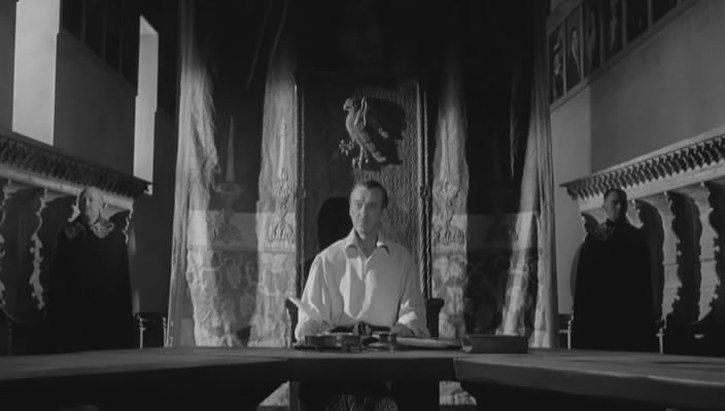
The film sports a great cast, and is a middling occult story (although the dialogue is a bit "highfalutin'"), presents a rather amazing location in the Chateau de Hautefort, but undercut by direction that one can only describe as "odd" and off-kilter, and editing that follows a particular beat for no apparent reason, then when it comes to shock moments, cuts away just too soon, so that one can't register what they're seeing. Eye of the Devil is frustrating on very many levels But probably more for the producer. More on that later. First, the film.
You start off watching the film by asking the question "why does Deborah Kerr have two children under the age of six?" It was physically possible, of course (she was 45 at the time of filming), it's just that...well, in movie terms*it doesn't quite skew. Then, the editing has an odd rhythm, allowing you to hear all the words people are saying, of course, but the natural beats are slightly "off." The camera glides along, cat-like, and BOOM there's an edit that feels uncomfortable or unnecessary given what's transpiring on-screen.
Things unravel as the mysteries deepen and people start to do "movie-logic" things. For example, David Niven's marquis Phillipe de Montfaucon is called away at a dinner party; it seems the vineyards at his estate are dying and he must make one of his infrequent trips to the old stomping grounds of Bellenac. He explicitly tells his wife Catherine (Kerr) to keep the home fires burning while he goes to tend to things. Trusting him implicitly, she bundles up the kids and drives all the way out there, where she is greeted with all the welcome you'd give to a burning bag of poop at the front door.
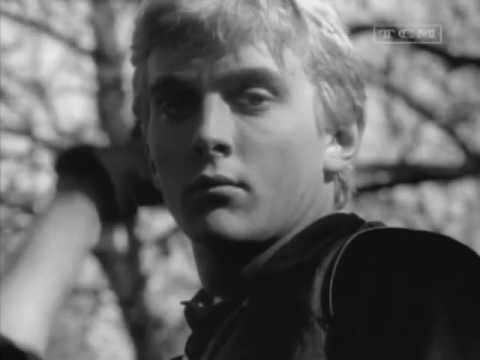
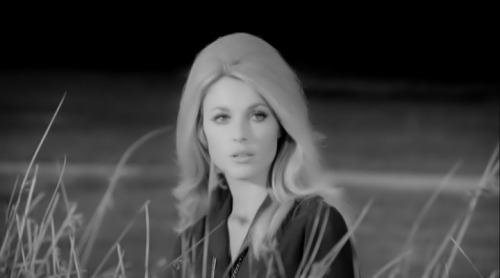
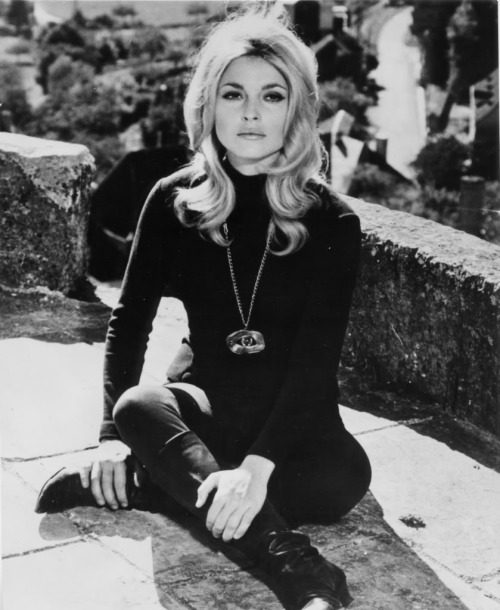
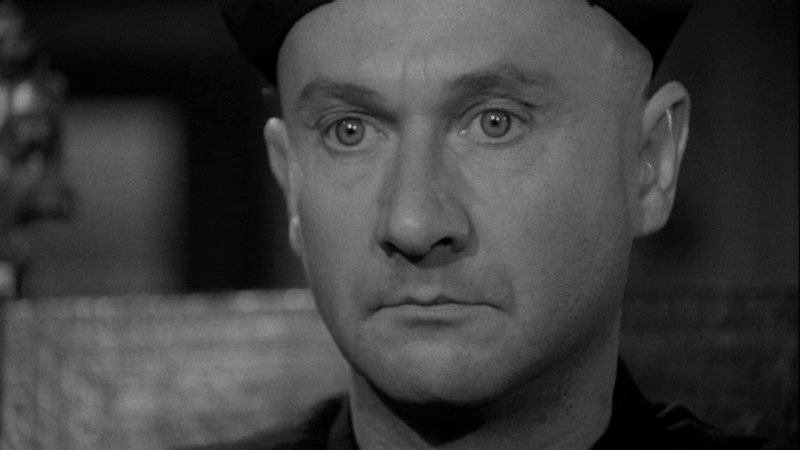
Phillipe's Aunt Estell (the wonderful Flora Robson) is outward-smiles, but suggests that all things are fine (dear), why don't you go home? Then, there are the strange kids hanging around, Christian and Odille de Caray (David Hemmings and "introducing" Sharon Tate, dubbed). Christian thinks nothing of bow-skewing a dove in front of the wife and kids and Odile is all heavily-made-upblond-thing-in-a-black-catsuit (Were they able to watch "The Avengers" in Bellenac?). Then, there's the unwelcome presence of Father Dominic (Donald Pleasence, whose name rhymes with "unwelcome presence," especially in the 1960's), who has the gaze of a psycho and looks like if he ran out of wine, he'd skip a step in the Mass and just serve blood to the parishioners, instead. Plus, Mrs. de Montfaucon has creeping "Rebecca" disease, where the uneasy mistress of the house can't stop poking around all the dark corners and shuttered rooms of the castle. One night, she finds a conclave of robed visitors surrounding her husband in a circle, and frightened, she runs into a mysterious man who tells her to go far, far from here.
Does she? Nope. Not even when the kids are encouraged to play near the edge of the castle's high parapets by Odile, not when she is nearly sent over the edge herself, and not when she decides to take an impromptu trip to the family mausoleum and finds herself surrounded by those 12 hooded...who-evers. She doesn't get a clue when she finds the word "DEMON" chiseled into the mausoleum's wall.
It's a mess of a film, trying to emulate the Hammerstyle ofoccultish films—long entrance to the story, heavy atmospherics, and heaving starlets—and it probably would have been this messy even with the original players. The first director attached was Michael Anderson, then Sidney J. Furie (probably where a lot of the confusion came in, even though it worked well with The Ipcress File), then, briefly Arthur Hiller, then J. Lee Thompson came in to pick up the pieces. When filming started, the cast was in place, but Kim Novak was playing the role of Niven's suspicious wife, and left the production weeks into filming.**Kerr was quickly hired and any frame involving Novak had to be re-shot. There's only so much work-around you can do, and that's why Eye of the Devil looks so odd in presentation. It's a patch-work affair with a good cast and good intentions, but a Frankenstein monster of a script and a completion cut. Maybe it belongs in the "Horror" category, after all.
No, really, honey, what was your first clue?
* And when I say "movie terms" I mean the ageist and sexist tropes that go along with film entertainment (and not just Hollywood, folks)—that an older woman can't have younger children, or that older men can't have wives that are older than, say, 20. Or that older film stars can have mothers who are two years older (or younger) than they are ** "Creative differences." Let's call it that. It was explained away as a back injury from a horse riding scene (Novak is an excellent equestrian and lives with her vet-husband on a horse ranch these days) for insurance purposes. These things are always "he said/she said." Kim Novak is an extremely talented actor, who manages to make the most of material, good, bad and indifferent. She was particular in how she wanted to come across on-camera for the character and that could rankle the front office. But, it is also tough to negotiate the "boy's club" of the picture making industry, and if you want to take control at all, you're considered "difficult." I'm sure that leaving the production was a difficult decision. I found this interesting web-site that tells the changing story.
The Fearless Vampire Killers(aka The Fearless Vampire Killers: or Pardon Me, But Your Teeth Are in My Neck)(Roman Polanski, 1967) One must be patient with movie marketers; sometimes you get a concept that you simply don't know how to sell.
Take these words, for example: "A Roman Polanski Comedy." Now, in 1966, those words might not have had the same weight as they do these days. In 1966, Polanski had made three critically-acclaimed films—Knife in the Water, Repulsion, and Cul-De-Sac—all quirky, dark, perverse films that had garnered attention at Cannes and the American Motion Picture Academy. After his first film made in Poland, Polanski had moved to France, where he found he wasn't exactly welcome being not only Polish but also jewish, so he settled in London to make The Fearless Vampire Killers, which would prove to be his entrance to America (where he would be hired by Robert Evans to make Rosemary's Baby). The Fearless Vampire Killers (which was filmed under the title that it would be released with in Europe, The Dance of the Vampires) was designed to be a comedy with the aesthetic of the Hammer Studios' style of horror film, but with some differences—the subject matter would be treated more comically, especially in dealing with the vampire tropes dealing with religion and sexuality. These would be vampires of different stripes.
Disgraced Professor Abronsius (Jack McGowran)—due to his studies of the superstitious notion of vampires—and his hapless assistant Alfred (Polanski) travel to eastern Europe to investigate the existence of vampires, and arrive, nearly frozen at a county inn in the realm of Count von Krolock (Ferdy Maine). After being properly thawed out, they discover that the inn has been suspiciously draped with strands of garlic, the better to ward off visitations by creatures of the night. The Professor is excited at the prospect of finally being able to prove his theories, but Alfred would rather not have his suspicions proven, being something of an innocent, and something more than a coward.
Alfred is the Porky Pig to Abronsius' Daffy Duck, noticing the dangers that the other blithely ignores, or worse, is encouraged about. While Abronsius is determined to prove the existence of vampires, Alfred would just as soon run away from them, or, better yet, find out that they really don't exist. Even as they were carriage into town, Abronsius sleeps while Alfred watches wild wolves pursue them—until the pack is scared off by a hunchback, who then disappears without a trace. That sort of thing can really worry a guy—one who notices, that is.
What Alfred would rather notice is a hot meal...or the girl they find taking a bath in their room—the only room at the inn with such a luxury. She's Sarah (Sharon Tate), daughter of the Jewish inn-keeper, and Alfred is instantly bitten by the love-bug. Better that than something else.
During Sarah's daily bubble-bath, she notices it starting to snow in the bathroom, and before the two vampire-hunters can intervene, the tub is empty, save for water and bubbles tainted ever so slightly by blood from her jugular—she has been abducted, apparently by Count von Krolock. The inn is set in an uproar. Shagal, the inn-keeper, is bereft, vowing revenge and before he can be restrained sets out for the Count's castle, Abronsius and Alfred make their own plans to infiltrate the Count's castle to prove he's a vampire and try to rescue Sarah.
Shagal comes back to the inn, but he's in no shape to do anything, dead from a vampire attack and frozen stiff from the from the cold trip. Before long, he'll thaw out and start his own batty behavior, pursuing the inn's chambermaid, who he'd lusted after in his previous life. One of the best jokes in the movie has the servant-girl holding up a crucifix to ward him off, to which he scoffs "Oy, do you have the wrong vampire."
When Anbrosius and Alfred get to the Count's castle, they are given a chilly welcome and accommodations by the Count, who shows them around the castle, but never tells them his plans for them. The next night will be the annual vampire's ball, and he will make them and Sarah part of the feast.
After a botched attempt to kill von Krolock and his gay son, Herbert (Iain Quarrier) who fancies Alfred, the young assistant finds Sarah, who is completely unconcerned about their fates at the evening's event. The two become locked in the castle's tower, where the Count taunts them for their stupidity and letting them know what their futures hold. The Count no longer cares to hide the fact that he's a vampire, for his plans are to infect every last human on the planet.
As a comedy, The Fearless Vampire Killers isn't very funny. Oh, it has a few conceits with the genre that are clever and, even to this day, might make a few horror fans think about how silly some of the unquestioned tropes of the vampire form are. But, those moments are few and far between. Mostly, there are moments of forced slapstick. These vampire hunters have a tendency to trip over anything in their paths and their ineptitude is in ample evidence for all to see. Perhaps that's why, when the film was released in the States, M-G-M cut ten minutes out of it and slapped on a decidedly unfunny and unnecessary cartoon opening to try and alert patrons that what they're about to see is a comedy. They also tacked on a sub-text to the title, not unlike Kubrick's Dr. Strangelove or: How I stopped Worrying and Love the Bomb. They studio's attempt to force the laughter comes off as a hamstrung effort that actually does the reverse—it's completely at odds with the atmospherics of the film.
And that's where the film's strength lies; The Fearless Vampire Killers feels more mid-European and a bit more true to its era than most of the Hammer films it emulates, and it benefits from lovingly realized cinematography from Douglas Slocombe, who gives everything an enhanced other-worldly shimmer, even if it's merely to follow the track of a stone arch-way. It has the look of a comic fairy-tale, even if its comedy doesn't hold up throughout the film.
It looks beautiful, with production values that belie the subject matter. Even if one isn't charmed or amused, one still sees a dedication to artistic aspirations that go far beyond what Polanski had achieved previously. It's no wonder Evans called him to do Rosemary's Baby, which cemented his reputation right before his world came crashing in on him...again. Polanski and Tate ended up marrying after the film was completed. You know the rest.