Showing posts with label Emlyn Williams. Show all posts

Tuesday, July 26, 2022

The Wreck of the Mary Deare

The Wreck of the Mary Deare (Michael Anderson, 1959) It was intended to be an MGM production for Alfred Hitchcock—he'd liked the best-seller and he'd wanted to work with Gary Cooper since Foreign Correspondent in 1940—but screenwriter Ernest Lehman found it pretty dull with an extended, dry courtroom scene at the end, and the two decided to fulfill his real ambition—to make the "ultimate Hitchcock film"—which turned out to be North By Northwest.

We are all the better for it. 


As it is, The Wreck of the Mary Deare is an odd picture with a great mysterious opening and a dry-as-dust finale, try as scripter Eric Ambler and director Anderson might to make a suitable action closer to it.  In turbulent seas in the English Channel, a salvage tug, captained by John Sands (Charlton Heston), finds a ghost-freighter marooned and adrift, nearly colliding  and destroying his ship. Pulling alongside, Sands grabs a dangling line and laboriously clambers aboard. The rusting hulk, the Mary Deare, is without power, a large gash in its side that is slowly flooding the engine room, and with no sign of life on-board...at least initially.
One man has remained—First Officer Gerald Patch (Cooper), a merchant marine eking out an existence on the ship, which was recently abandoned, and desperately trying to scuttle it before it sinks of its own accord. The reason is not because he wants it to be salvaged; he needs it for evidence, but why is being kept a closely guarded secret. With the reluctant help of Sands, Patch gets the boiler-room going, the ship under power, and the Captain-by-default's mission accomplished.
All of which is great stuff—the conflicts, the questionable sanity of Patch, Sands' greediness in wanting to claim the salvage on the ship—which would have made a great film if it ended there. Unfortunately, that's only thirty minutes of it. It would have been a great short subject, though, but the movie trundles along over the investigation and trial over who owns the boat and the conflicting testimonies between Patch and the eventually-found crew (ring-leadered by Richard Harris, who can't seem to eke out an interesting performance from the material, try as he might).
Michael Anderson is no one's idea of an innovative director—and he started his career assisting David Lean and Carol Reed! His widescreen compositions look like they're meant to be cropped for a boxy television presentation, although he was known for taking elephantine projects—Around the World in 80 Days, Logan's Run—and making them as quickly and cheaply as possible, There is the sense watching his films that a creative presentation, rather than a practical one, was thought unnecessary—keep the focus, hit the marks, and, as far as lighting, make sure the audience can see the stars' faces.
Both Cooper and Heston are good
, in what seems to be dueling portrayals of earnestness. But, ultimately, the secrets that Patch is keeping just aren't very interesting, and although some attempt is made to salvage it at the end, the movie is, like its namesake, something of a drifting hulk. 

Wednesday, April 13, 2022

The Citadel

The Citadel (King Vidor, 1938) Dr. Andrew Manson (Robert Donat) gets off the train at the Welsh mining town of Blaenly in which he's been employed as an assistant, only to find the doctor he's working for, Page, is himself, lain up in bed. Not a good sign. He finds that in his new job he's poorly paid, and only has a small room to live in. And—as always in small towns—nobody trusts the new doctor or vet or priest or shopkeeper or whatever until he does them a good turn that seems miraculous. In small towns, trust is earned and then spread by word-of-mouth, just like a communicable disease.
 
That miraculous moment doesn't occur until, when he is called to a miner's home to deliver a child, he is confronted with the woman already having given birth, the child stillborn. But, Manson is able to resuscitate it and, for awhile, there is that trust in the community. Passed by word of mouth, trust is also communicable in small villages. He makes the acquaintance of another doctor, Denny (Ralph Richardson), who has been dealing with these issues longer and is quite cynical, a cynicism which is self-medicated with a healthy dose of alcohol. "No hospital, no X-ray, no ambulance, no anything. If you want to operate you use the kitchen table." The two compare notes on a pernicious cough that veteran miners have displayed while the two take patient calls.
A typhus epidemic, however, erupts throughout the town, devastating the community, and the two idealistic doctors decide that the best remedy is fight the source, trying to convince the mine owners of the danger of the sub-par sewer system, and then, when rebuffed, they decide to go to extremes, prescribe themselves some civil disobedience and blow it up, forcing the "do-as-little-as-possible" owners to have to replace it. The mine-owners had evidently taken a hypocritical oath. Denny tells Manson of a position to be filled in the mining town of Aberalaw, but holds little hope of being accepted as he's not a married man. Well, that's a bit of a problem. What's the remedy?
Well, it so happens the good doctor has made the acquaintance of the local school mistress, Christine Barlow (
Rosalind Russell), who's seen the good works the doctor provides her students, and the two decide to (for the betterment of Aberalaw, of course!) get hitched. The two work together, helping patients by day and by night studying the debilitating effects the mining industry has to the lungs of the community. He publishes his findings which are hailed by the medical community, but the miners—much like the mine-owners in Blaeny—are more concerned with how their livelihoods might be affected. So, they take a note from the doctor's past and before he can (maybe) blow up the mine, they ransack his office...because...the studies they don't like have already been published. Angry mobs are not so much concerned with timing. This is why they are miners and not scientists (rocket or otherwise).
Well, being the pariah of the community doesn't do much for one's medical practice no matter how altruistic, so doctor and wife move to London, deciding to set up a clinic in one of the city's poorer districts, because...hippocratic oath and humanitarianism and all that bleeding heart stuff (come to think of it, that's something I would call a doctor for!) And this is where the movie gets very interesting because at some point, he is persuaded by a school-friend of his (played by
Rex Harrison) to specialize in diseases of the rich and hypochondriacal—which is sort of a communicable disease among doctors...it doesn't blacken the lung so much as the soul.
Okay, it's 2022 and you're SO SUPERIOR for pointing out that a doctor specializing 
in Black Lung Disease is so smoking so cavalierly.

How will it turn out? Will the doctor heal himself of his over-charging frivolous ways to patients who'll pay through the nose (or any other orifice), or will he go back to helping the poor who resent him for trying to help them with things they don't want help with?
 
Do you want the movie answer, or the "real-world" answer?
 
See it twice and call me in the morning.

Wednesday, October 26, 2016

Eye of the Devil

Eye of the Devil (aka 13, J. Lee Thompson et al., 1966)
Going in cold to Eye of the Devil—its end-credits say that "13" is presented by M-G-M and that was the name of it when released in Europe—you wonder what were the filmmakers trying to achieve. 

The film sports a great cast, and is a middling occult story (although the dialogue is a bit "highfalutin'"), presents a rather amazing location in the Chateau de Hautefort, but undercut by direction that one can only describe as "odd" and off-kilter, and editing that follows a particular beat for no apparent reason, then when it comes to shock moments, cuts away just too soon, so that one can't register what they're seeing. Eye of the Devil is frustrating on very many levels

But probably more for the producer.  More on that later. First, the film.

You start off watching the film by asking the question "why does Deborah Kerr have two children under the age of six?"  It was physically possible, of course (she was 45 at the time of filming), it's just that...well, in movie terms* it doesn't quite skew.  Then, the editing has an odd rhythm, allowing you to hear all the words people are saying, of course, but the natural beats are slightly "off." The camera glides along, cat-like, and BOOM there's an edit that feels uncomfortable or unnecessary given what's transpiring on-screen.

Things unravel as the mysteries deepen and people start to do "movie-logic" things.  For example, David Niven's marquis Phillipe de Montfaucon is called away at a dinner party; it seems the vineyards at his estate are dying and he must make one of his infrequent trips to the old stomping grounds of Bellenac. He explicitly tells his wife Catherine (Kerr) to keep the home fires burning while he goes to tend to things. Trusting him implicitly, she bundles up the kids and drives all the way out there, where she is greeted with all the welcome you'd give to a burning bag of poop at the front door.
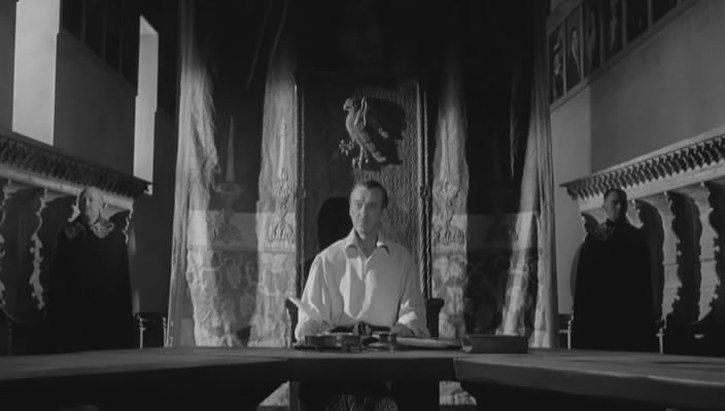
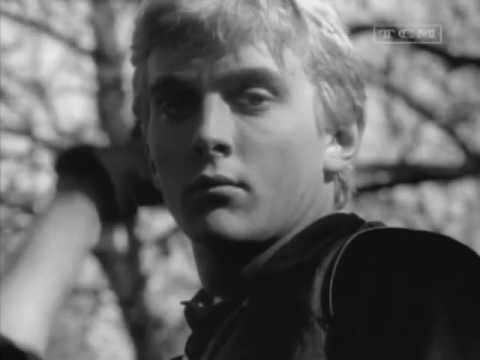
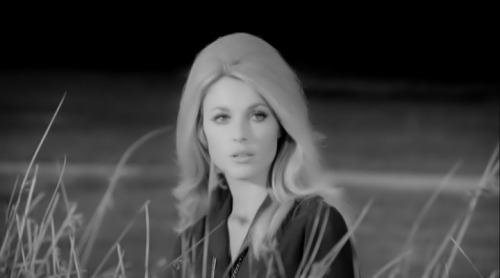
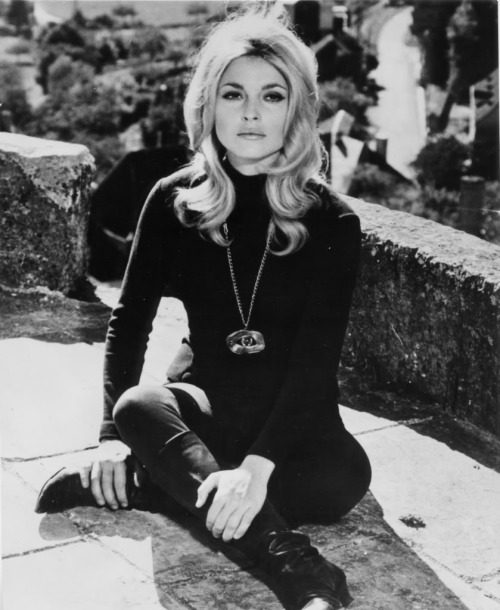
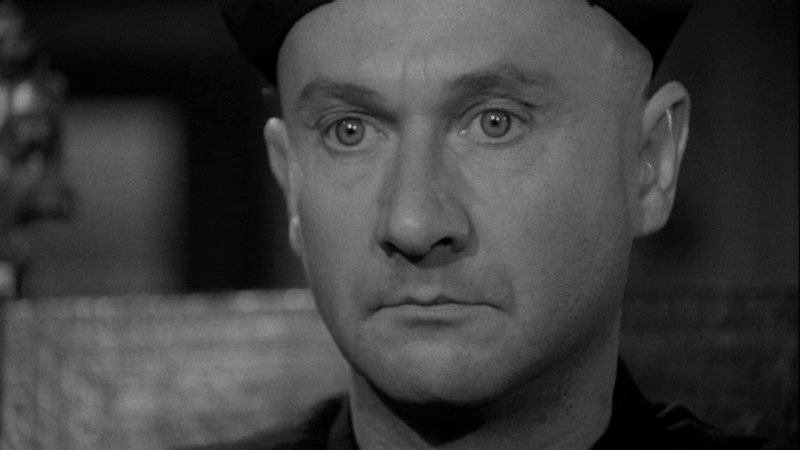
Phillipe's Aunt Estell (the wonderful Flora Robson) is outward-smiles, but suggests that all things are fine (dear), why don't you go home? Then, there are the strange kids hanging around, Christian and Odille de Caray (David Hemmings and "introducing" Sharon Tate, dubbed). Christian thinks nothing of bow-skewing a dove in front of the wife and kids and Odile is all heavily-made-up blond-thing-in-a-black-catsuit (Were they able to watch "The Avengers" in Bellenac?). Then, there's the unwelcome presence of Father Dominic (Donald Pleasence, whose name rhymes with "unwelcome presence," especially in the 1960's), who has the gaze of a psycho and looks like if he ran out of wine, he'd skip a step in the Mass and just serve blood to the parishioners, instead. Plus, Mrs. de Montfaucon has creeping "Rebecca" disease, where the uneasy mistress of the house can't stop poking around all the dark corners and shuttered rooms of the castle. One night, she finds a conclave of robed visitors surrounding her husband in a circle, and frightened, she runs into a mysterious man who tells her to go far, far from here.
Does she?  Nope. Not even when the kids are encouraged to play near the edge of the castle's high parapets by Odile, not when she is nearly sent over the edge herself, and not when she decides to take an impromptu trip to the family mausoleum and finds herself surrounded by those 12 hooded...who-evers. She doesn't get a clue when she finds the word "DEMON" chiseled into the mausoleum's wall.
It's a mess of a film, trying to emulate the Hammer style of occultish films—long entrance to the story, heavy atmospherics, and heaving starlets—and it probably would have been this messy even with the original players. The first director attached was Michael Anderson, then Sidney J. Furie (probably where a lot of the confusion came in, even though it worked well with The Ipcress File), then, briefly Arthur Hiller, then J. Lee Thompson came in to pick up the pieces. When filming started, the cast was in place, but Kim Novak was playing the role of Niven's suspicious wife, and left the production weeks into filming.** Kerr was quickly hired and any frame involving Novak had to be re-shot. There's only so much work-around you can do, and that's why Eye of the Devil looks so odd in presentation. It's a patch-work affair with a good cast and good intentions, but a Frankenstein monster of a script and a completion cut. 

Maybe it belongs in the "Horror" category, after all.

No, really, honey, what was your first clue?


* And when I say "movie terms" I mean the ageist and sexist tropes that go along with film entertainment (and not just Hollywood, folks)—that an older woman can't have younger children, or that older men can't have wives that are older than, say, 20.  Or that older film stars can have mothers who are two years older (or younger) than they are

** "Creative differences." Let's call it that. It was explained away as a back injury from a horse riding scene (Novak is an excellent equestrian and lives with her vet-husband on a horse ranch these days) for insurance purposes. These things are always "he said/she said." Kim Novak is an extremely talented actor, who manages to make the most of material, good, bad and indifferent. She was particular in how she wanted to come across on-camera for the character and that could rankle the front office. But, it is also tough to negotiate the "boy's club" of the picture making industry, and if you want to take control at all, you're considered "difficult."  I'm sure that leaving the production was a difficult decision.  I found this interesting web-site that tells the changing story.