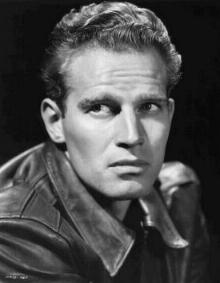
The Wreck of the Mary Deare(Michael Anderson, 1959) It was intended to be an MGM production for Alfred Hitchcock—he'd liked the best-seller and he'd wanted to work with Gary Cooper since Foreign Correspondentin 1940—but screenwriter Ernest Lehman found it pretty dull with an extended, dry courtroom scene at the end, and the two decided to fulfill his real ambition—to make the "ultimate Hitchcock film"—which turned out to be North By Northwest. We are all the better for it. As it is, The Wreck of the Mary Deare is an odd picture with a great mysterious opening and a dry-as-dust finale, try as scripter Eric Ambler and director Anderson might to make a suitable action closer to it. In turbulent seas in the English Channel, a salvage tug, captained by John Sands (Charlton Heston), finds a ghost-freighter marooned and adrift, nearly colliding and destroying his ship. Pulling alongside, Sands grabs a dangling line and laboriously clambers aboard. The rusting hulk, the Mary Deare, is without power, a large gash in its side that is slowly flooding the engine room, and with no sign of life on-board...at least initially.
One man has remained—First Officer Gerald Patch (Cooper), a merchant marine eking out an existence on the ship, which was recently abandoned, and desperately trying to scuttle it before it sinks of its own accord. The reason is not because he wants it to be salvaged; he needs it for evidence, but why is being kept a closely guarded secret. With the reluctant help of Sands, Patch gets the boiler-room going, the ship under power, and the Captain-by-default's mission accomplished.
All of which is great stuff—the conflicts, the questionable sanity of Patch, Sands' greediness in wanting to claim the salvage on the ship—which would have made a great film if it ended there. Unfortunately, that's only thirty minutes of it. It would have been a great short subject, though, but the movie trundles along over the investigation and trial over who owns the boat and the conflicting testimonies between Patch and the eventually-found crew (ring-leadered by Richard Harris, who can't seem to eke out an interesting performance from the material, try as he might).
Michael Anderson is no one's idea of an innovative director—and he started his career assisting David Lean and Carol Reed! His widescreen compositions look like they're meant to be cropped for a boxy television presentation, although he was known for taking elephantine projects—Around the World in 80 Days, Logan's Run—and making them as quickly and cheaply as possible, There is the sense watching his films that a creative presentation, rather than a practical one, was thought unnecessary—keep the focus, hit the marks, and, as far as lighting, make sure the audience can see the stars' faces.
Both Cooper and Heston are good, in what seems to be dueling portrayals of earnestness. But, ultimately, the secrets that Patch is keeping just aren't very interesting, and although some attempt is made to salvage it at the end, the movie is, like its namesake, something of a drifting hulk.
Let's just take that out of the equation and take the film for what it is.
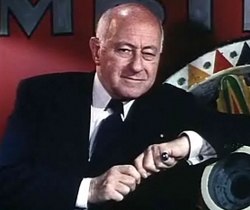
The Greatest Show On Earth is an extended commercial/documentary/drama for The Ringling Brothers and Barnum and Bailey Circus. Filmed in eye-popping Technicolor (which is where the film, showing off the bright colors in many hues, truly is spectacular), that begins with the Director sepulchrally narrating a series of work-a-day location footage of the circus being prepped for its yearly run. The pompous tone that he sets is akin to a war film, the army metaphors stacked up thick and deep like a chain of marching elephants, with all the accompanying lack of grace and subtlety. Leave it to DeMille to take the fun out of a circus and turn it into something resembling boot-camp.
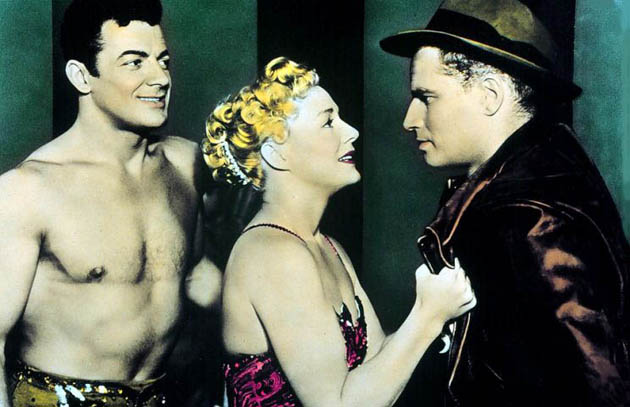
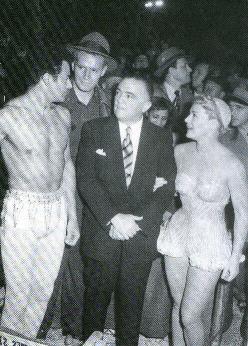
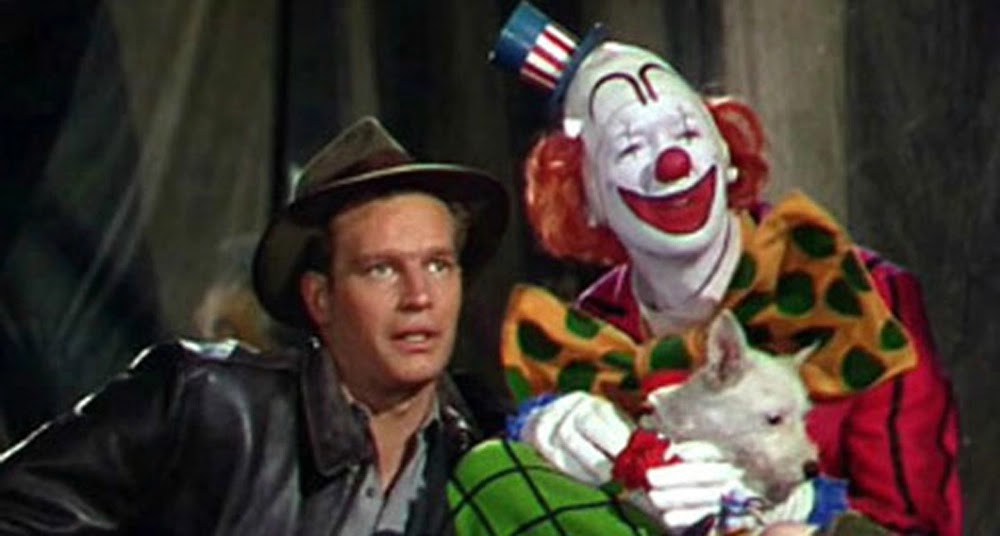
We transition (roughly, as DeMille's favorite transition is a quick right to left scene wipe, making it all seem like a moving slide-show) to the stars of the film acting roles that the folks who are told to stay out of their way actually do. Charlton Heston is the circus "boss"—the show-runner, if you will—who, in order to guarantee a "full season" (the complete city tour) has brought a marquee name, "The Great Sebastian" (Cornel Wilde, cheerily smarmy) to take the center ring, displacing his aerialist sweetie, the plucky but vain Holly, played by Betty Hutton.
This top-billed character is particularly annoying. Hutton could play dumb well (with a vocal range from A to A-), but here's she's a schizo in need of a pair of padded tongs and a generator, with a change of motivation and character for every change of scene. Buffed up to do her own trapeze stunts (smattering of applause for that), her character is so insecure that she's a harpie spinning like a Tasmanian Devil: "I HATE the Great Sebastian!" "I'm JEALOUS of the Great Sebastian!" "I LOVE the Great Sebastian," "No, now I HATE the Great Sebastian!" "I LOVE you, Sebastian!" "I feel GUILTY about Sebastian" "I'm going to forsake my Ca-REER for Sebastian!")
I pity Sebastian, myself. As well as Heston, the guy you see rubbing his neck from whip-lash. See, she's in love with his character, although she's annoyed with the fact that he spends all his time trying to keep the Circus going, thus letting her keep the only job she's capable of, besides waving on floats. Hutton's Holly not only wears her heart on her sleeve, but also her ankle, around her pretty little neck as a broach, as a hat, anything but a symbol of commitment. She accuses Heston's Brad Braden**of having "sawdust in his veins"—at least he's got something in his. I wanted her capped in the head with her own trapeze twenty minutes in. Probably sawdust in that, too.
No such luck. Before one can turn their attention to what Holly would look like in the tiger-cage and quicker than one can shout "Sebastian! No! Don't do it without the net!!," tragedy does befall the circus leading to broken bones and souls, angst and recrimination and another case of Holly-pong in desperate need of a net...held by men in white coats.
The movie sets up a dull pattern: stentorian documentary section narrated by DeMille on "Circus as War Machine"/slide wipe to melodrama/slide-wipe to an extended sequence of abbreviated cir-cussedness that manages to make you feel slighted while still feeling interminable each time. Along the way, much of the subjects' opportunities are squandered, if not down-right sabotaged. For a scene of DeMille's heavies planning badness, DeMille stages the two Runyon-esque hoods***(without the quaint patois) in front of a process shot simulating the outdoors. Halfway, DeMille cuts to a tighter shot of the two, but behind them the projection-screen image doesn't move, making it look like they've quantum-jumped closer to the camera. It's an amateurish give-away of a process shot.
And there's a cynical, rather crude attitude towards the circus audience—pandering to the audience while bashing them at the same time by endlessly showing giddy parents consuming ice-cream cones while their bored children look like they to want to erp up their cotton candy. But as the originator of this particular circus so famously said: "There's a sucker born every minute!" DeMille knew that lesson well.
Another little game of the movie is a sporadic "Spot the Stars." There's Hopalong Cassidy! There's...somebody? Is that dewey debutante Jeanne Crain or a DeMille "ingenue?" And Bob Hope and Bing Crosby show up during Dorothy Lamour's number because its a Cyclical Universe on the Paramount Lot, with very tight gravitational rules; you could almost make a case for Creationism.
"Hey, is that Roddy McDowell?"
At some point during this megalith, you begin to realize with butt-numbing certainty, that if DeMille had cut out any of his "Circuses aren't some pink clown-show, they're American Hard Work" lectures, or maybe cut a "Tribute" sequence or parade or two, or one of the forgettable songs (or allowed Holly one less seizure) that the movie wouldn't have had to clock in at 2 1/2 hours in length.
2 1/2 hours is a longish book, with...ya know...subtleties, not a circus movie. But DeMille must have seemed unable to strip whole sequences, however redundant, away. Like Spielberg wanting to over-stuff 1941**** with beloved-by-none-but him-gut-and-budget-busting sequences, DeMille super-saturates the screen until the Technicolor fairly bleeds. And he couldn't bear, or didn't know enough, to cut any of it.
The only thing never mentioned in the many of DeMille's "Bozo Marches On!" narrations, is the requisite shoveling of the tons of manure. Why bother? The evidence is all there on the screen.
In a brilliant "meta" move, DeMille stages a train-wreck in a train-wreck.
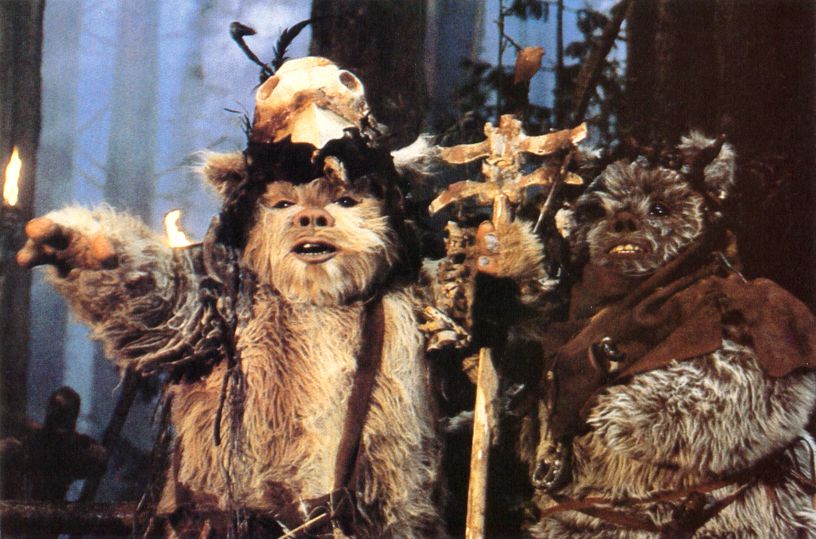
** ?...Brad Braden...of the "we-couldn't-come-up-with-a-better-last-name" Bradens? I think he became an "Ewok" trainer in later life.
*** One of them being Hollywood bad boy/guy Lawrence Tierney. He and Heston have a seething scene of clashing testosterone blasts.
**** It was this very movie that inspired the Spiel-boy-g to pursue a career directing films. Spielberg learned his lessons concerning movie elephantiasis in his 20's. DeMille was in his 60's.
The Big Country(William Wyler, Robert Swink, 1958) One of those films you hear so much about—when one is talking about "epics"—that, once you see it, you wonder what all the fuss is about. Oh, the technical specs are there: stunning cinematography by Franz Planer in Technicolor and Technirama(although early videos before remastered DVD's tended to look a bit washed out and squeezed); a top-notch cast where Charlton Heston is only fourth-billed; and a rousing score by Jerome Moross that busily pumped up the excitement when nothing much was happening (director Wyler evidently hated the score, but it rarely flags—much the same way Elmer Bernstein's score for The Magnificent Seven goosed that film a couple years later). And William Wyler's framing has just enough "edge" to it that when he went off to prep Ben-Hur in Rome (leaving second unit director Robert Swink to finish it) the difference is extremely noticeable. Swink managed to solve some story-issues, but the "snap" of Wyler's visual flair just isn't there, especially in its use of the Technirama frame.
East-coaster James Mackay (Gregory Peck), a sailor by trade, has traveled out West to San Rafael to marry his beloved, Patricia Terrill (Carroll Baker), daughter to "The Major" (Charles Bickford), wealthy land-baron and owner of the Ladder ranch. He's met by ranch foreman Steve Leech (Heston), who takes one look at McKay's city-slicker duds and pegs him for a "rube," especially galling as he's a little sweet on his boss' daughter, as well.
What McKay doesn't know is he's stepped right into a situation not too far afield of Dashiell Hammett's "Red Harvest" where two warring factions are competing for supremacy—the Terrill's and the Hannassey's (led by the blustery Rufus Hannassey played by Burl Ives in an Oscar-winning turn). San Rafael may be "Big Country" (as McKay is continually told by locals), but it doesn't seem to be big enough for two ranches and their respective herds of cattle. The burr under everybody's saddles is the Maragon spread, which has an accommodating body of water for watering the parched cows out on the chaparral. The late owner of the area kept the peace by allowing access to everyone, but things seem to have gotten out of control, now that it's run by Maragon's daughter, school-teacher Julie (Jean Simmons). Seems the strategy for dealing with her is to either make her sell or marry her and she's not having any of it.
And McKay is metaphorically a fish out of water. He doesn't fit in out West. He does things differently than they're used to in the passive-aggressive West. When a bunch of Hannassey's men (led by son Chuck Connors) have a little fun drunkenly hog-tying McKay, the Terrill's want to string them up—and even shoot up the Hannassey ranch over it—but McKay dismisses the attack and doesn't want anybody escalating the tensions on his behalf. That's not how they do things out West! And McKay is taken to be a coward, something driven home when Leech offers the use of the horse "Old Thunder"—withholding the information that "Thunder" is a notorious ill-tempered bronco—which McKay refuses, not wanting to be made sport of.
While the Terrill's are off on their little pissing match, McKay secretly works with the horse, constantly being bucked off*, until it finally is worn down and acquiesces to being ridden. McKay chooses to keep that knowledge secret—he doesn't give a rip what the others think of him, nor does he check with anyone when he takes a solo sortie out to the Maragon place to inquire about purchase. The Terrill's go into a panic at his disappearance, not realizing that McKay knows how to navigate...and evidently never having seen a compass.
McKay's "otherness" is played up in a lot of the film for drama and comedy—McKay's never acquiring the hang of greeting with "Howdy" or "Good Morning" garners an exquisite Peck triple-take—and his stoicism may be the biggest point of the film. Wyler had some dealings with water-rights in his private life, but he saw The Big Country as a Cold War allegory of oneupmanship and territorial transgressions using the philosophy of "Might Makes Right." His protagonist is no antagonist. Peck's McKay doesn't like violence, and though he does carry guns in the film—they're a gift to the Major in a fancy case—he only fires one once...and quite deliberately. In a wild west with so many characters shooting promiscuously (as they say in The Wind and the Lion), McKay's naval Captain makes a third act resolution a little problematic—the film was constantly being rewritten while in production (much to the consternation of the actors). It's what happens when you concentrate on "The Message" rather than "The Story."
It's an odd Western where so much of the footage is of someone thinking rather than acting (or "reacting"). It throws the pacing off—Moross' score helps speed through the gaps—and there are a couple of dodgy "within-the-take" edits indicating that someone was aware of the pokiness. The overall effect is to make one think that the West is some kind of "Crazy Town"—maybe there's something in that water!—where everyone is just a little too quick to make assumptions and stubbornly adhere to them no matter what anyone says. Except for the one stranger who sticks to his lack of guns and is comfortable in his own skin, no matter what anybody else thinks. One may initially think that the heads of the Terrill and Hannassey clans are the stubborn ones, but there's enough mule-headedness in everyone to go around.
The West is thus a place of contradictions—you have to be strong and stand up for yourself, but in a way that the community approves of, and if you change to accommodate them isn't that going against that principle? Maybe that's what Peck is thinking about throughout the movie (the Westerners certainly don't appear to be thinking!)—stay methodical and tenacious and consistent and maybe you can wear people down in the same way as "Old Thunder." And...if you do that enough over time...maybe, just maybe...you can bring life to the desert and bring civilization to the wild.
* Peck, of course, doesn't do the stunts himself for obvious safety reasons, but in addition the horse's owner insisted on doing the stunts himself. That owner was Slim Pickens.
Cameraman: The Life and Work of Jack Cardiff(Craig McCall, 2010) I love films about cinematography and there are damned few of them; I tend to come away with a new appreciation of light and vision, and the world looks fresh and new, bright and awash with color. It happens so rarely when I watch films where the world seems different post-movie—the films of Orson Welles or Nicholas Roeg do that to me...and films about cinematography.*
Documentarian Craig McCall shows it all and knows how to get great quotes from the man and anecdotes about the various personalities he worked with, the directors he worked for and the subjects he photographed, literally a man in the middle who knew how to make both sides look their best. Some of the surviving directors give testimony, as well as Martin Scorsese, Powell's editor-wife Thelma Schoonmaker, Lauren Bacall, Charlton Heston, Kirk Douglas (a rare post-stroke interview), John Mills, as well as Moira Shearer, Kim Hunter and Kathleen Byron.
In showing the history of this one man, it is also a fascinating overview of the entire art and history of the cinema as well, and how the well-composed image is as timeless as beauty itself. This is gorgeous to look at, and very educational and highly, highly recommended.
* One of my favorites is Visions of Light, which was produced with the ASC Union and has a broad spectrum of subject matter and timeline, as does Camerman. You can't do a film about lighting movies without mentioning Dietrich, and I'll always remember that 45 degree angle trick.
So, there's a link to buy Visions of Light, but YouTube has two versions of it: one in its original format with cut-away's to interviews and some disturbing format transitions, and a remastered meticulously recreated version that gives prominence to the cinematography
Major Dundee(Sam Peckinpah, 1965) Semi-restored version of Major Dundee that's a bit closer to the idea Sam Peckinpah had in mind when producer Jerry Bresler took the film over, edited it with a meat cleaver and threw on a wildly inappropriate score (a ranch massacre with bodies littering the desert and the main house on fire until it collapses is set to a bouncy Mitch Miller tune?* Say, what? Peckinpah has been accused of bad taste in his movies, but he'd never have pulled something as egregious as that!). Peckinpah's first A-budget movie has a great story. A hard-nosed Union Major, Amos Dundee (Charlton Heston)**side-tracks a bit from the Civil War to capture or kill the marauding Apache chief who torched that outpost. To do so, he must cross the border to Mexico in a mission that doesn't officially exist. His requisitioned army of nobodies employs cut-throats and horse-thiefs, Confederate Rebels and Buffalo Soldiers. No one asks: Can't we all get along? It's just assumed that they can't, but a sense of order and hierarchy is maintained within the groups, while the groups test and prod each other en route.
And the film is full of detail (you want to see it on a big screen). There are some extraordinary screen-caps from the film below that show Peckinpah's innate ability to fuse landscape and character, not unlike John Ford, whom Peckinpah seems to emulate while presenting either a celebrational rabble or a ceremonial piety but infused with a more cynical rough-hewn presentation. I don't think John Ford would have had a soldier swatting flies away from a war wound, but I could be wrong.
Heston is a bit of an odd man out in the film, his acting rhythms are slower than Peckinpah is able to deal with in his cutting style (in fact, there's a couple places where Peckinpah cuts in the middle of Heston's reaction shots just to speed the man up a bit) and the clashes show. In an interview, R.G. Armstrong calls Heston "a poser," (which is certainly true, but also calls him "the nicest guy in Hollywood"—Heston gave up his salary to keep an embattled Peckinpah as director***), but Heston loosens up quite a bit in this film than he had in any previous one, setting a tone for his subsequent work as less heroic, more recognizably human presences.
But the movie falls apart somewhat, when the troop liberates a starving town from the French; everyone looks impoverished (even the dogs outside town are skin and bones), the exception being the widow Santiago (Senta Berger)**** whose nursing duties among the starving citizens hasn't reduced the glow in her cheeks or made her any less voluptuous. Her presence and the subsequent romance with Dundee just doesn't sit well with the grit of the rest of the movie, and so Peckinpah wounds Dundee and sets him on a rehabilitating toot that manages to negate a lot of the nobleness of the character, and undermines a couple other parts as well.
A broken arch does not connect (and thus dooms any romance) between Major Dundee and Teresa Santiago (Senta Berger)
Production began before a suitable third act was constructed, and Peckinpah was convinced that once filming had begun, the script would be hammered out. But production delays and disputes between the director, the studio and the producer ate up a lot of that valuable work-time. And Peckinpah began to drink, most days towards the end, showing up drunk on the set.
Peckinpah gives shape to Richard Harris' Captain Tyreen caught between his sense of honor and loyalty to the Confederacy.
Still, up until the romance, it's a gritty, atypical Western story with integrity and a nice mature brusque edge to it. Studio interference would hamper this film and dog Peckinpah for the rest of his career.
The remains of Dundee's command escape the French across the Rio Grande. A shot with such depth it approaches 3-D.
* The opening credits run over the shot of the house burning, and the structure collapses when the director's credit comes up. Peckinpah liked to do things like that.
** To give you a flavor of the writing by Peckinpah and Harry Julian Fink (Dirty Harry), Dundee is characterized as a "$70 red-wool, pure-quill military genius or the biggest damn fool in Northern Mexico."
*** When asked by a reporter if that would set a precedent among Hollywood actors, Heston said, "It's not even going to set a precedent with ME!" A great line.
**** Peckinpah was dissatisfied with the romance story-line imposed on the script but not the actress: Senta Berger would work with Peckinpah again (and James Coburn) in the director's fine Nazi war film Cross of Iron.
Khartoum(Basil Dearden, Eliot Elisofon, 1966) The Middle East has long been a daunting prospect, like the desert terrain that makes up so much of it. If the world's problems stem from an innate tribalism, the most embedded, ancient forms of it come from there for the longest time. And, hey, if they've lasted that long with it, how bad can it be? Pretty bad. Tribalism, in all its forms, be they religious, political, affillial or other origin, comes from the innate need to no longer be alone and gain strength through numbers, while simultaneously separating ourselves into camps or sects, creating that bond of community and distancing ourselves from that "other." "I am this, and 'they' are that." And if "they" are "that" then they are not me. Tribalism simultaneously bonds and divides, whether you're a Muslim (Sunni or Shia) or a Jew (Orthodox or Reform), Democrat or Republican, Conservative or Liberal, Communist, Socialist, "John Bircher" or "Tea Party", Union, Confederate, Army, Navy, Freudian or Jungian, Creationist or Evolutionist, Freemason or Elk, Black Lives Matter and IUPA. "Liberté, égalité, fraternité?" One of these things don't belong with the other. But, seemingly, the world starts to look a bit less complicated when it's "us" versus "them." It makes it a lot easier to not think for ourselves and submit to the dictates of mob rule. How bad can it be? For myself, I subscribe to the Marxist philosophy (Groucho): "I don't care to belong to any club that will have me as its member."
Khartoum was written by Robert Ardrey, the author of "African Genesis" and "The Territorial Imperative" and is a somewhat Hollywood-ized version of the Siege of Khartoum in the mid-1880's. At the time Egypt controlled Sudan and the British Empire claimed Egypt as "a protectorate." Muslim extremists, jihadists, followers of Muhammad Ahmad, the self-proclaimed Mahdi and "redeemer" of the Muslim nation, were determined to wrest Sudan from Egyptian rule and set himself up as leader of Sudan and of all the Muslim nations (he eventually did take over Sudan, imposing Shariah law, and eventually dying of typhus six months into his rule*).
When the film starts (in 1883) England is reacting to the killing of 10,000 Egyptian troops by Ahmad's supporters, who are on track to take on the capital of Khartoum. The Prime Minister, William Gladstone (Ralph Richardson) is reluctant to send "boots on the ground," and at an impasse as to how to proceed, not commit and still appease the Queen and the British public. The British foreign secretary (Michael Hordern) suggests an alternative: send in one particular man, Major General Charles George "Chinese" Gordon (Charlton Heston), the former governor of Sudan, whose popularity in Britain is widespread. He is given one task—evacuate the civilians and troops from Khartoum and that is all. He is told that he is going in by himself, without the sanction of the British government, who will deny any knowledge of his efforts if he fails. Gordon, who suffers from hubris, has an impatience with authority other than his own, and a paternalistic leaning toward the people of Sudan based on his past work, agrees to the assignment.
The British politico's know that, Gordon being Gordon, he will overstep his mission, and they want to see what will come of that, without risking British lives and without direct accountability. Gordon, confident, travels to the Sudan.
He is greeted in the Sudan as a hero, and immediately begins organizing the Egyptian forces for defending the city. His is reminded by his aide, Col. John Stewart (Richard Johnson) that he is already overstepping his bounds. But, Gordon pays no heed. He will not "cut and run," he's going to go to the root of the conflict.
The movie-Gordon decides that he must pay a visit to Ahmad (Laurence Olivier) himself. This never happened, and is probably as ludicrous as going to talk to Usama bin Laden over tea.But, it does afford Heston the opportunity to do a couple of scenes with Olivier, who is heavily swathed in a make-up merely a few shades lighter than his "Othello" was, and employs an accent that is high-ly "rimi-NI-scint" of Leo McKern's Clang from Help!**
That aside, the scenes between Heston and Olivier are the highlights of the film, besides the battles that play out impressively in the Ultra-Panavision format (the film was released in Cinerama) and if the two directors can't be said to be especially "impressive" in how they put the film together (Dearden directed the least effective parts of the Ealing horror anthology Dead of Night), at least they fill the screen with detail to take advantage of the widescreen format.
When Ahmad makes it clear to Gordon that he will not stop his jihad until he has prayed in every mosqueall the way through to Constantinople, overrunning cities if he has to, in an effort to solidify his position as the appointed instrument of Mohammad on Earth among the Islamic people. If Gordon has any doubts as to his intentions, he shows Gordon the heads and hands of English (including the war correspondent of The Times) and French who have been slain in his battles. Gordon leaves, alarmed, but not before assuring the self-described Mahdi that, as a religious man, he sees the battle as one between competing Gods.
"Is it not your own ring?"
Gordon, rather than evacuating Khartoum, begins to set up defenses, digging deep trenches between the Mahdi's forces and the city, allowing the Nile itself to fill the trench and create a discouraging moat for the jihadists. At the same time, he arms the city and trains forces in the hopes that he can stay the Sudanese until reinforcements are sent from England, something Gladstone is reluctant to do.
Inevitably, time works against Gordon and when the Nile recedes, his moat dries up and the city is overwhelmed by 100,000 jihadists in an assault from the front and from the Nile. Accounts vary, but Gordon was killed in the attack—the movie's version of it has Gordon dying as a martyr as was presented in the painting by George W. Joy—the first of quite a few spears that Charlton Heston would take throughout the rest of his career.
The film was relatively successful and earned Ardrey an Academy Award nomination for best screenplay. Heston, who had hoped for better known British directors—like Lewis Gilbert, Guy Hamilton, or Guy Green—to oversee the project, was only relatively satisfied with the results. What Khartoum does do, no matter the results of the film, is to provide a bit of historical perspective in light of recent events in history. There is nothing new under the sun, even the one that beats down on the desert. These conflicts will arise as long as humans insist on creating borders, imaginary or otherwise, to emphasize what divides us, rather than what unites us. You'd think in a desert, one of Nature's harshest environments, there'd be more of a collective effort to conquer it, rather than each other. إن الله لا يغير ما بقوم حتى يغيروا ما بأنفسهم
On the technical side, it is interesting to note that Khartoum was the last film photographed in "Ultra-Panavision 70" until Quentin Tarantino made The Hateful Eight 49 years later. So, Khartoum still holds the title of being the last good film photographed in Ultra-Panavision and making the format worth it.
Frank McCarthy's key art for Khartoum featuring one version with Olivier and the other without.




.jpg)


_01.jpg)