The Wreck of the Mary Deare(Michael Anderson, 1959) It was intended to be an MGM production for Alfred Hitchcock—he'd liked the best-seller and he'd wanted to work with Gary Cooper since Foreign Correspondentin 1940—but screenwriter Ernest Lehman found it pretty dull with an extended, dry courtroom scene at the end, and the two decided to fulfill his real ambition—to make the "ultimate Hitchcock film"—which turned out to be North By Northwest. We are all the better for it. As it is, The Wreck of the Mary Deare is an odd picture with a great mysterious opening and a dry-as-dust finale, try as scripter Eric Ambler and director Anderson might to make a suitable action closer to it. In turbulent seas in the English Channel, a salvage tug, captained by John Sands (Charlton Heston), finds a ghost-freighter marooned and adrift, nearly colliding and destroying his ship. Pulling alongside, Sands grabs a dangling line and laboriously clambers aboard. The rusting hulk, the Mary Deare, is without power, a large gash in its side that is slowly flooding the engine room, and with no sign of life on-board...at least initially.
One man has remained—First Officer Gerald Patch (Cooper), a merchant marine eking out an existence on the ship, which was recently abandoned, and desperately trying to scuttle it before it sinks of its own accord. The reason is not because he wants it to be salvaged; he needs it for evidence, but why is being kept a closely guarded secret. With the reluctant help of Sands, Patch gets the boiler-room going, the ship under power, and the Captain-by-default's mission accomplished.
All of which is great stuff—the conflicts, the questionable sanity of Patch, Sands' greediness in wanting to claim the salvage on the ship—which would have made a great film if it ended there. Unfortunately, that's only thirty minutes of it. It would have been a great short subject, though, but the movie trundles along over the investigation and trial over who owns the boat and the conflicting testimonies between Patch and the eventually-found crew (ring-leadered by Richard Harris, who can't seem to eke out an interesting performance from the material, try as he might).
Michael Anderson is no one's idea of an innovative director—and he started his career assisting David Lean and Carol Reed! His widescreen compositions look like they're meant to be cropped for a boxy television presentation, although he was known for taking elephantine projects—Around the World in 80 Days, Logan's Run—and making them as quickly and cheaply as possible, There is the sense watching his films that a creative presentation, rather than a practical one, was thought unnecessary—keep the focus, hit the marks, and, as far as lighting, make sure the audience can see the stars' faces.
Both Cooper and Heston are good, in what seems to be dueling portrayals of earnestness. But, ultimately, the secrets that Patch is keeping just aren't very interesting, and although some attempt is made to salvage it at the end, the movie is, like its namesake, something of a drifting hulk.
In these days of communicable diseases and precautionary measures for the greater good, folks on both sides of the aisle and of every color-stripe are being a little flippant with the "N"-word—"Nazi." So, just for a refresher course, we are going to sub-set the "Spies" series we're doing with movies where there are Nazi's (you know, "the bad guys"—Indiana Jones fought them in Raiders of the Lost Ark!) And we're going to call it "Nazi's...Nazi's everywhere." Oh. And "Saturday is "Take Out the Trash" Day...
The Quiller Memorandum(Michael Anderson, 1966) This low-key spy film came out in the Christmas glut of 1966, competing with two other spy films released at the same time: Funeral in Berlin, the second Harry Palmer film to star Michael Caine and Murderer's Row, the second of the "Matt Helm" films starring Dean Martin. Blame Bond. The success of the James Bond series in the 1960's overwhelmed the movie marketplace with secret agents in plain sight, a rolodex of acronymically named organizations, disposable starlets, and a fawning desire to seem "hip" while toeing the party-line during the Cold War. It was a very odd time. The Quiller Memorandum slotted somewhere in between the two films, both in temperament and quality. Funeral was a typical spy film that took itself very seriously, while the Dean Martin picture was a parody of the Bond series (which itself is a bit of a parody) that took nothing seriously. And Quiller, which had an estimable cast and boasted a screenplay by Harold Pinter, should have been the best of the lot, but has a lackluster quality despite key ingredients.
The film begins with the late-night murder of a man in a phone booth in Berlin, the consequences of which inspire a breakfast meeting between two British functionaries (played by George Sanders and Robert Flemyng), who supercilliously discuss the next person to take over the assignment that got the man killed—making him the second—with as much import given to the quality of the meal as to the matter of men's lives. Pinter's dialogue is circuitous, ambiguous and names are not used, merely initials.
Quiller (George Segal) is "on holiday" after an assignment in the Middle East and has been tapped for the assignment, the third man, and he is briefed on his task ("this is not an order...more of a request...") by Pol (Alec Guinness) in Berlin's Olympiastadiom ("...certain well-known personalities used to stand right up there" Pol deadpans). Quiller knew the other agents, knows that they refused cover on their assignments and that he will be watched for his protection. "The request" is to get a handle on the base of a strong Nazi element in Berlin, a new guard, "Youth...Nazi from top to toe_in the classic tradition...difficult to pinpoint. No one wears a brown shirt anymore, you see. No banners. Consequently, they're difficult to recognize—they look like everybody else."
Quiller begins by losing a company-man tailing him, then doubling back and finding what he wants. It's his contact who gives him research papers from the previous attempts. It's not promising: a receipt from a bowling alley and a swimming center, and an article about a teacher who has committed suicide after being accused of war crimes. He checks each location, glibly giving different covers, and blithely acting the fool, but finds nothing of interest other than the dead teacher's replacement, Inge Lindt (Senta Berger), but his interest is not particularly professional.
Quiller knows he's being watched, but his plan to let "the other side" know he's in town seems to be working only too well—the number of people matching his moves is starting to increase, but it is only when he is drugged*, kidnapped and interrogated by head-man Oktober (Max von Sydow) that his suspicions solidify. Perhaps his playfully losing his body-man speeding on the highway wasn't such a good strategy.
"You must be lonely sitting here among strangers." "No...I like meeting people.."
When the drugs wear off, Oktober begins the interrogation: "My name is Oktober. What's yours?" Quiller deflects, lies, makes up fanciful stories ("They call me 'Spike'"), moving around Oktober's direct questions and attempts to appeal to the hopelessness of his situation—he already knows who Quiller is and what his past assignments are, so Quiller's cheeky replies that he's a rare book purchaser at Doubleday's named O'Reilly-Kennety ("a double barreled name I found kind of weighty"), but this gets Oktober nowhere, so he zeroes in on his specific wants.
"You got a telephone around here? I should call my lawyer in New York, a guy called Kaspensky... I'll make it collect so don't worry about that."
Oktober seeks "the exact location of your local Control in Berlin. We would like to know a little more about your current code-systems. We would like to be able to appreciate the extent of your knowledge about us. And also, what information, if any, your predecessor managed to pass to your Control. We would like to know the exact nature of your present mission in Berlin. You're a sensible man. You know perfectly well, you must give us this information since you have no alternative."Quiller considers this, looks a bit sheepish for a few beats then asks for a telephone to call his lawyer.
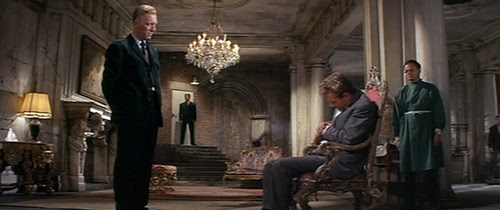
Sydow goose-steps a very fine line between menace and amusement during the sequence, cracking his knuckles and speaking in a cooing, clipped German accent, cajoling, seducing, grasping at straws of information that Segal babbles under further drug injections. But, Segal, try as he might, doesn't quite sell his struggles during the interrogation, except for a weak desperation. Perhaps it's because he's previously been so cocky and glib—but not in the manner of his minders with their noblesse oblique—he's a bit of a smart-ass, and if Segal was looking to inject some comedy in a straight-ahead thriller (that everyone else is treating satirically), it's at the cost of caring what he goes through and his competence at his job.
Oktober finally tires of his efforts and gives orders for another injection and when Quiller is out cold to kill him. But, Quiller wakes up on a half-submerged pier, shoe-less and groggy, but competent enough to hijack a taxi and escape pursuers. But, the point is: he's alive when he should be dead. The Nazi's want to use him as his Division does—to lead them to the opposition. At his next meeting with Pol—far less in the open that their previous one—Guinness' spy-master spells it out, using muffins:
"Let me put it this way. There are two opposing armies drawn up on the field but there's a heavy fog- they can't see each other. Oh, they want to, of course, very much. You are in the gap between them. You can just see us, you can just see them. Your mission is to get near enough to see them, to signal their position to us so giving us the advantage. But if, in signaling their position to us, you inadvertently signal our position to them it is they who will gain a very considerable advantage. That's where you are, Quiller. In the gap."
It's the most obtuse of missions without an end-game. Find out where they are, but don't tell them where we are. And Quiller, not sure of either side—having been set up as bait—and being used by friend and foe alike for the exact same purpose, becomes what he babbled under narcotics—"I am my own master." He'll do the job—give them the address of the Nazi base—but will do it his way, not telling them how, lest he be betrayed.
The film is so subtle for most of its length that when the film attempts to do something big, it comes off as ham-fisted, a bit like Segal's choice of mannerisms, played for comedy and without a lot of nuance. One wonders why he makes the choices he did, but one also wonders what would have happened to the overall tone of the film if the first choice, Charlton Heston had managed to secure the deal. One does not think it would be for the better.
Anderson's direction is better with location than people. Every so often, one gets a good composition with a cluster of actors in it, but most of the time, the shots are perfunctory and sometimes a bit clumsy, as with the shot of Senta Berger below. So much wasted space there, when he could have shown the gulf existing between Quiller and Ilsa—both kept alive as useful tools of the new Nazi's—by careful use of the widescreen format (even if subsequent versions have been cropped).
What does benefit the film is the odd score by Bond-composer John Barry, who abandons the Kentonesque jazz he'd employed in other thrillers and built his themes around a childish-tune played on a cymbalon, with an off-key whistling melody buried underneath that gets under one's skin, leaving an unsettling feeling of menace. It's not a soundtrack that would "chart," necessarily, (and has always made for an agitated listen) but it certainly works better at conveying the ambiguous ending. It's a last-minute "save" that communicates a wistful dread at what the future will hold, the battle being won but the war being lost.
* The weaknesses of Pinter's script and Anderson's direction is on display right there. Quiller is knocked in the leg by a suitcase as he's leaving his hotel, turns around and demands "What's your name?" of the clumsy man, then walks to his car and flies on the Autobahn for several minutes to lose his handler. At a stop-light, the picture tilts and goes out of focus and one may wonder why Quiller is acting a bit stupid that he gets snatched. When he's strapped down by his inquisitors, he puts two and two together, and turns and looks at the man who bumped him (separate close-up of the man). "He did it!" he says almost happily. "Oh, hi, hello!" One is in danger of missing the whole thing if one has fallen asleep waiting for something to happen...which is a danger.
Dog Savage: Man of Bronze(Michael Anderson, 1975) Lester Dent (writing as Kenneth Robeson) produced the "Doc Savage" series of stories for Street & Smith Publications from its first issue in March, 1933 (based on a first outline by publisher Henry Ralston and editor John Nanovic) through the summer of 1949, "pulp" publications, known for the low quality paper used to print them. "Doc" Savage was of the gruesome adventure variety, a kind of Sherlock Holmes without the deductive gifts, more the type along the lines of "The Shadow" (also published by Street & Smith), Fu Manchu, and "The Avenger" ("Justice, Inc." variety), heroes with a sense of the exotic and the somewhat mystical. The "Savage" series made a phoenix-like resurrection in the 1960's with their re-printing in paperback editions (one per month!) published by Bantam Books (with those freakishly attractive Larry Bama covers.) But "Doc" Savage (real name: Clark Savage Jr.),apart from the dark edge of the stories, had a shining bright side—a giddily altruistic hero, scientist, inventor, surgeon, biologist and all-around paragon of virtue and athleticism, a soldier-of-fortune without need of wealth, altruistic to the point of not considering romance (despite opportunity) to protect any loved ones from being a target for revenge. This doesn't stop him from surrounding himself with a devoted clutch of idiosyncratic specialists who serve as both Dei ex Machina and comic relief when Doc gets in a jam. personally or professionally. For this reason—"The Fabulous Five" as they're nicknamed—if anybody does another Doc Savage adaptation (and there are talks of Dwayne Johnson being approached as a sort of "Rock" Savage), it is going to be very crowded.
If anyone does another Doc Savage film, the 1975 version is a must-see...for what not to do. The last film to be produced by the ingenious producer-director George Pal (The War of the Worlds, The Time Machine, Destination Moon, The Seven Faces of Dr. Lao, to name a few), the film is a-clutter with his design sense, but none of his sensibility. Whatever genre Pal put his imagination to—science fiction, fantasy, puppetry—there was a seriousness of purpose, even for a project as rife with puerile pot-holes as Robinson Crusoe on Mars.
This was 1975, the year before the U.S. bicentennial, but two years after the resignation of President Richard Nixon before he could be impeached. In the years after Watergate, cynicism about anything, let alone altruism, was the easy answer—the knee-jerk reaction—of the day. Heroes were not to be believed, but, rather mocked, not just because they were "too-good-to-be-true," but because such a "goody-goody" attitude was naive...and stupid. After all, If you can't trust your President, who can you trust? Roger Moore was James Bond (Moore didn't believe in that type of hero and played him as such). And in a litigious society, where everybody is "lawyered up," and PR is a major industry in a perpetual "spin-cycle" to make their shady clients look good, the mere appearance of honesty leaves one suspect.*
Directed by Michael Anderson, who always seemed to make any film, no matter the budget, look a little cheap-jack, Doc Savage: Man of Bronze engenders worrisome thoughts from the get-go. A tiny American flag gyrates over a frozen wasteland. That flag is attached to a snowmobile, one embossed with a "Doc Savage" logo on it (apparently all of his vehicles, be they cars, autogyro's, what-have-you, will have it) as it approaches a perfectly made igloo on the snow surface. Doffing his parka-hood, Ron Ely makes his first appearance, revealing a shock of blond hair and a literal, animated twinkle in his eye as Narrator Paul Frees intones "This is Doc Savage...The Man of Bronze!" Then the music comes up—the subsequent title will say "Music by John Phillip Sousa" specifically "The Thunderer" as it is adapted by Frank DeVol—a fine craftsman, but even he can't do anything with something that's 100% joke material.
Oh, good Lord. The thing sets out to "out-camp" the "Batman" television series from the 1960's. Some of that is part of the "'Doc' Savage" appeal—for instance, check out the "Code of Doc Savage" below. My favorite line in it is a perfect example, as Savage explains to the female lead (Pamela Helmsley, not the most expressive of actresses unless she was playing "the bad guy") why he can never have a woman in his life after she has suddenly (and somewhat inexplicably) blurted out her love for him. "I understand," she says, betraying just a hint of disappointment behind her stoicism. Doc gently cuffs her chin and says amicably, "Mona...you're a brick." I seem to remember that line from the book and chortling over it, but, how "camp" is that?
Ron Ely plays Doc Savage the way Charlton Heston played everything. Given the circumstances and the silliness with which the whole thing is presented, he could have taken "camp" lessons from Adam West, who at least managed to "play straight" while always letting you know he knew there was a joke going on. The main villain is played by Paul Wexler, who seems to have no appetite for scenery-chewing (which is disappointing, especially when one of the villains has the habit of sleeping in a crib) or maybe he just didn't know how to do it entertainingly. The whole thing is horrendously "dubbed" the sets look cheap, the locations very "back-lot" and one has to put the blame on Anderson, who even managed to make his next film, Logan's Run, look cheap despite a budget of nine million dollars (Compare it to Star Wars which was made a year later for 13). Whatever is clever in the movie can be sourced to the novel—Doc's amazing inventions, for instance—but, in the year in which Jaws was released, Doc Savage: The Man of Bronze bombed horribly at the box-office.
Like so much of what passes for humor in movies these days, you have to be a little bit high, or in some other way impaired, in order to appreciate this film—any number of pharmaceuticals and concoctions can be used to lower the bar—and taste—sufficiently. But, look, if you can make a series of "Indiana Jones" parodies of B-movie serials, Lara Croft video-game movies, you can certainly make a serious (if tongue in cheek) version of the "Doc Savage" series and do it somewhat competently.
The film ends with this title card—part of it was filmed but shelved when The Man of Bronze did poorly at the box-office. Still, the second film boasted a screenplay by Phillip Jose Farmer, which one can only see as a missed opportunity.
* I once talked to a lawyer over a contentious issue where he brought up "The Golden Rule," which he declared was "the one with the gold makes the rules" and I replied "Is that what they taught you in law school? I grew up with "The Golden Rule" being "Do unto others as you would have them do unto you." He looked at me with a pitying look, and I decided the best "do unto you" was not to strangle him by his cheap neck-tie.
Logan's Run(Michael Anderson, 1976) Logan is a movie I'd like to have been a part of. There are so many steps where someone should have taken Saul David, Michael Anderson, or David Zelag Goodman by the hand with a warm glass of milk and a cookie and explain to them that what they wanted to do wouldn't work, and that the slip-shod way they were planning to realize it wasn't going to help it, either.
Mind you, there are some things I like. The Jerry Goldsmith score (what, I'm going to desert Goldsmith now? Herrmann's dead and Barry's comatose!)*Jenny Agutter is in it, and provides some moments of acting that actually seem natural in this spectacle of the unnatural (unnatural matte shots, etc.) (Why, in God's name has it taken Jenny Agutter five years since her last movie to appear in another one? The insight and wisdom displayed in her performances in The Railway Children, and in (Nicholas) Roeg's Walkabout should have made her much more in demand, since she is undoubtedly the best young actress since Pamela Franklin--and have you seen what's she's been in lately?)**Peter Ustinov comes in and says his lines like he just thought them up, and makes Michael York et al. look like The Reader's Theater.
I was in love with Jenny Agutter and this is an angle from which you should never see Michael York.
Washington D.C. has returned to swamp-land at the time of Logan's Run.
A friend of mine who's read the book says that book and movie have only the title in common. It's too bad that this should be such a turkey. I remember Bruce Dern's plaintive cry in Silent Running--"What happened to the flowers?" Walking out (of Logan's Run), echoed in my mind "What happened to the $8 million?" Sleazy matte shots. Cruddy model shots. And from the company that put 2001 together.***It has been said that we are about to be engulfed by a resurgence of sci-fi movies, their popularity expanding in the fifties, and then dwindling out to be revived when someone came out with a new special effect technique. Now, unfortunately, it looks like Logan predicts a resurgence of '50's technique. What happened to Magicam that was supposed to be so revolutionary? Is everything being used on the Star Trek film?****
The city-scape of Logan's Run looks like it could have been built in somebody's rec-room
But, lest it be mistaken that I am concerned only with special effects, let me say that "Special effects are worthless unless the ideas presented are special, as well!"***** Or else we get things like "Space: 1999" which looks gorgeous, but its scripts have the consistency (and intelligence) of tapioca pudding.****** (I'm writing this in a camper-pickup truck bouncing over Wyoming's dirt roads). We must have intelligent writing! (and I'm not helping!)
Logan (and Jessica) running
Ah, youth. Pretty bad and squirrelly writing here (and I was complaining about intelligent writing—heh), even for the back of a pick-up truck, but my sentiments about Logan's Run haven't changed one jot. The sets are cheesy (although setting the city in a mall was, in retrospect, a particularly good idea--we'll probably all live in hermetically-sealed malls in the future), the effects ARE bad—the city-scape miniatures wouldn't pass Gerry Anderson "Thunderbirds" muster and the matte shots have edges that disappear—and the original story is fairly trashed. Director Michael Anderson's idea of composition is to make an impressive proscenium arch set and put the actors in the middle of it. Not exactly inspired work here.
Reflective of the tawdry set-design of Logan's Run (and, yes, that's Farrah Fawcett walking in the foreground)
Clearly, he didn't think about improving the screenplay much. The dumbest decision by the movie-makers is to make the central theme of the book, the lottery for "renewal"—that is, the chance for those turning 30, (21 in the book) to be given a few more years of life or "renewed"—a spectator sport. You'd think that after watching weekly events that destroy every participant taking part that one of these young people would come to the conclusion that NOBODY ever got renewed. I don't care how self-absorbed or de-sensitized or drugged-out they are, someone would notice. If they were looking for a war-draft metaphor, it doesn't get past a glancing consideration before it falls apart.
"Renewal" is staged like a sporting event, but nobody's keeping score.
They're working on a remake now, which might be the perfect thing for a youth-dominated movie market of kids barely out of their teens. In the meantime, the film had an unofficial distillation of themes in Michael Bay's The Island.
Some more of the bad set-design...and WHAT are these people wearing?
The latest: I wrote that last bit in 2008—and they are (in 2015) STILL talking about a re-make of Logan's Run—this time with Ryan Reynolds starring (too old, actually) and Simon ("X-Men" series) Kinberg writing and possibly directing (He's a big fan of this movie, so I don't hold out much hope for it). The next time I run this piece it will be probably still be un-made, despite recent press hyping the relatively short novel into a Hunger Games/Divergent/Maze Runner-type movie series. And by the way, how's that Fahrenheit 451 remake going?
* I've written about Goldsmithhere. Composer Bernard Herrmann had recently died (his last released score--for DePalma's Obsession would be released a scant two weeks later. And John Barry was not comatose--I was being facetious--but he had relaxed his movie composing style to a slow dirge pace orchestrated for a massive number of strings.
** I wrote this when I was 21. All I can say in my defense is I had the "hots" for Jenny Agutter, so I was partial. I think it was because she didn't mind doing nude scenes. And there wasn't five years between movies--I just hadn't seen any of the ones she'd made in that time. Agutter continues to act occasionally--to show how time passes, she actually played the mother in a remake of The Railway Children, and had a role in the excellent "Mi-5" series (aka "Spooks"). She can currently be seen as a nun on the BBC series "Call the Mid-wife" and she's also one of the shadowy S.H.I.E.L.D. heads in the Marvel Film Universe. Pamela Franklin (who I also found attractive) had just appeared in The Legend of Hell House (hence the remark). I still think both actresses are very talented, now given the objectivity of years (hell, decades), and I see myself whenever I read some inexplicably passionate comment in IMDB that says that (say) "Selena Gomez/Jennifer Lopez/Jena Malone/Rachel Bilson/Nicola Peltz/Emma Watson/NameSomebodyHere is teh best actress ever and should win an Oscar!!!" Mm-hmm. *** The distributor has nothing to do with it, kiddo. It's the producer and the director and the design team.
On the road-trip where we saw this movie, we stopped by the Ft. Worth Water Gardens where this was filmed. We didn't visit the Mall where a lot of the interiors were shot.
**** The plight of the science-fiction film would be resolved (or made worse, depending on your view) the next year with the release of Star Wars and Close Encounters of the Third Kind. The success of these films kick-started the on-again/off-again Star Trek film and its resultant film series. And Magicam is not the hardware or the app, it was a VFX company that was attached to the first still-untitled Star Trek movie that would become Star Trek: The Motion Picture.
***** This was originally bolded in big block letters. The sentiment is still good (if obvious everywhere except Hollywood), but, really, there's no need to shout!
Operation Crossbow(Michael Anderson, 1965) There actually was an "Operation Crossbow" during the second World War of the 20th Century, designed to stop the next generation of weapons the Nazi's were dabbling in, after the costly Battle of Britain and before an anticipated amphibious landing on the shores of Great Britain—the V-1 (or "buzzbombs") and the V-2 rockets (predecessor to both the American and Russian space programs, but designed to deliver explosives and blind destruction). The reality was a bit more mundane than here, which is staged like The Guns of Navarone (the script was initially drafted by Emeric Pressburger of "The Archers") with a team of experts charged with infiltrating the German development complex with a plan to destroy it from without and within. As with so many of these "true stories" of the war, it's only partially true: the threat was real; dealing with it was another matter. The film is comprised of two sections: the administrators of the mission (Richard Johnson, Trevor Howard, John Mills) coming up with various strategies to deal with the pilotless weapons and the recruits (George Peppard, Tom Courtney, and Jeremy Kemp) whose job it is to drop behind enemy lines, pose as dead or missing German engineers and infiltrate the Peenemünde rocket-works, gather information and/or sabotage the facility.
Bunker windows are letter-boxed! Watching a V-1 test—actually the most interesting part of the film.
From the beginning, the mission is sabotaged by a lack of complete intelligence and by infiltrators in the process: one of the missing Germans is missing for a reason—he's wanted for murder and sticks out like a sore thumb to the authorities when he suddenly shows up in plain sight; one of the specialists volunteering to break into the rocket plant is a German spy (Anthony Quayle) who goes back to Germany and runs interference throughout the rest of the film.
"You want us to...what?" Courtney, Kemp and Peppard Operation Crossbow
Then there's Peppard's alias—seems his German has a wife (Sophia Loren) who comes looking for him when she learns that he's suddenly turned up in a German hotel. Well, that complicates things when she discovers the man with her husband's name and identity is a total stranger. She's kept under wraps by a resistance couple (Lili Palmer, Philo Hauser) until the trio can escape the scrutiny of the German authorities.
"Uh...what's she doing here?"
Loren's role is completely unnecessary—and very brief—as there are enough complications with the purloined identities to make things rough going. No, she's there to be confused, wistful, play slightly drunk, and exit, and not too quietly. Oh...and get top billing to bring in the crowds, and to provide the unnecessary (and frankly irrelevant and mislabeled) "love interest"—although it hardly qualifies—for a film that is essentially all-male in character and scope.* While the historically valid "Crossbow" occurs in the skies over London with the various anti-aircraft measures designed to blow the missiles out of the skies or at least knock them off-course, the trio of infiltrators (minus one) get recruited at the vast underground missile complex and begin the process of finding the weaknesses of the weapons (while ironically working to fix them to maintain their cover) and the complex (which they, unironically, intend to destroy).
Peppard and Kemp compare notes on missiles—Peppard has appeared to be beaten up, although that sequence was cut from the film.
The film did not do well at the American box-office, prompting the studio to re-name the film The Great Spy Mission (check out the poster paste-over to the right) upon re-release as they thought the "Crossbow" reference might have confused audiences into thinking it was involving knights and archery (and as the movie-going public was in the midst of being bombarded with everything James Bond...hey, it couldn't hurt). The film, whatever its title, has more in common with The Guns of Navarone than with Bond, although the next year the Bond producers would begin work on You Only Live Twice, which, itself, more resembled Navarone and this film than anything from Fleming's source-novel. Certainly, Crossbow's imagining of Peenemünde has as much basis in reality as a hollowed-out volcano space-command does. And the writers-producers have upped the ante by introducing a new weapon that has come online—the "New York" bomb, that city presumably being the target because, hey, bombing London just isn't enough, especially if you're trying to sell a film to an American audience.
As dumb as that idea is, and the whole puffery of the thing, you do have to give some sort of pointage to a film that had the balls(Spoiler Alert) to kill off two its major stars before the half-way point of the film and eliminate all of its heroes by the film's end. For all the fantasy that the film imparted to the war, it dared to not reward courage but show the indiscriminate horror of war, despite all efforts and good intentions. America was in the midst of the Vietnam war at the time, and despite its trappings of fantasy amidst the threads of the true story, it dared to show the true nihilism of war—in the generation of deliberate destruction, no one gets out alive. Operation Crossbow has real problems as a film, but it dared to not cave in to a happy ending with garlands and celebration, or even of satisfaction with a mission accomplished. It leaves the viewer with a realization of cost towards the noble in the most ignoble of times.
*Not entirely true, that: some of the best scenes involve a German aviatrix, Hannah Reitsch—yes, she did exist—who worked on the project investigating why early test pilots of the V-1 in its planning stages were being killed trying to land the thing. She discovered the V-1's had a tendency to stall and lose all guidance capabilities—not good if you're targeting something.




.jpg)


_01.jpg)


