Destination Moon(Irving Pichel, 1950) As it's the 55th Anniversary of the "Yes, It Really Happened" First Moon Landing with a new movie (however fanciful) and all, it's a good time to look at a past movie about a first trip to the moon—we've done reviews of First Man and Fritz Lang's Die Frau in Mond—like this 1950 George Pal production that had considerable input (co-scenarist based on his novel, technical advisor) from "Mr. Grok" himself, science fiction author Robert A. Heinlein.
It's a fascinating little curiosity, by turns both sophisticated and puerile—something you could say about most Pal movies—that can take into account such things as G-forces, orbital mechanics, and weight playing a part in fuel consumption and maintain a strict adherence to science (no sound in space—not even for dramatic purposes—and the advantages and disadvantages of micro-gravity and the ritual of pressurizing air-locks) while having some of the more advanced concepts being explained in a Woody Woodpecker cartoon.*
Bear in mind that Destination Moon was made seven years before Sputnik put the fear of dumbness into Americans**and kicked our fledgling rocket program into "trust" mode. In the movie's opening minutes, researchers and private corporations are on the cusp of launching the first man-made satellite into orbit only to have the rocket launch off the pad and then slam itself into the desert, disastrously. And just a couple of months later, they're talking about sending a manned rocket to the Moon. Baby...steps, guys....
The Woody Woodpecker cartoon attracts investors (it's called "science fiction" for a reason...) and pretty soon construction begins on a Moon rocket using atomic energy to create enough steam thrusters to power it out of Earth's gravity and to the Moon. The entrepreneurial heads of the program are going to be the ones on-board for the flight, not test pilots, and they are Jim Barnes (John Archer) the aerospace magnate whose company built it, famed rocket scientist Dr. Charles Hargraves (Warner Anderson) who designed it, retired General Thayer (Tom Powers) who wants America's presence in space to be used for deterrence and technician Browne (Ted Warde) who supervised the technical aspects of the good ship, Luna.
But, there are complications—political ones. The Atomic Energy Commission (referred to as just "the Commission" here) denies permission to test Hargraves' atomic engine at its launch-site in the desert given protests by local citizens. Barnes suspects foul play by one of our nation's enemies (after all, how could American citizens complain about atomic testing ten miles away from their homes?) and to avoid any legal action...like a pending court order...the crew determines that, instead of further testing and other technical details, they'll launch this brand-new untested space ship in just 17 hours time.
But, that causes another complication: Browne comes down with appendicitis and has to go in for emergency surgery, his place to be taken by Brooklynite technician Joe Sweeney (Dick Wesson, who suggestsnothing so much as Humphrey Bogart's younger, goofier brother) who would rather not, thank you, as not only because he thinks the thing won't get off the ground (he's the technician??) but also he has "a date with a chick" the next day. See what I mean by the movie being a bit puerile?
But, complications aside, the ship launches just moments ahead of a court order, and, for 1950, the sequence isn't bad, suggesting G-forces pressing the astronauts into their couches and distorting their forces from the strain. An unscheduled EVA has to happen to set up radio communications as Sweeney had "greased" the aerial to make sure it deployed, not realizing that the gunk would freeze in the vacuum of space (again...he's the technician?).
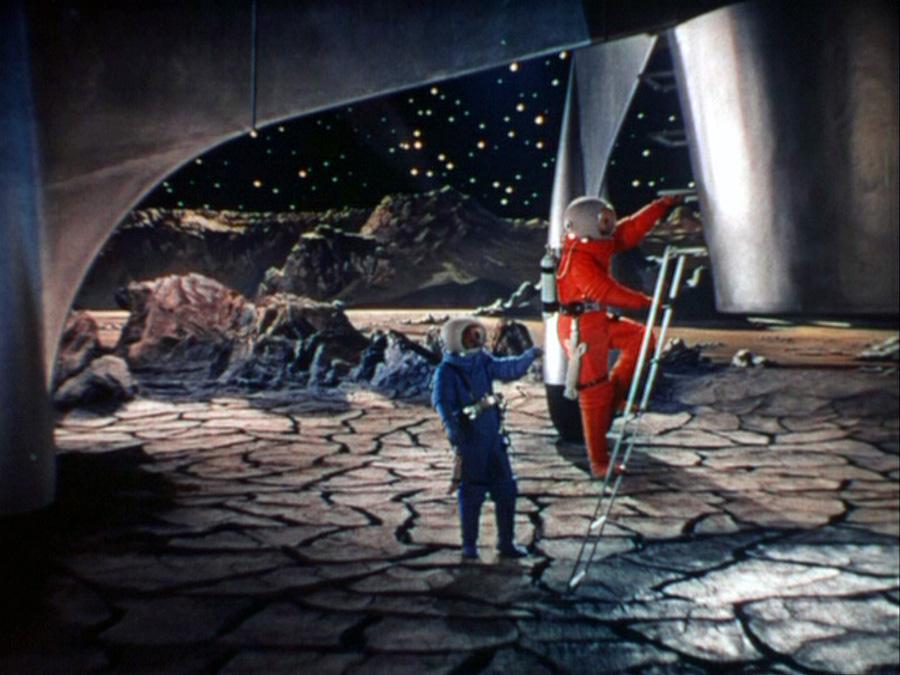
About the moon sequences: it's eerie that a movie about Americans reaching the moon should reflect so much of what the actual Moon landing was like with its talk of "for all mankind" and the description of the Moon as "barren and desolate" and a formal phone-call from Earth as the astronauts are standing on the lunar surface—as if they have nothing better to do. Science Fiction illustrator Chesley Bonestell, credited as "technical advisor of astronomical art", provides the vast vistas of the lunar surface as well as shots of earth and the Moon's sphere.
At the time, the gee-wizardry made the film very popular while today it feels like a silly relic with all the risky behavior that goes on in order to get the ship off the ground without so much as a safety check. But, this was made at a time when test-pilots were flying by the seat-of-their-pants and years before the first artificial satellites started educating us about the formalities of near-Earth space travel. It was science fiction for the audiences of 1950.
The ironic thing is that, after the efforts, the chances taken, and the lives lost, and the mission accomplished, a hefty percentage of Americans still think its fiction.
Who could have predicted that in 1950? Probably nobody. Some concepts are just too strange to grasp.
* But then, Steven Spielberg did the somewhat the same thing in Jurassic Park, didn't he?
** I wish we had that NOW!
Dinah Washington's "Destination Moon" which was the End-title song for the recent Fly Me to the Moon
Saturday is traditionally "Take Out the Trash" day.
Atlantis, the Lost Continent(George Pal, 1961) After making one of his best films—1960's The Time Machine—fantasist/director Pal made one of his worst. Pal had been interested in making a fantasy film about Atlantis since he'd read a 1949 stage-play by Sir Gerald Hargreaves. but, timing is everything in the film business; Hargreaves' play may have exceeded its shelf-life and, due to an impending writer's strike, Pal ended up with a script that was half-baked.
It wasn't entirely his fault—he did the best with what was given to him, within the confines of a miniscule budget, forcing him to raid M-G-M's vaults for decor, props and film (a lot of which was culled from Quo Vadis? but also The Prodigal,The Naked Jungle, and...Kismet? Forbidden Planet?) and a mandate from M-G-M to take his long-in-gestation project and making something that would appeal to the same market as the Steve Reeves "Hercules" films and The Last Days of Pompeii. The bar was set so low that only a desperate director (with a large bank account and/or home equity loan) could clear the bar without breaking his back in the cinematic equivalent of a snake-belly limbo contest.
The film begins with the ultimate opening crawl—a narration with graphics of some five minutes in length*(and intoned—one would not use the term "spoken" for this—by Man of a Thousand Voices, Paul Frees, and he gets his own credit as "Narrator") explaining the reason why scholars might think there was a "Missing Link" of a civilization that would explain similarities in culture between the Euro-Afric-Asian expanse and the Americas. The facts are piled on interminably, not allowing time for anyone to say "Holy Pangea! it's due to continental drift caused by shifting plate tectonics!" But, then, if you were saying that (risking an incoming avalanche of popcorn), you probably wouldn't be buying the appearance of giant crystal-ray weapons and a cameo by Poseidon. The anthropological lesson is a show-stopper right from the "Leo" logo. It doesn't get much better.
Demetrios (Sal Ponti, credited as "Anthony Hall") and his father (Wolfe Barzell) are fishing off the Greek coast when they catch something quite unexpected—a beautiful girl, who is soon revealed (mostly by her haughty manner) to be Princess Antillia (Joyce Taylor) of Atlantis. Demetrios is intrigued enough by her loveliness that he resists the urge to throw her back, but does seek to return her to her home—once she bestows permission—whether to meet the parents, or to expand his horizons, or to see if there are any more like her but without being so stuck-up is hard to determine.
Demetrios and Antillia take the fishing ship to the Mediterranean and past the Pillars of Hercules to the open ocean, where, due to the work of Poseidon becomes a difficult slog. They are saved by a reptilian-looking submarine, which provides them passage all the way to Atlantis, where Princess Antillia is welcomed back with much fanfare, and Demetrios (being a foreigner) is rewarded by being arrested and thrown into the slave camps, where he must work in Atlantis' active volcano trying to dig out power crystals that absorb the heat of the sun. Atlantis sounds like a lousy vacation spot, and like any border town I've ever visited.
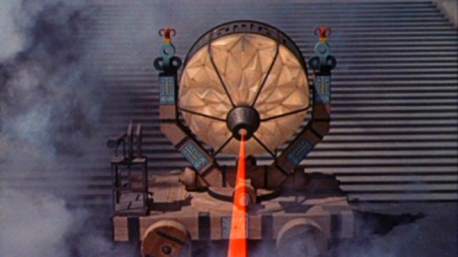
Demetrios will get no help from Antillia's Dad, Atlantis' King Cronus (Edgar Stehli)—he's being advised by the villainous Zaren (John Dall) who is using the dubious talents of Sonoy the Astrologer (Frank DeKova) to influence the gullible King. Zaren's plot is to use those crystal's, which have provided light and heat to the citizens, and to weaponize it into a ray weapon, with which he intends to (dare I say it?) rule the world. Sure thing, rather than have their power needs provided for, any intelligent citizenry will forego them to satisfy the megalomaniacal desires of their leaders. I'd say that was sarcasm, if I didn't see it happen in front of my own eyes lately! Of COURSE, they're gonna let the bastard Zaren have his death machine. They'll even PAY for it, too. (Oh, they'll pay, alright, but I'm getting ahead of myself)
At some point, Demetrios is taken from the volcano to be turned into a beast-like human-animal hybrid—some kind of splicing is involved here, but whether it's DNA or the plot for "Island of Dr. Moreau" to beef up the movie is up in the air—but is given the chance to escape the fate by a battle with an ogre, which he wins handily, and is thus allowed to become a citizen of Atlantis. Worst Naturalization Policy ever! But, it does allow Demetrios to wander around in places a slave wouldn't be allowed in order to drive the plot forward. That's enough for him to notice that all the wildlife is voting itself off the island, a sign to High Priest Azar (Ed Platt) that Disaster is coming to the island, and explains to him about the Power Crystal Ray that Zaren is constructing. Platt's ability to keep a straight face no matter what silly thing he's asked to do (famously utililised in TV's "Get Smart") does him well in this role, as it convinces Demetrios to cozy up to Zaren in an attempt to sabotage the weapon.
You'd think that Zaren would be paranoid enough to suspect that a former slave who'd been thrown into the mines after rescuing a Princess might not have the villain's best interests in mind...but, ya know, a little flattery has shown to be very effective in impressing the most monomaniacal of leaders. Loyalty is their kryptonite. And, wouldn't you know, when Zaren starts his little Expansion plans by demonstrating the ray-beam, it coincides with the volcano dominating Atlantis erupting, earthquakes rumbling, and models of buildings falling like so many Lego constructions.
Back to the splicing: so many shots of disasters from other movies get threaded together with stock-footage of natural lava flows that, if you're to believe this movie, Atlantis didn't so much sink as get mashed up. One should not be looking at their watch while an entire civilization is decimated, but Atlantis, the Lost Continent made me callous. By the end, I didn't care about the characters, the continent, or what movie they re-used the footage from. That last one just doesn't sound like me.
I did care about George Pal, though. He would rebound from this, making the story sequences of The Wonderful World of the Brothers Grimm and the quite delightful The Seven Faces of Dr. Lao, as well as producinga few other films before his death in 1980. He was a master at stretching the imagination and—as evidenced here—a budget. And his work has been influential among the current crop of directors of the fantastic.
But, this one? It should probably stay sunk.
* I decided to "asterisk" the narration so it wouldn't stop the review from proceeding:
"When Columbus discovered America, a series of mysteries arose to confound the scholars of Europe. Here are two continents, completely isolated from each other, yet they simultaneously developed similar cultures. For example, the Mayans measured time on the same principle as the Gregorian calendar of Europe. They used the same signs of the zodiac, the same decimal and mathematical system. They valued silver and gold, using both for jewelry and barter. Another mystery was the banana plant, a native of Asia that cannot be grown from seed, yet Columbus found it thriving in the New World. Elephants at that time did not exist in the Americas, yet their likenesses were cleaved on the walls of prehistoric caves in Peru. The pyramids in Mexico and in Egypt were built on identical architectural principles. Then there was the striking resemblance of a witch of Spain, and the witch depicted in the New World. But the most significant of all, Mayan and Aztec legends shared with Greek and Hebrew and Assyrian literature an account of a terrible deluge, a deluge many believe had destroyed the link, the mother empire, that had spread her civilization to both sides of the Atlantic. The Greek scholar Plato recorded this theory first, over two thousand years ago. There was once another continent: Atlantis: The Lost Continent."
Atlantis is not credited with the phrase "Location. Location. Location."
The Time Machine(George Pal, 1960) We are all time-travelers, really, moving forward into the future one second at a time, for that is the natural order of things. The trouble comes when we want a little more speed...or go back, which is unnatural and out of order. Perhaps there is a core-wisdom to not want to live in the past or skip ahead to our future. But, folks have been writing time-travel stories since the Mahabharata (if we're to believe Wikipedia) because wouldn't it be nice to go back in time to meet this person, or to right a wrong, or because just now you thought of the perfect come-back you wish you had then. It is speculated that time slows down, relatively, the closer you get to the speed of light (299,792,458 meters per second—it's just not a good idea; it's the law) or, more recently conceived, to a massive gravity source—say, a black hole. And there is speculation that by going faster than the speed of light, one could out-race time and catch up with it (as if it was a single-stream device, like a TIVO). Anyway, it worked (or will work) on "Star Trek."*
Either way, back, or forth, it seems it takes a lot of effort and energy for so little time. It's all theory, though. Tick-tick-tick is the speed of things. At least for now. And...now.
In George Pal's version of the H.G. Wellsnovel, the time is January 5th, 1900. H. George Wells (Rod Taylor) stumbles (just in time) into the pre-arranged meeting with his friends and acquaintances, David Filby (Alan Young), Dr. Philip Hillyer (Sebastian Cabot), Anthony Bridewell (Tom Helmore), and Walter Kemp (the ubiquitous Whit Bissell), and he looks bruised and bedraggled. He has a story to tell them about how he got that way—over his last few hours—and it has a lot to do with their meeting the week before—one that ended with much scoffing and condescension about George's crazy ideas.
At that meeting (as he reminds them), he posited the invention of a machine to cross "the fourth dimension"—time. He showed them a model, which—at the press of a switch—disappeared, and explaining to his gob-smacked and uncomprehending friends who wondered where it went that it was not a question of "where" it went but "when." The little model is still there, in that room, it's just in another time—where they are not. Philosophically, George is concerned that, with the Boer War going on and strife everywhere, that the answers to man's struggles must be in the future and he intends to see.
To a man, they are practical...and skeptical. His ideas and skills would be better put to helping the war effort, but George cannot be dissuaded. Fearing for his mind, Filby encourages George to see in the New Year with his family, but Wells refuses but assures his friend that he won't walk beyond his door that night. And, indeed, he won't. George decides to do that thing that all visionaries should be wary of—experimenting on oneself—and tests his full-size version of his time machine to travel, tentatively, into the future. He stops in 1917 and things have changed a bit—he monitors changes in fashion from a mannequin in a shop window across the street. Taking a tentative look outside, he runs into a person he thinks is Filby—but it's actually his son. Filby is dead and buried, and his son has just returned from The Great War. That doesn't auger well for Wells' dream of a better world, so he presses on.
A second trial takes him past WWII, where his time machine feels the effects of the blitz and he sees his rural town become surrounded by skyscrapers. Stopping in 1966, he's just "in time" to witness a nuclear bombardment that he only manages to escape with his machine. Volcanic activity leaves him sealed in a cave and he punches forward through time until erosion has taken its time and he can see daylight again. He stops at October 12, 802701. And the world has changed considerably.
Oh, there's oxygen, conveniently—the nuclear winter and volcanic activity seems to have subsided and formed a livable atmosphere after 802,000 years. The Earth that he encounters is verdant, lush, and judging from the life-forms appears to be in Malibu by way of Logan's Run.** Everybody is in their early 20's, are model-proportioned, and have sun-bleached blond hair (they're also extremely passive preferring to hang out by the river, and if someone falls in and is in danger of drowning, nobody helps—perhaps they're federal employees!)
But, these aren't the only bipeds roaming about in the 803rd century, merely the ones who see the light of day. Life has bifurcated to include another life-form that lives underground in a subterranean power-plant of tunnels and caves. These are the Morlocks, who prey—and feast—upon the youngsters (who should be called "Veal," but are, instead, called the "Eloi," who are beckoned to the underground chambers by a summons from a pyramid-like structure resembling a temple.
George is aghast at this, and by the Eloi's compliance; when a herd of Eloi is beckoned (including a comely Eloi he has become besotted with (played by Yvette Mimieux), he invades the Morlock Masonic and goes all "Spartacus" on them, inspiring a revolt against the Morlocks and saving the Eloi to return to a life of..."whatever" (that's exactly what they seem to be returning to...a life of "what-everrr") Despite his feelings for "Weena"—as he calls her—he decides to power up his time-machine and return to his present time...for a time, anyway.
It's a good little adaptation of the Wells book, full of fine antiquated period detail and adolescent thrills—if you're not thinking about it too much—which is a mark of the films of George Pal, ever-concerned with the whiz-bang image (effects are usually done in brisk stop-motion sequences) and, if there's a message, best to leave it immersed in sub-text or the basic DNA of the source. And Rod Taylor fit the bill for the type of just-charismatic-enough-for-the-budget star. Taylor hailed from Australia—adept enough that you'd never know it from the expert lack of accent (you could swear he was Canadian!), filtered down by years of stage, film and television work (this was his first starring role)—and makes a fine adventurer to identify with. The film was remade in 2002 with Guy Pearce, and Nicholas Meyer made an excellent "cousin" film, Time After Time, in 1979. We'll be looking at the latter...some time.
Now, a final note about time-travel: don't dress lightly.
The trouble with the depictions that we've seen is that they're a bit myopic—at least according to professional physics buzz-kill Dr. Neil Degrass Tyson. All time machines we've seen have been neatly rooted to the ground (at least, The Time Machine acknowledged that the very surroundings that it existed on would change over time). But, even as we're moving through time, so is the Earth. So is the Universe. But let's simplify it. In the same way that a plane has to aim for the spot its destination will be at the time of arrival, you also have to do on a more cosmic scale. The Earth travels in its orbit around the sun at 29.78 km/s. So, that means if we wanted to travel, let's say, a day in the future, we should take a rocket to the point where the Earth would be in 24 hours, which would be 1,598,784 miles down the ecliptic. Say we did travel 24 hours in time; without compensating for the constant movement of the Universe, we would end our time-journey with the Earth "'way over there", and we'd be gasping for air before our lungs would explode...because we'd be in space.
Always wear a space-suit when time travelling, kids (and take PLENTY of oxygen) because you may know WHEN you'll show up, but you might not know WHERE.
"Missed it by that much..."
* Michael Crichton's "Timeline" proposed a simpler, more catastrophic solution to time-travel; it can't exist. "Time" doesn't flow as is the conception of pre-quantum time-travel stories—"Time doesn't pass; we pass" says a tech in it—and that what has been more romantically termed "time travel" is actually space-travel to another dimension in the multi-verse that has branched off. One could "travel" to those alternative branches by atomizing the human body and, upon reaching that dimension, reconstructing the physical form from its genetic map. Sounds really, really complicated, but, again, it worked "so well" on "Star Trek."
Transporter accident as imagined by the late, great Mort Drucker
* I didn't know this until I was doing some research on Pal, but he was trying to get a "Logan's Run" adaptation as early as 1968.
Dog Savage: Man of Bronze(Michael Anderson, 1975) Lester Dent (writing as Kenneth Robeson) produced the "Doc Savage" series of stories for Street & Smith Publications from its first issue in March, 1933 (based on a first outline by publisher Henry Ralston and editor John Nanovic) through the summer of 1949, "pulp" publications, known for the low quality paper used to print them. "Doc" Savage was of the gruesome adventure variety, a kind of Sherlock Holmes without the deductive gifts, more the type along the lines of "The Shadow" (also published by Street & Smith), Fu Manchu, and "The Avenger" ("Justice, Inc." variety), heroes with a sense of the exotic and the somewhat mystical. The "Savage" series made a phoenix-like resurrection in the 1960's with their re-printing in paperback editions (one per month!) published by Bantam Books (with those freakishly attractive Larry Bama covers.) But "Doc" Savage (real name: Clark Savage Jr.),apart from the dark edge of the stories, had a shining bright side—a giddily altruistic hero, scientist, inventor, surgeon, biologist and all-around paragon of virtue and athleticism, a soldier-of-fortune without need of wealth, altruistic to the point of not considering romance (despite opportunity) to protect any loved ones from being a target for revenge. This doesn't stop him from surrounding himself with a devoted clutch of idiosyncratic specialists who serve as both Dei ex Machina and comic relief when Doc gets in a jam. personally or professionally. For this reason—"The Fabulous Five" as they're nicknamed—if anybody does another Doc Savage adaptation (and there are talks of Dwayne Johnson being approached as a sort of "Rock" Savage), it is going to be very crowded.
If anyone does another Doc Savage film, the 1975 version is a must-see...for what not to do. The last film to be produced by the ingenious producer-director George Pal (The War of the Worlds, The Time Machine, Destination Moon, The Seven Faces of Dr. Lao, to name a few), the film is a-clutter with his design sense, but none of his sensibility. Whatever genre Pal put his imagination to—science fiction, fantasy, puppetry—there was a seriousness of purpose, even for a project as rife with puerile pot-holes as Robinson Crusoe on Mars.
This was 1975, the year before the U.S. bicentennial, but two years after the resignation of President Richard Nixon before he could be impeached. In the years after Watergate, cynicism about anything, let alone altruism, was the easy answer—the knee-jerk reaction—of the day. Heroes were not to be believed, but, rather mocked, not just because they were "too-good-to-be-true," but because such a "goody-goody" attitude was naive...and stupid. After all, If you can't trust your President, who can you trust? Roger Moore was James Bond (Moore didn't believe in that type of hero and played him as such). And in a litigious society, where everybody is "lawyered up," and PR is a major industry in a perpetual "spin-cycle" to make their shady clients look good, the mere appearance of honesty leaves one suspect.*
Directed by Michael Anderson, who always seemed to make any film, no matter the budget, look a little cheap-jack, Doc Savage: Man of Bronze engenders worrisome thoughts from the get-go. A tiny American flag gyrates over a frozen wasteland. That flag is attached to a snowmobile, one embossed with a "Doc Savage" logo on it (apparently all of his vehicles, be they cars, autogyro's, what-have-you, will have it) as it approaches a perfectly made igloo on the snow surface. Doffing his parka-hood, Ron Ely makes his first appearance, revealing a shock of blond hair and a literal, animated twinkle in his eye as Narrator Paul Frees intones "This is Doc Savage...The Man of Bronze!" Then the music comes up—the subsequent title will say "Music by John Phillip Sousa" specifically "The Thunderer" as it is adapted by Frank DeVol—a fine craftsman, but even he can't do anything with something that's 100% joke material.
Oh, good Lord. The thing sets out to "out-camp" the "Batman" television series from the 1960's. Some of that is part of the "'Doc' Savage" appeal—for instance, check out the "Code of Doc Savage" below. My favorite line in it is a perfect example, as Savage explains to the female lead (Pamela Helmsley, not the most expressive of actresses unless she was playing "the bad guy") why he can never have a woman in his life after she has suddenly (and somewhat inexplicably) blurted out her love for him. "I understand," she says, betraying just a hint of disappointment behind her stoicism. Doc gently cuffs her chin and says amicably, "Mona...you're a brick." I seem to remember that line from the book and chortling over it, but, how "camp" is that?
Ron Ely plays Doc Savage the way Charlton Heston played everything. Given the circumstances and the silliness with which the whole thing is presented, he could have taken "camp" lessons from Adam West, who at least managed to "play straight" while always letting you know he knew there was a joke going on. The main villain is played by Paul Wexler, who seems to have no appetite for scenery-chewing (which is disappointing, especially when one of the villains has the habit of sleeping in a crib) or maybe he just didn't know how to do it entertainingly. The whole thing is horrendously "dubbed" the sets look cheap, the locations very "back-lot" and one has to put the blame on Anderson, who even managed to make his next film, Logan's Run, look cheap despite a budget of nine million dollars (Compare it to Star Wars which was made a year later for 13). Whatever is clever in the movie can be sourced to the novel—Doc's amazing inventions, for instance—but, in the year in which Jaws was released, Doc Savage: The Man of Bronze bombed horribly at the box-office.
Like so much of what passes for humor in movies these days, you have to be a little bit high, or in some other way impaired, in order to appreciate this film—any number of pharmaceuticals and concoctions can be used to lower the bar—and taste—sufficiently. But, look, if you can make a series of "Indiana Jones" parodies of B-movie serials, Lara Croft video-game movies, you can certainly make a serious (if tongue in cheek) version of the "Doc Savage" series and do it somewhat competently.
The film ends with this title card—part of it was filmed but shelved when The Man of Bronze did poorly at the box-office. Still, the second film boasted a screenplay by Phillip Jose Farmer, which one can only see as a missed opportunity.
* I once talked to a lawyer over a contentious issue where he brought up "The Golden Rule," which he declared was "the one with the gold makes the rules" and I replied "Is that what they taught you in law school? I grew up with "The Golden Rule" being "Do unto others as you would have them do unto you." He looked at me with a pitying look, and I decided the best "do unto you" was not to strangle him by his cheap neck-tie.
The Power(Byron Haskin, 1968) A sci-fi "who-thunk-it" by the producing-directing team of George Pal and Byron Haskin, whose work included the 1953 War of the Worlds, When Worlds Collide, and Robinson Crusoe on Mars. The subjects of the Pal-Haskin team were usually puerile, with sophisticated special effects that dazzled the child in anyone, no matter their age. The Power, however, is light on special effects, and the sub-text is less extra-terrestrial than sensorial. A team of scientists (George Hamilton, Suzanne Pleshette, Richard Carlson, Earl Holliman, Nehemiah Persoff, and Arthur O'Connell) are working on a top-secret project testing astronaut endurance. They are visited one day by their government liaison Arthur Norlund (Michael Rennie) who is skeptical of the worth of the whole project, other than the ideas of the team crack-pot, anthropologist Henry Hallson (O'Connell) who is convinced by his survey studies that one of the subjects has paranormal abilities. His outbursts embarrass the entire board, especially Dr. Tanner (Hamilton) who tries to beat down the doctor's ideas at every opportunity. However, a simple test proves that one of the scientific team has extraordinary mental powers.
Before you can say "Agatha Christie's 'Ten Little Indians'" the scientists start being knocked off in strange ways that only we, the audience, are privy to. First Dr. Hallson is found dead, centripetally squished in a centrifuge run amok. Then Dr. Tanner is fired from the project, accused of never having attended college, and faking his way into his position. He teams up with fellow researcher (and main squeeze) Marge Lansing (Pleshette) to try and track down who the murderer could be. In the meantime, more of the research team end up incapacitated, and it becomes readily apparent to Tanner and Lansing that they're going to end up on a slab unless they can find the killer. But who is it?
The movie is quite clever in how it clicks along, even if the love story feels a bit tepid, and Haskin's stage sense is always assured at making the strange either commonplace or particularly fascinating.* For instance, the scientists work in a facility where their offices are separated by glass, so everybody can keep tabs on everybody else, making hiding the killer a difficult project. Once Tanner is fired, however, the confining space is taken out of the equation, and the individual attempts at messing with people's minds are given free reign and can come out of anywhere...and nowhere at the same time.
As far as the acting is concerned, it's a bit cheesy, with O'Connell over-emoting until you wonder about his credentials, and Hamilton smolders throughout, as if told he'd be the leading man, but not told how. He's at his best convincing us that the illusions he sees are real, and the horror/confusion that he feels play across his face. That's when he truly bonds with his audience, and is the filmmakers' best asset in making the movie come across.
* Haskin had worked with Disney live action films, and did the more superior episodes of the original version of "The Outer Limits" as well as the first pilot for a little series called "Star Trek."
Seventy eight years ago tonight (at 8 pm EST, in fact), Orson Welles chose to do a radio broadcast just for Hallowe'en—a radio adaptation of H.G. Well's novel of "The War of the Worlds" on his "Mercury Theater On the Air" broadcast on the CBS radio network. Welles' "Mercury Theater" show was not that popular, and so a lot of people didn't hear the introduction of the piece stating clearly that it "presenting 'The War of the Worlds' by H.G. Wells"; most of those listening to the radio at that time of the evening were listening to the more popular "The Chase and Sanborn Hour", which featured ventriloquist Edgar Bergen and his dummy Charlie McCarthy (yes, a show with a ventriloquist was very popular on radio). But, twelve minutes into the comedy show, there was a song interlude, and people did then what they do now—they surfed the dial, looking for something better until the segment was over and they could turn back. And what they found was this:
At about twelve minutes in, the broadcast was just getting interesting: a faux dance music program was being presented and interrupted by "news bulletins" reporting that plumes of incandescent gas had been seen leaving the planet Mars and headed for Earth. A "return to scheduled programming." Then another interruption saying that meteorites have landed near Grover's Mill, New Jersey (as opposed to Woking, Surrey in Wells' novel) and Princeton expert Professor Richard Pearson (Welles) is brought in to speculate that there is no life on Mars. The next segment is a "live report" from Grover's Mill where "reporter Carl Phillips" (played by Frank Readick, who had "prepped" for this segment by listening to reporting of the explosion of The Hindenburg) reports on the opening of the cylindrical meteorites, the appearance of tentacled creatures wielding a death beam that incinerates the crowd... And then...silence.
The original script (by the ubiquitous Howard Koch) was deemed too dull by Welles, and a new draft was created, inspired by an Archibald MacLeish radio-play "Air Raid" (in which Welles had appeared). The idea was not to dramatize events as in the novel, but to use the medium of radio to provide the context and the drama of how such an invasion might play out under the circumstances and over the air-waves. More than the audio of a staged play (as most of these things were), it was very much of its source—a radio-play, by, of, and about the experience of getting the news live over this new medium, unfiltered and immediately...without a chance for resolution.
"Panic" may be too strong a word for the result, and the newspapers played it up to discredit the reliance of radio for news,* but there were many, many, many people who heard the simulated news-casts and, now used to recent advances that allowed "news flashes" interrupting programming, and at a time when Germany was making moves on Austria and Czechoslovakia, took them for the real thing. A cursory search on the dial would have told them that the only network broadcasting the events at Grover's Mill was CBS, but the events were so compelling that not many switched away. Some merely left their radios in their panic to avoid "the coming invasion." It wasn't until the 43 minute mark in the broadcast (which ran no commercials as it was not sponsored) that the network broke in to remind listeners that they were, in reality, listening to a radio-play. This was necessitated as the CBS switchboard in New York was flooded with calls to the point of incapacitation.
For Welles, three things happened: he became a nationwide celebrity, "The Mercury Theater On the Air" got a sponsor and became "The Campbell Soup Hour", and Welles was lured to Hollywood by RKO Studios, where they hoped he might make a film of "The War of the Worlds," to cash in on the notoriety. He had other plans.
A film of "The War of the Worlds" would have to wait.
The War of the Worlds(Byron Haskin, 1953) Twenty five years after Welles' broadcast, George Pal made a Technicolor movie out of Wells' novel. Like the radio broadcast, it updated the story for the times. The time is the present and the phenomenon is world-wide while the film concentrates on cylinders landing in Linda Rosa, California, outside of Los Angeles. By chance, Dr. Clayton Forrester (Gene Barry), a scientist involved with America's development of the atomic bomb happens to be fishing nearby when the nearest craft zooms overhead. Investigating, he finds a crowd of people, including Linda Rosa residents Silvia van Buren (Ann Robinson) and pastor Matthew Collins (Lewis Martin), her uncle. The glowing craft is giving off radioactivity and so three locals elect to stand guard until the thing cools down enough to be investigated, and Forrester elects to wait until morning in town.
Before he can return the meteorite opens up and a snake-like periscope rises from the crash. As the three men approach, the scope emits a shrieking heat-ray that atomizes them on the spot, and knocks out power to the town, alerting Forrester that something's happened and he finds out that Earth is under attack from Martian war-machines, shaped like flying manta-rays.**
** Although not a tripod as in the novel, the Martian attack-ships start off elevating on three beams of energy that then disappear (no doubt owing to the cost of animating)
The 1953 movie is interesting for its inclusion of nuclear power and weaponry into the mix—eight years after Hiroshima and amid other films that, at the time, used atomic energy to produce horrors in Nature. Religion is given far more importance in the 1953 movie than the novel (where Wells dismisses it entirely), although it proves ineffective in the short term, but is given the credit for the long-term outcome. Forrester stands in for Wells' unnamed narrator, separated from his fellow survivors and struggling to evade the war machines to get back to his wife—in the movie's instance, its the newly reunited Ms. van Buren, Forrester's former student.
Pal's version became a classic, one of the few science fiction films that the Hollywood establishment took notice of besides its receipts (in no small part due to Cecil B. DeMille's championing of it), winning a de facto Oscar for its spectacular effects combining wire-and-model work and animation (the machines were so popular they were re-used in Pal and Haskin's Robinson Crusoe on Mars). It is still well-regarded as a superior sci-fi adventure film. The Wells estate was so enthusiastic with the result that they gave Pal the pick of any of Wells' stories to make another film of. His choice was The Time Machine, which was released in 1960.
War of the Worlds(Steven Spielberg, 2005) Fifty two years after George Pal's film and sixty seven years after Welles' broadcast, Spielberg completed his unofficial trilogy of Earth invasion films (after Close Encounters of the Third Kind and E.T. the Extra-terrestrial) with his own version of the Wells story, again, updated for the times and without the article "the" in the title, so as to avoid confusion with the original. The invasion is, once again, world-wide, although attention is centered on the east coast of the United States. This "War" was made within the memory of the 9/11 attacks, as Spielberg stages large infrastructure-dusting battles that tip over intersections and vaporize human beings (leaving their clothes to float empty to the ground). The attackers are not named as "Martians" but acknowledged as "other-worldly" with a suspiciously complicated origin—evidently, they've been long buried in the Earth, only needing the transmission of a spirit via lightning storm that simultaneously energizes the war-machines and knocks out the surrounding power grid. These machines are more the design of Wells' original intent—ungainly tripods that still manage to do sizable damage with its heat-rays, black smoke, and red vegetation that carpets the area in a means of terra-forming (all from Wells' source novel).
Although it may seem like a "typical" Spielberg project, it is an odd blend of Wells' and Spielberg's sensibilities, and in fact, anti-Spielberg sensibilities. Wells' story was about his narrator trying to get back to his wife amidst the chaos of the war. Spielberg has the same story-line, but his protagonist is another Spielberg "common man" (or as common as Tom Cruise will allow himself to be), who must rise to the occasion—in this case Cruise's Ray Ferrier is a dead-beat, uninvolved dad who must get his kids back to his estranged wife, amidst all the chaos.
Given that CE3K and ET were films by a less mature Spielberg that broke families apart, while offering them a glimpse of the heavens, this time, Spielberg's protagonist is doing everything he can (as in Wells' novel) to re-unite his family. Spielberg has grown up by the time these aliens visit Earth. And yet, for all his heroics, the film has more in keeping with the ending of John Ford's The Searchers, as Ferrier is left standing in the street of his in-laws' brownstone (and they're played, naturally, by Gene Barry and Ann Robinson from the '53 version), satisfied enough that he has brought them together, but acknowledging that he is still an outsider without regard for acceptance as reward. He's done what he should have been doing all along. And mature enough now to not expect anything from it. It's one of my favorite Spielberg endings.
* The Slate article preceding this asterisk debunks the myth by citing lack of evidence—not the most reliable indicator—but what's strange is that when stations repeat the stunt (as reported on Radiolab's episode about the broadcast), the results tend to skew the same way. There are always going to be a few that will panic, and with mob-mentality as an accelerant, things can get out of hand...even for Martians to handle.

 Bear in mind that Destination Moon was made seven years before Sputnik put the fear of dumbness into Americans** and kicked our fledgling rocket program into "trust" mode. In the movie's opening minutes, researchers and private corporations are on the cusp of launching the first man-made satellite into orbit only to have the rocket launch off the pad and then slam itself into the desert, disastrously. And just a couple of months later, they're talking about sending a manned rocket to the Moon. Baby...steps, guys....
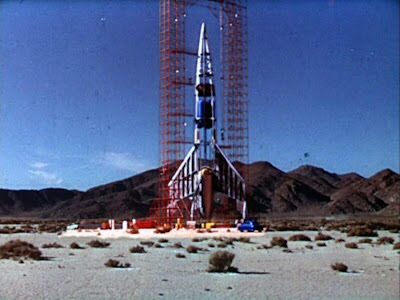 The Woody Woodpecker cartoon attracts investors (it's called "science fiction" for a reason...) and pretty soon construction begins on a Moon rocket using atomic energy to create enough steam thrusters to power it out of Earth's gravity and to the Moon. The entrepreneurial heads of the program are going to be the ones on-board for the flight, not test pilots, and they are Jim Barnes (John Archer) the aerospace magnate whose company built it, famed rocket scientist Dr. Charles Hargraves (Warner Anderson) who designed it, retired General Thayer (Tom Powers) who wants America's presence in space to be used for deterrence and technician Browne (Ted Warde) who supervised the technical aspects of the good ship, Luna.




+1.jpg)