Showing posts with label Michael Rennie. Show all posts

Saturday, September 12, 2020

The Daze After The Day the Earth Stood Still

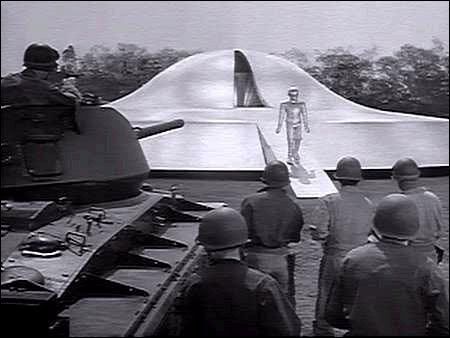
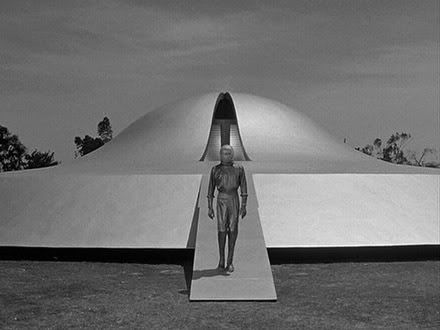
The Day The Earth Stood Still (Robert Wise, 1951) Iconic sci-fi pic that managed to be just strange enough to be spiritual without having to explain itself. Edmund H. North's script (adapted from the 1940 Harry Bates story "Farewell to the Master") just assumed that any advanced civilization's technology would seem like magic to us (ala Clarke's Third Law). It's anti-nuke theme was somewhat off-set by it's Christ allegory under-pinnings: a human-appearing being from above comes to Earth with a "message," is killed and resurrected to give mankind a lesson in humility. That the alien--Klaatu (Michael Rennie)--walks among us under the guise of a "Mr. Carpenter" just nails the significance home.

Right from the get-go, The Day The Earth Stood Still announces its intention with a "spooky" theremin-laced score (by the brilliant Bernard Herrmann), quite at odds with its message of peace. Wise shows a global humanity surrounded by its current technology (radio, television, radar) spreading the news of an invader from space, which lands in the Mall area of a tourist-clogged Washington D.C. in Spring. 

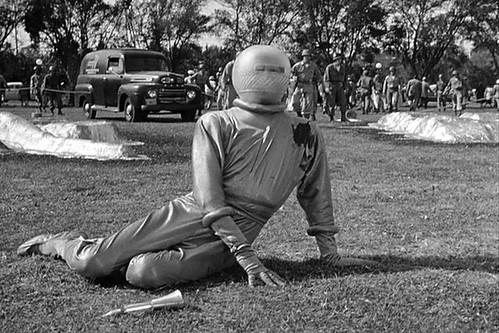
Phalanxed by a wall of tanks and military might (with a larger crowd of tourists behind it) the alien presence reveals itself and is shot by a panicky soldier for its trouble. Before you can say "Kent State," the alien is taken to Walter Reed to be treated, observed and questioned, and the formal Klaatu--patient, curious, but with a hint of passive condescension--does his own analysis, escaping from the hospital and blending with the populace as "Mr. Carpenter"--taking a room at a boarding house, becoming involved with a widowed secretary (Patricia Neal)--it IS the '50's, after all--and her son, with the intent of seeing humanity first-hand.
Meanwhile, his Enforcer, Gort, a lumbering, laser-cyclopsed, soft-metal robot stands guard over the saucer, turning his evil eye on any hint of aggression, without any regard to how much of the GNP was flushed to make those tanks. If Gort could laugh when he turned on his eye-light, he'd probably do it with glee.
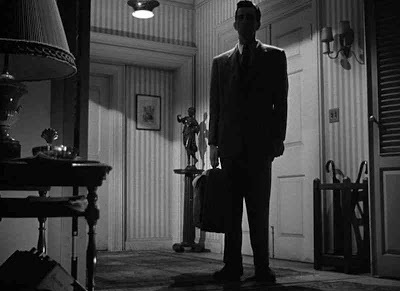
There are so many small details that delight: Patricia Neal's uncommonly common working Mom, with a wary eye towards Mr. Carpenter--there's not even the hint of romance there; Sam Jaffe's cameo as Einstein stand-in Dr. Barnhardt, looking at his business-suited stranger visitor from another planet with eyes of dazzled wonder; the whole design of the thing that has so permeated our culture with sleek silver surfaces that fold in and out of each other seamlessly; "Gort, Klaatu Barada Nikto!" which, indicative of the race's parsimoniousness, roughly translates to: "Robot, take Klaatu's body back to the space-ship and repair whatever damage has been done to it, bring him back to life, and oh! while you're at it, don't turn me into a smoking pile of ash, thank you very much*"--talk about "Three Little Words!"; Robert Wise's unerring sense of staging and for putting the camera in the exact, most effective place without making you aware that it's the most effective place. Wise is always given short-shrift as a director, implying a yeomanlike sensibility rather than an artistic one, but the Man Who Edited Citizen Kane also conceived beautiful, eerie, creepy shots like this:
Thanks to Glenn Kenny of "Some Came Running," who reminded me **

The Day the Earth Stood Still is a classic film—a time-capsule, of a kind—from a different time and place and space that reminds, yes, with great power comes great responsibility--but there's always someone more powerful, who might take yours away, and make you stop and smell the fall-out.
—————————————————————————————————————————————————————
Written at the time of the film's release...

"Everything New (Testament) is Old Again"
or

"Yeah. I'm Thinkin' I'm Back!"

So why remake it? Well, it's a question that Klaatu's United Planets couldn't negotiate--and Gort's Galactic Police Force would probably give you the eye. But the agent of Keanu Reeves saw a poster of the original and dollar signs swam into his head and here, we have it. And Scott Derrickson (who put a different head-spin on The Exorcism of Emily Rose) thought he could turn it into a warning about global warming, and Reeves thought that, though the original Klaatu preached peace, he did so threatening force, which he found "fascist."

Sigh.

That sounds noble in thought (if a tad simplistic). On-screen, it's a different matter entirely.

Because it's a "re-imagining" (rather than "a remake"), there is no "
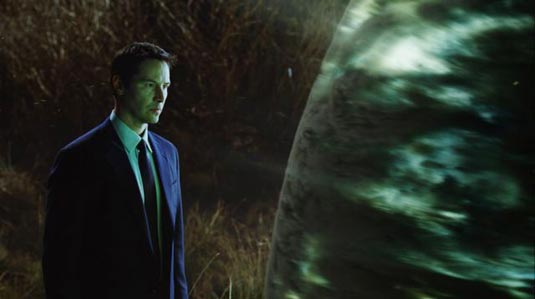
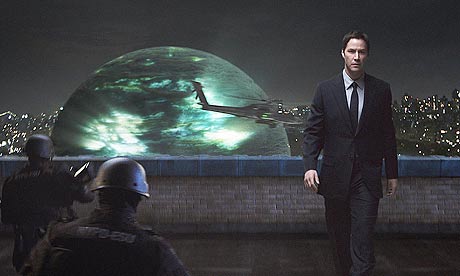
flying saucer," but a cloudy, spacy "orb" (all the better to remind you of the planet, but I kept wondering what kept it in place), and rather than the military, scientists are in the front line (with Princeton astro-biologist Helen Benson, played by Jennifer Connelly, as the point-person). The military is back-up.***

The scenario starts the same: Land-Bang-End up in Hospital. And there things start to change. The original Klaatu had no special powers. Gort was the "muscle" (and here, the robot is 20 feet tall, gun-metal gray in color, and a completely CG construct--it's actually simplified from the original's design--and, as with the first Gort, its unreadability makes it a genuinely creepy sight). Keanu Reeves' Klaatu has a nasty way with bio-feedback that does damage. So much for pacifism. But, this Klaatu isn't Christ-in-a-business-suit. This one goes back a few chapters, back to the Old Testament. Particularly those parts dealing with Noah and Moses. The threat is environmental, rather than nuclear, and to sustain one of "the handful of planets that can support life," Keanu-Klaatu's United Planets are thinking of a little Silent Spring Cleaning of the life-form doing the most damage. Good thing he doesn't carry around a cook-book!
The following section is SPOILER material, so if you want to be surprised how it ends—if you care—don't highlight the next paragraph which, like the Earth, gets blacked out:

That scouring consists of billions of nanite-sized metal locusts (why they have to specifically look like insects, I have no idea, but I'd guess it has something to do with why Klaatu's named "Mr. Carpenter" in the first one). So, this "plague" starts doing its damage, devouring metal of all kinds, sports-arenas and such, and one can only hope that it can distinguish "green" technology, like solar panels and wind-generators, from the other kinds, but I suspect not--that might involve thinking! Keatu, or Klaanu, or whatever you want to call him, decides at the last minute that because humans have the capacity for change, they maybe, just maybe, could save their environment, so he sacrifices himself sabotaging the plague, leaving humans with no electricity, no technology, and presumably the resolve to stop the global warming crisis with, as a much wiser alien once inventoried, "stone knives and bear-skins." Thanks, Kleatu or Kono, or whatever your name is, thanks a lot. Who's gonna pick up these continents of dead nanites corrupting the soil, Mr. "Ecology?" And they thought the first one gave off mixed signals?

Keanu Reeves has the most limited range of any actor who hasn't suffered a stroke, but he does have two specialties at which he excels: endearingly stupid, or robotic. The latter serves him well, as in Speed, the portions of The Matrix when he was portrayed by pixels, and this film. His strange visitor from another planet is a nice piece of craft, slightly more human than Jeff Bridges' Starman, and extremely efficient in his movements--when he turns his head to look you right in the eye, you'd better take him seriously. He's quite effective in the role. Jennifer Connelly delivers the techno-babble expertly (as she did in Hulk), but she really doesn't have much more to do than Patricia Neal did, as the role is basically reduced to "concerned mother." As the child she's concerned about, Jaden Smith at least doesn't fall into the "predictable child" category. He finds different ways of doing things than the "stock-child" role. Kathy Bates is too good for her role of Secretary of Defense, Jon Hamm, of "Mad Men," doesn't really separate himself from the pack, but Robert Knepper does a fine job as a Colonel in charge of trying to stop a tidal wave with a tea-cup. It's always great to see cameo's by James Hong, and John Cleese, who plays Prof. Barnhardt in this version.****
But, ultimately, there wasn't much point in doing this, other than to give people jobs, and give some Hollywood-types more "green" cred. The production was carbon-neutral (wouldn't that have been ironic?), which means they presumably paid carbon credits used to destroy old-growth forests for eucalyptus plantations.

"The Universe wastes nothing," Keatu says at one point.

He's never been to Hollywood.

* I hope there's a "please" in there, somewhere!

** Kenny has a wonderful illustrated tribute to director Robert Mulligan. It's far better than anything I could contribute.


*** There is one amusing bit--when Benson is shanghaied to participate in the landing investigation by the military, it's set-up and photographed exactly as it was done in The Andromeda Strain...directed by original TDTESS director Robert Wise. Coincidence? Nothing's a coincidence in a "re-imagining."

**** I hate playing the "If only..." game—it smacks of frustrated screenwriters—but, as they had an Albert Einstein-clone in the original, it would have been interesting to have a Stephen Hawking in this one—brilliant, but crippled, talking through a voice-box. If Klaatu wanted inspiration from the human race, who better? Then, imagine this scenario: the group leaves, but Klaatu hangs back, turning to look at the wheelchair-bound pysicist. "I could cure you..." Pause. The voice-box rasps: "Save...the...world."

But, they didn't.

Thursday, September 20, 2018

5 Fingers

5 Fingers (Joseph L. Mankiewicz, 1952) Factually-based WWII spy story produced by 20th Century Fox, shepherded by studio head Darryl F. Zanuck, based on a 1950 book with a screenplay by soon-to-be-blacklisted writer Michael Wilson (with some dialogue additions by Mankiewicz whose contract with 20th was almost up), directed by Joseph L. Mankiewicz, with a jittery score by Bernard Herrmann and filmed in many of the locations where the incidents supposedly took place (according to the producers).

5 Fingers has, as its spine, the notion that there is no honor among thieves (or spies, for all that) as the shadowy figures spend most of their screen-time suspecting each other of duplicity, while never really knowing the depths that duplicity would reach.


It is 1944, and the Swiss Countess Anna Staviska (Danielle Darrieux) is in exile in Angarat, Turkey eking out an existence by selling her jewelry in order to maintain lodging at a fairly grubby flat. She is making the rounds of swanky get-togethers where she offers her services as an intelligence agent to give information to the diplomatic corps, whether it be British or German.
But, her career as a spy doesn't gain much traction, probably because she has nothing to sell. She might have better luck if she knew who her competition is—Ulysses Diello (James Mason), the valet for the British Ambassador in Turkey, Sir Frederic Taylor (Walter Hampden). On the very night that the Countess has been chatting up Taylor and German ambassador Count Franz von Papen (John Wengraf) for spywork, Diello makes a clandestine meeting with von Papen's attaché Moyzisch (Oskar Karlweis) to propose a mutually beneficial relationship: for the sum of 20,000 British pounds, Diello will provide top secret papers to the Germans with the promise of several more drops of information...for a price.
Moyzisch is excited at the prospect—it elevates him somewhat in the Reich's eyes—and urges von Papen to take it, and the Germans tentatively agree to Diello's terms. Diello's plan is simple—he has access to Taylor's safe and, in the ambassador's absence, he photographs carefully chosen documents, the film to be delivered to Moyzisch for payment. The two have a terse appraisal of each other as Diello (who the Germans code-name "Cicero") delivers his first shipment of secrets. 
But, while Moyzisch dispatches the film to Berlin for inspection, Diello has other interests besides the £20,000 in his pocket; he goes to visit the Countess. He confides with her that he will be coming into quite a substantial bit of money, and he asks of her several requests: she is to keep the money for safety, and he gives her £5,000 of it to buy back her jewelry, and acquire a villa, which will be used as Cicero's "safe house" should he have to meet with higher German authorities—it is his intention to keep the source of his documents a secret and a neutral ground away from the British Embassy will help ensure that.

But, he has more intentions than that. It seems that before he was employed as the valet of the British Ambassador, he served the same function for the late Count Staviska, Anna's husband, and, when their fortunes reversed, he was dismissed. But, he has not forgotten her, as Diello sensed a mutual attraction between the two, and he lets her in on his ultimate plans—once he's acquired the money for his services to the Reich (some £120,000), he will leave Hungary to become a man of the world in South America...and he would like her to join him. The Countess makes it clear to Diello that she still considers him a servant, but is willing to be a contributing partner to his plans. What may come after only time will tell.
The Germans are convinced of the genuineness of Diello's documents—the predicted bombing of a Romanian oil depot by the Allies clinches it and the Reich allows the facility to be destroyed, lest the Allies become suspicious that their plans have been compromised. The regime is only too happy to continue the relationship with "Cicero" but they send a higher German authority, Col. von Richter (Herbert Berghof), to replace the rather careless Moyzisch as the liaison for the secret film. Diello's plans for the villa meetings turns out to be a fortuitous investment as it gives the valet a chance to pose as a more established member of society, which throws the Nazi's off any attempts to learn his actual identity. And, her comfort ensured with the charade, the Countess displays warmer feelings towards Diello.
But, there are complications—the Allies have been intercepting a decoding German communiques and begin to suspect that there's a "leak" somewhere in their communications that are getting to the enemy. The British send a counter-intelligence man, Colin Travers (Michael Rennie) to investigate, and he quickly zeroes in on acquaintances of the Ambassador, and, specifically, the Countess, whose lifestyle has substantially improved after making it known she would serve as a spy for either side. And Travers sets up an elaborate alarm system on the Ambassador's safe.

Plus, the Germans are starting to make demands; von Richter wants the plans for what will be the inevitable push on Germany, Operation Overlord—what will eventually become known in History as "D-Day". Diello agrees that acquiring it will be a great coup, but he raises his price for that particular subject of documents to £ 40,000.

Now, Diello begins a curious cat-and-mouse game where both sides seem to be after him, either as a target or a bargaining chip, and he must change his plans accordingly if his goals are to be achieved.
Again, it's another one of those amazing, suspense stories that came out of the second of the World Wars, where the stakes were so high and the depths to which men could sink seemed limitless. And it's mostly true. The movie is based on a book written by that Nazi attaché, Moyzisch, and names have been changed—"Cicero" was named Elyesna Bazna, not Diello—and Wilson, perhaps to throw some romance into the mix, or to meet a Zanuckian need for a female co-star, invented the character of the Countess out of whole cloth (which gives the film an added depth, actually, and a more perfect dramatic denouement). The film teeters on becoming unhinged with a quality of "who can you trust" among all the players on both sides—it's even revealed that the Allies, after learning of the "leak" at the Embassy, began to send mis-information there to further confuse and obfuscate what was really being planned in the war. Well, of course, they did.

But, ultimately, it is not the secrets that are the true MacGuffin of 5 Fingers, but the notion of the cannibalistic tendencies of the self-serving. With the exception of the intelligence officers sent to track the security breach (and, possibly, the British ambassador), everybody in 5 Fingers is out for themselves. With so parsimony, there can't be much harmony and all of them get something like their "just desserts" with the added humiliation that they almost...almost...reach their goals. It is a wonderful touch of screenwriter Wilson's that Diello gets his comeuppance—and his revenge—simultaneously.
Director Mankiewicz is a utilitarian director—nothing fancy, nothing arty (that would come later in his career), just communicative, the only sequences showing anything visually compelling are in the montage sequences. Where he excels is in the highlighting of the performances, and in that, he is expert, catching the nuances and subtleties of the performances.

There is a delightful story that, while filming was being done in Turkey, both the author Moyzisch and the real "Cicero" separately offered their services to the producers as technical consultants for the film...and both were turned down cold. 

Even Hollywood has its limits on trust.

Wednesday, May 3, 2017

The Power

The Power (Byron Haskin, 1968) A sci-fi "who-thunk-it" by the producing-directing team of George Pal and Byron Haskin, whose work included the 1953 War of the Worlds, When Worlds Collide, and Robinson Crusoe on Mars. The subjects of the Pal-Haskin team were usually puerile, with sophisticated special effects that dazzled the child in anyone, no matter their age.  The Power, however, is light on special effects, and the sub-text is less extra-terrestrial than sensorial.

A team of scientists (George Hamilton, Suzanne Pleshette, Richard Carlson, Earl Holliman, Nehemiah Persoff, and Arthur O'Connell) are working on a top-secret project testing astronaut endurance. They are visited one day by their government liaison Arthur Norlund (Michael Rennie) who is skeptical of the worth of the whole project, other than the ideas of the team crack-pot, anthropologist Henry Hallson (O'Connell) who is convinced by his survey studies that one of the subjects has paranormal abilities. His outbursts embarrass the entire board, especially Dr. Tanner (Hamilton) who tries to beat down the doctor's ideas at every opportunity. However, a simple test proves that one of the scientific team has extraordinary mental powers.

Before you can say "Agatha Christie's 'Ten Little Indians'" the scientists start being knocked off in strange ways that only we, the audience, are privy to. First Dr. Hallson is found dead, centripetally squished in a centrifuge run amok. Then Dr. Tanner is fired from the project, accused of never having attended college, and faking his way into his position. He teams up with fellow researcher (and main squeeze) Marge Lansing (Pleshette) to try and track down who the murderer could be. In the meantime, more of the research team end up incapacitated, and it becomes readily apparent to Tanner and Lansing that they're going to end up on a slab unless they can find the killer. But who is it?
The movie is quite clever in how it clicks along, even if the love story feels a bit tepid, and Haskin's stage sense is always assured at making the strange either commonplace or particularly fascinating.* For instance, the scientists work in a facility where their offices are separated by glass, so everybody can keep tabs on everybody else, making hiding the killer a difficult project. Once Tanner is fired, however, the confining space is taken out of the equation, and the individual attempts at messing with people's minds are given free reign and can come out of anywhere...and nowhere at the same time.
As far as the acting is concerned, it's a bit cheesy, with O'Connell over-emoting until you wonder about his credentials, and Hamilton smolders throughout, as if told he'd be the leading man, but not told how. He's at his best convincing us that the illusions he sees are real, and the horror/confusion that he feels play across his face. That's when he truly bonds with his audience, and is the filmmakers' best asset in making the movie come across.


  * Haskin had worked with Disney live action films, and did the more superior episodes of the original version of "The Outer Limits" as well as the first pilot for a little series called "Star Trek."